(All MSCI index returns are shown net and in U.S. dollars unless otherwise noted.)

Markets Review

Sources: CAPS CompositeHubTM, Bloomberg
Past performance is not indicative of future results. Aristotle International Equity Composite returns are presented gross and net of investment advisory fees and include the reinvestment of all income. Gross returns will be reduced by fees and other expenses that may be incurred in the management of the account. Net returns are presented net of actual investment advisory fees and after the deduction of all trading expenses. Aristotle Capital Composite returns are preliminary pending final account reconciliation. Please see important disclosures at the end of this document.

Global equity markets rallied in the fourth quarter. Overall, the MSCI ACWI Index rose 11.03% during the period. Concurrently, the Bloomberg Global Aggregate Bond Index increased 8.10%. In terms of style, value stocks underperformed their growth counterparts during the quarter, with the MSCI ACWI Value Index trailing the MSCI ACWI Growth Index by 3.57%.

Both regionally and on a sector basis, gains were broad-based. Latin America and North America posted the best results, while Emerging Markets and Japan, albeit strong performers, gained the least. On a sector basis, ten out of the eleven sectors within the MSCI ACWI Index finished in the green, with Information Technology, Real Estate and Industrials increasing the most. Meanwhile, Energy was the only sector to decline, while Consumer Staples and Health Care gained the least.

Despite posting overall gains, global equity markets were shocked with another war and humanitarian crisis as tensions between Israel and Hamas reached a watershed during the quarter. In response to the deadly terrorist attack on civilians by Hamas, Israel commenced a military campaign in the Gaza Strip. While concerns that the war might spread throughout the entire Middle East abated during the period, the complex religious, ethnic and political makeup of the region could complicate diplomatic relationships in the future.

Meanwhile, in Europe, Ukraine’s 2023 counteroffensive against Russia was confirmed as a failure, and Western support for the beleaguered nation seems to be waning. President Putin has stated that Russia’s war goals have not changed, but reports indicate that he may be open to a cease-fire. In Asia, President Xi Jinping claimed that reunification is inevitable, adding to the mounting Chinese pressure on Taiwan ahead of Taiwan’s 2024 election.

On the economic front, global labor markets remained tight, and most countries and regions continued to make inroads in the battle against inflation, as the U.S., U.K., eurozone and Japan all reported slowing annual inflation in November; 3.1%, 3.9%, 2.4% and 2.8%, respectively. In response to the improving conditions, both major western and eastern nations largely kept interest rate policy steady during the quarter. However, future policy direction looks to be divided heading into the new year, as the U.S. signaled potential rate cuts, the U.K. and eurozone rebuffed premature discussions of cuts, and Japan looks to end its policy of negative rates in 2024. Nevertheless, the International Monetary Fund expects global inflation to continue to steadily decline due to overall tighter monetary policy and lower commodity prices, which have been further suppressed by the bursting of China’s property bubble.

Annual Markets Review

After a tumultuous year in 2022, global equity markets rebounded in 2023, as the MSCI ACWI posted a full-year return of 22.20%. Additionally, after underperforming value in 2022 by the largest amount since 2000, growth recovered, as the MSCI ACWI Growth Index outperformed the MSCI ACWI Value Index by 21.41% in 2023. Meanwhile, fixed income markets also rose, as the Bloomberg Global Aggregate Bond Index increased 5.72%.

Though markets trended in a positive direction, 2023 still had its share of twists and turns in the form of a banking crisis and geopolitical conflicts in Europe, the Middle East and Asia. Furthermore, inflation, corresponding central bank policies, and economic recovery in areas like Europe and Asia generated significant headlines and proved to be key macroeconomic factors.

Given the multitude of headlines in a year and their fickle nature, short-term returns are often volatile and inconsistent. Therefore, we instead choose to focus on business fundamentals over the long term. By finding great businesses that are undervalued with actionable catalysts within our investment time horizon, we believe we can provide consistent and lasting value to our clients.

Performance and Attribution Summary

For the fourth quarter of 2023, Aristotle Capital’s Global Equity Composite posted a total return of 11.99% gross of fees
(11.90% net of fees), outperforming the MSCI World Index, which returned 11.42%, and the MSCI ACWI Index, which returned 11.03%. Please refer to the table below for detailed performance.

Performance (%) 4Q231 Year3 Years5 Years10 Years Since Inception*
Global Equity Composite (gross)11.9920.166.1212.799.3810.02
Global Equity Composite (net)11.9019.805.8012.429.009.58
MSCI World Index (net)11.4223.797.2712.808.609.54
MSCI ACWI Index (net)11.0322.205.7511.717.928.62
*The inception date for the Global Equity Composite is November 1, 2010. Past performance is not indicative of future results. Aristotle Global Equity Composite returns are presented gross and net of investment advisory fees and include the reinvestment of all income. Gross returns will be reduced by fees and other expenses that may be incurred in the management of the account. Net returns are presented net of actual investment advisory fees and after the deduction of all trading expenses. Aristotle Capital Composite returns are preliminary pending final account reconciliation. Please see important disclosures at the end of this document.

Source: FactSet
Past performance is not indicative of future results. Attribution results are based on sector returns which are gross of investment advisory fees. Attribution is based on performance that is gross of investment advisory fees and includes the reinvestment of income.

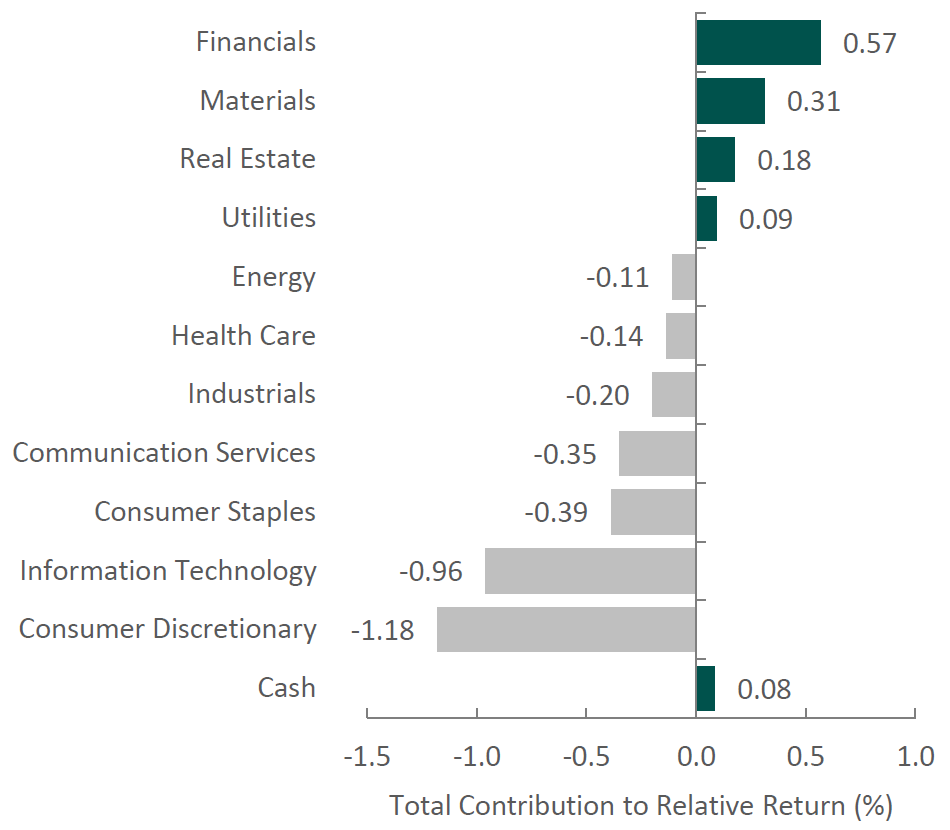
From a sector perspective, the portfolio’s outperformance relative to the MSCI World Index can be attributed to security selection, while allocation effects had a negative impact. Security selection in Consumer Discretionary, Energy and Information Technology contributed the most to the portfolio’s relative performance. Conversely, security selection in Industrials, Financials and Health Care detracted from relative return.

Regionally, security selection was responsible for the portfolio’s outperformance relative to the MSCI World Index, while allocation effects had a negative impact. Security selection in North America and our exposure in Emerging Markets contributed the most to relative performance, while security selection in Europe and an overweight in Japan detracted.

Contributors and Detractors for 4Q 2023

Relative ContributorsRelative Detractors
LennarRentokil Initial
NemetschekJazz Pharmaceuticals
Martin Marietta MaterialsFMC Corporation
QualcommAlcon
BrookfieldTotalEnergies

Lennar, one of the nation’s largest homebuilders, was the top contributor for the period. Increasing mortgage rates reached a peak during the fourth quarter, but Lennar’s dynamic pricing model, combined with its digital marketing platform and buyer incentives, continued to drive volume and generate cash flow, all while reducing construction cycle times, returning capital to shareholders and further lowering the company’s debt. In 2023, Lennar delivered 73,000 homes (a 10% year-over-year volume increase).The company’s land light strategy also continues to move forward, with 76% of land now controlled through options, as compared to 69% a year ago (and less than 30% in 2015).Over our decade-plus investment in Lennar, we have admired the management team’s ability to respond to changing housing dynamics. We believe Lennar’s current land and pricing strategy should continue to support enhanced FREE cash flow generation. In addition, Lennar’s strong balance sheet, prudent inventory management and further ability to implement cost and production efficiencies position it well to meet demand amid the decade-long undersupply of homes in the U.S.

Nemetschek, a project management software solutions provider for the architecture, engineering and construction industry, was the one of the largest contributors for the quarter. Over the past couple of years, the company has made significant efforts to transition the business from a license to a subscription SaaS (software as a service) model, which we expected would drive higher and more stable revenues per user while creating more long-term value for customers. In line with this strategy, the company reported that ~75% of its revenues are now recurring, up from ~65% last year. Furthermore, with the backdrop of stable demand and strong operational execution, management reported EBITDA margins at the high end of guidance and raised its revenue projections for the year. We believe the optimization of Nemetschek’s business model, continued improvement in operational efficiency through efforts like internalization, and product innovation such as the open and cloud-based dTwin platform, will lead to long-term improvements in profitability and position the company for market share gains as building complexity continues to increase.

Rentokil Initial, the U.K.-based pest control and hygiene services company, was the largest detractor for the quarter. The company’s pest control segment (which accounts for 94% of total operating profit) reported a slowdown in organic revenue growth from 5.6% in the first half of 2023 to 2.3% in the third quarter. As these results are short term in nature, we will continue to closely monitor the company’s progress on both integration of Terminix and further improvement of its marketing strategy. This includes the recent appointment of Brad Paulsen as CEO of the North America Region and his impact on the company’s most important geography (accounting for ~75% of pest control sales). Over the long term, we remain confident that the Terminix acquisition will create scale efficiencies and in-market densification (with a targeted $200 million in cost synergies by 2025), as well as accelerate the consolidation of the U.S. pest control market. Short-term impacts on the company’s stock price, in our opinion, are overdone given these fundamental improvements coupled with the resilient nature of the pest control business.

FMC Corporation, the global provider of crop protection solutions, was the largest detractor for the year and a top detractor for the fourth quarter. Following robust orders during the 2020-2022 period, customer destocking persisted throughout 2023, particularly in Latin America. Despite strong end-market demand, market forces, including inflationary prices and sharply higher interest rates, have combined to motivate customers to draw down existing inventories. As a result, FMC lowered its 2023 guidance and introduced a global restructuring initiative. In November, we attended FMC’s Investor Day where management detailed its strategic plans and introduced mid-term financial goals. We came away with increased confidence that FMC is at or near a cyclical bottom and that management is taking appropriate actions in navigating the worst downcycle the crop protection market has seen in more than 40 years.

Recent Portfolio Activity

BuysSells
MonotaROKubota

During the quarter, we sold our position in Kubota and invested in a new position, MonotaRO.

We first invested in Kubota, the maker of tractors and construction machinery, during the second quarter of 2015. During our holding period, the company has increased its agricultural sales by entering wet field markets in Southeast Asia, gained share of small tractors/construction machinery in North America, and restructured its water and environment segment. We decided to sell in favor of what we think is a more compelling investment opportunity. However, we will continue to monitor this high-quality company and follow with interest its attempts to increase its presence in India, a very attractive tractor market where Kubota has yet to prove whether it will be able to take meaningful share.

MonotaRO Co., Ltd.

Established in Japan in 2000, MonotaRO operates a business-to-business (B2B) e-commerce platform, selling about 20 million items (over 650,000 SKUs) to more than 8 million customers (mostly in Japan). The company is an MRO (maintenance, repair and operations) distributor focused on small- and mid-sized companies (~two-thirds of customers), with manufacturing, construction and auto repair industries accounting for the majority of sales. For those reading this online, MonotaRO’s business may seem simple or even obvious; however, the company’s unique profile (>95% of sales are online) and innovative solutions, we believe, provide its customers a distinct value proposition and its shareholders a compelling opportunity to own a leader in a fragmented industry.

MonotaRO serves as a one-stop solution, allowing customers to shop for millions of products via a centralized location. Its transparent pricing saves clients time and reduces costs by removing the need to rely on independent catalogs, individual quotes or separate orders. The company sources its merchandise from thousands of suppliers (i.e., manufacturers and wholesalers) in ten countries and carries over 500,000 products in stock, ready for same-day shipment from its own distribution centers. In addition, its ONE SOURCE Lite allows large clients to link their purchasing management systems to MonotaRO’s, providing company-wide visibility of items and purchases and an integrated experience.

MonotaRO operates as a consolidated subsidiary of U.S.-based Grainger (an industrials supplier) and provides consulting services to the parent’s e-commerce businesses in the U.S., Germany and the U.K.

High-Quality Business

Some of the quality characteristics we have identified for MonotaRO include:

  • High barriers to entry given that scale is essential to most products in the MRO market, which requires high variety yet small lot ordering, making it imperative to offer a high number of SKUs while investing in technology to provide easier curation and shorter delivery times;
  • The company’s vast product breath, combined with its advanced data analytics, allows it to analyze procurement behaviors and better predict which items to keep in inventory. The client is able to spend less time ordering and can count on reliable delivery;
  • Attractive business fundamentals, as ordering can be cumbersome, and clients value reliability, convenience and variety more so than price. The MRO market is also highly fragmented and inefficient. As MonotaRO expands, the more difficult it becomes for others to compete; and
  • Expertise in database marketing leads to high repeat order rates, while its integrated purchasing management system into large corporations increases their switching costs.

Attractive Valuation

Using our estimates of normalized sales attained through continued market share gains, we believe MonotaRO’s current stock price is offered at a discount to our estimate of the company’s intrinsic value.

Compelling Catalysts

Catalysts we have identified for MonotaRo, which we believe will cause its stock price to appreciate over our three- to five-year investment horizon, include:

  • Ability to continue gaining share from inefficient small players (e.g., door-to-door dealers relying on people, catalogs and even fax machines);
  • Increasing existing customers’ sales through technological improvements (e.g., website personalization and recommendation displays) aimed at reducing the time it takes to (1) find, (2) purchase and (3) receive products;
  • Further penetration into enterprise customers should provide a larger source for sales growth, as this segment represents a higher customer lifetime value as well as stickiness; and
  • Growth in sales of MonotaRO’s private label offering of approximately 300,000 products that are higher margin yet provide savings to clients.

Conclusion

With volatile economic data points, changing central bank policies, shocks to the banking system and various geopolitical conflicts, 2023 was full of headline-worthy news. However, as the market’s attention quickly shifted from one macro event to the next, we remained true to our bottom up, fundamental investment philosophy.

As such, instead of chasing the next headline or “placing bets” on short-term predictions, our focus remains on business fundamentals and what is analyzable in the long run. For over the past quarter century, we have dedicated ourselves to a “bottom-up” process of identifying high-quality businesses trading at meaningful discounts to intrinsic value, that possess catalysts which are underway and within management’s control. By doing so, we believe we can find long-term success regardless of the macroeconomic environment or news of the day.

Disclosures

The opinions expressed herein are those of Aristotle Capital Management, LLC (Aristotle Capital) and are subject to change without notice. Past performance is not a guarantee or indicator of future results. This material is not financial advice or an offer to buy or sell any product. You should not assume that any of the securities transactions, sectors or holdings discussed in this report were or will be profitable, or that recommendations Aristotle Capital makes in the future will be profitable or equal the performance of the securities listed in this report. The portfolio characteristics shown relate to the Aristotle Global Equity strategy. Not every client’s account will have these characteristics. Aristotle Capital reserves the right to modify its current investment strategies and techniques based on changing market dynamics or client needs. There is no assurance that any securities discussed herein will remain in an account’s portfolio at the time you receive this report or that securities sold have not been repurchased. The securities discussed may not represent an account’s entire portfolio and, in the aggregate, may represent only a small percentage of an account’s portfolio holdings. The performance attribution presented is of a representative account from Aristotle Capital’s Global Equity Composite. The representative account is a discretionary client account which was chosen to most closely reflect the investment style of the strategy. The criteria used for representative account selection is based on the account’s period of time under management and its similarity of holdings in relation to the strategy. Recommendations made in the last 12 months are available upon request.

Returns are presented gross and net of investment advisory fees and include the reinvestment of all income. Gross returns will be reduced by fees and other expenses that may be incurred in the management of the account. Net returns are presented net of actual investment advisory fees and after the deduction of all trading expenses.

All investments carry a certain degree of risk, including the possible loss of principal. Investments are also subject to political, market, currency and regulatory risks or economic developments. International investments involve special risks that may in particular cause a loss in principal, including currency fluctuation, lower liquidity, different accounting methods and economic and political systems, and higher transaction costs. These risks typically are greater in emerging markets. Securities of small‐ and medium‐sized companies tend to have a shorter history of operations, be more volatile and less liquid. Value stocks can perform differently from the market as a whole and other types of stocks.

The material is provided for informational and/or educational purposes only and is not intended to be and should not be construed as investment, legal or tax advice and/or a legal opinion. Investors should consult their financial and tax adviser before making investments. The opinions referenced are as of the date of publication, may be modified due to changes in the market or economic conditions, and may not necessarily come to pass. Information and data presented has been developed internally and/or obtained from sources believed to be reliable. Aristotle Capital does not guarantee the accuracy, adequacy or completeness of such information.

Aristotle Capital Management, LLC is an independent investment adviser registered under the Investment Advisers Act of 1940, as amended. Registration does not imply a certain level of skill or training. More information about Aristotle Capital, including our investment strategies, fees and objectives, can be found in our Form ADV Part 2, which is available upon request. ACM-2401-89

Performance Disclosures

Sources: CAPS CompositeHubTM, MSCI

Composite returns for all periods ended December 31, 2023 are preliminary pending final account reconciliation.

The Aristotle Global Equity Composite has an inception date of November 1, 2010; however, the strategy initially began at Howard Gleicher’s predecessor firm in July 2007. A supplemental performance track record from January 1, 2008 through October 31, 2010 is provided on this page and complements the Global Equity Composite presentation that is located at the end of this presentation. The performance results were achieved while Mr. Gleicher managed the strategy at a prior firm. The returns are those of a publicly available mutual fund from the fund’s inception through Mr. Gleicher’s departure from the firm. During that time, Mr. Gleicher had primary responsibility for managing the fund.

Past performance is not indicative of future results. The information provided should not be considered financial advice or a recommendation to purchase or sell any particular security or product. Performance results for periods greater than one year have been annualized.

Returns are presented gross and net of investment advisory fees and include the reinvestment of all income. Gross returns will be reduced by fees and other expenses that may be incurred in the management of the account. Net returns are presented net of actual investment advisory fees and after the deduction of all trading expenses.

Index Disclosures

The MSCI World Index is a free float-adjusted market capitalization weighted index that is designed to measure the equity market performance of developed markets. The MSCI World Index consists of the following 23 developed market country indexes: Australia, Austria, Belgium, Canada, Denmark, Finland, France, Germany, Hong Kong, Ireland, Israel, Italy, Japan, Netherlands, New Zealand, Norway, Portugal, Singapore, Spain, Sweden, Switzerland, the United Kingdom and the United States. The MSCI Emerging Markets Index is a free float-adjusted market capitalization-weighted index that is designed to measure equity market performance of emerging markets. The MSCI Emerging Markets Index consists of the following 24 emerging market country indexes: Brazil, Chile, China, Colombia, Czech Republic, Egypt, Greece, Hungary, India, Indonesia, Korea, Kuwait, Malaysia, Mexico, Peru, Philippines, Poland, Qatar, Saudi Arabia, South Africa, Taiwan, Thailand, Turkey and United Arab Emirates. The MSCI ACWI captures large and mid-cap representation across 23 developed markets and 24 emerging markets countries. With approximately 3,000 constituents, the Index covers approximately 85% of the global investable equity opportunity set. The MSCI ACWI Growth Index captures large and mid-cap securities exhibiting overall growth style characteristics across 23 developed markets countries and 24 emerging markets countries. The MSCI ACWI Value Index captures large and mid-cap securities exhibiting overall value style characteristics across 23 developed markets countries and 24 emerging markets countries. The MSCI Europe Index captures large and mid-cap representation across 15 developed markets countries in Europe. With more than 400 constituents, the Index covers approximately 85% of the free float-adjusted market capitalization across the European developed markets equity universe. The MSCI Japan Index is designed to measure the performance of the large and mid-cap segments of the Japanese market. With approximately 250 constituents, the Index covers approximately 85% of the free float-adjusted market capitalization in Japan. The S&P 500® Index is the Standard & Poor’s Composite Index of 500 stocks and is a widely recognized, unmanaged index of common stock prices. The Bloomberg Global Aggregate Bond Index is a flagship measure of global investment grade debt from 28 local currency markets. This multi-currency benchmark includes Treasury, government-related, corporate and securitized fixed rate bonds from both developed and emerging markets issuers. The Brent Crude Oil Index is a major trading classification of sweet light crude oil that serves as a major benchmark price for purchases of oil worldwide. The volatility (beta) of the Composite may be greater or less than the benchmarks. It is not possible to invest directly in these indexes.

(All MSCI index returns are shown net and in U.S. dollars unless otherwise noted.)

Markets Review

Sources: CAPS CompositeHubTM, Bloomberg
Past performance is not indicative of future results. Aristotle International Equity Composite returns are presented gross and net of investment advisory fees and include the reinvestment of all income. Gross returns will be reduced by fees and other expenses that may be incurred in the management of the account. Net returns are presented net of actual investment advisory fees and after the deduction of all trading expenses. Aristotle Capital Composite returns are preliminary pending final account reconciliation. Please see important disclosures at the end of this document.

Global equity markets rallied in the fourth quarter. Overall, the MSCI ACWI Index rose 11.03% during the period. Concurrently, the Bloomberg Global Aggregate Bond Index increased 8.10%. In terms of style, value stocks underperformed their growth counterparts during the quarter, with the MSCI ACWI Value Index trailing the MSCI ACWI Growth Index by 3.57%.

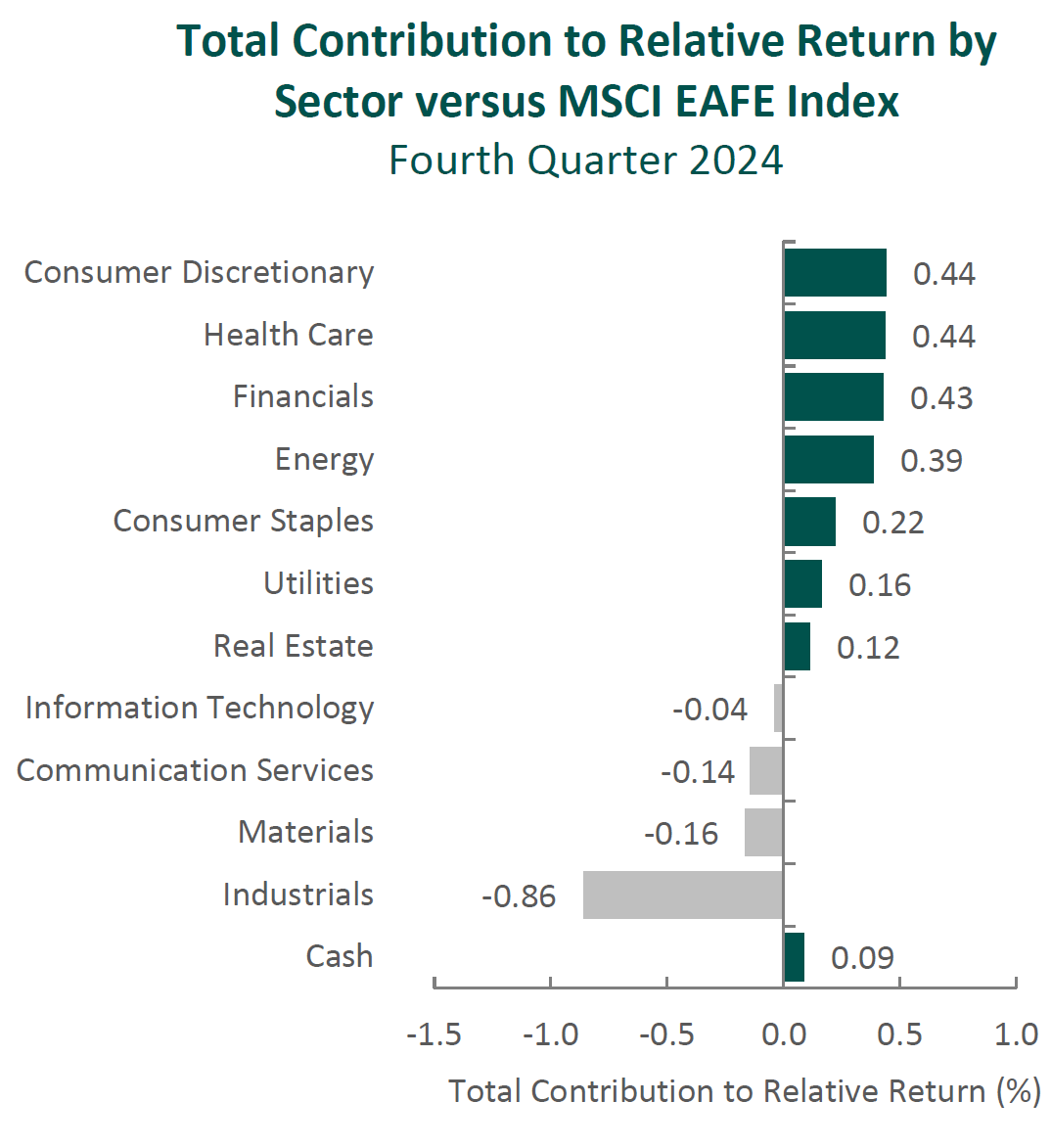
The MSCI EAFE Index climbed 10.42% during the fourth quarter, while the MSCI ACWI ex USA Index increased 9.75%. Within the MSCI EAFE Index, Europe & Middle East and Asia were the strongest performers, while the U.K., though posting strong absolute results, gained the least. On a sector basis, all eleven sectors within the MSCI EAFE Index posted positive returns, with Information Technology, Materials and Real Estate generating the largest gains. Conversely, Energy, Health Care and Consumer Staples gained the least.

Despite posting overall gains, global equity markets were shocked with another war and humanitarian crisis as tensions between Israel and Hamas reached a watershed during the quarter. In response to the deadly terrorist attack on civilians by Hamas, Israel commenced a military campaign in the Gaza Strip. While concerns that the war might spread throughout the entire Middle East abated during the period, the complex religious, ethnic and political makeup of the region could complicate diplomatic relationships in the future.

Meanwhile, in Europe, Ukraine’s 2023 counteroffensive against Russia was confirmed as a failure, and Western support for the beleaguered nation seems to be waning. President Putin has stated that Russia’s war goals have not changed, but reports indicate that he may be open to a cease-fire. In Asia, President Xi Jinping claimed that reunification is inevitable, adding to the mounting Chinese pressure on Taiwan ahead of Taiwan’s 2024 election.

On the economic front, global labor markets remained tight, and most countries and regions continued to make inroads in the battle against inflation, as the U.S., U.K., eurozone and Japan all reported slowing annual inflation in November; 3.1%, 3.9%, 2.4% and 2.8%, respectively. In response to the improving conditions, both major western and eastern nations largely kept interest rate policy steady during the quarter. However, future policy direction looks to be divided heading into the new year, as the U.S. signaled potential rate cuts, the U.K. and eurozone rebuffed premature discussions of cuts, and Japan looks to end its policy of negative rates in 2024. Nevertheless, the International Monetary Fund expects global inflation to continue to steadily decline due to overall tighter monetary policy and lower commodity prices, which have been further suppressed by the bursting of China’s property bubble.

Annual Markets Review

After a tumultuous year in 2022, global equity markets rebounded in 2023, as the MSCI ACWI posted a full-year return of 22.20%. Additionally, after underperforming value in 2022 by the largest amount since 2000, growth recovered, as the MSCI ACWI Growth Index outperformed the MSCI ACWI Value Index by 21.41% in 2023. Meanwhile, fixed income markets also rose, as the Bloomberg Global Aggregate Bond Index increased 5.72%.

Though markets trended in a positive direction, 2023 still had its share of twists and turns in the form of a banking crisis and geopolitical conflicts in Europe, the Middle East and Asia. Furthermore, inflation, corresponding central bank policies, and economic recovery in areas like Europe and Asia generated significant headlines and proved to be key macroeconomic factors.

Given the multitude of headlines in a year and their fickle nature, short-term returns are often volatile and inconsistent. Therefore, we instead choose to focus on business fundamentals over the long term. By finding great businesses that are undervalued with actionable catalysts within our investment time horizon, we believe we can provide consistent and lasting value to our clients.

Performance and Attribution Summary

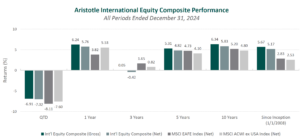
For the fourth quarter of 2023, Aristotle Capital’s International Equity Composite posted a total return of 10.41% gross of fees (10.31% net of fees), underperforming the MSCI EAFE Index, which returned 10.42%, and outperforming the MSCI ACWI ex USA Index, which returned 9.75%. Please refer to the table below for detailed performance.

Performance (%) 4Q231 Year3 Years5 Years10 Years Since Inception*
International Equity Composite (gross)10.4118.543.328.815.175.63
International Equity Composite (net)10.3118.002.848.304.665.13
MSCI EAFE Index (net)10.4218.244.028.164.282.76
MSCI ACWI ex USA Index (net)9.7515.621.557.083.832.35
*The inception date for the International Equity Composite is January 1, 2008. Past performance is not indicative of future results. Aristotle International Equity Composite returns are presented gross and net of investment advisory fees and include the reinvestment of all income. Gross returns will be reduced by fees and other expenses that may be incurred in the management of the account. Net returns are presented net of actual investment advisory fees and after the deduction of all trading expenses. Aristotle Capital Composite returns are preliminary pending final account reconciliation. Please see important disclosures at the end of this document.

Source: FactSet
Past performance is not indicative of future results. Attribution results are based on sector returns which are gross of investment advisory fees. Attribution is based on performance that is gross of investment advisory fees and includes the reinvestment of income.

From a sector perspective in the fourth quarter, the portfolio’s modest underperformance relative to the MSCI EAFE Index can be attributed to allocation effects, while security selection had a positive impact. Security selection in Industrials and Health Care, as well as an overweight in Energy, detracted the most from the portfolio’s relative performance. Conversely, security selection in Financials, Consumer Discretionary and Energy contributed to relative return.

Regionally, security selection was responsible for the portfolio’s underperformance, while allocation effects had a positive impact. Security selection in the U.K. and Asia detracted from relative performance, while exposure to Canada and security selection in Europe & Middle East contributed.

Contributors and Detractors for 4Q 2023

Relative ContributorsRelative Detractors
NemetschekRentokil Initial
BrookfieldHaleon
Assa AbloyAlcon
ExperianNidec
Samsung ElectronicsMunich Reinsurance

Rentokil Initial, the U.K.-based pest control and hygiene services company, was the largest detractor for the quarter. The company’s pest control segment (which accounts for 94% of total operating profit) reported a slowdown in organic revenue growth from 5.6% in the first half of 2023 to 2.3% in the third quarter. As these results are short term in nature, we will continue to closely monitor the company’s progress on both integration of Terminix and further improvement of its marketing strategy. This includes the recent appointment of Brad Paulsen as CEO of the North America Region and his impact on the company’s most important geography (accounting for ~75% of pest control sales). Over the long term, we remain confident that the Terminix acquisition will create scale efficiencies and in-market densification (with a targeted $200 million in cost synergies by 2025), as well as accelerate the consolidation of the U.S. pest control market. Short-term impacts on the company’s stock price, in our opinion, are overdone given these fundamental improvements coupled with the resilient nature of the pest control business.

Japan-based Nidec, the global supplier of brushless motors, was one of the largest detractors for the quarter. The company’s electric vehicle (EV) traction motor business has disappointed, with shipment assumptions dropping to 350,000 from 949,000 at the start of the fiscal year. Management also withdrew its ambitious target for the EV business to turn profitable this fiscal year, now projecting an operating loss of ¥15 billion, as it noted all motor suppliers to Chinese EV manufacturers are currently experiencing losses due to intensifying price competition. In response, Nidec has announced a shift in its strategy to both increase R&D spending to accelerate product development and shore up profitability with more selective order placement. While we continue to believe Nidec’s expertise in power efficiency provides it with a unique advantage to supply industrial motors across markets (not only for EVs, but also robots, appliances and industrial applications), we are carefully reviewing whether recent setbacks are cyclical issues or more permanent in nature, and we also continue to monitor changes in leadership, including those set to take place in April 2024.

Nemetschek, a project management software solutions provider for the architecture, engineering and construction industry, was the largest contributor for the quarter. Over the past couple of years, the company has made significant efforts to transition the business from a license to a subscription SaaS (software as a service) model, which we expected would drive higher and more stable revenues per user while creating more long-term value for customers. In line with this strategy, the company reported that ~75% of its revenues are now recurring, up from ~65% last year. Furthermore, with the backdrop of stable demand and strong operational execution, management reported EBITDA margins at the high end of guidance and raised its revenue projections for the year. We believe the optimization of Nemetschek’s business model, continued improvement in operational efficiency through efforts like internalization, and product innovation, such as the open and cloud-based dTwin platform, will lead to long-term improvements in profitability and position the company for market share gains as building complexity continues to increase.

Experian, one of the largest credit bureau companies in the world, was a primary contributor during the quarter. Amidtighter lending conditions, the company continues to show its strength. This includes recent product launches and innovation within the company’s Ascend platform, which leverages deeper analytics so that lenders can automate processes and target audiences more effectively. The credit bureau also expanded its position in employer services and verifications and has seen further digital penetration in areas like Auto and Health. During our well over a decade-long ownership of Experian, the company has increasingly found ways to monetize existing data sets and serve new types of customers. We believe Experian’s unique industry structure and massive data library (with data on ~1.5 billion consumers and ~200 million businesses) not only creates an exceptionally scalable business with high barriers to entry, but also makes it uniquely positioned to benefit from the increased need for big data across many industries.

Recent Portfolio Activity

BuysSells
Daikin IndustriesDassault Systèmes
Sandoz

During the quarter, we sold our positions in Dassault Systèmes and Sandoz and invested in a new position in Daikin Industries.

We first invested in Dassault in the first quarter of 2015. During our more than eight-year holding period, the company executed on a number of catalysts, including a profitable transition to a new software platform (i.e., 3DExperience) and successful entry into new verticals such as life sciences via the 2019 acquisition of Medidata. While we continue to view Dassault as a high-quality company, we decided to exit our investment in favor of what we view as a more optimal opportunity in Daikin Industries, which is discussed in detail below.

We have been Novartis shareholders for over a decade. In October of 2023, the company completed the spinoff of Sandoz, its generics and biosimilars business. This divestiture furthers Novartis’s ongoing transition to a focus on branded prescription drugs, having over the last several years also exited its eye care, vaccine, animal health and consumer healthcare businesses. Upon further analysis, we decided to sell the shares received in the Sandoz spinoff and use the proceeds for what we consider to be a more optimal investment.

Daikin Industries, Ltd.

Founded in 1924 and headquartered in Japan, Daikin Industries is the world’s largest commercial and residential air conditioner company. Daikin primarily manufactures and sells air conditioning systems, heat pumps, air purifiers and refrigeration equipment (which accounts for over 90% of revenue). Daikin has long been an industry leader in developing energy-efficient products, which was molded by its roots in Japan, a region with limited natural resources and high energy costs. The company’s R&D consists of a global Technology Innovation Center and 39 other regional development facilities in charge of tailoring offerings to their local markets. Today Daikin’s products are sold in over 170 countries, and the company boasts leading market positions in Japan and China, as well as in the U.S. residential market.

Distribution is particularly important since air conditioning systems are difficult to install. Daikin’s 2012 acquisition of Goodman in the U.S. added hundreds of distribution points across the country, providing Daikin with a leading national market position and platform from which to expand. In China, specialty retail stores (ProShops) sell directly to homeowners, focusing on high-end, multi-unit products at much higher margins than if they were selling to a developer or contractor.

High-Quality Business

Some of the quality characteristics we have identified for Daikin include:

  • Strong brand recognition and a large global distribution network are, in our opinion, strong competitive advantages and serve as high barriers to entry;
  • History of technological innovation, particularly in energy-saving inverters and variable refrigerant flow systems; and
  • Ability to tailor products to different local preferences across geographies and varied levels of HVAC regulations, thanks to Daikin’s network of global production bases and development facilities.

Attractive Valuation

Based on our estimates, shares of the company are attractively valued. We believe greater global adoption of air conditioning, as well as higher priced and more profitable technologies (i.e., heat pumps and inverters), will lead to higher normalized FREE cash flow than currently appreciated by the market.

Compelling Catalysts

Catalysts we have identified for Daikin, which we believe will cause its stock price to appreciate over our three- to five-year investment horizon, include:

  • As the largest global supplier and a leader in energy efficiency, Daikin is uniquely positioned to benefit from the increase in worldwide air conditioning adoption rates (projected to triple by 2050) while leveraging its intellectual property in inverters and heat pumps;
  • Market share gains in the U.S. as Daikin further leverages its technology in premium residential air conditioning supported by Goodman’s distribution network; and
  • Execution of its Fusion 25 strategic plan that includes making improvements in technological development, strengthening sales and service networks, promoting digital transformation, and more.

Conclusion

With volatile economic data points, changing central bank policies, shocks to the banking system and various geopolitical conflicts, 2023 was full of headline-worthy news. However, as the market’s attention quickly shifted from one macro event to the next, we remained true to our bottom up, fundamental investment philosophy.

As such, instead of chasing the next headline or “placing bets” on short-term predictions, our focus remains on business fundamentals and what is analyzable in the long run. For over the past quarter century, we have dedicated ourselves to a “bottom-up” process of identifying high-quality businesses trading at meaningful discounts to intrinsic value, that possess catalysts which are underway and within management’s control. By doing so, we believe we can find long-term success regardless of the macroeconomic environment or news of the day.

Disclosures

The opinions expressed herein are those of Aristotle Capital Management, LLC (Aristotle Capital) and are subject to change without notice. Past performance is not a guarantee or indicator of future results. This material is not financial advice or an offer to buy or sell any product. You should not assume that any of the securities transactions, sectors or holdings discussed in this report were or will be profitable, or that recommendations Aristotle Capital makes in the future will be profitable or equal the performance of the securities listed in this report. The portfolio characteristics shown relate to the Aristotle International Equity strategy. Not every client’s account will have these characteristics. Aristotle Capital reserves the right to modify its current investment strategies and techniques based on changing market dynamics or client needs. There is no assurance that any securities discussed herein will remain in an account’s portfolio at the time you receive this report or that securities sold have not been repurchased. The securities discussed may not represent an account’s entire portfolio and, in the aggregate, may represent only a small percentage of an account’s portfolio holdings. The performance attribution presented is of a representative account from Aristotle Capital’s International Equity Composite. The representative account is a discretionary client account which was chosen to most closely reflect the investment style of the strategy. The criteria used for representative account selection is based on the account’s period of time under management and its similarity of holdings in relation to the strategy. Recommendations made in the last 12 months are available upon request.

Returns are presented gross and net of investment advisory fees and include the reinvestment of all income. Gross returns will be reduced by fees and other expenses that may be incurred in the management of the account. Net returns are presented net of actual investment advisory fees and after the deduction of all trading expenses.

All investments carry a certain degree of risk, including the possible loss of principal. Investments are also subject to political, market, currency and regulatory risks or economic developments. International investments involve special risks that may in particular cause a loss in principal, including currency fluctuation, lower liquidity, different accounting methods and economic and political systems, and higher transaction costs. These risks typically are greater in emerging markets. Securities of small‐ and medium‐sized companies tend to have a shorter history of operations, be more volatile and less liquid. Value stocks can perform differently from the market as a whole and other types of stocks.

The material is provided for informational and/or educational purposes only and is not intended to be and should not be construed as investment, legal or tax advice and/or a legal opinion. Investors should consult their financial and tax adviser before making investments. The opinions referenced are as of the date of publication, may be modified due to changes in the market or economic conditions, and may not necessarily come to pass. Information and data presented has been developed internally and/or obtained from sources believed to be reliable. Aristotle Capital does not guarantee the accuracy, adequacy or completeness of such information.

Aristotle Capital Management, LLC is an independent registered investment adviser under the Advisers Act of 1940, as amended. Registration does not imply a certain level of skill or training. More information about Aristotle Capital, including our investment strategies, fees and objectives, can be found in our Form ADV Part 2, which is available upon request. ACM-2401-45

Performance Disclosures

Sources: CAPS CompositeHubTM, MSCI

Composite returns for all periods ended December 31, 2023 are preliminary pending final account reconciliation.

Past performance is not indicative of future results. The information provided should not be considered financial advice or a recommendation to purchase or sell any particular security or product. Performance results for periods greater than one year have been annualized.

Returns are presented gross and net of investment advisory fees and include the reinvestment of all income. Gross returns will be reduced by fees and other expenses that may be incurred in the management of the account. Net returns are presented net of actual investment advisory fees and after the deduction of all trading expenses.

Index Disclosures

The MSCI EAFE Index (Europe, Australasia, Far East) is a free float-adjusted market capitalization-weighted index that is designed to measure the equity market performance of developed markets, excluding the United States and Canada. The MSCI EAFE Index consists of the following 21 developed market country indexes: Australia, Austria, Belgium, Denmark, Finland, France, Germany, Hong Kong, Ireland, Israel, Italy, Japan, the Netherlands, New Zealand, Norway, Portugal, Singapore, Spain, Sweden, Switzerland and the United Kingdom. The MSCI ACWI captures large and mid-cap representation across 23 developed market countries and 24 emerging markets countries. With approximately 3,000 constituents, the Index covers approximately 85% of the global investable equity opportunity set. The MSCI ACWI Growth Index captures large and mid-cap securities exhibiting overall growth style characteristics across 23 developed markets countries and 24 emerging markets countries. The MSCI ACWI Value Index captures large and mid-cap securities exhibiting overall value style characteristics across 23 developed markets countries and 24 emerging markets countries. The MSCI ACWI ex USA Index captures large and mid-cap representation across 22 of 23 developed markets countries (excluding the United States) and 24 emerging markets countries. With approximately 2,300 constituents, the Index covers approximately 85% of the global equity opportunity set outside the United States. The MSCI Emerging Markets Index is a free float-adjusted market capitalization-weighted index that is designed to measure the equity market performance of emerging markets. The MSCI Emerging Markets Index consists of the following 24 emerging market country indexes: Brazil, Chile, China, Colombia, Czech Republic, Egypt, Greece, Hungary, India, Indonesia, Korea, Kuwait, Malaysia, Mexico, Peru, Philippines, Poland, Qatar, Saudi Arabia, South Africa, Taiwan, Thailand, Turkey and United Arab Emirates. The S&P 500® Index is the Standard & Poor’s Composite Index of 500 stocks and is a widely recognized, unmanaged index of common stock prices. The Brent Crude Oil Index is a major trading classification of sweet light crude oil that serves as a major benchmark price for purchases of oil worldwide. The MSCI Japan Index is designed to measure the performance of the large and mid-cap segments of the Japanese market. With approximately 250 constituents, the Index covers approximately 85% of the free float-adjusted market capitalization in Japan. The Bloomberg Global Aggregate Bond Index is a flagship measure of global investment grade debt from 28 local currency markets. This multi-currency benchmark includes treasury, government-related, corporate and securitized fixed-rate bonds from both developed and emerging markets issuers. The MSCI United Kingdom Index is designed to measure the performance of the large and mid-cap segments of the U.K. market. With nearly 100 constituents, the Index covers approximately 85% of the free float-adjusted market capitalization in the United Kingdom. The MSCI Europe Index captures large and mid-cap representation across 15 developed markets countries in Europe. With approximately 430 constituents, the Index covers approximately 85% of the free float-adjusted market capitalization across the European developed markets equity universe. These indexes have been selected as the benchmarks and are used for comparison purposes only. The volatility (beta) of the Composite may be greater or less than the respective benchmarks. It is not possible to invest directly in these indexes.


For more on International Equity, access the latest resources.

ARISTOTLE CAPITAL BOSTON, LLC

Markets Review

As we’ve highlighted several times throughout the year, volatility was a recurring theme for most of 2023 and the fourth quarter was no exception. Following a sluggish start to the quarter, small cap stocks rallied off their October lows and ended the period with a double-digit gain. For the quarter, the Russell 2000’s gain of 14.03% outpaced the 11.96% total return of the Russell 1000 Index, marking the first quarterly outperformance period for the small cap index since the third quarter of 2022. Overall equity performance continued to be tightly correlated to 10-year US Treasury bond yields. When yields rose in October, stocks fell sharply. Yields collapsed in November and December, and stocks rallied. The Federal Reserve’s dovish commentary was a primary catalyst for the ‘everything-rally’ that ensued into year end. At the mid-December meeting, Chairman Powell made public comments that suggested the Fed had interest rate cuts on its mind, saying cuts were “a topic of discussion” among Federal Reserve members. At the time of this writing, markets are currently pricing in several rate cuts in 2024, however, the situation remains fluid as a host of uncertainties could potentially alter the pace and direction of policy moves throughout the year.

Stylistically, value stocks outperformed their more expensive growth counterparts during the quarter as evidenced by the Russell 2000 Value Index returning 15.26% compared to 12.75% for the Russell 2000 Growth Index. For 2023 as a whole, however, the Russell 2000 Growth Index led, gaining 18.66% versus 14.65% for the Russell 2000 Value. Factor performance was decidedly mixed during the fourth quarter, although companies with negative earnings, high short interest, and low ROE & ROIC were among the strongest performers into year end, indicating a lower quality skew to the Russell 2000 rally during the period.

At the sector level, ten of the eleven sectors in the Russell 2000 Index recorded positive returns during the fourth quarter, led by robust returns in the Financials (+21.56%), Consumer Discretionary (+17.39%) and Real Estate (+16.86%) sectors. Conversely, Energy (-6.03%), Utilities (+7.83%), and Communication Services (+9.68%) all underperformed. For the full year, Information Technology, Consumer Discretionary and Industrial fared best. Utilities was the lone sector to finish in negative territory while Health Care and Communication Services also lagged.

Sources: CAPS Composite Hub, Russell Investments

Past performance is not indicative of future results. Returns are presented gross and net of investment advisory fees and include the reinvestment of all income. Gross returns will be reduced by fees and other expenses that may be incurred in the management of the account. Net returns are presented net of actual investment advisory fees and after the deduction of all trading expenses. Aristotle Small Cap Equity Composite returns are preliminary pending final account reconciliation. Please see important disclosures at the end of this document.

Performance Review

For the fourth quarter of 2023, the Aristotle Small Cap Equity Composite posted a total return of 11.02% net of fees (11.18% gross of fees), trailing the 14.03% total return of the Russell 2000 Index. Underperformance was driven by a combination of security selection and allocation effects. Overall, security selection was weakest within the Health Care, Information Technology and Consumer Staples sectors and strongest in Utilities, Financials and Materials. From an allocation perspective, underweights in Financials and Consumer Discretionary detracted from relative returns but were partially offset by underweights in Energy and Communication Services which contributed.

Relative ContributorsRelative Detractors
SP PlusOceaneering International
Customers BancorpBelden
ACI WorldwidePatterson-UTI Energy
ViadHuron Consulting
HASIDesigner Brands

CONTRIBUTORS

SP Plus (SP), a provider of parking management, payment services, facility maintenance and event logistics solutions, appreciated following an announcement that the company would be acquired by Metropolis Technologies. We maintain a position ahead of the expected close of the transaction in 2024.

Customers Bancorp (CUBI), a Pennsylvania-based regional bank, benefited from strong fundamental performance and improved sentiment following the company’s latest earnings release after the company reported net interest margin expansion alongside, solid credit, capital, and broader business trends. We maintain our investment as we believe management’s focus on accumulating capital, limiting balance growth, and remixing loans and deposits into higher value-add verticals should create additional shareholder value in periods to come.  

DETRACTORS

Oceaneering International (OII), a global technology company delivering engineered services, products and robotic solutions to the offshore energy, defense, aerospace, manufacturing, and entertainment industries, declined during the period amid a pullback in energy prices and conservative management commentary around the company’s near-term outlook. We maintain a position, as we believe the company should continue to benefit from future increases in offshore activity along with continued growth within its industrial robotics business segment.

Belden (BDC), a manufacturer and seller of connectors, cables, and networking gear to help its customers acquire, transmit, manage, and orchestrate data, declined during the period amid a weaker demand environment, pauses in capital spending, and channel de-stocking. Despite these near-term pressures, we maintain our position as we believe the company’s ongoing transition from being mostly a commoditized component supplier to a complete solutions provider can drive margin expansion. Furthermore, we believe the company’s focus on serving secularly attractive end markets of Industrial Automation, Cybersecurity, Broadband & 5G, and Smart Buildings will position the company favorably over the long term.

Recent Portfolio Activity

Buys/AcquisitionsSells/Liquidations
Northern Oil & GasCoherus Biosciences

BUYS/ACQUISITIONS

Northern Oil & Gas (NOG), a leading non-operated working interest franchise in the premier shale basins across the United States, was added to the portfolio. Overall, we believe the company’s ability to opportunistically add high-quality acreage in multiple basins remains a key differentiator for the stock. Furthermore, we believe the company’s scale and proprietary database built from participation in over 9,800 wells provides management with intimate knowledge and the ability to make swift and informed capital allocation decisions.

SELLS/LIQUIDATIONS

Coherus Biosciences (CHRS), a commercial-stage biopharmaceutical company engaged in the development and commercialization of biosimilar and immune-oncology therapeutics for major regulated markets, was removed from the portfolio. Despite the company’s efforts to grow and diversify its revenue base through a series of upcoming product launches, a variety of factors contributed to our decision to step away from our investment including a shift in company focus, competitive pricing pressures, and a recent C-suite departure.

Outlook

Compared to late 2022, when the market seemed to be bracing for a recession, the end of 2023 seems to indicate a more optimistic tone as we move into the new year. Recent sentiment has been boosted by optimism of falling inflation and dovish messaging out of the Federal Reserve, although we acknowledge that the market’s enthusiasm on this matter in recent months may be overly optimistic. Regardless of any forthcoming policy decisions, we are reminded that the days of zero interest rates and easy access to capital have likely come to an end.  Our view is that an end to the ‘public venture capital’ mindset that has dominated small cap markets in recent years should give way to a renewed focus on profits, cash flows and balance sheet strength, which should be beneficial for fundamentally oriented active managers. In the near term, we continue to focus our efforts on the risks associated with individual investment positions under various potential scenarios instead of attempting to forecast Fed policy or interest rate moves. Based on our recent conversations with management teams, we believe the economic environment can be characterized as “good, not great” which is an improvement from this time last year, when many believed a recession was imminent both domestically and across the globe. In many ways, 2023 was another reminder that asset allocators must learn to expect the unexpected. We see that theme continuing into the new year, especially in the face of an uncertain economic backdrop and looming presidential election.

Regarding the impact on small caps, we believe macro concerns have been a drag on investor sentiment, which, once again, negatively impacted the asset class relative to large caps in 2023. Relief in this area and an improvement in the forward outlook could have the opposite effect and provide a relative boost for small caps in 2024. Valuations of small versus large continue to remain near multi-decade lows, which we believe suggests a more favorable setup for small caps relative to large caps in the periods to come (14.7x P/E for the Russell 2000 Index vs. 23.3x P/E for the Russell 1000 Index). Additionally, earnings and sales growth are expected to improve for small & mid caps in 2024 and outpace that of large caps, which we believe provides further fundamental support and potential upside for the asset class. Against a backdrop of moderating inflation, normalized interest rates, and a still growing U.S. economy, it looks to us that small-cap’s lengthy stretch of relative underperformance may be long in the tooth. If the economy continues to stabilize, our view is that valuations are likely to rise for those businesses that have largely sat out the mega-cap performance regime.  It also helps that the well-noted concentration in large caps is reaching 50-year highs and small cap valuation relative to large cap is at multi-decade lows, therefore any fundamentally driven repositioning is likely to benefit small caps more than larger companies, in our view. Lastly, large cap cycles have historically peaked at market tops crowded with mega caps, a scenario we find ourselves in today.

Positioning

Our current positioning is a function of our bottom-up security selection process and our ability to identify what we view as attractive investment candidates, regardless of economic sector definitions. Overweights in Industrials and Information Technology are mostly a function of our underlying company specific views rather than any top-down predictions for each sector. Conversely, we continue to be underweight in Consumer Discretionary, as we have been unable to identify what we consider to be compelling long-term opportunities that fit our discipline given the rising risk profiles of many retail businesses and a potential deceleration in goods spending following a period of strength. While the portfolio’s allocation to Health Care is modestly below that of the benchmark, we continue to remain underweight the Biotechnology industry as many companies within that group do not fit our discipline due to their elevated levels of binary risk. Given our focus on long-term business fundamentals, patient investment approach and low portfolio turnover, the strategy’s sector positioning generally does not change significantly from quarter to quarter. However, we may take advantage of periods of volatility by adding selectively to certain companies when appropriate.

Disclosures

The opinions expressed herein are those of Aristotle Capital Boston, LLC (Aristotle Boston) and are subject to change without notice.

Past performance is not indicative of future results. The information provided in this report should not be considered financial advice or a recommendation to purchase or sell any particular security. There is no assurance that any securities discussed herein will remain in an account’s portfolio at the time you receive this report or that securities sold have not been repurchased. The securities discussed may not represent an account’s entire portfolio and, in the aggregate, may represent only a small percentage of an account’s portfolio holdings. The performance attribution presented is of a representative account from Aristotle Boston’s Small Cap Equity Composite. The representative account is a discretionary client account which was chosen to most closely reflect the investment style of the strategy. The criteria used for representative account selection is based on the account’s period of time under management and its similarity of holdings in relation to the strategy. It should not be assumed that any of the securities transactions, holdings or sectors discussed were or will be profitable, or that the investment recommendations or decisions Aristotle Boston makes in the future will be profitable or equal the performance of the securities discussed herein. Aristotle Boston reserves the right to modify its current investment strategies and techniques based on changing market dynamics or client needs. Recommendations made in the last 12 months are available upon request.

Returns are presented gross and net of investment advisory fees and include the reinvestment of all income. Gross returns will be reduced by fees and other expenses that may be incurred in the management of the account. Net returns are presented net of actual investment advisory fees and after the deduction of all trading expenses.

Effective January 1, 2022, the Aristotle Small Cap Equity Composite has been redefined to exclude accounts with meaningful industry-specific restrictions or substantial values-based screens hampering implementation of the small cap strategy.

Effective January 1, 2022, the Russell 2000 Value Index was removed as the secondary benchmark for the Aristotle Capital Boston Small Cap Equity strategy.

All investments carry a certain degree of risk, including the possible loss of principal. Investments are also subject to political, market, currency and regulatory risks or economic developments. International investments involve special risks that may in particular cause a loss in principal, including currency fluctuation, lower liquidity, different accounting methods and economic and political systems, and higher transaction costs.

These risks typically are greater in emerging markets. Securities of small‐ and medium‐sized companies tend to have a shorter history of operations, be more volatile and less liquid. Value stocks can perform differently from the market as a whole and other types of stocks. The material is provided for informational and/or educational purposes only and is not intended to be and should not be construed as investment, legal or tax advice and/or a legal opinion. Investors should consult their financial and tax adviser before making investments.

The opinions referenced are as of the date of publication, may be modified due to changes in the market or economic conditions, and may not necessarily come to pass.

The firm’s coverage of Signature Bank includes time at a predecessor firm.

Aristotle Capital Boston, LLC is an independent investment adviser registered under the Investment Advisers Act of 1940, as amended. Registration does not imply a certain level of skill or training. More information about Aristotle Boston, including our investment strategies, fees and objectives, can be found in our Form ADV Part 2, which is available upon request. ACB-2401-21

Performance Disclosures

Sources: CAPS Composite Hub, Russell Investments

Composite returns for periods ended December 31, 2023 are preliminary pending final account reconciliation.

*The Aristotle Small Cap Equity Composite has an inception date of November 1, 2006 at a predecessor firm. During this time, Jack McPherson and Dave Adams had primary responsibility for managing the strategy. Performance starting January 1, 2015 was achieved at Aristotle Boston.

**For the period November 2006 through December 2006.

Past performance is not indicative of future results. Performance results for periods greater than one year have been annualized.

Effective January 1, 2022, the Aristotle Small Cap Equity Composite has been redefined to exclude accounts with meaningful industry-specific restrictions or substantial values-based screens hampering implementation of the small cap strategy.

Effective January 1, 2022, the Russell 2000 Value was removed as the secondary benchmark for the Aristotle Capital Boston Small Cap Equity strategy.

Returns are presented gross and net of investment advisory fees and include the reinvestment of all income. Gross returns will be reduced by fees and other expenses that may be incurred in the management of the account. Net returns are presented net of actual investment advisory fees and after the deduction of all trading expenses. Please see important disclosures enclosed within this document.


Index Disclosures

The Russell 2000® Index measures the performance of the small cap segment of the U.S. equity universe. The Russell 2000 Index is a subset of the Russell 3000® Index representing approximately 10% of the total market capitalization of that index. It includes approximately 2000 of the smallest securities based on a combination of their market cap and current index membership. The Russell 2000 Growth® Index measures the performance of the small cap companies located in the United States that also exhibit a growth probability. The Russell 2000 Value® Index measures the performance of the small cap companies located in the United States that also exhibit a value probability. The Russell 1000® Index measures the performance of the large cap segment of the U.S. equity universe. The Russell 1000 Index is a subset of the Russell 3000® Index, representing approximately 90% of the total market capitalization of that index. It includes approximately 1,000 of the largest securities based on a combination of their market capitalization and current index membership. The volatility (beta) of the composite may be greater or less than the benchmarks. It is not possible to invest directly in these indices.

For more on Small Cap Equity, access the latest resources.

ARISTOTLE CAPITAL BOSTON, LLC

Markets Review

As we’ve highlighted several times throughout the year, volatility was a recurring theme for most of 2023 and the fourth quarter was no exception. Following a sluggish start to the quarter, SMID cap stocks rallied off their October lows and ended the period with a double-digit gain. For the quarter, the Russell 2500’s gain of 13.35% outpaced the 11.96% total return of the Russell 1000 Index, marking the only quarterly outperformance period for the SMID cap index for the calendar year. Overall equity performance continued to be tightly correlated to 10-year US Treasury bond yields. When yields rose in October, stocks fell sharply. Yields collapsed in November and December, and stocks rallied. The Federal Reserve’s dovish commentary was a primary catalyst for the ‘everything-rally’ that ensued into year end. At the mid-December meeting, Chairman Powell made public comments that suggested the Fed had interest rate cuts on its mind, saying cuts were “a topic of discussion” among Federal Reserve members. At the time of this writing, markets are currently pricing in several rate cuts in 2024, however, the situation remains fluid as a host of uncertainties could potentially alter the pace and direction of policy moves throughout the year.

Stylistically, value stocks outperformed their more expensive growth counterparts during the quarter as evidenced by the Russell 2500 Value Index returning 13.76% compared to 12.59% for the Russell 2500 Growth Index. For 2023 as a whole, however, the Russell 2500 Growth Index led, gaining 18.93% versus 15.98% for the Russell 2500 Value. Factor performance was decidedly mixed during the fourth quarter although companies with negative earnings, high short interest, and low ROE & ROIC were among the strongest performers at year end, indicating a lower quality skew to the Russell 2500 rally during the period.

At the sector level, ten of the eleven sectors in the Russell 2500 Index recorded positive returns during the fourth quarter, led by robust returns in the Financials (+18.16%), Consumer Discretionary (+16.60%) and Real Estate (+16.52%) sectors. Conversely, Energy (-5.78%), Consumer Staples (+7.94%) and Utilities (+10.34%) all underperformed. For the full year, Industrials, Information Technology, and Consumer Discretionary fared best. Utilities was the lone sector to finish in negative territory while Health Care and Energy also lagged.

Sources: CAPS Composite Hub, Russell Investments

Past performance is not indicative of future results. Returns are presented gross and net of investment advisory fees and include the reinvestment of all income. Gross returns will be reduced by fees and other expenses that may be incurred in the management of the account. Net returns are presented net of actual investment advisory fees and after the deduction of all trading expenses. Aristotle Small Cap Equity Composite returns are preliminary pending final account reconciliation. Please see important disclosures at the end of this document.

Performance Review

For the fourth quarter of 2023, the Aristotle Small/Mid Cap Equity Composite generated a total return of 9.52% net of fees (9.67% gross of fees), trailing the 13.35% total return of the Russell 2500 Index. Underperformance was driven by a combination of security selection and allocation effects. Overall, security selection was weakest within the Health Care, Industrials, and Information Technology sectors and strongest in Financials, Utilities, and Real Estate. From an allocation perspective, underweights in Consumer Discretionary and Real Estate detracted from relative returns but were partially offset by underweights in Consumer Staples and Utilities which contributed.

Relative ContributorsRelative Detractors
BankUnitedBelden
GartnerOceaneering International
HASIPatterson-UTI Energy
Dycom IndustriesRange Resources
ACI WorldwideHuron Consulting Group

CONTRIBUTORS

BankUnited (BKU), a bank holding company that provides commercial and consumer banking services in select regions nationally, appreciated alongside the broader regional banking sector during the quarter as deposits continued to stabilize, net interest margins expanded, and credit trends remained relatively strong. We maintain our investment given the company’s favorable geographic footprint, expansion into new markets, and improving underlying fundamentals.

Gartner (IT), a global research and advisory firm, helping senior executives in IT, Finance, HR, and other areas make better business decisions, appreciated after delivering strong fundamental performance within the company’s Research and Consulting departments along with continued cost discipline driving favorable margin performance. We continue to maintain a position given the company’s subscription-based, highly cash generative business model and our expectations for continued underlying demand for the company’s IT Research and Consulting as they support their client’s mission-critical priorities.

DETRACTORS

Belden (BDC), a manufacturer and seller of connectors, cables, and networking gear to help its customers acquire, transmit, manage, and orchestrate data, declined during the period amid a weaker demand environment, pauses in capital spending, and channel de-stocking. Despite these near-term pressures, we maintain our position as we believe the company’s ongoing transition from being mostly a commoditized component supplier to a complete solutions provider can drive margin expansion. Furthermore, we believe the company’s focus on serving secularly attractive end markets of Industrial Automation, Cybersecurity, Broadband & 5G, and Smart Buildings will position the company favorably over the long term.

Oceaneering International (OII), a global technology company delivering engineered services, products and robotic solutions to the offshore energy, defense, aerospace, manufacturing, and entertainment industries, declined during the period amid a pullback in energy prices and conservative management commentary around the company’s near-term outlook. We maintain a position, as we believe the company should continue to benefit from future increases in offshore activity along with continued growth within its industrial robotics business segment.

Recent Portfolio Activity

Buys/AcquisitionsSells/Liquidations
Northern Oil & GasCoherus Biosciences
LKQ Corporation

BUYS/ACQUISITIONS

Northern Oil & Gas (NOG), a leading non-operated working interest franchise in the premier shale basins across the United States was added to the portfolio. Overall, we believe the company’s ability to opportunistically add high-quality acreage in multiple basins remains a key differentiator for the stock. Furthermore, we believe the company’s scale and proprietary database built from participation in over 9,800 wells provides management with intimate knowledge and the ability to make swift and informed capital allocation decisions.

LKQ Corporation (LKQ), a North American market leader in alternative collision repair parts with expertise stemming across used, recycled, refurbished, and remanufactured collision repair parts as well as the market for (new) aftermarket collision repair, was added to the portfolio. Overall, we believe the company maintains favorable scale advantages that allow for volume purchase discounts from suppliers and a wider distribution network, higher fill rates, and faster response times relative to competition. Furthermore, the company has made investments in improving its technology and logistics network beyond that of its smaller competitors, which we believe will further cement its market position through technological sophistication.

SELLS/LIQUIDATIONS

Coherus Biosciences (CHRS), a commercial-stage biopharmaceutical company engaged in the development and commercialization of biosimilar and immune-oncology therapeutics for major regulated markets, was removed from the portfolio. Despite the company’s efforts to grow and diversify its revenue base through a series of upcoming product launches, a variety of factors contributed to our decision to step away from our investment including a shift in company focus, competitive pricing pressures, and a recent C-suite departure.

Outlook

Compared to late 2022, when the market seemed to be bracing for a recession, the end of 2023 seems to indicate a more optimistic tone as we move into the new year. Recent sentiment has been boosted by optimism of falling inflation and dovish messaging out of the Federal Reserve, although we acknowledge that the market’s enthusiasm on this matter in recent months may be overly optimistic. Regardless of any forthcoming policy decisions, we are reminded that the days of zero interest rates and easy access to capital have likely come to an end.  Our view is that an end to the ‘public venture capital’ mindset that has dominated SMID cap markets in recent years should give way to a renewed focus on profits, cash flows and balance sheet strength, which should be beneficial for fundamentally oriented active managers. In the near term, we continue to focus our efforts on the risks associated with individual investment positions under various potential scenarios instead of attempting to forecast Fed policy or interest rate moves. Based on our recent conversations with management teams, we believe the economic environment can be characterized as “good, not great” which is an improvement from this time last year, when many believed a recession was imminent both domestically and across the globe. In many ways, 2023 was another reminder that asset allocators must learn to expect the unexpected. We see that theme continuing into the new year, especially in the face of an uncertain economic backdrop and looming presidential election.

Regarding the impact on SMID caps, we believe macro concerns have been a drag on investor sentiment, which, once again, negatively impacted the asset class relative to large caps in 2023. Relief in this area and an improvement in the forward outlook could have the opposite effect and provide a relative boost for SMID caps in 2024. Valuations of SMID versus large continue to remain near multi-decade lows, which we believe suggests a more favorable setup for SMID caps relative to large caps in the periods to come (15.5x P/E for the Russell 2500 Index vs. 23.3x P/E for the Russell 1000 Index). Additionally, earnings and sales growth are expected to improve for small & mid caps in 2024 and outpace that of large caps, which we believe provides further fundamental support and potential upside for the asset class. Against a backdrop of moderating inflation, normalized interest rates, and a still growing U.S. economy, it looks to us that SMID cap’s lengthy stretch of relative underperformance may be long in the tooth. If the economy continues to stabilize, our view is that valuations are likely to rise for those businesses that have largely sat out the mega cap performance regime.  It also helps that the well-noted concentration in large caps is reaching 50-year highs and SMID cap valuation relative to large cap is at multi-decade lows, therefore any fundamentally driven repositioning is likely to benefit SMID caps more than larger companies, in our view. Lastly, large cap cycles have historically peaked at market tops crowded with mega caps, a scenario we find ourselves in today.

Positioning

Our current positioning is a function of our bottom-up security selection process and our ability to identify what we view as attractive investment candidates, regardless of economic sector definitions. Overweights in Industrials and Information Technology are mostly a function of our underlying company specific views rather than any top-down predictions for each sector. Conversely, we continue to be underweight in Consumer Discretionary, as we have been unable to identify what we consider to be compelling long-term opportunities that fit our discipline given the rising risk profiles of many retail businesses and a potential deceleration in goods spending following a period of strength. We also continue to be underweight in Real Estate as a result of structural challenges for various end markets within the sector. Given our focus on long-term business fundamentals, patient investment approach and low portfolio turnover, the strategy’s sector positioning generally does not change significantly from quarter to quarter. However, we may take advantage of periods of volatility by adding selectively to certain companies when appropriate.

Disclosures

The opinions expressed herein are those of Aristotle Capital Boston, LLC (Aristotle Boston) and are subject to change without notice.

Past performance is not indicative of future results. The information provided in this report should not be considered financial advice or a recommendation to purchase or sell any particular security. There is no assurance that any securities discussed herein will remain in an account’s portfolio at the time you receive this report or that securities sold have not been repurchased. The securities discussed may not represent an account’s entire portfolio and, in the aggregate, may represent only a small percentage of an account’s portfolio holdings. The performance attribution presented is of a representative account from Aristotle Boston’s Small/Mid Cap Equity Composite. The representative account is a discretionary client account which was chosen to most closely reflect the investment style of the strategy. The criteria used for representative account selection is based on the account’s period of time under management and its similarity of holdings in relation to the strategy. It should not be assumed that any of the securities transactions, holdings or sectors discussed were or will be profitable, or that the investment recommendations or decisions Aristotle Boston makes in the future will be profitable or equal the performance of the securities discussed herein. Aristotle Boston reserves the right to modify its current investment strategies and techniques based on changing market dynamics or client needs. Recommendations made in the last 12 months are available upon request.

Returns are presented gross and net of investment advisory fees and include the reinvestment of all income. Gross returns will be reduced by fees and other expenses that may be incurred in the management of the account. Net returns are presented net of actual investment advisory fees and after the deduction of all trading expenses.

Effective January 1, 2022, the Russell 2500 Value Index was removed as the secondary benchmark for the Aristotle Boston Small/Mid Cap Equity strategy.

Non-fee-paying accounts represented less than 5% of the SMID Cap Composite assets from December 31, 2010 to December 31, 2013. As of December 31, 2014, there were no non-fee-paying accounts in the Composite. In instances where non-fee paying accounts were included in the SMID Cap Composite, the highest model fee was applied to recalculate the net returns for composite purposes and the impact on the since inception return of the composite was deemed immaterial.

All investments carry a certain degree of risk, including the possible loss of principal. Investments are also subject to political, market, currency and regulatory risks or economic developments. International investments involve special risks that may in particular cause a loss in principal, including currency fluctuation, lower liquidity, different accounting methods and economic and political systems, and higher transaction costs.

These risks typically are greater in emerging markets. Securities of small‐ and medium‐sized companies tend to have a shorter history of operations, be more volatile and less liquid. Value stocks can perform differently from the market as a whole and other types of stocks.

The material is provided for informational and/or educational purposes only and is not intended to be and should not be construed as investment, legal or tax advice and/or a legal opinion. Investors should consult their financial and tax adviser before making investments.

The opinions referenced are as of the date of publication, may be modified due to changes in the market or economic conditions, and may not necessarily come to pass.

The firm’s coverage of Signature Bank includes time at a predecessor firm.

Aristotle Capital Boston, LLC is an independent investment adviser registered under the Investment Advisers Act of 1940, as amended. Registration does not imply a certain level of skill or training. More information about Aristotle Boston, including our investment strategies, fees and objectives, can be found in our Form ADV Part 2, which is available upon request. ACB-2401-23

Performance Disclosures

Sources: CAPS Composite Hub, Russell Investments

Composite returns for periods ended December 31, 2023 are preliminary pending final account reconciliation.

*The Aristotle Small/Mid Cap Equity Composite has an inception date of January 1, 2008 at a predecessor firm. During this time, Jack McPherson and Dave Adams had primary responsibility for managing the strategy. Performance starting January 1, 2015 was achieved at Aristotle Boston.

Effective January 1, 2022, the Russell 2500 Value Index was removed as the secondary benchmark for the Aristotle Boston Small/Mid Cap Equity Strategy.  Non-fee-paying accounts represented less than 5% of the SMID Cap Composite assets from December 31, 2010 to December 31, 2013. As of December 31, 2014, there were no non-fee-paying accounts in the Composite. In instances where non-fee paying accounts were included in the SMID Cap Composite, the highest model fee was applied to recalculate the net returns for composite purposes and the impact on the since inception return of the composite was deemed immaterial. Past performance is not indicative of future results. Performance results for periods greater than one year have been annualized.

Returns are presented gross and net of investment advisory fees and include the reinvestment of all income. Gross returns will be reduced by fees and other expenses that may be incurred in the management of the account. Net returns are presented net of actual investment advisory fees and after the deduction of all trading expenses. Please see important disclosures enclosed within this document.

Index Disclosures

The Russell 2500 Index is a subset of the Russell 3000® Index representing approximately 10% of the total market capitalization of that index. It includes approximately 2000 of the smallest securities based on a combination of their market cap and current index membership. The Russell 2500 Growth® Index measures the performance of the small/mid cap companies located in the United States that also exhibit a growth probability. The Russell 2500 Value® Index measures the performance of the small/mid cap companies located in the United States that also exhibit a value probability. The Russell 1000 Index is a subset of the Russell 3000® Index, representing approximately 90% of the total market capitalization of that index. It includes approximately 1,000 of the largest securities based on a combination of their market capitalization and current index membership. The volatility (beta) of the composite may be greater or less than the benchmarks. It is not possible to invest directly in these indices.

For more on Small Cap Equity, access the latest resources.

Markets Review

Sources: CAPS CompositeHubTM, Bloomberg
Past performance is not indicative of future results. Aristotle Value Equity Composite returns are presented gross and net of investment advisory fees and include the reinvestment of all income. Gross returns will be reduced by fees and other expenses that may be incurred in the management of the account. Net returns are presented net of actual investment advisory fees and after the deduction of all trading expenses. Aristotle Capital Composite returns are preliminary pending final account reconciliation. Please see important disclosures at the end of this document.

The U.S. equity market rebounded, as the S&P 500 Index rose 11.69% during the period. Concurrently, the Bloomberg U.S. Aggregate Bond Index rallied, increasing 6.82% for the quarter. In terms of style, the Russell 1000 Value Index underperformed its growth counterpart by 4.66%.

Gains were broad-based, as ten out of the eleven sectors within the Russell 1000 Value Index finished higher. Real Estate, Financials and Information Technology were the best-performing sectors. Meanwhile, Energy was the only sector to finish in the red, while Consumer Staples and Health Care gained the least.

Data released during the period showed that the U.S. economy had accelerated in the third quarter, with real GDP rising at an annual rate of 4.9%—the fastest pace of growth in nearly two years. The robust results were driven by increases in consumer spending and inventory investment. Additionally, single-family housing starts rose 18% month-over-month in November, and the labor market remained tight with 3.7% unemployment. Meanwhile, inflation continued its downward trend, as the annual CPI fell from 3.7% in September to 3.1% in November. The drop was primarily driven by softening energy prices, as both WTI and Brent fell below $80 a barrel. These developments combined to send longer-term interest rates lower, with the 10-year U.S. Treasury yield falling over 70 basis points during the quarter to finish at 3.88%.

As a result of easing inflation, combined with potentially slowing economic activity and a strong but moderating job market, the Federal Reserve (Fed) held the benchmark federal funds rate steady during the quarter. Chair Jerome Powell stated that the central bank’s policy rate is likely at or near its peak for the current tightening cycle, while the Federal Open Market Committee members’ median estimates indicate three quarter-point cuts in 2024.

On the corporate earnings front, results were strong, as 82% of S&P 500 companies exceeded EPS estimates, leading to 4.7% growth in earnings for the Index. Looking forward, analysts expect earnings to accelerate in 2024, with growth of 11.5% year-over-year.

Lastly, in U.S. politics, after backing a bipartisan stopgap funding bill to stave off a partial government shutdown, Congressman Kevin McCarthy was removed as speaker of the United States House of Representatives. This marked the first time in American history that a speaker of the House was ousted through a motion to vacate. Subsequently, Congressman Mike Johnson was elected as McCarthy’s replacement.

Annual Markets Review

After a tumultuous year in 2022, the U.S. equity market rallied in 2023, as the S&P 500 Index posted a full-year return of 26.29%. The increase was primarily driven by the performance of the seven largest companies in the Index, which were responsible for 62% of the S&P 500’s gains. Additionally, after underperforming value last year by the largest amount since 2000, growth recovered, as the Russell 1000 Growth Index outperformed the Russell 1000 Value Index by 31.22% for the year. Meanwhile, the fixed income market also rebounded, as the Bloomberg U.S. Aggregate Bond Index rose 5.53% in 2023.

Macroeconomic news was dominated by inflation, central bank policies, regional bank failures and geopolitical conflicts, while other topics, such as artificial intelligence and congressional politics, made headlines as well. Economic data points were mixed throughout the year, and corporate earnings were just as unpredictable.

Given the multitude of headlines in a year and their fickle nature, short-term returns are often volatile and inconsistent. Therefore, we instead choose to focus on business fundamentals over the long term. By finding great businesses that are undervalued with actionable catalysts within our investment time horizon, we believe we can provide consistent and lasting value to our clients.

Performance and Attribution Summary

For the fourth quarter of 2023, Aristotle Capital’s Value Equity Composite posted a total return of 14.43% gross of fees (14.36% net of fees), outperforming the 9.50% return of the Russell 1000 Value Index and the 11.69% return of the S&P 500 Index. Please refer to the table for detailed performance.

Performance (%) 4Q23 1 Year3 Years5 Years10 Years
Value Equity Composite (gross)14.4320.599.0414.8211.82
Value Equity Composite (net)14.3620.298.7714.5111.48
Russell 1000 Value Index9.5011.468.8610.908.39
S&P 500 Index11.6926.2910.0015.6812.03
Past performance is not indicative of future results. Aristotle Value Equity Composite returns are presented gross and net of investment advisory fees and include the reinvestment of all income. Gross returns will be reduced by fees and other expenses that may be incurred in the management of the account. Net returns are presented net of actual investment advisory fees and after the deduction of all trading expenses. Aristotle Capital Composite returns are preliminary pending final account reconciliation. Please see important disclosures at the end of this document.

Source: FactSet
Past performance is not indicative of future results. Attribution results are based on sector returns which are gross of investment advisory fees. Attribution is based on performance that is gross of investment advisory fees and includes the reinvestment of income.

The portfolio’s outperformance relative to the Russell 1000 Value Index in the fourth quarter can be primarily attributed to security selection, while allocation effects also had a positive impact. Security selection in Financials, Information Technology and Consumer Discretionary contributed the most to relative performance. Conversely, underweights in Financials, Real Estate and Industrials detracted. (Relative weights are the result of bottom-up security selection.)

Contributors and Detractors for 4Q 2023

Relative ContributorsRelative Detractors
LennarCorteva
Capital One FinancialCoterra Energy
MicrosoftConstellation Brands
QualcommAlcon
U.S. BancorpMitsubishi UFJ Financial

Lennar, one of the nation’s largest homebuilders, was the primary contributor for the period. Increasing mortgage rates reached a peak during the fourth quarter, but Lennar’s dynamic pricing model, combined with its digital marketing platform and buyer incentives, continued to drive volume and generate cash flow, all while reducing construction cycle times, returning capital to shareholders and further lowering the company’s debt. In 2023, Lennar delivered 73,000 homes (a 10% year-over-year volume increase).The company’s land light strategy also continues to move forward, with 76% of land now controlled through options, as compared to 69% a year ago (and less than 30% in 2015).Over our decade-plus investment in Lennar, we have admired the management team’s ability to respond to changing housing dynamics. We believe Lennar’s current land and pricing strategyshould continue to support enhanced FREE cash flow generation. In addition, Lennar’s strong balance sheet, prudent inventory management and further ability to implement cost and production efficiencies position it well to meet demand amid the decade-long undersupply of homes in the U.S.

Corteva, the seed and crop protection company, was the largest detractor during the quarter. Following robust orders during the 2020-2022 period, customer destocking persisted throughout 2023, particularly in Brazil, causing Corteva to lower 2023 revenue and profit guidance to -2% and -3% year-over-year, respectively. While the crop protection business appears to be, in our view, at or near a cyclical bottom, the seed business remained resilient, with +14% year-over-year price/mix effects more than offsetting the 12% fall in volumes during the third quarter. We are encouraged by management’s actions, including further optimization of the crop protection business and Corteva’s FREE cash flow generation during this challenging period. Despite cyclical headwinds, the company continues to execute on catalysts we previously identified, including margin expansion via improved pricing and product mix, as well as reduced royalty expenses.

Recent Portfolio Activity

BuysSells
Teledyne TechnologiesCincinnati Financial
U.S. Bancorp

During the quarter, we sold our position in Cincinnati Financial and invested in two new positions: Teledyne Technologies and U.S. Bancorp.

We first invested in property and casualty insurer Cincinnati Financial during the fourth quarter of 2020. We continue to admire the company’s prudent underwriting, strong relationships with agencies and financial strength, as evidenced by 60+ consecutive years of dividend increases. Catalysts that have been realized during our holding period include market share gains for agencies and areas that were entered in prior years. We continue to admire this business but decided to sell in favor of what we think is a more optimal opportunity.

Teledyne Technologies, Inc.

Headquartered in Thousand Oaks, California, Teledyne Technologies is an industrial technology company which manufactures sensors, cameras, instruments and systems that enable its customers to monitor, analyze and distribute information. Teledyne focuses on end markets that demand advanced technology and high reliability, such as aerospace and defense, environmental monitoring, electronics design and development, medical imaging, oceanographic research, and deepwater activities. Teledyne’s offerings are supported by decades of research and development enabling customers at all wavelengths and all applications, from deep sea to deep space.

Teledyne’s roots go back to 1960 and Founder/CEO Henry Singleton; however, the current version of Teledyne was spun out of Allegheny in 1999. At the time, Teledyne was a low-margin aerospace and defense company with the U.S. government accounting for ~50% of sales, non-U.S. markets accounting for ~15% and digital imaging 0%. Today, Teledyne earns a ~25% EBITDA margin, digital imaging accounts for >50% of sales, the U.S. government is ~25% and non-U.S. markets are ~50% of sales. The company has transformed itself over the years via dozens of mergers and acquisitions, most meaningfully through the 2021 purchase of FLIR Systems, a key catalyst discussed below.

High-Quality Business

Some of the quality characteristics we have identified for Teledyne include:

  • Highly engineered, premium priced, critical technologies sold across a diverse range of end markets;
  • Simple concepts rigorously applied: A decentralized management structure, along with an innovative yet cost-conscious culture, has resulted in steady margin expansion; and
  • History of successful acquisitions (>50 in past 15 years), as evidenced by compounding of FREE cash flow and value creation.

Attractive Valutaion

Using our estimates of normalized cash earnings power, we believe Teledyne’s current stock price is offered at a discount to our estimate of the company’s intrinsic value. We believe the improvements in the company’s business mix and FREE cash flow generation power following the FLIR Systems acquisition are not fully appreciated by the market.

Compelling Catalysts

Catalysts we have identified for Teledyne, which we believe will propel the business forward over our three- to five-year investment horizon include:

  • Continued integration of FLIR Systems leading to improved profitability and further penetration of attractive end markets (e.g., thermal imaging, with particular potential in autonomous driving);
  • Further market share gains, as Teledyne is uniquely positioned to benefit from increased demand for surveillance and unmanned systems in both commercial and non-commercial end markets (e.g., carbon and air quality monitoring, industrial automation, social services, defense); and
  • Improving balance sheet, as FREE cash flow has been dedicated to lowering acquisition-related debt (<2.0x net debt to EBITDA) and can now, once again, be utilized for value-enhancing acquisitions.

U.S. Bancorp

Headquartered in Minneapolis, Minnesota, and with origins dating back to 1863, U.S. Bancorp (USB) is a diversified regional bank that operates over 2,400 branches across 26 states, primarily in the Western and Midwestern U.S. As of September 30, 2023, the company had $668 billion in assets, over $518 billion in deposits and more than $375 billion in loans, making it the fifth-largest retail bank in the country.

The bank offers a variety of services, including retail as well as commercial banking, credit cards, investment management and trust services. At the end of 2022, USB acquired Union Bank from Mitsubishi UFJ Financial (also a Value Equity holding) for approximately $8 billion, adding $82 billion in assets to its balance sheet. This was the bank’s biggest acquisition since 2001 and provides the company with a larger presence on the West Coast, particularly in California.

High-Quality Business

Some of the quality characteristics we have identified for USB include:

  • Proven operating efficiency having generated returns above peers and its own cost of capital for the last 15 years;
  • Balanced loan portfolio and mix of fee-generating businesses (~40% of revenues), such as payments and corporate trusts, which often have high barriers to entry and scalability due to fixed cost structures;
  • Economies of scale and attractive funding profile with high deposit share (e.g., average deposit share of 8% per state, with top five positions in 17 states); and
  • History of increasing its dividend and shrinking shares outstanding (with an average annual decrease of 2% over the past decade).

Attractive Valutaion

Using our estimates of normalized earnings, we believe USB’s current stock price is offered at a discount to our estimate of the company’s intrinsic value. We believe USB is well positioned to improve its market position while maintaining an attractive return profile.

Compelling Catalysts

Catalysts we have identified for USB, which we believe will cause its stock price to appreciate over our three- to five-year investment horizon, include:

  • Enhanced revenues and cost-savings through expense synergies following the recent acquisition of Union Bank;
  • Continued balanced and relatively low-risk loan growth coupled with deposit share gains in most geographies in which it operates;
  • Improvement in return-on-assets through both efficiency gains and a more robust product offering; and
  • Increased returns to shareholders following a near-term period when, as a result of enhanced regulatory requirements due to higher total assets from the Union Bank acquisition, share buybacks were paused.

Conclusion

With volatile economic data points, changing central bank policies, shocks to the banking system and various geopolitical conflicts, 2023 was full of headline-worthy news. However, as the market’s attention quickly shifted from one macro event to the next, we remained true to our bottom up, fundamental investment philosophy.

As such, instead of chasing the next headline or “placing bets” on short-term predictions, our focus remains on business fundamentals and what is analyzable in the long run. For over the past quarter century, we have dedicated ourselves to a “bottom-up” process of identifying high-quality businesses trading at meaningful discounts to intrinsic value, that possess catalysts which are underway and within management’s control. By doing so, we believe we can find long-term success regardless of the macroeconomic environment or news of the day.

Disclosures

The opinions expressed herein are those of Aristotle Capital Management, LLC (Aristotle Capital) and are subject to change without notice. Past performance is not a guarantee or indicator of future results. This material is not financial advice or an offer to purchase or sell any product. You should not assume that any of the securities transactions, sectors or holdings discussed in this report were or will be profitable, or that recommendations Aristotle Capital makes in the future will be profitable or equal the performance of the securities listed in this report. The portfolio characteristics shown relate to the Aristotle Value Equity strategy. Not every client’s account will have these characteristics. Aristotle Capital reserves the right to modify its current investment strategies and techniques based on changing market dynamics or client needs. There is no assurance that any securities discussed herein will remain in an account’s portfolio at the time you receive this report or that securities sold have not been repurchased. The securities discussed may not represent an account’s entire portfolio and, in the aggregate, may represent only a small percentage of an account’s portfolio holdings. The performance attribution presented is of a representative account from Aristotle Capital’s Value Equity Composite. The representative account is a discretionary client account which was chosen to most closely reflect the investment style of the strategy. The criteria used for representative account selection is based on the account’s period of time under management and its similarity of holdings in relation to the strategy. Recommendations made in the last 12 months are available upon request.

Returns are presented gross and net of investment advisory fees and include the reinvestment of all income. Gross returns will be reduced by fees and other expenses that may be incurred in the management of the account. Net returns are presented net of actual investment advisory fees and after the deduction of all trading expenses.

All investments carry a certain degree of risk, including the possible loss of principal. Investments are also subject to political, market, currency and regulatory risks or economic developments. International investments involve special risks that may in particular cause a loss in principal, including currency fluctuation, lower liquidity, different accounting methods and economic and political systems, and higher transaction costs. These risks typically are greater in emerging markets. Securities of small‐ and medium‐sized companies tend to have a shorter history of operations, be more volatile and less liquid. Value stocks can perform differently from the market as a whole and other types of stocks.

The material is provided for informational and/or educational purposes only and is not intended to be and should not be construed as investment, legal or tax advice and/or a legal opinion. Investors should consult their financial and tax adviser before making investments. The opinions referenced are as of the date of publication, may be modified due to changes in the market or economic conditions, and may not necessarily come to pass. Information and data presented has been developed internally and/or obtained from sources believed to be reliable. Aristotle Capital does not guarantee the accuracy, adequacy or completeness of such information.

Aristotle Capital Management, LLC is an independent registered investment adviser under the Advisers Act of 1940, as amended. Registration does not imply a certain level of skill or training. More information about Aristotle Capital, including our investment strategies, fees and objectives, can be found in our ADV Part 2, which is available upon request. ACM-2401-44

Performance Disclosures

Sources:  CAPS CompositeHubTM, Russell Investments, Standard & Poor’s

Composite returns for all periods ended December 31, 2023 are preliminary pending final account reconciliation.

Past performance is not indicative of future results. The information provided should not be considered financial advice or a recommendation to purchase or sell any particular security or product. Performance results for periods greater than one year have been annualized. The Aristotle Value Equity strategy has an inception date of November 1, 2010; however, the strategy initially began at Mr. Gleicher’s predecessor firm in October 1997. A supplemental performance track record from January 1, 2001 through October 31, 2010 is provided above. The returns are based on two separate accounts and performance results are based on custodian data. During this time, Mr. Gleicher had primary responsibility for managing the two accounts, one account starting in November 2000 and the other December 2000.

Returns are presented gross and net of investment advisory fees and include the reinvestment of all income. Gross returns will be reduced by fees and other expenses that may be incurred in the management of the account. Net returns are presented net of actual investment advisory fees and after the deduction of all trading expenses.

Index Disclosures

The Russell 1000 Value® Index measures the performance of the large cap value segment of the U.S. equity universe. It includes those Russell 1000 Index companies with lower price-to-book ratios and lower expected growth values. The S&P 500® Index is the Standard & Poor’s Composite Index of 500 stocks and is a widely recognized, unmanaged index of common stock prices. The Russell 1000® Growth Index measures the performance of the large cap growth segment of the U.S. equity universe. It includes those Russell 1000 companies with higher price-to-book ratios and higher forecasted growth values. The Russell 2000® Index measures the performance of the small cap segment of the U.S. equity universe. The Russell 2000 Index is a subset of the Russell 3000® Index representing approximately 10% of the total market capitalization of that index. It includes approximately 2,000 of the smallest securities based on a combination of their market cap and current index membership. The Dow Jones Industrial Average® is a price-weighted measure of 30 U.S. blue-chip companies. The Index covers all industries except transportation and utilities. The NASDAQ Composite Index measures all NASDAQ domestic and international based common type stocks listed on The NASDAQ Stock Market. The NASDAQ Composite includes over 3,000 companies, more than most other stock market indexes. The Bloomberg U.S. Aggregate Bond Index is an unmanaged index of domestic investment grade bonds, including corporate, government and mortgage-backed securities. The WTI Crude Oil Index is a major trading classification of sweet light crude oil that serves as a major benchmark price for oil consumed in the United States. The Brent Crude Oil Index is a major trading classification of sweet light crude oil that serves as a major benchmark price for purchases of oil worldwide. The 3-Month U.S. Treasury Bill is a short-term debt obligation backed by the U.S. Treasury Department with a maturity of three months. Consumer Price Index is a measure of the average change over time in the prices paid by urban consumers for a market basket of consumer goods and services. The volatility (beta) of the Composite may be greater or less than its respective benchmarks. It is not possible to invest directly in these indexes.

Host: Alex Warren, CFA, CAIA

Guest: Aylon Ben-Shlomo, CFA

December 6, 2023

Episode Length: 2:28

In this episode, we speak with Aylon Ben-Shlomo, CFA, Managing Director at Aristotle Capital, about AI and how it may impact companies in Japan. 

SHOW NOTES
  • Episode and guest introduction (0:00 – 0:29)
  • AI and the opportunity for businesses in Japan (0:30 – 1:37)
  • Disclosures (1:38 – 2:28)
TRANSCRIPT

Alex Warren: Welcome to The Power of Patience. I’m Alex Warren, product specialist at Aristotle Capital. I’m speaking with Aylon Ben-Shlomo, Client Portfolio Manager at Aristotle Capital. We’re going to be changing up the format today to talk about Japan, and this episode is titled Opportunity Hidden in Plain Sight. Aylon, thank you so much for joining me today.

Aylon Ben-Shlomo: Thanks for having me, Alex, and thanks to all the listeners out there.

Alex Warren: All right, Aylon, I want to get your thoughts on AI because it’s been a hot topic lately. Can you talk about the opportunity for businesses in Japan?

Aylon Ben-Shlomo: The headlines around AI have been much more focused on the consumer-facing application, things like ChatGPT, and of course, we’ve seen the darlings of the Magnificent Seven as they’re being called, and how those stock prices have really taken off. While those are interesting, and they do seem to be unlocking certain efficiencies, some of the things that get us interested, particularly with respect to Japan, where there’s lots of industrial companies, manufacturing companies, goods producing companies, rather than software companies, is what the second and third order effects of enterprise-facing AI technologies can do.

There are companies that are using AI to unlock the next generation of manufacturing, unlock the next generation of factory automation, warehouse automation, and other types of areas that have lower margins today, but lots of opportunity for higher margins and higher cash flows in the future. Instead of looking to make bets on who will win the AI race, what we’re trying to do is understand how AI might benefit businesses in the future.

DISCLOSURE

For additional disclosures please refer to www.aristotlecap.com

Host: Alex Warren, CFA, CAIA

Guest: Aylon Ben-Shlomo, CFA

November 22, 2023

Episode Length: 5:30

In this episode, we speak with Aylon Ben-Shlomo, CFA, Managing Director at Aristotle Capital about changes being implemented by the Tokyo Stock Exchange and what that may mean for value investors.

SHOW NOTES
  • Episode and guest introduction (0:00 – 0:22)
  • What moves from the Tokyo Stock Exchange focusing on improving governance standards mean for value investors (0:23 – 2:07)
  • How price-to-book valuation matters when assessing Japan’s corporate health (2:08 – 3:49)
  • Disclosures (3:50 – 5:30)
TRANSCRIPT

Alex Warren: Welcome to the Power of Patience. I’m Alex Warren, product specialist at Aristotle Capital. I’m speaking with Aylon Ben-Shlomo Client Portfolio Manager at Aristotle Capital. We’re going to be changing up the format today to talk about Japan, and this episode is titled Opportunity Hidden in Plain Sight. Aylon, thank you so much for joining me today.

Aylon Ben-Shlomo: Thanks for having me, Alex. And thanks to all the listeners out there.

Alex Warren: Now, Aylon, I want to get your thoughts on some of the news the last year. What do the moves from the Tokyo Stock Exchange focusing on improving governance standards mean for value investors?

Aylon Ben-Shlomo: The recent announcements from the Tokyo Stock Exchange are using some rather harsh language. They’re focused on promoting measures that increase “the literacy of cost of capital and stock price”. They’re zeroing in on companies that persistently trade at a price-to-book ratio of below one, meaning they’re focused on companies that are less efficient with their capital and therefore not generating a substantial returns for their shareholders. And while these all sound like very good initiatives to us, perhaps they sound more like something that an activist investor would bring to the table rather than a stock exchange. The media is calling these initiatives, naming and shaming companies that are named by the Tokyo Stock Exchange as being on this list run the risk of being delisted. While they don’t face regulatory or legal challenges, fines and the like, they do run the risk of being delisted, which would obviously make cost of capital more expensive. And being delisted is not something any publicly traded company wants. There is clear accountability in the public spotlight that is being created by these initiatives. So what are companies doing? Cash balances are declining, dividends are increasing, buybacks are increasing. Corporate Japan has gotten the message, or at least they’re receiving the message and they’re acting on it by improving returns to shareholders, improving profitability, improving margins, and of course, there is still lots of room to go, but we’re encouraged by what we’re seeing and we’re eager to monitor the progress.


Alex Warren: Now, Aylon, you touched on this a moment ago, but I want to dive in a bit deeper. How much do you believe price-to-book valuation matters when assessing Japan’s corporate health?

Aylon Ben-Shlomo: While price-to-book is clearly something that the Tokyo Stock Exchange is focused on, and we would agree that it can be a helpful valuation metric, it is not our North Star hereat Aristotle Capital. What we’re focused on is cashflow return on economic value. It’s our way of getting at free cashflow yield or owner’s earnings. What can a business generate in terms of cash for its shareholders? That’s what ultimately drives intrinsic value in our eyes, and that’s what we’re most focused on. And so we put more emphasis on that than price-to-book. But we’re also mindful that price-to-book right now in Japan, at least in the Tokyo Stock Exchange’s eye, that’s going to be a metric that they’re going to hold companies accountable for. And so we’ll be aware of it, but it won’t drive our decisions. What will drive our decisions here at Aristotle is cashflow, cashflow, return on economic value, what we call C-F-R-O-E-V of C-F-R-O-E-V has guided us around the globe.

It’s enabled us to find companies that meet our QVC criteria, not just here in the U.S. but in Europe and in Japan. It’s exposure that we’ve had for a number of years, and it’s a quality that we see in Japan today and in the future. There are lots of cashflow generating businesses that are leaders in their industry across the globe that happen to be headquartered in Japan. Now with the tailwinds of the Tokyo Stock Exchange naming and shaming initiatives, perhaps that will give these companies the extra push and will give investors around the world the extra spotlight that they need to see the opportunities that we’ve seen in Japan for many years.

DISCLOSURE

For additional disclosures please refer to www.aristotlecap.com

For additional disclosures please refer to www.aristotlecap.com

For additional disclosures please refer to www.aristotlecap.com

For additional disclosures please refer to www.aristotlecap.com

Markets Review

After three consecutive positive quarters, the U.S. equity market pulled back, as the S&P 500 Index declined 3.27% during the quarter. Concurrently, the Bloomberg U.S. Aggregate Bond Index also fell, dropping 3.23% for the quarter. In terms of style, the Russell 1000 Growth Index slightly outperformed its value counterpart by 0.03%.

Sources: CAPS CompositeHubTM, Bloomberg
Past performance is not indicative of future results. Aristotle Atlantic Focus Growth Composite returns are presented gross and net of investment advisory fees and include the reinvestment of all income. Gross returns will be reduced by fees and other expenses that may be incurred in the management of the account. Net returns are presented net of actual investment advisory fees and after the deduction of all trading expenses. Aristotle Atlantic Composite returns are preliminary pending final account reconciliation. Please see important disclosures at the end of this document.

Declines were broad-based, as nine out of the eleven sectors within the Russell 1000 Growth Index finished lower. Utilities, Real Estate and Consumer Staples were the worst-performing sectors. Meanwhile, Energy and Communication Services were the only two sectors in the green, and Health Care declined the least.

Economic growth in the U.S. remained steady, as data released during the quarter showed real GDP increased at an annual rate of 2.1%. The increase was driven by higher levels of consumer and government spending, as well as nonresidential fixed investment. The labor market remained tight during the period, with a 3.8% unemployment rate in August, while average hourly earnings for all employees increased by 4.3% year-over-year.

There was an uptick in inflation reported during the quarter, as annualized CPI increased from 3.0% in June to 3.7% in August. In addition, oil hit its highest level of the year, with both WTI and Brent eclipsing $90 a barrel. Given the concerns about rebounding inflation, 10-year and 30-year Treasury yields spiked to their highest marks since 2007 and 2011, finishing the quarter at 4.59% and 4.73%, respectively. However, the broader trend of disinflation continues, as the 3.7% August CPI figure is still less than half the 8.3% increase the Index experienced the year prior.

After raising its benchmark federal funds rate to a range of 5.25% to 5.50% in July, the Federal Reserve (Fed) held interest rates steady in September, citing a solid pace of expanding economic activity, a slightly softer—yet still strong—labor market and tighter credit conditions. The Fed indicated that it would continue to monitor cumulative monetary policy, the lagged effects of policy decisions, and economic and financial developments when determining the extent of additional rate increases.

On the corporate earnings front, S&P 500 companies reported a 4.1% decline in earnings, the third straight quarter that saw a year-over-year decrease. Despite the drop, fewer companies discussed “recession” and “inflation” during the reporting period. Furthermore, aggregate earnings estimates for the third quarter increased by 0.4% (above the 10-year average of -3.4%), the first increase in nearly two years.

Performance and Attribution Summary

For the third quarter of 2023, Aristotle Atlantic’s Focus Growth Composite posted a total return of -5.51% gross of fees (-5.53% net of fees), underperforming the -3.13% total return of the Russell 1000 Growth Index.

Performance (%)3Q23YTD1 Year3 Years5 YearsSince Inception*
Focus Growth Composite (gross)-5.5119.2922.492.508.6210.32
Focus Growth Composite (net)-5.5319.2122.372.408.4110.07
Russell 1000 Growth Index-3.1324.9827.727.9712.4113.37
*The Focus Growth Composite has an inception date of March 1, 2018. Past performance is not indicative of future results. Aristotle Atlantic Focus Growth Composite returns are presented gross and net of investment advisory fees and include the reinvestment of all income. Gross returns will be reduced by fees and other expenses that may be incurred in the management of the account. Net returns are presented net of actual investment advisory fees and after the deduction of all trading expenses. Aristotle Atlantic Composite returns are preliminary pending final account reconciliation. Please see important disclosures at the end of this document.

Sources: FactSet
Past performance is not indicative of future results. Attribution results are based on sector returns which are gross of investment advisory fees. Attribution is based on performance that is gross of investment advisory fees and includes the reinvestment of income. Please see important disclosures at the end of this document.

During the third quarter, the portfolio’s underperformance relative to the Russell 1000 Growth Index was due to both allocation effects and security selection. Security selection in Health Care, Financials and Industrials detracted the most from performance. Conversely, security selection in Information Technology and Real Estate, as well as an overweight in Financials, contributed to relative results.

Contributors and Detractors for 3Q 2023

Relative ContributorsRelative Detractors
AppleDexCom
SynopsysSage Therapeutics
Costco WholesaleDarling Ingredients
NvidiaIovance Biotherapeutics
ServiceNowBio-Techne

Contributors

Apple

Apple contributed to outperformance in the third quarter, as a result of the underweight position relative to the benchmark.  Following a very strong first-half performance, the stock saw a pullback ahead of the iPhone 15 launch, as investors weigh the potential growth from the new phone in the face of macroeconomic headwinds and slowing consumer spend.

Synopsys

Synopsys contributed to performance in the quarter as the company reported third quarter revenues that were above consensus, additionally the company raised fiscal year guidance for 2023. Synopsys continues to be a key beneficiary from the demand for semiconductors throughout the entire economy, as well as the increasing complexity of semiconductor design, particularly for silicon used in the artificial intelligence (AI) technology stack.  The company is also leveraging AI for its design tools which can drive increased usage and improve margins for the company’s tools. 

Detractors

DexCom

DexCom shares were weaker in the third quarter following Novo Nordisk’s announcement of topline data from the SELECT trial on cardiovascular outcomes on patients using their weight loss drug Wegovy on August 8th.  The trial showed a 20% reduction in major adverse cardiovascular events in patients using the drug.  This led to broad-based pressure on companies in the diabetes space, as well as those exposed to other weight-related maladies.  The weakness came despite DexCom reporting 26% organic growth and raising full-year guidance in late July.  We continue to see continuous glucose monitoring devices playing an important role in driving better health outcomes for diabetes patients and believe that given the low penetration rates, DexCom can continue to grow. 

Darling Ingredients

Darling Ingredients shares were weak in the third quarter after the company reported an inline quarter and reaffirmed guidance for the fourth quarter. Diamond Green Diesel had a planned downtime in July when an unexpected fire resulted in 10 days of no production in Norco Los Angeles later in the quarter. Higher interest rates this month pressured companies with outsized leverage, such as Darling Ingredients, and they are working on deleveraging following several acquisitions last year.    

Recent Portfolio Activity

The table below shows all buys and sells completed during the quarter, followed by a brief rationale.

BuysSells
Adobe Crowdstrike Holdings
Meta Platforms NXP Semiconductors
Sage Therapeutics
Iovance Biotechnologies

Buys

Adobe

Adobe is one of the largest and most diversified software companies in the world. It has been known for brands such as Acrobat, Photoshop and Adobe Document Cloud. Adobe’s business is organized into three reportable segments: Digital Media, Digital Experience, and Publishing and Advertising. The Company’s products allow users to express and use information across all print and electronic media.

We see Adobe as a key enabler of digital transformation initiatives through the Digital Media and Digital Experience business segments. Adobe continues to innovate and integrate new capabilities across all its product suites. We see several products per customer continuing to increase, as Adobe users continue to use more products.  We see this as a competitive advantage.

Meta Platforms

Meta Platforms, formerly known as Facebook, is a global technology company specializing in social networking and the development of augmented and virtual reality technologies. Founded in 2004 and headquartered in Menlo Park, CA, the company has expanded its reach to nearly three billion monthly active users worldwide.

We see Meta as well-positioned to capture a significant share of the rapidly growing digital advertising market and has created an interconnected ecosystem of apps that drives higher user engagements. While leveraging AI and machine learning technology, Meta should see an acceleration in the development of targeted digital advertising capabilities and enhance the user experience across its platform. We see near-term catalysts in Rising Reels and Messenger revenue monetization and an expected robust 2024 political and Olympic advertising. Year-to-date, investors have been optimistic about the company’s pivot away from a focus on metaverse investments to an emphasis on profitability and growth in what the company calls its “Year of Efficiency.”

Sells

CrowdStrike Holdings

We sold CrowdStrike Holdings and believe that recent channel checks and commentary from competitors and software companies indicate increasing headwinds across multiple industry verticals. We also believe that macroeconomic conditions and high interest rates are resulting in shorter contract cycles which also represent headwinds to Free Cash Flow growth.  While the company continues to be an industry leader in endpoint detection, we view a potential slowdown.

NXP Semiconductors

We sold NXP Semiconductors to reduce our exposure to the automotive sector in semiconductors following the strong returns over the past 3 years.  We are seeing early data of slowing global auto sales due to macroeconomic conditions and higher interest rates.  While we think this may be a shorter-term slowdown, the risk is increasing of elevated inventory levels and pricing headwinds.

Sage Therapeutics

We sold Sage Therapeutics following results of the company’s new drug application for Zuranalone that was approved in Post Partem Depression (PPD), but not major depressive disorder (MDD).  The complete response letter (CRL) on MDD stated that the company would need to complete additional trials to prove the efficacy and durability in MDD, so they are evaluating next steps along with Biogen.  Sage was unable to say how committed they or Biogen would be to funding additional studies at this point.  Given the uncertainty surrounding the company, we decided to exit the position.

Iovance Biotherapeutics

We sold Iovance Biotherapeutics, following uncertainty which arose from the company canceling out of two investor events.  Iovance is in the late stages of FDA review on their lead candidate Lifileucel in advanced melanoma. These cancellations could stem from issues with site inspections which tend to take place later in the review cycle.  The company has not commented on why it canceled these investor events, and we do not think this bodes well for the prospects of a straightforward approval with a clean, positive label for the company.

Outlook

The equity markets in the third quarter were negatively impacted by a steep rise in interest rates. The move in interest rates reflects the outlook that the Fed will have to keep rates higher for longer to get inflation under control. Rising oil prices did not help the inflation outlook but did result in pushing the Energy sector into positive territory and making the sector the best performer for the period. The consumer is now facing higher gasoline prices at the pump, and those with student loans are now faced with renewed interest payments due to the failed attempt to forgive student debt. This has resulted in an increased probability of slower economic growth due to these challenges. The one bright spot continues to be the strong backlog of orders in the industrial segment of the economy. We have yet to see a material benefit from the recently passed legislative packages that could extend and add to these backlogs. We are now entering a period where the economy should show signs of slowing given the duration and severity of rate hikes on the part of the Fed. The equity markets may very well welcome bad economic news as a sign that the rate cycle is finally coming to an end. Our focus will continue to be at the company level, with an emphasis on seeking to invest in companies with secular tailwinds or strong product-driven cycles.

Disclosures

The opinions expressed herein are those of Aristotle Atlantic Partners, LLC (Aristotle Atlantic) and are subject to change without notice. Past performance is not a guarantee or indicator of future results. This material is not financial advice or an offer to purchase or sell any product. You should not assume that any of the securities transactions, sectors or holdings discussed in this report were or will be profitable, or that recommendations Aristotle Atlantic makes in the future will be profitable or equal the performance of the listed in this report. The portfolio characteristics shown relate to the Aristotle Atlantic Focus Growth strategy. Not every client’s account will have these characteristics. Aristotle Atlantic reserves the right to modify its current investment strategies and techniques based on changing market dynamics or client needs. There is no assurance that any securities discussed herein will remain in an account’s portfolio at the time you receive this report or that securities sold have not been repurchased. The securities discussed may not represent an account’s entire portfolio and, in the aggregate, may represent only a small percentage of an account’s portfolio holdings. The performance attribution presented is of a representative account from Aristotle Atlantic’s Focus Growth Composite. The representative account is a discretionary client account which was chosen to most closely reflect the investment style of the strategy. The criteria used for representative account selection is based on the account’s period of time under management and its similarity of holdings in relation to the strategy. Recommendations made in the last 12 months are available upon request. Returns are presented gross and net of investment advisory fees and include the reinvestment of all income. Gross returns will be reduced by fees and other expenses that may be incurred in the management of the account. Net returns are presented net of actual investment advisory fees and after the deduction of all trading expenses.

All investments carry a certain degree of risk, including the possible loss of principal. Investments are also subject to political, market, currency and regulatory risks or economic developments. International investments involve special risks that may in particular cause a loss in principal, including currency fluctuation, lower liquidity, different accounting methods and economic and political systems, and higher transaction costs. These risks typically are greater in emerging markets. Securities of small‐ and medium‐sized companies tend to have a shorter history of operations, be more volatile and less liquid. Value stocks can perform differently from the market as a whole and other types of stocks.

The material is provided for informational and/or educational purposes only and is not intended to be and should not be construed as investment, legal or tax advice and/or a legal opinion. Investors should consult their financial and tax adviser before making investments. The opinions referenced are as of the date of publication, may be modified due to changes in the market or economic conditions, and may not necessarily come to pass. Information and data presented has been developed internally and/or obtained from sources believed to be reliable. Aristotle Atlantic does not guarantee the accuracy, adequacy or completeness of such information.

Aristotle Atlantic Partners, LLC is an independent registered investment adviser under the Advisers Act of 1940, as amended. Registration does not imply a certain level of skill or training. More information about Aristotle Atlantic, including our investment strategies, fees and objectives, can be found in our Form ADV Part 2, which is available upon request.  AAP-2310-34

Performance Disclosures

Sources: CAPS Composite Hub, Russell Investments

Composite returns for all periods ended September 30, 2023 are preliminary pending final account reconciliation.

Past performance is not indicative of future results. Performance results for periods greater than one year have been annualized. Returns are presented gross and net of investment advisory fees and include the reinvestment of all income. Gross returns will be reduced by fees and other expenses that may be incurred in the management of the account. Net returns are presented net of actual investment advisory fees and after the deduction of all trading expenses.

Index Disclosures

The Russell 1000® Growth Index measures the performance of the large cap growth segment of the U.S. equity universe. It includes those Russell 1000 companies with higher price-to-book ratios and higher forecasted growth values. This index has been selected as the benchmark and is used for comparison purposes only. The Russell 1000® Value Index measures the performance of the large cap value segment of the U.S. equity universe. It includes those Russell 1000 companies with lower price-to-book ratios and lower expected growth values. The S&P 500® Index is the Standard & Poor’s Composite Index of 500 stocks and is a widely recognized, unmanaged index of common stock prices. The Russell 2000® Index measures the performance of the small cap segment of the U.S. equity universe. The Russell 2000 Index is a subset of the Russell 3000® Index representing approximately 10% of the total market capitalization of that index. It includes approximately 2,000 of the smallest securities based on a combination of their market cap and current index membership. The Dow Jones Industrial Average® is a price-weighted measure of 30 U.S. blue-chip companies. The Index covers all industries except transportation and utilities. The NASDAQ Composite Index measures all NASDAQ domestic and international based common type stocks listed on The NASDAQ Stock Market. The NASDAQ Composite includes over 3,000 companies, more than most other stock market indices. The Bloomberg U.S. Aggregate Bond Index is an unmanaged index of domestic investment grade bonds, including corporate, government and mortgage-backed securities. The WTI Crude Oil Index is a major trading classification of sweet light crude oil that serves as a major benchmark price for oil consumed in the United States. The 3-Month U.S. Treasury Bill is a short-term debt obligation backed by the U.S. Treasury Department with a maturity of three months.  The Consumer Price Index (CPI) is a measure of the average change over time in the prices paid by urban consumers for a market basket of consumer goods and services. While stock selection is not governed by quantitative rules, a stock typically is added only if the company has an excellent reputation, demonstrates sustained growth and is of interest to a large number of investors. The volatility (beta) of the Composite may be greater or less than its respective benchmarks. It is not possible to invest directly in these indices.

Markets Review

After three consecutive positive quarters, the U.S. equity market pulled back, as the S&P 500 Index declined 3.27% during the quarter. Concurrently, the Bloomberg U.S. Aggregate Bond Index also fell, dropping 3.23% for the quarter. In terms of style, the Russell 1000 Growth Index slightly outperformed its value counterpart by 0.03%.

Sources: CAPS CompositeHubTM, Bloomberg
Past performance is not indicative of future results. Aristotle Atlantic Large Cap Growth Composite returns are presented gross and net of investment advisory fees and include the reinvestment of all income. Gross returns will be reduced by fees and other expenses that may be incurred in the management of the account. Net returns are presented net of actual investment advisory fees and after the deduction of all trading expenses. Aristotle Atlantic Composite returns are preliminary pending final account reconciliation. Please see important disclosures at the end of this document.

Declines were broad-based, as nine out of the eleven sectors within the Russell 1000 Growth Index finished lower. Utilities, Real Estate and Consumer Staples were the worst-performing sectors. Meanwhile, Energy and Communication Services were the only two sectors in the green, and Health Care declined the least.

Economic growth in the U.S. remained steady, as data released during the quarter showed real GDP increased at an annual rate of 2.1%. The increase was driven by higher levels of consumer and government spending, as well as nonresidential fixed investment. The labor market remained tight during the period, with a 3.8% unemployment rate in August, while average hourly earnings for all employees increased by 4.3% year-over-year.

There was an uptick in inflation reported during the quarter, as annualized CPI increased from 3.0% in June to 3.7% in August. In addition, oil hit its highest level of the year, with both WTI and Brent eclipsing $90 a barrel. Given the concerns about rebounding inflation, 10-year and 30-year Treasury yields spiked to their highest marks since 2007 and 2011, finishing the quarter at 4.59% and 4.73%, respectively. However, the broader trend of disinflation continues, as the 3.7% August CPI figure is still less than half the 8.3% increase the Index experienced the year prior.

After raising its benchmark federal funds rate to a range of 5.25% to 5.50% in July, the Federal Reserve (Fed) held interest rates steady in September, citing a solid pace of expanding economic activity, a slightly softer—yet still strong—labor market and tighter credit conditions. The Fed indicated that it would continue to monitor cumulative monetary policy, the lagged effects of policy decisions, and economic and financial developments when determining the extent of additional rate increases.

On the corporate earnings front, S&P 500 companies reported a 4.1% decline in earnings, the third straight quarter that saw a year-over-year decrease. Despite the drop, fewer companies discussed “recession” and “inflation” during the reporting period. Furthermore, aggregate earnings estimates for the third quarter increased by 0.4% (above the 10-year average of -3.4%), the first increase in nearly two years.

Performance and Attribution Summary

For the third quarter of 2023, Aristotle Atlantic’s Large Cap Growth Composite posted a total return of -5.34% gross of fees
(-5.51% net of fees), underperforming the -3.13% return of the Russell 1000 Growth Index.

Performance (%) 3Q23YTD1 Year3 Years5 YearsSince Inception*
Large Cap Growth Composite (gross)-5.3420.4423.284.2310.2515.01
Large Cap Growth Composite (net)-5.5120.0222.743.829.8114.56
Russell 1000 Growth Index-3.1324.9827.727.9712.4116.24

*The Large Cap Growth Composite has an inception date of November 1, 2016. Past performance is not indicative of future results. Aristotle Atlantic Large Cap Growth Equity Composite returns are presented gross and net of investment advisory fees and include the reinvestment of all income. Gross returns will be reduced by fees and other expenses that may be incurred in the management of the account. Net returns are presented net of actual investment advisory fees and after the deduction of all trading expenses. Aristotle Atlantic Composite returns are preliminary pending final account reconciliation. Please see important disclosures at the end of this document.

Sources: FactSet
Past performance is not indicative of future results. Attribution results are based on sector returns which are gross of investment advisory fees. Attribution is based on performance that is gross of investment advisory fees and includes the reinvestment of income. Please see important disclosures at the end of this document.

During the third quarter, the portfolio’s underperformance relative to the Russell 1000 Growth Index was due to both security selection and allocation effects. Security selection in Health Care, Industrials and Financials detracted the most from relative performance. Conversely, security selection in Information Technology and Real Estate, as well as an overweight in Health Care contributed to relative returns.

Contributors and Detractors for 3Q 2023

Relative ContributorsRelative Detractors
SynopsysSage Therapeutics
AppleDexCom
NvidiaDarling Ingredients
Chart Industries Bio-Techne
UnitedHealth GroupIovance Biotherapeutics

Contributors

Synopsys

Synopsys contributed to performance in the quarter as the company reported third quarter revenues that were above consensus, additionally the company raised fiscal year guidance for 2023. Synopsys continues to be a key beneficiary from the demand for semiconductors throughout the entire economy, as well as the increasing complexity of semiconductor design, particularly for silicon used in the aritifical intelligence (AI) technology stack.  The company is also leveraging AI for its design tools which can drive increased usage and improve margins for the company’s tools.

Apple

Apple contributed to outperformance in the third quarter, as a result of the underweight position relative to the benchmark.  Following a very strong first-half performance, the stock saw a pullback ahead of the iPhone 15 launch, as investors weigh the potential growth from the new phone in the face of macroeconomic headwinds and slowing consumer spend. 

Detractors

DexCom

DexCom shares were weaker in the third quarter following Novo Nordisk’s announcement of topline data from the SELECT trial on cardiovascular outcomes on patients using their weight loss drug Wegovy on August 8th.  The trial showed a 20% reduction in major adverse cardiovascular events in patients using the drug.  This led to broad-based pressure on companies in the diabetes space, as well as those exposed to other weight-related maladies. The weakness came despite DexCom reporting 26% organic growth and raising full-year guidance in late July.  We continue to see continuous glucose monitoring devices playing an important role in driving better health outcomes for diabetes patients and believe that given the low penetration rates, DexCom can continue to grow. 

Darling Ingredients

Darling Ingredients shares were weak in the third quarter after the company reported an inline quarter and reaffirmed guidance for the fourth quarter. Diamond Green Diesel had a planned downtime in July when an unexpected fire resulted in 10 days of no production in Norco Los Angeles later in the quarter. Higher interest rates this month pressured companies with outsized leverage, such as Darling Ingredients, and they are working on deleveraging following several acquisitions last year. 

Recent Portfolio Activity

The table below shows all buys and sells completed during the quarter, followed by a brief rationale.

BuysSells
Meta PlatformsAmeriprise Financial
AdobeCrowdstrike Holdings
Uber TechnologiesNXP Semiconductors
Sage Therapeutics
Iovance Biotherapeutics

Buys

Meta Platforms

Meta Platforms, formerly known as Facebook, is a global technology company specializing in social networking and the development of augmented and virtual reality technologies. Founded in 2004 and headquartered in Menlo Park, CA, the company has expanded its reach to nearly three billion monthly active users worldwide.

We see Meta as well-positioned to capture a significant share of the rapidly growing digital advertising market and has created an interconnected ecosystem of apps that drives higher user engagements. While leveraging AI and machine learning technology, Meta should see an acceleration in the development of targeted digital advertising capabilities and enhance the user experience across its platform. We see near-term catalysts in Rising Reels and Messenger revenue monetization and an expected robust 2024 political and Olympic advertising. Year-to-date, investors have been optimistic about the company’s pivot away from a focus on metaverse investments to an emphasis on profitability and growth in what the company calls its “Year of Efficiency.”

Adobe

Adobe is one of the largest and most diversified software companies in the world. It has been known for brands such as Acrobat, Photoshop and Adobe Document Cloud. Adobe’s business is organized into three reportable segments: Digital Media, Digital Experience, and Publishing and Advertising. The Company’s products allow users to express and use information across all print and electronic media.

We see Adobe as a key enabler of digital transformation initiatives through the Digital Media and Digital Experience business segments. Adobe continues to innovate and integrate new capabilities across all its product suites. We see several products per customer continuing to increase, as Adobe users continue to use more products. We see this as a competitive advantage.

Uber Technologies

Uber Technologies develops and operates proprietary technology applications. The company operates through three segments: Mobility, Delivery and Freight. The Company develops and operates proprietary technology applications supporting a variety of offerings on its platform.

We see the company as the global leader in ride-hailing and one of the few delivery app companies with a strong network effect for both businesses. Uber is experiencing strong revenue growth as adoption and frequency of usage continue to grow in both segments. We expect the company will also benefit from more demand due to the higher frequency of workers attending work in the office, rather than working from their homes. We look for revenue growth as the adoption of Uber’s services increases and the company expands globally.

Sells

Ameriprise Financial

We sold our position in Ameriprise Financial out of the Large Cap Growth strategy to fund our initiation of Meta Platforms. We continue to believe Amerprise’s continued mix-shift to its higher-growth, higher-margin and less capital-intensive Advice & Wealth Management business will increase shareholder value over time; however, META offers a more attractive risk-reward opportunity currently, in our view. In addition, Ameriprise Financial continues to face the near-term headwinds that sustained high-interest rates have on its securities portfolio and customer cash-sorting activity.

CrowdStrike Holdings

We sold CrowdStrike Holdings and believe that recent channel checks and commentary from competitors and software companies indicate increasing headwinds across multiple industry verticals. We also believe that macroeconomic conditions and high interest rates are resulting in shorter contract cycles which also represent headwinds to Free Cash Flow growth.  While the company continues to be an industry leader in endpoint detection, we view a potential slowdown.

NXP Semiconductors

We sold NXP Semiconductors to reduce our exposure to the automotive sector in semiconductors following the strong returns over the past 3 years.  We are seeing early data of slowing global auto sales due to macroeconomic conditions and higher interest rates.  While we think this may be a shorter-term slowdown, the risk is increasing of elevated inventory levels and pricing headwinds.

Sage Therapeutics

We sold Sage Therapeutics following results of the company’s new drug application for Zuranalone that was approved in Post Partem Depression (PPD), but not major depressive disorder (MDD).  The complete response letter (CRL) on MDD stated that the company would need to complete additional trials to prove the efficacy and durability in MDD, so they are evaluating next steps along with Biogen.  Sage was unable to say how committed they or Biogen would be to funding additional studies at this point.  Given the uncertainty surrounding the company, we decided to exit the position.

Iovance Biotherapeutics

We sold Iovance Biotherapeutics following uncertainty which arose from the company canceling out of two investor events.  Iovance is in the late stages of FDA review on their lead candidate Lifileucel in advanced melanoma. These cancellations could stem from issues with site inspections which tend to take place later in the review cycle.  The company has not commented on why it canceled these investor events, and we do not think this bodes well for the prospects of a straightforward approval with a clean, positive label for the company.

Outlook

The equity markets in the third quarter were negatively impacted by a steep rise in interest rates. The move in interest rates reflects the outlook that the Fed will have to keep rates higher for longer to get inflation under control. Rising oil prices did not help the inflation outlook but did result in pushing the Energy sector into positive territory and making the sector the best performer for the period. The consumer is now facing higher gasoline prices at the pump, and those with student loans are now faced with renewed interest payments due to the failed attempt to forgive student debt. This has resulted in an increased probability of slower economic growth due to these challenges. The one bright spot continues to be the strong backlog of orders in the industrial segment of the economy. We have yet to see a material benefit from the recently passed legislative packages that could extend and add to these backlogs. We are now entering a period where the economy should show signs of slowing given the duration and severity of rate hikes on the part of the Fed. The equity markets may very well welcome bad economic news as a sign that the rate cycle is finally coming to an end. Our focus will continue to be at the company level, with an emphasis on seeking to invest in companies with secular tailwinds or strong product-driven cycles.

Disclosures

The opinions expressed herein are those of Aristotle Atlantic Partners, LLC (Aristotle Atlantic) and are subject to change without notice. Past performance is not a guarantee or indicator of future results. This material is not financial advice or an offer to purchase or sell any product. You should not assume that any of the securities transactions, sectors or holdings discussed in this report were or will be profitable, or that recommendations Aristotle Atlantic makes in the future will be profitable or equal the performance of the securities listed in this report. The portfolio characteristics shown relate to the Aristotle Atlantic Large Cap Growth strategy. Not every client’s account will have these characteristics. Aristotle Atlantic reserves the right to modify its current investment strategies and techniques based on changing market dynamics or client needs. There is no assurance that any securities discussed herein will remain in an account’s portfolio at the time you receive this report or that securities sold have not been repurchased. The securities discussed may not represent an account’s entire portfolio and, in the aggregate, may represent only a small percentage of an account’s portfolio holdings. The performance attribution presented is of a representative account from Aristotle Atlantic’s Large Cap Growth Composite. The representative account is a discretionary client account which was chosen to most closely reflect the investment style of the strategy. The criteria used for representative account selection is based on the account’s period of time under management and its similarity of holdings in relation to the strategy. Recommendations made in the last 12 months are available upon request. Returns are presented gross and net of investment advisory fees and include the reinvestment of all income. Gross returns will be reduced by fees and other expenses that may be incurred in the management of the account. Net returns are presented net of actual investment advisory fees and after the deduction of all trading expenses.

All investments carry a certain degree of risk, including the possible loss of principal. Investments are also subject to political, market, currency and regulatory risks or economic developments. International investments involve special risks that may in particular cause a loss in principal, including currency fluctuation, lower liquidity, different accounting methods and economic and political systems, and higher transaction costs. These risks typically are greater in emerging markets. Securities of small‐ and medium‐sized companies tend to have a shorter history of operations, be more volatile and less liquid. Value stocks can perform differently from the market as a whole and other types of stocks.

The material is provided for informational and/or educational purposes only and is not intended to be and should not be construed as investment, legal or tax advice and/or a legal opinion. Investors should consult their financial and tax adviser before making investments. The opinions referenced are as of the date of publication, may be modified due to changes in the market or economic conditions, and may not necessarily come to pass. Information and data presented has been developed internally and/or obtained from sources believed to be reliable. Aristotle Atlantic does not guarantee the accuracy, adequacy or completeness of such information.

Aristotle Atlantic Partners, LLC is an independent registered investment adviser under the Advisers Act of 1940, as amended. Registration does not imply a certain level of skill or training. More information about Aristotle Atlantic, including our investment strategies, fees and objectives, can be found in our Form ADV Part 2, which is available upon request. AAP-2310-31

Performance Disclosure

Sources: CAPS Composite Hub, Russell Investments

Composite returns for all periods ended September 30, 2023 are preliminary pending final account reconciliation.

Past performance is not indicative of future results. Performance results for periods greater than one year have been annualized. Returns are presented gross and net of investment advisory fees and include the reinvestment of all income. Gross returns will be reduced by fees and other expenses that may be incurred in the management of the account. Net returns are presented net of actual investment advisory fees and after the deduction of all trading expenses.

Index Disclosure

The Russell 1000® Growth Index measures the performance of the large cap growth segment of the U.S. equity universe. It includes those Russell 1000 companies with higher price-to-book ratios and higher forecasted growth values. This index has been selected as the benchmark and is used for comparison purposes only. The Russell 1000® Value Index measures the performance of the large cap value segment of the U.S. equity universe. It includes those Russell 1000 companies with lower price-to-book ratios and lower expected growth values. The S&P 500® Index is the Standard & Poor’s Composite Index of 500 stocks and is a widely recognized, unmanaged index of common stock prices. The Dow Jones Industrial Average® is a price-weighted measure of 30 U.S. blue-chip companies. The Index covers all industries except transportation and utilities. The NASDAQ Composite Index measures all NASDAQ domestic and international based common type stocks listed on The NASDAQ Stock Market. The NASDAQ Composite includes over 3,000 companies, more than most other stock market indices. The Bloomberg U.S. Aggregate Bond Index is an unmanaged index of domestic investment grade bonds, including corporate, government and mortgage-backed securities. The WTI Crude Oil Index is a major trading classification of sweet light crude oil that serves as a major benchmark price for oil consumed in the United States. The Brent Crude Oil Index is a major trading classification of sweet light crude oil that serves as a major benchmark price for purchases of oil worldwide. The 3-Month U.S. Treasury Bill is a short-term debt obligation backed by the U.S. Treasury Department with a maturity of three months.  The Consumer Price Index (CPI) is a measure of the average change over time in the prices paid by urban consumers for a market basket of consumer goods and services. While stock selection is not governed by quantitative rules, a stock typically is added only if the company has an excellent reputation, demonstrates sustained growth and is of interest to a large number of investors. The volatility (beta) of the Composite may be greater or less than its respective benchmarks. It is not possible to invest directly in these indices.

Markets Review

After three consecutive positive quarters, the U.S. equity market pulled back, as the S&P 500 Index declined 3.27% during the quarter. Concurrently, the Bloomberg U.S. Aggregate Bond Index also fell, dropping 3.23% for the quarter. In terms of style, the Russell 1000 Growth Index slightly outperformed its value counterpart by 0.03%

Declines were broad-based, as nine out of the eleven sectors within the S&P 500 Index finished lower for the quarter. Utilities, Real Estate and Consumer Staples were the worst-performing sectors. Meanwhile, Energy and Communication services were the only two sectors in the green, and Financials declined the least.

Sources: CAPS CompositeHubTM, Bloomberg
Past performance is not indicative of future results. Aristotle Atlantic Core Equity Composite returns are presented gross and net of investment advisory fees and include the reinvestment of all income. Gross returns will be reduced by fees and other expenses that may be incurred in the management of the account. Net returns are presented net of actual investment advisory fees and after the deduction of all trading expenses. Aristotle Atlantic Composite returns are preliminary pending final account reconciliation. Please see important disclosures at the end of this document.

Economic growth in the U.S. remained steady, as data released during the quarter showed real GDP increased at an annual rate of 2.1%. The increase was driven by higher levels of consumer and government spending, as well as nonresidential fixed investment. The labor market remained tight during the period, with a 3.8% unemployment rate in August, while average hourly earnings for all employees increased by 4.3% year-over-year.

There was an uptick in inflation reported during the quarter, as annualized CPI increased from 3.0% in June to 3.7% in August. In addition, oil hit its highest level of the year, with both WTI and Brent eclipsing $90 a barrel. Given the concerns about rebounding inflation, 10-year and 30-year Treasury yields spiked to their highest marks since 2007 and 2011, finishing the quarter at 4.59% and 4.73%, respectively. However, the broader trend of disinflation continues, as the 3.7% August CPI figure is still less than half the 8.3% increase the Index experienced the year prior.

After raising its benchmark federal funds rate to a range of 5.25% to 5.50% in July, the Federal Reserve (Fed) held interest rates steady in September, citing a solid pace of expanding economic activity, a slightly softer—yet still strong—labor market and tighter credit conditions. The Fed indicated that it would continue to monitor cumulative monetary policy, the lagged effects of policy decisions, and economic and financial developments when determining the extent of additional rate increases.

On the corporate earnings front, S&P 500 companies reported a 4.1% decline in earnings, the third straight quarter that saw a year-over-year decrease. Despite the drop, fewer companies discussed “recession” and “inflation” during the reporting period. Furthermore, aggregate earnings estimates for the third quarter increased by 0.4% (above the 10-year average of -3.4%), the first increase in nearly two years.

Performance and Attribution Summary

For the third quarter of 2023, Aristotle Atlantic’s Core Equity Composite posted a total return of -4.87 % gross of fees (-4.98% net of fees), underperforming the S&P 500 Index, which recorded a total return of -3.27%.

Performance (%) 3Q23YTD1 Year3 Years5 Years7 YearsSince Inception*
Core Equity Composite (gross)-4.879.6517.377.139.2012.1712.17
Core Equity Composite (net)-4.989.3016.876.688.7511.6511.65
S&P 500 Index-3.2713.0721.6210.159.9111.9111.72
*The Core Equity Composite has an inception date of August 1, 2013. Past performance is not indicative of future results. Aristotle Atlantic Core Equity Composite returns are presented gross and net of investment advisory fees and include the reinvestment of all income. Gross returns will be reduced by fees and other expenses that may be incurred in the management of the account. Net returns are presented net of actual investment advisory fees and after the deduction of all trading expenses. Aristotle Atlantic Composite returns are preliminary pending final account reconciliation. Please see important disclosures at the end of this document.

Source: FactSet
Past performance is not indicative of future results. Attribution results are based on sector returns which are gross of investment advisory fees. Attribution is based on performance that is gross of investment advisory fees and includes the reinvestment of income. Please see important disclosures at the end of this document.

During the third quarter, the portfolio’s underperformance relative to the S&P 500 Index was due to both security selection and allocation effects. Security selection in Health Care, Consumer Staples and Industrials detracted the most from relative performance. Conversely, security selection in Materials, Financials and Communication Services contributed to relative performance.

Contributors and Detractors for 3Q 2023

Relative ContributorsRelative Detractors
HalliburtonDarling Ingredients
ChubbSpirit AeroSystems
Avery DennisonBio-Techne
Marriott InternationalDollar General
Trane TechnologiesTeleflex

Contributors

Halliburton

Halliburton contributed to outperformance in the quarter. The company continues to benefit from higher commodity prices, with both oil and natural gas prices increasing due to supply concerns, as well as improving supply-demand fundamentals in 2024. Investors are focusing on the upside growth benefits to the company in 2024, as North American oil and gas producers begin to increase rig counts, and international oil companies (IOCs) and national oil companies (NOCs) continue to increase their spending on mega projects. Halliburton should see a reacceleration in topline growth and improved margins as the result of the company’s focus over the last few years on higher-margin tools and technology offerings.

Chubb

Chubb contributed to outperformance due to sustained momentum across business units and global regions, a favorable property and casualty (P&C) rate environment and an attractive valuation with shares trading below historical averages. The company’s earnings report early in the quarter highlighted its underwriting and risk-assessment capabilities, with management projecting a continuation of what we believe are positive pricing trends through the remainder of this year. 

Detractors

Darling Ingredients

Darling Ingredients shares were weak in the third quarter after the company reported an inline quarter and reaffirmed guidance for the fourth quarter. Diamond Green Diesel had a planned downtime in July when an unexpected fire resulted in 10 days of no production in Norco Los Angeles later in the quarter. Higher interest rates this month pressured companies with outsized leverage, such as Darling Ingredients, and they are working on deleveraging following several acquisitions last year. 

Spirit AeroSystems

Spirit AeroSystems underperformed in the third quarter. The company reported disappointing earnings in August. Additionally, the company reported its second manufacturing quality issue on its most important aircraft program, the 737 MAX which should result in additional costs to the company and a delay in revenue recognition on the program. The company is also experiencing manufacturing issues on the Boeing 787, Airbus A220 and A350 that need to be resolved with Boeing and Airbus, respectively.  After the end of the quarter, the CEO was replaced, which we view as a positive development.

Recent Portfolio Activity

The table below shows all buys and sells completed during the quarter, followed by a brief rationale.

BuysSells
OracleMicrochip Technology
Meta PlatformsDollar General

Buys

Oracle

Oracle provides products and services that address enterprise information technology (IT) environments. The company’s products and services include enterprise applications and infrastructure offerings that are delivered worldwide through a variety of flexible and interoperable IT deployment models. The company operates in three segments: cloud and license business, hardware, and services.

We believe Oracle’s cloud infrastructure product, OCI 2.0, continues to demonstrate strong revenue growth over several quarters. Additionally, we see the rapid growth of artificial intelligence (AI) computing needs as being a differentiated growth driver for Oracle. We believe that Oracle will continue to drive positive outcomes for the Cerner business through a better margin structure, as well as topline sales synergies.

Meta Platforms

Meta Platforms, formerly known as Facebook, is a global technology company specializing in social networking and the development of augmented and virtual reality technologies. Founded in 2004 and headquartered in Menlo Park, CA, the company has expanded its reach to nearly three billion monthly active users worldwide.

We see Meta as well-positioned to capture a significant share of the rapidly growing digital advertising market and has created an interconnected ecosystem of apps that drives higher user engagements. While leveraging AI and machine learning technology, Meta should see an acceleration in the development of targeted digital advertising capabilities and enhance the user experience across its platform. We see near-term catalysts in Rising Reels and Messenger revenue monetization and an expected robust 2024 political and Olympic advertising. Year-to-date, investors have been optimistic about the company’s pivot away from a focus on metaverse investments to an emphasis on profitability and growth in what the company calls its “Year of Efficiency.”

Sells

Microchip Technology

We sold Microchip Technology and moved to an equal weight in the semiconductor subsector. We expect to see a couple more quarters of volatility in many of the end markets that the company sells into and expect inventory levels to remain elevated, forcing lower sell-through than expected. 

Dollar General

We sold Dollar General following the company’s earnings report where same-store sales fell 0.1%, which was below expectations. The company cited the deteriorating macro environment affecting an already challenged consumer, including an unanticipated impact from reductions in federal food stamp programs (SNAP) and lower tax refunds. The company lowered its full-year guidance, as the company continues to invest in price, wages and supply chain initiatives. The shifting mix towards lower-margin consumables versus higher-margin discretionary items in store continues to hamper margins. Comparable sales are expected to be negative in the third quarter and improving in the fourth quarter on easing comparisons. Given Dollar General’s commitment to investing in growth initiatives, margin recovery could be delayed versus management’s plans.

Outlook

The equity markets in the third quarter were negatively impacted by a steep rise in interest rates. The move in interest rates reflects the outlook that the Fed will have to keep rates higher for longer to get inflation under control. Rising oil prices did not help the inflation outlook but did result in pushing the Energy sector into positive territory and making the sector the best performer for the period. The consumer is now facing higher gasoline prices at the pump, and those with student loans are now faced with renewed interest payments due to the failed attempt to forgive student debt. This has resulted in an increased probability of slower economic growth due to these challenges. The one bright spot continues to be the strong backlog of orders in the industrial segment of the economy. We have yet to see a material benefit from the recently passed legislative packages that could extend and add to these backlogs. We are now entering a period where the economy should show signs of slowing given the duration and severity of rate hikes on the part of the Fed. The equity markets may very well welcome bad economic news as a sign that the rate cycle is finally coming to an end. Our focus will continue to be at the company level, with an emphasis on seeking to invest in companies with secular tailwinds or strong product-driven cycles.

Disclosures

The opinions expressed herein are those of Aristotle Atlantic Partners, LLC (Aristotle Atlantic) and are subject to change without notice. Past performance is not a guarantee or indicator of future results. This material is not financial advice or an offer to purchase or sell any product. You should not assume that any of the securities transactions, sectors or holdings discussed in this report were or will be profitable, or that recommendations Aristotle Atlantic makes in the future will be profitable or equal the performance of the securities listed in this report. The portfolio characteristics shown relate to the Aristotle Atlantic Core Equity strategy. Not every client’s account will have these characteristics. Aristotle Atlantic reserves the right to modify its current investment strategies and techniques based on changing market dynamics or client needs. There is no assurance that any securities discussed herein will remain in an account’s portfolio at the time you receive this report or that securities sold have not been repurchased. The securities discussed may not represent an account’s entire portfolio and, in the aggregate, may represent only a small percentage of an account’s portfolio holdings. The performance attribution presented is of a representative account from Aristotle Atlantic’s Core Equity Composite. The representative account is a discretionary client account which was chosen to most closely reflect the investment style of the strategy. The criteria used for representative account selection is based on the account’s period of time under management and its similarity of holdings in relation to the strategy. Recommendations made in the last 12 months are available upon request.

Returns are presented gross and net of investment advisory fees and include the reinvestment of all income. Gross returns will be reduced by fees and other expenses that may be incurred in the management of the account. Net returns are presented net of actual investment advisory fees and after the deduction of all trading expenses.

All investments carry a certain degree of risk, including the possible loss of principal. Investments are also subject to political, market, currency and regulatory risks or economic developments. International investments involve special risks that may in particular cause a loss in principal, including currency fluctuation, lower liquidity, different accounting methods and economic and political systems, and higher transaction costs. These risks typically are greater in emerging markets. Securities of small‐ and medium‐sized companies tend to have a shorter history of operations, be more volatile and less liquid. Value stocks can perform differently from the market as a whole and other types of stocks.

The material is provided for informational and/or educational purposes only and is not intended to be and should not be construed as investment, legal or tax advice and/or a legal opinion. Investors should consult their financial and tax adviser before making investments. The opinions referenced are as of the date of publication, may be modified due to changes in the market or economic conditions, and may not necessarily come to pass. Information and data presented has been developed internally and/or obtained from sources believed to be reliable. Aristotle Atlantic does not guarantee the accuracy, adequacy or completeness of such information.

Aristotle Atlantic Partners, LLC is an independent registered investment adviser under the Advisers Act of 1940, as amended. Registration does not imply a certain level of skill or training. More information about Aristotle Atlantic, including our investment strategies, fees and objectives, can be found in our Form ADV Part 2, which is available upon request. AAP-2310-32

Performance Disclosures

Sources: CAPS Composite Hub, Russell Investments

Composite returns for all periods ended September 30, 2023 are preliminary pending final account reconciliation.

The Aristotle Core Equity Composite has an inception date of August 1, 2013 at a predecessor firm. During this time, Mr. Fitzpatrick had primary responsibility for managing the strategy. Performance starting November 1, 2016 was achieved at Aristotle Atlantic.

Past performance is not indicative of future results. Performance results for periods greater than one year have been annualized. Returns are presented gross and net of investment advisory fees and include the reinvestment of all income. Gross returns will be reduced by fees and other expenses that may be incurred in the management of the account. Net returns are presented net of actual investment advisory fees and after the deduction of all trading expenses.

Index Disclosures

The Russell 1000® Growth Index measures the performance of the large cap growth segment of the U.S. equity universe. It includes those Russell 1000 companies with higher price-to-book ratios and higher forecasted growth values. This index has been selected as the benchmark and is used for comparison purposes only. The Russell 1000® Value Index measures the performance of the large cap value segment of the U.S. equity universe. It includes those Russell 1000 companies with lower price-to-book ratios and lower expected growth values. The S&P 500® Index is the Standard & Poor’s Composite Index of 500 stocks and is a widely recognized, unmanaged index of common stock prices. The Dow Jones Industrial Average® is a price-weighted measure of 30 U.S. blue-chip companies. The Index covers all industries except transportation and utilities. The NASDAQ Composite Index measures all NASDAQ domestic and international based common type stocks listed on The NASDAQ Stock Market. The NASDAQ Composite includes over 3,000 companies, more than most other stock market indices. The Bloomberg U.S. Aggregate Bond Index is an unmanaged index of domestic investment grade bonds, including corporate, government and mortgage-backed securities. The WTI Crude Oil Index is a major trading classification of sweet light crude oil that serves as a major benchmark price for oil consumed in the United States. The Brent Crude Oil Index is a major trading classification of sweet light crude oil that serves as a major benchmark price for purchases of oil worldwide. The 3-Month U.S. Treasury Bill is a short-term debt obligation backed by the U.S. Treasury Department with a maturity of three months.  The Consumer Price Index (CPI) is a measure of the average change over time in the prices paid by urban consumers for a market basket of consumer goods and services. While stock selection is not governed by quantitative rules, a stock typically is added only if the company has an excellent reputation, demonstrates sustained growth and is of interest to a large number of investors. The volatility (beta) of the Composite may be greater or less than its respective benchmarks. It is not possible to invest directly in these indices.