FOR FINANCIAL PROFESSIONAL USE ONLY. NOT FOR USE WITH THE PUBLIC.

Markets Review
Sources: SS&C Advent, Bloomberg
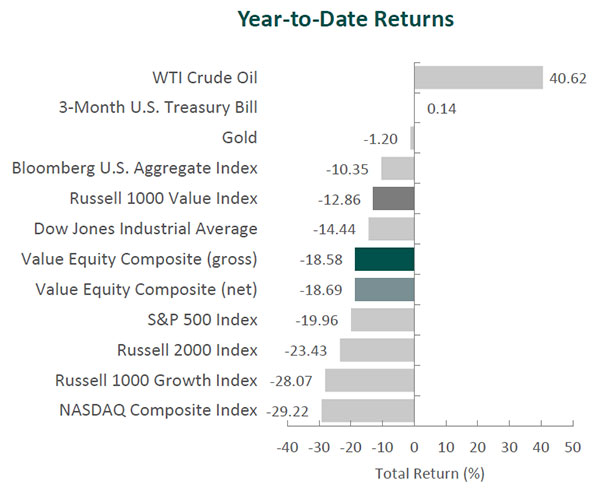
Past performance is not indicative of future results. Aristotle Value Equity Composite returns are presented gross and net of investment advisory fees and include the reinvestment of all income. Aristotle Capital Composite returns are preliminary pending final account reconciliation. Please see important disclosures at the end of this document.

The U.S. equity market posted its second consecutive quarterly decline, as the S&P 500 Index fell 16.10% during the period, bringing its year-to-date return to -19.96%. The year-to-date performance marked the worst first half of a year since 1962. Concurrently, the Bloomberg U.S. Aggregate Bond Index dropped 4.69% for the quarter, bringing the year-to-date return to -10.35%. In terms of style, the Russell 1000 Value Index outperformed its growth counterpart by 8.71% during the quarter. For the first half of the year, that outperformance was 15.21%, on track to be the largest calendar year lead for value since the early 2000s.

On a sector basis, all eleven sectors within the Russell 1000 Value Index finished lower for the quarter, with Information Technology, Materials and Financials falling the most. Meanwhile, Health Care, Utilities and Energy declined the least.

Soaring inflation, combined with a 1.6% decrease in first quarter GDP and estimates for another decline in the second quarter, is increasing fears that a recession may be on the horizon. The CPI rose 8.6% for the year ended in May, and average U.S. gasoline prices (briefly) breached $5 per gallon in June for the first time in history.

Consumers responded to the broad-based increase in prices by reducing their personal savings rate to 4.4% in April, the lowest level since September 2008. The negative effects of supply-chain disruptions also persist, and management teams have highlighted that the strengthening dollar has reduced demand for U.S. goods sold abroad.

In many ways, the economy has continued to show signs of strength. The labor market has remained tight, with unemployment at 3.6% in May, similar to previous cyclical lows. Companies again reported robust earnings, as S&P 500 constituents grew earnings 9%, year over year, with 77% of companies exceeding consensus EPS estimates.

In response to elevated inflation, in May, the Federal Reserve raised the federal funds rate 0.50%. In June, it raised rates an additional 0.75%, the largest increase since 1994, moving the benchmark rate to a range of 1.50% to 1.75%. Additionally, the U.S. central bank officially began quantitative tightening, as it moved to reduce its $9 trillion balance sheet. So far, the increase in rates has been felt most notably in the housing market. The average 30-year fixed-rate mortgage ended the quarter at 5.70% – more than double its low of 2.65% in January 2021. Higher rates have decreased homeownership affordability and raised concerns about a potential slowdown in the real estate market.

Furthermore, geopolitical tensions remained high as the war in Ukraine continued. Western governments intensified their pressure on Russia through various sanctions, such as bans on Russian oil and gold, causing the country to default on its foreign debt for the first time since 1918. Nevertheless, a great deal of uncertainty remains surrounding a potential resolution of the conflict, further complicating the outlook for global economic activity and inflation.

Performance and Attribution Summary

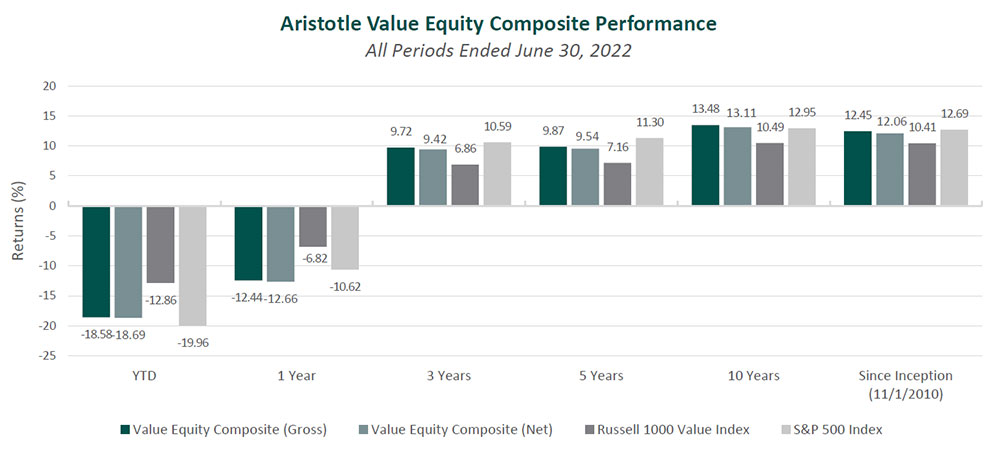
For the second quarter of 2022, Aristotle Capital’s Value Equity Composite posted a total return of -12.27% gross of fees (-12.32% net of fees), underperforming the -12.21% return of the Russell 1000 Value Index and outperforming the -16.10% return of the S&P 500 Index. Please refer to the table for detailed performance.

Performance (%) 2Q22 YTD1 Year3 Years5 Years10 Years
Value Equity Composite (gross)-12.27-18.58-12.449.729.8713.48
Value Equity Composite (net)-12.32-18.69-12.669.429.5413.11
Russell 1000 Value Index-12.21-12.86-6.826.867.1610.49
S&P 500 Index-16.10-19.96-10.6210.5911.3012.95
Past performance is not indicative of future results. Returns are presented gross and net of actual investment advisory fees and after the deduction of all trading expenses and include the reinvestment of all income. Aristotle Capital Value Equity Composite returns are preliminary pending final account reconciliation. Please see important disclosures at the end of this document.

Source: FactSet
Past performance is not indicative of future results. Attribution results are based on sector returns, which are gross of investment advisory fees and include the reinvestment of all income. Please see important disclosures at the end of this document.

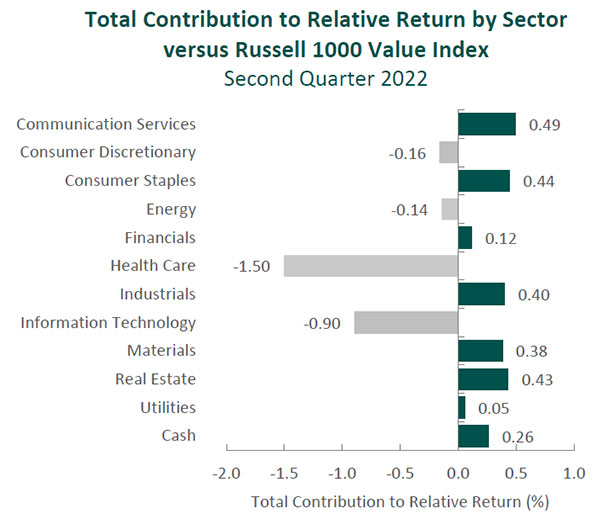
The portfolio’s underperformance relative to the Russell 1000 Value Index this quarter can be attributed to allocation effects, while security selection had a positive impact. Security selection in Health Care, an overweight in Information Technology and an underweight in Health Care detracted the most from relative performance. Conversely, security selection in Materials, Real Estate and Communication Services contributed. (Relative weights are the result of bottom-up security selection.)

Contributors and Detractors for 2Q 2022

Relative ContributorsRelative Detractors
TwitterBlackstone
AmgenANSYS
Coca-ColaMartin Marietta Materials
Xcel EnergyMicrochip Technology
Corteva AgrisciencePayPal Holdings

Aggregates producer Martin Marietta Materials was one of the largest detractors for the quarter. Despite robust demand and positive pricing momentum, labor shortages, logistics challenges and cost inflation outpaced top-line improvement. Specifically, management cited the higher-than-anticipated rise in energy costs as a primary driver of the company’s year-over-year decline in profit margins. Nevertheless, annual price increases effective April 1, some of the largest in Martin Marietta’s recent history, and a second round of price increases in July are expected to more than offset cost pressures, resulting in long-term margin expansion. We believe the company’s ability to navigate this challenging environment with strong pricing power highlights Martin Marietta’s leading market position and geographically advantaged asset base. Furthermore, the company completed the sale of its Colorado and Central Texas ready mixed concrete operations during the period in line with its SOAR 2025 priorities. This divesture contributes to the overall optimization of Martin Marietta’s aggregates-led portfolio, which should reduce business cyclicality and raw material cost inflation exposure in the long run.

Microchip Technology, the microcontroller (MCU) and analog semiconductor producer, was a primary detractor for the period. Shares declined during the quarter despite strong fundamentals, as the company posted its fifth consecutive quarter of record revenues. After years of industry consolidation and cost cutting, led by Microchip’s disciplined and frugal executives, the business is executing on our catalyst of enhanced profitability, with operating margins exceeding 40%. FREE cash flow generation has continued to improve, allowing the company to pay out $1.6 billion in dividends and repurchase $426 million shares since fiscal year 2019. Having paid down $5 billion in debt during the same period, Microchip’s credit rating was upgraded to investment grade in 2021, reflecting its higher-quality balance sheet. While we recognize Microchip operates in a cyclical industry, we admire the company’s history of strong FREE cash flow generation through the cycles. Moreover, our conviction remains in Microchip’s ability to grow its market share while uniquely benefiting from the secular trend of expanded usage of MCUs across segments that include 5G products, IoT, data centers, electric vehicles and autonomous driving systems.

Amgen, the pharmaceutical company focused on biotechnology-based therapeutics, was a top contributor for the quarter. The company reported solid results, with a variety of products, such as bone-strengthening drugs Prolia and EVENITY, contributing to overall revenue growth. Amgen continued to increase the market share for cholesterol drug Repatha (a catalyst we had originally identified), delivering record quarterly sales as the drug’s usage expands with high-risk patients who have not yet had a cardiovascular event, and as barriers for prescribers, healthcare systems and patients are removed. In addition, we believe the company is poised to gain market share with its biosimilars (akin to generic versions of biologic drugs), also a previously identified catalyst. Biosimilars accounted for over $2 billion in revenue in 2021, and we believe this has the potential to more than double by the end of the decade, accelerated by six additional biosimilars (for a total of 11 products on the market). This includes the upcoming launch in the U.S. of arthritis treatment Amjetiva in January 2023. Meanwhile, the company is advancing its robust pipeline of early- and late-stage assets, with several phase III results due this year. These developments have caused us to remain enthusiastic about Amgen’s ability to build on its decades of success developing novel treatments using biopharmaceuticals.

Coca-Cola, the global beverage business, was a leading contributor for the period. Coca-Cola continues to benefit from the refranchising of its bottling operations and realignment of incentives, catalysts we previously identified. These initiatives are demonstrating their strength in an inflationary and supply-chain-challenged environment. Additionally, the company has focused on evolving its customer engagement practices by leveraging digital and social medias for targeted campaigns, such as the design and launch of Coke Byte in the metaverse. Lastly, Coca-Cola has furthered its transformation into a total beverage company, as it debuted its new Jack Daniel’s Tennessee Whiskey and Coca-Cola ready-to-drink premixed cocktail. Although uncertainties surrounding cost pressures, lockdowns and geopolitical conflicts remain, we believe Coca-Cola is uniquely positioned to successfully continue its transition toward a total beverage business.

Recent Portfolio Activity

We first invested in Twitter in the third quarter of 2018. During our holding period, the company executed on some catalysts that include improving the health of the platform (though more improvements can certainly be made) and enhancing the advertising server to allow for a greater mix of direct response ads.

BuysSells
AutodeskTwitter

However, Twitter disappointed on others, chief among them being the company’s inability to gain market share. Furthermore, we recently began evaluating the strategy of new CEO Parag Agrawal (appointed at the end of 2021), but the prospect of changes under his leadership was overcome by Elon Musk’s $44 billion offer ($54.20 per share) to acquire Twitter. As the investment case became more reliant on a merger-arbitrage scenario – and less about Twitter’s business fundamentals – we exited our position in late April/early May and invested the proceeds in Autodesk, which is discussed below.

Autodesk, Inc.

Headquartered in Northern California and founded in 1982, Autodesk produces software that allows companies to design and model their products and/or projects. The company is the global industry standard for computer-aided design in the architecture, engineering and construction industry (AEC). Autodesk’s millions of subscribers rely on its software to design and model buildings, manufactured products, animated films and video games. The company’s four segments are AEC (44% of net sales), its iconic software AutoCAD (29%), Manufacturing (21%), and Media and Entertainment (M&E) (6%).

Autodesk primarily sells its software on a subscription basis, having discontinued perpetual license sales of most standalone products in 2016. As part of the move to subscription licensing, Autodesk replaced its product suite with three streamlined “Industry Collections” focused on AEC, Manufacturing and M&E.

In recent years, the AEC industry has increasingly sought to resolve the inefficiencies that arise when many parties are needed to complete a building project. Autodesk has been at the cutting edge of enabling improvement through innovation and promoting the use of open standards, or open building information modeling (BIM), which allows for all relevant building data to be processed virtually in a 3D model and shared across stakeholders. Importantly, Autodesk’s leadership in ensuring the interoperability of its software with that of competitors increases collaboration and productivity among architects, engineers and contractors – an attractive value proposition for its customers.

High-Quality Business

Some of the quality characteristics we have identified for Autodesk include:

  • Brand power, as AutoCAD is one of the most recognizable products in the industry;
  • Leading market share in the underpenetrated AEC software market;
  • Large and loyal installed base of over six million users across more than 180 countries;
  • Stable business model with a high degree of recurring revenue (97% of total) and FREE cash flow generation; and
  • Substantial switching costs and pricing power that stem from its advanced solutions, network effects and the time (often many years) it requires for a professional to master Autodesk software.

Attractive Valuation

We believe shares of Autodesk are attractively valued given our estimates of normalized earnings. More specifically, our analysis indicates that Autodesk’s opportunity to enhance profitability is underappreciated.

Compelling Catalysts

Catalysts we have identified for Autodesk, which we believe will cause its stock price to appreciate over our three- to five-year investment horizon, include:

  • Further benefits from its subscription-based model, as it can increasingly upsell existing users through updates and bundling of products;
  • Expanding addressable market in AEC as BIM continues to be more widely implemented across the industry;
  • Improved profitability aided by further adoption of its cloud offerings; and
  • The conversion of non-compliant users who are still using older software should increase revenue.

Conclusion

In the first half of 2022, we witnessed a new, significant geopolitical conflict, soaring inflation and tighter monetary policy. As usual, every period (up or down) brings its own “news of the day” questions, which at the time may seem critical: Is the economy entering a recession? If so, how long will it last? What will central banks do next? … and so on. Instead of spending our time making predictions or analyzing the “news of the day” (which can change rapidly), we continue to direct our efforts toward understanding the long-term fundamentals of businesses. Before investing in a company, we spend time understanding its experience in prior times of adversity, its ability (or inability) to express pricing power, management’s ability to react to changing conditions and many other factors that may impact a company’s sustainable competitive advantages. Today, we continue to focus on the long-term fundamentals of businesses, as we believe this is the best way for us to serve our clients.

Disclosures

The opinions expressed herein are those of Aristotle Capital Management, LLC (Aristotle Capital) and are subject to change without notice. Past performance is not a guarantee or indicator of future results. This material is not financial advice or an offer to purchase or sell any product. You should not assume that any of the securities transactions, sectors or holdings discussed in this report were or will be profitable, or that recommendations Aristotle Capital makes in the future will be profitable or equal the performance of the securities listed in this report. The portfolio characteristics shown relate to the Aristotle Value Equity strategy. Not every client’s account will have these characteristics. Aristotle Capital reserves the right to modify its current investment strategies and techniques based on changing market dynamics or client needs. There is no assurance that any securities discussed herein will remain in an account’s portfolio at the time you receive this report or that securities sold have not been repurchased. The securities discussed may not represent an account’s entire portfolio and, in the aggregate, may represent only a small percentage of an account’s portfolio holdings. The performance attribution presented is of a representative account from Aristotle Capital’s Value Equity Composite. The representative account is a discretionary client account which was chosen to most closely reflect the investment style of the strategy. The criteria used for representative account selection is based on the account’s period of time under management and its similarity of holdings in relation to the strategy. Recommendations made in the last 12 months are available upon request.

Returns are presented gross and net of investment advisory fees and include the reinvestment of all income. Gross returns will be reduced by fees and other expenses that may be incurred in the management of the account. Net returns are presented net of actual investment advisory fees and after the deduction of all trading expenses.

The Russell 1000 Value® Index measures the performance of the large cap value segment of the U.S. equity universe. It includes those Russell 1000 Index companies with lower price‐to‐book ratios and lower expected growth values. The S&P 500® Index is the Standard & Poor’s Composite Index of 500 stocks and is a widely recognized, unmanaged index of common stock prices. The Russell 1000® Growth Index measures the performance of the large cap growth segment of the U.S. equity universe. It includes those Russell 1000 companies with higher price‐to‐book ratios and higher forecasted growth values. The Russell 2000® Index measures the performance of the small cap segment of the U.S. equity universe. The Russell 2000 Index is a subset of the Russell 3000® Index representing approximately 10% of the total market capitalization of that index. It includes approximately 2,000 of the smallest securities based on a combination of their market cap and current index membership. The Dow Jones Industrial Average® is a price‐weighted measure of 30 U.S. blue‐chip companies. The Index covers all industries except transportation and utilities. The NASDAQ Composite Index measures all NASDAQ domestic and international based common type stocks listed on The NASDAQ Stock Market. The NASDAQ Composite includes over 3,000 companies, more than most other stock market indexes. The Bloomberg U.S. Aggregate Bond Index is an unmanaged index of domestic investment grade bonds, including corporate, government and mortgage‐backed securities. The WTI Crude Oil Index is a major trading classification of sweet light crude oil that serves as a major benchmark price for oil consumed in the United States. The 3‐Month U.S. Treasury Bill is a shortterm debt obligation backed by the U.S. Treasury Department with a maturity of three months. Consumer Price Index is a measure of the average change over time in the prices paid by urban consumers for a market basket of consumer goods and services. The volatility (beta) of the Composite may be greater or less than its respective benchmarks. It is not possible to invest directly in these indices.

Aristotle Capital Management, LLC is an independent registered investment adviser under the Advisers Act of 1940, as amended. Registration does not imply a certain level of skill or training. More information about Aristotle Capital, including our investment strategies, fees and objectives, can be found in our ADV Part 2, which is available upon request. ACM‐2207‐62-MLFA
Performance Disclosures

Composite returns for all periods ended June 30, 2022 are preliminary pending final account reconciliation.
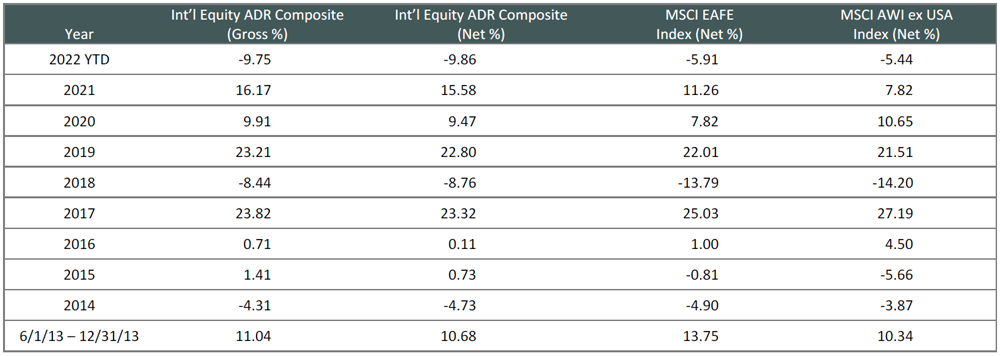
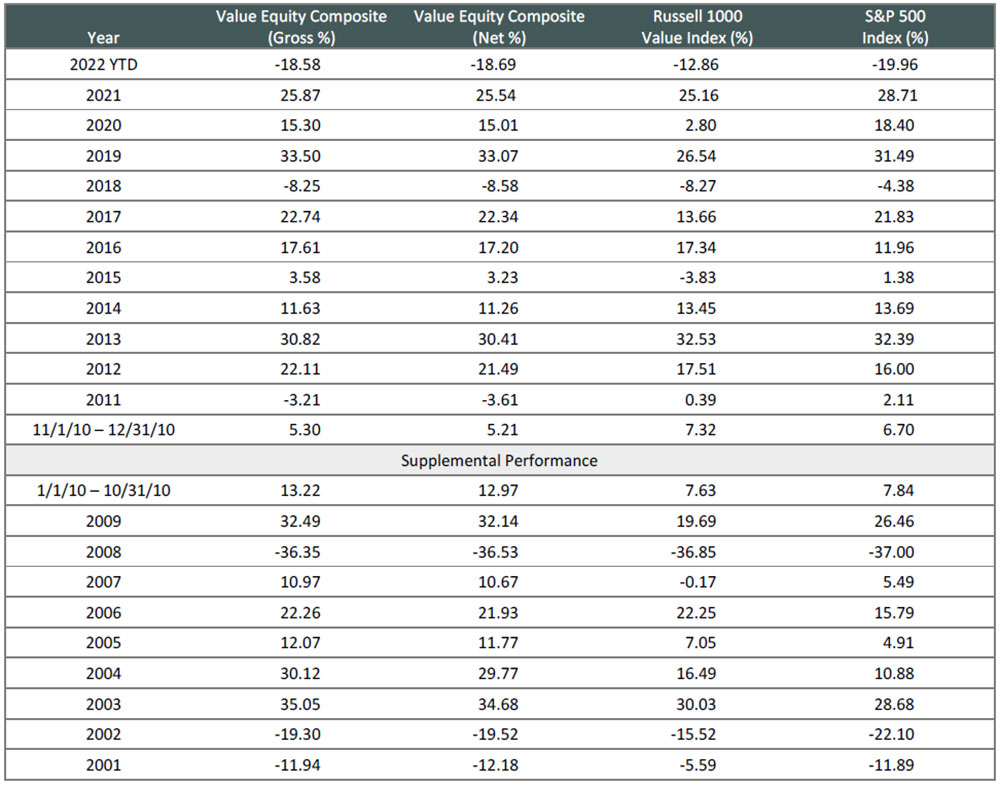
Past performance is not indicative of future results. Performance results for periods greater than one year have been annualized. Returns presented are gross and net of investment advisory fees and include the reinvestment of all income. The Aristotle Value Equity strategy has an inception date of November 1, 2010; however, the strategy initially began at Mr. Gleicher’s predecessor firm in October 1997. A supplemental performance track record from January 1, 2001 through October 31, 2010 is provided above. The returns are based on two separate accounts and performance results are based on custodian data. During this time, Mr. Gleicher had primary responsibility for managing the two accounts. Mr. Gleicher began managing one account in November 2000 and the other December 2000.
Returns are presented gross and net of investment advisory fees and include the reinvestment of all income. Gross returns will be reduced by fees and other expenses that may be incurred in the management of the account. Net returns are presented net of actual investment advisory fees and after the deduction of all trading expenses.
FOR FINANCIAL ADVISORS ONLY. NOT FOR PUBLIC DISTRIBUTION.

Markets Review

Sources: SS&C Advent, Bloomberg
Past performance is not indicative of future results. Aristotle Value Equity Composite returns are presented gross and net of investment advisory fees and include the reinvestment of all income. Aristotle Capital Composite returns are preliminary pending final account reconciliation. Please see important disclosures at the end of this document.

The U.S. equity market posted its second consecutive quarterly decline, as the S&P 500 Index fell 16.10% during the period, bringing its year-to-date return to -19.96%. The year-to-date performance marked the worst first half of a year since 1962. Concurrently, the Bloomberg U.S. Aggregate Bond Index dropped 4.69% for the quarter, bringing the year-to-date return to -10.35%. In terms of style, the Russell 1000 Value Index outperformed its growth counterpart by 8.71% during the quarter. For the first half of the year, that outperformance was 15.21%, on track to be the largest calendar year lead for value since the early 2000s.

On a sector basis, all eleven sectors within the Russell 1000 Value Index finished lower for the quarter, with Information Technology, Materials and Financials falling the most. Meanwhile, Health Care, Utilities and Energy declined the least.

Soaring inflation, combined with a 1.6% decrease in first quarter GDP and estimates for another decline in the second quarter, is increasing fears that a recession may be on the horizon. The CPI rose 8.6% for the year ended in May, and average U.S. gasoline prices (briefly) breached $5 per gallon in June for the first time in history.

Consumers responded to the broad-based increase in prices by reducing their personal savings rate to 4.4% in April, the lowest level since September 2008. The negative effects of supply-chain disruptions also persist, and management teams have highlighted that the strengthening dollar has reduced demand for U.S. goods sold abroad.

In many ways, the economy has continued to show signs of strength. The labor market has remained tight, with unemployment at 3.6% in May, similar to previous cyclical lows. Companies again reported robust earnings, as S&P 500 constituents grew earnings 9%, year over year, with 77% of companies exceeding consensus EPS estimates.

In response to elevated inflation, in May, the Federal Reserve raised the federal funds rate 0.50%. In June, it raised rates an additional 0.75%, the largest increase since 1994, moving the benchmark rate to a range of 1.50% to 1.75%. Additionally, the U.S. central bank officially began quantitative tightening, as it moved to reduce its $9 trillion balance sheet. So far, the increase in rates has been felt most notably in the housing market. The average 30-year fixed-rate mortgage ended the quarter at 5.70% – more than double its low of 2.65% in January 2021. Higher rates have decreased homeownership affordability and raised concerns about a potential slowdown in the real estate market.

Furthermore, geopolitical tensions remained high as the war in Ukraine continued. Western governments intensified their pressure on Russia through various sanctions, such as bans on Russian oil and gold, causing the country to default on its foreign debt for the first time since 1918. Nevertheless, a great deal of uncertainty remains surrounding a potential resolution of the conflict, further complicating the outlook for global economic activity and inflation.

Performance and Attribution Summary

For the second quarter of 2022, Aristotle Capital’s Value Equity Composite posted a total return of -12.27% gross of fees (-12.32% net of fees), underperforming the -12.21% return of the Russell 1000 Value Index and outperforming the -16.10% return of the S&P 500 Index. Please refer to the table for detailed performance.

Performance (%) 2Q22 YTD1 Year3 Years5 Years10 Years
Value Equity Composite (gross)-12.27-18.58-12.449.729.8713.48
Value Equity Composite (net)-12.32-18.69-12.669.429.5413.11
Russell 1000 Value Index-12.21-12.86-6.826.867.1610.49
S&P 500 Index-16.10-19.96-10.6210.5911.3012.95
Past performance is not indicative of future results. Returns are presented gross and net of actual investment advisory fees and after the deduction of all trading expenses and include the reinvestment of all income. Aristotle Capital Value Equity Composite returns are preliminary pending final account reconciliation. Please see important disclosures at the end of this document.

Source: FactSet
Past performance is not indicative of future results. Attribution results are based on sector returns, which are gross of investment advisory fees and include the reinvestment of all income. Please see important disclosures at the end of this document.

The portfolio’s underperformance relative to the Russell 1000 Value Index this quarter can be attributed to allocation effects, while security selection had a positive impact. Security selection in Health Care, an overweight in Information Technology and an underweight in Health Care detracted the most from relative performance. Conversely, security selection in Materials, Real Estate and Communication Services contributed. (Relative weights are the result of bottom-up security selection.)

Contributors and Detractors for 2Q 2022

Relative ContributorsRelative Detractors
TwitterBlackstone
AmgenANSYS
Coca-ColaMartin Marietta Materials
Xcel EnergyMicrochip Technology
Corteva AgrisciencePayPal Holdings

Aggregates producer Martin Marietta Materials was one of the largest detractors for the quarter. Despite robust demand and positive pricing momentum, labor shortages, logistics challenges and cost inflation outpaced top-line improvement. Specifically, management cited the higher-than-anticipated rise in energy costs as a primary driver of the company’s year-over-year decline in profit margins. Nevertheless, annual price increases effective April 1, some of the largest in Martin Marietta’s recent history, and a second round of price increases in July are expected to more than offset cost pressures, resulting in long-term margin expansion. We believe the company’s ability to navigate this challenging environment with strong pricing power highlights Martin Marietta’s leading market position and geographically advantaged asset base. Furthermore, the company completed the sale of its Colorado and Central Texas ready mixed concrete operations during the period in line with its SOAR 2025 priorities. This divesture contributes to the overall optimization of Martin Marietta’s aggregates-led portfolio, which should reduce business cyclicality and raw material cost inflation exposure in the long run.

Microchip Technology, the microcontroller (MCU) and analog semiconductor producer, was a primary detractor for the period. Shares declined during the quarter despite strong fundamentals, as the company posted its fifth consecutive quarter of record revenues. After years of industry consolidation and cost cutting, led by Microchip’s disciplined and frugal executives, the business is executing on our catalyst of enhanced profitability, with operating margins exceeding 40%. FREE cash flow generation has continued to improve, allowing the company to pay out $1.6 billion in dividends and repurchase $426 million shares since fiscal year 2019. Having paid down $5 billion in debt during the same period, Microchip’s credit rating was upgraded to investment grade in 2021, reflecting its higher-quality balance sheet. While we recognize Microchip operates in a cyclical industry, we admire the company’s history of strong FREE cash flow generation through the cycles. Moreover, our conviction remains in Microchip’s ability to grow its market share while uniquely benefiting from the secular trend of expanded usage of MCUs across segments that include 5G products, IoT, data centers, electric vehicles and autonomous driving systems.

Amgen, the pharmaceutical company focused on biotechnology-based therapeutics, was a top contributor for the quarter. The company reported solid results, with a variety of products, such as bone-strengthening drugs Prolia and EVENITY, contributing to overall revenue growth. Amgen continued to increase the market share for cholesterol drug Repatha (a catalyst we had originally identified), delivering record quarterly sales as the drug’s usage expands with high-risk patients who have not yet had a cardiovascular event, and as barriers for prescribers, healthcare systems and patients are removed. In addition, we believe the company is poised to gain market share with its biosimilars (akin to generic versions of biologic drugs), also a previously identified catalyst. Biosimilars accounted for over $2 billion in revenue in 2021, and we believe this has the potential to more than double by the end of the decade, accelerated by six additional biosimilars (for a total of 11 products on the market). This includes the upcoming launch in the U.S. of arthritis treatment Amjetiva in January 2023. Meanwhile, the company is advancing its robust pipeline of early- and late-stage assets, with several phase III results due this year. These developments have caused us to remain enthusiastic about Amgen’s ability to build on its decades of success developing novel treatments using biopharmaceuticals.

Coca-Cola, the global beverage business, was a leading contributor for the period. Coca-Cola continues to benefit from the refranchising of its bottling operations and realignment of incentives, catalysts we previously identified. These initiatives are demonstrating their strength in an inflationary and supply-chain-challenged environment. Additionally, the company has focused on evolving its customer engagement practices by leveraging digital and social medias for targeted campaigns, such as the design and launch of Coke Byte in the metaverse. Lastly, Coca-Cola has furthered its transformation into a total beverage company, as it debuted its new Jack Daniel’s Tennessee Whiskey and Coca-Cola ready-to-drink premixed cocktail. Although uncertainties surrounding cost pressures, lockdowns and geopolitical conflicts remain, we believe Coca-Cola is uniquely positioned to successfully continue its transition toward a total beverage business.

Recent Portfolio Activity

We first invested in Twitter in the third quarter of 2018. During our holding period, the company executed on some catalysts that include improving the health of the platform (though more improvements can certainly be made) and enhancing the advertising server to allow for a greater mix of direct response ads.

BuysSells
AutodeskTwitter

However, Twitter disappointed on others, chief among them being the company’s inability to gain market share. Furthermore, we recently began evaluating the strategy of new CEO Parag Agrawal (appointed at the end of 2021), but the prospect of changes under his leadership was overcome by Elon Musk’s $44 billion offer ($54.20 per share) to acquire Twitter. As the investment case became more reliant on a merger-arbitrage scenario – and less about Twitter’s business fundamentals – we exited our position in late April/early May and invested the proceeds in Autodesk, which is discussed below.

Autodesk, Inc.

Headquartered in Northern California and founded in 1982, Autodesk produces software that allows companies to design and model their products and/or projects. The company is the global industry standard for computer-aided design in the architecture, engineering and construction industry (AEC). Autodesk’s millions of subscribers rely on its software to design and model buildings, manufactured products, animated films and video games. The company’s four segments are AEC (44% of net sales), its iconic software AutoCAD (29%), Manufacturing (21%), and Media and Entertainment (M&E) (6%).

Autodesk primarily sells its software on a subscription basis, having discontinued perpetual license sales of most standalone products in 2016. As part of the move to subscription licensing, Autodesk replaced its product suite with three streamlined “Industry Collections” focused on AEC, Manufacturing and M&E.

In recent years, the AEC industry has increasingly sought to resolve the inefficiencies that arise when many parties are needed to complete a building project. Autodesk has been at the cutting edge of enabling improvement through innovation and promoting the use of open standards, or open building information modeling (BIM), which allows for all relevant building data to be processed virtually in a 3D model and shared across stakeholders. Importantly, Autodesk’s leadership in ensuring the interoperability of its software with that of competitors increases collaboration and productivity among architects, engineers and contractors – an attractive value proposition for its customers.

High-Quality Business

Some of the quality characteristics we have identified for Autodesk include:

  • Brand power, as AutoCAD is one of the most recognizable products in the industry;
  • Leading market share in the underpenetrated AEC software market;
  • Large and loyal installed base of over six million users across more than 180 countries;
  • Stable business model with a high degree of recurring revenue (97% of total) and FREE cash flow generation; and
  • Substantial switching costs and pricing power that stem from its advanced solutions, network effects and the time (often many years) it requires for a professional to master Autodesk software.

Attractive Valuation

We believe shares of Autodesk are attractively valued given our estimates of normalized earnings. More specifically, our analysis indicates that Autodesk’s opportunity to enhance profitability is underappreciated.

Compelling Catalysts

Catalysts we have identified for Autodesk, which we believe will cause its stock price to appreciate over our three- to five-year investment horizon, include:

  • Further benefits from its subscription-based model, as it can increasingly upsell existing users through updates and bundling of products;
  • Expanding addressable market in AEC as BIM continues to be more widely implemented across the industry;
  • Improved profitability aided by further adoption of its cloud offerings; and
  • The conversion of non-compliant users who are still using older software should increase revenue.

Conclusion

In the first half of 2022, we witnessed a new, significant geopolitical conflict, soaring inflation and tighter monetary policy. As usual, every period (up or down) brings its own “news of the day” questions, which at the time may seem critical: Is the economy entering a recession? If so, how long will it last? What will central banks do next? … and so on. Instead of spending our time making predictions or analyzing the “news of the day” (which can change rapidly), we continue to direct our efforts toward understanding the long-term fundamentals of businesses. Before investing in a company, we spend time understanding its experience in prior times of adversity, its ability (or inability) to express pricing power, management’s ability to react to changing conditions and many other factors that may impact a company’s sustainable competitive advantages. Today, we continue to focus on the long-term fundamentals of businesses, as we believe this is the best way for us to serve our clients.

Disclosures

The opinions expressed herein are those of Aristotle Capital Management, LLC (Aristotle Capital) and are subject to change without notice. Past performance is not a guarantee or indicator of future results. This material is not financial advice or an offer to purchase or sell any product. You should not assume that any of the securities transactions, sectors or holdings discussed in this report were or will be profitable, or that recommendations Aristotle Capital makes in the future will be profitable or equal the performance of the securities listed in this report. The portfolio characteristics shown relate to the Aristotle Value Equity strategy. Not every client’s account will have these characteristics. Aristotle Capital reserves the right to modify its current investment strategies and techniques based on changing market dynamics or client needs. There is no assurance that any securities discussed herein will remain in an account’s portfolio at the time you receive this report or that securities sold have not been repurchased. The securities discussed may not represent an account’s entire portfolio and, in the aggregate, may represent only a small percentage of an account’s portfolio holdings. The performance attribution presented is of a representative account from Aristotle Capital’s Value Equity Composite. The representative account is a discretionary client account which was chosen to most closely reflect the investment style of the strategy. The criteria used for representative account selection is based on the account’s period of time under management and its similarity of holdings in relation to the strategy. Recommendations made in the last 12 months are available upon request.

Returns are presented gross and net of investment advisory fees and include the reinvestment of all income. Gross returns will be reduced by fees and other expenses that may be incurred in the management of the account. Net returns are presented net of actual investment advisory fees and after the deduction of all trading expenses.
The Russell 1000 Value® Index measures the performance of the large cap value segment of the U.S. equity universe. It includes those Russell 1000 Index companies with lower price‐to‐book ratios and lower expected growth values. The S&P 500® Index is the Standard & Poor’s Composite Index of 500 stocks and is a widely recognized, unmanaged index of common stock prices. The Russell 1000® Growth Index measures the performance of the large cap growth segment of the U.S. equity universe. It includes those Russell 1000 companies with higher price‐to‐book ratios and higher forecasted growth values. The Russell 2000® Index measures the performance of the small cap segment of the U.S. equity universe. The Russell 2000 Index is a subset of the Russell 3000® Index representing approximately 10% of the total market capitalization of that index. It includes approximately 2,000 of the smallest securities based on a combination of their market cap and current index membership. The Dow Jones Industrial Average® is a price‐weighted measure of 30 U.S. blue‐chip companies. The Index covers all industries except transportation and utilities. The NASDAQ Composite Index measures all NASDAQ domestic and international based common type stocks listed on The NASDAQ Stock Market. The NASDAQ Composite includes over 3,000 companies, more than most other stock market indexes. The Bloomberg U.S. Aggregate Bond Index is an unmanaged index of domestic investment grade bonds, including corporate, government and mortgage‐backed securities. The WTI Crude Oil Index is a major trading classification of sweet light crude oil that serves as a major benchmark price for oil consumed in the United States. The 3‐Month U.S. Treasury Bill is a shortterm debt obligation backed by the U.S. Treasury Department with a maturity of three months. Consumer Price Index is a measure of the average change over time in the prices paid by urban consumers for a market basket of consumer goods and services. The volatility (beta) of the Composite may be greater or less than its respective benchmarks. It is not possible to invest directly in these indices.

Aristotle Capital Management, LLC is an independent registered investment adviser under the Advisers Act of 1940, as amended. Registration does not imply a certain level of skill or training. More information about Aristotle Capital, including our investment strategies, fees and objectives, can be found in our ADV Part 2, which is available upon request. ACM‐2207‐62-UBSFA

Performance Disclosures

Composite returns for all periods ended June 30, 2022 are preliminary pending final account reconciliation.
Past performance is not indicative of future results. Performance results for periods greater than one year have been annualized. Returns presented are gross and net of investment advisory fees and include the reinvestment of all income. The Aristotle Value Equity strategy has an inception date of November 1, 2010; however, the strategy initially began at Mr. Gleicher’s predecessor firm in October 1997. A supplemental performance track record from January 1, 2001 through October 31, 2010 is provided above. The returns are based on two separate accounts and performance results are based on custodian data. During this time, Mr. Gleicher had primary responsibility for managing the two accounts. Mr. Gleicher began managing one account in November 2000 and the other December 2000.
Returns are presented gross and net of investment advisory fees and include the reinvestment of all income. Gross returns will be reduced by fees and other expenses that may be incurred in the management of the account. Net returns are presented net of actual investment advisory fees and after the deduction of all trading expenses.
FOR PRESENTATION TO MORGAN STANLEY FINANCIAL ADVISORS ONLY

Markets Review

Sources: SS&C Advent, Bloomberg
Past performance is not indicative of future results. Aristotle Value Equity Composite returns are presented gross and net of investment advisory fees and include the reinvestment of all income. Aristotle Capital Composite returns are preliminary pending final account reconciliation. Please see important disclosures at the end of this document.

The U.S. equity market posted its second consecutive quarterly decline, as the S&P 500 Index fell 16.10% during the period, bringing its year-to-date return to -19.96%. The year-to-date performance marked the worst first half of a year since 1962. Concurrently, the Bloomberg U.S. Aggregate Bond Index dropped 4.69% for the quarter, bringing the year-to-date return to -10.35%. In terms of style, the Russell 1000 Value Index outperformed its growth counterpart by 8.71% during the quarter. For the first half of the year, that outperformance was 15.21%, on track to be the largest calendar year lead for value since the early 2000s.

On a sector basis, all eleven sectors within the Russell 1000 Value Index finished lower for the quarter, with Information Technology, Materials and Financials falling the most. Meanwhile, Health Care, Utilities and Energy declined the least.

Soaring inflation, combined with a 1.6% decrease in first quarter GDP and estimates for another decline in the second quarter, is increasing fears that a recession may be on the horizon. The CPI rose 8.6% for the year ended in May, and average U.S. gasoline prices (briefly) breached $5 per gallon in June for the first time in history.

Consumers responded to the broad-based increase in prices by reducing their personal savings rate to 4.4% in April, the lowest level since September 2008. The negative effects of supply-chain disruptions also persist, and management teams have highlighted that the strengthening dollar has reduced demand for U.S. goods sold abroad.

In many ways, the economy has continued to show signs of strength. The labor market has remained tight, with unemployment at 3.6% in May, similar to previous cyclical lows. Companies again reported robust earnings, as S&P 500 constituents grew earnings 9%, year over year, with 77% of companies exceeding consensus EPS estimates.

In response to elevated inflation, in May, the Federal Reserve raised the federal funds rate 0.50%. In June, it raised rates an additional 0.75%, the largest increase since 1994, moving the benchmark rate to a range of 1.50% to 1.75%. Additionally, the U.S. central bank officially began quantitative tightening, as it moved to reduce its $9 trillion balance sheet. So far, the increase in rates has been felt most notably in the housing market. The average 30-year fixed-rate mortgage ended the quarter at 5.70% – more than double its low of 2.65% in January 2021. Higher rates have decreased homeownership affordability and raised concerns about a potential slowdown in the real estate market.

Furthermore, geopolitical tensions remained high as the war in Ukraine continued. Western governments intensified their pressure on Russia through various sanctions, such as bans on Russian oil and gold, causing the country to default on its foreign debt for the first time since 1918. Nevertheless, a great deal of uncertainty remains surrounding a potential resolution of the conflict, further complicating the outlook for global economic activity and inflation.

Please see important Morgan Stanley Wealth Management disclosures at the end of this document.

Performance and Attribution Summary

For the second quarter of 2022, Aristotle Capital’s Value Equity Composite posted a total return of -12.27% gross of fees (-12.32% net of fees), underperforming the -12.21% return of the Russell 1000 Value Index and outperforming the -16.10% return of the S&P 500 Index. Please refer to the table for detailed performance.

Performance (%) 2Q22 YTD1 Year3 Years5 Years10 Years
Value Equity Composite (gross)-12.27-18.58-12.449.729.8713.48
Value Equity Composite (net)-12.32-18.69-12.669.429.5413.11
Russell 1000 Value Index-12.21-12.86-6.826.867.1610.49
S&P 500 Index-16.10-19.96-10.6210.5911.3012.95
Past performance is not indicative of future results. Returns are presented gross and net of actual investment advisory fees and after the deduction of all trading expenses and include the reinvestment of all income. Aristotle Capital Value Equity Composite returns are preliminary pending final account reconciliation. Please see important disclosures at the end of this document.

Source: FactSet
Past performance is not indicative of future results. Attribution results are based on sector returns, which are gross of investment advisory fees and include the reinvestment of all income. Please see important disclosures at the end of this document.

The portfolio’s underperformance relative to the Russell 1000 Value Index this quarter can be attributed to allocation effects, while security selection had a positive impact. Security selection in Health Care, an overweight in Information Technology and an underweight in Health Care detracted the most from relative performance. Conversely, security selection in Materials, Real Estate and Communication Services contributed. (Relative weights are the result of bottom-up security selection.)

Contributors and Detractors for 2Q 2022

Relative ContributorsRelative Detractors
TwitterBlackstone
AmgenANSYS
Coca-ColaMartin Marietta Materials
Xcel EnergyMicrochip Technology
Corteva AgrisciencePayPal Holdings

Aggregates producer Martin Marietta Materials was one of the largest detractors for the quarter. Despite robust demand and positive pricing momentum, labor shortages, logistics challenges and cost inflation outpaced top-line improvement. Specifically, management cited the higher-than-anticipated rise in energy costs as a primary driver of the company’s year-over-year decline in profit margins. Nevertheless, annual price increases effective April 1, some of the largest in Martin Marietta’s recent history, and a second round of price increases in July are expected to more than offset cost pressures, resulting in long-term margin expansion. We believe the company’s ability to navigate this challenging environment with strong pricing power highlights Martin Marietta’s leading market position and geographically advantaged asset base. Furthermore, the company completed the sale of its Colorado and Central Texas ready mixed concrete operations during the period in line with its SOAR 2025 priorities. This divesture contributes to the overall optimization of Martin Marietta’s aggregates-led portfolio, which should reduce business cyclicality and raw material cost inflation exposure in the long run.

Microchip Technology, the microcontroller (MCU) and analog semiconductor producer, was a primary detractor for the period. Shares declined during the quarter despite strong fundamentals, as the company posted its fifth consecutive quarter of record revenues. After years of industry consolidation and cost cutting, led by Microchip’s disciplined and frugal executives, the business is executing on our catalyst of enhanced profitability, with operating margins exceeding 40%. FREE cash flow generation has continued to improve, allowing the company to pay out $1.6 billion in dividends and repurchase $426 million shares since fiscal year 2019. Having paid down $5 billion in debt during the same period, Microchip’s credit rating was upgraded to investment grade in 2021, reflecting its higher-quality balance sheet. While we recognize Microchip operates in a cyclical industry, we admire the company’s history of strong FREE cash flow generation through the cycles. Moreover, our conviction remains in Microchip’s ability to grow its market share while uniquely benefiting from the secular trend of expanded usage of MCUs across segments that include 5G products, IoT, data centers, electric vehicles and autonomous driving systems.

Amgen, the pharmaceutical company focused on biotechnology-based therapeutics, was a top contributor for the quarter. The company reported solid results, with a variety of products, such as bone-strengthening drugs Prolia and EVENITY, contributing to overall revenue growth. Amgen continued to increase the market share for cholesterol drug Repatha (a catalyst we had originally identified), delivering record quarterly sales as the drug’s usage expands with high-risk patients who have not yet had a cardiovascular event, and as barriers for prescribers, healthcare systems and patients are removed. In addition, we believe the company is poised to gain market share with its biosimilars (akin to generic versions of biologic drugs), also a previously identified catalyst. Biosimilars accounted for over $2 billion in revenue in 2021, and we believe this has the potential to more than double by the end of the decade, accelerated by six additional biosimilars (for a total of 11 products on the market). This includes the upcoming launch in the U.S. of arthritis treatment Amjetiva in January 2023. Meanwhile, the company is advancing its robust pipeline of early- and late-stage assets, with several phase III results due this year. These developments have caused us to remain enthusiastic about Amgen’s ability to build on its decades of success developing novel treatments using biopharmaceuticals.

Coca-Cola, the global beverage business, was a leading contributor for the period. Coca-Cola continues to benefit from the refranchising of its bottling operations and realignment of incentives, catalysts we previously identified. These initiatives are demonstrating their strength in an inflationary and supply-chain-challenged environment. Additionally, the company has focused on evolving its customer engagement practices by leveraging digital and social medias for targeted campaigns, such as the design and launch of Coke Byte in the metaverse. Lastly, Coca-Cola has furthered its transformation into a total beverage company, as it debuted its new Jack Daniel’s Tennessee Whiskey and Coca-Cola ready-to-drink premixed cocktail. Although uncertainties surrounding cost pressures, lockdowns and geopolitical conflicts remain, we believe Coca-Cola is uniquely positioned to successfully continue its transition toward a total beverage business.

Recent Portfolio Activity

We first invested in Twitter in the third quarter of 2018. During our holding period, the company executed on some catalysts that include improving the health of the platform (though more improvements can certainly be made) and enhancing the advertising server to allow for a greater mix of direct response ads.

BuysSells
AutodeskTwitter

However, Twitter disappointed on others, chief among them being the company’s inability to gain market share. Furthermore, we recently began evaluating the strategy of new CEO Parag Agrawal (appointed at the end of 2021), but the prospect of changes under his leadership was overcome by Elon Musk’s $44 billion offer ($54.20 per share) to acquire Twitter. As the investment case became more reliant on a merger-arbitrage scenario – and less about Twitter’s business fundamentals – we exited our position in late April/early May and invested the proceeds in Autodesk, which is discussed below.

Autodesk, Inc.

Headquartered in Northern California and founded in 1982, Autodesk produces software that allows companies to design and model their products and/or projects. The company is the global industry standard for computer-aided design in the architecture, engineering and construction industry (AEC). Autodesk’s millions of subscribers rely on its software to design and model buildings, manufactured products, animated films and video games. The company’s four segments are AEC (44% of net sales), its iconic software AutoCAD (29%), Manufacturing (21%), and Media and Entertainment (M&E) (6%).

Autodesk primarily sells its software on a subscription basis, having discontinued perpetual license sales of most standalone products in 2016. As part of the move to subscription licensing, Autodesk replaced its product suite with three streamlined “Industry Collections” focused on AEC, Manufacturing and M&E.

In recent years, the AEC industry has increasingly sought to resolve the inefficiencies that arise when many parties are needed to complete a building project. Autodesk has been at the cutting edge of enabling improvement through innovation and promoting the use of open standards, or open building information modeling (BIM), which allows for all relevant building data to be processed virtually in a 3D model and shared across stakeholders. Importantly, Autodesk’s leadership in ensuring the interoperability of its software with that of competitors increases collaboration and productivity among architects, engineers and contractors – an attractive value proposition for its customers.

High-Quality Business

Some of the quality characteristics we have identified for Autodesk include:

  • Brand power, as AutoCAD is one of the most recognizable products in the industry;
  • Leading market share in the underpenetrated AEC software market;
  • Large and loyal installed base of over six million users across more than 180 countries;
  • Stable business model with a high degree of recurring revenue (97% of total) and FREE cash flow generation; and
  • Substantial switching costs and pricing power that stem from its advanced solutions, network effects and the time (often many years) it requires for a professional to master Autodesk software.

Attractive Valuation

We believe shares of Autodesk are attractively valued given our estimates of normalized earnings. More specifically, our analysis indicates that Autodesk’s opportunity to enhance profitability is underappreciated.

Compelling Catalysts

Catalysts we have identified for Autodesk, which we believe will cause its stock price to appreciate over our three- to five-year investment horizon, include:

  • Further benefits from its subscription-based model, as it can increasingly upsell existing users through updates and bundling of products;
  • Expanding addressable market in AEC as BIM continues to be more widely implemented across the industry;
  • Improved profitability aided by further adoption of its cloud offerings; and
  • The conversion of non-compliant users who are still using older software should increase revenue.

Conclusion

In the first half of 2022, we witnessed a new, significant geopolitical conflict, soaring inflation and tighter monetary policy. As usual, every period (up or down) brings its own “news of the day” questions, which at the time may seem critical: Is the economy entering a recession? If so, how long will it last? What will central banks do next? … and so on. Instead of spending our time making predictions or analyzing the “news of the day” (which can change rapidly), we continue to direct our efforts toward understanding the long-term fundamentals of businesses. Before investing in a company, we spend time understanding its experience in prior times of adversity, its ability (or inability) to express pricing power, management’s ability to react to changing conditions and many other factors that may impact a company’s sustainable competitive advantages. Today, we continue to focus on the long-term fundamentals of businesses, as we believe this is the best way for us to serve our clients.

Disclosures

The opinions expressed herein are those of Aristotle Capital Management, LLC (Aristotle Capital) and are subject to change without notice. Past performance is not a guarantee or indicator of future results. This material is not financial advice or an offer to purchase or sell any product. You should not assume that any of the securities transactions, sectors or holdings discussed in this report were or will be profitable, or that recommendations Aristotle Capital makes in the future will be profitable or equal the performance of the securities listed in this report. The portfolio characteristics shown relate to the Aristotle Value Equity strategy. Not every client’s account will have these characteristics. Aristotle Capital reserves the right to modify its current investment strategies and techniques based on changing market dynamics or client needs. There is no assurance that any securities discussed herein will remain in an account’s portfolio at the time you receive this report or that securities sold have not been repurchased. The securities discussed may not represent an account’s entire portfolio and, in the aggregate, may represent only a small percentage of an account’s portfolio holdings. The performance attribution presented is of a representative account from Aristotle Capital’s Value Equity Composite. The representative account is a discretionary client account which was chosen to most closely reflect the investment style of the strategy. The criteria used for representative account selection is based on the account’s period of time under management and its similarity of holdings in relation to the strategy. Recommendations made in the last 12 months are available upon request.

Returns are presented gross and net of investment advisory fees and include the reinvestment of all income. Gross returns will be reduced by fees and other expenses that may be incurred in the management of the account. Net returns are presented net of actual investment advisory fees and after the deduction of all trading expenses.
The Russell 1000 Value® Index measures the performance of the large cap value segment of the U.S. equity universe. It includes those Russell 1000 Index companies with lower price-to-book ratios and lower expected growth values. The S&P 500® Index is the Standard & Poor’s Composite Index of 500 stocks and is a widely recognized, unmanaged index of common stock prices. The Russell 1000® Growth Index measures the performance of the large cap growth segment of the U.S. equity universe. It includes those Russell 1000 companies with higher price-to-book ratios and higher forecasted growth values. The Russell 2000® Index measures the performance of the small cap segment of the U.S. equity universe. The Russell 2000 Index is a subset of the Russell 3000® Index representing approximately 10% of the total market capitalization of that index. It includes approximately 2,000 of the smallest securities based on a combination of their market cap and current index membership. The Dow Jones Industrial Average® is a price-weighted measure of 30 U.S. blue-chip companies. The Index covers all industries except transportation and utilities. The NASDAQ Composite Index measures all NASDAQ domestic and international based common type stocks listed on The NASDAQ Stock Market. The NASDAQ Composite includes over 3,000 companies, more than most other stock market indexes. The Bloomberg U.S. Aggregate Bond Index is an unmanaged index of domestic investment grade bonds, including corporate, government and mortgage-backed securities. The WTI Crude Oil Index is a major trading classification of sweet light crude oil that serves as a major benchmark price for oil consumed in the United States. The 3-Month U.S. Treasury Bill is a short-term debt obligation backed by the U.S. Treasury Department with a maturity of three months. Consumer Price Index is a measure of the average change over time in the prices paid by urban consumers for a market basket of consumer goods and services. The volatility (beta) of the Composite may be greater or less than its respective benchmarks. It is not possible to invest directly in these indices.

This presentation is to report on the investment strategies as reported by Aristotle Capital Management, LLC and is for illustrative purposes only. The information contained herein is obtained from multiple sources and believed to be reliable. Information has not been verified by Morgan Stanley Wealth Management, and may differ from documents created by Morgan Stanley Wealth Management. The financial advisor should refer to the Profile. This must be preceded or accompanied by the Morgan Stanley Wealth Management Profile, which you can obtain from the Morgan Stanley Wealth Management Performance Analytics. For additional information on other programs, please speak to Patrick Schussman at Aristotle Capital at (310) 954-8156.

Aristotle Capital Management, LLC is an independent registered investment adviser under the Advisers Act of 1940, as amended. Registration does not imply a certain level of skill or training. More information about Aristotle Capital, including our investment strategies, fees and objectives, can be found in our ADV Part 2, which is available upon request. ACM-2207-62-MSFA

Performance Disclosures


Composite returns for all periods ended June 30, 2022 are preliminary pending final account reconciliation.
Past performance is not indicative of future results. Performance results for periods greater than one year have been annualized. Returns presented are gross and net of investment advisory fees and include the reinvestment of all income. The Aristotle Value Equity strategy has an inception date of November 1, 2010; however, the strategy initially began at Mr. Gleicher’s predecessor firm in October 1997. A supplemental performance track record from January 1, 2001 through October 31, 2010 is provided above. The returns are based on two separate accounts and performance results are based on custodian data. During this time, Mr. Gleicher had primary responsibility for managing the two accounts. Mr. Gleicher began managing one account in November 2000 and the other December 2000.
Returns are presented gross and net of investment advisory fees and include the reinvestment of all income. Gross returns will be reduced by fees and other expenses that may be incurred in the management of the account. Net returns are presented net of actual investment advisory fees and after the deduction of all trading expenses.
FOR PRESENTATION TO MORGAN STANLEY FINANCIAL ADVISORS ONLY

Summary

U.S. corporate credit markets continued to decline in the second quarter as bank loans outperformed investment grade corporate bonds and high yield bonds for the second consecutive quarter. Bank loans returned -4.35% during the period as measured by the Credit Suisse Leveraged Loan Index. Investment grade corporate bonds returned -7.26% as measured by the Bloomberg U.S. Corporate Bond Index with higher yields impacting longer duration bonds. High yield bonds fell -9.83% as measured by the Bloomberg U.S. Corporate High Yield Bond Index, resulting in the worst second quarter performance on record for the broad high yield bond market.

U.S. equities declined as the S&P 500 Index fell -16.10% during the quarter, bringing its year-to-date return to -19.96%. Tighter financial conditions, higher inflation and lower growth combined to undermine risk assets during the quarter. The Consumer Price Index (CPI) rose 8.6% year-over-year in May, while Gross Domestic Product (GDP) declined 1.6% in the first quarter and is projected to continue to decline in the second quarter. The labor market, however, remained resilient as the unemployment rate sat at its cycle low of 3.6% in May.

In response to soaring inflation, the Federal Reserve (Fed) raised the Fed Funds rate by 50 basis points in May and 75 basis points in June, bringing its benchmark rate to a range of 1.50% to 1.75%. The June hike was the largest since 1994 and the central bank signaled a hike of similar magnitude in July while acknowledging higher rates could lead to slower growth. The Fed also officially began the process of quantitative tightening as it slowly unwinds its $9 trillion balance sheet. Geopolitical tensions also persisted with Western governments intensifying pressure on Russia while battling the impact of rising oil and natural gas prices at home. Additionally, supply chain issues, which have been exacerbated by China’s zero-COVID policy, and a strong U.S. dollar have dampened the overall economic outlook.

Market Environment

U.S. Treasury yields climbed further in the second quarter but at a more modest pace than in the first quarter. Yields shifted higher across the curve as the yield on the U.S. 2-Year note increased roughly 62 basis points and the yield on the U.S. 10-Year note rose nearly 68 basis points. In response to the weakening growth outlook in the second half of June, U.S. Treasury yields declined with the yield on the U.S. 10-Year note ending the quarter more than 40 basis points below its high from earlier in the month.

After a relatively sanguine start to the year, U.S. corporate credit spreads widened sharply in the second quarter. High yield bond spreads ended the quarter at the widest level since July 2020, rising roughly 248 basis points as measured by the Bloomberg U.S. Corporate High Yield Bond Index. Investment grade corporate bonds also widened to a multiyear high, ending the quarter roughly 41 basis points higher as measured by the Bloomberg U.S. Corporate Bond Index.

Issuance in the high yield bond market slowed dramatically in the second quarter with new supply totaling roughly $25 billion. The year-to-date total now stands at just $71 billion, down 76% compared to the same period in 2021. Investment grade corporate bond issuance slowed at a less dramatic pace with total year-to-date issuance falling close to 13% compared to the first half of 2021. Leveraged loan supply also suffered, falling to roughly $61 billion in the quarter as year-to-date volumes fell 48% compared to the prior year.

On the demand side, funds across all three sectors experienced outflows. High yield bond fund outflows for the quarter totaled nearly $15 billion, bringing the year-to-date total outflow to almost $43 billion, the largest six-month stretch of outflows on record. Leveraged loan funds experienced large inflows earlier in the year, but flows reversed in May with just over $3 billion in outflows for the quarter. Additionally, investment grade bond funds experienced outflows of nearly $54 billion in the first half of 2022.

Within the high yield bond universe, the decline in risk sentiment and sharp rise in credit spreads helped higher quality bonds outperform as ‘BB’s (-8.43%) outperformed ‘B’s (-10.76%) and ‘CCC’s (-12.98%). From an industry perspective, Food, Beverage & Tobacco (-6.49%) outperformed while Pharmaceuticals (-19.50%) underperformed. Defaults and distressed transactions picked up in the second quarter with more than $15 billion in defaults during the quarter as the 12-month trailing, par-weighted U.S. high yield default rate rose to 0.76% at the end of June, its highest level since September 2021 and 53 basis points above the year-to-date low in April.

Performance and Attribution Summary

High Yield Bond – SMA

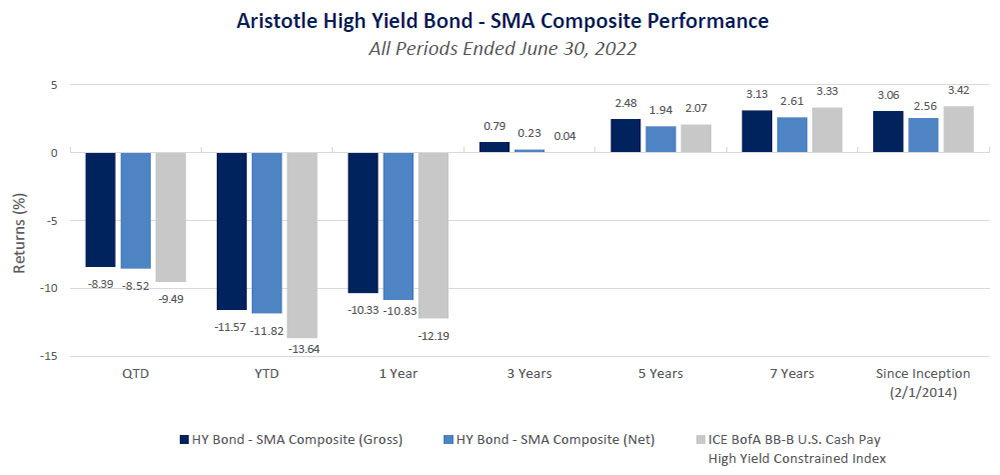
The Aristotle High Yield Bond – SMA Composite returned -8.39% gross of fees (-8.52% net of fees) in the second quarter, outperforming the -9.49% return of the ICE BofA BB-B U.S. Cash Pay High Yield Constrained Index. Security selection was the primary contributor to relative performance, while industry allocation was the primary detractor from relative performance.

Security selection contributed to relative performance led by holdings in Media & Entertainment and Lodging & Leisure. This was partially offset by security selection in Retailers & Restaurants and Telecommunications. Sector rotation also contributed to relative performance led by the allocation to cash and investment grade corporate bonds. There were no offsetting sector rotation factors.

Industry allocation detracted from relative performance led by an overweight in Lodging & Leisure and an underweight in Food, Beverage & Tobacco. This was partially offset by an underweight in Pharmaceuticals and an overweight in Diversified Manufacturing & Construction Machinery.

Top Five Contributors Top Five Detractors
Bausch HealthTelecom Italia
BrinkerT-Mobile
RR Donnelley & SonsBeazer Homes
CarnivalLevel 3 Financing
United AirlinesBed Bath & Beyond
*Bold securities held in representative account

High Yield Bond Focused ESG

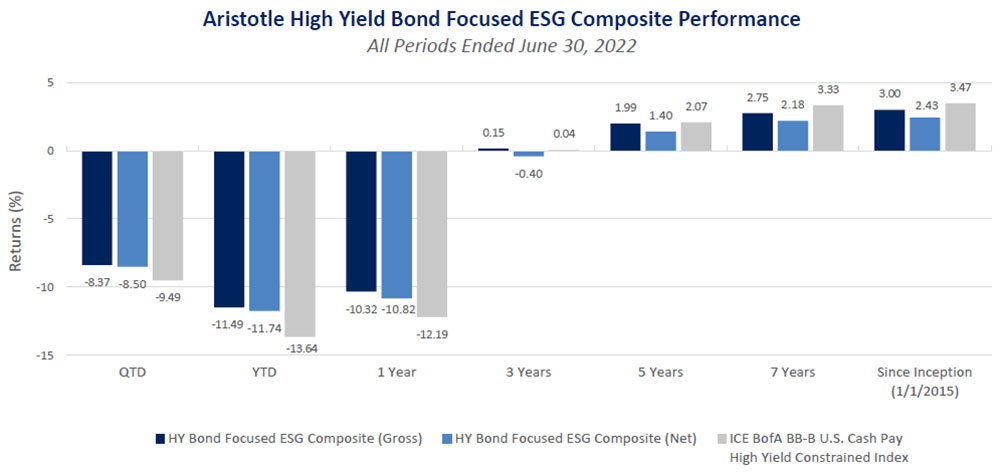
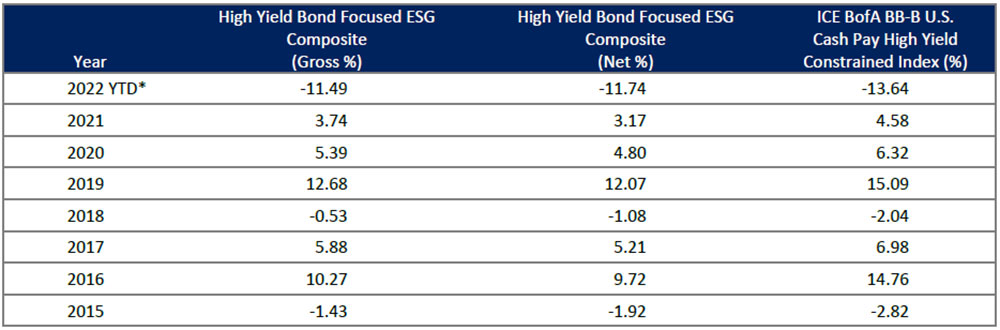
The Aristotle High Yield Bond Focused ESG Composite returned -8.37% gross of fees (-8.50% net of fees) in the second quarter, outperforming the -9.49% return of the ICE BofA BB-B U.S. Cash Pay High Yield Constrained Index. Security selection was the primary contributor to relative performance, while industry allocation was the primary detractor from relative performance.

Security selection contributed to relative performance led by holdings in Media & Entertainment and Energy. This was partially offset by security selection in Retailers & Restaurants and Telecommunications. Sector rotation also contributed to relative performance led by the allocation to cash and investment grade corporate bonds. There were no offsetting sector rotation factors.

Industry allocation detracted from relative performance led by overweights in Retailers & Restaurants and Lodging & Leisure. This was partially offset by an underweight in Pharmaceuticals and an overweight in Diversified Manufacturing & Construction Machinery.

Top Five Contributors Top Five Detractors
Bausch HealthT-Mobile
Murphy OilTelecom Italia
BrinkerLevel 3 Financing
RR Donnelley & SonsBeazer Homes
CarnivalBed Bath & Beyond
*Bold securities held in representative account

Short Duration High Yield Bond

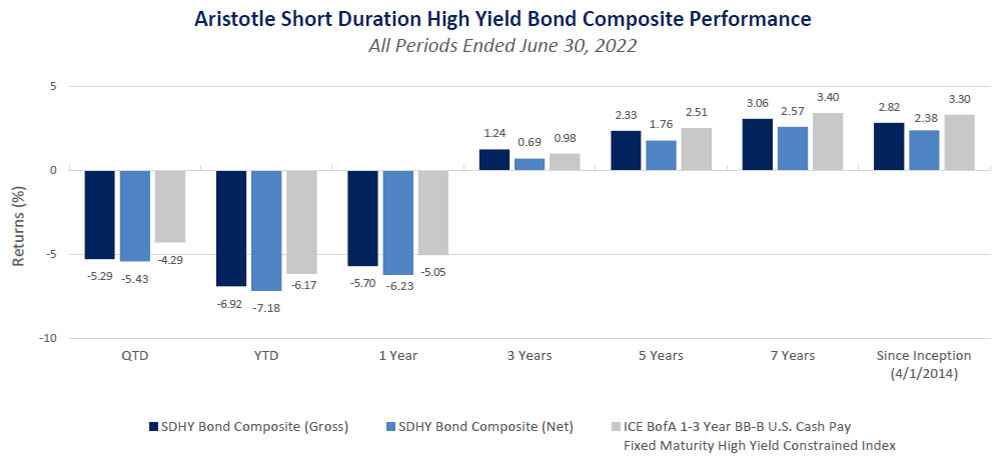
The Aristotle Short Duration High Yield Bond Composite returned -5.29% gross of fees (-5.43% net of fees) in the second quarter, underperforming the -4.29% return of the ICE BofA 1-3 Year BB-B U.S. Cash Pay Fixed Maturity High Yield Constrained Index. Security selection was the primary detractor from relative performance, while sector rotation was the primary contributor to relative performance.

Security selection detracted from relative performance led by holdings in Retailers & Restaurants and Lodging & Leisure. This was partially offset by security selection in Consumer Products and Media & Entertainment. Industry allocation also detracted from relative performance led by overweights in Cable & Satellite and Real Estate Investment Trusts (REITs) & Real Estate-Related. This was partially offset by overweights in Consumer Products and Media & Entertainment.

Sector rotation contributed to relative performance led by the allocation to cash and investment grade corporate bonds. There were no offsetting sector rotation factors.

Top Five Contributors Top Five Detractors
BrinkerNuStar Logistics
TevaDISH Network
Nature & Co.Navient
PopularService Properties Trust
Continental ResourcesBed Bath & Beyond
*Bold securities held in representative account

Outlook

In the second quarter, the primary driver of corporate credit market performance shifted from interest rate risk to credit risk as higher-than-expected inflation and rising interest rates slowed growth. Despite increased volatility and wider credit spreads warranting a more cautious approach in the coming months, we believe the current environment favors specific segments of the corporate credit market such as higher quality high yield bonds.

The macroeconomic backdrop continued to darken in the second quarter, driving volatility in both yields and spreads. While the Fed has already increased its benchmark rate multiple times, we believe it is not yet near the neutral rate. While this is partially the result of an artificially low starting point after the unprecedented monetary policy response to the global pandemic, in our view, the Fed may be forced to hike into a recession to fight stubbornly high inflation. We believe the result could depress corporate margins and weigh on earnings estimates going forward.

We expect inflation to remain at elevated levels into the second half of the year. In our view, rental and housing inflation will continue to rise and offset the effect of stabilizing food inflation, easing supply chain pressures and slowing demand for consumer goods. We believe weakness in economically sensitive commodities may also help moderate inflationary pressures while flagging a weaker growth outlook as industrial metals, in particular, rolled over into the end of the second quarter. We believe these underlying trends indicate tighter financial conditions are starting to impact consumption and increasing the probability of a recession.

We believe corporate America is still in solid shape as many companies benefitted from historically low rates by issuing a record sum of debt over the last two years. We are comfortable with most corporate balance sheets, and in our opinion, issuers have largely been successful in managing maturities through the end of 2024. Nonetheless, we believe it is important to distinguish between the companies that have already raised sufficient cash to weather a downturn and those that will require funding in the near future. We also remain wary of the bank loan market given most of these issuers have the majority of their longer-term financing tied up in floating rate debt and we believe short-term rates can continue to climb.

We are positioned cautiously across our portfolios and continue to favor companies with ample cash on their balance sheets. We believe a slowdown in growth may have a more negative impact on corporate earnings than on credit spreads. While we expect volatility to persist, we believe it can create opportunities as the significant repricing that has already occurred presents a much better entry point from a risk/reward and yield perspective.

High Yield Bond Positioning

In our high yield portfolios, we modestly increased exposure to higher quality, more economically defensive credits and marginally reduced exposure to select consumer cyclical credits. While we remain significantly shorter than benchmark duration, the focus on higher quality high yield credits has marginally increased the duration exposure of the portfolios.

Our high yield portfolios were conservatively positioned heading into the second quarter, thus we only marginally shifted exposure during the quarter. We maintained an average credit quality of nearly ‘BB’ in our high yield portfolios throughout the quarter. The increase in duration exposure was largely driven by our view on quality rather than on rates, which we believe can continue higher.

From an industry perspective, we made minor changes. Prior to this quarter, we added credits that we believe would benefit from the economy reopening and we remain comfortable with many of these names. However, within this group, we still prefer those companies providing consumer experiences over those producing and/or selling more discretionary consumer goods. At the end of the quarter, we held overweights in Transportation, Media & Entertainment and Energy alongside underweights in Technology, Telecommunications and Healthcare.

Disclosures

Prior to making any investment or financial decisions, an investor should seek individualized advice from personal, financial, legal, tax and other professionals that take into account all of the particular facts and circumstances of an investor’s own situation before making an investment decision.


The opinions expressed herein are those of Aristotle Credit Partners, LLC (Aristotle Credit) and are subject to change without notice. Past performance is not a guarantee or indicator of future results. This material is not financial advice or an offer to buy or sell any product. You should not assume that any of the securities transactions, sectors or holdings discussed in this report are or will be profitable, or that recommendations Aristotle Credit makes in the future will be profitable or equal the performance of the securities listed in this report. The portfolio characteristics shown relate to the Aristotle Credit High Yield Bond – SMA strategy, the Aristotle Credit High Yield Bond Focused ESG strategy and the Aristotle Credit Short Duration High Yield Bond strategy. Not every client’s account will have these characteristics. Aristotle Credit reserves the right to modify its current investment strategies and techniques based on changing market dynamics or client needs. There is no assurance that any securities discussed herein will remain in an account’s portfolio at the time you receive this report or that securities sold have not been repurchased. The securities discussed may not represent an account’s entire portfolio and, in the aggregate, may represent only a small percentage of an account’s portfolio holdings. For a full list of all recommendations made by Aristotle Credit during the last 12 months, please contact us at (949) 681-2100. This is not a recommendation to buy or sell a particular security.

You should not assume that any of the securities transactions, industries or holdings discussed in this report are or will be profitable, or that recommendations Aristotle Credit Partners, LLC (Aristotle Credit) makes in the future will be profitable or equal the performance of the securities listed in this report. There is no assurance that any securities, or industries discussed herein will be included in or excluded from an account’s portfolio.

There are risks associated with fixed income investments, including interest rate risk and credit risk. Bond values fluctuate in price in response to market conditions. Typically, when interest rates rise, there is a corresponding decline in bond values. This risk may be more pronounced for bonds with longer-term maturities. Credit risk refers to the possibility that the bond issuer will not be able to make principal and interest payments. High yield securities are generally rated lower than investment grade and may be subject to greater market fluctuations, increased price volatility, risk of issuer default, less liquidity, or loss of income and principal compared to investment grade securities.

Past performance is not indicative of future results. Performance results for periods greater than one year have been annualized. Returns are preliminary pending final account reconciliation. Returns reflect the reinvestment of income.

High Yield Bond – SMA and High Yield Bond Focused ESG Returns – Returns are presented gross and net of investment advisory fees and include the reinvestment of all income. Gross returns will be reduced by fees and other expenses that may be incurred in the management of the account. Net returns are presented net of actual investment advisory fees and after the deduction of all trading expenses.
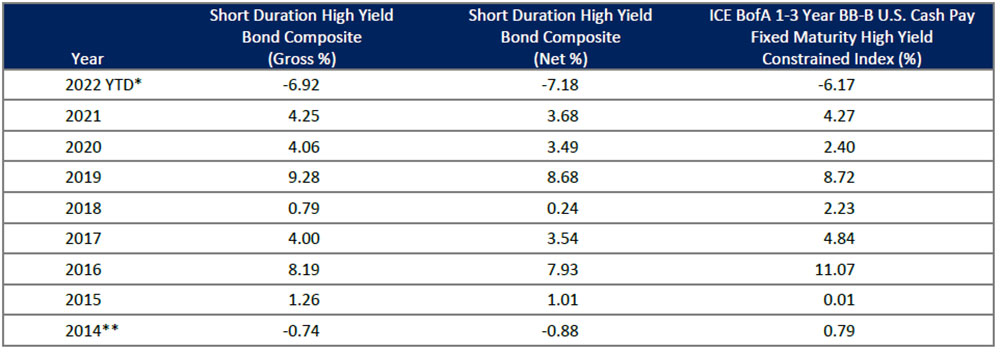
Short Duration High Yield Bond Returns – Pure gross returns do not reflect the deduction of any trading costs, fees or expenses. Pure gross returns prior to 2017 reflect the deduction of transaction costs. Starting from September 2017, composite returns are presented pure gross and net of the highest wrap fee stated of 0.55%. Performance for periods prior to September 2017 are presented pure gross and net of actual investment advisory fees.

The Bloomberg U.S. Corporate Bond Index measures the investment grade, fixed-rate, taxable corporate bond market. It includes securities publicly issued by U.S. and non-U.S. industrial, utility and financial issuers that are all U.S. dollar denominated. The Bloomberg U.S. Corporate Bond Index is a component of the Bloomberg U.S. Credit Bond Index. The Bloomberg U.S. Corporate High Yield Bond Index measures the U.S. dollar-denominated, high yield, fixed-rate corporate bond market. Securities are classified as high yield if the middle rating of Moody’s, Fitch and S&P is Ba1/BB+/BB+ or below. Bonds from issuers with an emerging markets country of risk, based on Bloomberg EM country definition, are excluded. The Credit Suisse Leveraged Loan Index is a market-weighted index designed to track the performance of the investable universe of the U.S. dollar-denominated leveraged loan market. The S&P 500 Index is the Standard & Poor’s Composite Index and is a widely recognized, unmanaged index of common stock prices. It is market cap weighted and includes 500 leading companies, capturing approximately 80% coverage of available market capitalization. The ICE Bank of America (ICE BofA) BB-B U.S. Cash Pay High Yield Constrained Index measures the performance of the U.S. dollar-denominated BB-rated and B-rated corporate debt issued in the U.S. domestic market, a fixed coupon schedule and a minimum amount outstanding of $100 million, issued publicly. Allocations to an individual issuer in the Index will not exceed 2%. The ICE Bank of America (ICE BofA) 1-3 Year BB-B U.S. Cash Pay Fixed Maturity High Yield Constrained Index tracks the performance of the U.S. dollar-denominated below investment grade corporate debt, currently in a coupon paying period, that is publicly issued in the U.S. domestic market; including 144A securities, both with and without registration rights. Qualifying securities must have risk exposure to countries are members of the FX-G10, Western Europe, or territories of the United States and Western Europe. The FX-G10 includes all Euro members: the United States, Japan, the United Kingdom, Canada, Australia, New Zealand, Switzerland, Norway and Sweden. Qualifying securities include only those rated BB1 through B3. Perpetual securities are not included as all securities must have a fixed final maturity date. All final maturity dates must range between one and three years. It is a capitalization-weighted index, constrained to 2% maximum weighting per issuer. The Consumer Price Index (CPI) is a measure of the average change over time in the prices paid by urban consumers for a market basket of consumer goods and services. The volatility (beta) of the Composites may be greater or less than the indices. It is not possible to invest directly in these indices. Composite and index returns reflect the reinvestment of income.

This presentation is to report on the investment strategies as reported by Aristotle Credit Partners, LLC and is for illustrative purposes only. Not all strategies listed are available for sale at Morgan Stanley Wealth Management. The information contained herein is obtained from multiple sources and believed to be reliable. Information has not been verified by Morgan Stanley Wealth Management and may differ from documents created by Morgan Stanley Wealth Management. The financial advisor should refer to the Profile. This must be preceded or accompanied by the Morgan Stanley Wealth Management Profile, which you can obtain from the Morgan Stanley Wealth Management Performance Analytics. For additional information on other programs, please speak to Patrick Schussman at Aristotle Credit at (310) 954-8156.

Aristotle Credit Partners, LLC is an independent registered investment adviser under the Advisers Act of 1940, as amended. Registration does not imply a certain level of skill or training. More information about Aristotle Credit, including our investment strategies, fees and objectives, can be found in our Form ADV Part 2, which is available upon request. ACP-2207-64

Performance Disclosures


Sources: SS&C Advent; ICE BofA
*Composite returns are preliminary pending final account reconciliation.
**2014 is a partial-year period of eleven months, representing data from February 1, 2014 to December 31, 2014.
Past performance is not indicative of future results. Returns presented are gross and net of investment advisory fees and include the reinvestment of all income. Gross returns will be reduced by fees and other expenses that may be incurred in the management of the account. Net returns are presented net of actual investment advisory fees and after the deduction of all trading expenses. Please refer to disclosures at the end of this document.
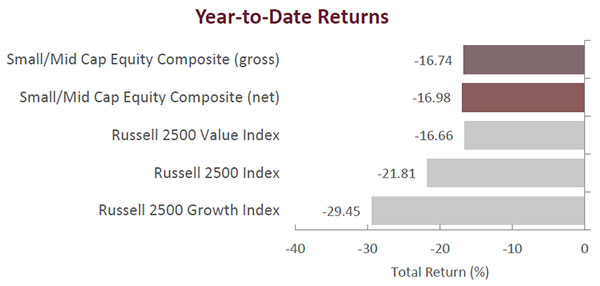
*Composite returns are preliminary pending final account reconciliation.
Past performance is not indicative of future results. Returns presented are gross and net of investment advisory fees and include the reinvestment of all income. Gross returns will be reduced by fees and other expenses that may be incurred in the management of the account. Net returns are presented net of actual investment advisory fees and after the deduction of all trading expenses. Please refer to disclosures at the end of this document.
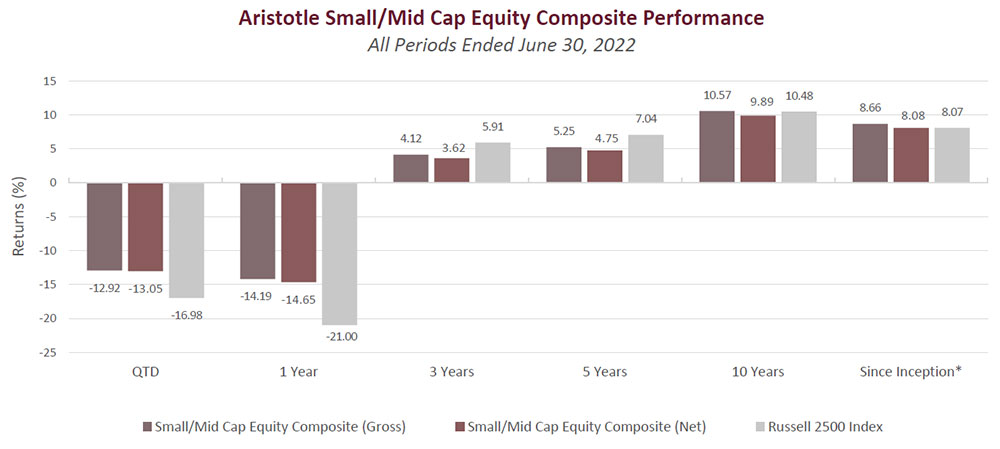
 

Sources: SS&C Advent; ICE BofA
*Composite returns are preliminary pending final account reconciliation.
**2014 is a partial-year period of period of nine months, representing data from April 1, 2014 to December 31, 2014.
Past performance is not indicative of future results. Performance results for periods greater than one year have been annualized. Returns are preliminary pending final account reconciliation. Returns reflect the reinvestment of income. Pure gross returns do not reflect the deduction of any trading costs, fees or expenses. Pure gross returns prior to 2017 reflect the deduction of transaction costs. Starting from September 2017, composite returns are presented pure gross and net of the highest wrap fee stated of 0.55%. Performance for periods prior to September 2017 are presented pure gross and net of actual investment advisory fees. This material is not financial advice or an offer to buy or sell any product. Please see important disclosures at the end of this document.

FOR FINANCIAL ADVISORS ONLY. NOT FOR PUBLIC DISTRIBUTION.

Summary

U.S. corporate credit markets continued to decline in the second quarter as bank loans outperformed investment grade corporate bonds and high yield bonds for the second consecutive quarter. Bank loans returned -4.35% during the period as measured by the Credit Suisse Leveraged Loan Index. Investment grade corporate bonds returned -7.26% as measured by the Bloomberg U.S. Corporate Bond Index with higher yields impacting longer duration bonds. High yield bonds fell -9.83% as measured by the Bloomberg U.S. Corporate High Yield Bond Index, resulting in the worst second quarter performance on record for the broad high yield bond market.

U.S. equities declined as the S&P 500 Index fell -16.10% during the quarter, bringing its year-to-date return to -19.96%. Tighter financial conditions, higher inflation and lower growth combined to undermine risk assets during the quarter. The Consumer Price Index (CPI) rose 8.6% year-over-year in May, while Gross Domestic Product (GDP) declined 1.6% in the first quarter and is projected to continue to decline in the second quarter. The labor market, however, remained resilient as the unemployment rate sat at its cycle low of 3.6% in May.

In response to soaring inflation, the Federal Reserve (Fed) raised the Fed Funds rate by 50 basis points in May and 75 basis points in June, bringing its benchmark rate to a range of 1.50% to 1.75%. The June hike was the largest since 1994 and the central bank signaled a hike of similar magnitude in July while acknowledging higher rates could lead to slower growth. The Fed also officially began the process of quantitative tightening as it slowly unwinds its $9 trillion balance sheet. Geopolitical tensions also persisted with Western governments intensifying pressure on Russia while battling the impact of rising oil and natural gas prices at home. Additionally, supply chain issues, which have been exacerbated by China’s zero-COVID policy, and a strong U.S. dollar have dampened the overall economic outlook.

Market Environment

U.S. Treasury yields climbed further in the second quarter but at a more modest pace than in the first quarter. Yields shifted higher across the curve as the yield on the U.S. 2-Year note increased roughly 62 basis points and the yield on the U.S. 10-Year note rose nearly 68 basis points. In response to the weakening growth outlook in the second half of June, U.S. Treasury yields declined with the yield on the U.S. 10-Year note ending the quarter more than 40 basis points below its high from earlier in the month.

After a relatively sanguine start to the year, U.S. corporate credit spreads widened sharply in the second quarter. High yield bond spreads ended the quarter at the widest level since July 2020, rising roughly 248 basis points as measured by the Bloomberg U.S. Corporate High Yield Bond Index. Investment grade corporate bonds also widened to a multiyear high, ending the quarter roughly 41 basis points higher as measured by the Bloomberg U.S. Corporate Bond Index.

Issuance in the high yield bond market slowed dramatically in the second quarter with new supply totaling roughly $25 billion. The year-to-date total now stands at just $71 billion, down 76% compared to the same period in 2021. Investment grade corporate bond issuance slowed at a less dramatic pace with total year-to-date issuance falling close to 13% compared to the first half of 2021. Leveraged loan supply also suffered, falling to roughly $61 billion in the quarter as year-to-date volumes fell 48% compared to the prior year.

On the demand side, funds across all three sectors experienced outflows. High yield bond fund outflows for the quarter totaled nearly $15 billion, bringing the year-to-date total outflow to almost $43 billion, the largest six-month stretch of outflows on record. Leveraged loan funds experienced large inflows earlier in the year, but flows reversed in May with just over $3 billion in outflows for the quarter. Additionally, investment grade bond funds experienced outflows of nearly $54 billion in the first half of 2022.

Within the high yield bond universe, the decline in risk sentiment and sharp rise in credit spreads helped higher quality bonds outperform as ‘BB’s (-8.43%) outperformed ‘B’s (-10.76%) and ‘CCC’s (-12.98%). From an industry perspective, Food, Beverage & Tobacco (-6.49%) outperformed while Pharmaceuticals (-19.50%) underperformed. Defaults and distressed transactions picked up in the second quarter with more than $15 billion in defaults during the quarter as the 12-month trailing, par-weighted U.S. high yield default rate rose to 0.76% at the end of June, its highest level since September 2021 and 53 basis points above the year-to-date low in April.

Performance and Attribution Summary

High Yield Bond – SMA

The Aristotle High Yield Bond – SMA Composite returned -8.39% gross of fees (-8.52% net of fees) in the second quarter, outperforming the -9.49% return of the ICE BofA BB-B U.S. Cash Pay High Yield Constrained Index. Security selection was the primary contributor to relative performance, while industry allocation was the primary detractor from relative performance.

Security selection contributed to relative performance led by holdings in Media & Entertainment and Lodging & Leisure. This was partially offset by security selection in Retailers & Restaurants and Telecommunications. Sector rotation also contributed to relative performance led by the allocation to cash and investment grade corporate bonds. There were no offsetting sector rotation factors.

Industry allocation detracted from relative performance led by an overweight in Lodging & Leisure and an underweight in Food, Beverage & Tobacco. This was partially offset by an underweight in Pharmaceuticals and an overweight in Diversified Manufacturing & Construction Machinery.

Top Five Contributors Top Five Detractors
Bausch HealthTelecom Italia
BrinkerT-Mobile
RR Donnelley & SonsBeazer Homes
CarnivalLevel 3 Financing
United AirlinesBed Bath & Beyond
*Bold securities held in representative account

High Yield Bond Focused ESG

The Aristotle High Yield Bond Focused ESG Composite returned -8.37% gross of fees (-8.50% net of fees) in the second quarter, outperforming the -9.49% return of the ICE BofA BB-B U.S. Cash Pay High Yield Constrained Index. Security selection was the primary contributor to relative performance, while industry allocation was the primary detractor from relative performance.

Security selection contributed to relative performance led by holdings in Media & Entertainment and Energy. This was partially offset by security selection in Retailers & Restaurants and Telecommunications. Sector rotation also contributed to relative performance led by the allocation to cash and investment grade corporate bonds. There were no offsetting sector rotation factors.

Industry allocation detracted from relative performance led by overweights in Retailers & Restaurants and Lodging & Leisure. This was partially offset by an underweight in Pharmaceuticals and an overweight in Diversified Manufacturing & Construction Machinery.

Top Five Contributors Top Five Detractors
Bausch HealthT-Mobile
Murphy OilTelecom Italia
BrinkerLevel 3 Financing
RR Donnelley & SonsBeazer Homes
CarnivalBed Bath & Beyond
*Bold securities held in representative account

Short Duration High Yield Bond

The Aristotle Short Duration High Yield Bond Composite returned -5.29% gross of fees (-5.43% net of fees) in the second quarter, underperforming the -4.29% return of the ICE BofA 1-3 Year BB-B U.S. Cash Pay Fixed Maturity High Yield Constrained Index. Security selection was the primary detractor from relative performance, while sector rotation was the primary contributor to relative performance.

Security selection detracted from relative performance led by holdings in Retailers & Restaurants and Lodging & Leisure. This was partially offset by security selection in Consumer Products and Media & Entertainment. Industry allocation also detracted from relative performance led by overweights in Cable & Satellite and Real Estate Investment Trusts (REITs) & Real Estate-Related. This was partially offset by overweights in Consumer Products and Media & Entertainment.

Sector rotation contributed to relative performance led by the allocation to cash and investment grade corporate bonds. There were no offsetting sector rotation factors.

Top Five Contributors Top Five Detractors
BrinkerNuStar Logistics
TevaDISH Network
Nature & Co.Navient
PopularService Properties Trust
Continental ResourcesBed Bath & Beyond
*Bold securities held in representative account

Outlook

In the second quarter, the primary driver of corporate credit market performance shifted from interest rate risk to credit risk as higher-than-expected inflation and rising interest rates slowed growth. Despite increased volatility and wider credit spreads warranting a more cautious approach in the coming months, we believe the current environment favors specific segments of the corporate credit market such as higher quality high yield bonds.

The macroeconomic backdrop continued to darken in the second quarter, driving volatility in both yields and spreads. While the Fed has already increased its benchmark rate multiple times, we believe it is not yet near the neutral rate. While this is partially the result of an artificially low starting point after the unprecedented monetary policy response to the global pandemic, in our view, the Fed may be forced to hike into a recession to fight stubbornly high inflation. We believe the result could depress corporate margins and weigh on earnings estimates going forward.

We expect inflation to remain at elevated levels into the second half of the year. In our view, rental and housing inflation will continue to rise and offset the effect of stabilizing food inflation, easing supply chain pressures and slowing demand for consumer goods. We believe weakness in economically sensitive commodities may also help moderate inflationary pressures while flagging a weaker growth outlook as industrial metals, in particular, rolled over into the end of the second quarter. We believe these underlying trends indicate tighter financial conditions are starting to impact consumption and increasing the probability of a recession.

We believe corporate America is still in solid shape as many companies benefitted from historically low rates by issuing a record sum of debt over the last two years. We are comfortable with most corporate balance sheets, and in our opinion, issuers have largely been successful in managing maturities through the end of 2024. Nonetheless, we believe it is important to distinguish between the companies that have already raised sufficient cash to weather a downturn and those that will require funding in the near future. We also remain wary of the bank loan market given most of these issuers have the majority of their longer-term financing tied up in floating rate debt and we believe short-term rates can continue to climb.

We are positioned cautiously across our portfolios and continue to favor companies with ample cash on their balance sheets. We believe a slowdown in growth may have a more negative impact on corporate earnings than on credit spreads. While we expect volatility to persist, we believe it can create opportunities as the significant repricing that has already occurred presents a much better entry point from a risk/reward and yield perspective.

High Yield Bond Positioning

In our high yield portfolios, we modestly increased exposure to higher quality, more economically defensive credits and marginally reduced exposure to select consumer cyclical credits. While we remain significantly shorter than benchmark duration, the focus on higher quality high yield credits has marginally increased the duration exposure of the portfolios.

Our high yield portfolios were conservatively positioned heading into the second quarter, thus we only marginally shifted exposure during the quarter. We maintained an average credit quality of nearly ‘BB’ in our high yield portfolios throughout the quarter. The increase in duration exposure was largely driven by our view on quality rather than on rates, which we believe can continue higher.

From an industry perspective, we made minor changes. Prior to this quarter, we added credits that we believe would benefit from the economy reopening and we remain comfortable with many of these names. However, within this group, we still prefer those companies providing consumer experiences over those producing and/or selling more discretionary consumer goods. At the end of the quarter, we held overweights in Transportation, Media & Entertainment and Energy alongside underweights in Technology, Telecommunications and Healthcare.

Disclosures

The opinions expressed herein are those of Aristotle Credit Partners, LLC (Aristotle Credit) and are subject to change without notice. Past performance is not a guarantee or indicator of future results. This material is not financial advice or an offer to buy or sell any product. You should not assume that any of the securities transactions, sectors or holdings discussed in this report are or will be profitable, or that recommendations Aristotle Credit makes in the future will be profitable or equal the performance of the securities listed in this report. The portfolio characteristics shown relate to the Aristotle Credit High Yield Bond – SMA strategy, the Aristotle Credit High Yield Bond Focused ESG strategy and the Aristotle Credit Short Duration High Yield Bond strategy. Not every client’s account will have these characteristics. Aristotle Credit reserves the right to modify its current investment strategies and techniques based on changing market dynamics or client needs. There is no assurance that any securities discussed herein will remain in an account’s portfolio at the time you receive this report or that securities sold have not been repurchased. The securities discussed may not represent an account’s entire portfolio and, in the aggregate, may represent only a small percentage of an account’s portfolio holdings. For a full list of all recommendations made by Aristotle Credit during the last 12 months, please contact us at (949) 681-2100. This is not a recommendation to buy or sell a particular security.

Returns are presented gross and net of investment advisory fees and include the reinvestment of all income. Gross returns will be reduced by fees and other expenses that may be incurred in the management of the account. Net returns are presented net of actual investment advisory fees and after the deduction of all trading expenses.
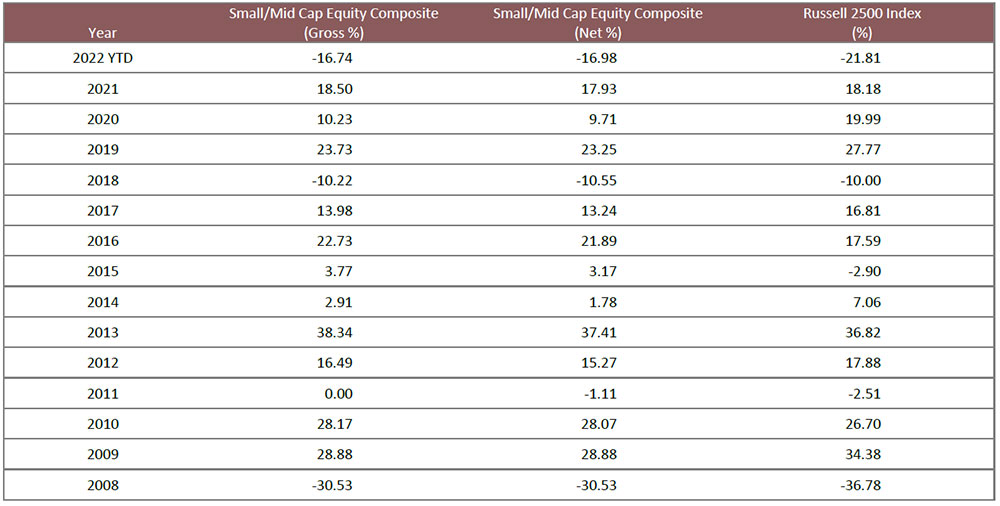
The Bloomberg U.S. Corporate Bond Index measures the investment grade, fixed-rate, taxable corporate bond market. It includes securities publicly issued by U.S. and non-U.S. industrial, utility and financial issuers that are all U.S. dollar denominated. The Bloomberg U.S. Corporate Bond Index is a component of the Bloomberg U.S. Credit Bond Index. The Bloomberg U.S. Corporate High Yield Bond Index measures the U.S. dollar-denominated, high yield, fixed-rate corporate bond market. Securities are classified as high yield if the middle rating of Moody’s, Fitch and S&P is Ba1/BB+/BB+ or below. Bonds from issuers with an emerging markets country of risk, based on Bloomberg EM country definition, are excluded. The Credit Suisse Leveraged Loan Index is a market-weighted index designed to track the performance of the investable universe of the U.S. dollar-denominated leveraged loan market. The S&P 500 Index is the Standard & Poor’s Composite Index and is a widely recognized, unmanaged index of common stock prices. It is market cap weighted and includes 500 leading companies, capturing approximately 80% coverage of available market capitalization. The ICE Bank of America (ICE BofA) BB-B U.S. Cash Pay High Yield Constrained Index measures the performance of the U.S. dollar-denominated BB-rated and B-rated corporate debt issued in the U.S. domestic market, a fixed coupon schedule and a minimum amount outstanding of $100 million, issued publicly. Allocations to an individual issuer in the Index will not exceed 2%. The ICE Bank of America (ICE BofA) 1-3 Year BB-B U.S. Cash Pay Fixed Maturity High Yield Constrained Index tracks the performance of the U.S. dollar-denominated below investment grade corporate debt, currently in a coupon paying period, that is publicly issued in the U.S. domestic market; including 144A securities, both with and without registration rights. Qualifying securities must have risk exposure to countries are members of the FX-G10, Western Europe, or territories of the United States and Western Europe. The FX-G10 includes all Euro members: the United States, Japan, the United Kingdom, Canada, Australia, New Zealand, Switzerland, Norway and Sweden. Qualifying securities include only those rated BB1 through B3. Perpetual securities are not included as all securities must have a fixed final maturity date. All final maturity dates must range between one and three years. It is a capitalization-weighted index, constrained to 2% maximum weighting per issuer. The Consumer Price Index (CPI) is a measure of the average change over time in the prices paid by urban consumers for a market basket of consumer goods and services. The volatility (beta) of the Composites may be greater or less than the indices. It is not possible to invest directly in these indices. Composite and index returns reflect the reinvestment of income.

Aristotle Credit Partners, LLC is an independent registered investment adviser under the Advisers Act of 1940, as amended. Registration does not imply a certain level of skill or training. More information about Aristotle Credit, including our investment strategies, fees and objectives, can be found in our Form ADV Part 2, which is available upon request. ACP-2207-20-UBSFA

Performance Disclosures


Sources: SS&C Advent; ICE BofA
*Composite returns are preliminary pending final account reconciliation.
**2014 is a partial-year period of eleven months, representing data from February 1, 2014 to December 31, 2014.
Past performance is not indicative of future results. Returns presented are gross and net of investment advisory fees and include the reinvestment of all income. Gross returns will be reduced by fees and other expenses that may be incurred in the management of the account. Net returns are presented net of actual investment advisory fees and after the deduction of all trading expenses. Please refer to disclosures at the end of this document.
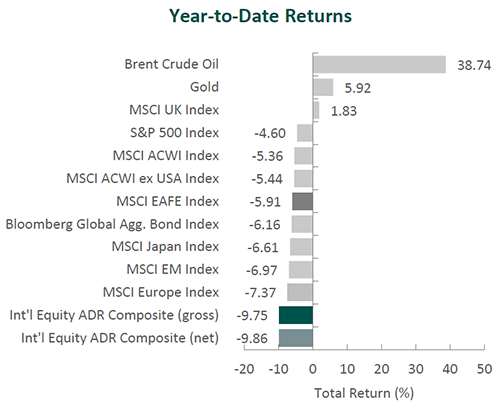
 

Sources: SS&C Advent; ICE BofA
*Composite returns are preliminary pending final account reconciliation.
Past performance is not indicative of future results. Returns presented are gross and net of investment advisory fees and include the reinvestment of all income. Gross returns will be reduced by fees and other expenses that may be incurred in the management of the account. Net returns are presented net of actual investment advisory fees and after the deduction of all trading expenses. Please refer to disclosures at the end of this document.
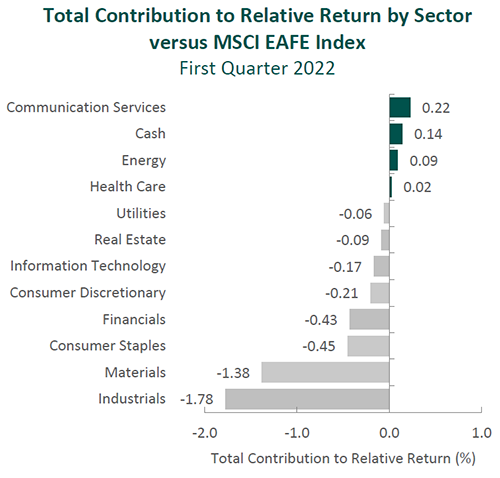
 

Sources: SS&C Advent; ICE BofA
*Composite returns are preliminary pending final account reconciliation.
**2014 is a partial-year period of period of nine months, representing data from April 1, 2014 to December 31, 2014.
Past performance is not indicative of future results. Returns presented are gross and net of investment advisory fees and include the reinvestment of all income. Gross returns will be reduced by fees and other expenses that may be incurred in the management of the account. Net returns are presented net of actual investment advisory fees and after the deduction of all trading expenses. Please refer to disclosures at the end of this document.
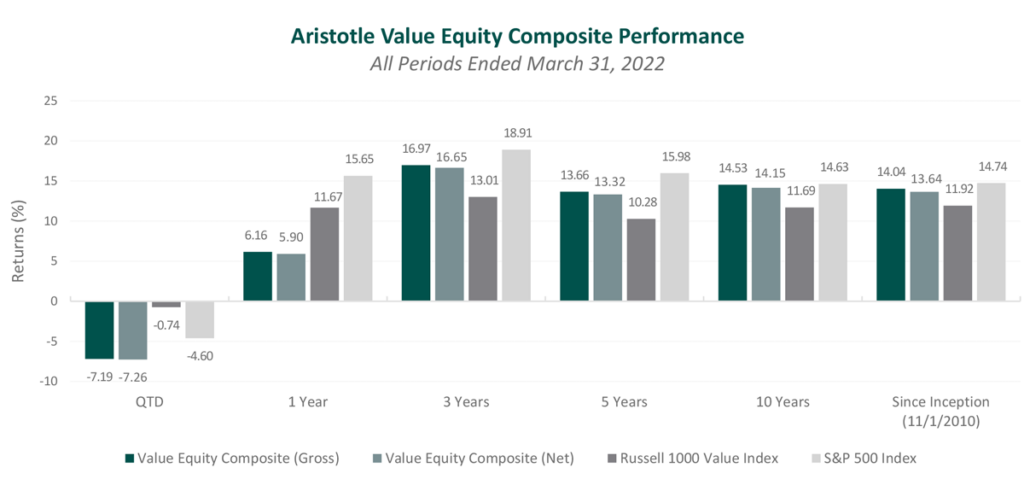
FOR PRESENTATION TO MORGAN STANLEY FINANCIAL ADVISORS ONLY

ARISTOTLE CAPITAL BOSTON, LLC

Markets Review

Selling pressures resumed during the second quarter leading to fairly indiscriminate declines for both growth and value styles across the market capitalization spectrum. For small/mid caps, the end result was a 16.98% decline, as inflation and higher borrowing costs fueled recessionary fears and dampened investor sentiment. U.S. GDP contracted at a 1.5% annualized rate for the first quarter of 2022, representing its first decline since the second quarter of 2020. While the trade and inventory components were largely responsible for the negative figure, the trend in consumer spending also slowed throughout the period. On the inflation front, the U.S. Federal Reserve (Fed) raised the federal funds rate in mid-June for the third time this year in an effort to tame inflation – this time raising the bar 0.75 percentage points, marking the highest single increase the Fed has applied since 1994. While economic measures of inflation continue to remain elevated (i.e., headline May Consumer Price Index (CPI) reaching a 40-year high), there have been some signs of a sequential easing of pressures as freight costs, gasoline and pockets of the commodity complex have begun to disinflate, particularly in the month of June. Any further relief on this front would be a welcomed sight to investors and consumers alike.

Within small/mid cap markets, performance was negative across the board, with all eleven sectors within the Russell 2500 Index declining during the quarter. Communication Services (-24.95%), Information Technology (-21.72%) and Materials (‑20.13%) were the worst performing sectors, all of which posted declines in excess of 20%. Defensives Utilities (-4.24%) and Consumer Staples (-8.07%) held in best on a relative basis followed by Energy (-11.33%). For the year-to-date period, ten of the eleven sectors remain in the red with Energy being the lone sector in the green.

Dividend Payers, Low Beta and Quality-Related factor exposures outperformed in the second quarter, which is not surprising as investors generally flock to stocks with less perceived risk in periods characterized by increased volatility and rapid selling. Stylistically, value continued its outperformance over growth in the second quarter, as evidenced by the Russell 2500 Value Index’s return of -15.39% compared to the -19.55% return of the Russell 2500 Growth Index. This marks the fourth consecutive quarter of outperformance for the Russell 2500 Value Index relative to the Russell 2500 Growth Index and brings its one-year return differential to 18.62% in favor of the value index.

Sources: SS&C Advent; Russell Investments

Past performance is not indicative of future results. Returns are presented gross and net of actual investment advisory fees and after the deduction of all trading expenses and include the reinvestment of all income. Aristotle Boston Composite returns are preliminary pending final account reconciliation. Please see important disclosures at the end of this document.

Performance Review

For the second quarter of 2022, the Aristotle Small/Mid Cap Equity Composite generated a total return of -12.92% gross of fees (-13.05% net of fees), outperforming the -16.98% total return of the Russell 2500 Index. Outperformance during the quarter was driven primarily by security selection, although allocation effects modestly contributed as well. Security selection within the Industrials, Information Technology and Health Care sectors added the most value on a relative basis, while selection within Financials, Real Estate and Utilities detracted. From an allocation perspective, the portfolio benefited from underweights in Consumer Discretionary and Communication Services; however, this was partially offset by an overweight in Information Technology and an underweight in Utilities.

Relative ContributorsRelative Detractors
FTI ConsultingHarsco
Huron Consulting GroupSignature Bank
Acadia HealthcarePacWest Bancorp
Dycom IndustriesCoherus Biosciences
TreeHouse FoodsCalAmp

CONTRIBUTORS

Security selection added the most value within the Industrials, Information Technology and Health Care sectors. From an allocation perspective, the portfolio benefited from underweights in Consumer Discretionary and Communications Services. Additionally, the portfolio’s orientation towards higher quality companies and avoidance of highly valued/unprofitable businesses also contributed. At the company level, FTI Consulting and Huron Consulting Group were two of the largest contributors during the quarter.

FTI Consulting (FCN), a global business advisory firm that provides a variety of consulting services to large corporations, benefited from strong fundamental performance driven by increased demand for the company’s services as its clients navigate through increased regulatory scrutiny, mergers and acquisitions activity, and a proliferation of corporate litigation. We maintain a position, as we believe the firm’s diversified business mix, global reach and management efforts to optimize the business can create value for shareholders going forward.

Huron Consulting Group (HURN), a specialty consulting company that provides financial, operational, and digital consulting services to health care, education and commercial clients, appreciated after delivering strong results, raising guidance and outlining a new strategic plan focused on fueling growth, expanding margins and returning capital to shareholders via buybacks. We maintain our investment as we believe the company remains well-positioned to capitalize on a demand backdrop aided by financial and operational pressures in its largest end-markets, along with secular tailwinds supporting digital transformation, analytics and cloud consulting.

DETRACTORS

Security selection detracted within the Financials, Real Estate and Utilities sectors. Additionally, the portfolio’s overweight in Information Technology and underweight in Utilities detracted from relative performance. At the company level, Harsco and Signature Bank were two of the largest detractors during the quarter.

Harsco (HSC), a provider of infrastructure services and outsourced industrial functions, declined amid inflationary pressures resulting in a downward adjustment to the company’s forward-looking outlook. We maintain a position, as we believe management’s efforts to rationalize the portfolio and reorient the business towards less cyclical industrial and environmentally-focused business lines will create additional value for shareholders.

Signature Bank (SBNY), a full-service commercial bank with offices in New York, California and North Carolina, declined despite reporting strong financial results during the quarter. It appears the share price weakness is in part due to subdued sentiment associated with the company’s exposure to the digital currency ecosystem. We maintain our investment, as we believe the company’s core business continues to perform well, and that the company’s recent expansion into the California market will augment further growth at above-market rates both organically and inorganically, which should allow for additional shareholder value creation going forward.

Recent Portfolio Activity

Buys/AcquisitionsSells/Liquidations
Aspen TechnologyBottomline Technologies
Summit Materials

BUYS/ACQUISITIONS

Aspen Technology (AZPN), a process optimization software company and existing portfolio holding, was acquired by Emerson Electric Co. during the quarter. As a result, Emerson contributed cash and two of its software businesses for a majority stake in the newly formed entity. The new company will retain and trade under the previous ticker AZPN.

Summit Materials (SUM), a leading vertically integrated materials-based company that supplies aggregates, cement, ready-mix concrete and asphalt, was added to the portfolio. We initiated a position, as we believe company-specific self-help initiatives combined with a favorable demand backdrop, particularly with infrastructure spending on the horizon, can unlock shareholder value over the next several years.

SELLS/LIQUIDATIONS

Bottomline Technologies (EPAY), a FinTech company offering digital banking, legal spend management and online bill pay solutions for corporations, was removed from the portfolio after being acquired by private equity sponsor Thoma Bravo.

Outlook and Positioning

Coming into the year, we believed that 2022 would deliver more muted returns than the Russell 2500 Index’s 21.98% average calendar year return over the past three years. However, following the sharp decline in equity markets during the second quarter, the Russell 2500 Index is now down 21.81% year-to-date and will require a healthy rebound in the second half to achieve a positive full-year return. If small/mid cap equities are unable to rebound into positive territory by year-end, it will mark the first negative year for the Russell 2500 Index since 2018. Corrections of this nature, however, are not uncommon, and our work shows that declines of this magnitude typically portend strong forward returns.

From a valuation perspective, small/mid cap equities continue to remain attractive on a forward valuation basis, both on an absolute level and relative to large caps. As of quarter end, the relative forward P/E of the Russell 2500 Index versus the Russell 1000 Index continues to trade at a discount to its long-term average and now sits at its cheapest levels since the early 2000s. For long-term investors, these valuations may imply a more favorable set up for small/mid caps relative to large caps in the periods to come. In the near term, investors will turn their attention to earnings season, as earnings disappointments and guidance revisions have been flagged as the next potential risk for stocks after multiple contraction drove the first half selloff.

While it is our belief that these disruptions and selling pressures will eventually fade, we realize this continues to be a unique period in history from a policy, macroeconomic and geopolitical standpoint, with few historical analogs that compare. Although issues such as inflation, interest rates, war and trade relations may certainly persist in the coming quarters, we remain focused on what, in our opinion, is analyzable. As such, rather than attempting to forecast an outcome that is completely outside of our control, such as future Fed policy actions or the timing of commodity price moves, we choose to spend our time studying businesses that we believe can navigate uncertainty, adapt and improve their prospects regardless of the current environment. Focusing our attention on those factors that are analyzable while others chase the prevailing geopolitical or macroeconomic winds, we feel is a distinct competitive advantage.

As always, our current positioning is a function of our bottom-up security selection process and our ability to identify what we view as attractive investment candidates, regardless of economic sector definitions. Recent purchases and sales have been spread across industries and are idiosyncratic in nature, as opposed to being tied to an outlook for a particular sector. Overweights in Industrials and Information Technology are mostly a function of recent portfolio activity and the relative performance of our holdings in these sectors over the past few periods. Conversely, we continue to be underweight in Real Estate as a result of valuations and structural challenges for various end markets within the sector. We also continue to be underweight in Consumer Discretionary, as we have been unable to identify what we consider to be compelling opportunities that fit our discipline given the rising risk profiles as a result of structural headwinds for various brick and mortar businesses. Given our focus on long-term business fundamentals, patient investment approach and low portfolio turnover, the strategy’s sector positioning generally does not change significantly from quarter to quarter; however, we may take advantage of periods of volatility by adding selectively to certain companies when appropriate.

Disclosures

The opinions expressed herein are those of Aristotle Capital Boston, LLC (Aristotle Boston) and are subject to change without notice. Past performance is not indicative of future results. The information provided in this report should not be considered financial advice or a recommendation to purchase or sell any particular security. There is no assurance that any securities discussed herein will remain in an account’s portfolio at the time you receive this report or that securities sold have not been repurchased. The securities discussed may not represent an account’s entire portfolio and, in the aggregate, may represent only a small percentage of an account’s portfolio holdings. The performance attribution presented is of a representative account from Aristotle Boston’s Small/Mid Cap Equity Composite. The representative account is a discretionary client account which was chosen to most closely reflect the investment style of the strategy. The criteria used for representative account selection is based on the account’s period of time under management and its similarity of holdings in relation to the strategy. It should not be assumed that any of the securities transactions, holdings or sectors discussed were or will be profitable, or that the investment recommendations or decisions Aristotle Boston makes in the future will be profitable or equal the performance of the securities discussed herein. Aristotle Boston reserves the right to modify its current investment strategies and techniques based on changing market dynamics or client needs. Recommendations made in the last 12 months are available upon request.

Returns are presented gross and net of investment advisory fees and include the reinvestment of all income. Gross returns will be reduced by fees and other expenses that may be incurred in the management of the account. Net returns are presented net of actual investment advisory fees and after the deduction of all trading expenses.
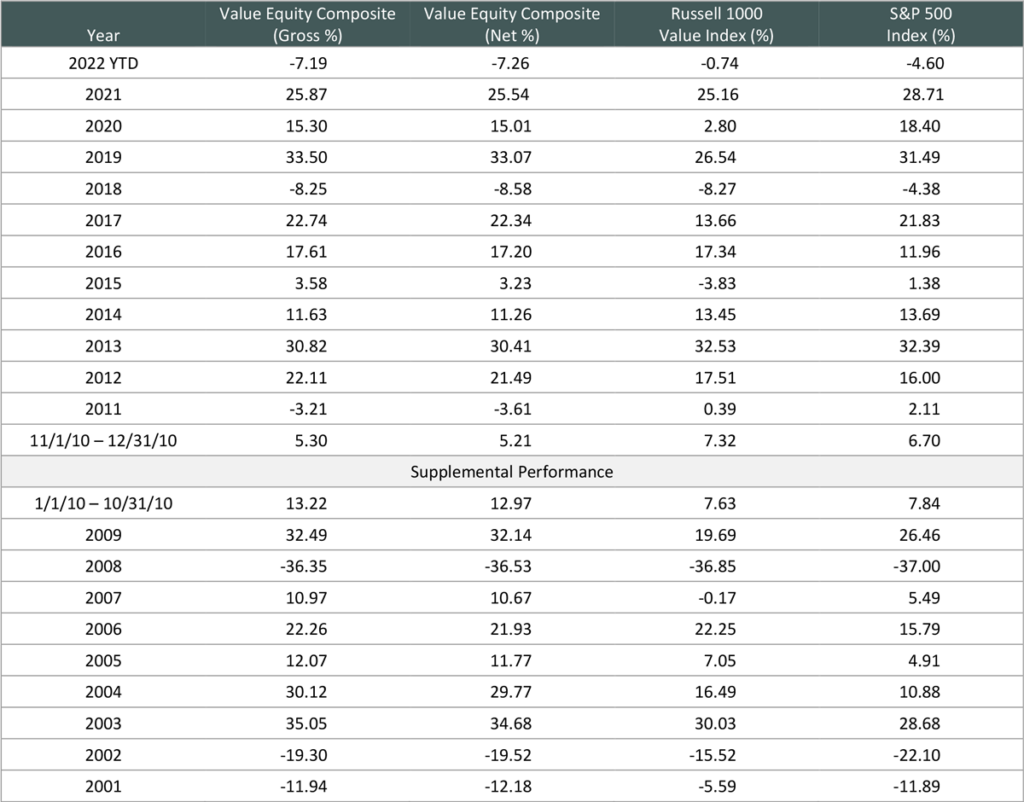
As of 12/31/2021, the Russell 2500 Value Index was removed as the secondary benchmark for the Aristotle Boston Small/Mid Cap Equity strategy.

The Russell 2500 Index is a subset of the Russell 3000® Index representing approximately 10% of the total market capitalization of that index. It includes approximately 2000 of the smallest securities based on a combination of their market cap and current index membership. The Russell 2500 Growth® Index measures the performance of the small/mid cap companies located in the United States that also exhibit a growth probability. The Russell 2500 Value® Index measures the performance of the small/mid cap companies located in the United States that also exhibit a value probability. The Russell 1000 Index is a subset of the Russell 3000® Index, representing approximately 90% of the total market capitalization of that index. It includes approximately 1,000 of the largest securities based on a combination of their market capitalization and current index membership. The volatility (beta) of the composite may be greater or less than the benchmarks. It is not possible to invest directly in these indices.

This presentation is to report on the investment strategies as reported by Aristotle Capital Boston, LLC and is for illustrative purposes only. The information contained herein is obtained from multiple sources and believed to be reliable. Information has not been verified by Morgan Stanley Wealth Management, and may differ from documents created by Morgan Stanley Wealth Management. The financial advisor should refer to the Profile. This must be preceded or accompanied by the Morgan Stanley Wealth Management Profile, which you can obtain from the Morgan Stanley Wealth Management Performance Analytics. For additional information on other programs, please speak to Patrick Schussman at Aristotle Capital at (310) 954-8156.

Aristotle Capital Boston, LLC is an independent investment adviser registered under the Investment Advisers Act of 1940, as amended. Registration does not imply a certain level of skill or training. More information about Aristotle Boston, including our investment strategies, fees and objectives, can be found in our Form ADV Part 2, which is available upon request. ACB-2207-32-MSFA

Performance Disclosures


Sources: SS&C Advent, Russell Investments
Composite returns for periods ended June 30, 2022 are preliminary pending final account reconciliation.
*The Aristotle Small/Mid Cap Equity Composite has an inception date of January 1, 2008 at a predecessor firm. During this time, Jack McPherson and Dave Adams had primary responsibility for managing the strategy. Performance starting January 1, 2015 was achieved at Aristotle Boston.
Past performance is not indicative of future results. Performance results for periods greater than one year have been annualized.
Returns are presented gross and net of investment advisory fees and include the reinvestment of all income. Gross returns will be reduced by fees and other expenses that may be incurred in the management of the account. Net returns are presented net of actual investment advisory fees and after the deduction of all trading expenses. Please see important disclosures enclosed within this document.
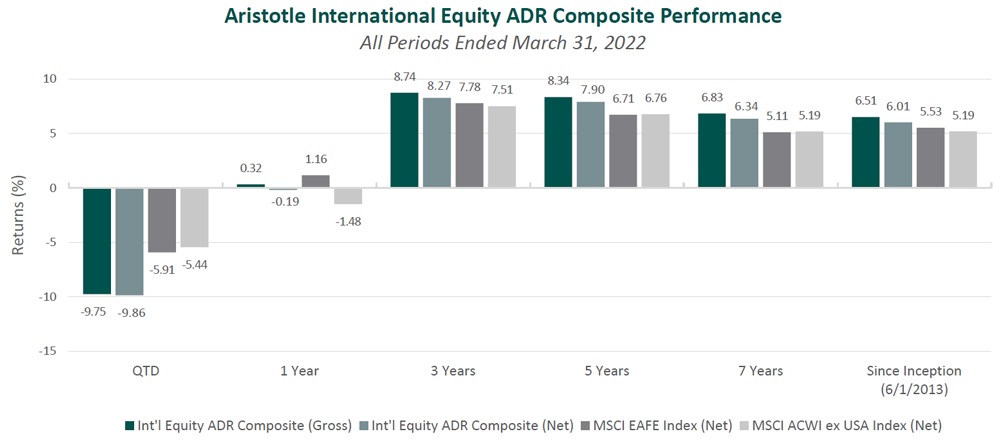
At Aristotle Capital Management (Aristotle), we have three core tenets to our investment process: we seek to invest in high quality businesses, trading at attractive valuations, where there are company-specific catalysts underway to propel the company forward. While the term “quality” is common in the investment management industry, we would like to explain how we think about quality and why we invest a tremendous amount of effort attempting to assess quality.

We believe identifying quality businesses is a combination of art and science. Quality does not lend itself to a formula. Both quantitative and qualitative “brushes” are required. That is part of the beauty of our process – it is not formulaic, but rather a mosaic.

Many investors seek quality by “screening” for financial figures they believe to be “proof ” of a high-quality company. While we, too, scrutinize financial data, we do not utilize screens. We believe quantitative screens to be exclusionary, at best, and think they often funnel investors into the same stocks, leading to herd behavior. Instead, our new ideas are “screened in” based on the knowledge and expertise the team garners by spending the vast majority its time studying our existing holdings and their value chains (e.g., competitors, suppliers, customers and disruptors).

To read the full thought piece, please use the link below. 

FOR PRESENTATION TO MERRILL LYNCH WEALTH MANAGEMENT FINANCIAL ADVISORS ONLY

(All MSCI index returns are shown net and in U.S. dollars unless otherwise noted.)

Markets Review

Global equity markets declined during the first quarter of the year. Overall, the MSCI ACWI Index fell 5.36% during the period. Concurrently, the Bloomberg Global Aggregate Bond Index pulled back 6.16%. In terms of style, value stocks outperformed their growth counterparts during the quarter, with the MSCI ACWI Value Index beating the MSCI ACWI Growth Index by 8.77%.

Sources: SS&C Advent, Bloomberg
Past performance is not indicative of future results. Aristotle International Equity ADR Composite returns are presented gross and net of investment advisory fees and include the reinvestment of all income. Aristotle Capital Composite returns are preliminary pending final account reconciliation. Please see important disclosures at the end of this document.

The MSCI EAFE Index dropped 5.91% during the first quarter, while the MSCI ACWI ex USA Index decreased 5.44%. Regionally, Europe & Middle East and Asia were the weakest performers, while the U.K. was the strongest. On a sector basis, nine out of the eleven sectors within the MSCI EAFE Index posted negative returns, with Information Technology, Consumer Discretionary and Industrials generating the largest declines. Conversely, Energy, Materials and Financials were the best-performing sectors.

Geopolitical conflict and corresponding economic consequences took the spotlight for the quarter. Russia invaded Ukraine by attacking major cities such as Kyiv, Kharkiv and Mariupol. As a result of the war, many Western countries imposed sweeping economic sanctions on Russia, including freezing the assets of Russia’s central bank and removing Russian banks from the international financial messaging system SWIFT.

Russia’s invasion of Ukraine created a grave humanitarian crisis and exacerbated preexisting concerns surrounding inflation and global trade relations. The war and subsequent sanctions caused further supply-chain disruptions, spiked prices of commodities such as wheat and oil, deflated global growth estimates and renewed tensions between the U.S. and China.

Nevertheless, central bank reactions to current global economic conditions and the conflict in Ukraine have been mixed.  The European Central Bank stated that it will wait until the final months of the year before it raises interest rates for the first time in over a decade. Meanwhile, the U.S. Federal Reserve has already completed its first rate increase since 2018 and has communicated its view that further hikes will be appropriate. However, the People’s Bank of China has taken the opposite approach by reiterating forecasts of slowing economic growth and continuing interest rate cuts, as inflation in Asia remains relatively low.

Performance and Attribution Summary

For the first quarter of 2022, Aristotle Capital’s International Equity ADR Composite posted a total U.S. dollar return of -9.75% gross of fees (-9.86% net of fees), underperforming the MSCI EAFE Index, which returned -5.91%, and the MSCI ACWI ex USA Index, which returned -5.44%. Please refer to the table below for detailed performance.

Performance (%) 1Q221 Year3 Years5 Years Since Inception*
Int’l Equity ADR Composite (gross)-9.750.328.748.346.51
Int’l Equity ADR Composite (net)-9.86-0.198.277.906.01
MSCI EAFE Index (net)-5.911.167.786.715.53
MSCI ACWI ex USA Index (net)-5.44-1.487.516.765.19
*The inception date for the International Equity ADR Composite is June 1, 2013. Past performance is not indicative of future results. Returns are presented gross and net of investment advisory fees and include the reinvestment of all income. Aristotle Capital Composite returns are preliminary pending final account reconciliation. Please see important disclosures at the end of this document.

Source: FactSet

Past performance is not indicative of future results. Attribution results are based on sector returns, which are gross of investment advisory fees and include the reinvestment of all income. Please see important disclosures at the end of this document..


From a sector perspective, the portfolio’s underperformance relative to the MSCI EAFE Index can be attributed to both security selection and allocation effects. Security selection in Industrials, Materials and Financials detracted the most from the portfolio’s relative performance. Conversely, security selection in Communication Services and Consumer Discretionary, as well as an overweight in Financials contributed to relative return.

Regionally, security selection was primarily responsible for the portfolio’s underperformance, while allocation effects had a positive impact. Security selection in the U.K., Europe & Middle East and Asia detracted the most from relative performance, while our exposure to Emerging Markets, an underweight in Europe & Middle East and an overweight in the U.K. contributed.

Contributors and Detractors for 1Q 2022

ContributorsDetractors
CredicorpNidec
CamecoING Groep
Pan Pacific InternationalAccenture
KDDISony
DBS GroupAshtead Group

Nidec, the global supplier of brushless motors, was one of the largest detractors for the quarter. Profits came under pressure since, in the short run, the company was both impacted by lost sales due to the semiconductor shortage and its inability to fully pass increases in material costs on to its customers. However, on a normalized basis, we believe the impact of material prices will be neutral, as Nidec can negotiate with clients and pass on portions of the cost variation. Management has also reiterated confidence in its growing business supplying traction motors for electric vehicles, still expecting to ship 3.5 million of such motors in fiscal year 2025. The company plans to invest approximately ¥300 billion to ready itself to supply the developing electric vehicle market and has six factories that are either already running or in the process of being built. We believe Nidec’s experience delivering electric power steering motors to auto OEMs for more than 20 years, as well as its expertise in power efficiency, provides a unique advantage to establishing additional relationships for electric vehicle motors with OEMs.

Sony, maker of the PlayStation videogame console, was a leading detractor for the quarter. After a strong year in 2021, a shortfall in PlayStation 5 sales due to continued semiconductor shortages has dampened new console unit sales. Although there are likely to be continued limitations on the supply of components in the short term, consumer demand remains strong, and upcoming releases of major titles such as Horizon Forbidden West and Gran Turismo 7 are likely to further enhance demand. While Sony continues to manage supply-chain headwinds, the company has also again demonstrated its ability to build on the fundamental strength of its business across various segments. During the quarter, Sony acquired Bungie, a U.S.-based videogame developer known for the Destiny franchise and live game services; completed its initial equity investment in Japan Advanced Semiconductor Manufacturing, a foundry service subsidiary of Taiwan Semiconductor Manufacturing Company (TSMC); and acquired Brazilian music label Som Livre. Lastly, Sony announced a partnership with Honda Motor where the two companies expect to combine Honda’s expertise in manufacturing vehicles with Sony’s proficiency in imaging, sensing, telecommunication and network technologies to develop and commercialize electric vehicles. We feel these strategic actions demonstrate Sony’s ability to continue to improve on its market positions across its business segments with a long-term, forward-looking approach.

Cameco, the world’s largest publicly traded uranium producer, was a primary contributor for the quarter. After years of stringent operational discipline that included production cuts, inventory reduction and market purchases, the company has reported strengthening market fundamentals, as industry-wide supply concerns continue to abate. The improving conditions can provide Cameco significant leverage to drive higher prices under its market-related contracts. Moreover, the company has obtained 70 million pounds of additional long-term contracts since the beginning of 2021, demonstrating Cameco’s strong position to capture increasing demand. Nevertheless, management has reiterated its commitment to maintaining supply discipline while continuing to invest in operational efficiency through automation, digitization and training. As such, the company expects to see significant improvements in cash flow generation, as it ramps up to its 2024 planned production capacity. We believe Cameco’s disciplined approach and conservative financial management continue to reinforce its long-term position and its ability to return value to shareholders. This was recently demonstrated when Cameco’s board approved a 50% increase to the company’s annual dividend for 2022.

KDDI, the second-largest telecom operator in Japan, was a leading contributor for the quarter. The company saw strong improvements during the period with operating profits increasing substantially. Furthermore, KDDI’s board approved a ¥50 billion stock buyback and, with the continued rollout of 5G in new areas, 5G unit sales grew steadily. In addition, KDDI laid out its plan to stop offering 3G service over its network and allow current 3G users to upgrade to 4G- or 5G-compatible phones at no cost to the customer, which management indicated would free up frequencies. The company also continued its success at diversifying away from traditional telecom revenue streams, making progress toward its transformation into a “Life Design Company”—a catalyst we had previously identified. Its customer base for bundled services such as home electricity, payments and mobile entertainment all expanded. In our view, this diminishes the risk of the business becoming just a “pipe” like many other telecom service providers.

Recent Portfolio Activity

BuysSells
NoneNone

Consistent with our long-term horizon and low turnover, there were no new purchases or sales completed during the quarter.

Conclusion

Performance for the first few months of 2022 has undoubtedly been disappointing. However, in both strong short-term periods and weak ones, we are resolute in our mantra — “not every quarter, not every year.” Down markets and short-term price swings are a natural part of investing. While issues such as inflation, interest rates, war and trade relations will certainly persist in the coming quarters, we remain focused on what, in our opinion, is analyzable. As such, while we are ever cognizant of the events and environment around us, we will always choose to instead concentrate on the long-term fundamentals of the businesses we study. We believe our approach of understanding companies’ earnings power from a normalized perspective, combined with our focus on high-quality, undervalued businesses that possess significant catalysts, is the best way to create lasting long-term value for our clients.

Disclosures

The opinions expressed herein are those of Aristotle Capital Management, LLC (Aristotle Capital) and are subject to change without notice. Past performance is not a guarantee or indicator of future results. This material is not financial advice or an offer to buy or sell any product. You should not assume that any of the securities transactions, sectors or holdings discussed in this report were or will be profitable, or that recommendations Aristotle Capital makes in the future will be profitable or equal the performance of the securities listed in this report. The portfolio characteristics shown relate to the Aristotle International Equity ADR strategy. Not every client’s account will have these characteristics. Aristotle Capital reserves the right to modify its current investment strategies and techniques based on changing market dynamics or client needs. There is no assurance that any securities discussed herein will remain in an account’s portfolio at the time you receive this report or that securities sold have not been repurchased. The securities discussed may not represent an account’s entire portfolio and, in the aggregate, may represent only a small percentage of an account’s portfolio holdings. The performance attribution presented is of a representative account from Aristotle Capital’s International Equity ADR Composite. The representative account is a discretionary client account which was chosen to most closely reflect the investment style of the strategy. The criteria used for representative account selection is based on the account’s period of time under management and its similarity of holdings in relation to the strategy. Recommendations made in the last 12 months are available upon request.

Returns are presented gross and net of investment advisory fees and include the reinvestment of all income. Gross returns will be reduced by fees and other expenses that may be incurred in the management of the account. For example, a 0.5% annual fee deducted quarterly (0.125%) from an account with a ten‐year annualized growth rate of 5.0% will produce a net result of 4.4%. Actual performance results will vary from this example. Please see important disclosures enclosed within this document.

The MSCI EAFE Index (Europe, Australasia, Far East) is a free float‐adjusted market capitalization‐weighted index that is designed to measure the equity market performance of developed markets, excluding the United States and Canada. The MSCI EAFE Index consists of the following 21 developed market country indices: Australia, Austria, Belgium, Denmark, Finland, France, Germany, Hong Kong, Ireland, Israel, Italy, Japan, the Netherlands, New Zealand, Norway, Portugal, Singapore, Spain, Sweden, Switzerland and the United Kingdom. The MSCI ACWI captures large and mid‐cap representation across 23 developed market countries and 24 emerging markets countries. With approximately 3,000 constituents, the Index covers approximately 85% of the global investable equity opportunity set. The MSCI ACWI Growth Index captures large and mid‐cap securities exhibiting overall growth style characteristics across 23 developed markets countries and 24 emerging markets countries. The MSCI ACWI Value Index captures large and mid‐cap securities exhibiting overall value style characteristics across 23 developed markets countries and 24 emerging markets countries. The MSCI ACWI ex USA Index captures large and mid‐cap representation across 22 of 23 developed markets countries (excluding the United States) and 24 emerging markets countries. With over 2,300 constituents, the Index covers approximately 85% of the global equity opportunity set outside the United States. The MSCI Emerging Markets Index is a free float‐adjusted market capitalization‐weighted index that is designed to measure the equity market performance of emerging markets. The MSCI Emerging Markets Index consists of the following 24 emerging market country indexes: Brazil, Chile, China, Colombia, Czech Republic, Egypt, Greece, Hungary, India, Indonesia, Korea, Kuwait, Malaysia, Mexico, Peru, Philippines, Poland, Qatar, Saudi Arabia, South Africa, Taiwan, Thailand, Turkey and United Arab Emirates. The S&P 500® Index is the Standard & Poor’s Composite Index of 500 stocks and is a widely recognized, unmanaged index of common stock prices. The Brent Crude Oil Index is a major trading classification of sweet light crude oil that serves as a major benchmark price for purchases of oil worldwide. The MSCI Japan Index is designed to measure the performance of the large and mid‐cap segments of the Japanese market. With over 250 constituents, the Index covers approximately 85% of the free float‐adjusted market capitalization in Japan. The Bloomberg Global Aggregate Bond Index is a flagship measure of global investment grade debt from 28 local currency markets. This multi‐currency benchmark includes treasury, government‐related, corporate and securitized fixed‐rate bonds from both developed and emerging markets issuers. The MSCI United Kingdom Index is designed to measure the performance of the large and mid‐cap segments of the U.K. market. With nearly 100 constituents, the Index covers approximately 85% of the free float‐adjusted market capitalization in the United Kingdom. The MSCI Europe Index captures large and mid‐cap representation across 15 developed markets countries in Europe. With approximately 430 constituents, the Index covers approximately 85% of the free float‐adjusted market capitalization across the European developed markets equity universe. These indices have been selected as the benchmarks and are used for comparison purposes only. The volatility (beta) of the Composite may be greater or less than the respective benchmarks. It is not possible to invest directly in these indices.

Aristotle Capital Management, LLC is an independent registered investment adviser under the Advisers Act of 1940, as amended. Registration does not imply a certain level of skill or training. More information about Aristotle Capital, including our investment strategies, fees and objectives, can be found in our Form ADV Part 2, which is available upon request. ACM‐2204‐141-MLFA

Performance Disclosures


Composite returns for all periods ended March 31, 2022 are preliminary pending final account reconciliation.

Past performance is not indicative of future results. Performance results for periods greater than one year have been annualized. Returns presented are gross and net of investment advisory fees and include the reinvestment of all income. The Aristotle Value Equity strategy has an inception date of November 1, 2010; however, the strategy initially began at Mr. Gleicher’s predecessor firm in October 1997. A supplemental performance track record from January 1, 2001 through October 31, 2010 is provided above. The returns are based on two separate accounts and performance results are based on custodian data. During this time, Mr. Gleicher had primary responsibility for managing the two accounts. Mr. Gleicher began managing one account in November 2000 and the other December 2000.

FOR FINANCIAL ADVISORS ONLY. NOT FOR PUBLIC DISTRIBUTION.

(All MSCI index returns are shown net and in U.S. dollars unless otherwise noted.)

Markets Review

Global equity markets declined during the first quarter of the year. Overall, the MSCI ACWI Index fell 5.36% during the period. Concurrently, the Bloomberg Global Aggregate Bond Index pulled back 6.16%. In terms of style, value stocks outperformed their growth counterparts during the quarter, with the MSCI ACWI Value Index beating the MSCI ACWI Growth Index by 8.77%.

Sources: SS&C Advent, Bloomberg
Past performance is not indicative of future results. Aristotle International Equity ADR Composite returns are presented gross and net of investment advisory fees and include the reinvestment of all income. Aristotle Capital Composite returns are preliminary pending final account reconciliation. Please see important disclosures at the end of this document.

The MSCI EAFE Index dropped 5.91% during the first quarter, while the MSCI ACWI ex USA Index decreased 5.44%. Regionally, Europe & Middle East and Asia were the weakest performers, while the U.K. was the strongest. On a sector basis, nine out of the eleven sectors within the MSCI EAFE Index posted negative returns, with Information Technology, Consumer Discretionary and Industrials generating the largest declines. Conversely, Energy, Materials and Financials were the best-performing sectors.

Geopolitical conflict and corresponding economic consequences took the spotlight for the quarter. Russia invaded Ukraine by attacking major cities such as Kyiv, Kharkiv and Mariupol. As a result of the war, many Western countries imposed sweeping economic sanctions on Russia, including freezing the assets of Russia’s central bank and removing Russian banks from the international financial messaging system SWIFT.

Russia’s invasion of Ukraine created a grave humanitarian crisis and exacerbated preexisting concerns surrounding inflation and global trade relations. The war and subsequent sanctions caused further supply-chain disruptions, spiked prices of commodities such as wheat and oil, deflated global growth estimates and renewed tensions between the U.S. and China.

Nevertheless, central bank reactions to current global economic conditions and the conflict in Ukraine have been mixed.  The European Central Bank stated that it will wait until the final months of the year before it raises interest rates for the first time in over a decade. Meanwhile, the U.S. Federal Reserve has already completed its first rate increase since 2018 and has communicated its view that further hikes will be appropriate. However, the People’s Bank of China has taken the opposite approach by reiterating forecasts of slowing economic growth and continuing interest rate cuts, as inflation in Asia remains relatively low.

Performance and Attribution Summary

For the first quarter of 2022, Aristotle Capital’s International Equity ADR Composite posted a total U.S. dollar return of -9.75% gross of fees (-9.86% net of fees), underperforming the MSCI EAFE Index, which returned -5.91%, and the MSCI ACWI ex USA Index, which returned -5.44%. Please refer to the table below for detailed performance.

Performance (%) 1Q221 Year3 Years5 Years Since Inception*
Int’l Equity ADR Composite (gross)-9.750.328.748.346.51
Int’l Equity ADR Composite (net)-9.86-0.198.277.906.01
MSCI EAFE Index (net)-5.911.167.786.715.53
MSCI ACWI ex USA Index (net)-5.44-1.487.516.765.19
*The inception date for the International Equity ADR Composite is June 1, 2013. Past performance is not indicative of future results. Returns are presented gross and net of investment advisory fees and include the reinvestment of all income. Aristotle Capital Composite returns are preliminary pending final account reconciliation. Please see important disclosures at the end of this document.

Source: FactSet

Past performance is not indicative of future results. Attribution results are based on sector returns, which are gross of investment advisory fees and include the reinvestment of all income. Please see important disclosures at the end of this document..


From a sector perspective, the portfolio’s underperformance relative to the MSCI EAFE Index can be attributed to both security selection and allocation effects. Security selection in Industrials, Materials and Financials detracted the most from the portfolio’s relative performance. Conversely, security selection in Communication Services and Consumer Discretionary, as well as an overweight in Financials contributed to relative return.

Regionally, security selection was primarily responsible for the portfolio’s underperformance, while allocation effects had a positive impact. Security selection in the U.K., Europe & Middle East and Asia detracted the most from relative performance, while our exposure to Emerging Markets, an underweight in Europe & Middle East and an overweight in the U.K. contributed.

Contributors and Detractors for 1Q 2022

ContributorsDetractors
CredicorpNidec
CamecoING Groep
Pan Pacific InternationalAccenture
KDDISony
DBS GroupAshtead Group

Nidec, the global supplier of brushless motors, was one of the largest detractors for the quarter. Profits came under pressure since, in the short run, the company was both impacted by lost sales due to the semiconductor shortage and its inability to fully pass increases in material costs on to its customers. However, on a normalized basis, we believe the impact of material prices will be neutral, as Nidec can negotiate with clients and pass on portions of the cost variation. Management has also reiterated confidence in its growing business supplying traction motors for electric vehicles, still expecting to ship 3.5 million of such motors in fiscal year 2025. The company plans to invest approximately ¥300 billion to ready itself to supply the developing electric vehicle market and has six factories that are either already running or in the process of being built. We believe Nidec’s experience delivering electric power steering motors to auto OEMs for more than 20 years, as well as its expertise in power efficiency, provides a unique advantage to establishing additional relationships for electric vehicle motors with OEMs.

Sony, maker of the PlayStation videogame console, was a leading detractor for the quarter. After a strong year in 2021, a shortfall in PlayStation 5 sales due to continued semiconductor shortages has dampened new console unit sales. Although there are likely to be continued limitations on the supply of components in the short term, consumer demand remains strong, and upcoming releases of major titles such as Horizon Forbidden West and Gran Turismo 7 are likely to further enhance demand. While Sony continues to manage supply-chain headwinds, the company has also again demonstrated its ability to build on the fundamental strength of its business across various segments. During the quarter, Sony acquired Bungie, a U.S.-based videogame developer known for the Destiny franchise and live game services; completed its initial equity investment in Japan Advanced Semiconductor Manufacturing, a foundry service subsidiary of Taiwan Semiconductor Manufacturing Company (TSMC); and acquired Brazilian music label Som Livre. Lastly, Sony announced a partnership with Honda Motor where the two companies expect to combine Honda’s expertise in manufacturing vehicles with Sony’s proficiency in imaging, sensing, telecommunication and network technologies to develop and commercialize electric vehicles. We feel these strategic actions demonstrate Sony’s ability to continue to improve on its market positions across its business segments with a long-term, forward-looking approach.

Cameco, the world’s largest publicly traded uranium producer, was a primary contributor for the quarter. After years of stringent operational discipline that included production cuts, inventory reduction and market purchases, the company has reported strengthening market fundamentals, as industry-wide supply concerns continue to abate. The improving conditions can provide Cameco significant leverage to drive higher prices under its market-related contracts. Moreover, the company has obtained 70 million pounds of additional long-term contracts since the beginning of 2021, demonstrating Cameco’s strong position to capture increasing demand. Nevertheless, management has reiterated its commitment to maintaining supply discipline while continuing to invest in operational efficiency through automation, digitization and training. As such, the company expects to see significant improvements in cash flow generation, as it ramps up to its 2024 planned production capacity. We believe Cameco’s disciplined approach and conservative financial management continue to reinforce its long-term position and its ability to return value to shareholders. This was recently demonstrated when Cameco’s board approved a 50% increase to the company’s annual dividend for 2022.

KDDI, the second-largest telecom operator in Japan, was a leading contributor for the quarter. The company saw strong improvements during the period with operating profits increasing substantially. Furthermore, KDDI’s board approved a ¥50 billion stock buyback and, with the continued rollout of 5G in new areas, 5G unit sales grew steadily. In addition, KDDI laid out its plan to stop offering 3G service over its network and allow current 3G users to upgrade to 4G- or 5G-compatible phones at no cost to the customer, which management indicated would free up frequencies. The company also continued its success at diversifying away from traditional telecom revenue streams, making progress toward its transformation into a “Life Design Company”—a catalyst we had previously identified. Its customer base for bundled services such as home electricity, payments and mobile entertainment all expanded. In our view, this diminishes the risk of the business becoming just a “pipe” like many other telecom service providers.

Recent Portfolio Activity

BuysSells
NoneNone

Consistent with our long-term horizon and low turnover, there were no new purchases or sales completed during the quarter.

Conclusion

Performance for the first few months of 2022 has undoubtedly been disappointing. However, in both strong short-term periods and weak ones, we are resolute in our mantra — “not every quarter, not every year.” Down markets and short-term price swings are a natural part of investing. While issues such as inflation, interest rates, war and trade relations will certainly persist in the coming quarters, we remain focused on what, in our opinion, is analyzable. As such, while we are ever cognizant of the events and environment around us, we will always choose to instead concentrate on the long-term fundamentals of the businesses we study. We believe our approach of understanding companies’ earnings power from a normalized perspective, combined with our focus on high-quality, undervalued businesses that possess significant catalysts, is the best way to create lasting long-term value for our clients.

Disclosures

The opinions expressed herein are those of Aristotle Capital Management, LLC (Aristotle Capital) and are subject to change without notice.  Past performance is not a guarantee or indicator of future results. This material is not financial advice or an offer to buy or sell any product.  You should not assume that any of the securities transactions, sectors or holdings discussed in this report were or will be profitable, or that recommendations Aristotle Capital makes in the future will be profitable or equal the performance of the securities listed in this report. The portfolio characteristics shown relate to the Aristotle International Equity ADR strategy. Not every client’s account will have these characteristics. Aristotle Capital reserves the right to modify its current investment strategies and techniques based on changing market dynamics or client needs. There is no assurance that any securities discussed herein will remain in an account’s portfolio at the time you receive this report or that securities sold have not been repurchased. The securities discussed may not represent an account’s entire portfolio and, in the aggregate, may represent only a small percentage of an account’s portfolio holdings. The performance attribution presented is of a representative account from Aristotle Capital’s International Equity ADR Composite. The representative account is a discretionary client account which was chosen to most closely reflect the investment style of the strategy. The criteria used for representative account selection is based on the account’s period of time under management and its similarity of holdings in relation to the strategy. Recommendations made in the last 12 months are available upon request.

Returns are presented gross and net of investment advisory fees and include the reinvestment of all income. Gross returns will be reduced by fees and other expenses that may be incurred in the management of the account. For example, a 0.5% annual fee deducted quarterly (0.125%) from an account with a ten‐year annualized growth rate of 5.0% will produce a net result of 4.4%. Actual performance results will vary from this example. Please see important disclosures enclosed within this document.

The MSCI EAFE Index (Europe, Australasia, Far East) is a free float‐adjusted market capitalization‐weighted index that is designed to measure the equity market performance of developed markets, excluding the United States and Canada. The MSCI EAFE Index consists of the following 21 developed market country indices: Australia, Austria, Belgium, Denmark, Finland, France, Germany, Hong Kong, Ireland, Israel, Italy, Japan, the Netherlands, New Zealand, Norway, Portugal, Singapore, Spain, Sweden, Switzerland and the United Kingdom. The MSCI ACWI captures large and mid‐cap representation across 23 developed market countries and 24 emerging markets countries. With approximately 3,000 constituents, the Index covers approximately 85% of the global investable equity opportunity set. The MSCI ACWI Growth Index captures large and mid‐cap securities exhibiting overall growth style characteristics across 23 developed markets countries and 24 emerging markets countries. The MSCI ACWI Value Index captures large and mid‐cap securities exhibiting overall value style characteristics across 23 developed markets countries and 24 emerging markets countries. The MSCI ACWI ex USA Index captures large and mid‐cap representation across 22 of 23 developed markets countries (excluding the United States) and 24 emerging markets countries. With over 2,300 constituents, the Index covers approximately 85% of the global equity opportunity set outside the United States. The MSCI Emerging Markets Index is a free float‐adjusted market capitalization‐weighted index that is designed to measure the equity market performance of emerging markets. The MSCI Emerging Markets Index consists of the following 24 emerging market country indexes: Brazil, Chile, China, Colombia, Czech Republic, Egypt, Greece, Hungary, India, Indonesia, Korea, Kuwait, Malaysia, Mexico, Peru, Philippines, Poland, Qatar, Saudi Arabia, South Africa, Taiwan, Thailand, Turkey and United Arab Emirates. The S&P 500® Index is the Standard & Poor’s Composite Index of 500 stocks and is a widely recognized, unmanaged index of common stock prices. The Brent Crude Oil Index is a major trading classification of sweet light crude oil that serves as a major benchmark price for purchases of oil worldwide. The MSCI Japan Index is designed to measure the performance of the large and mid‐cap segments of the Japanese market. With over 250 constituents, the Index covers approximately 85% of the free float‐adjusted market capitalization in Japan. The Bloomberg Global Aggregate Bond Index is a flagship measure of global investment grade debt from 28 local currency markets. This multi‐currency benchmark includes treasury, government‐related, corporate and securitized fixed‐rate bonds from both developed and emerging markets issuers. The MSCI United Kingdom Index is designed to measure the performance of the large and mid‐cap segments of the U.K. market. With nearly 100 constituents, the Index covers approximately 85% of the free float‐adjusted market capitalization in the United Kingdom. The MSCI Europe Index captures large and mid‐cap representation across 15 developed markets countries in Europe. With approximately 430 constituents, the Index covers approximately 85% of the free float‐adjusted market capitalization across the European developed markets equity universe. These indices have been selected as the benchmarks and are used for comparison purposes only. The volatility (beta) of the Composite may be greater or less than the respective benchmarks. It is not possible to invest directly in these indices.

Aristotle Capital Management, LLC is an independent registered investment adviser under the Advisers Act of 1940, as amended. Registration does not imply a certain level of skill or training. More information about Aristotle Capital, including our investment strategies, fees and objectives, can be found in our Form ADV Part 2, which is available upon request. ACM‐2204‐141-UBSFA

Performance Disclosures


Composite returns for all periods ended March 31, 2022 are preliminary pending final account reconciliation.
The performance information presented is based on the Aristotle International Equity ADR Composite. Past performance is not indicative of future results.
Performance results for periods greater than one year have been annualized. Returns are presented gross and net of investment advisory fees and include the reinvestment of all income. Please see important disclosures within this document.

FOR FINANCIAL ADVISORS ONLY.  NOT FOR PUBLIC DISTRIBUTION.

(All MSCI index returns are shown net and in U.S. dollars unless otherwise noted.)

Markets Review

Global equity markets declined during the first quarter of the year. Overall, the MSCI ACWI Index fell 5.36% during the period. Concurrently, the Bloomberg Global Aggregate Bond Index pulled back 6.16%. In terms of style, value stocks outperformed their growth counterparts during the quarter, with the MSCI ACWI Value Index beating the MSCI ACWI Growth Index by 8.77%.

Sources: SS&C Advent, Bloomberg
Past performance is not indicative of future results. Aristotle International Equity ADR Composite returns are presented gross and net of investment advisory fees and include the reinvestment of all income. Aristotle Capital Composite returns are preliminary pending final account reconciliation. Please see important disclosures at the end of this document.

The MSCI EAFE Index dropped 5.91% during the first quarter, while the MSCI ACWI ex USA Index decreased 5.44%. Regionally, Europe & Middle East and Asia were the weakest performers, while the U.K. was the strongest. On a sector basis, nine out of the eleven sectors within the MSCI EAFE Index posted negative returns, with Information Technology, Consumer Discretionary and Industrials generating the largest declines. Conversely, Energy, Materials and Financials were the best-performing sectors.

Geopolitical conflict and corresponding economic consequences took the spotlight for the quarter. Russia invaded Ukraine by attacking major cities such as Kyiv, Kharkiv and Mariupol. As a result of the war, many Western countries imposed sweeping economic sanctions on Russia, including freezing the assets of Russia’s central bank and removing Russian banks from the international financial messaging system SWIFT.

Russia’s invasion of Ukraine created a grave humanitarian crisis and exacerbated preexisting concerns surrounding inflation and global trade relations. The war and subsequent sanctions caused further supply-chain disruptions, spiked prices of commodities such as wheat and oil, deflated global growth estimates and renewed tensions between the U.S. and China.

Nevertheless, central bank reactions to current global economic conditions and the conflict in Ukraine have been mixed.  The European Central Bank stated that it will wait until the final months of the year before it raises interest rates for the first time in over a decade. Meanwhile, the U.S. Federal Reserve has already completed its first rate increase since 2018 and has communicated its view that further hikes will be appropriate. However, the People’s Bank of China has taken the opposite approach by reiterating forecasts of slowing economic growth and continuing interest rate cuts, as inflation in Asia remains relatively low.

Performance and Attribution Summary

For the first quarter of 2022, Aristotle Capital’s International Equity ADR Composite posted a total U.S. dollar return of -9.75% gross of fees (-9.86% net of fees), underperforming the MSCI EAFE Index, which returned -5.91%, and the MSCI ACWI ex USA Index, which returned -5.44%. Please refer to the table below for detailed performance.

Performance (%) 1Q221 Year3 Years5 Years Since Inception*
Int’l Equity ADR Composite (gross)-9.750.328.748.346.51
Int’l Equity ADR Composite (net)-9.86-0.198.277.906.01
MSCI EAFE Index (net)-5.911.167.786.715.53
MSCI ACWI ex USA Index (net)-5.44-1.487.516.765.19
*The inception date for the International Equity ADR Composite is June 1, 2013. Past performance is not indicative of future results. Returns are presented gross and net of investment advisory fees and include the reinvestment of all income. Aristotle Capital Composite returns are preliminary pending final account reconciliation. Please see important disclosures at the end of this document.

Source: FactSet

Past performance is not indicative of future results. Attribution results are based on sector returns, which are gross of investment advisory fees and include the reinvestment of all income. Please see important disclosures at the end of this document..


From a sector perspective, the portfolio’s underperformance relative to the MSCI EAFE Index can be attributed to both security selection and allocation effects. Security selection in Industrials, Materials and Financials detracted the most from the portfolio’s relative performance. Conversely, security selection in Communication Services and Consumer Discretionary, as well as an overweight in Financials contributed to relative return.

Regionally, security selection was primarily responsible for the portfolio’s underperformance, while allocation effects had a positive impact. Security selection in the U.K., Europe & Middle East and Asia detracted the most from relative performance, while our exposure to Emerging Markets, an underweight in Europe & Middle East and an overweight in the U.K. contributed.

Contributors and Detractors for 1Q 2022

ContributorsDetractors
CredicorpNidec
CamecoING Groep
Pan Pacific InternationalAccenture
KDDISony
DBS GroupAshtead Group

Nidec, the global supplier of brushless motors, was one of the largest detractors for the quarter. Profits came under pressure since, in the short run, the company was both impacted by lost sales due to the semiconductor shortage and its inability to fully pass increases in material costs on to its customers. However, on a normalized basis, we believe the impact of material prices will be neutral, as Nidec can negotiate with clients and pass on portions of the cost variation. Management has also reiterated confidence in its growing business supplying traction motors for electric vehicles, still expecting to ship 3.5 million of such motors in fiscal year 2025. The company plans to invest approximately ¥300 billion to ready itself to supply the developing electric vehicle market and has six factories that are either already running or in the process of being built. We believe Nidec’s experience delivering electric power steering motors to auto OEMs for more than 20 years, as well as its expertise in power efficiency, provides a unique advantage to establishing additional relationships for electric vehicle motors with OEMs.

Sony, maker of the PlayStation videogame console, was a leading detractor for the quarter. After a strong year in 2021, a shortfall in PlayStation 5 sales due to continued semiconductor shortages has dampened new console unit sales. Although there are likely to be continued limitations on the supply of components in the short term, consumer demand remains strong, and upcoming releases of major titles such as Horizon Forbidden West and Gran Turismo 7 are likely to further enhance demand. While Sony continues to manage supply-chain headwinds, the company has also again demonstrated its ability to build on the fundamental strength of its business across various segments. During the quarter, Sony acquired Bungie, a U.S.-based videogame developer known for the Destiny franchise and live game services; completed its initial equity investment in Japan Advanced Semiconductor Manufacturing, a foundry service subsidiary of Taiwan Semiconductor Manufacturing Company (TSMC); and acquired Brazilian music label Som Livre. Lastly, Sony announced a partnership with Honda Motor where the two companies expect to combine Honda’s expertise in manufacturing vehicles with Sony’s proficiency in imaging, sensing, telecommunication and network technologies to develop and commercialize electric vehicles. We feel these strategic actions demonstrate Sony’s ability to continue to improve on its market positions across its business segments with a long-term, forward-looking approach.

Cameco, the world’s largest publicly traded uranium producer, was a primary contributor for the quarter. After years of stringent operational discipline that included production cuts, inventory reduction and market purchases, the company has reported strengthening market fundamentals, as industry-wide supply concerns continue to abate. The improving conditions can provide Cameco significant leverage to drive higher prices under its market-related contracts. Moreover, the company has obtained 70 million pounds of additional long-term contracts since the beginning of 2021, demonstrating Cameco’s strong position to capture increasing demand. Nevertheless, management has reiterated its commitment to maintaining supply discipline while continuing to invest in operational efficiency through automation, digitization and training. As such, the company expects to see significant improvements in cash flow generation, as it ramps up to its 2024 planned production capacity. We believe Cameco’s disciplined approach and conservative financial management continue to reinforce its long-term position and its ability to return value to shareholders. This was recently demonstrated when Cameco’s board approved a 50% increase to the company’s annual dividend for 2022.

KDDI, the second-largest telecom operator in Japan, was a leading contributor for the quarter. The company saw strong improvements during the period with operating profits increasing substantially. Furthermore, KDDI’s board approved a ¥50 billion stock buyback and, with the continued rollout of 5G in new areas, 5G unit sales grew steadily. In addition, KDDI laid out its plan to stop offering 3G service over its network and allow current 3G users to upgrade to 4G- or 5G-compatible phones at no cost to the customer, which management indicated would free up frequencies. The company also continued its success at diversifying away from traditional telecom revenue streams, making progress toward its transformation into a “Life Design Company”—a catalyst we had previously identified. Its customer base for bundled services such as home electricity, payments and mobile entertainment all expanded. In our view, this diminishes the risk of the business becoming just a “pipe” like many other telecom service providers.

Recent Portfolio Activity

BuysSells
NoneNone

Consistent with our long-term horizon and low turnover, there were no new purchases or sales completed during the quarter.

Conclusion

Performance for the first few months of 2022 has undoubtedly been disappointing. However, in both strong short-term periods and weak ones, we are resolute in our mantra — “not every quarter, not every year.” Down markets and short-term price swings are a natural part of investing. While issues such as inflation, interest rates, war and trade relations will certainly persist in the coming quarters, we remain focused on what, in our opinion, is analyzable. As such, while we are ever cognizant of the events and environment around us, we will always choose to instead concentrate on the long-term fundamentals of the businesses we study. We believe our approach of understanding companies’ earnings power from a normalized perspective, combined with our focus on high-quality, undervalued businesses that possess significant catalysts, is the best way to create lasting long-term value for our clients.

Disclosures

The opinions expressed herein are those of Aristotle Capital Management, LLC (Aristotle Capital) and are subject to change without notice. Past performance is not a guarantee or indicator of future results. This material is not financial advice or an offer to buy or sell any product. You should not assume that any of the securities transactions, sectors or holdings discussed in this report were or will be profitable, or that recommendations Aristotle Capital makes in the future will be profitable or equal the performance of the securities listed in this report. The portfolio characteristics shown relate to the Aristotle International Equity ADR strategy. Not every client’s account will have these characteristics. Aristotle Capital reserves the right to modify its current investment strategies and techniques based on changing market dynamics or client needs. There is no assurance that any securities discussed herein will remain in an account’s portfolio at the time you receive this report or that securities sold have not been repurchased. The securities discussed may not represent an account’s entire portfolio and, in the aggregate, may represent only a small percentage of an account’s portfolio holdings. The performance attribution presented is of a representative account from Aristotle Capital’s International Equity ADR Composite. The representative account is a discretionary client account which was chosen to most closely reflect the investment style of the strategy. The criteria used for representative account selection is based on the account’s period of time under management and its similarity of holdings in relation to the strategy. Recommendations made in the last 12 months are available upon request.

Returns are presented gross and net of investment advisory fees and include the reinvestment of all income. Gross returns will be reduced by fees and other expenses that may be incurred in the management of the account. For example, a 0.5% annual fee deducted quarterly (0.125%) from an account with a ten-year annualized growth rate of 5.0% will produce a net result of 4.4%. Actual performance results will vary from this example. Please see important disclosures enclosed within this document.

The MSCI EAFE Index (Europe, Australasia, Far East) is a free float-adjusted market capitalization-weighted index that is designed to measure the equity market performance of developed markets, excluding the United States and Canada. The MSCI EAFE Index consists of the following 21 developed market country indices: Australia, Austria, Belgium, Denmark, Finland, France, Germany, Hong Kong, Ireland, Israel, Italy, Japan, the Netherlands, New Zealand, Norway, Portugal, Singapore, Spain, Sweden, Switzerland and the United Kingdom. The MSCI ACWI captures large and mid-cap representation across 23 developed market countries and 24 emerging markets countries. With approximately 3,000 constituents, the Index covers approximately 85% of the global investable equity opportunity set. The MSCI ACWI Growth Index captures large and mid-cap securities exhibiting overall growth style characteristics across 23 developed markets countries and 24 emerging markets countries. The MSCI ACWI Value Index captures large and mid-cap securities exhibiting overall value style characteristics across 23 developed markets countries and 24 emerging markets countries. The MSCI ACWI ex USA Index captures large and mid-cap representation across 22 of 23 developed markets countries (excluding the United States) and 24 emerging markets countries. With over 2,300 constituents, the Index covers approximately 85% of the global equity opportunity set outside the United States. The MSCI Emerging Markets Index is a free float-adjusted market capitalization-weighted index that is designed to measure the equity market performance of emerging markets. The MSCI Emerging Markets Index consists of the following 24 emerging market country indexes: Brazil, Chile, China, Colombia, Czech Republic, Egypt, Greece, Hungary, India, Indonesia, Korea, Kuwait, Malaysia, Mexico, Peru, Philippines, Poland, Qatar, Saudi Arabia, South Africa, Taiwan, Thailand, Turkey and United Arab Emirates. The S&P 500® Index is the Standard & Poor’s Composite Index of 500 stocks and is a widely recognized, unmanaged index of common stock prices. The Brent Crude Oil Index is a major trading classification of sweet light crude oil that serves as a major benchmark price for purchases of oil worldwide. The MSCI Japan Index is designed to measure the performance of the large and mid-cap segments of the Japanese market. With over 250 constituents, the Index covers approximately 85% of the free float-adjusted market capitalization in Japan. The Bloomberg Global Aggregate Bond Index is a flagship measure of global investment grade debt from 28 local currency markets. This multi-currency benchmark includes treasury, governmentrelated, corporate and securitized fixed-rate bonds from both developed and emerging markets issuers. The MSCI United Kingdom Index is designed to measure the performance of the large and mid-cap segments of the U.K. market. With nearly 100 constituents, the Index covers approximately 85% of the free float-adjusted market capitalization in the United Kingdom. The MSCI Europe Index captures large and mid-cap representation across 15 developed markets countries in Europe. With approximately 430 constituents, the Index covers approximately 85% of the free float-adjusted market capitalization across the European developed markets equity universe. These indices have been selected as the benchmarks and are used for comparison purposes only. The volatility (beta) of the Composite may be greater or less than the respective benchmarks. It is not possible to invest directly in these indices.

This presentation is to report on the investment strategies as reported by Aristotle Capital Management, LLC and is for illustrative purposes only. The information contained herein is obtained from multiple sources and believed to be reliable. Information has not been verified by Morgan Stanley Wealth Management, and may differ from documents created by Morgan Stanley Wealth Management. The financial advisor should refer to the Profile. This must be preceded or accompanied by the Morgan Stanley Wealth Management Profile, which you can obtain from the Morgan Stanley Wealth Management Performance Analytics. For additional information on other programs, please speak to Patrick Schussman at Aristotle Capital at (310) 954-8156.

Aristotle Capital Management, LLC is an independent registered investment adviser under the Advisers Act of 1940, as amended. Registration does not imply a certain level of skill or training. More information about Aristotle Capital, including our investment strategies, fees and objectives, can be found in our Form ADV Part 2, which is available upon request. ACM-2204-141-MSFA

Performance Disclosures


Composite returns for all periods ended March 31, 2022 are preliminary pending final account reconciliation.
The performance information presented is based on the Aristotle International Equity ADR Composite. Past performance is not indicative of future results.
Performance results for periods greater than one year have been annualized. Returns are presented gross and net of investment advisory fees and include the reinvestment of all income. Please see important disclosures within this document.