ARISTOTLE CAPITAL BOSTON, LLC

Markets Review

Sources: SS&C Advent; Russell Investments

Past performance is not indicative of future results. Returns are presented gross and net of investment advisory fees and include the reinvestment of all income. Gross returns will be reduced by fees and other expenses that may be incurred in the management of the account. Net returns are presented net of actual investment advisory fees and after the deduction of all trading expenses. Aristotle Small Cap Equity Composite returns are preliminary pending final account reconciliation. Please see important disclosures at the end of this document.

Small caps ended the year on a positive note, with the Russell 2000 Index rising 6.23% during the final quarter of the year. Despite some relief in the fourth quarter, 2022 will mainly be remembered as a year when markets priced in the unpleasant consequences of higher inflation and interest rates, which many expect to hit the global economy in 2023. To that end, inflation remained elevated in the U.S., with the Consumer Price Index (CPI) rising 7.1% for the 12-month period ending in November, continuing to slow from the 40-year highs of 9.1% set in June. While some economic indicators are suggesting that an economic slowdown lies ahead, third quarter U.S. Gross Domestic Product (GDP) was revised higher during the period, increasing 3.2%, and rebounding from two consecutive quarters of contraction. In response to the economic and inflationary backdrop, the Federal Reserve (Fed) raised its policy rate by 50 basis points at its December meeting, providing somewhat of a reprieve relative to the prior four 75 basis points increases. Still, this represented the fastest increase in rates since 1970 and a total increase of 4.25% in 2022. Against this backdrop, small caps declined 20.44% for the full calendar year, ending a three-year run of positive returns for the broad Russell 2000 Index.

Stylistically, the Russell 2000 Value Index was a relative outperformer throughout 2022, with a full year return of -14.48% versus the -26.36% return of the Russell 2000 Growth Index. This marks the second consecutive calendar year where value has led the small cap market and the first time that value has outperformed growth in two consecutive years since 2005-2006. Likewise, cash flow generation and profitability remained in favor throughout the year after taking a multi-year back seat to anticipated revenue growth in the hierarchy of small cap investor preferences. This is highlighted by the performance differential between money-losing and profitable companies in recent periods. For the full year, unprofitable* companies within the Russell 2000 Index returned -37.18%, while those with positive earnings declined “only” -15.66% on average.

At the sector level, ten of the eleven economic sectors within the Russell 2000 Index generated positive returns during the quarter led by Energy, Materials and Industrials. Health Care was the only sector to generate a negative return, while Communication Services and Information Technology also lagged. For the full year, Energy was by far the best performing sector within the index and the only sector to generate a positive return. Defensives Utilities and Consumer Staples were the next best performing sectors, finishing the year with modest declines. Communication Services, Information Technology and Consumer Discretionary were the worst performing sectors for the year, all producing declines in excess of -30%.

*Based on earnings expectations over the next twelve months. Source: FactSet

Performance Review

For the fourth quarter of 2022, the Aristotle Small Cap Equity Composite posted a total return of 12.12% net of fees (12.28% gross of fees), outperforming the 6.23% total return of the Russell 2000 Index. Outperformance was driven entirely by security selection during the quarter. Overall, security selection was strongest within the Health Care and Information Technology sectors and weakest in Financials and Consumer Discretionary. From an allocation perspective, the portfolio benefited from an overweight in Industrials and an underweight in Communication Services. This was partially offset by an underweight in Energy and Materials. For the full calendar year, the Aristotle Small Cap Equity Composite generated a total return of -10.13 net of fees (-9.58% gross of fees), outperforming the -20.44% return of the Russell 2000 Index.

Relative ContributorsRelative Detractors
Ardmore ShippingDesigner Brands
Altra Industrial MotionViad
OceaneeringASGN
AerCap HoldingsModivCare
Merit Medical SystemsSignature Bank

CONTRIBUTORS

Ardmore Shipping (ASC), a product and chemical transportation company focused on modern mid-sized “eco-friendly” vessels, appreciated following record third quarter earnings driven by supportive industry supply-demand fundamentals, higher spot rates and longer voyages. We maintain a position, as we believe the company continues to operate from a position of strength, driven by recent shareholder friendly capital allocation decisions, strong operating performance and a favorable industry supply-demand backdrop.

Altra Industrial Motion (AIMC), a global manufacturer and supplier of motion control, power transmission and automation products, appreciated following an announcement that the company would be acquired by Regal Rexnord Corporation. The merger is expected to close in the first half of 2023 and upon the completion of the transaction, Altra shares will no longer be listed in the public market.

DETRACTORS

Designer Brands (DBI), a designer, producer and retailer of footwear and accessories, declined in the face of broad consumer weakness and a downwardly revised forward outlook. We maintain a position, as we believe the company is well-positioned to benefit from the continued growth of its in-house brands and direct-to-consumer channels, along with in-store strategic initiatives.

Viad (VVI), a provider of high-quality, experience-based services for the hospitality and live events industries, declined amid a slower than expected recovery in long-haul international travel and an unfortunate disruption of company operations due to wildfires near some of the company’s hotels and attractions. We maintain our investment, as we believe the company’s growing service offering, expanded marketing platform and a recovery in international leisure travel and live events can drive shareholder value creation over the next several years.

Recent Portfolio Activity

Buys/AcquisitionsSells/Liquidations
AdeiaCal-Maine Foods
EnhabitXperi Holding
Safehold

BUYS/ACQUISITIONS

Adeia (ADEA), is an intellectual property (IP) licensing business, focused on the media and semiconductor end markets. We inherited shares of Adeia via a spinoff from existing holding Xperi Holdings during the quarter. We maintain our investment in the company, as we assess the risk-reward profile of the standalone business.

Enhabit (EHAB), a provider of home health and hospice services, was added to the portfolio following its recent spinoff from Encompass Health. We initiated a position, as we believe the company should benefit from favorable demographic tailwinds, an advantageous geographic exposure and an accelerated migration of care to the home-setting, which should increase demand for the company’s services.

Safehold (SAFE), is a real estate investment trust (REIT) focused on acquiring, owning, managing and capitalizing ground leases. We inherited shares of Safehold via a special dividend from existing holding iStar, which holds a meaningful stake in Safehold. We maintain our shares ahead of the anticipated business combination between the two entities, which will create the only self-managed, pure-play ground lease company in the public markets.

SELLS/LIQUIDATIONS

Cal-Maine Foods (CALM), the largest producer and distributor of fresh shell eggs in the U.S., was removed from the portfolio based on our belief that shares were fully valued amid a favorable pricing environment, in part, driven by the supply related impact of the ongoing Avian Flu outbreak. While we continue to believe that Cal-Maine is a high-quality company, we are cognizant of the risk that egg prices may eventually return to a normalized level and prefer to step aside while we monitor the company’s progress from the sidelines.

Xperi Holding (XPER), a developer of technology for entertainment and consumer electronics products, was removed from the portfolio following its recent business reorganization, which resulted in the separation of the company’s product business, Xperi, and the company’s IP licensing business, Adeia.

Outlook and Positioning

2022 was a year to forget for investors, as markets grappled with a myriad of challenges that resulted in the worst calendar year decline for the Russell 2000 Index since 2008. Whether or not the market can rebound and produce a positive total return in 2023 will likely depend on many of the same factors that have influenced corporate profits and investor sentiment in 2022, including the timing and magnitude of future rate moves in response to inflation expectations, the seemingly never-ending geopolitical uncertainty around the world, changes to business and consumer spending patterns and commodity price movements, among others. The risks associated with these and other currently unknown issues may continue to impact global economic activity and thus equity market returns. However, the reality is that we do not know if, when or where these risks might be realized, so it is difficult to manage portfolios for specific threats that may or may not occur. Therefore, we remain focused on understanding the risk associated with each investment position within the context of our fundamentally-oriented approach and managing that risk through a disciplined approach to portfolio construction and management. As we have previously stated, we believe the current market environment reinforces the need for selectivity and further argues for a focus on companies with quality characteristics, particularly strong balance sheets and healthy profitability to offer a buffer in the face of adverse economic conditions.

On the plus side, given the recent declines and well-documented economic and corporate challenges on investors’ minds, we believe at least some of this risk may be priced into markets already, particularly within the small cap segment. At 12x, the Russell 2000 Index’s forward P/E is trading at its lowest levels in over 30 years, in-line with lows during the Great Financial Crisis and below the COVID-19 recession and 2001 recession lows. The relative P/E of the Russell 2000 Index versus the Russell 1000 Index also remains near historic lows and sits at its cheapest levels since the Dot-com bubble. For long-term investors, these valuations may imply a more favorable setup for small caps relative to large caps in the periods to come. Additionally, the 2020s may mark the beginning of deglobalization, where re-shoring of U.S. manufacturing accelerates following the pandemic and accompanying supply chain disruptions, trade tensions and geopolitical conflict. U.S. reshoring efforts, along with the accompanying need for regional banking, warehousing, etc., could result in a tailwind for small caps, whose sales are more highly correlated with U.S. CapEx cycles than large caps. Lastly, using history as a guide, we observe that calendar year declines of this magnitude, typically portend positive returns in the following year, with the Russell 2000 only having experienced two negative years in a row once since its inception. High and falling inflationary environments have also been favorable market environments for small caps historically, a scenario we may find ourselves in this year.

As always, our current positioning is a function of our bottom-up security selection process and our ability to identify what we view as attractive investment candidates, regardless of economic sector definitions. Recent purchases and sales have been spread across industries and are idiosyncratic in nature, as opposed to being tied to an outlook for a particular sector. Overweights in Industrials and Information Technology are mostly a function of recent portfolio activity and the relative performance of our holdings in these sectors over the past few periods. Conversely, we continue to be underweight in Consumer Discretionary, as we have been unable to identify what we consider to be compelling long-term opportunities that fit our discipline given the rising risk profiles as a result of structural headwinds for various brick and mortar businesses. We also continue to be underweight in Real Estate as a result of valuations and structural challenges for various end markets within the sector. Given our focus on long-term business fundamentals, patient investment approach and low portfolio turnover, the strategy’s sector positioning generally does not change significantly from quarter to quarter. However, we may take advantage of periods of volatility by adding selectively to certain companies when appropriate.

Disclosures

The opinions expressed herein are those of Aristotle Capital Boston, LLC (Aristotle Boston) and are subject to change without notice.

Past performance is not indicative of future results. The information provided in this report should not be considered financial advice or a recommendation to purchase or sell any particular security. There is no assurance that any securities discussed herein will remain in an account’s portfolio at the time you receive this report or that securities sold have not been repurchased. The securities discussed may not represent an account’s entire portfolio and, in the aggregate, may represent only a small percentage of an account’s portfolio holdings. The performance attribution presented is of a representative account from Aristotle Boston’s Small Cap Equity Composite. The representative account is a discretionary client account which was chosen to most closely reflect the investment style of the strategy. The criteria used for representative account selection is based on the account’s period of time under management and its similarity of holdings in relation to the strategy. It should not be assumed that any of the securities transactions, holdings or sectors discussed were or will be profitable, or that the investment recommendations or decisions Aristotle Boston makes in the future will be profitable or equal the performance of the securities discussed herein. Aristotle Boston reserves the right to modify its current investment strategies and techniques based on changing market dynamics or client needs. Recommendations made in the last 12 months are available upon request.

Returns are presented gross and net of investment advisory fees and include the reinvestment of all income. Gross returns will be reduced by fees and other expenses that may be incurred in the management of the account. Net returns are presented net of actual investment advisory fees and after the deduction of all trading expenses.

Effective January 1, 2022, the Aristotle Small Cap Equity Composite has been redefined to exclude accounts with meaningful industry-specific restrictions or substantial values-based screens hampering implementation of the small cap strategy.

Effective January 1, 2022, the Russell 2000 Value Index was removed as the secondary benchmark for the Aristotle Capital Boston Small Cap Equity strategy.

All investments carry a certain degree of risk, including the possible loss of principal. Investments are also subject to political, market, currency and regulatory risks or economic developments. International investments involve special risks that may in particular cause a loss in principal, including currency fluctuation, lower liquidity, different accounting methods and economic and political systems, and higher transaction costs.

These risks typically are greater in emerging markets. Securities of small‐ and medium‐sized companies tend to have a shorter history of operations, be more volatile and less liquid. Value stocks can perform differently from the market as a whole and other types of stocks. The material is provided for informational and/or educational purposes only and is not intended to be and should not be construed as investment, legal or tax advice and/or a legal opinion. Investors should consult their financial and tax adviser before making investments.

The opinions referenced are as of the date of publication, may be modified due to changes in the market or economic conditions, and may not necessarily come to pass.

Aristotle Capital Boston, LLC is an independent investment adviser registered under the Investment Advisers Act of 1940, as amended. Registration does not imply a certain level of skill or training. More information about Aristotle Boston, including our investment strategies, fees and objectives, can be found in our Form ADV Part 2, which is available upon request.

Performance Disclosures

Sources: SS&C Advent, Russell Investments

Composite returns for periods ended December 31, 2022 are preliminary pending final account reconciliation.

*The Aristotle Small Cap Equity Composite has an inception date of November 1, 2006 at a predecessor firm. During this time, Jack McPherson and Dave Adams had primary responsibility for managing the strategy. Performance starting January 1, 2015 was achieved at Aristotle Boston.

**For the period November 2006 through December 2006.

Past performance is not indicative of future results. Performance results for periods greater than one year have been annualized.

Effective January 1, 2022, the Aristotle Small Cap Equity Composite has been redefined to exclude accounts with meaningful industry-specific restrictions or substantial values-based screens hampering implementation of the small cap strategy.

Effective January 1, 2022, the Russell 2000 Value Index was removed as the secondary benchmark for the Aristotle Capital Boston Small Cap Equity strategy.

Returns are presented gross and net of investment advisory fees and include the reinvestment of all income. Gross returns will be reduced by fees and other expenses that may be incurred in the management of the account. Net returns are presented net of actual investment advisory fees and after the deduction of all trading expenses. 

Aristotle Capital Boston, LLC is an independent investment adviser registered under the Investment Advisers Act of 1940, as amended. Registration does not imply a certain level of skill or training. More information about Aristotle Boston, including our investment strategies, fees and objectives, can be found in our Form ADV Part 2, which is available upon request. ACB-2301-16

Index Disclosures

The Russell 2000® Index measures the performance of the small cap segment of the U.S. equity universe. The Russell 2000 Index is a subset of the Russell 3000® Index representing approximately 10% of the total market capitalization of that index. It includes approximately 2000 of the smallest securities based on a combination of their market cap and current index membership. The Russell 2000 Growth® Index measures the performance of the small cap companies located in the United States that also exhibit a growth probability. The Russell 2000 Value® Index measures the performance of the small cap companies located in the United States that also exhibit a value probability. The Russell 1000® Index measures the performance of the large cap segment of the U.S. equity universe. The Russell 1000 Index is a subset of the Russell 3000® Index, representing approximately 90% of the total market capitalization of that index. It includes approximately 1,000 of the largest securities based on a combination of their market capitalization and current index membership. The Consumer Price Index (CPI) is a measure of the average change over time in the prices paid by urban consumers for a market basket of consumer goods and services. The volatility (beta) of the composite may be greater or less than the benchmarks. It is not possible to invest directly in these indices.

For more on Small Cap Equity, access the latest resources.

ARISTOTLE CAPITAL BOSTON, LLC

Markets Review

Sources: SS&C Advent; Russell Investments

Past performance is not indicative of future results. Returns are presented gross and net of investment advisory fees and include the reinvestment of all income. Gross returns will be reduced by fees and other expenses that may be incurred in the management of the account. Net returns are presented net of actual investment advisory fees and after the deduction of all trading expenses. Aristotle Small/Mid Cap Equity Composite returns are preliminary pending final account reconciliation. Please see important disclosures at the end of this document.

Small/mid cap equities ended the year on a positive note, with the Russell 2500 Index rising 7.43% during the final quarter of the year. Despite some relief in the fourth quarter, 2022 will mainly be remembered as a year when markets priced in the unpleasant consequences of higher inflation and interest rates, which many expect to hit the global economy in 2023. To that end, inflation remained elevated in the U.S., with the Consumer Price Index (CPI) rising 7.1% for the 12-month period ending in November, continuing to slow from the 40-year highs of 9.1% set in June. While some economic indicators are suggesting that an economic slowdown lies ahead, third quarter U.S. Gross Domestic Product (GDP) was revised higher during the period, increasing 3.2%, and rebounding from two consecutive quarters of contraction. In response to the economic and inflationary backdrop, the Federal Reserve (Fed) raised its policy rate by 50 basis points at its December meeting, providing somewhat of a reprieve relative to the prior four 75 basis points increases. Still, this represented the fastest increase in rates since 1970 and a total increase of 4.25% in 2022. Against this backdrop, small/mid caps declined -18.37% for the full calendar year, ending a three-year run of positive returns for the broad Russell 2500 Index.

Stylistically, the Russell 2500 Value Index was a relative outperformer throughout 2022, with a full year return of -13.08% versus the -26.21% return of the Russell 2500 Growth Index. This marks the second consecutive calendar year where value has led the small/mid cap market and the first time value has outperformed growth in two consecutive years since 2001-2002. Likewise, cash flow generation and profitability remained in favor throughout the year after taking a multi-year back seat to anticipated revenue growth in the hierarchy of small/mid cap investor preferences. This is highlighted by the performance differential between money-losing and profitable companies in recent periods. For the full year, unprofitable* companies within the Russell 2500 Index returned -40.34%, while those with positive earnings declined “only” -14.10% on average.

At the sector level, all eleven economic sectors within the Russell 2500 Index generated positive returns during the quarter led by Materials, Energy and Consumer Discretionary. Health Care, Communication Services and Information Technology were the worst performing sectors during the quarter. For the full year Energy was by far the best performing sector within the index and the only sector to generate a positive return. Utilities and Materials were the next best performing sectors, finishing the year with modest declines. Communication Services, Information Technology and Health Care were the worst performing sectors for the year, all producing declines in excess of -25%.

*Based on earnings expectations over the next twelve months. Source: FactSet

Performance Review

For the fourth quarter of 2022, the Aristotle Small/Mid Cap Equity Composite generated a total return of 10.47% net of fees (10.59% gross of fees), outperforming the 7.43% total return of the Russell 2500 Index. Outperformance during the period was driven entirely by security selection while allocation effects modestly detracted. Overall, security selection was strongest within the Information Technology, Health Care and Industrials sectors and weakest within the Financials, Consumer Discretionary and Communication Services sectors. From an allocation perspective, the portfolio benefited from an overweight in Industrials and an underweight in Real Estate. This was partially offset by an underweight in Consumer Discretionary and an overweight in Health Care. For the full calendar year, the Aristotle Small/Mid Cap Equity Composite generated a total return of -12.58% net of fees (-12.11% gross of fees), outperforming the -18.37% return of the Russell 2500 Index.

Relative ContributorsRelative Detractors
Altra Industrial MotionCatalent
OceaneeringSignature Bank
AerCap HoldingsCarlisle Cos
Merit Medical SystemsDesigner Brands
Barnes GroupASGN

CONTRIBUTORS

Altra Industrial Motion (AIMC), a global manufacturer and supplier of motion control, power transmission and automation products, appreciated following an announcement that the company would be acquired by Regal Rexnord Corporation. The merger is expected to close in the first half of 2023 and upon the completion of the transaction, Altra shares will no longer be listed in the public market.

Oceaneering (OII), a global provider of engineered products, services and robotic solutions for a variety of end markets, benefited from improved operating performance and profitability across all its business units. We maintain a position, as we believe the company’s strong portfolio of technologically advanced products and services remains well-positioned to benefit from a recovery in its offshore activity. Additionally, we believe the company’s Mobile and Subsea Robotics may garner increased interest moving forward, as automation lowers on-site personnel requirements and enables remote supervisory control.

DETRACTORS

Catalent (CTLT), a pharmaceutical contract development and manufacturing organization, declined amid broader macroeconomic challenges impacting the biotech funding landscape and the more discretionary areas of the company’s consumer health business. We maintain a position, as we believe the long-term value creation opportunity for the company remains intact, driven by its competitive position in biologics, particularly within the company’s cell and gene therapy sub-segments.

Signature Bank (SBNY), a full-service commercial bank with offices across the U.S., declined despite reporting strong financial results during the quarter. It appears the share price weakness is in part due to subdued sentiment associated with the company’s exposure to the digital currency ecosystem. We maintain our investment, as we believe the company’s core business continues to perform well and that the company’s recent expansion into the West Coast market will augment further growth at above-market rates both organically and inorganically, which should allow for additional shareholder value creation going forward.

Recent Portfolio Activity

Buys/AcquisitionsSells/Liquidations
AdeiaCal-Maine Foods
SafeholdXperi Holding

BUYS/ACQUISITIONS

Adeia (ADEA), is an intellectual property (IP) licensing business, focused on the media and semiconductor end markets. We inherited shares of Adeia via a spinoff from existing holding Xperi during the quarter. We maintain our investment in the company, as we assess the risk-reward profile of the standalone business.

Safehold (SAFE), is a real estate investment trust (REIT), focused on acquiring, owning, managing and capitalizing ground leases. We inherited shares of Safehold via a special dividend from existing holding iStar, which holds a meaningful stake in Safehold. We maintain our shares ahead of the anticipated business combination between the two entities, which will create the only self-managed, pure-play ground lease company in the public markets.

SELLS/LIQUIDATIONS

Cal-Maine Foods (CALM), the largest producer and distributor of fresh shell eggs in the U.S., was removed from the portfolio based on our belief that shares were fully valued amid a favorable pricing environment, in part, driven by the supply related impact of the ongoing Avian Flu outbreak. While we continue to believe that Cal-Maine is a high-quality company, we are cognizant of the risk that egg prices may eventually return to a normalized level and prefer to step aside while we monitor the company’s progress from the sidelines.

Xperi Holding (XPER), a developer of technology for entertainment and consumer electronics products, was removed from the portfolio following its recent business reorganization, which resulted in the separation of the company’s product business, Xperi, and the company’s IP licensing business, Adeia.

Outlook and Positioning

2022 was a year to forget for investors, as markets grappled with a myriad of challenges that resulted in the worst calendar year decline for the Russell 2500 Index since 2008. Whether or not the market can rebound and produce a positive total return in 2023 will likely depend on many of the same factors that have influenced corporate profits and investor sentiment in 2022, including the timing and magnitude of future rate moves in response to inflation expectations, the seemingly never-ending geopolitical uncertainty around the world, changes to business and consumer spending patterns and commodity price movements, among others. The risks associated with these and other currently unknown issues may continue to impact global economic activity and thus equity market returns. However, the reality is that we do not know if, when or where these risks might be realized, so it is difficult to manage portfolios for specific threats that may or may not occur. Therefore, we remain focused on understanding the risk associated with each investment position within the context of our fundamentally-oriented approach and managing that risk through a disciplined approach to portfolio construction and management. As we have previously stated, we believe the current market environment reinforces the need for selectivity and further argues for a focus on companies with quality characteristics, particularly strong balance sheets and healthy profitability to offer a buffer in the face of adverse economic conditions.

On the plus side, given the recent declines and well-documented economic and corporate challenges on investors’ minds, we believe at least some of this risk may be priced into markets already, particularly within the small/mid cap segment. At 12x, the Russell 2500 Index’s forward P/E is trading near its lowest levels in over 30 years, only slightly above the lows during the Great Financial Crisis and below the COVID-19 recession and 2001 recession lows. The relative P/E of the Russell 2500 Index versus the Russell 1000 Index also remains near historic lows and sits at its cheapest levels since the Dot-com bubble. For long-term investors, these valuations may imply a more favorable setup for small/mid caps relative to large caps in the periods to come. Additionally, the 2020s may mark the beginning of deglobalization, where re-shoring of U.S. manufacturing accelerates following the pandemic and accompanying supply chain disruptions, trade tensions and geopolitical conflict. U.S. reshoring efforts, along with the accompanying need for regional banking, warehousing, etc., could result in a tailwind for small/mid caps, whose sales are more highly correlated with U.S. CapEx cycles than large caps. Lastly, using history as a guide, we observe that calendar year declines of this magnitude, typically portend positive returns in the following year, with the Russell 2500 never having experienced two negative years in a row since its inception. High and falling inflationary environments have also been favorable market environments for small/mid caps historically, a scenario we may find ourselves in this year.

As always, our current positioning is a function of our bottom-up security selection process and our ability to identify what we view as attractive investment candidates, regardless of economic sector definitions. Recent purchases and sales have been spread across industries and are idiosyncratic in nature, as opposed to being tied to an outlook for a particular sector. Overweights in Industrials and Information Technology are mostly a function of recent portfolio activity and the relative performance of our holdings in these sectors over the past few periods. Conversely, we continue to be underweight in Consumer Discretionary, as we have been unable to identify what we consider to be compelling long-term opportunities that fit our discipline given the rising risk profiles as a result of structural headwinds for various brick and mortar businesses. We also continue to be underweight in Real Estate as a result of valuations and structural challenges for various end markets within the sector. Given our focus on long-term business fundamentals, patient investment approach and low portfolio turnover, the strategy’s sector positioning generally does not change significantly from quarter to quarter. However, we may take advantage of periods of volatility by adding selectively to certain companies when appropriate.

Disclosures

The opinions expressed herein are those of Aristotle Capital Boston, LLC (Aristotle Boston) and are subject to change without notice.

Past performance is not indicative of future results. The information provided in this report should not be considered financial advice or a recommendation to purchase or sell any particular security. There is no assurance that any securities discussed herein will remain in an account’s portfolio at the time you receive this report or that securities sold have not been repurchased. The securities discussed may not represent an account’s entire portfolio and, in the aggregate, may represent only a small percentage of an account’s portfolio holdings. The performance attribution presented is of a representative account from Aristotle Boston’s Small/Mid Cap Equity Composite. The representative account is a discretionary client account which was chosen to most closely reflect the investment style of the strategy. The criteria used for representative account selection is based on the account’s period of time under management and its similarity of holdings in relation to the strategy. It should not be assumed that any of the securities transactions, holdings or sectors discussed were or will be profitable, or that the investment recommendations or decisions Aristotle Boston makes in the future will be profitable or equal the performance of the securities discussed herein. Aristotle Boston reserves the right to modify its current investment strategies and techniques based on changing market dynamics or client needs. Recommendations made in the last 12 months are available upon request.

Returns are presented gross and net of investment advisory fees and include the reinvestment of all income. Gross returns will be reduced by fees and other expenses that may be incurred in the management of the account. Net returns are presented net of actual investment advisory fees and after the deduction of all trading expenses.

Effective January 1, 2022, the Russell 2500 Value Index was removed as the secondary benchmark for the Aristotle Boston Small/Mid Cap Equity strategy.

Non-fee-paying accounts represented less than 5% of the SMID Cap Composite assets from December 31, 2010 to December 31, 2013. As of December 31, 2014, there were no non-fee-paying accounts in the Composite. In instances where non-fee paying accounts were included in the SMID Cap Composite, the highest model fee was applied to recalculate the net returns for composite purposes and the impact on the since inception return of the composite was deemed immaterial.

All investments carry a certain degree of risk, including the possible loss of principal. Investments are also subject to political, market, currency and regulatory risks or economic developments. International investments involve special risks that may in particular cause a loss in principal, including currency fluctuation, lower liquidity, different accounting methods and economic and political systems, and higher transaction costs.

These risks typically are greater in emerging markets. Securities of small‐ and medium‐sized companies tend to have a shorter history of operations, be more volatile and less liquid. Value stocks can perform differently from the market as a whole and other types of stocks.

The material is provided for informational and/or educational purposes only and is not intended to be and should not be construed as investment, legal or tax advice and/or a legal opinion. Investors should consult their financial and tax adviser before making investments.

The opinions referenced are as of the date of publication, may be modified due to changes in the market or economic conditions, and may not necessarily come to pass.

Aristotle Capital Boston, LLC is an independent investment adviser registered under the Investment Advisers Act of 1940, as amended. Registration does not imply a certain level of skill or training. More information about Aristotle Boston, including our investment strategies, fees and objectives, can be found in our Form ADV Part 2, which is available upon request.

Performance Disclosures

Sources: SS&C Advent, Russell Investments

Composite returns for periods ended December 31, 2022 are preliminary pending final account reconciliation.

*The Aristotle Small/Mid Cap Equity Composite has an inception date of January 1, 2008 at a predecessor firm. During this time, Jack McPherson and Dave Adams had primary responsibility for managing the strategy. Performance starting January 1, 2015 was achieved at Aristotle Boston.

Effective January 1, 2022, the Russell 2500 Value Index was removed as the secondary benchmark for the Aristotle Boston Small/Mid Cap Equity Strategy.  Non-fee-paying accounts represented less than 5% of the SMID Cap Composite assets from December 31, 2010 to December 31, 2013. As of December 31, 2014, there were no non-fee-paying accounts in the Composite. In instances where non-fee paying accounts were included in the SMID Cap Composite, the highest model fee was applied to recalculate the net returns for composite purposes and the impact on the since inception return of the composite was deemed immaterial. Past performance is not indicative of future results. Performance results for periods greater than one year have been annualized.

Returns are presented gross and net of investment advisory fees and include the reinvestment of all income. Gross returns will be reduced by fees and other expenses that may be incurred in the management of the account. Net returns are presented net of actual investment advisory fees and after the deduction of all trading expenses. 

Aristotle Capital Boston, LLC is an independent investment adviser registered under the Investment Advisers Act of 1940, as amended. Registration does not imply a certain level of skill or training. More information about Aristotle Boston, including our investment strategies, fees and objectives, can be found in our Form ADV Part 2, which is available upon request. ACB-2301-17

Index Disclosures

The Russell 2500 Index is a subset of the Russell 3000® Index representing approximately 10% of the total market capitalization of that index. It includes approximately 2000 of the smallest securities based on a combination of their market cap and current index membership. The Russell 2500 Growth® Index measures the performance of the small/mid cap companies located in the United States that also exhibit a growth probability. The Russell 2500 Value® Index measures the performance of the small/mid cap companies located in the United States that also exhibit a value probability. The Russell 1000 Index is a subset of the Russell 3000® Index, representing approximately 90% of the total market capitalization of that index. It includes approximately 1,000 of the largest securities based on a combination of their market capitalization and current index membership. The Consumer Price Index (CPI) is a measure of the average change over time in the prices paid by urban consumers for a market basket of consumer goods and services. The volatility (beta) of the composite may be greater or less than the benchmarks. It is not possible to invest directly in these indices.

For more on Small/Mid Cap Equity, access the latest resources.

Markets Review

U.S. equity market performance was positive in the final quarter of the year, as the S&P 500 Index rose 7.56% during the period. Concurrently, the Bloomberg U.S. Aggregate Bond Index increased 1.87% for the quarter. In terms of style, the Russell 1000 Value Index outperformed its growth counterpart by 10.22% during the quarter.

On a sector basis, nine out of eleven sectors within the S&P 500 Index finished higher for the quarter, with Energy, Industrials and Materials posting the largest gains. Meanwhile, Consumer Discretionary and Communication Services were the only sectors to post negative returns, while Real Estate rose the least.

Sources: SS&C Advent, Bloomberg
Past performance is not indicative of future results. Aristotle Atlantic Core Equity Composite returns are presented gross and net of investment advisory fees and include the reinvestment of all income. Gross returns will be reduced by fees and other expenses that may be incurred in the management of the account. Net returns are presented net of actual investment advisory fees and after the deduction of all trading expenses. Aristotle Atlantic Composite returns are preliminary pending final account reconciliation. Please see important disclosures at the end of this document.

Inflation has remained elevated in the U.S., with a 7.1% rise in the CPI for the 12-month period ending in November. However, increases have slowed since the second half of the year, as the annualized CPI figure has come down steadily since reaching a 40-year high of 9.1% in June. This moderation in price increases was partly driven by falling energy costs, as average U.S. gasoline prices approached $3 a gallon—lows not seen since before Russia invaded Ukraine. When assessing consumer health, spending proved resilient and the labor market remained tight, with a 3.7% unemployment rate and a 5.1% year-over-year increase in average hourly earnings in November. With respect to the U.S. economy’s overall performance, investors welcomed news that GDP grew at an annual rate of 3.2% in the third quarter following two consecutive quarters of contraction.

As inflation trended lower, the Federal Reserve (Fed) slowed the pace of rate increases to 0.5% in December after raising rates by 0.75% for the fourth consecutive time in November, moving the benchmark rate to a range of 4.25% to 4.50%. Although the magnitude of rate hikes has shifted down, the Fed has indicated that, given the current labor market and its 2% inflation target, there is still more work to be done from a monetary policy standpoint. As such, apprehension around a recession remains; however, the Fed’s decision to step down from 0.75% increases and the weakening dollar alleviated some of those concerns heading into the new year.

On the corporate earnings front, signals remained mixed, as 70% of S&P 500 companies exceeded EPS estimates, while 61% of S&P 500 companies provided negative EPS guidance for the third quarter. In addition, management teams have continued to navigate the inflationary environment, with roughly 400 companies mentioning inflation on earnings calls. 

Lastly, in U.S. politics, the Republican Party won a majority in the House of Representatives, while the Democratic Party retained control of the Senate after the 2022 midterm elections. The results end one-party control of Congress for the remainder of the Biden administration’s first term.

Annual Markets Review

After posting seven consecutive quarters of positive performance prior to 2022, the U.S. equity market faltered, as the S&P 500 Index finished lower for the first three quarters of the year, leading to a full-year return of -18.11%. Additionally, after five straight calendar years of growth outperforming value, the Russell 1000 Value Index outperformed the Russell 1000 Growth Index by 21.60%, the largest outperformance by value since 2000.

Meanwhile, despite fixed income’s tendency to provide stability when equities are turbulent, the Bloomberg U.S. Aggregate Bond Index fell 13.01%—its worst year on record. 2022 easily surpassed the Index’s previous worst year, when it declined 2.92% in 1994 as inflation and the corresponding interest rate environment remained primary themes. Macroeconomic headlines were dominated by inflation, while factors such as geopolitical conflict, supply-chain disruptions, labor shortages and increasing commodity and housing prices also played a role.

Although it was a challenging year, these volatile periods are precisely why we emphasize the phrase, “not every quarter, not every year.” Short-term returns are always subject to change, and macroeconomic factors such as inflation, central bank policies and geopolitical conflicts are impossible to predict. Consequently, we remain focused on the long-term fundamentals of businesses, and we strive to identify undervalued, high-quality companies that can weather the complex and changing market dynamics. We believe this steadfast approach will allow us to provide lasting long-term value to our clients. 

Performance and Attribution Summary

For the fourth quarter of 2022, Aristotle Atlantic’s Core Equity Composite posted a total return of 6.92% net of fees (7.03% gross of fees), underperforming the S&P 500 Index, which recorded a total return of 7.56%.

4Q22 1 Year3 Years5 Years7 YearsSince Inception*
Core Equity Composite (gross)7.03-21.617.529.9211.6912.09
Core Equity Composite (net)6.92-21.947.089.4711.2211.57
S&P 500 Index7.56-18.117.659.4211.4711.24
*The Core Equity Composite has an inception date of August 1, 2013. Past performance is not indicative of future results. Aristotle Atlantic Core Equity Composite returns are presented gross and net of investment advisory fees and include the reinvestment of all income. Gross returns will be reduced by fees and other expenses that may be incurred in the management of the account. Net returns are presented net of actual investment advisory fees and after the deduction of all trading expenses. Aristotle Atlantic Composite returns are preliminary pending final account reconciliation. Please see important disclosures at the end of this document.

Source: FactSet
Past performance is not indicative of future results. Attribution results are based on sector returns which are gross of investment advisory fees. Attribution is based on performance that is gross of investment advisory fees and includes the reinvestment of income. Please see important disclosures at the end of this document.

During the fourth quarter, the portfolio’s underperformance relative to the S&P 500 Index was due to security selection and allocation effects. Security selection in Health Care, Consumer Staples and Industrials detracted the most from relative performance. Conversely, security selection in Consumer Discretionary, Financials and Information Technology contributed the most to relative performance.

Contributors and Detractors for 4Q 2022

Relative ContributorsRelative Detractors
AMETEKCatalent
BroadcomChart Industries
Ameriprise FinancialGuardant Health
 HalliburtonDarling Ingredients
Phillips 66Alphabet

Contributors

AMETEK

AMETEK contributed to performance in the fourth quarter following a better-than-expected third quarter earnings report and an increase in full year guidance. The company has low balance sheet leverage and management appeared confident in its ability to source acquisitions. Management believes that the company’s recession risk is lower than in previous economic cycles due to the remixing of the portfolio to less cyclical end markets.  

Broadcom

Broadcom contributed to performance in the quarter following the company’s solid fourth quarter 2022 results. This was driven by better-than-expected results in both its semiconductor solutions, networking and storage segments. The company also provided first quarter guidance that was ahead of consensus as well as 2023 commentary that expects earnings momentum to continue due to a strong product cycle. 

Detractors

Catalent

Catalent shares were weak following an earnings miss and a reduction in guidance. The lowering of guidance  is attributable to two items: slower consumer spending on the pharmaceutical and consumer health segment due to low consumer confidence, inflation and a deteriorating macroeconomic environment; and cash conservatism amongst customers in both retail (wanting to reduce inventory to protect working capital) and pharma/biotech, reprioritizing pipelines and slowing certain pipeline programs. Excluding COVID-19-related business, revenue grew in excess of 20% on an organic basis. As a result, their base businesses remain strong.   

Chart Industries

Chart Industries detracted from performance in the fourth quarter following the announcement of the acquisition of Howden Group in early November. The acquisition diluted the clean energy exposure at Chart and will increase balance sheet leverage. In December, Chart successfully raised debt that is required to close the acquisition at interest rates that were in line with management’s expectations at the time of the announcement of the deal. The decline in natural gas prices in the fourth quarter was also likely a contributor to weakness in the shares. 

Recent Portfolio Activity

The table below shows all buys and sells completed during the quarter, followed by a brief rationale.

BuysSells
Antero ResourcesNone

Buys

Antero Resources

Antero Resources is engaged in the development, production, exploration and acquisition of natural gas, natural gas liquids (NGLs) and oil properties located in the Appalachian Basin. Operating entirely within the U.S., Colorado-based Antero Resources holds approximately 502,000 net acres of oil and gas properties in Ohio and West Virginia. Antero Resources intends to leverage its team’s experience delineating and developing natural gas resource plays to continue developing its reserves and production, primarily on the company’s existing multi-year project inventory.

We see the company generating significant free cash flow (FCF) over the next few years and a sizable return of FCF to shareholders through buybacks. Antero Resources has significantly reduced its debt over the past three years. Longer-term structural tailwinds exist for natural gas and NGLs, as U.S. supply growth rates remains constrained by takeaway capacity additions and lower reinvestment rates by Exploration & Production (E&P), following years of shareholder pressure to reduce leverage and balance shareholder returns with growth. We continue to see a structural shift in demand for natural gas and NGLs supporting prices at these levels or higher leading to attractive FCF growth for Antero Resources.

Sells

There were no new sales completed during the quarter.

Outlook

The focus for equity investors going into 2023 will be the potential for an economic recession and the corresponding impact on corporate profits. Although inflation may have peaked, the Federal Reserve will potentially look to continue to raise interest rates and reduce their balance sheet in an effort to cool the labor market. One of the key statistics tracking the labor market is the Job Openings and Labor Turnover Survey (JOLTS), which has started to show signs of softening, with the number of job openings declining from recent highs. The gap between job openings and people looking for work still stands at an elevated ratio of 1.7 as of October 2022. With the labor market still tight, the Federal Reserve will most likely raise interest rates another two to three times in 2023 with the potential for the federal funds rate to peak at 5.00% to 5.25%. Although the federal funds futures point to the potential for a pivot into an easing cycle, the most likely scenario is for the Federal Reserve to take a wait-and-see approach once they are done raising interest rates. This can create an uncertain economic environment for at least the first half of 2023. On a positive note, the price of goods may likely continue to decline as many of the issues around tight supply chain have eased. The pace of decline in goods prices could very well be delayed or lessened by the spike in COVID-19 cases in China. As we approach the second half of the year, the debt ceiling could add to equity market volatility, as we now have a split party government. Lastly, the uncertain outcome and potential for escalation in Ukraine on the part of Russia may, at times, unsettle markets. The equity market will most likely struggle at the start of 2023, as investors weigh the economic impact of an aggressive tightening cycle. Once the Federal Reserve signals the end of the tightening cycle, we should expect a sizable rally in equity markets.  Our focus will continue to be at the company level, with an emphasis on seeking to invest in companies with secular tailwinds or strong product-driven cycles.

Disclosures

The opinions expressed herein are those of Aristotle Atlantic Partners, LLC (Aristotle Atlantic) and are subject to change without notice. Past performance is not a guarantee or indicator of future results. This material is not financial advice or an offer to purchase or sell any product. You should not assume that any of the securities transactions, sectors or holdings discussed in this report were or will be profitable, or that recommendations Aristotle Atlantic makes in the future will be profitable or equal the performance of the securities listed in this report. The portfolio characteristics shown relate to the Aristotle Atlantic Core Equity strategy. Not every client’s account will have these characteristics. Aristotle Atlantic reserves the right to modify its current investment strategies and techniques based on changing market dynamics or client needs. There is no assurance that any securities discussed herein will remain in an account’s portfolio at the time you receive this report or that securities sold have not been repurchased. The securities discussed may not represent an account’s entire portfolio and, in the aggregate, may represent only a small percentage of an account’s portfolio holdings. The performance attribution presented is of a representative account from Aristotle Atlantic’s Core Equity Composite. The representative account is a discretionary client account which was chosen to most closely reflect the investment style of the strategy. The criteria used for representative account selection is based on the account’s period of time under management and its similarity of holdings in relation to the strategy. Recommendations made in the last 12 months are available upon request. Returns are presented gross and net of investment advisory fees and include the reinvestment of all income. Gross returns will be reduced by fees and other expenses that may be incurred in the management of the account. Net returns are presented net of actual investment advisory fees and after the deduction of all trading expenses.

All investments carry a certain degree of risk, including the possible loss of principal. Investments are also subject to political, market, currency and regulatory risks or economic developments. International investments involve special risks that may in particular cause a loss in principal, including currency fluctuation, lower liquidity, different accounting methods and economic and political systems, and higher transaction costs. These risks typically are greater in emerging markets. Securities of small‐ and medium‐sized companies tend to have a shorter history of operations, be more volatile and less liquid. Value stocks can perform differently from the market as a whole and other types of stocks.

The material is provided for informational and/or educational purposes only and is not intended to be and should not be construed as investment, legal or tax advice and/or a legal opinion. Investors should consult their financial and tax adviser before making investments. The opinions referenced are as of the date of publication, may be modified due to changes in the market or economic conditions, and may not necessarily come to pass. Information and data presented has been developed internally and/or obtained from sources believed to be reliable. Aristotle Atlantic does not guarantee the accuracy, adequacy or completeness of such information.

Aristotle Atlantic Partners, LLC is an independent registered investment adviser under the Advisers Act of 1940, as amended. Registration does not imply a certain level of skill or training. More information about Aristotle Atlantic, including our investment strategies, fees and objectives, can be found in our Form ADV Part 2, which is available upon request.

Performance Disclosures

Composite returns for all periods ended December 31, 2022 are preliminary pending final account reconciliation.

The Aristotle Core Equity Composite has an inception date of August 1, 2013 at a predecessor firm. During this time, Mr. Fitzpatrick had primary responsibility for managing the strategy. Performance starting November 1, 2016 was achieved at Aristotle Atlantic.

Past performance is not indicative of future results. Performance results for periods greater than one year have been annualized. Returns are presented gross and net of investment advisory fees and include the reinvestment of all income. Gross returns will be reduced by fees and other expenses that may be incurred in the management of the account. Net returns are presented net of actual investment advisory fees and after the deduction of all trading expenses.

Aristotle Atlantic Partners, LLC is an independent registered investment adviser under the Advisers Act of 1940, as amended. Registration does not imply a certain level of skill or training. More information about Aristotle Atlantic, including our investment strategies, fees and objectives, can be found in our Form ADV Part 2, which is available upon request. AAP-2301-6

Index Disclosures

The Russell 1000® Growth Index measures the performance of the large cap growth segment of the U.S. equity universe. It includes those Russell 1000 companies with higher price-to-book ratios and higher forecasted growth values. This index has been selected as the benchmark and is used for comparison purposes only. The Russell 1000® Value Index measures the performance of the large cap value segment of the U.S. equity universe. It includes those Russell 1000 companies with lower price-to-book ratios and lower expected growth values. The S&P 500® Index is the Standard & Poor’s Composite Index of 500 stocks and is a widely recognized, unmanaged index of common stock prices. The Russell 2000® Index measures the performance of the small cap segment of the U.S. equity universe. The Russell 2000 Index is a subset of the Russell 3000® Index representing approximately 10% of the total market capitalization of that index. It includes approximately 2,000 of the smallest securities based on a combination of their market cap and current index membership. The Dow Jones Industrial Average® is a price-weighted measure of 30 U.S. blue-chip companies. The Index covers all industries except transportation and utilities. The NASDAQ Composite Index measures all NASDAQ domestic and international based common type stocks listed on The NASDAQ Stock Market. The NASDAQ Composite includes over 3,000 companies, more than most other stock market indices. The Bloomberg U.S. Aggregate Bond Index is an unmanaged index of domestic investment grade bonds, including corporate, government and mortgage-backed securities. The WTI Crude Oil Index is a major trading classification of sweet light crude oil that serves as a major benchmark price for oil consumed in the United States. The 3-Month U.S. Treasury Bill is a short-term debt obligation backed by the U.S. Treasury Department with a maturity of three months. The U.S. Dollar Index (DXY) is a measure of the value of the U.S. dollar relative to the value of a basket of currencies of the majority of the United States’ most significant trading partners. Consumer Price Index (CPI) is a measure of the average change over time in the prices paid by urban consumers for a market basket of consumer goods and services. While stock selection is not governed by quantitative rules, a stock typically is added only if the company has an excellent reputation, demonstrates sustained growth and is of interest to a large number of investors. The volatility (beta) of the Composite may be greater or less than its respective benchmarks. It is not possible to invest directly in these indices.

Markets Review

U.S. equity market performance was positive in the final quarter of the year, as the S&P 500 Index rose 7.56% during the period. Concurrently, the Bloomberg U.S. Aggregate Bond Index increased 1.87% for the quarter. In terms of style, the Russell 1000 Value Index outperformed its growth counterpart by 10.22% during the quarter.

Sources: SS&C Advent, Bloomberg
Past performance is not indicative of future results. Aristotle Atlantic Focus Growth Composite returns are presented gross and net of investment advisory fees and include the reinvestment of all income. Gross returns will be reduced by fees and other expenses that may be incurred in the management of the account. Net returns are presented net of actual investment advisory fees and after the deduction of all trading expenses. Aristotle Atlantic Composite returns are preliminary pending final account reconciliation. Please see important disclosures at the end of this document.

On a sector basis, nine out of eleven sectors within the Russell 1000 Growth Index finished higher for the quarter, with Utilities, Industrials and Health Care gaining the most. Meanwhile, Consumer Discretionary and Communication Services posted the largest declines and Information Technology rose the least.

Inflation has remained elevated in the U.S., with a 7.1% rise in the CPI for the 12-month period ending in November. However, increases have slowed since the second half of the year, as the annualized CPI figure has come down steadily since reaching a 40-year high of 9.1% in June. This moderation in price increases was partly driven by falling energy costs, as average U.S. gasoline prices approached $3 a gallon—lows not seen since before Russia invaded Ukraine. When assessing consumer health, spending proved resilient and the labor market remained tight, with a 3.7% unemployment rate and a 5.1% year-over-year increase in average hourly earnings in November. With respect to the U.S. economy’s overall performance, investors welcomed news that GDP grew at an annual rate of 3.2% in the third quarter following two consecutive quarters of contraction.

As inflation trended lower, the Federal Reserve (Fed) slowed the pace of rate increases to 0.5% in December after raising rates by 0.75% for the fourth consecutive time in November, moving the benchmark rate to a range of 4.25% to 4.50%. Although the magnitude of rate hikes has shifted down, the Fed has indicated that, given the current labor market and its 2% inflation target, there is still more work to be done from a monetary policy standpoint. As such, apprehension around a recession remains; however, the Fed’s decision to step down from 0.75% increases and the weakening dollar alleviated some of those concerns heading into the new year.

On the corporate earnings front, signals remained mixed, as 70% of S&P 500 companies exceeded EPS estimates, while 61% of S&P 500 companies provided negative EPS guidance for the third quarter. In addition, management teams have continued to navigate the inflationary environment, with roughly 400 companies mentioning inflation on earnings calls.

Lastly, in U.S. politics, the Republican Party won a majority in the House of Representatives, while the Democratic Party retained control of the Senate after the 2022 midterm elections. The results end one-party control of Congress for the remainder of the Biden administration’s first term.

Annual Markets Review

After posting seven consecutive quarters of positive performance prior to 2022, the U.S. equity market faltered, as the S&P 500 Index finished lower for the first three quarters of the year, leading to a full-year return of -18.11%. Additionally, after five straight calendar years of growth outperforming value, the Russell 1000 Value Index outperformed the Russell 1000 Growth Index by 21.60%, the largest outperformance by value since 2000.

Meanwhile, despite fixed income’s tendency to provide stability when equities are turbulent, the Bloomberg U.S. Aggregate Bond Index fell 13.01%—its worst year on record. 2022 easily surpassed the Index’s previous worst year, when it declined 2.92% in 1994 as inflation and the corresponding interest rate environment remained primary themes. Macroeconomic headlines were dominated by inflation, while factors such as geopolitical conflict, supply-chain disruptions, labor shortages and increasing commodity and housing prices also played a role.

Although it was a challenging year, these volatile periods are precisely why we emphasize the phrase, “not every quarter, not every year.” Short-term returns are always subject to change, and macroeconomic factors such as inflation, central bank policies and geopolitical conflicts are impossible to predict. Consequently, we remain focused on the long-term fundamentals of businesses, and we strive to identify undervalued, high-quality companies that can weather the complex and changing market dynamics. We believe this steadfast approach will allow us to provide lasting long-term value to our clients.

Performance and Attribution Summary

For the fourth quarter of 2022, Aristotle Atlantic’s Focus Growth Composite posted a total return of 2.66% net of fees (2.68% gross of fees), outperforming the 2.20% total return of the Russell 1000 Growth Index.

4Q221 Year3 YearsSince Inception*
Focus Growth Composite (gross)2.68-33.265.01 7.99
Focus Growth Composite (net)2.66-33.354.92 7.72
Russell 1000 Growth Index2.20-29.147.7810.38
*The Focus Growth Composite has an inception date of March 1, 2018. Past performance is not indicative of future results. Aristotle Atlantic Focus Growth Composite returns are presented gross and net of investment advisory fees and include the reinvestment of all income. Gross returns will be reduced by fees and other expenses that may be incurred in the management of the account. Net returns are presented net of actual investment advisory fees and after the deduction of all trading expenses. Aristotle Atlantic Composite returns are preliminary pending final account reconciliation. Please see important disclosures at the end of this document.

Sources: FactSet
Past performance is not indicative of future results. Attribution results are based on sector returns which are gross of investment advisory fees. Attribution is based on performance that is gross of investment advisory fees and includes the reinvestment of income. Please see important disclosures at the end of this document.

During the fourth quarter, the portfolio’s outperformance relative to the Russell 1000 Growth Index was due to security selection and allocation effects. Security selection in Consumer Discretionary, and Real Estate and an underweight in Consumer Discretionary contributed the most to performance. Conversely, security selection in Consumer Staples and Communication Services, as well as an underweight in Industrials, detracted the most from relative results.

Contributors and Detractors for 4Q 2022

Relative ContributorsRelative Detractors
Horizon TherapeuticsGuardant Health
DexcomIovance Biotherapeutics
VisaCrowdStrike Holdings
AppleAmazon
AMETEKDarling Ingredients

Contributors

Horizon Therapeutics

Horizon Therapeutic was a relative contributor, as its stock price was up on news that Amgen was acquiring the company for $116.50 per share, a roughly 36% premium to the pre-deal speculation price.

Dexcom

Dexcom shares were strong following a solid third quarter earnings announcement as well as news of additional Medicare reimbursement and that the FDA has approved their next generation device, G7, in early December.

Detractors

Guardant Health

Guardant shares were weak following the release of the pivotal Eclipse trial in over 20,000 patients to evaluate performance of its blood-based test, Shield, for detecting colorectal cancer (CRC) in average-risk adults. Sensitivity was 83%, marginally below investor expectations of 85%. Detection of advanced adenomas (AA) came in at 13% which was lower than the 20% update that took the stock down previously. We believe, as does the company, that the results are sufficient to gain FDA approval for the minimally invasive blood screening test and to capture a meaningful share of the 49 million average-risk adults who are recommended for screening and yet are still not screened.

Iovance Biotherapeutics

Iovance shares were weak in the quarter due to the company’s announcement that they were delaying the completion of their Biologics Licensing Application filing from the end of the fourth quarter of 2022 to the end of the first quarter of 2023.

Recent Portfolio Activity

The table below shows all buys and sells completed during the quarter, followed by a brief rationale.

BuysSells
KLATwilio
Snowflake

Buys

KLA

KLA is a supplier of process control equipment and data analytics products for a broad range of industries, including semiconductors, printed circuit boards (PCB) and displays. It provides solutions for manufacturing and testing wafers and reticles, integrated circuits (IC or chip), packaging, light-emitting diodes (LED), power devices, compound semiconductor devices, microelectromechanical systems (MEMS), data storage, PCBs, flat and flexible panel displays, and general materials research, as well as providing contracted and comprehensive installation and maintenance services across its installed base. Customers in international markets account for about 90% of the company’s revenue.

We see a unique opportunity in KLA to benefit from the increasing complexity of semiconductor wafer manufacturing through its leading position in process technology and wafer inspection. We believe Wafer Fab Equipment (WFE) spending will continue to rise over the next decade, as semiconductor capital intensity remains elevated and as semiconductors continue to account for a larger share of the global economy due to the above average growth of IoT devices, auto electrification, data center and cloud computing, and mobile communication/computing. We see the stock as an attractive investment opportunity, as investor expectations for 2023 have been reset at lower levels following WFE capital expenditures (CapEx) cuts by foundries and semiconductor companies.

Sells

Twilio

We sold Twilio and thereby reduced our subsector weight in software. The company reported a decent third quarter, but disappointed on fourth quarter 2022, full year 2023, and long-term guidance. The company is seeing macroeconomic headwinds and a slowdown spreading from technology, social media and cryptocurrency to retail and e-commerce. The other negative disclosure and a driver of this gross margin “miss” was that Twilio’s software sales are not accelerating at the rate that we expected. We are disappointed with this lower topline and low operating margin improvement guidance. The business transformation is taking longer than expected, and there is the heightened possibility that the new software growth could be stifled by more formidable competition as Twilio has made too many missteps.

Snowflake

We sold Snowflake and thereby reduced our subsector weight in software. We see risks to the consumption model from further spending cuts and rationalizations across their core verticals which include finance, technology and media. These three verticals have contributed to the weaknesses in the digital advertising space. We have increasing concerns that even the company’s conservative Fiscal Year 2023 guidance for revenue growth could now be pressured, as customer spending cuts have accelerated.

Outlook

The focus for equity investors going into 2023 will be the potential for an economic recession and the corresponding impact on corporate profits. Although inflation may have peaked, the Federal Reserve will potentially look to continue to raise interest rates and reduce their balance sheet in an effort to cool the labor market. One of the key statistics tracking the labor market is the Job Openings and Labor Turnover Survey (JOLTS), which has started to show signs of softening, with the number of job openings declining from recent highs. The gap between job openings and people looking for work still stands at an elevated ratio of 1.7 as of October 2022. With the labor market still tight, the Federal Reserve will most likely raise interest rates another two to three times in 2023 with the potential for the federal funds rate to peak at 5.00% to 5.25%. Although the federal funds futures point to the potential for a pivot into an easing cycle, the most likely scenario is for the Federal Reserve to take a wait-and-see approach once they are done raising interest rates. This can create an uncertain economic environment for at least the first half of 2023. On a positive note, the price of goods may likely continue to decline as many of the issues around tight supply chain have eased. The pace of decline in the price of goods could very well be delayed or lessened by the spike in COVID-19 cases in China. As we approach the second half of the year, the debt ceiling could add to equity market volatility, as we now have a split party government. Lastly, the uncertain outcome and potential for escalation in Ukraine on the part of Russia may, at times, unsettle markets. The equity market will most likely struggle at the start of 2023, as investors weigh the economic impact of an aggressive tightening cycle. Once the Federal Reserve signals the end of the tightening cycle, we should expect a sizable rally in equity markets. Our focus will continue to be at the company level, with an emphasis on seeking to invest in companies with secular tailwinds or strong product-driven cycles.

Disclosures

The opinions expressed herein are those of Aristotle Atlantic Partners, LLC (Aristotle Atlantic) and are subject to change without notice. Past performance is not a guarantee or indicator of future results. This material is not financial advice or an offer to purchase or sell any product. You should not assume that any of the securities transactions, sectors or holdings discussed in this report were or will be profitable, or that recommendations Aristotle Atlantic makes in the future will be profitable or equal the performance of the listed in this report. The portfolio characteristics shown relate to the Aristotle Atlantic Focus Growth strategy. Not every client’s account will have these characteristics. Aristotle Atlantic reserves the right to modify its current investment strategies and techniques based on changing market dynamics or client needs. There is no assurance that any securities discussed herein will remain in an account’s portfolio at the time you receive this report or that securities sold have not been repurchased. The securities discussed may not represent an account’s entire portfolio and, in the aggregate, may represent only a small percentage of an account’s portfolio holdings. The performance attribution presented is of a representative account from Aristotle Atlantic’s Focus Growth Composite. The representative account is a discretionary client account which was chosen to most closely reflect the investment style of the strategy. The criteria used for representative account selection is based on the account’s period of time under management and its similarity of holdings in relation to the strategy. Recommendations made in the last 12 months are available upon request. Returns are presented gross and net of investment advisory fees and include the reinvestment of all income. Gross returns will be reduced by fees and other expenses that may be incurred in the management of the account. Net returns are presented net of actual investment advisory fees and after the deduction of all trading expenses.

All investments carry a certain degree of risk, including the possible loss of principal. Investments are also subject to political, market, currency and regulatory risks or economic developments. International investments involve special risks that may in particular cause a loss in principal, including currency fluctuation, lower liquidity, different accounting methods and economic and political systems, and higher transaction costs. These risks typically are greater in emerging markets. Securities of small‐ and medium‐sized companies tend to have a shorter history of operations, be more volatile and less liquid. Value stocks can perform differently from the market as a whole and other types of stocks.

The material is provided for informational and/or educational purposes only and is not intended to be and should not be construed as investment, legal or tax advice and/or a legal opinion. Investors should consult their financial and tax adviser before making investments. The opinions referenced are as of the date of publication, may be modified due to changes in the market or economic conditions, and may not necessarily come to pass. Information and data presented has been developed internally and/or obtained from sources believed to be reliable. Aristotle Atlantic does not guarantee the accuracy, adequacy or completeness of such information.

Aristotle Atlantic Partners, LLC is an independent registered investment adviser under the Advisers Act of 1940, as amended. Registration does not imply a certain level of skill or training. More information about Aristotle Atlantic, including our investment strategies, fees and objectives, can be found in our Form ADV Part 2, which is available upon request.  

Performance Disclosures

Composite returns for all periods ended December 31, 2022 are preliminary pending final account reconciliation.

Past performance is not indicative of future results. Performance results for periods greater than one year have been annualized. Returns are presented gross and net of investment advisory fees and include the reinvestment of all income. Gross returns will be reduced by fees and other expenses that may be incurred in the management of the account. Net returns are presented net of actual investment advisory fees and after the deduction of all trading expenses.

Aristotle Atlantic Partners, LLC is an independent registered investment adviser under the Advisers Act of 1940, as amended. Registration does not imply a certain level of skill or training. More information about Aristotle Atlantic, including our investment strategies, fees and objectives, can be found in our Form ADV Part 2, which is available upon request. AAP-2301-7

Index Disclosures

The Russell 1000® Growth Index measures the performance of the large cap growth segment of the U.S. equity universe. It includes those Russell 1000 companies with higher price-to-book ratios and higher forecasted growth values. This index has been selected as the benchmark and is used for comparison purposes only. The Russell 1000® Value Index measures the performance of the large cap value segment of the U.S. equity universe. It includes those Russell 1000 companies with lower price-to-book ratios and lower expected growth values. The S&P 500® Index is the Standard & Poor’s Composite Index of 500 stocks and is a widely recognized, unmanaged index of common stock prices. The Russell 2000® Index measures the performance of the small cap segment of the U.S. equity universe. The Russell 2000 Index is a subset of the Russell 3000® Index representing approximately 10% of the total market capitalization of that index. It includes approximately 2,000 of the smallest securities based on a combination of their market cap and current index membership. The Dow Jones Industrial Average® is a price-weighted measure of 30 U.S. blue-chip companies. The Index covers all industries except transportation and utilities. The NASDAQ Composite Index measures all NASDAQ domestic and international based common type stocks listed on The NASDAQ Stock Market. The NASDAQ Composite includes over 3,000 companies, more than most other stock market indices. The Bloomberg U.S. Aggregate Bond Index is an unmanaged index of domestic investment grade bonds, including corporate, government and mortgage-backed securities. The WTI Crude Oil Index is a major trading classification of sweet light crude oil that serves as a major benchmark price for oil consumed in the United States. The 3-Month U.S. Treasury Bill is a short-term debt obligation backed by the U.S. Treasury Department with a maturity of three months. The U.S. Dollar Index (DXY) is a measure of the value of the U.S. dollar relative to the value of a basket of currencies of the majority of the United States’ most significant trading partners. Consumer Price Index (CPI) is a measure of the average change over time in the prices paid by urban consumers for a market basket of consumer goods and services. While stock selection is not governed by quantitative rules, a stock typically is added only if the company has an excellent reputation, demonstrates sustained growth and is of interest to a large number of investors. The volatility (beta) of the Composite may be greater or less than its respective benchmarks. It is not possible to invest directly in these indices.

Markets Review

U.S. equity market performance was positive in the final quarter of the year, as the S&P 500 Index rose 7.56% during the period. Concurrently, the Bloomberg U.S. Aggregate Bond Index increased 1.87% for the quarter. In terms of style, the Russell 1000 Value Index outperformed its growth counterpart by 10.22% during the quarter.

Sources: SS&C Advent, Bloomberg
Past performance is not indicative of future results. Aristotle Atlantic Large Cap Growth Composite returns are presented gross and net of investment advisory fees and include the reinvestment of all income. Gross returns will be reduced by fees and other expenses that may be incurred in the management of the account. Net returns are presented net of actual investment advisory fees and after the deduction of all trading expenses. Aristotle Atlantic Composite returns are preliminary pending final account reconciliation. Please see important disclosures at the end of this document.

On a sector basis, nine out of eleven sectors within the Russell 1000 Growth Index finished higher for the quarter, with Utilities, Industrials and Health Care gaining the most. Meanwhile, Consumer Discretionary and Communication Services posted the largest declines and Information Technology rose the least.

Inflation has remained elevated in the U.S., with a 7.1% rise in the CPI for the 12-month period ending in November. However, increases have slowed since the second half of the year, as the annualized CPI figure has come down steadily since reaching a 40-year high of 9.1% in June. This moderation in price increases was partly driven by falling energy costs, as average U.S. gasoline prices approached $3 a gallon—lows not seen since before Russia invaded Ukraine. When assessing consumer health, spending proved resilient and the labor market remained tight, with a 3.7% unemployment rate and a 5.1% year-over-year increase in average hourly earnings in November. With respect to the U.S. economy’s overall performance, investors welcomed news that GDP grew at an annual rate of 3.2% in the third quarter following two consecutive quarters of contraction.

As inflation trended lower, the Federal Reserve (Fed) slowed the pace of rate increases to 0.5% in December after raising rates by 0.75% for the fourth consecutive time in November, moving the benchmark rate to a range of 4.25% to 4.50%. Although the magnitude of rate hikes has shifted down, the Fed has indicated that, given the current labor market and its 2% inflation target, there is still more work to be done from a monetary policy standpoint. As such, apprehension around a recession remains; however, the Fed’s decision to step down from 0.75% increases and the weakening dollar alleviated some of those concerns heading into the new year.

On the corporate earnings front, signals remained mixed, as 70% of S&P 500 companies exceeded EPS estimates, while 61% of S&P 500 companies provided negative EPS guidance for the third quarter. In addition, management teams have continued to navigate the inflationary environment, with roughly 400 companies mentioning inflation on earnings calls. 

Lastly, in U.S. politics, the Republican Party won a majority in the House of Representatives, while the Democratic Party retained control of the Senate after the 2022 midterm elections. The results end one-party control of Congress for the remainder of the Biden administration’s first term.

Annual Markets Review

After posting seven consecutive quarters of positive performance prior to 2022, the U.S. equity market faltered, as the S&P 500 Index finished lower for the first three quarters of the year, leading to a full-year return of -18.11%. Additionally, after five straight calendar years of growth outperforming value, the Russell 1000 Value Index outperformed the Russell 1000 Growth Index by 21.60%, the largest outperformance by value since 2000.

Meanwhile, despite fixed income’s tendency to provide stability when equities are turbulent, the Bloomberg U.S. Aggregate Bond Index fell 13.01%—its worst year on record. 2022 easily surpassed the Index’s previous worst year, when it declined 2.92% in 1994 as inflation and the corresponding interest rate environment remained primary themes. Macroeconomic headlines were dominated by inflation, while factors such as geopolitical conflict, supply-chain disruptions, labor shortages and increasing commodity and housing prices also played a role.

Although it was a challenging year, these volatile periods are precisely why we emphasize the phrase, “not every quarter, not every year.” Short-term returns are always subject to change, and macroeconomic factors such as inflation, central bank policies and geopolitical conflicts are impossible to predict. Consequently, we remain focused on the long-term fundamentals of businesses, and we strive to identify undervalued, high-quality companies that can weather the complex and changing market dynamics. We believe this steadfast approach will allow us to provide lasting long-term value to our clients. 

Performance and Attribution Summary

For the fourth quarter of 2022, Aristotle Atlantic’s Large Cap Growth Composite posted a total return of 2.27% net of fees (2.36% gross of fees), outperforming the 2.20% total return of the Russell 1000 Growth Index.

Performance (%) 4Q221 Year3 Years5 YearsSince Inception*
Large Cap Growth Composite (gross)2.36-31.376.2110.2613.51
Large Cap Growth Composite (net)2.27-31.615.819.8313.07
Russell 1000 Growth Index2.20-29.147.7810.9514.17

*The Large Cap Growth Composite has an inception date of November 1, 2016. Past performance is not indicative of future results. Aristotle Atlantic Large Cap Growth Equity Composite returns are presented gross and net of investment advisory fees and include the reinvestment of all income. Gross returns will be reduced by fees and other expenses that may be incurred in the management of the account. Net returns are presented net of actual investment advisory fees and after the deduction of all trading expenses. Aristotle Atlantic Composite returns are preliminary pending final account reconciliation. Please see important disclosures at the end of this document.

Sources: FactSet
Past performance is not indicative of future results. Attribution results are based on sector returns which are gross of investment advisory fees. Attribution is based on performance that is gross of investment advisory fees and includes the reinvestment of income. Please see important disclosures at the end of this document.

During the fourth quarter, the portfolio’s outperformance relative to the Russell 1000 Growth Index was due to security selection while allocation effects moderately detracted. Security selection in Consumer Discretionary, Industrials and Financials contributed the most to relative performance. Conversely, security selection in Health Care, Consumer Staples and Information Technology detracted the most from relative returns.

Contributors and Detractors for 4Q 2022

Relative ContributorsRelative Detractors
Horizon TherapeuticsGuardant Health
DexcomCrowdStrike Holdings
O’Reilly AutomotiveIovance Biotherapeutics
VisaAmazon
AMETEKTwilio

Contributors

Horizon Therapeutics

Horizon Therapeutics was a relative contributor, as its stock price was up on news that Amgen was acquiring the company for $116.50 per share, a roughly 36% premium to the pre-deal speculation price. 

Dexcom

Dexcom shares were strong following a solid third quarter earnings announcement, as well as news of additional Medicare reimbursement and that the FDA has approved their next generation device, G7, in early December. 

Detractors

Guardant Health

Guardant shares were weak following the release of the pivotal Eclipse trial in over 20,000 patients to evaluate performance of its blood-based test, Shield, for detecting colorectal cancer (CRC) in average-risk adults. Sensitivity was 83%, marginally below investor expectations of 85%. Detection of advanced adenomas (AA) came in at 13% which was lower than the 20% update that took the stock down previously. We believe, as does the company, that the results are sufficient to gain FDA approval for the minimally invasive blood screening test and to capture a meaningful share of the 49 million average-risk adults who are recommended for screening and yet are still not screened. 

CrowdStrike Holdings

CrowdStrike detracted from performance in the quarter due to lower-than-expected net new annual recurring revenue (ARR) as reported on the company’s third quarter earnings call. The overall cybersecurity software space saw a pullback in the quarter, as investors are concerned about a slowdown in spending. Additionally, management reduced the company’s fourth quarter net new ARR guide, further raising concerns of a greater-than-anticipated slowdown. We believe that management is being very conservative in their guide to reset expectations in the face of significant macroeconomic uncertainties and see underlying metrics and win rates as being supportive of the long-term growth rate of the company which we consider to be a franchise leader in the cybersecurity software space.

Recent Portfolio Activity

The table below shows all buys and sells completed during the quarter, followed by a brief rationale.

BuysSells
Quanta ServicesTwilio
KLA Snowflake
Adobe

Buys

Quanta Services

Quanta Services is a specialty infrastructure service provider for the utility, renewable energy, communications and energy industries. The company reports in three segments: Electric Power Infrastructure Solutions, Renewable Energy Infrastructure Solutions and Underground Utility & Infrastructure Solutions. Quanta is involved in the full scope of its projects from design, engineering, project management, installation, maintenance and replacement. 

We believe premium multiples are warranted because the company has been exceeding consensus estimates over the past few years as well as the increased exposure to trends in renewable power. The Electric Power solutions is the largest segment at 50% of revenue. This segment is exposed to trends in electric grid modernization and hardening. We expect this segment will benefit from increasing demands for electricity for electric vehicles. The Renewable Energy Solutions segment and Underground Utility & Infrastructure Solutions are each approximately 25% of total revenue and look to benefit from renewable power growth and replacement business opportunities.

KLA

KLA is a supplier of process control equipment and data analytics products for a broad range of industries, including semiconductors, printed circuit boards (PCB) and displays. It provides solutions for manufacturing and testing wafers and reticles, integrated circuits (IC or chip), packaging, light-emitting diodes (LED), power devices, compound semiconductor devices, microelectromechanical systems (MEMS), data storage, PCBs, flat and flexible panel displays, and general materials research, as well as providing contracted and comprehensive installation and maintenance services across its installed base. Customers in international markets account for about 90% of the company’s revenue.

We see a unique opportunity in KLA to benefit from the increasing complexity of semiconductor wafer manufacturing through its leading position in process technology and wafer inspection. We believe Wafer Fab Equipment (WFE) spending will continue to rise over the next decade, as semiconductor capital intensity remains elevated and as semiconductors continue to account for a larger share of the global economy due to the above average growth of IoT devices, auto electrification, data center and cloud computing, and mobile communication/computing. We see the stock as an attractive investment opportunity, as investor expectations for 2023 have been reset at lower levels following WFE capital expenditures (CapEx) cuts by foundries and semiconductor companies. 

Sells

Twilio

We sold Twilio and thereby reduced our subsector weight in software. The company reported a decent third quarter, but disappointed on fourth quarter 2022, full year 2023, and long-term guidance. The company is seeing macroeconomic headwinds and a slowdown spreading from technology, social media and cryptocurrency to retail and e-commerce. The other negative disclosure and a driver of this gross margin “miss” is that Twilio’s software sales are not accelerating at the rate that we expected. We are disappointed with this lower topline guide and low operating margin improvement guide. The business transformation is taking longer than expected, and there is the heightened possibility that the new software growth could be stifled by more formidable competition as Twilio has made too many missteps.

Snowflake

We sold Snowflake and thereby reduced our subsector weight in software. We see risks to the consumption model from further spending cuts and rationalizations across their core verticals which include finance, technology and media. These three verticals have contributed to the weaknesses in the digital advertising space. We have increasing concerns that even the company’s conservative Fiscal Year 2023 guide for revenue growth could now be pressured, as customer spending cuts have accelerated. 

Adobe

We sold our position in Adobe, as we see continued macroeconomic pressures affecting the business’s digital media business through reduced headcount at both enterprise and small businesses. We also see further slowing e-commerce and advertising trends leading to lower growth rates in the digital experience business unit impacting the margin expansion thesis. Adobe’s recent acquisition announcement of Figma highlights the concerns we see around increased competitive pressures which we see as negative for both growth and margins over the next few years. The regulatory concerns around the deal closing will also mean less clarity for ongoing business initiatives which we see as a further headwind for the stock in the near term.  

Outlook

The focus for equity investors going into 2023 will be the potential for an economic recession and the corresponding impact on corporate profits. Although inflation may have peaked, the Federal Reserve will potentially look to continue to raise interest rates and reduce their balance sheet in an effort to cool the labor market. One of the key statistics tracking the labor market is the Job Openings and Labor Turnover Survey (JOLTS), which has started to show signs of softening, with the number of job openings declining from recent highs. The gap between job openings and people looking for work still stands at an elevated ratio of 1.7 as of October 2022. With the labor market still tight, the Federal Reserve will most likely raise interest rates another two to three times in 2023 with the potential for the federal funds rate to peak at 5.00% to 5.25%. Although the federal funds futures point to the potential for a pivot into an easing cycle, the most likely scenario is for the Federal Reserve to take a wait-and-see approach once they are done raising rates. This can create an uncertain economic environment for at least the first half of 2023. On a positive note, the price of goods may likely continue to decline as many of the issues around tight supply chain have eased. The pace of decline in goods prices could very well be delayed or lessened by the spike in COVID-19 cases in China. As we approach the second half of the year, the debt ceiling could add to equity market volatility, as we now have a split party government. Lastly, the uncertain outcome and potential for escalation in Ukraine on the part of Russia may, at times, unsettle markets. The equity market will most likely struggle at the start of 2023, as investors weigh the economic impact of an aggressive tightening cycle. Once the Federal Reserve signals the end of the tightening cycle, we should expect a sizable rally in equity markets. Our focus will continue to be at the company level, with an emphasis on seeking to invest in companies with secular tailwinds or strong product-driven cycles.

Disclosures

The opinions expressed herein are those of Aristotle Atlantic Partners, LLC (Aristotle Atlantic) and are subject to change without notice. Past performance is not a guarantee or indicator of future results. This material is not financial advice or an offer to purchase or sell any product. You should not assume that any of the securities transactions, sectors or holdings discussed in this report were or will be profitable, or that recommendations Aristotle Atlantic makes in the future will be profitable or equal the performance of the securities listed in this report. The portfolio characteristics shown relate to the Aristotle Atlantic Large Cap Growth strategy. Not every client’s account will have these characteristics. Aristotle Atlantic reserves the right to modify its current investment strategies and techniques based on changing market dynamics or client needs. There is no assurance that any securities discussed herein will remain in an account’s portfolio at the time you receive this report or that securities sold have not been repurchased. The securities discussed may not represent an account’s entire portfolio and, in the aggregate, may represent only a small percentage of an account’s portfolio holdings. The performance attribution presented is of a representative account from Aristotle Atlantic’s Large Cap Growth Composite. The representative account is a discretionary client account which was chosen to most closely reflect the investment style of the strategy. The criteria used for representative account selection is based on the account’s period of time under management and its similarity of holdings in relation to the strategy. Recommendations made in the last 12 months are available upon request. Returns are presented gross and net of investment advisory fees and include the reinvestment of all income. Gross returns will be reduced by fees and other expenses that may be incurred in the management of the account. Net returns are presented net of actual investment advisory fees and after the deduction of all trading expenses.

All investments carry a certain degree of risk, including the possible loss of principal. Investments are also subject to political, market, currency and regulatory risks or economic developments. International investments involve special risks that may in particular cause a loss in principal, including currency fluctuation, lower liquidity, different accounting methods and economic and political systems, and higher transaction costs. These risks typically are greater in emerging markets. Securities of small‐ and medium‐sized companies tend to have a shorter history of operations, be more volatile and less liquid. Value stocks can perform differently from the market as a whole and other types of stocks.

The material is provided for informational and/or educational purposes only and is not intended to be and should not be construed as investment, legal or tax advice and/or a legal opinion. Investors should consult their financial and tax adviser before making investments. The opinions referenced are as of the date of publication, may be modified due to changes in the market or economic conditions, and may not necessarily come to pass. Information and data presented has been developed internally and/or obtained from sources believed to be reliable. Aristotle Atlantic does not guarantee the accuracy, adequacy or completeness of such information.

The Russell 1000® Growth Index measures the performance of the large cap growth segment of the U.S. equity universe. It includes those Russell 1000 companies with higher price-to-book ratios and higher forecasted growth values. This index has been selected as the benchmark and is used for comparison purposes only. The Russell 1000® Value Index measures the performance of the large cap value segment of the U.S. equity universe. It includes those Russell 1000 companies with lower price-to-book ratios and lower expected growth values. The S&P 500® Index is the Standard & Poor’s Composite Index of 500 stocks and is a widely recognized, unmanaged index of common stock prices. The Russell 2000® Index measures the performance of the small cap segment of the U.S. equity universe. The Russell 2000 Index is a subset of the Russell 3000® Index representing approximately 10% of the total market capitalization of that index. It includes approximately 2,000 of the smallest securities based on a combination of their market cap and current index membership. The Dow Jones Industrial Average® is a price-weighted measure of 30 U.S. blue-chip companies. The Index covers all industries except transportation and utilities. The NASDAQ Composite Index measures all NASDAQ domestic and international based common type stocks listed on The NASDAQ Stock Market. The NASDAQ Composite includes over 3,000 companies, more than most other stock market indices. The Bloomberg U.S. Aggregate Bond Index is an unmanaged index of domestic investment grade bonds, including corporate, government and mortgage-backed securities. The WTI Crude Oil Index is a major trading classification of sweet light crude oil that serves as a major benchmark price for oil consumed in the United States. The 3-Month U.S. Treasury Bill is a short-term debt obligation backed by the U.S. Treasury Department with a maturity of three months. The U.S. Dollar Index (DXY) is a measure of the value of the U.S. dollar relative to the value of a basket of currencies of the majority of the United States’ most significant trading partners. Consumer Price Index (CPI) is a measure of the average change over time in the prices paid by urban consumers for a market basket of consumer goods and services. While stock selection is not governed by quantitative rules, a stock typically is added only if the company has an excellent reputation, demonstrates sustained growth and is of interest to a large number of investors. The volatility (beta) of the Composite may be greater or less than its respective benchmarks. It is not possible to invest directly in these indices.

Aristotle Atlantic Partners, LLC is an independent registered investment adviser under the Advisers Act of 1940, as amended. Registration does not imply a certain level of skill or training. More information about Aristotle Atlantic, including our investment strategies, fees and objectives, can be found in our Form ADV Part 2, which is available upon request.

Performance Disclosures

Composite returns for all periods ended December 31, 2022 are preliminary pending final account reconciliation.

Past performance is not indicative of future results. Performance results for periods greater than one year have been annualized. Returns are presented gross and net of investment advisory fees and include the reinvestment of all income. Gross returns will be reduced by fees and other expenses that may be incurred in the management of the account. Net returns are presented net of actual investment advisory fees and after the deduction of all trading expenses.

Aristotle Atlantic Partners, LLC is an independent registered investment adviser under the Advisers Act of 1940, as amended. Registration does not imply a certain level of skill or training. More information about Aristotle Atlantic, including our investment strategies, fees and objectives, can be found in our Form ADV Part 2, which is available upon request. AAP-2301-8

(All MSCI index returns are shown net and in U.S. dollars unless otherwise noted.)

Markets Review
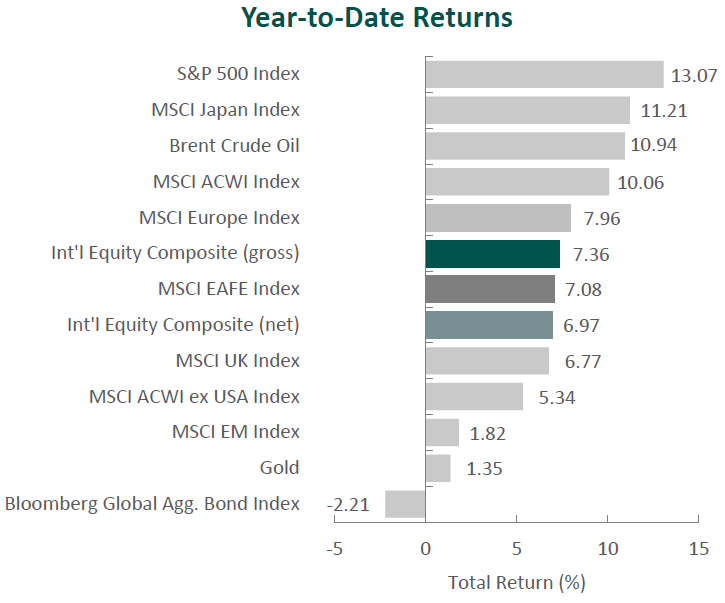
Global equity markets finished lower for the third consecutive quarter. Overall, the MSCI ACWI Index dropped 6.82% during the period, bringing its year-to-date return to -25.63%. Concurrently, the Bloomberg Global Aggregate Bond Index pulled back 6.94%, bringing its year-to-date return to -19.89%. In terms of style, growth stocks outperformed their value counterparts during the quarter, with the MSCI ACWI Growth Index beating the MSCI ACWI Value Index by 1.73%. Nevertheless, for the year-to-date period, the MSCI ACWI Value Index has outperformed the MSCI ACWI Growth Index by 13.14%.

Sources: SS&C Advent, Bloomberg
Past performance is not indicative of future results. Aristotle Global Equity Composite returns are presented gross and net of investment advisory fees and include the reinvestment of all income. Gross returns will be reduced by fees and other expenses that may be incurred in the management of the account. Net returns are presented net of actual investment advisory fees and after the deduction of all trading expenses. Aristotle Capital Composite returns are preliminary pending final account reconciliation. Please see important disclosures at the end of this document.

Regionally, Emerging Markets and Asia/Pacific ex-Japan were the weakest performers during the quarter. On the other hand, Latin America and North America were the best performers. On a sector basis, all eleven sectors within the MSCI ACWI Index posted losses, with Communication Services, Real Estate and Utilities being the worst performers. The best performers were Energy, Consumer Discretionary and Financials.

As energy prices inflicted pain across much of the world, and the tensions between East and West became more pronounced, the outlook for global economic activity and inflation continued to worsen. The IMF now projects global growth to slow from 6.1% in 2021 to 3.2% in 2022 versus the 3.6% projection last quarter. The IMF also raised its 2022 inflation estimates to 6.6% for advanced economies and 9.5% for developing economies.

In response to elevated inflation, many central banks tightened monetary policy during the quarter. With two 0.75% increases, the U.S. Federal Reserve raised its benchmark rate to a range of 3.00% to 3.25%. The European Central Bank also raised its benchmark lending rate from 0.00% to 1.25%—its first hike in eleven years—while the Bank of England, with two 0.50% increases, raised its benchmark rate to 2.25%. Meanwhile, Japan continues to maintain its ultra-low interest rates, and China’s central bank cut key policy rates.

The divergence in monetary policies between the U.S. Federal Reserve and other central banks, plus concerns for slowing global growth, sent the U.S. Dollar Index (DXY) to a two-decade high. Currencies such as the Euro and Yen have lost approximately 14% and 20% in relative value, respectively, year-to-date. The rapid one-sided movement in the foreign exchange market caused the Bank of Japan to intervene and strengthen the Yen for the first time in 24 years.

The U.K. gathered the world’s attention this quarter, as Queen Elizabeth II—the second-longest reigning monarch in world history—passed away in September, leaving the throne to her son King Charles III. A new government was also installed after Boris Johnson resigned. He was replaced in a special election by current Prime Minister Liz Truss, a fellow member of the Conservative Party. However, Prime Minister Truss’s plan to help citizens afford energy through tax cuts and subsidies stood in contrast to the Bank of England’s efforts to curb inflation. The mixed messages resulted in a sharp sell-off in U.K. government bonds, forcing England’s central bank to reverse its stance toward quantitative tightening to prop up tumbling gilt prices.

Outside of the U.K., Russia’s ongoing invasion of Ukraine has not only caused tragic human suffering and loss of life, but is also threatening European countries’ ability to procure natural gas ahead of winter. Sanctions, pipeline issues and the surge in prices have revealed Europe’s acute need for new energy sources—independent of Russia. In addition, U.S. and Chinese relations became further strained in August following Nancy Pelosi’s visit to Taiwan, only to be compounded by President Biden’s statement that the U.S. military could be used to defend the island. These events have served to exacerbate already heightened global economic uncertainty.

Performance and Attribution Summary

For the third quarter of 2022, Aristotle Capital’s Global Equity Composite posted a total return of -6.75% gross of fees (-6.82% net of fees), compared to the MSCI World Index, which returned -6.19%, and the MSCI ACWI Index, which returned -6.82%. Please refer to the table below for detailed performance.

Performance (%) 3Q22YTD1 Year3 Years5 Years10 Years ITD*
Global Equity Composite (gross)-6.75-26.63-21.984.205.468.948.32
Global Equity Composite (net)-6.82-26.81-22.193.865.118.527.89
MSCI World Index (net)-6.19-25.42-19.634.555.308.107.79
MSCI ACWI Index (net)-6.82-25.63-20.663.744.447.286.90
*The inception date for the Global Equity Composite is November 1, 2010. Past performance is not indicative of future results. Aristotle Global Equity Composite returns are presented gross and net of investment advisory fees and include the reinvestment of all income. Gross returns will be reduced by fees and other expenses that may be incurred in the management of the account. Net returns are presented net of actual investment advisory fees and after the deduction of all trading expenses. Aristotle Capital Composite returns are preliminary pending final account reconciliation. Please see important disclosures at the end of this document.

Source: FactSet

Past performance is not indicative of future results. Attribution results are based on sector returns, which are gross of investment advisory fees and include the reinvestment of all income. Please see important disclosures at the end of this document.

From a sector perspective, the portfolio’s underperformance relative to the MSCI World Index can be attributed to security selection, while allocation effects had a positive impact. Security selection in Consumer Discretionary, Information Technology and Health Care detracted the most from the portfolio’s relative performance. Conversely, security selection in Materials and Energy, as well as an underweight in Communication Services, contributed to relative return.

Regionally, allocation effects were responsible for the portfolio’s underperformance relative to the MSCI World Index, while security selection had a positive impact. Security selection in Europe and our exposure in Emerging Markets detracted the most from relative performance, while our security selection in North America and Asia/Pacific ex-Japan contributed.

Contributors and Detractors for 3Q 2022

Relative ContributorsRelative Detractors
CamecoGSK
DBS GroupAdobe
Martin Marietta MaterialsSony
LennarAIA Group
Microchip TechnologySamsung Electronics

Adobe, the content creation and publishing software provider, was one of the largest detractors for the quarter. So far in 2022, Adobe has achieved record revenues with strength in all its businesses, as the acceleration toward digital has continued to drive content creation across industries. During the quarter, however, the company’s shares declined after announcing its plans to acquire Figma, a web-first collaborative interface design platform, for $20 billion. What at first glance may seem like a steep price, Figma’s web-based, multi-player platform could accelerate the delivery of Adobe’s Creative Cloud technologies on the web, increasing Adobe’s reach and total addressable market. Management expects the deal to close in 2023 and the transaction to be accretive by the end of the third year of integration. As is the case with any significant acquisition, we will take our time to understand this deal’s rationale and follow management’s ability to take Figma to “new heights.” This has been the case with previous acquisitions, including Marketo and Magento (although each at a much smaller purchase price). In general, we admire management teams that are able to recognize the evolving needs of their clients and are unafraid of “competing with themselves” by developing new offerings. We will continue to study this acquisition and better understand the desire of content creators to collaborate over the web.

Sony, the global provider of videogames and consoles, image sensors, and music, as well as movies, was a major detractor for the period. The share price of the company has struggled this year following its strong performance in 2021. Signs of a slowdown in the gaming industry (as people seem inclined to take on outdoor activities as pandemic fears have subsided), combined with sales of its PlayStation 5 that have been held up by a global parts shortage, have led to gaming-related software sales falling more than 20% year-over-year. Rather than focusing on short-term demand dislocations, we focus on the company’s ability to continue migrating videogame users toward the firm’s subscription offerings, as well as its capacity to leverage content across its video, music and gaming platforms. We are also impressed with the expansion of Sony’s Music segment, which has been supported by the pervasiveness of streaming services. Management’s ongoing work to improve the company’s TV and film studios is bearing fruit as well, with sales growing 67% year-over-year for its Pictures segment as its regional strategy has taken hold, including recent progress made toward solidifying a merger plan with India-based Zee Entertainment. All of this is to say we remain excited by the oligopolistic nature of the businesses Sony operates in, and the future prospects for the company given its leadership in image sensors, music publishing and gaming consoles.

Cameco, the world’s largest publicly traded uranium producer, was the top contributor for the quarter. In order to pivot away from a reliance on Russian energy without jeopardizing net-zero commitments, policymakers and businesses have (finally) turned their attention toward nuclear power generation. Germany extended the life of two nuclear power plants, and Japan announced it will look at extending the life of existing reactors, restart additional idle reactors and look at developing next-generation reactors. These shifts in energy policies have increased demand at a time of tight supply. Although such market dynamics will likely favor Cameco in the short term, we believe the company’s continued focus on supply discipline will help ensure long-term success as well. By obtaining long-term contracts and slowly ramping production, we believe Cameco is well positioned in the changing energy landscape. The company has already recorded 45 million pounds in new long-term uranium contracts this year, with additional contract discussions underway. Furthermore, Cameco increased its ownership in Cigar Lake by 4.52%, bringing its ownership stake to 54.55%. This ownership expansion, combined with investment in operational readiness for McArthur River/Key Lake, should allow the company to continue to meet utility customers’ changing and growing long-term demand. This sets the stage for Cameco to execute on our catalyst of increasing its uranium volume sold at higher prices, all while lowering production costs through scale and its access to some of the highest-grade ore on the planet.

DBS Group, Singapore’s largest bank1, was a leading contributor. We have long been attracted to the Singapore banking industry due to its oligopoly structure and the stability of the country’s regulatory environment, as well as its fiscal and monetary policies. Part of this stability is attributable to the central bank’s long-standing currency monitoring band, which has kept the Singapore dollar tightly linked to the U.S. dollar. In our opinion, outside of a robust first half 2022 earnings report, the quarter contained nothing material from a catalyst or fundamental perspective. As such, we believe this quarter’s stock price performance was likely due to U.S. dollar strength—something we do not attempt to predict. We continue to admire DBS’s leadership in digital banking, which we believe should allow the company to drive further efficiency gains. Moreover, we continue to monitor DBS’s pending acquisition of Citigroup’s consumer banking business in Taiwan; this acquisition should bolster our ongoing catalyst of profitable expansion outside of Singapore.

1As measured by assets as of June 30,2022.

Recent Portfolio Activity

Consistent with our long-term horizon and low turnover, there were no new purchases or sales completed during the quarter.

BuysSells
NoneNone

Conclusion

Our investment process seeks to identify businesses that, in our opinion, possess a combination of qualities that are both sustainable and difficult to reproduce. While broad macroeconomic factors such as inflation, central bank policies, foreign exchange markets and various other data points are taken into consideration as part of our research, we spend the vast majority of our time analyzing individual companies. Rather than attempting to predict the path of stock prices in the short term, we focus our efforts on understanding businesses over the long term. We believe the long-term benefits of patience and extensive research far outweigh the potential risk of a missed opportunity; seldom are reactionary decisions optimal. While the current market environment seems to be dominated by macro news and geopolitical events, we remain steadfast in our belief that the fundamentals of a company, ultimately, determine its intrinsic worth. As such, we will continue to focus our efforts on studying the unique qualities and characteristics of the companies in which we are invested.

Disclosures

The opinions expressed herein are those of Aristotle Capital Management, LLC (Aristotle Capital) and are subject to change without notice. Past performance is not a guarantee or indicator of future results. This material is not financial advice or an offer to buy or sell any product. You should not assume that any of the securities transactions, sectors or holdings discussed in this report were or will be profitable, or that recommendations Aristotle Capital makes in the future will be profitable or equal the performance of the securities listed in this report. The portfolio characteristics shown relate to the Aristotle Global Equity strategy. Not every client’s account will have these characteristics. Aristotle Capital reserves the right to modify its current investment strategies and techniques based on changing market dynamics or client needs. There is no assurance that any securities discussed herein will remain in an account’s portfolio at the time you receive this report or that securities sold have not been repurchased. The securities discussed may not represent an account’s entire portfolio and, in the aggregate, may represent only a small percentage of an account’s portfolio holdings. The performance attribution presented is of a representative account from Aristotle Capital’s Global Equity Composite. The representative account is a discretionary client account which was chosen to most closely reflect the investment style of the strategy. The criteria used for representative account selection is based on the account’s period of time under management and its similarity of holdings in relation to the strategy. Recommendations made in the last 12 months are available upon request.

Returns are presented gross and net of investment advisory fees and include the reinvestment of all income. Gross returns will be reduced by fees and other expenses that may be incurred in the management of the account. Net returns are presented net of actual investment advisory fees and after the deduction of all trading expenses.

All investments carry a certain degree of risk, including the possible loss of principal. Investments are also subject to political, market, currency and regulatory risks or economic developments. International investments involve special risks that may in particular cause a loss in principal, including currency fluctuation, lower liquidity, different accounting methods and economic and political systems, and higher transaction costs. These risks typically are greater in emerging markets. Securities of small‐ and medium‐sized companies tend to have a shorter history of operations, be more volatile and less liquid. Value stocks can perform differently from the market as a whole and other types of stocks.

The material is provided for informational and/or educational purposes only and is not intended to be and should not be construed as investment, legal or tax advice and/or a legal opinion. Investors should consult their financial and tax adviser before making investments. The opinions referenced are as of the date of publication, may be modified due to changes in the market or economic conditions, and may not necessarily come to pass. Information and data presented has been developed internally and/or obtained from sources believed to be reliable. Aristotle Capital does not guarantee the accuracy, adequacy or completeness of such information.

Aristotle Capital Management, LLC is an independent investment adviser registered under the Investment Advisers Act of 1940, as amended. Registration does not imply a certain level of skill or training. More information about Aristotle Capital, including our investment strategies, fees and objectives, can be found in our Form ADV Part 2, which is available upon request.

Performance Disclosures


Composite returns for all periods ended September 30, 2022 are preliminary pending final account reconciliation.

The Aristotle Global Equity Composite has an inception date of November 1, 2010; however, the strategy initially began at Howard Gleicher’s predecessor firm in July 2007. A supplemental performance track record from January 1, 2008 through October 31, 2010 is provided on this page and complements the Global Equity Composite presentation that is located at the end of this presentation. The performance results were achieved while Mr. Gleicher managed the strategy at a prior firm. The returns are those of a publicly available mutual fund from the fund’s inception through Mr. Gleicher’s departure from the firm. During that time, Mr. Gleicher had primary responsibility for managing the fund.

Past performance is not indicative of future results. The information provided should not be considered financial advice or a recommendation to purchase or sell any particular security or product.  Performance results for periods greater than one year have been annualized.

Returns are presented gross and net of investment advisory fees and include the reinvestment of all income. Gross returns will be reduced by fees and other expenses that may be incurred in the management of the account. Net returns are presented net of actual investment advisory fees and after the deduction of all trading expenses.

Aristotle Capital Management, LLC is an independent investment adviser registered under the Investment Advisers Act of 1940, as amended. Registration does not imply a certain level of skill or training. More information about Aristotle Capital, including our investment strategies, fees and objectives, can be found in our Form ADV Part 2, which is available upon request. ACM-2210-97

Index Disclosures

The MSCI World Index is a free float-adjusted market capitalization weighted index that is designed to measure the equity market performance of developed markets. The MSCI World Index consists of the following 23 developed market country indices: Australia, Austria, Belgium, Canada, Denmark, Finland, France, Germany, Hong Kong, Ireland, Israel, Italy, Japan, Netherlands, New Zealand, Norway, Portugal, Singapore, Spain, Sweden, Switzerland, the United Kingdom and the United States. The MSCI Emerging Markets Index is a free float-adjusted market capitalization-weighted index that is designed to measure equity market performance of emerging markets. The MSCI Emerging Markets Index consists of the following 24 emerging market country indexes: Brazil, Chile, China, Colombia, Czech Republic, Egypt, Greece, Hungary, India, Indonesia, Korea, Kuwait, Malaysia, Mexico, Peru, Philippines, Poland, Qatar, Saudi Arabia, South Africa, Taiwan, Thailand, Turkey and United Arab Emirates. The MSCI ACWI captures large and mid-cap representation across 23 developed markets and 24 emerging markets countries. With approximately 3,000 constituents, the Index covers approximately 85% of the global investable equity opportunity set. The MSCI ACWI Growth Index captures large and mid-cap securities exhibiting overall growth style characteristics across 23 developed markets countries and 24 emerging markets countries. The MSCI ACWI Value Index captures large and mid-cap securities exhibiting overall value style characteristics across 23 developed markets countries and 24 emerging markets countries. The MSCI Europe Index captures large and mid-cap representation across 15 developed markets countries in Europe. With more than 400 constituents, the Index covers approximately 85% of the free float-adjusted market capitalization across the European developed markets equity universe. The MSCI Japan Index is designed to measure the performance of the large and mid-cap segments of the Japanese market. With approximately 250 constituents, the Index covers approximately 85% of the free float-adjusted market capitalization in Japan. The S&P 500® Index is the Standard & Poor’s Composite Index of 500 stocks and is a widely recognized, unmanaged index of common stock prices. The NYSE FAANG+ Index is an equal-dollar-weighted index designed to represent a segment of the Information Technology and Consumer Discretionary sectors consisting of highly traded growth stocks of technology and tech-enabled companies, such as Facebook, Apple, Amazon, Netflix and Alphabet’s Google. The Bloomberg Global Aggregate Bond Index is a flagship measure of global investment grade debt from 28 local currency markets. This multi-currency benchmark includes Treasury, government-related, corporate and securitized fixed rate bonds from both developed and emerging markets issuers. The Brent Crude Oil Index is a major trading classification of sweet light crude oil that serves as a major benchmark price for purchases of oil worldwide. The U.S. Dollar Index (DXY) is a measure of the value of the U.S. dollar relative to the value of a basket of currencies of the majority of the United States’ most significant trading partners. The volatility (beta) of the Composite may be greater or less than the benchmarks. It is not possible to invest directly in these indices.

(All MSCI index returns are shown net and in U.S. dollars unless otherwise noted.)

Markets Review

Global equity markets finished lower for the third consecutive quarter. Overall, the MSCI ACWI Index dropped 6.82% during the period, bringing its year-to-date return to -25.63%. Concurrently, the Bloomberg Global Aggregate Bond Index pulled back 6.94%, bringing its year-to-date return to -19.89%. In terms of style, growth stocks outperformed their value counterparts during the quarter, with the MSCI ACWI Growth Index beating the MSCI ACWI Value Index by 1.73%. Nevertheless, for the year-to-date period, the MSCI ACWI Value Index has outperformed the MSCI ACWI Growth Index by 13.14%.

Sources: SS&C Advent, Bloomberg
Past performance is not indicative of future results. Aristotle International Equity Composite returns are presented gross and net of investment advisory fees and include the reinvestment of all income. Gross returns will be reduced by fees and other expenses that may be incurred in the management of the account. Net returns are presented net of actual investment advisory fees and after the deduction of all trading expenses. Aristotle Capital Composite returns are preliminary pending final account reconciliation. Please see important disclosures at the end of this document.

The MSCI EAFE Index dropped 9.36% during the third quarter, while the MSCI ACWI ex USA Index decreased 9.91%. Regionally, the U.K. and Europe & Middle East were the weakest performers, while Asia declined the least. On a sector basis, all eleven sectors within the MSCI EAFE Index posted negative returns, with Communication Services, Utilities and Real Estate generating the largest losses. Conversely, Energy, Consumer Staples and Information Technology declined the least.

As energy prices inflicted pain across much of the world, and the tensions between East and West became more pronounced, the outlook for global economic activity and inflation continued to worsen. The IMF now projects global growth to slow from 6.1% in 2021 to 3.2% in 2022 versus the 3.6% projection last quarter. The IMF also raised its 2022 inflation estimates to 6.6% for advanced economies and 9.5% for developing economies.

In response to elevated inflation, many central banks tightened monetary policy during the quarter. With two 0.75% increases, the U.S. Federal Reserve raised its benchmark rate to a range of 3.00% to 3.25%. The European Central Bank also raised its benchmark lending rate from 0.00% to 1.25%—its first hike in eleven years—while the Bank of England, with two 0.50% increases, raised its benchmark rate to 2.25%. Meanwhile, Japan continues to maintain its ultra-low interest rates, and China’s central bank cut key policy rates.

The divergence in monetary policies between the U.S. Federal Reserve and other central banks, plus concerns for slowing global growth, sent the U.S. Dollar Index (DXY) to a two-decade high. Currencies such as the Euro and Yen have lost approximately 14% and 20% in relative value, respectively, year-to-date. The rapid one-sided movement in the foreign exchange market caused the Bank of Japan to intervene and strengthen the Yen for the first time in 24 years.

The U.K. gathered the world’s attention this quarter, as Queen Elizabeth II—the second-longest reigning monarch in world history—passed away in September, leaving the throne to her son King Charles III. A new government was also installed after Boris Johnson resigned. He was replaced in a special election by current Prime Minister Liz Truss, a fellow member of the Conservative Party. However, Prime Minister Truss’s plan to help citizens afford energy through tax cuts and subsidies stood in contrast to the Bank of England’s efforts to curb inflation. The mixed messages resulted in a sharp sell-off in U.K. government bonds, forcing England’s central bank to reverse its stance toward quantitative tightening to prop up tumbling gilt prices.

Outside of the U.K., Russia’s ongoing invasion of Ukraine has not only caused tragic human suffering and loss of life, but is also threatening European countries’ ability to procure natural gas ahead of winter. Sanctions, pipeline issues and the surge in prices have revealed Europe’s acute need for new energy sources—independent of Russia. In addition, U.S. and Chinese relations became further strained in August following Nancy Pelosi’s visit to Taiwan, only to be compounded by President Biden’s statement that the U.S. military could be used to defend the island. These events have served to exacerbate already heightened global economic uncertainty.

Performance and Attribution Summary

For the third quarter of 2022, Aristotle Capital’s International Equity Composite posted a total return of -7.90% gross of fees (-8.03% net of fees), outperforming the MSCI EAFE Index, which returned -9.36%, and the MSCI ACWI ex USA Index, which returned -9.91%. Please refer to the table below for detailed performance.

Performance (%) 3Q22YTD1 Year3 Years5 Years10 Years Since Inception*
International Equity Composite (gross)-7.90-30.24-26.44-1.081.164.573.98
International Equity Composite (net)-8.03-30.49-26.79-1.550.684.053.48
MSCI EAFE Index (net)-9.36-27.09-25.13-1.83-0.843.670.74
MSCI ACWI ex USA Index (net)-9.91-26.50-25.17-1.52-0.813.010.63
*The inception date for the International Equity Composite is January 1, 2008. Past performance is not indicative of future results. Aristotle International Equity Composite returns are presented gross and net of investment advisory fees and include the reinvestment of all income. Gross returns will be reduced by fees and other expenses that may be incurred in the management of the account. Net returns are presented net of actual investment advisory fees and after the deduction of all trading expenses. Aristotle Capital Composite returns are preliminary pending final account reconciliation. Please see important disclosures at the end of this document.

Source: FactSet

Past performance is not indicative of future results. Attribution results are based on sector returns which are gross of investment advisory fees. Attribution is based on performance that is gross of investment advisory fees and includes the reinvestment of income.

From a sector perspective, the portfolio’s outperformance relative to the MSCI EAFE Index can be attributed to both security selection and allocation effects. Security selection in Industrials, Financials and Energy contributed the most to the portfolio’s relative performance. Conversely, security selection in Health Care, Information Technology and Consumer Staples detracted from relative return.

Regionally, both security selection and allocation effects were responsible for the portfolio’s outperformance. Exposure to Canada and security selection in the U.K. contributed the most to relative performance, while an underweight in Asia and an overweight in the U.K. detracted.

Contributors and Detractors for 3Q 2022

Relative ContributorsRelative Detractors
CamecoGSK
Pan Pacific InternationalSony
Ashtead GroupNemetschek
DBS GroupAIA Group
Munich Re GroupAmundi

Cameco, the world’s largest publicly traded uranium producer, was the top contributor for the quarter. In order to pivot away from a reliance on Russian energy without jeopardizing net-zero commitments, policymakers and businesses have (finally) turned their attention toward nuclear power generation. Germany extended the life of two nuclear power plants, and Japan announced it will look at extending the life of existing reactors, restart additional idle reactors and look at developing next-generation reactors. These shifts in energy policies have increased demand at a time of tight supply. Although such market dynamics will likely favor Cameco in the short term, we believe the company’s continued focus on supply discipline will help ensure long-term success as well. By obtaining long-term contracts and slowly ramping production, we believe Cameco is well positioned in the changing energy landscape. The company has already recorded 45 million pounds in new long-term uranium contracts this year, with additional contract discussions underway. Furthermore, Cameco increased its ownership in Cigar Lake by 4.52%, bringing its ownership stake to 54.55%. This ownership expansion, combined with investment in operational readiness for McArthur River/Key Lake, should allow the company to continue to meet utility customers’ changing and growing long-term demand. This sets the stage for Cameco to execute on our catalyst of increasing its uranium volume sold at higher prices, all while lowering production costs through scale and its access to some of the highest-grade ore on the planet.

DBS Group, Singapore’s largest bank1 was a leading contributor. We have long been attracted to the Singapore banking industry due to its oligopoly structure and the stability of the country’s regulatory environment, as well as its fiscal and monetary policies. Part of this stability is attributable to the central bank’s long-standing currency monitoring band, which has kept the Singapore dollar tightly linked to the U.S. dollar. In our opinion, outside of a robust first half 2022 earnings report, the quarter contained nothing material from a catalyst or fundamental perspective. As such, we believe this quarter’s stock price performance was likely due to U.S. dollar strength—something we do not attempt to predict. We continue to admire DBS’s leadership in digital banking, which we believe should allow the company to drive further efficiency gains. Moreover, we continue to monitor DBS’s pending acquisition of Citigroup’s consumer banking business in Taiwan; this acquisition should bolster our ongoing catalyst of profitable expansion outside of Singapore.

1As measured by assets as of June 30, 2022.

GSK, the U.K.-headquartered pharmaceutical company, was the largest detractor. GSK completed the demerger of its consumer health business in July, creating the independent, publicly traded company Haleon. As discussed below, we made Haleon a full position following the spinoff. We believe the separation unlocks value and allows remaining GSK to benefit from greater focus on biopharmaceuticals and vaccines. After managing the completed spinoff, CFO Iain Mackay announced his plans to retire in May 2023, to be replaced by Julie Brown. Having served in previous CFO posts at both the luxury goods brand Burberry, as well as the pharmaceutical firm AstraZeneca, we look forward to following Ms. Brown’s initiatives at GSK. Moreover, the company has been advancing on our catalyst of market share gains for Shingrix, its vaccine to prevent shingles. Shingrix again delivered record sales growth and continues to be a key driver of GSK’s vaccine revenue expansion. Lastly, legal concerns related to potential side effects from the heartburn medicine Zantac made headlines. Although Zantac was marketed by several firms and its associated risks have been known for a number of years, upcoming lawsuits in the U.S. received media attention this quarter. We are closely following the litigation and may have more to share in future commentaries. In the interim, we find the price adjustment to be overdone. The largest side effect-related drug settlements have been in the single-digit billions, while more than £20 billion in market capitalization has been removed from GSK. Despite recent share price declines, we remain confident in GSK’s ability to further penetrate markets with its current products and evolve its pipeline of innovative medicines.

Sony, the global provider of videogames and consoles, image sensors, and music, as well as movies, was a major detractor for the period. The share price of the company has struggled this year following its strong performance in 2021. Signs of a slowdown in the gaming industry (as people seem inclined to take on outdoor activities as pandemic fears have subsided), combined with sales of its PlayStation 5 that have been held up by a global parts shortage, have led to gaming-related software sales falling more than 20% year-over-year. Rather than focusing on short-term demand dislocations, we focus on the company’s ability to continue migrating videogame users toward the firm’s subscription offerings, as well as its capacity to leverage content across its video, music and gaming platforms. We are also impressed with the expansion of Sony’s Music segment, which has been supported by the pervasiveness of streaming services. Management’s ongoing work to improve the company’s TV and film studios is bearing fruit as well, with sales growing 67% year-over-year for its Pictures segment as its regional strategy has taken hold, including recent progress made toward solidifying a merger plan with India-based Zee Entertainment.

Recent Portfolio Activity

BuysSells
HaleonReckitt

We have owned shares of Reckitt—the global manufacturer and marketer of household, health and personal care products—for over a decade, having become investors in the second quarter of 2011. The company’s well-known brands include Mucinex, Dr. Scholl’s, Woolite and Lysol. During our holding period, Reckitt executed on some, but not all, of our catalysts. In particular, the 2017 acquisition of Mead Johnson increased its emerging markets presence by expanding the company’s offerings in China; however, the acquisition came at too high of a cost in our opinion. The fresh perspective Laxman Narasimhan brought when he joined as CEO in 2019, which was reflected in his reorganization of the Health and Hygiene units and a shift toward higher-margin products, was another catalyst we identified. While we still view Reckitt as a high-quality business, with many of its catalysts now closer to completion, we decided to exit our position in favor of what we consider to be a more optimal opportunity in Haleon, which is discussed below.

Haleon plc

Haleon, headquartered in the U.K., is currently the only publicly traded, pure-play global consumer health company. The company has existed for decades in various forms and, through a history of M&A, is the product of three major pharmaceutical companies’ assets: GSK, Novartis and Pfizer. With roughly £9.5 billion in revenue, Haleon operates in over 170 markets, selling products in oral health (~28% of 2021 revenue), pain relief (~23%), digestive health (~21%), vitamin and mineral supplements (~16%), and respiratory health (~12%). Its recognizable brands include Sensodyne toothpaste, the pain relief product Advil, Theraflu for cold and flu symptoms, and Centrum multivitamins.

Haleon was spun off this summer by existing holding GSK. Impressed by this consumer health products business, we decided to increase our ownership to a full weight in the portfolio.

Quality

Some of the quality characteristics we have identified for Haleon include:

– Portfolio of well-known brands, supported by a history of innovation and doctors’ advocacy;

– Market leadership in different categories across the world’s fragmented consumer health industry, including number one positions in digestive health and vitamin and mineral supplements; and

– Global reach and diversification across geographies and categories, with a track record of improving EBITDA margins and stable FREE cash flow generation.

Attractive Valuation

Given our estimates of higher normalized earnings, both due to further product penetration and efficiency gains as a standalone enterprise, we believe the company is offered at an attractive price. In addition, we recognize the risks associated with the recent Zantac lawsuits and believe this is more than reflected in the current stock price.

Compelling Catalysts

Catalysts we have identified for Haleon, which we believe will cause its stock price to appreciate over our three- to five-year investment horizon, include:

– Enhanced profitability and increased revenue, as many of its products, including what the company refers to as its higher-margin “power brands,” are better supported for growth by the company’s ability to make its own capital allocation decisions;

– Benefits from being managed as an independent company that should spur improved business structures and innovation efforts; and

– Management’s plan for debt reduction should also allow for more optimal capital allocation and increased cash returns to shareholders.

Conclusion

Our investment process seeks to identify businesses that, in our opinion, possess a combination of qualities that are both sustainable and difficult to reproduce. While broad macroeconomic factors such as inflation, central bank policies, foreign exchange markets and various other data points are taken into consideration as part of our research, we spend the vast majority of our time analyzing individual companies. Rather than attempting to predict the path of stock prices in the short term, we focus our efforts on understanding businesses over the long term. We believe the long-term benefits of patience and extensive research far outweigh the potential risk of a missed opportunity; seldom are reactionary decisions optimal. While the current market environment seems to be dominated by macro news and geopolitical events, we remain steadfast in our belief that the fundamentals of a company, ultimately, determine its intrinsic worth. As such, we will continue to focus our efforts on studying the unique qualities and characteristics of the companies in which we are invested.

Disclosures

The opinions expressed herein are those of Aristotle Capital Management, LLC (Aristotle Capital) and are subject to change without notice. Past performance is not a guarantee or indicator of future results. This material is not financial advice or an offer to buy or sell any product. You should not assume that any of the securities transactions, sectors or holdings discussed in this report were or will be profitable, or that recommendations Aristotle Capital makes in the future will be profitable or equal the performance of the securities listed in this report. The portfolio characteristics shown relate to the Aristotle International Equity strategy. Not every client’s account will have these characteristics. Aristotle Capital reserves the right to modify its current investment strategies and techniques based on changing market dynamics or client needs. There is no assurance that any securities discussed herein will remain in an account’s portfolio at the time you receive this report or that securities sold have not been repurchased. The securities discussed may not represent an account’s entire portfolio and, in the aggregate, may represent only a small percentage of an account’s portfolio holdings. The performance attribution presented is of a representative account from Aristotle Capital’s International Equity Composite. The representative account is a discretionary client account which was chosen to most closely reflect the investment style of the strategy. The criteria used for representative account selection is based on the account’s period of time under management and its similarity of holdings in relation to the strategy. Recommendations made in the last 12 months are available upon request.

Returns are presented gross and net of investment advisory fees and include the reinvestment of all income. Gross returns will be reduced by fees and other expenses that may be incurred in the management of the account. Net returns are presented net of actual investment advisory fees and after the deduction of all trading expenses.

All investments carry a certain degree of risk, including the possible loss of principal. Investments are also subject to political, market, currency and regulatory risks or economic developments. International investments involve special risks that may in particular cause a loss in principal, including currency fluctuation, lower liquidity, different accounting methods and economic and political systems, and higher transaction costs. These risks typically are greater in emerging markets. Securities of small‐ and medium‐sized companies tend to have a shorter history of operations, be more volatile and less liquid. Value stocks can perform differently from the market as a whole and other types of stocks.

The material is provided for informational and/or educational purposes only and is not intended to be and should not be construed as investment, legal or tax advice and/or a legal opinion. Investors should consult their financial and tax adviser before making investments. The opinions referenced are as of the date of publication, may be modified due to changes in the market or economic conditions, and may not necessarily come to pass. Information and data presented has been developed internally and/or obtained from sources believed to be reliable. Aristotle Capital does not guarantee the accuracy, adequacy or completeness of such information.

Aristotle Capital Management, LLC is an independent registered investment adviser under the Advisers Act of 1940, as amended. Registration does not imply a certain level of skill or training. More information about Aristotle Capital, including our investment strategies, fees and objectives, can be found in our ADV Part 2, which is available upon request.

Performance Disclosures


Composite returns for all periods ended September 30, 2022 are preliminary pending final account reconciliation.

Past performance is not indicative of future results. The information provided should not be considered financial advice or a recommendation to purchase or sell any particular security or product.  Performance results for periods greater than one year have been annualized.

Returns are presented gross and net of investment advisory fees and include the reinvestment of all income. Gross returns will be reduced by fees and other expenses that may be incurred in the management of the account. Net returns are presented net of actual investment advisory fees and after the deduction of all trading expenses.

Aristotle Capital Management, LLC is an independent registered investment adviser under the Advisers Act of 1940, as amended. Registration does not imply a certain level of skill or training. More information about Aristotle Capital, including our investment strategies, fees and objectives, can be found in our ADV Part 2, which is available upon request. ACM-2210-44

Index Disclosures

The MSCI EAFE Index (Europe, Australasia, Far East) is a free float-adjusted market capitalization-weighted index that is designed to measure the equity market performance of developed markets, excluding the United States and Canada. The MSCI EAFE Index consists of the following 21 developed market country indices: Australia, Austria, Belgium, Denmark, Finland, France, Germany, Hong Kong, Ireland, Israel, Italy, Japan, the Netherlands, New Zealand, Norway, Portugal, Singapore, Spain, Sweden, Switzerland and the United Kingdom. The MSCI ACWI captures large and mid-cap representation across 23 developed market countries and 24 emerging markets countries. With approximately 3,000 constituents, the Index covers approximately 85% of the global investable equity opportunity set. The MSCI ACWI Growth Index captures large and mid-cap securities exhibiting overall growth style characteristics across 23 developed markets countries and 24 emerging markets countries. The MSCI ACWI Value Index captures large and mid-cap securities exhibiting overall value style characteristics across 23 developed markets countries and 24 emerging markets countries. The MSCI ACWI ex USA Index captures large and mid-cap representation across 22 of 23 developed markets countries (excluding the United States) and 24 emerging markets countries. With approximately 2,300 constituents, the Index covers approximately 85% of the global equity opportunity set outside the United States. The MSCI Emerging Markets Index is a free float-adjusted market capitalization-weighted index that is designed to measure the equity market performance of emerging markets. The MSCI Emerging Markets Index consists of the following 24 emerging market country indexes: Brazil, Chile, China, Colombia, Czech Republic, Egypt, Greece, Hungary, India, Indonesia, Korea, Kuwait, Malaysia, Mexico, Peru, Philippines, Poland, Qatar, Saudi Arabia, South Africa, Taiwan, Thailand, Turkey and United Arab Emirates. The S&P 500® Index is the Standard & Poor’s Composite Index of 500 stocks and is a widely recognized, unmanaged index of common stock prices. The Brent Crude Oil Index is a major trading classification of sweet light crude oil that serves as a major benchmark price for purchases of oil worldwide. The U.S. Dollar Index (DXY) is a measure of the value of the U.S. dollar relative to the value of a basket of currencies of the majority of the United States’ most significant trading partners. The MSCI Japan Index is designed to measure the performance of the large and mid-cap segments of the Japanese market. With approximately 250 constituents, the Index covers approximately 85% of the free float-adjusted market capitalization in Japan. The Bloomberg Global Aggregate Bond Index is a flagship measure of global investment grade debt from 28 local currency markets. This multi-currency benchmark includes treasury, government-related, corporate and securitized fixed-rate bonds from both developed and emerging markets issuers. The MSCI United Kingdom Index is designed to measure the performance of the large and mid-cap segments of the U.K. market. With nearly 100 constituents, the Index covers approximately 85% of the free float-adjusted market capitalization in the United Kingdom. The MSCI Europe Index captures large and mid-cap representation across 15 developed markets countries in Europe. With approximately 430 constituents, the Index covers approximately 85% of the free float-adjusted market capitalization across the European developed markets equity universe. These indices have been selected as the benchmarks and are used for comparison purposes only. The volatility (beta) of the Composite may be greater or less than the respective benchmarks. It is not possible to invest directly in these indices.   

For more on International Equity, access the latest resources.

FOR FINANCIAL ADVISOR USE ONLY – NOT FOR PUBLIC DISTRIBUTION

(All MSCI index returns are shown net and in U.S. dollars unless otherwise noted.)

Markets Review

Global equity markets rebounded in the fourth quarter. Overall, the MSCI ACWI Index rose 9.76% during the period. Concurrently, the Bloomberg Global Aggregate Bond Index increased 4.55%. In terms of style, value stocks outperformed their growth counterparts during the quarter, with the MSCI ACWI Value Index beating the MSCI ACWI Growth Index by 8.93%.

Sources: SS&C Advent, Bloomberg
Past performance is not indicative of future results. Aristotle International Equity ADR Composite returns are presented gross and net of investment advisory fees and include the reinvestment of all income. Aristotle Capital Composite returns are preliminary pending final account reconciliation. Please see important disclosures at the end of this document.

The MSCI EAFE Index climbed by 17.34% during the fourth quarter, while the MSCI ACWI ex USA Index increased 14.28%. Within the MSCI EAFE Index, Europe & Middle East and the U.K. were the strongest performers, while Asia, though posting a positive double-digit return, performed the worst. On a sector basis, all eleven sectors within the MSCI EAFE Index posted positive returns, with Financials, Materials and Energy generating the largest gains. Conversely, Communication Services, Consumer Staples and Real Estate gained the least.

As 2022 came to a close, the global economy continued to navigate various headwinds, such as persistent inflation, central bank policy actions, geopolitical uncertainty, the continued war in Ukraine and ongoing impacts from the pandemic. As a result, the IMF projects global growth to slow from 6.0% in 2021 to 3.2% and 2.7% in 2022 and 2023, respectively. Meanwhile, the IMF expects global inflation to rise to 8.8% in 2022 and then fall to 6.5% in 2023 and 4.1% in 2024 as both restrictive monetary policy and further resolution of supply-chain issues take effect. On the currency front, the U.S. Dollar Index (DXY) reversed, falling 7.87% after five consecutive quarters of appreciation.

Despite tighter monetary policy in most regions, global inflation remained at multidecade highs. This provided reason for many central banks to maintain a hawkish stance, including the U.S. Federal Reserve, which made two additional rate hikes during the quarter, raising its benchmark rate to a range of 4.25% to 4.50%. Likewise, the European Central Bank raised its benchmark lending rate to 2.50%, and the Bank of England increased its benchmark rate to 3.50%—the highest level in 14 years. However, all three of these central banks slowed the pace of rate increases in their latest hike in order to assess progress made against inflation given the corresponding lag in economic effects. Additionally, the Bank of Japan announced a surprising hawkish shift to its yield curve control policy, allowing the 10-year bond yield to move 0.50%, instead of the previously set 0.25%, on either side of its 0.00% target. While this decision from the world’s largest creditor signals the beginning of tightening financial conditions in Japan, the central bank’s yield target remains unchanged, and officials have indicated increased bond buying in the future. Meanwhile, the People’s Bank of China cut the reserve requirement ratio for banks by 25 basis points, adding around $70 billion of liquidity into the Chinese economy. The accomodative approach in China comes on the heels of reported record high COVID cases, as the country finally began easing its zero-COVID policy by shortening quarantine periods, relaxing contact tracing and lifting travel requirements. In Europe, U.K. instability continued as Prime Minister Truss’s controversial proposal for unfunded tax cuts—a stimulative approach to fiscal policy during a time of rampant inflation—sparked significant sell-offs in both gilts and sterling, which heightened market volatility. This led to Prime Minister Truss’s resignation after just 44 days in office, making her the shortest-serving prime minister in British history. She was replaced by Prime Minister Rishi Sunak, who has pledged to reverse many of Truss’s plans that caused turmoil in the U.K.

Lastly, on the geopolitical front, Russia withdrew its forces from Kherson, a significant strategic region forming a land bridge from Russia to Crimea. In addition to the success of Ukranian troops, the G7 formally set a price cap on Russian oil at $60 per barrel. This measure is expected to limit Russia’s ability to continue to finance its war in Ukraine.

Annual Markets Review

Global equity markets faltered in 2022, as the MSCI ACWI finished lower for the first three quarters of the year, leading to a
full-year return of -18.36%. Additionally, the MSCI ACWI Value Index outperformed the MSCI ACWI Growth Index for the year by 21.06%, value’s second consecutive year of outperformance and the largest since 2000.

Meanwhile, despite fixed income’s tendency to provide stability when equities are turbulent, the Bloomberg Global Aggregate Bond Index fell 16.25%, as inflation and the corresponding interest rate environment remained primary themes. In addition, supply-chain disruptions, soaring commodity prices and COVID restrictions—particularly in China—persisted, while new factors such as geopolitical conflict came to the forefront of market attention. On the currency front, the U.S.dollar strengthened against global currencies during the year, rising approximately 7.87%, as measured by the DXY. This caused the euro to break parity with the dollar in July, the British pound to touch its lowest point in over 200 years against the dollar and the Japanese yen to hit a low not seen since 1990.

Although it was a challenging year for investors, these volatile periods are precisely why we emphasize the phrase, “not every quarter, not every year.” Short-term returns are always subject to change, and macroeconomic factors are impossible to predict. As such, we remain focused on the long-term fundamentals of businesses, and we strive to identify undervalued, high-quality companies that can weather the complex and changing market dynamics. We believe this steadfast approach will allow us to provide lasting long-term value to our clients.

Performance and Attribution Summary

For the fourth quarter of 2022, Aristotle Capital’s International Equity ADR Composite posted a total return of 14.27% gross of fees (14.16% net of fees), underperforming the MSCI EAFE Index, which returned 17.34%, and the MSCI ACWI ex USA Index, which returned 14.28%. Please refer to the table below for detailed performance.

Performance (%) 4Q221 Year3 Years5 Years Since Inception*
Int’l Equity ADR Composite (gross)14.27-17.601.713.484.99
Int’l Equity ADR Composite (net)14.16-18.041.213.044.49
MSCI EAFE Index (net)17.34-14.450.871.544.04
MSCI ACWI ex USA Index (net)14.28-16.000.070.883.49
*The inception date for the International Equity ADR Composite is June 1, 2013. Past performance is not indicative of future results. Aristotle International Equity ADR Composite returns are presented gross and net of investment advisory fees and include the reinvestment of all income. Gross returns will be reduced by fees and other expenses that may be incurred in the management of the account. Net returns are presented net of actual investment advisory fees and after the deduction of all trading expenses. Aristotle Capital Composite returns are preliminary pending final account reconciliation. Please see important disclosures at the end of this document.

From a sector perspective in the fourth quarter, the portfolio’s underperformance relative to the MSCI EAFE Index can be attributed to security selection, while allocation effects had a slightly positive impact. Security selection in Industrials, Information Technology and Financials detracted the most from the portfolio’s relative performance. Conversely, security selection in Consumer Staples, an overweight in Financials and a lack of exposure to Real Estate contributed to relative return.

Regionally, both security selection and allocation effects were responsible for the portfolio’s underperformance. Exposure to Canada and security selection in Asia detracted the most from relative performance, while security selection in the U.K. and an underweight in Asia contributed.

Source: FactSet
Past performance is not indicative of future results. Attribution results are based on sector returns which are gross of investment advisory fees. Attribution is based on performance that is gross of investment advisory fees and includes the reinvestment of income.

Contributors and Detractors for 4Q 2022

ContributorsDetractors
ING GroepCameco
TotalEnergiesBrookfield
Munich ReinsuranceAccenture
SafranNidec
Estre Group BankDassault Systèmes

Cameco, the world’s largest publicly traded uranium producer, was the largest detractor for the quarter. The company announced a strategic partnership with Brookfield Renewable to acquire Westinghouse Electric Company, one of the world’s largest nuclear services businesses, for a total enterprise value of $7.87 billion. Cameco’s 49% interest in Westinghouse will be funded with cash, equity issuance and debt. While the announcement and resulting equity issuance came as a surprise, our initial impression is positive. Industry consolidation and management’s prior prudence (i.e., net cash balance sheet and shutting production in tough times), we believe, uniquely positioned Cameco to pursue this strategic transaction. We recognize the deal increases Cameco’s financial leverage; however, we believe Westinghouse’s market-leading downstream capabilities will align well with Cameco’s production and fuel services to offer a highly competitive nuclear fuel solution. In addition to the acquisition, the company announced the production of the first packaged pounds of uranium since restarting McArthur River mine and Key Lake mill. Moreover, Cameco signed a uranium supply agreement with China Nuclear International Corporation, a subsidiary of one of the country’s largest nuclear power operators, China National Nuclear Corporation. We believe these events highlight Cameco’s continued market leadership and opportunistic mindset in a fast-changing energy landscape.

Brookfield, one of the world’s largest and most diversified private market investors, was one of the biggest detractors. In December, the company completed the previously announced spinoff of 25% of its asset management business. The asset management business is now known as Brookfield Asset Management (“Manager,” ticker: BAM), and the parent company is now known as Brookfield Corporation (“Corporation,” ticker: BN). Shareholders received one share of the Manager for every four shares owned of the Corporation, and the Corporation retained a 75% interest in the Manager. While the transaction has limited economic impact, the spinoff creates additional transparency, as well as a listed entity for shareholders to invest in the pure-play asset management business. We continue to hold our investment in both the Corporation and Manager.

Munich Reinsurance, the world’s largest reinsurance company, was a leading contributor for the quarter. Despite the negative impacts of Hurricane Ian—the deadliest hurricane to strike the state of Florida since 1935—and volatility in capital markets, Munich Re continued to experience strong fundamental developments to its overall business. Specifically, the company saw significant improvements in profitability in business units such as Life and Health Reinsurance and strong premium growth across all of its business units as it continues to win market share, leverage its global scale and demonstrate underwriting discipline. The company also announced the formation of its new Global Specialty Insurance (GSI) division, which will be comprised of various primary insurance businesses that are currently classified within the reinsurance segment. Management believes this restructuring will allow them to efficiently support the various business lines while driving further expansion in the specialty primary insurance space. Additionally, Munich Re remains committed to investing in technology that improves efficiency across its value chain, exemplified by its acquisition of apinity GmbH, an application programming interface (API) solutions provider. In the long run, we believe the company is well positioned to continue to win market share and improve profitability.

Safran, the French aerospace propulsion and equipment manufacturer, was a top contributor. As the leading supplier of narrow-body aircraft engines (approximately 70% market share), Safran has benefited as flight activities have increased and the aging fleet of aircraft has spurred demand for needed service. Part of our attraction to Safran is the nature of its product categories, which tend to exhibit both pricing power and a lengthy after-market business—the growth of which we identified as a catalyst. As such, during the quarter, the company made additional progress by signing a number of long-term service agreements, including a contract to support U.S. Army helicopters, as well as landing gear for Philippine Airlines. In addition, deliveries of the company’s latest-generation LEAP engines increased 54% from the second to third quarter of the year. Longer term, we believe Safran will benefit from the continued transition to LEAP engines as airlines upgrade their fleets to be more efficient and environmentally friendly.

1As measured by assets as of June 30,2022.

Recent Portfolio Activity

BuysSells
NoneCarnival
Marui Group

During the quarter, we sold our positions in Carnival and Marui Group and made no new purchases.

We first invested in Carnival, the world’s largest cruise line, during the second quarter of 2019. At the time, we believed the company was improving in quality, as the industry (and shipyards) had consolidated to a point where returns on capital could increase systematically over time. In addition, cruising is underpenetrated when compared to land-based alternatives. While, in our opinion, consumers’ appetite for cruising remains high—with cumulative advanced bookings at the upper end of historical ranges—the unprecedented operating environment during the pandemic required Carnival to add significant operating debt.

We first invested in Japan-based Marui Group in the first quarter of 2016. At the time, we viewed the company as a credit card company disguised as a retailer. Over the years, Marui executed on two key catalysts. On the retail front, the company transitioned from a consignment-based model to a rental revenue-based business model, which improved profitability. Meanwhile, Marui’s credit card business continued to expand and shifted the group’s business mix from. Retailing to the highermargin FinTech segment, which is now ~95% of operating income. The shift was recognized by investors and index providers, with Marui moving from the Consumer Discretionary sector to the Financials sector.

Conclusion

2022 proved a tumultuous year for most investors, with no shortage of macroeconomic and geopolitical events gripping the world’s attention and stirring volatility in markets. Global inflation reached multi-decade highs, central banks made drastic shifts in monetary policy, governments navigated instability and changes in leadership, and rising tensions between Eastern and Western nations came to a head with a ground war in Europe. This year serves as a staunch reminder that there is “always something” to consider in financial markets and economics. However, for us at Aristotle Capital, it is important to assess whether events are truly analyzable. In our opinion, macroeconomic factors and the market’s corresponding reactions are impossible to predict consistently. We will therefore, as we always have, stay focused on what we do best—the continuous study and better understanding of individual businesses. We remain convinced this “bottom up” approach will allow us to best serve our clients, as fundamentals, not headline news, reflect long-term value.

Disclosures

The opinions expressed herein are those of Aristotle Capital Management, LLC (Aristotle Capital) and are subject to change without notice. Past performance is not a guarantee or indicator of future results. This material is not financial advice or an offer to buy or sell any product. You should not assume that any of the securities transactions, sectors or holdings discussed in this report were or will be profitable, or that recommendations Aristotle Capital makes in the future will be profitable or equal the performance of the securities listed in this report. The portfolio characteristics shown relate to the Aristotle International Equity ADR strategy. Not every client’s account will have these characteristics. Aristotle Capital reserves the right to modify its current investment strategies and techniques based on changing market dynamics or client needs. There is no assurance that any securities discussed herein will remain in an account’s portfolio at the time you receive this report or that securities sold have not been repurchased. The securities discussed may not represent an account’s entire portfolio and, in the aggregate, may represent only a small percentage of an account’s portfolio holdings. The performance attribution presented is of a representative account from Aristotle Capital’s International Equity ADR Composite. The representative account is a discretionary client account which was chosen to most closely reflect the investment style of the strategy. The criteria used for representative account selection is based on the account’s period of time under management and its similarity of holdings in relation to the strategy. Recommendations made in the last 12 months are available upon request.

Returns are presented gross and net of investment advisory fees and include the reinvestment of all income. Gross returns will be reduced by fees and other expenses that may be incurred in the management of the account. Net returns are presented net of actual investment advisory fees and after the deduction of all trading expenses.

All investments carry a certain degree of risk, including the possible loss of principal. Investments are also subject to political, market, currency and regulatory risks or economic developments. International investments involve special risks that may in particular cause a loss in principal, including currency fluctuation, lower liquidity, different accounting methods and economic and political systems, and higher transaction costs. These risks typically are greater in emerging markets. Securities of smalland medium‐sized companies tend to have a shorter history of operations, be more volatile and less liquid. Value stocks can perform differently from the market as a whole and other types of stocks.

The material is provided for informational and/or educational purposes only and is not intended to be and should not be construed as investment, legal or tax advice and/or a legal opinion. Investors should consult their financial and tax adviser before making investments. The opinions referenced are as of the date of publication, may be modified due to changes in the market or economic conditions, and may not necessarily come to pass. Information and data presented has been developed internally and/or obtained from sources believed to be reliable. Aristotle Capital does not guarantee the accuracy, adequacy or completeness of such information.

This presentation is to report on the investment strategies as reported by Aristotle Capital Management, LLC and is for illustrative purposes only. The information contained herein is obtained from multiple sources and believed to be reliable. Information has not been verified by Morgan Stanley Wealth Management, and may differ from documents created by Morgan Stanley Wealth Management. The financial advisor should refer to the Profile. This must be preceded or accompanied by the Morgan Stanley Wealth Management Profile, which you can obtain from the Morgan Stanley Wealth Management Performance Analytics. For additional information on other programs, please speak to Patrick Schussman at Aristotle Capital at (310) 954‐8156.

Aristotle Capital Management, LLC is an independent registered investment adviser under the Advisers Act of 1940, as amended. Registration does not imply a certain level of skill or training. More information about Aristotle Capital, including our investment strategies, fees and objectives, can be found in our Form ADV Part 2, which is available upon request. ACM‐2301‐108‐MSFA

Performance Disclosures

Composite returns for all periods ended December 31, 2022 are preliminary pending final account reconciliation.

Past performance is not indicative of future results. The information provided should not be considered financial advice or a recommendation to purchase or sell any particular security or product. Performance results for periods greater than one year have been annualized.

Returns are presented gross and net of investment advisory fees and include the reinvestment of all income. Gross returns will be reduced by fees and other expenses that may be incurred in the management of the account. Net returns are presented net of actual investment advisory fees and after the deduction of all trading expenses.

Index Disclosures

The MSCI EAFE Index (Europe, Australasia, Far East) is a free float‐adjusted market capitalization‐weighted index that is designed to measure the equity market performance of developed markets, excluding the United States and Canada. The MSCI EAFE Index consists of the following 21 developed market country indices: Australia, Austria, Belgium, Denmark, Finland, France, Germany, Hong Kong, Ireland, Israel, Italy, Japan, the Netherlands, New Zealand, Norway, Portugal, Singapore, Spain, Sweden, Switzerland and the United Kingdom. The MSCI ACWI captures large and mid‐cap representation across 23 developed market countries and 24 emerging markets countries. With approximately 3,000 constituents, the Index covers approximately 85% of the global investable equity opportunity set. The MSCI ACWI Growth Index captures large and mid‐cap securities exhibiting overall growth style characteristics across 23 developed markets countries and 24 emerging markets countries. The MSCI ACWI Value Index captures large and mid‐cap securities exhibiting overall value style characteristics across 23 developed markets countries and 24 emerging markets countries. The MSCI ACWI ex USA Index captures large and mid‐cap representation across 22 of 23 developed markets countries (excluding the United States) and 24 emerging markets countries. With approximately 2,300 constituents, the Index covers approximately 85% of the global equity opportunity set outside the United States. The MSCI Emerging Markets Index is a free float‐adjusted market capitalization‐weighted index that is designed to measure the equity market performance of emerging markets. The MSCI Emerging Markets Index consists of the following 24 emerging market country indexes: Brazil, Chile, China, Colombia, Czech Republic, Egypt, Greece, Hungary, India, Indonesia, Korea, Kuwait, Malaysia, Mexico, Peru, Philippines, Poland, Qatar, Saudi Arabia, South Africa, Taiwan, Thailand, Turkey and United Arab Emirates. The S&P 500® Index is the Standard & Poor’s Composite Index of 500 stocks and is a widely recognized, unmanaged index of common stock prices. The Brent Crude Oil Index is a major trading classification of sweet light crude oil that serves as a major benchmark price for purchases of oil worldwide. The U.S. Dollar Index (DXY) is a measure of the value of the U.S. dollar relative to the value of a basket of currencies of the majority of the United States’ most significant trading partners. The MSCI Japan Index is designed to measure the performance of the large and mid‐cap segments of the Japanese market. With approximately 250 constituents, the Index covers approximately 85% of the free float‐adjusted market capitalization in Japan. The Bloomberg Global Aggregate Bond Index is a flagship measure of global investment grade debt from 28 local currency markets. This multi‐currency benchmark includes treasury, government‐related, corporate and securitized fixed‐rate bonds from both developed and emerging markets issuers. The MSCI United Kingdom Index is designed to measure the performance of the large and mid‐cap segments of the U.K. market. With nearly 100 constituents, the Index covers approximately 85% of the free float‐adjusted market capitalization in the United Kingdom. The MSCI Europe Index captures large and mid‐cap representation across 15 developed markets countries in Europe. With approximately 430 constituents, the Index covers approximately 85% of the free float‐adjusted market capitalization across the European developed markets equity universe. These indices have been selected as the benchmarks and are used for comparison purposes only. The volatility (beta) of the Composite may be greater or less than the respective benchmarks. It is not possible to invest directly in these indices.

For more on International Equity, access the latest resources.

FOR FINANCIAL ADVISOR USE ONLY – NOT FOR PUBLIC DISTRIBUTION

(All MSCI index returns are shown net and in U.S. dollars unless otherwise noted.)

Markets Review

Global equity markets finished lower for the third consecutive quarter. Overall, the MSCI ACWI Index dropped 6.82% during the period, bringing its year-to-date return to -25.63%. Concurrently, the Bloomberg Global Aggregate Bond Index pulled back 6.94%, bringing its year-to-date return to -19.89%. In terms of style, growth stocks outperformed their value counterparts during the quarter, with the MSCI ACWI Growth Index beating the MSCI ACWI Value Index by 1.73%. Nevertheless, for the year-to-date period, the MSCI ACWI Value Index has outperformed the MSCI ACWI Growth Index by 13.14%.

Sources: SS&C Advent, Bloomberg
Past performance is not indicative of future results. Aristotle International Equity ADR Composite returns are presented gross and net of investment advisory fees and include the reinvestment of all income. Aristotle Capital Composite returns are preliminary pending final account reconciliation. Please see important disclosures at the end of this document.

The MSCI EAFE Index dropped 9.36% during the third quarter, while the MSCI ACWI ex USA Index decreased 9.91%. Regionally, the U.K. and Europe & Middle East were the weakest performers, while Asia declined the least. On a sector basis, all eleven sectors within the MSCI EAFE Index posted negative returns, with Communication Services, Utilities and Real Estate generating the largest losses. Conversely, Energy, Consumer Staples and Information Technology declined the least.

As energy prices inflicted pain across much of the world, and the tensions between East and West became more pronounced, the outlook for global economic activity and inflation continued to worsen. The IMF now projects global growth to slow from 6.1% in 2021 to 3.2% in 2022 versus the 3.6% projection last quarter. The IMF also raised its 2022 inflation estimates to 6.6% for advanced economies and 9.5% for developing economies.

In response to elevated inflation, many central banks tightened monetary policy during the quarter. With two 0.75% increases, the U.S. Federal Reserve raised its benchmark rate to a range of 3.00% to 3.25%. The European Central Bank also raised its benchmark lending rate from 0.00% to 1.25%—its first hike in eleven years—while the Bank of England, with two 0.50% increases, raised its benchmark rate to 2.25%. Meanwhile, Japan continues to maintain its ultra-low interest rates, and China’s central bank cut key policy rates.

The divergence in monetary policies between the U.S. Federal Reserve and other central banks, plus concerns for slowing global growth, sent the U.S. Dollar Index (DXY) to a two-decade high. Currencies such as the Euro and Yen have lost approximately 14% and 20% in relative value, respectively, year-to-date. The rapid one-sided movement in the foreign exchange market caused the Bank of Japan to intervene and strengthen the Yen for the first time in 24 years.

The U.K. gathered the world’s attention this quarter, as Queen Elizabeth II—the second-longest reigning monarch in world history—passed away in September, leaving the throne to her son King Charles III. A new government was also installed after Boris Johnson resigned. He was replaced in a special election by current Prime Minister Liz Truss, a fellow member of the Conservative Party. However, Prime Minister Truss’s plan to help citizens afford energy through tax cuts and subsidies stood in contrast to the Bank of England’s efforts to curb inflation. The mixed messages resulted in a sharp sell-off in U.K. government bonds, forcing England’s central bank to reverse its stance toward quantitative tightening to prop up tumbling gilt prices.

Outside of the U.K., Russia’s ongoing invasion of Ukraine has not only caused tragic human suffering and loss of life, but is also threatening European countries’ ability to procure natural gas ahead of winter. Sanctions, pipeline issues and the surge in prices have revealed Europe’s acute need for new energy sources—independent of Russia. In addition, U.S. and Chinese relations became further strained in August following Nancy Pelosi’s visit to Taiwan, only to be compounded by President Biden’s statement that the U.S. military could be used to defend the island. These events have served to exacerbate already heightened global economic uncertainty.

Performance and Attribution Summary

For the third quarter of 2022, Aristotle Capital’s International Equity ADR Composite posted a total return of -7.12% gross of fees (-7.26% net of fees), outperforming the MSCI EAFE Index, which returned -9.36%, and the MSCI ACWI ex USA Index, which returned -9.91%. Please refer to the table below for detailed performance.

Performance (%) 3Q22YTD1 Year3 Years5 Years Since Inception*
Int’l Equity ADR Composite (gross)-7.12-27.89-24.53-0.531.553.63
Int’l Equity ADR Composite (net)-7.26-28.21-24.94-1.011.123.14
MSCI EAFE Index (net)-9.36-27.09-25.13-1.83-0.842.39
MSCI ACWI ex USA Index (net)-9.91-26.50-25.17-1.52-0.812.12
*The inception date for the International Equity ADR Composite is June 1, 2013. Past performance is not indicative of future results. Aristotle International Equity ADR Composite returns are presented gross and net of investment advisory fees and include the reinvestment of all income. Gross returns will be reduced by fees and other expenses that may be incurred in the management of the account. Net returns are presented net of actual investment advisory fees and after the deduction of all trading expenses. Aristotle Capital Composite returns are preliminary pending final account reconciliation. Please see important disclosures at the end of this document.

Source: FactSet

Past performance is not indicative of future results. Attribution results are based on sector returns which are gross of investment advisory fees. Attribution is based on performance that is gross of investment advisory fees and includes the reinvestment of income.


From a sector perspective, the portfolio’s outperformance relative to the MSCI EAFE Index can be attributed to both security selection and allocation effects. Security selection in Financials, Industrials and Energy contributed the most to the portfolio’s relative performance. Conversely, security selection in Health Care, Consumer Staples and Materials detracted from relative return.

Regionally, both security selection and allocation effects were responsible for the portfolio’s outperformance. Exposure to Canada and security selection in the Developed Europe & Middle East contributed the most to relative performance, while an underweight in Asia and an overweight in the U.K. detracted.

Contributors and Detractors for 3Q 2022

ContributorsDetractors
CamecoGSK
Pan Pacific InternationalSony
Ashtead GroupAIA Group
DBS GroupCoca-Cola Europacific Partners
Munich Re GroupAlcon

Cameco, the world’s largest publicly traded uranium producer, was the top contributor for the quarter. In order to pivot away from a reliance on Russian energy without jeopardizing net-zero commitments, policymakers and businesses have (finally) turned their attention toward nuclear power generation. Germany extended the life of two nuclear power plants, and Japan announced it will look at extending the life of existing reactors, restart additional idle reactors and look at developing next-generation reactors. These shifts in energy policies have increased demand at a time of tight supply. Although such market dynamics will likely favor Cameco in the short term, we believe the company’s continued focus on supply discipline will help ensure long-term success as well. By obtaining long-term contracts and slowly ramping production, we believe Cameco is well positioned in the changing energy landscape. The company has already recorded 45 million pounds in new long-term uranium contracts this year, with additional contract discussions underway. Furthermore, Cameco increased its ownership in Cigar Lake by 4.52%, bringing its ownership stake to 54.55%. This ownership expansion, combined with investment in operational readiness for McArthur River/Key Lake, should allow the company to continue to meet utility customers’ changing and growing long-term demand. This sets the stage for Cameco to execute on our catalyst of increasing its uranium volume sold at higher prices, all while lowering production costs through scale and its access to some of the highest-grade ore on the planet.

DBS Group, Singapore’s largest bank1, was a leading contributor. We have long been attracted to the Singapore banking industry due to its oligopoly structure and the stability of the country’s regulatory environment, as well as its fiscal and monetary policies. Part of this stability is attributable to the central bank’s long-standing currency monitoring band, which has kept the Singapore dollar tightly linked to the U.S. dollar. In our opinion, outside of a robust first half 2022 earnings report, the quarter contained nothing material from a catalyst or fundamental perspective. As such, we believe this quarter’s stock price performance was likely due to U.S. dollar strength—something we do not attempt to predict. We continue to admire DBS’s leadership in digital banking, which we believe should allow the company to drive further efficiency gains. Moreover, we continue to monitor DBS’s pending acquisition of Citigroup’s consumer banking business in Taiwan; this acquisition should bolster our ongoing catalyst of profitable expansion outside of Singapore.

GSK, the U.K.-headquartered pharmaceutical company, was the largest detractor. GSK completed the demerger of its consumer health business in July, creating the independent, publicly traded company Haleon. As discussed below, we made Haleon a full position following the spinoff. We believe the separation unlocks value and allows remaining GSK to benefit from greater focus on biopharmaceuticals and vaccines. After managing the completed spinoff, CFO Iain Mackay announced his plans to retire in May 2023, to be replaced by Julie Brown. Having served in previous CFO posts at both the luxury goods brand Burberry, as well as the pharmaceutical firm AstraZeneca, we look forward to following Ms. Brown’s initiatives at GSK. Moreover, the company has been advancing on our catalyst of market share gains for Shingrix, its vaccine to prevent shingles. Shingrix again delivered record sales growth and continues to be a key driver of GSK’s vaccine revenue expansion. Lastly, legal concerns related to potential side effects from the heartburn medicine Zantac made headlines. Although Zantac was marketed by several firms and its associated risks have been known for a number of years, upcoming lawsuits in the U.S. received media attention this quarter. We are closely following the litigation and may have more to share in future commentaries. In the interim, we find the price adjustment to be overdone. The largest side effect-related drug settlements have been in the single-digit billions, while more than £20 billion in market capitalization has been removed from GSK. Despite recent share price declines, we remain confident in GSK’s ability to further penetrate markets with its current products and evolve its pipeline of innovative medicines.

Sony, the global provider of videogames and consoles, image sensors, and music, as well as movies, was a major detractor for the period. The share price of the company has struggled this year following its strong performance in 2021. Signs of a slowdown in the gaming industry (as people seem inclined to take on outdoor activities as pandemic fears have subsided), combined with sales of its PlayStation 5 that have been held up by a global parts shortage, have led to gaming-related software sales falling more than 20% year-over-year. Rather than focusing on short-term demand dislocations, we focus on the company’s ability to continue migrating videogame users toward the firm’s subscription offerings, as well as its capacity to leverage content across its video, music and gaming platforms. We are also impressed with the expansion of Sony’s Music segment, which has been supported by the pervasiveness of streaming services. Management’s ongoing work to improve the company’s TV and film studios is bearing fruit as well, with sales growing 67% year-over-year for its Pictures segment as its regional strategy has taken hold, including recent progress made toward solidifying a merger plan with India-based Zee Entertainment.

1As measured by assets as of June 30,2022.

Recent Portfolio Activity

BuysSells
HaleonReckitt

We have owned shares of Reckitt—the global manufacturer and marketer of household, health and personal care products—for over a decade, having become investors in the second quarter of 2011. The company’s well-known brands include Mucinex, Dr. Scholl’s, Woolite and Lysol. During our holding period, Reckitt executed on some, but not all, of our catalysts. In particular, the 2017 acquisition of Mead Johnson increased its emerging markets presence by expanding the company’s offerings in China; however, the acquisition came at too high of a cost in our opinion. The fresh perspective Laxman Narasimhan brought when he joined as CEO in 2019, which was reflected in his reorganization of the Health and Hygiene units and a shift toward higher-margin products, was another catalyst we identified. While we still view Reckitt as a high-quality business, with many of its catalysts now closer to completion, we decided to exit our position in favor of what we consider to be a more optimal opportunity in Haleon, which is discussed below.

Haleon plc

Haleon, headquartered in the U.K., is currently the only publicly traded, pure-play global consumer health company. The company has existed for decades in various forms and, through a history of M&A, is the product of three major pharmaceutical companies’ assets: GSK, Novartis and Pfizer. With roughly £9.5 billion in revenue, Haleon operates in over 170 markets, selling products in oral health (~28% of 2021 revenue), pain relief (~23%), digestive health (~21%), vitamin and mineral supplements (~16%), and respiratory health (~12%). Its recognizable brands include Sensodyne toothpaste, the pain relief product Advil, Theraflu for cold and flu symptoms, and Centrum multivitamins.

Haleon was spun off this summer by existing holding GSK. Impressed by this consumer health products business, we decided to increase our ownership to a full weight in the portfolio.

Quality

Some of the quality characteristics we have identified for Haleon include:

– Portfolio of well-known brands, supported by a history of innovation and doctors’ advocacy;

– Market leadership in different categories across the world’s fragmented consumer health industry, including number one positions in digestive health and vitamin and mineral supplements; and

– Global reach and diversification across geographies and categories, with a track record of improving EBITDA margins and stable FREE cash flow generation.

Attractive Valuation

Given our estimates of higher normalized earnings, both due to further product penetration and efficiency gains as a standalone enterprise, we believe the company is offered at an attractive price. In addition, we recognize the risks associated with the recent Zantac lawsuits and believe this is more than reflected in the current stock price.

Compelling Catalysts

Catalysts we have identified for Haleon, which we believe will cause its stock price to appreciate over our three- to five-year investment horizon, include:

– Enhanced profitability and increased revenue, as many of its products, including what the company refers to as its higher-margin “power brands,” are better supported for growth by the company’s ability to make its own capital allocation decisions;

– Benefits from being managed as an independent company that should spur improved business structures and innovation efforts; and

– Management’s plan for debt reduction should also allow for more optimal capital allocation and increased cash returns to shareholders.

Conclusion

Our investment process seeks to identify businesses that, in our opinion, possess a combination of qualities that are both sustainable and difficult to reproduce. While broad macroeconomic factors such as inflation, central bank policies, foreign exchange markets and various other data points are taken into consideration as part of our research, we spend the vast majority of our time analyzing individual companies. Rather than attempting to predict the path of stock prices in the short term, we focus our efforts on understanding businesses over the long term. We believe the long-term benefits of patience and extensive research far outweigh the potential risk of a missed opportunity; seldom are reactionary decisions optimal. While the current market environment seems to be dominated by macro news and geopolitical events, we remain steadfast in our belief that the fundamentals of a company, ultimately, determine its intrinsic worth. As such, we will continue to focus our efforts on studying the unique qualities and characteristics of the companies in which we are invested.

Disclosures

The opinions expressed herein are those of Aristotle Capital Management, LLC (Aristotle Capital) and are subject to change without notice. Past performance is not a guarantee or indicator of future results. This material is not financial advice or an offer to buy or sell any product. You should not assume that any of the securities transactions, sectors or holdings discussed in this report were or will be profitable, or that recommendations Aristotle Capital makes in the future will be profitable or equal the performance of the securities listed in this report. The portfolio characteristics shown relate to the Aristotle International Equity ADR strategy. Not every client’s account will have these characteristics. Aristotle Capital reserves the right to modify its current investment strategies and techniques based on changing market dynamics or client needs. There is no assurance that any securities discussed herein will remain in an account’s portfolio at the time you receive this report or that securities sold have not been repurchased. The securities discussed may not represent an account’s entire portfolio and, in the aggregate, may represent only a small percentage of an account’s portfolio holdings. The performance attribution presented is of a representative account from Aristotle Capital’s International Equity ADR Composite. The representative account is a discretionary client account which was chosen to most closely reflect the investment style of the strategy. The criteria used for representative account selection is based on the account’s period of time under management and its similarity of holdings in relation to the strategy. Recommendations made in the last 12 months are available upon request.

Returns are presented gross and net of investment advisory fees and include the reinvestment of all income. Gross returns will be reduced by fees and other expenses that may be incurred in the management of the account. Net returns are presented net of actual investment advisory fees and after the deduction of all trading expenses.

All investments carry a certain degree of risk, including the possible loss of principal. Investments are also subject to political, market, currency and regulatory risks or economic developments. International investments involve special risks that may in particular cause a loss in principal, including currency fluctuation, lower liquidity, different accounting methods and economic and political systems, and higher transaction costs. These risks typically are greater in emerging markets. Securities of small‐ and medium‐sized companies tend to have a shorter history of operations, be more volatile and less liquid. Value stocks can perform differently from the market as a whole and other types of stocks.

The material is provided for informational and/or educational purposes only and is not intended to be and should not be construed as investment, legal or tax advice and/or a legal opinion. Investors should consult their financial and tax adviser before making investments. The opinions referenced are as of the date of publication, may be modified due to changes in the market or economic conditions, and may not necessarily come to pass. Information and date presented has been developed internally and/or obtained from sources believed to be reliable. Aristotle Capital does not guarantee the accuracy, adequacy or completeness of such information.

This presentation is to report on the investment strategies as reported by Aristotle Capital Management, LLC and is for illustrative purposes only. The information contained herein is obtained from multiple sources and believed to be reliable. Information has not been verified by Morgan Stanley Wealth Management, and may differ from documents created by Morgan Stanley Wealth Management. The financial advisor should refer to the Profile. This must be preceded or accompanied by the Morgan Stanley Wealth Management Profile, which you can obtain from the Morgan Stanley Wealth Management Performance Analytics. For additional information on other programs, please speak to Patrick Schussman at Aristotle Capital at (310) 954-8156.

Aristotle Capital Management, LLC is an independent registered investment adviser under the Advisers Act of 1940, as amended. Registration does not imply a certain level of skill or training. More information about Aristotle Capital, including our investment strategies, fees and objectives, can be found in our Form ADV Part 2, which is available upon request.

Performance Disclosures

Composite returns for all periods ended September 30, 2022 are preliminary pending final account reconciliation.
Past performance is not indicative of future results. The information provided should not be considered financial advice or a recommendation to purchase or sell any particular security or product. Performance results for periods greater than one year have been annualized.

Returns are presented gross and net of investment advisory fees and include the reinvestment of all income. Gross returns will be reduced by fees and other expenses that may be incurred in the management of the account. Net returns are presented net of actual investment advisory fees and after the deduction of all trading expenses.

Aristotle Capital Management, LLC is an independent registered investment adviser under the Advisers Act of 1940, as amended. Registration does not imply a certain level of skill or training. More information about Aristotle Capital, including our investment strategies, fees and objectives, can be found in our Form ADV Part 2, which is available upon request. ACM‐2210‐140-MSFA

Index Disclosures

The MSCI EAFE Index (Europe, Australasia, Far East) is a free float-adjusted market capitalization-weighted index that is designed to measure the equity market performance of developed markets, excluding the United States and Canada. The MSCI EAFE Index consists of the following 21 developed market country indices: Australia, Austria, Belgium, Denmark, Finland, France, Germany, Hong Kong, Ireland, Israel, Italy, Japan, the Netherlands, New Zealand, Norway, Portugal, Singapore, Spain, Sweden, Switzerland and the United Kingdom. The MSCI ACWI captures large and mid-cap representation across 23 developed market countries and 24 emerging markets countries. With approximately 3,000 constituents, the Index covers approximately 85% of the global investable equity opportunity set. The MSCI ACWI Growth Index captures large and mid-cap securities exhibiting overall growth style characteristics across 23 developed markets countries and 24 emerging markets countries. The MSCI ACWI Value Index captures large and mid-cap securities exhibiting overall value style characteristics across 23 developed markets countries and 24 emerging markets countries. The MSCI ACWI ex USA Index captures large and midcap representation across 22 of 23 developed markets countries (excluding the United States) and 24 emerging markets countries. With approximately 2,300 constituents, the Index covers approximately 85% of the global equity opportunity set outside the United States. The MSCI Emerging Markets Index is a free float-adjusted market capitalization-weighted index that is designed to measure the equity market performance of emerging markets. The MSCI Emerging Markets Index consists of the following 24 emerging market country indexes: Brazil, Chile, China, Colombia, Czech Republic, Egypt, Greece, Hungary, India, Indonesia, Korea, Kuwait, Malaysia, Mexico, Peru, Philippines, Poland, Qatar, Saudi Arabia, South Africa, Taiwan, Thailand, Turkey and United Arab Emirates. The S&P 500® Index is the Standard & Poor’s Composite Index of 500 stocks and is a widely recognized, unmanaged index of common stock prices. The Brent Crude Oil Index is a major trading classification of sweet light crude oil that serves as a major benchmark price for purchases of oil worldwide. The U.S. Dollar Index (DXY) is a measure of the value of the U.S. dollar relative to the value of a basket of currencies of the majority of the United States’ most significant trading partners. The MSCI Japan Index is designed to measure the performance of the large and mid-cap segments of the Japanese market. With approximately 250 constituents, the Index covers approximately 85% of the free float-adjusted market capitalization in Japan. The Bloomberg Global Aggregate Bond Index is a flagship measure of global investment grade debt from 28 local currency markets. This multi-currency benchmark includes treasury, government-related, corporate and securitized fixed-rate bonds from both developed and emerging markets issuers. The MSCI United Kingdom Index is designed to measure the performance of the large and mid-cap segments of the U.K. market. With nearly 100 constituents, the Index covers approximately 85% of the free float-adjusted market capitalization in the United Kingdom. The MSCI Europe Index captures large and mid-cap representation across 15 developed markets countries in Europe. With approximately 430 constituents, the Index covers approximately 85% of the free float-adjusted market capitalization across the European developed markets equity universe. These indices have been selected as the benchmarks and are used for comparison purposes only. The volatility (beta) of the Composite may be greater or less than the respective benchmarks. It is not possible to invest directly in these indices.

For more on International Equity, access the latest resources.

FOR FINANCIAL ADVISORS ONLY. NOT FOR PUBLIC DISTRIBUTION.

(All MSCI index returns are shown net and in U.S. dollars unless otherwise noted.)

Markets Review

Global equity markets finished lower for the third consecutive quarter. Overall, the MSCI ACWI Index dropped 6.82% during the period, bringing its year-to-date return to -25.63%. Concurrently, the Bloomberg Global Aggregate Bond Index pulled back 6.94%, bringing its year-to-date return to -19.89%. In terms of style, growth stocks outperformed their value counterparts during the quarter, with the MSCI ACWI Growth Index beating the MSCI ACWI Value Index by 1.73%. Nevertheless, for the year-to-date period, the MSCI ACWI Value Index has outperformed the MSCI ACWI Growth Index by 13.14%.

Sources: SS&C Advent, Bloomberg
Past performance is not indicative of future results. Aristotle International Equity ADR Composite returns are presented gross and net of investment advisory fees and include the reinvestment of all income. Aristotle Capital Composite returns are preliminary pending final account reconciliation. Please see important disclosures at the end of this document.

The MSCI EAFE Index dropped 9.36% during the third quarter, while the MSCI ACWI ex USA Index decreased 9.91%. Regionally, the U.K. and Europe & Middle East were the weakest performers, while Asia declined the least. On a sector basis, all eleven sectors within the MSCI EAFE Index posted negative returns, with Communication Services, Utilities and Real Estate generating the largest losses. Conversely, Energy, Consumer Staples and Information Technology declined the least.

As energy prices inflicted pain across much of the world, and the tensions between East and West became more pronounced, the outlook for global economic activity and inflation continued to worsen. The IMF now projects global growth to slow from 6.1% in 2021 to 3.2% in 2022 versus the 3.6% projection last quarter. The IMF also raised its 2022 inflation estimates to 6.6% for advanced economies and 9.5% for developing economies.

In response to elevated inflation, many central banks tightened monetary policy during the quarter. With two 0.75% increases, the U.S. Federal Reserve raised its benchmark rate to a range of 3.00% to 3.25%. The European Central Bank also raised its benchmark lending rate from 0.00% to 1.25%—its first hike in eleven years—while the Bank of England, with two 0.50% increases, raised its benchmark rate to 2.25%. Meanwhile, Japan continues to maintain its ultra-low interest rates, and China’s central bank cut key policy rates.

The divergence in monetary policies between the U.S. Federal Reserve and other central banks, plus concerns for slowing global growth, sent the U.S. Dollar Index (DXY) to a two-decade high. Currencies such as the Euro and Yen have lost approximately 14% and 20% in relative value, respectively, year-to-date. The rapid one-sided movement in the foreign exchange market caused the Bank of Japan to intervene and strengthen the Yen for the first time in 24 years.

The U.K. gathered the world’s attention this quarter, as Queen Elizabeth II—the second-longest reigning monarch in world history—passed away in September, leaving the throne to her son King Charles III. A new government was also installed after Boris Johnson resigned. He was replaced in a special election by current Prime Minister Liz Truss, a fellow member of the Conservative Party. However, Prime Minister Truss’s plan to help citizens afford energy through tax cuts and subsidies stood in contrast to the Bank of England’s efforts to curb inflation. The mixed messages resulted in a sharp sell-off in U.K. government bonds, forcing England’s central bank to reverse its stance toward quantitative tightening to prop up tumbling gilt prices.

Outside of the U.K., Russia’s ongoing invasion of Ukraine has not only caused tragic human suffering and loss of life, but is also threatening European countries’ ability to procure natural gas ahead of winter. Sanctions, pipeline issues and the surge in prices have revealed Europe’s acute need for new energy sources—independent of Russia. In addition, U.S. and Chinese relations became further strained in August following Nancy Pelosi’s visit to Taiwan, only to be compounded by President Biden’s statement that the U.S. military could be used to defend the island. These events have served to exacerbate already heightened global economic uncertainty.

Performance and Attribution Summary

For the third quarter of 2022, Aristotle Capital’s International Equity ADR Composite posted a total return of -7.12% gross of fees (-7.26% net of fees), outperforming the MSCI EAFE Index, which returned -9.36%, and the MSCI ACWI ex USA Index, which returned -9.91%. Please refer to the table below for detailed performance.

Performance (%) 3Q22YTD1 Year3 Years5 Years Since Inception*
Int’l Equity ADR Composite (gross)-7.12-27.89-24.53-0.531.553.63
Int’l Equity ADR Composite (net)-7.26-28.21-24.94-1.011.123.14
MSCI EAFE Index (net)-9.36-27.09-25.13-1.83-0.842.39
MSCI ACWI ex USA Index (net)-9.91-26.50-25.17-1.52-0.812.12
*The inception date for the International Equity ADR Composite is June 1, 2013. Past performance is not indicative of future results. Aristotle International Equity ADR Composite returns are presented gross and net of investment advisory fees and include the reinvestment of all income. Gross returns will be reduced by fees and other expenses that may be incurred in the management of the account. Net returns are presented net of actual investment advisory fees and after the deduction of all trading expenses. Aristotle Capital Composite returns are preliminary pending final account reconciliation. Please see important disclosures at the end of this document.

Source: FactSet

Past performance is not indicative of future results. Attribution results are based on sector returns which are gross of investment advisory fees. Attribution is based on performance that is gross of investment advisory fees and includes the reinvestment of income.


From a sector perspective, the portfolio’s outperformance relative to the MSCI EAFE Index can be attributed to both security selection and allocation effects. Security selection in Financials, Industrials and Energy contributed the most to the portfolio’s relative performance. Conversely, security selection in Health Care, Consumer Staples and Materials detracted from relative return.

Regionally, both security selection and allocation effects were responsible for the portfolio’s outperformance. Exposure to Canada and security selection in the Developed Europe & Middle East contributed the most to relative performance, while an underweight in Asia and an overweight in the U.K. detracted.

Contributors and Detractors for 3Q 2022

ContributorsDetractors
CamecoGSK
Pan Pacific InternationalSony
Ashtead GroupAIA Group
DBS GroupCoca-Cola Europacific Partners
Munich Re GroupAlcon

Cameco, the world’s largest publicly traded uranium producer, was the top contributor for the quarter. In order to pivot away from a reliance on Russian energy without jeopardizing net-zero commitments, policymakers and businesses have (finally) turned their attention toward nuclear power generation. Germany extended the life of two nuclear power plants, and Japan announced it will look at extending the life of existing reactors, restart additional idle reactors and look at developing next-generation reactors. These shifts in energy policies have increased demand at a time of tight supply. Although such market dynamics will likely favor Cameco in the short term, we believe the company’s continued focus on supply discipline will help ensure long-term success as well. By obtaining long-term contracts and slowly ramping production, we believe Cameco is well positioned in the changing energy landscape. The company has already recorded 45 million pounds in new long-term uranium contracts this year, with additional contract discussions underway. Furthermore, Cameco increased its ownership in Cigar Lake by 4.52%, bringing its ownership stake to 54.55%. This ownership expansion, combined with investment in operational readiness for McArthur River/Key Lake, should allow the company to continue to meet utility customers’ changing and growing long-term demand. This sets the stage for Cameco to execute on our catalyst of increasing its uranium volume sold at higher prices, all while lowering production costs through scale and its access to some of the highest-grade ore on the planet.

DBS Group, Singapore’s largest bank1, was a leading contributor. We have long been attracted to the Singapore banking industry due to its oligopoly structure and the stability of the country’s regulatory environment, as well as its fiscal and monetary policies. Part of this stability is attributable to the central bank’s long-standing currency monitoring band, which has kept the Singapore dollar tightly linked to the U.S. dollar. In our opinion, outside of a robust first half 2022 earnings report, the quarter contained nothing material from a catalyst or fundamental perspective. As such, we believe this quarter’s stock price performance was likely due to U.S. dollar strength—something we do not attempt to predict. We continue to admire DBS’s leadership in digital banking, which we believe should allow the company to drive further efficiency gains. Moreover, we continue to monitor DBS’s pending acquisition of Citigroup’s consumer banking business in Taiwan; this acquisition should bolster our ongoing catalyst of profitable expansion outside of Singapore.

GSK, the U.K.-headquartered pharmaceutical company, was the largest detractor. GSK completed the demerger of its consumer health business in July, creating the independent, publicly traded company Haleon. As discussed below, we made Haleon a full position following the spinoff. We believe the separation unlocks value and allows remaining GSK to benefit from greater focus on biopharmaceuticals and vaccines. After managing the completed spinoff, CFO Iain Mackay announced his plans to retire in May 2023, to be replaced by Julie Brown. Having served in previous CFO posts at both the luxury goods brand Burberry, as well as the pharmaceutical firm AstraZeneca, we look forward to following Ms. Brown’s initiatives at GSK. Moreover, the company has been advancing on our catalyst of market share gains for Shingrix, its vaccine to prevent shingles. Shingrix again delivered record sales growth and continues to be a key driver of GSK’s vaccine revenue expansion. Lastly, legal concerns related to potential side effects from the heartburn medicine Zantac made headlines. Although Zantac was marketed by several firms and its associated risks have been known for a number of years, upcoming lawsuits in the U.S. received media attention this quarter. We are closely following the litigation and may have more to share in future commentaries. In the interim, we find the price adjustment to be overdone. The largest side effect-related drug settlements have been in the single-digit billions, while more than £20 billion in market capitalization has been removed from GSK. Despite recent share price declines, we remain confident in GSK’s ability to further penetrate markets with its current products and evolve its pipeline of innovative medicines.

Sony, the global provider of videogames and consoles, image sensors, and music, as well as movies, was a major detractor for the period. The share price of the company has struggled this year following its strong performance in 2021. Signs of a slowdown in the gaming industry (as people seem inclined to take on outdoor activities as pandemic fears have subsided), combined with sales of its PlayStation 5 that have been held up by a global parts shortage, have led to gaming-related software sales falling more than 20% year-over-year. Rather than focusing on short-term demand dislocations, we focus on the company’s ability to continue migrating videogame users toward the firm’s subscription offerings, as well as its capacity to leverage content across its video, music and gaming platforms. We are also impressed with the expansion of Sony’s Music segment, which has been supported by the pervasiveness of streaming services. Management’s ongoing work to improve the company’s TV and film studios is bearing fruit as well, with sales growing 67% year-over-year for its Pictures segment as its regional strategy has taken hold, including recent progress made toward solidifying a merger plan with India-based Zee Entertainment.

1As measured by assets as of June 30,2022.

Recent Portfolio Activity

BuysSells
HaleonReckitt

We have owned shares of Reckitt—the global manufacturer and marketer of household, health and personal care products—for over a decade, having become investors in the second quarter of 2011. The company’s well-known brands include Mucinex, Dr. Scholl’s, Woolite and Lysol. During our holding period, Reckitt executed on some, but not all, of our catalysts. In particular, the 2017 acquisition of Mead Johnson increased its emerging markets presence by expanding the company’s offerings in China; however, the acquisition came at too high of a cost in our opinion. The fresh perspective Laxman Narasimhan brought when he joined as CEO in 2019, which was reflected in his reorganization of the Health and Hygiene units and a shift toward higher-margin products, was another catalyst we identified. While we still view Reckitt as a high-quality business, with many of its catalysts now closer to completion, we decided to exit our position in favor of what we consider to be a more optimal opportunity in Haleon, which is discussed below.

Haleon plc

Haleon, headquartered in the U.K., is currently the only publicly traded, pure-play global consumer health company. The company has existed for decades in various forms and, through a history of M&A, is the product of three major pharmaceutical companies’ assets: GSK, Novartis and Pfizer. With roughly £9.5 billion in revenue, Haleon operates in over 170 markets, selling products in oral health (~28% of 2021 revenue), pain relief (~23%), digestive health (~21%), vitamin and mineral supplements (~16%), and respiratory health (~12%). Its recognizable brands include Sensodyne toothpaste, the pain relief product Advil, Theraflu for cold and flu symptoms, and Centrum multivitamins.

Haleon was spun off this summer by existing holding GSK. Impressed by this consumer health products business, we decided to increase our ownership to a full weight in the portfolio.

Quality

Some of the quality characteristics we have identified for Haleon include:

– Portfolio of well-known brands, supported by a history of innovation and doctors’ advocacy;

– Market leadership in different categories across the world’s fragmented consumer health industry, including number one positions in digestive health and vitamin and mineral supplements; and

– Global reach and diversification across geographies and categories, with a track record of improving EBITDA margins and stable FREE cash flow generation.

Attractive Valuation

Given our estimates of higher normalized earnings, both due to further product penetration and efficiency gains as a standalone enterprise, we believe the company is offered at an attractive price. In addition, we recognize the risks associated with the recent Zantac lawsuits and believe this is more than reflected in the current stock price.

Compelling Catalysts

Catalysts we have identified for Haleon, which we believe will cause its stock price to appreciate over our three- to five-year investment horizon, include:

– Enhanced profitability and increased revenue, as many of its products, including what the company refers to as its higher-margin “power brands,” are better supported for growth by the company’s ability to make its own capital allocation decisions;

– Benefits from being managed as an independent company that should spur improved business structures and innovation efforts; and

– Management’s plan for debt reduction should also allow for more optimal capital allocation and increased cash returns to shareholders.

Conclusion

Our investment process seeks to identify businesses that, in our opinion, possess a combination of qualities that are both sustainable and difficult to reproduce. While broad macroeconomic factors such as inflation, central bank policies, foreign exchange markets and various other data points are taken into consideration as part of our research, we spend the vast majority of our time analyzing individual companies. Rather than attempting to predict the path of stock prices in the short term, we focus our efforts on understanding businesses over the long term. We believe the long-term benefits of patience and extensive research far outweigh the potential risk of a missed opportunity; seldom are reactionary decisions optimal. While the current market environment seems to be dominated by macro news and geopolitical events, we remain steadfast in our belief that the fundamentals of a company, ultimately, determine its intrinsic worth. As such, we will continue to focus our efforts on studying the unique qualities and characteristics of the companies in which we are invested.

Disclosures

The opinions expressed herein are those of Aristotle Capital Management, LLC (Aristotle Capital) and are subject to change without notice. Past performance is not a guarantee or indicator of future results. This material is not financial advice or an offer to buy or sell any product. You should not assume that any of the securities transactions, sectors or holdings discussed in this report were or will be profitable, or that recommendations Aristotle Capital makes in the future will be profitable or equal the performance of the securities listed in this report. The portfolio characteristics shown relate to the Aristotle International Equity ADR strategy. Not every client’s account will have these characteristics. Aristotle Capital reserves the right to modify its current investment strategies and techniques based on changing market dynamics or client needs. There is no assurance that any securities discussed herein will remain in an account’s portfolio at the time you receive this report or that securities sold have not been repurchased. The securities discussed may not represent an account’s entire portfolio and, in the aggregate, may represent only a small percentage of an account’s portfolio holdings. The performance attribution presented is of a representative account from Aristotle Capital’s International Equity ADR Composite. The representative account is a discretionary client account which was chosen to most closely reflect the investment style of the strategy. The criteria used for representative account selection is based on the account’s period of time under management and its similarity of holdings in relation to the strategy. Recommendations made in the last 12 months are available upon request.

Returns are presented gross and net of investment advisory fees and include the reinvestment of all income. Gross returns will be reduced by fees and other expenses that may be incurred in the management of the account. Net returns are presented net of actual investment advisory fees and after the deduction of all trading expenses.

All investments carry a certain degree of risk, including the possible loss of principal. Investments are also subject to political, market, currency and regulatory risks or economic developments. International investments involve special risks that may in particular cause a loss in principal, including currency fluctuation, lower liquidity, different accounting methods and economic and political systems, and higher transaction costs. These risks typically are greater in emerging markets. Securities of small‐ and medium‐sized companies tend to have a shorter history of operations, be more volatile and less liquid. Value stocks can perform differently from the market as a whole and other types of stocks.

The material is provided for informational and/or educational purposes only and is not intended to be and should not be construed as investment, legal or tax advice and/or a legal opinion. Investors should consult their financial and tax adviser before making investments. The opinions referenced are as of the date of publication, may be modified due to changes in the market or economic conditions, and may not necessarily come to pass. Information and data presented has been developed internally and/or obtained from sources believed to be reliable. Aristotle Capital does not guarantee the accuracy, adequacy or completeness of such information.

Aristotle Capital Management, LLC is an independent registered investment adviser under the Advisers Act of 1940, as amended. Registration does not imply a certain level of skill or training. More information about Aristotle Capital, including our investment strategies, fees and objectives, can be found in our Form ADV Part 2, which is available upon request.

Performance Disclosures

Composite returns for all periods ended September 30, 2022 are preliminary pending final account reconciliation.
Past performance is not indicative of future results. The information provided should not be considered financial advice or a recommendation to purchase or sell any particular security or product. Performance results for periods greater than one year have been annualized.
Returns are presented gross and net of investment advisory fees and include the reinvestment of all income. Gross returns will be reduced by fees and other expenses that may be incurred in the management of the account. Net returns are presented net of actual investment advisory fees and after the deduction of all trading expenses.

Aristotle Capital Management, LLC is an independent registered investment adviser under the Advisers Act of 1940, as amended. Registration does not imply a certain level of skill or training. More information about Aristotle Capital, including our investment strategies, fees and objectives, can be found in our Form ADV Part 2, which is available upon request. ACM‐2210‐140-UBSFA

Index Disclosures

The MSCI EAFE Index (Europe, Australasia, Far East) is a free float‐adjusted market capitalization‐weighted index that is designed to measure the equity market performance of developed markets, excluding the United States and Canada. The MSCI EAFE Index consists of the following 21 developed market country indices: Australia, Austria, Belgium, Denmark, Finland, France, Germany, Hong Kong, Ireland, Israel, Italy, Japan, the Netherlands, New Zealand, Norway, Portugal, Singapore, Spain, Sweden, Switzerland and the United Kingdom. The MSCI ACWI captures large and mid‐cap representation across 23 developed market countries and 24 emerging markets countries. With approximately 3,000 constituents, the Index covers approximately 85% of the global investable equity opportunity set. The MSCI ACWI Growth Index captures large and mid‐cap securities exhibiting overall growth style characteristics across 23 developed markets countries and 24 emerging markets countries. The MSCI ACWI Value Index captures large and mid‐cap securities exhibiting overall value style characteristics across 23 developed markets countries and 24 emerging markets countries. The MSCI ACWI ex USA Index captures large and midcap representation across 22 of 23 developed markets countries (excluding the United States) and 24 emerging markets countries. With approximately 2,300 constituents, the Index covers approximately 85% of the global equity opportunity set outside the United States. The MSCI Emerging Markets Index is a free float‐adjusted market capitalization‐weighted index that is designed to measure the equity market performance of emerging markets. The MSCI Emerging Markets Index consists of the following 24 emerging market country indexes: Brazil, Chile, China, Colombia, Czech Republic, Egypt, Greece, Hungary, India, Indonesia, Korea, Kuwait, Malaysia, Mexico, Peru, Philippines, Poland, Qatar, Saudi Arabia, South Africa, Taiwan, Thailand, Turkey and United Arab Emirates. The S&P 500® Index is the Standard & Poor’s Composite Index of 500 stocks and is a widely recognized, unmanaged index of common stock prices. The Brent Crude Oil Index is a major trading classification of sweet light crude oil that serves as a major benchmark price for purchases of oil worldwide. The U.S. Dollar Index (DXY) is a measure of the value of the U.S. dollar relative to the value of a basket of currencies of the majority of the United States’ most significant trading partners. The MSCI Japan Index is designed to measure the performance of the large and mid‐cap segments of the Japanese market. With approximately 250 constituents, the Index covers approximately 85% of the free float‐adjusted market capitalization in Japan. The Bloomberg Global Aggregate Bond Index is a flagship measure of global investment grade debt from 28 local currency markets. This multi‐currency benchmark includes treasury, government‐related, corporate and securitized fixed‐rate bonds from both developed and emerging markets issuers. The MSCI United Kingdom Index is designed to measure the performance of the large and mid‐cap segments of the U.K. market. With nearly 100 constituents, the Index covers approximately 85% of the free float‐adjusted market capitalization in the United Kingdom. The MSCI Europe Index captures large and mid‐cap representation across 15 developed markets countries in Europe. With approximately 430 constituents, the Index covers approximately 85% of the free float‐adjusted market capitalization across the European developed markets equity universe. These indices have been selected as the benchmarks and are used for comparison purposes only. The volatility (beta) of the Composite may be greater or less than the respective benchmarks. It is not possible to invest directly in these indices.

For more on International Equity, access the latest resources.