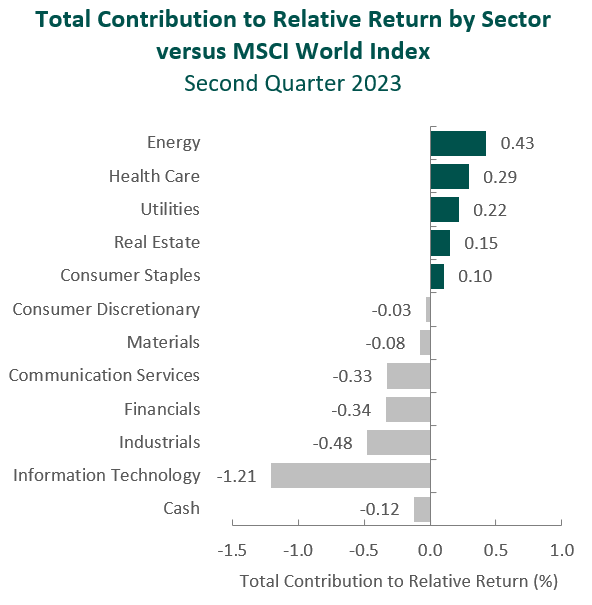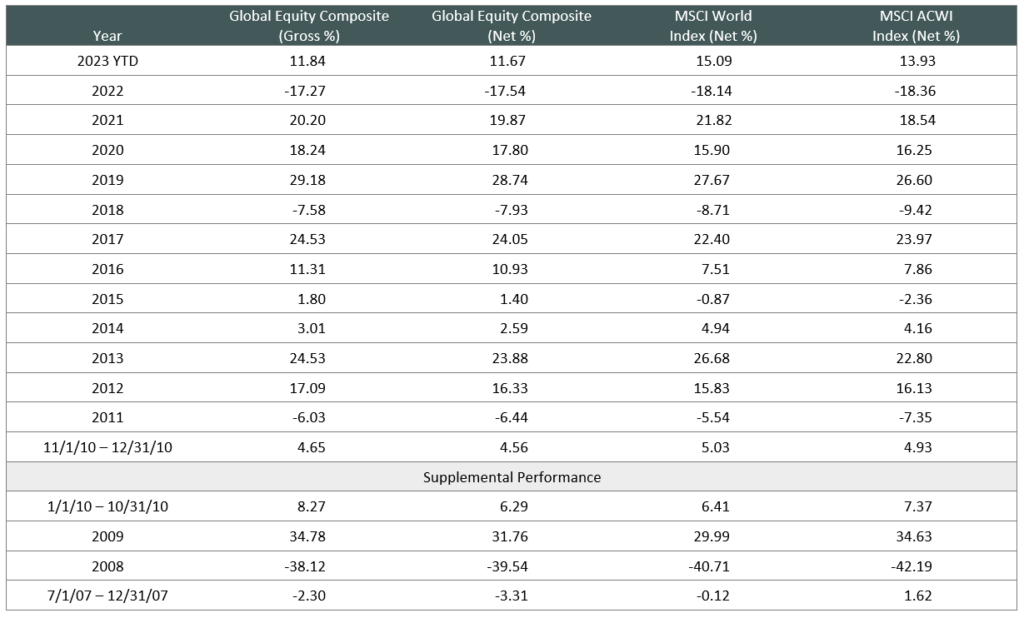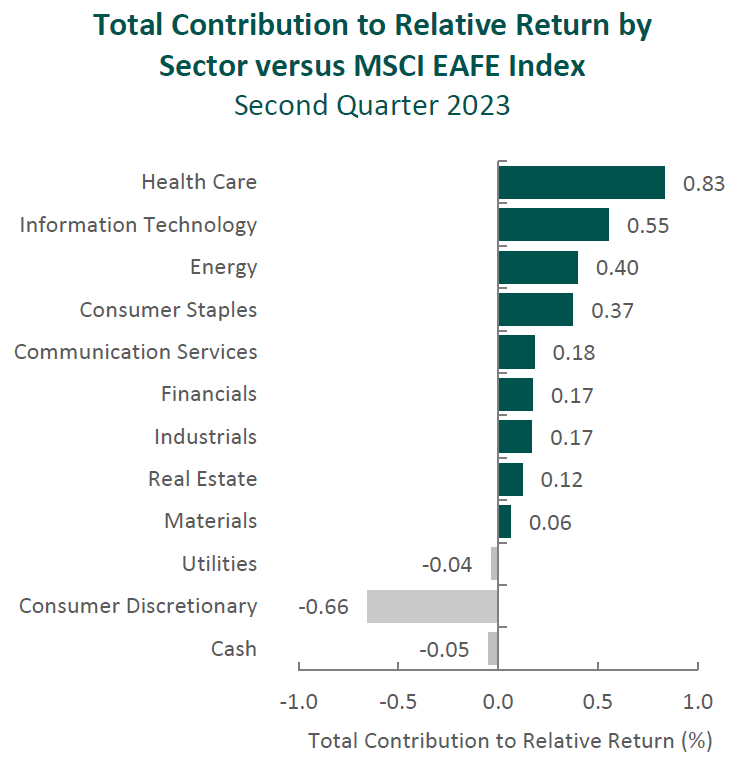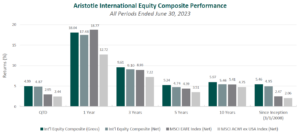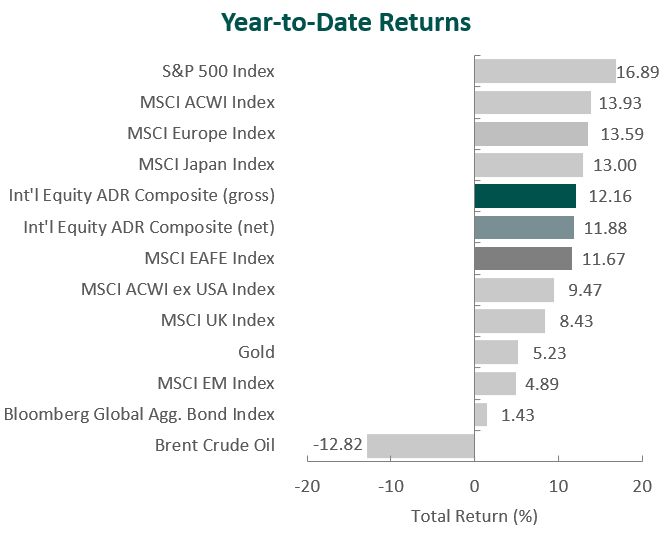
(All MSCI index returns are shown net and in U.S. dollars unless otherwise noted.)

Markets Review
Global equity markets finished lower for the third consecutive quarter. Overall, the MSCI ACWI Index dropped 6.82% during the period, bringing its year-to-date return to -25.63%. Concurrently, the Bloomberg Global Aggregate Bond Index pulled back 6.94%, bringing its year-to-date return to -19.89%. In terms of style, growth stocks outperformed their value counterparts during the quarter, with the MSCI ACWI Growth Index beating the MSCI ACWI Value Index by 1.73%. Nevertheless, for the year-to-date period, the MSCI ACWI Value Index has outperformed the MSCI ACWI Growth Index by 13.14%.

Sources: SS&C Advent, Bloomberg
Past performance is not indicative of future results. Aristotle International Equity ADR Composite returns are presented gross and net of investment advisory fees and include the reinvestment of all income. Aristotle Capital Composite returns are preliminary pending final account reconciliation. Please see important disclosures at the end of this document.

The MSCI EAFE Index dropped 9.36% during the third quarter, while the MSCI ACWI ex USA Index decreased 9.91%. Regionally, the U.K. and Europe & Middle East were the weakest performers, while Asia declined the least. On a sector basis, all eleven sectors within the MSCI EAFE Index posted negative returns, with Communication Services, Utilities and Real Estate generating the largest losses. Conversely, Energy, Consumer Staples and Information Technology declined the least.

As energy prices inflicted pain across much of the world, and the tensions between East and West became more pronounced, the outlook for global economic activity and inflation continued to worsen. The IMF now projects global growth to slow from 6.1% in 2021 to 3.2% in 2022 versus the 3.6% projection last quarter. The IMF also raised its 2022 inflation estimates to 6.6% for advanced economies and 9.5% for developing economies.

In response to elevated inflation, many central banks tightened monetary policy during the quarter. With two 0.75% increases, the U.S. Federal Reserve raised its benchmark rate to a range of 3.00% to 3.25%. The European Central Bank also raised its benchmark lending rate from 0.00% to 1.25%—its first hike in eleven years—while the Bank of England, with two 0.50% increases, raised its benchmark rate to 2.25%. Meanwhile, Japan continues to maintain its ultra-low interest rates, and China’s central bank cut key policy rates.

The divergence in monetary policies between the U.S. Federal Reserve and other central banks, plus concerns for slowing global growth, sent the U.S. Dollar Index (DXY) to a two-decade high. Currencies such as the Euro and Yen have lost approximately 14% and 20% in relative value, respectively, year-to-date. The rapid one-sided movement in the foreign exchange market caused the Bank of Japan to intervene and strengthen the Yen for the first time in 24 years.

The U.K. gathered the world’s attention this quarter, as Queen Elizabeth II—the second-longest reigning monarch in world history—passed away in September, leaving the throne to her son King Charles III. A new government was also installed after Boris Johnson resigned. He was replaced in a special election by current Prime Minister Liz Truss, a fellow member of the Conservative Party. However, Prime Minister Truss’s plan to help citizens afford energy through tax cuts and subsidies stood in contrast to the Bank of England’s efforts to curb inflation. The mixed messages resulted in a sharp sell-off in U.K. government bonds, forcing England’s central bank to reverse its stance toward quantitative tightening to prop up tumbling gilt prices.

Outside of the U.K., Russia’s ongoing invasion of Ukraine has not only caused tragic human suffering and loss of life, but is also threatening European countries’ ability to procure natural gas ahead of winter. Sanctions, pipeline issues and the surge in prices have revealed Europe’s acute need for new energy sources—independent of Russia. In addition, U.S. and Chinese relations became further strained in August following Nancy Pelosi’s visit to Taiwan, only to be compounded by President Biden’s statement that the U.S. military could be used to defend the island. These events have served to exacerbate already heightened global economic uncertainty.

Performance and Attribution Summary

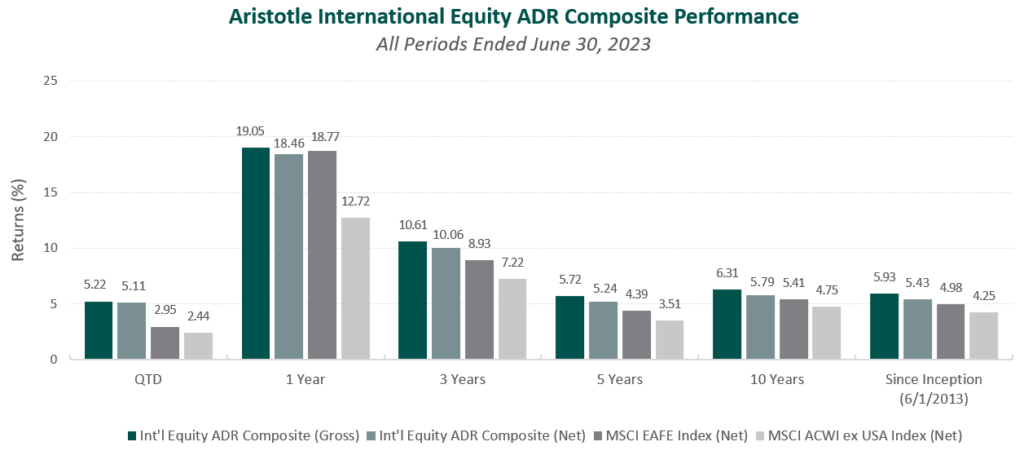
For the third quarter of 2022, Aristotle Capital’s International Equity ADR Composite posted a total return of -7.12% gross of fees (-7.26% net of fees), outperforming the MSCI EAFE Index, which returned -9.36%, and the MSCI ACWI ex USA Index, which returned -9.91%. Please refer to the table below for detailed performance.

Performance (%) 3Q22YTD1 Year3 Years5 Years Since Inception*
Int’l Equity ADR Composite (gross)-7.12-27.89-24.53-0.531.553.63
Int’l Equity ADR Composite (net)-7.26-28.21-24.94-1.011.123.14
MSCI EAFE Index (net)-9.36-27.09-25.13-1.83-0.842.39
MSCI ACWI ex USA Index (net)-9.91-26.50-25.17-1.52-0.812.12
*The inception date for the International Equity ADR Composite is June 1, 2013. Past performance is not indicative of future results. Aristotle International Equity ADR Composite returns are presented gross and net of investment advisory fees and include the reinvestment of all income. Gross returns will be reduced by fees and other expenses that may be incurred in the management of the account. Net returns are presented net of actual investment advisory fees and after the deduction of all trading expenses. Aristotle Capital Composite returns are preliminary pending final account reconciliation. Please see important disclosures at the end of this document.

Source: FactSet

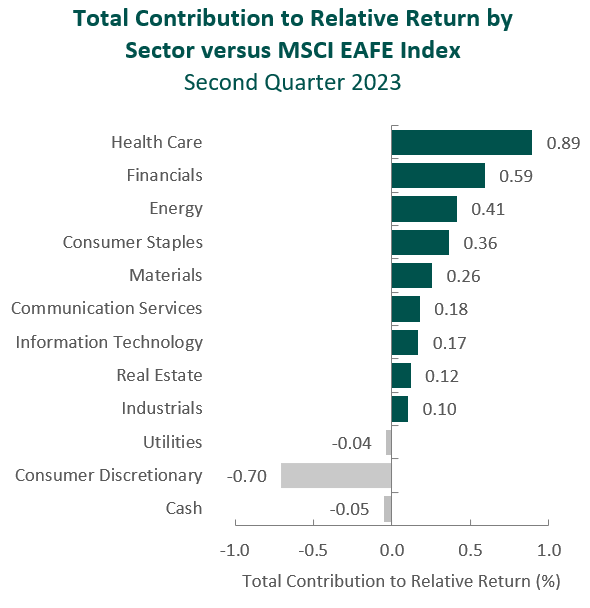
Past performance is not indicative of future results. Attribution results are based on sector returns which are gross of investment advisory fees. Attribution is based on performance that is gross of investment advisory fees and includes the reinvestment of income.


From a sector perspective, the portfolio’s outperformance relative to the MSCI EAFE Index can be attributed to both security selection and allocation effects. Security selection in Financials, Industrials and Energy contributed the most to the portfolio’s relative performance. Conversely, security selection in Health Care, Consumer Staples and Materials detracted from relative return.

Regionally, both security selection and allocation effects were responsible for the portfolio’s outperformance. Exposure to Canada and security selection in the Developed Europe & Middle East contributed the most to relative performance, while an underweight in Asia and an overweight in the U.K. detracted.

Contributors and Detractors for 3Q 2022

ContributorsDetractors
CamecoGSK
Pan Pacific InternationalSony
Ashtead GroupAIA Group
DBS GroupCoca-Cola Europacific Partners
Munich Re GroupAlcon

Cameco, the world’s largest publicly traded uranium producer, was the top contributor for the quarter. In order to pivot away from a reliance on Russian energy without jeopardizing net-zero commitments, policymakers and businesses have (finally) turned their attention toward nuclear power generation. Germany extended the life of two nuclear power plants, and Japan announced it will look at extending the life of existing reactors, restart additional idle reactors and look at developing next-generation reactors. These shifts in energy policies have increased demand at a time of tight supply. Although such market dynamics will likely favor Cameco in the short term, we believe the company’s continued focus on supply discipline will help ensure long-term success as well. By obtaining long-term contracts and slowly ramping production, we believe Cameco is well positioned in the changing energy landscape. The company has already recorded 45 million pounds in new long-term uranium contracts this year, with additional contract discussions underway. Furthermore, Cameco increased its ownership in Cigar Lake by 4.52%, bringing its ownership stake to 54.55%. This ownership expansion, combined with investment in operational readiness for McArthur River/Key Lake, should allow the company to continue to meet utility customers’ changing and growing long-term demand. This sets the stage for Cameco to execute on our catalyst of increasing its uranium volume sold at higher prices, all while lowering production costs through scale and its access to some of the highest-grade ore on the planet.

DBS Group, Singapore’s largest bank1, was a leading contributor. We have long been attracted to the Singapore banking industry due to its oligopoly structure and the stability of the country’s regulatory environment, as well as its fiscal and monetary policies. Part of this stability is attributable to the central bank’s long-standing currency monitoring band, which has kept the Singapore dollar tightly linked to the U.S. dollar. In our opinion, outside of a robust first half 2022 earnings report, the quarter contained nothing material from a catalyst or fundamental perspective. As such, we believe this quarter’s stock price performance was likely due to U.S. dollar strength—something we do not attempt to predict. We continue to admire DBS’s leadership in digital banking, which we believe should allow the company to drive further efficiency gains. Moreover, we continue to monitor DBS’s pending acquisition of Citigroup’s consumer banking business in Taiwan; this acquisition should bolster our ongoing catalyst of profitable expansion outside of Singapore.

GSK, the U.K.-headquartered pharmaceutical company, was the largest detractor. GSK completed the demerger of its consumer health business in July, creating the independent, publicly traded company Haleon. As discussed below, we made Haleon a full position following the spinoff. We believe the separation unlocks value and allows remaining GSK to benefit from greater focus on biopharmaceuticals and vaccines. After managing the completed spinoff, CFO Iain Mackay announced his plans to retire in May 2023, to be replaced by Julie Brown. Having served in previous CFO posts at both the luxury goods brand Burberry, as well as the pharmaceutical firm AstraZeneca, we look forward to following Ms. Brown’s initiatives at GSK. Moreover, the company has been advancing on our catalyst of market share gains for Shingrix, its vaccine to prevent shingles. Shingrix again delivered record sales growth and continues to be a key driver of GSK’s vaccine revenue expansion. Lastly, legal concerns related to potential side effects from the heartburn medicine Zantac made headlines. Although Zantac was marketed by several firms and its associated risks have been known for a number of years, upcoming lawsuits in the U.S. received media attention this quarter. We are closely following the litigation and may have more to share in future commentaries. In the interim, we find the price adjustment to be overdone. The largest side effect-related drug settlements have been in the single-digit billions, while more than £20 billion in market capitalization has been removed from GSK. Despite recent share price declines, we remain confident in GSK’s ability to further penetrate markets with its current products and evolve its pipeline of innovative medicines.

Sony, the global provider of videogames and consoles, image sensors, and music, as well as movies, was a major detractor for the period. The share price of the company has struggled this year following its strong performance in 2021. Signs of a slowdown in the gaming industry (as people seem inclined to take on outdoor activities as pandemic fears have subsided), combined with sales of its PlayStation 5 that have been held up by a global parts shortage, have led to gaming-related software sales falling more than 20% year-over-year. Rather than focusing on short-term demand dislocations, we focus on the company’s ability to continue migrating videogame users toward the firm’s subscription offerings, as well as its capacity to leverage content across its video, music and gaming platforms. We are also impressed with the expansion of Sony’s Music segment, which has been supported by the pervasiveness of streaming services. Management’s ongoing work to improve the company’s TV and film studios is bearing fruit as well, with sales growing 67% year-over-year for its Pictures segment as its regional strategy has taken hold, including recent progress made toward solidifying a merger plan with India-based Zee Entertainment.

1As measured by assets as of June 30,2022.

Recent Portfolio Activity

BuysSells
HaleonReckitt

We have owned shares of Reckitt—the global manufacturer and marketer of household, health and personal care products—for over a decade, having become investors in the second quarter of 2011. The company’s well-known brands include Mucinex, Dr. Scholl’s, Woolite and Lysol. During our holding period, Reckitt executed on some, but not all, of our catalysts. In particular, the 2017 acquisition of Mead Johnson increased its emerging markets presence by expanding the company’s offerings in China; however, the acquisition came at too high of a cost in our opinion. The fresh perspective Laxman Narasimhan brought when he joined as CEO in 2019, which was reflected in his reorganization of the Health and Hygiene units and a shift toward higher-margin products, was another catalyst we identified. While we still view Reckitt as a high-quality business, with many of its catalysts now closer to completion, we decided to exit our position in favor of what we consider to be a more optimal opportunity in Haleon, which is discussed below.

Haleon plc

Haleon, headquartered in the U.K., is currently the only publicly traded, pure-play global consumer health company. The company has existed for decades in various forms and, through a history of M&A, is the product of three major pharmaceutical companies’ assets: GSK, Novartis and Pfizer. With roughly £9.5 billion in revenue, Haleon operates in over 170 markets, selling products in oral health (~28% of 2021 revenue), pain relief (~23%), digestive health (~21%), vitamin and mineral supplements (~16%), and respiratory health (~12%). Its recognizable brands include Sensodyne toothpaste, the pain relief product Advil, Theraflu for cold and flu symptoms, and Centrum multivitamins.

Haleon was spun off this summer by existing holding GSK. Impressed by this consumer health products business, we decided to increase our ownership to a full weight in the portfolio.

Quality

Some of the quality characteristics we have identified for Haleon include:

– Portfolio of well-known brands, supported by a history of innovation and doctors’ advocacy;

– Market leadership in different categories across the world’s fragmented consumer health industry, including number one positions in digestive health and vitamin and mineral supplements; and

– Global reach and diversification across geographies and categories, with a track record of improving EBITDA margins and stable FREE cash flow generation.

Attractive Valuation

Given our estimates of higher normalized earnings, both due to further product penetration and efficiency gains as a standalone enterprise, we believe the company is offered at an attractive price. In addition, we recognize the risks associated with the recent Zantac lawsuits and believe this is more than reflected in the current stock price.

Compelling Catalysts

Catalysts we have identified for Haleon, which we believe will cause its stock price to appreciate over our three- to five-year investment horizon, include:

– Enhanced profitability and increased revenue, as many of its products, including what the company refers to as its higher-margin “power brands,” are better supported for growth by the company’s ability to make its own capital allocation decisions;

– Benefits from being managed as an independent company that should spur improved business structures and innovation efforts; and

– Management’s plan for debt reduction should also allow for more optimal capital allocation and increased cash returns to shareholders.

Conclusion

Our investment process seeks to identify businesses that, in our opinion, possess a combination of qualities that are both sustainable and difficult to reproduce. While broad macroeconomic factors such as inflation, central bank policies, foreign exchange markets and various other data points are taken into consideration as part of our research, we spend the vast majority of our time analyzing individual companies. Rather than attempting to predict the path of stock prices in the short term, we focus our efforts on understanding businesses over the long term. We believe the long-term benefits of patience and extensive research far outweigh the potential risk of a missed opportunity; seldom are reactionary decisions optimal. While the current market environment seems to be dominated by macro news and geopolitical events, we remain steadfast in our belief that the fundamentals of a company, ultimately, determine its intrinsic worth. As such, we will continue to focus our efforts on studying the unique qualities and characteristics of the companies in which we are invested.

Disclosures

The opinions expressed herein are those of Aristotle Capital Management, LLC (Aristotle Capital) and are subject to change without notice. Past performance is not a guarantee or indicator of future results. This material is not financial advice or an offer to buy or sell any product. You should not assume that any of the securities transactions, sectors or holdings discussed in this report were or will be profitable, or that recommendations Aristotle Capital makes in the future will be profitable or equal the performance of the securities listed in this report. The portfolio characteristics shown relate to the Aristotle International Equity ADR strategy. Not every client’s account will have these characteristics. Aristotle Capital reserves the right to modify its current investment strategies and techniques based on changing market dynamics or client needs. There is no assurance that any securities discussed herein will remain in an account’s portfolio at the time you receive this report or that securities sold have not been repurchased. The securities discussed may not represent an account’s entire portfolio and, in the aggregate, may represent only a small percentage of an account’s portfolio holdings. The performance attribution presented is of a representative account from Aristotle Capital’s International Equity ADR Composite. The representative account is a discretionary client account which was chosen to most closely reflect the investment style of the strategy. The criteria used for representative account selection is based on the account’s period of time under management and its similarity of holdings in relation to the strategy. Recommendations made in the last 12 months are available upon request.

Returns are presented gross and net of investment advisory fees and include the reinvestment of all income. Gross returns will be reduced by fees and other expenses that may be incurred in the management of the account. Net returns are presented net of actual investment advisory fees and after the deduction of all trading expenses.

All investments carry a certain degree of risk, including the possible loss of principal. Investments are also subject to political, market, currency and regulatory risks or economic developments. International investments involve special risks that may in particular cause a loss in principal, including currency fluctuation, lower liquidity, different accounting methods and economic and political systems, and higher transaction costs. These risks typically are greater in emerging markets. Securities of small‐ and medium‐sized companies tend to have a shorter history of operations, be more volatile and less liquid. Value stocks can perform differently from the market as a whole and other types of stocks.

The material is provided for informational and/or educational purposes only and is not intended to be and should not be construed as investment, legal or tax advice and/or a legal opinion. Investors should consult their financial and tax adviser before making investments. The opinions referenced are as of the date of publication, may be modified due to changes in the market or economic conditions, and may not necessarily come to pass. Information and data presented has been developed internally and/or obtained from sources believed to be reliable. Aristotle Capital does not guarantee the accuracy, adequacy or completeness of such information.

Aristotle Capital Management, LLC is an independent registered investment adviser under the Advisers Act of 1940, as amended. Registration does not imply a certain level of skill or training. More information about Aristotle Capital, including our investment strategies, fees and objectives, can be found in our Form ADV Part 2, which is available upon request.

Performance Disclosures


Composite returns for all periods ended September 30, 2022 are preliminary pending final account reconciliation.

Past performance is not indicative of future results. The information provided should not be considered financial advice or a recommendation to purchase or sell any particular security or product.  Performance results for periods greater than one year have been annualized.

Returns are presented gross and net of investment advisory fees and include the reinvestment of all income. Gross returns will be reduced by fees and other expenses that may be incurred in the management of the account. Net returns are presented net of actual investment advisory fees and after the deduction of all trading expenses.

Aristotle Capital Management, LLC is an independent registered investment adviser under the Advisers Act of 1940, as amended. Registration does not imply a certain level of skill or training. More information about Aristotle Capital, including our investment strategies, fees and objectives, can be found in our Form ADV Part 2, which is available upon request. ACM-2210-140

Index Disclosures

The MSCI EAFE Index (Europe, Australasia, Far East) is a free float-adjusted market capitalization-weighted index that is designed to measure the equity market performance of developed markets, excluding the United States and Canada. The MSCI EAFE Index consists of the following 21 developed market country indices: Australia, Austria, Belgium, Denmark, Finland, France, Germany, Hong Kong, Ireland, Israel, Italy, Japan, the Netherlands, New Zealand, Norway, Portugal, Singapore, Spain, Sweden, Switzerland and the United Kingdom. The MSCI ACWI captures large and mid-cap representation across 23 developed market countries and 24 emerging markets countries. With approximately 3,000 constituents, the Index covers approximately 85% of the global investable equity opportunity set. The MSCI ACWI Growth Index captures large and mid-cap securities exhibiting overall growth style characteristics across 23 developed markets countries and 24 emerging markets countries. The MSCI ACWI Value Index captures large and mid-cap securities exhibiting overall value style characteristics across 23 developed markets countries and 24 emerging markets countries. The MSCI ACWI ex USA Index captures large and mid-cap representation across 22 of 23 developed markets countries (excluding the United States) and 24 emerging markets countries. With approximately 2,300 constituents, the Index covers approximately 85% of the global equity opportunity set outside the United States. The MSCI Emerging Markets Index is a free float-adjusted market capitalization-weighted index that is designed to measure the equity market performance of emerging markets. The MSCI Emerging Markets Index consists of the following 24 emerging market country indexes: Brazil, Chile, China, Colombia, Czech Republic, Egypt, Greece, Hungary, India, Indonesia, Korea, Kuwait, Malaysia, Mexico, Peru, Philippines, Poland, Qatar, Saudi Arabia, South Africa, Taiwan, Thailand, Turkey and United Arab Emirates. The S&P 500® Index is the Standard & Poor’s Composite Index of 500 stocks and is a widely recognized, unmanaged index of common stock prices. The Brent Crude Oil Index is a major trading classification of sweet light crude oil that serves as a major benchmark price for purchases of oil worldwide. The U.S. Dollar Index (DXY) is a measure of the value of the U.S. dollar relative to the value of a basket of currencies of the majority of the United States’ most significant trading partners. The MSCI Japan Index is designed to measure the performance of the large and mid-cap segments of the Japanese market. With approximately 250 constituents, the Index covers approximately 85% of the free float-adjusted market capitalization in Japan. The Bloomberg Global Aggregate Bond Index is a flagship measure of global investment grade debt from 28 local currency markets. This multi-currency benchmark includes treasury, government-related, corporate and securitized fixed-rate bonds from both developed and emerging markets issuers. The MSCI United Kingdom Index is designed to measure the performance of the large and mid-cap segments of the U.K. market. With nearly 100 constituents, the Index covers approximately 85% of the free float-adjusted market capitalization in the United Kingdom. The MSCI Europe Index captures large and mid-cap representation across 15 developed markets countries in Europe. With approximately 430 constituents, the Index covers approximately 85% of the free float-adjusted market capitalization across the European developed markets equity universe. These indices have been selected as the benchmarks and are used for comparison purposes only. The volatility (beta) of the Composite may be greater or less than the respective benchmarks. It is not possible to invest directly in these indices.

Related Resources

For more on International Equity, access the latest resources.

FOR FINANCIAL ADVISOR USE ONLY – NOT FOR PUBLIC DISTRIBUTION

Markets Review

Sources: SS&C Advent, Bloomberg
Past performance is not indicative of future results. Aristotle Value Equity Composite returns are presented gross and net of investment advisory fees and include the reinvestment of all income. Gross returns will be reduced by fees and other expenses that may be incurred in the management of the account. Net returns are presented net of actual investment advisory fees and after the deduction of all trading expenses. Aristotle Capital Composite returns are preliminary pending final account reconciliation. Please see important disclosures at the end of this document.

U.S. equity market performance was positive in the final quarter of the year, as the S&P 500 Index rose 7.56% during the period. Concurrently, the Bloomberg U.S. Aggregate Bond Index increased 1.87% for the quarter. In terms of style, the Russell 1000 Value Index outperformed its growth counterpart by 10.22% during the quarter. 

All eleven sectors within the Russell 1000 Value Index finished higher for the quarter, with Energy, Industrials and Materials gaining the most. Meanwhile, Communication Services, Real Estate and Information Technology rose the least. 

Inflation has remained elevated in the U.S., with a 7.1% rise in the CPI for the 12-month period ending in November. However, increases have slowed since the second half of the year, as the annualized CPI figure has come down steadily since reaching a 40-year high of 9.1% in June. This moderation in price increases was partly driven by falling energy costs, as average U.S. gasoline prices approached $3 a gallon—lows not seen since before Russia invaded Ukraine. When assessing consumer health, spending proved resilient and the labor market remained tight, with a 3.7% unemployment rate and a 5.1% year-over-year increase in average hourly earnings in November. With respect to the U.S. economy’s overall performance, investors welcomed news that GDP grew at an annual rate of 3.2% in the third quarter following two consecutive quarters of contraction. 

As inflation trended lower, the Federal Reserve (Fed) slowed the pace of rate increases to 0.5% in December after raising rates by 0.75% for the fourth consecutive time in November, moving the benchmark rate to a range of 4.25% to 4.50%. Although the magnitude of rate hikes has shifted down, the Fed has indicated that, given the current labor market and its 2% inflation target, there is still more work to be done from a monetary policy standpoint. As such, apprehension around a recession remains; however, the Fed’s decision to step down from 0.75% increases and the weakening dollar alleviated some of those concerns heading into the new year. 

On the corporate earnings front, signals remained mixed, as 70% of S&P 500 companies exceeded EPS estimates, while 61% of S&P 500 companies provided negative EPS guidance for the third quarter. In addition, management teams have continued to navigate the inflationary environment, with roughly 400 companies mentioning inflation on earnings calls. 

Lastly, in U.S. politics, the Republican Party won a majority in the House of Representatives, while the Democratic Party retained control of the Senate after the 2022 midterm elections. The results end one-party control of Congress for the remainder of the Biden administration’s first term. 

Annual Markets Review

After posting seven consecutive quarters of positive performance prior to 2022, the U.S. equity market faltered, as the S&P 500 Index finished lower for the first three quarters of the year, leading to a full-year return of -18.11%. Additionally, after five straight calendar years of growth outperforming value, the Russell 1000 Value Index outperformed the Russell 1000 Growth Index by 21.60%, the largest outperformance by value since 2000. 

Meanwhile, despite fixed income’s tendency to provide stability when equities are turbulent, the Bloomberg U.S. Aggregate Bond Index fell 13.01%—its worst year on record. 2022 easily surpassed the Index’s previous worst year, when it declined 2.92% in 1994 as inflation and the corresponding interest rate environment remained primary themes. Macroeconomic headlines were dominated by inflation, while factors such as geopolitical conflict, supply-chain disruptions, labor shortages and increasing commodity and housing prices also played a role. 

Although it was a challenging year, these volatile periods are precisely why we emphasize the phrase, “not every quarter, not every year.” Short-term returns are always subject to change, and macroeconomic factors such as inflation, central bank policies and geopolitical conflicts are impossible to predict. Consequently, we remain focused on the long-term fundamentals of businesses, and we strive to identify undervalued, high-quality companies that can weather the complex and changing market dynamics. We believe this steadfast approach will allow us to provide lasting long-term value to our clients. 

Performance and Attribution Summary

For the fourth quarter of 2022, Aristotle Capital’s Value Equity Composite posted a total return of 10.57% gross of fees (10.50% net of fees), underperforming the 12.42% return of the Russell 1000 Value Index and outperforming the 7.56% return of the S&P 500 Index. Please refer to the table for detailed performance. 

Performance (%) 4Q22 1 Year3 Years5 Years10 Years
Value Equity Composite (gross)10.57-14.587.428.7112.73
Value Equity Composite (net)10.50-14.797.148.3912.38
Russell 1000 Value Index12.42-7.545.956.6610.29
S&P 500 Index7.56-18.117.659.4212.56
Past performance is not indicative of future results. Aristotle Value Equity Composite returns are presented gross and net of investment advisory fees and include the reinvestment of all income. Gross returns will be reduced by fees and other expenses that may be incurred in the management of the account. Net returns are presented net of actual investment advisory fees and after the deduction of all trading expenses. Aristotle Capital Composite returns are preliminary pending final account reconciliation. Please see important disclosures at the end of this document.

The portfolio’s underperformance relative to the Russell 1000 Value Index in the fourth quarter can be attributed to security selection, while allocation effects had a slight positive impact. Security selection in Materials and Energy and an overweight in Information Technology detracted the most from relative performance. Conversely, a lack of exposure to Communication Services and security selection in Consumer Discretionary and Industrials contributed. (Relative weights are the result of bottom-up security selection.) 

Source: FactSet
Past performance is not indicative of future results. Attribution results are based on sector returns which are gross of investment advisory fees. Attribution is based on performance that is gross of investment advisory fees and includes the reinvestment of income.

Contributors and Detractors for 4Q 2022

Relative ContributorsRelative Detractors
Mitsubishi UFJ Financial Blackstone
Ameriprise Financial Crown Castle
XylemCoterra Energy
HoneywellMicrosoft
MerckCorteva

Blackstone, one of the world’s largest alternative asset managers, was the leading detractor for the period. Shares of the company declined following the decision to limit withdrawals from its Blackstone Real Estate Income Trust (BREIT), which allows retail clients access to alternative investments (typically only available to institutions).

While we will continue to study potential long-term impacts of this move, the monthly redemption limits are a mere 2% of the fund’s assets and, importantly, the structure of the fund is one of the reasons that attracted us to Blackstone. We believe lockup periods and redemption limits create stickier capital, while the evergreen nature of BREIT provides an edge over traditional alternative funds that require fundraising cycles. Just after quarter end, a large institution invested $4 billion in BREIT at current net asset value, providing what we view as a noteworthy endorsement of both the fund and firm as a whole. Moreover, we believe Blackstone’s track record of investment performance, as well as first-mover and distribution advantages, positions the firm well to further penetrate retail and private wealth channels. 

Ameriprise Financial, the investment management firm, was a top contributor for the quarter. During our time as shareholders, Ameriprise has continued to execute on its transformation into an important player in the asset and wealth management industry (and away from insurance products). Today the Advice & Wealth Management segment, combined with the Asset Management segment, account for nearly 80% of the company’s revenues. This has served to de-risk its business model, unlock excess capital (of which it returned $632 million to shareholders during the quarter) and improve returns on equity, which are now in excess of 47%. In addition, the company takes pride in its ability to attract and retain financial advisors, providing them the tools to build relationships with clients. The market volatility during the year, in our view, has given ample opportunity for Ameriprise’s advisors to demonstrate the value their services can provide for clients. 

Recent Portfolio Activity

During the quarter, we exited our investments in Sun Communities, Elanco Animal Health and Tyson Foods and established new positions in Merck and Sysco. 

We originally invested in Sun Communities during the third quarter of 2018. During our time as shareholders, the company continued its expansion of housing sites and was able to steadily raise rents, items we had identified as catalysts.

BuysSells
Merck Sun Communities
SyscoElanco Animal Health
Tyson Foods

More recently, Sun has made significant acquisitions, including Safe Harbor in 2020 (owner and operator of ~100 marinas in the U.S.) and Park Holidays in 2022 (the second-largest U.K. holiday park). Given recent acquisitions and diversification outside of the U.S., we decided to exit our position in Sun and, with the proceeds, increase our investment in Equity Lifestyle Properties, also an operator of manufactured home communities. 

We were investors in the animal health company Elanco for a little over two years. At the time of initial investment, we believed that Elanco would benefit from being an independent company, and that this would be a significant catalyst. We now believe this catalyst has shifted outside of our time horizon, as we have concerns about the company’s integration of Bayer’s Animal Health business (acquired in 2020). In addition, competitor Zoetis seems to be taking further market share with its Simparica Trio, a one-pill treatment for heartworm, fleas and ticks. We continue to admire the animal health industry and, with our new investment in Merck, we have exposure (albeit smaller) to what we consider to be an attractive industry. 

We first invested in Tyson Foods during the second quarter of 2019. At the time, we were encouraged by what we had identified as the company’s demonstrated ability to “brand” what had been previously considered pure commodity products. Furthermore, we were attracted to Tyson’s Prepared Food business, consisting of a strong portfolio of brands with attractive margins and the opportunity to gain market share as consumer preferences shifted toward prepared foods. While we believe catalysts remain, we decided to sell, as we were concerned with management changes over the past year, starting with the CEO resigning in 2021 for personal reasons, followed by the resignation of the head of Prepared Foods and exacerbated by the company’s decision to name John R. Tyson, the 32-year-old son of the firm’s chairman, as CFO. 

Merck & Co.

Founded in 1891 and headquartered in New Jersey, Merck is one the world’s largest pharmaceutical firms. The company’s drugs are used to treat conditions in a variety of areas, including oncology (~38% of revenue), vaccines (~19%), diabetes (~11%), animal health (~11%) and other (~21%). Merck produced over $48 billion in sales in 2021, just under half of which were generated in the United States. Within oncology, the firm’s immuno-oncology platform is becoming a major contributor to overall sales, driven by the blockbuster1 drug Keytruda. The company’s vaccine business is also significant and includes Gardasil for the prevention of HPV (the disease that can lead to cervical cancer in women), as well as vaccines for hepatitis B, pediatric diseases and shingles. In recent years, Merck has been shifting its focus toward unmet medical needs in specialty-care areas. As part of this shift in focus, in June 2021, Merck received $9 billion from the spinoff of its women’s health, established brands, and biosimilars businesses into the now independent, publicly traded company Organon. 

High-Quality Business 

Some of the quality characteristics we have identified for Merck include: 

  • Leading market share in many of the therapeutic areas it focuses on; 
  • Strong salesforce that not only supports the sales of currently marketed drugs, but also serves as a barrier to entry against those seeking to launch competing products; 
  • Economies of scale allow for cost advantages, a particularly important attribute in the vaccine business; and 
  • Long and proven history in the research and development of innovative medicines. 

Attractive Valuation 

Based on our estimates, shares of the company are attractively valued. We believe continued market share gains for certain products will lead to higher levels of normalized FREE cash flow than are currently appreciated by the market. 

Compelling Catalysts 

Catalysts we have identified for Merck, which we believe will cause its stock price to appreciate over our three- to five-year investment horizon, include: 

  • Further market share gains for Keytruda which is currently being used in over 30 cancer types. Additional opportunities also exist for Keytruda in subcutaneous administration, coformulations and combination therapies;
  • Increased penetration of Gardasil, as less than 10% of the global qualified population is vaccinated for HPV; and 
  • Benefits from the Organon spinoff, which will streamline Merck’s remaining human health operations. 

Sysco Corporation 

Founded in 1969 and headquartered in Texas, Sysco is one of the largest food distribution companies in the world. The company generates more than $68 billion in annual sales and serves approximately 700,000 customers around the world (~90% of sales are generated in North America). 

Sysco provides its customers a single partner from which to conveniently source all the ingredients kitchens need to build complete menus. This includes fresh and frozen meats, seafoods, fruits, vegetables, dairy, bakery items and even disposable dishware products. In addition, the company’s more than 6,000 sales consultants work closely with individual chefs, providing product advice and helping construct menus. Sysco’s clients are predominately restaurants (63% of revenue), but also include health care facilities (8%), education and government entities (8%), and travel and leisure establishments (7%), as well as other locations (14%). 

High-Quality Business 

Some of the quality characteristics we have identified for Sysco include: 

  • While U.S. institutional food distribution is cyclical, highly competitive and fragmented, Sysco has been able to gain market share over time (currently #1 with ~16% share, several percentage points ahead of #2 and #3), buying complementary competitors while consistently returning cash to shareholders (as demonstrated by more than 40 consecutive years of dividend increases); 
  • Resiliency stemming from its essential food products (people have to eat!), diversified customer base and cost/service advantages provided by its widespread distribution network of more than 330 facilities; and 
  • Scale benefits that include purchasing power and the ability to provide value-added services such as technology tools that help customers control inventory and calculate menu profitability. 

Attractive Valuation 

We estimate the company’s revenue, margins and FREE cash flow to be higher on a normalized basis. As such, shares of Sysco are currently priced at a discount to our assessment of the company’s intrinsic value. 

Compelling Catalysts 

Catalysts we have identified for Sysco, which we believe will cause its stock price to appreciate over our three- to five-year investment horizon, include: 

  • Enhanced profitability and efficiency gains resulting from the organizational transformation initiated by CEO Kevin Hourican (in place since 2020); 
  • Further industry consolidation (with Sysco playing an active role as an acquirer), as well as increased market share from the shift to “away from home” food consumption; and 
  • Benefits from digitalization, revenue management and national account centralization. 

Conclusion

2022 proved a tumultuous year for most investors, with no shortage of macroeconomic and geopolitical events gripping the world’s attention and stirring volatility in markets. Global inflation reached multi-decade highs, central banks made drastic shifts in monetary policy, governments navigated instability and changes in leadership, and rising tensions between Eastern and Western nations came to a head with a ground war in Europe. This year serves as a staunch reminder that there is “always something” to consider in financial markets and economics. However, for us at Aristotle Capital, it is important to assess whether events are truly analyzable. In our opinion, macroeconomic factors and the market’s corresponding reactions are impossible to predict consistently. We will therefore, as we always have, stay focused on what we do best—the continuous study and better understanding of individual businesses. We remain convinced this “bottom-up” approach will allow us to best serve our clients, as fundamentals, not headline news, reflect long-term value. 

Disclosures

The opinions expressed herein are those of Aristotle Capital Management, LLC (Aristotle Capital) and are subject to change without notice. Past performance is not a guarantee or indicator of future results. This material is not financial advice or an offer to purchase or sell any product. You should not assume that any of the securities transactions, sectors or holdings discussed in this report were or will be profitable, or that recommendations Aristotle Capital makes in the future will be profitable or equal the performance of the securities listed in this report. The portfolio characteristics shown relate to the Aristotle Value Equity strategy. Not every client’s account will have these characteristics. Aristotle Capital reserves the right to modify its current investment strategies and techniques based on changing market dynamics or client needs. There is no assurance that any securities discussed herein will remain in an account’s portfolio at the time you receive this report or that securities sold have not been repurchased. The securities discussed may not represent an account’s entire portfolio and, in the aggregate, may represent only a small percentage of an account’s portfolio holdings. The performance attribution presented is of a representative account from Aristotle Capital’s Value Equity Composite. The representative account is a discretionary client account which was chosen to most closely reflect the investment style of the strategy. The criteria used for representative account selection is based on the account’s period of time under management and its similarity of holdings in relation to the strategy. Recommendations made in the last 12 months are available upon request. 

Returns are presented gross and net of investment advisory fees and include the reinvestment of all income. Gross returns will be reduced by fees and other expenses that may be incurred in the management of the account. Net returns are presented net of actual investment advisory fees and after the deduction of all trading expenses. 

All investments carry a certain degree of risk, including the possible loss of principal. Investments are also subject to political, market, currency and regulatory risks or economic developments. International investments involve special risks that may in particular cause a loss in principal, including currency fluctuation, lower liquidity, different accounting methods and economic and political systems, and higher transaction costs. These risks typically are greater in emerging markets. Securities of small‐ and medium‐sized companies tend to have a shorter history of operations, be more volatile and less liquid. Value stocks can perform differently from the market as a whole and other types of stocks. 

The material is provided for informational and/or educational purposes only and is not intended to be and should not be construed as investment, legal or tax advice and/or a legal opinion. Investors should consult their financial and tax adviser before making investments. The opinions referenced are as of the date of publication, may be modified due to changes in the market or economic conditions, and may not necessarily come to pass. Information and data presented has been developed internally and/or obtained from sources believed to be reliable. Aristotle Capital does not guarantee the accuracy, adequacy or completeness of such information. 

This presentation is to report on the investment strategies as reported by Aristotle Capital Management, LLC and is for illustrative purposes only. The information contained herein is obtained from multiple sources and believed to be reliable. Information has not been verified by Morgan Stanley Wealth Management, and may differ from documents created by Morgan Stanley Wealth Management. The financial advisor should refer to the Profile. This must be preceded or accompanied by the Morgan Stanley Wealth Management Profile, which you can obtain from the Morgan Stanley Wealth Management Performance Analytics. For additional information on other programs, please speak to Patrick Schussman at Aristotle Capital at (310) 954-8156. 

Aristotle Capital Management, LLC is an independent registered investment adviser under the Advisers Act of 1940, as amended. Registration does not imply a certain level of skill or training. More information about Aristotle Capital, including our investment strategies, fees and objectives, can be found in our ADV Part 2, which is available upon request. ACM-2301-10-MSFA 

Performance Disclosures

Composite returns for all periods ended December 31, 2022 are preliminary pending final account reconciliation. 

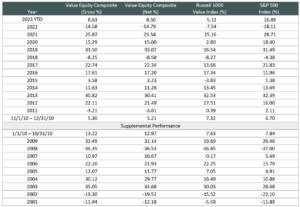
Past performance is not indicative of future results. The information provided should not be considered financial advice or a recommendation to purchase or sell any particular security or product. Performance results for periods greater than one year have been annualized. The Aristotle Value Equity strategy has an inception date of November 1, 2010; however, the strategy initially began at Mr. Gleicher’s predecessor firm in October 1997. A supplemental performance track record from January 1, 2001 through October 31, 2010 is provided above. The returns are based on two separate accounts and performance results are based on custodian data. During this time, Mr. Gleicher had primary responsibility for managing the two accounts. Mr. Gleicher began managing one account in November 2000 and the other December 2000. 

Returns are presented gross and net of investment advisory fees and include the reinvestment of all income. Gross returns will be reduced by fees and other expenses that may be incurred in the management of the account. Net returns are presented net of actual investment advisory fees and after the deduction of all trading expenses.

Index Disclosures

The Russell 1000 Value® Index measures the performance of the large cap value segment of the U.S. equity universe. It includes those Russell 1000 Index companies with lower price-to-book ratios and lower expected growth values. The S&P 500® Index is the Standard & Poor’s Composite Index of 500 stocks and is a widely recognized, unmanaged index of common stock prices. The Russell 1000® Growth Index measures the performance of the large cap growth segment of the U.S. equity universe. It includes those Russell 1000 companies with higher price-to-book ratios and higher forecasted growth values. The Russell 2000® Index measures the performance of the small cap segment of the U.S. equity universe. The Russell 2000 Index is a subset of the Russell 3000® Index representing approximately 10% of the total market capitalization of that index. It includes approximately 2,000 of the smallest securities based on a combination of their market cap and current index membership. The Dow Jones Industrial Average® is a price-weighted measure of 30 U.S. blue-chip companies. The Index covers all industries except transportation and utilities. The NASDAQ Composite Index measures all NASDAQ domestic and international based common type stocks listed on The NASDAQ Stock Market. The NASDAQ Composite includes over 3,000 companies, more than most other stock market indexes. The Bloomberg U.S. Aggregate Bond Index is an unmanaged index of domestic investment grade bonds, including corporate, government and mortgage-backed securities. The WTI Crude Oil Index is a major trading classification of sweet light crude oil that serves as a major benchmark price for oil consumed in the United States. The 3-Month U.S. Treasury Bill is a short-term debt obligation backed by the U.S. Treasury Department with a maturity of three months. Consumer Price Index is a measure of the average change over time in the prices paid by urban consumers for a market basket of consumer goods and services. The volatility (beta) of the Composite may be greater or less than its respective benchmarks. It is not possible to invest directly in these indices. 

FOR FINANCIAL ADVISOR USE ONLY – NOT FOR PUBLIC DISTRIBUTION

Markets Review

Sources: SS&C Advent, Bloomberg
Past performance is not indicative of future results. Aristotle Value Equity Composite returns are presented gross and net of investment advisory fees and include the reinvestment of all income. Gross returns will be reduced by fees and other expenses that may be incurred in the management of the account. Net returns are presented net of actual investment advisory fees and after the deduction of all trading expenses. Aristotle Capital Composite returns are preliminary pending final account reconciliation. Please see important disclosures at the end of this document.

The U.S. equity market finished lower for the third consecutive quarter, as the S&P 500 Index fell 4.88% during the period, bringing its year-to-date return to -23.87%. Concurrently, the Bloomberg U.S. Aggregate Bond Index dropped 4.75% for the quarter, bringing its year-to-date return to -14.61%. In terms of style, the Russell 1000 Growth Index outperformed its value counterpart by 2.02% during the quarter. Nevertheless, for the year-to-date period, the Russell 1000 Value Index has still outperformed the Russell 1000 Growth Index by 12.91%.

On a sector basis, ten sectors within the Russell 1000 Value Index finished lower for the quarter, with the Communication Services, Real Estate and Information Technology sectors falling the most. Energy was the only sector to post a positive return, while the Consumer Discretionary and Financials sectors declined the least.

With sustained levels of heightened inflation and continued tightening by the Federal Reserve, recessionary fears persisted throughout the period, as the U.S. economy contracted in both the first and second quarters of 2022. After setting a new 40-year high in June, the CPI remained elevated, recording an 8.3% rise for the year ended in August. Higher prices have weighed on consumers, as sentiment hit multi-year lows. However, the labor market remains tight with unemployment at 3.5% in September. During the first nine months of 2022, payroll employment rose 3.7 million to a record 152.9 million. In tandem, consumer spending during the first and second quarters increased 1.8% and 1.5%, respectively, on a quarter-over-quarter basis.

In response, the Federal Reserve raised the federal funds rate 0.75% in both July and September, moving the benchmark rate to a range of 3.00% to 3.25%, all while continuing to unwind its balance sheet. Restrictive monetary policy has perhaps most visibly impacted interest-rate sensitive sectors, in particular housing, as mortgage rates breached 7%—a 20-year high—and residential investment declined 14% year-over-year in the second quarter. Additionally, the U.S. Dollar Index (DXY) reached a two-decade high, deepening concerns for the durability of U.S. export demand and causing some central banks such as the Bank of Japan to intervene and support their currency.

On the corporate earnings front, although 76% of the companies in the S&P 500 Index exceeded earnings expectations, 72 companies provided negative guidance, the most since the fourth quarter of 2019. The mixed signals highlight the continued backdrop of uncertainty heading into the last quarter of the year.

In geopolitical news, tensions between the U.S. and China flared up as Nancy Pelosi visited Taiwan despite protests from the Chinese deputy foreign minister. The worsening relations with China, combined with the ongoing war in Ukraine, continued to stoke concerns surrounding further geopolitical disruption, inflation and the outlook for global economic activity.

Performance and Attribution Summary

For the third quarter of 2022, Aristotle Capital’s Value Equity Composite posted a total return of -5.11% gross of fees (-5.17% net of fees), outperforming the -5.62% return of the Russell 1000 Value Index and underperforming the -4.88% return of the S&P 500 Index. Please refer to the table for detailed performance.

Performance (%) 3Q22 YTD1 Year3 Years5 Years10 Years
Value Equity Composite (gross)-5.11-22.74-16.676.837.8112.06
Value Equity Composite (net)-5.17-22.89-16.886.557.5011.71
Russell 1000 Value Index-5.62-17.75-11.364.365.289.17
S&P 500 Index-4.88-23.87-15.478.159.2311.70
Past performance is not indicative of future results. Aristotle Value Equity Composite returns are presented gross and net of investment advisory fees and include the reinvestment of all income. Gross returns will be reduced by fees and other expenses that may be incurred in the management of the account. Net returns are presented net of actual investment advisory fees and after the deduction of all trading expenses. Aristotle Capital Composite returns are preliminary pending final account reconciliation. Please see important disclosures at the end of this document.

Source: FactSet
Past performance is not indicative of future results. Attribution results are based on sector returns which are gross of investment advisory fees. Attribution is based on performance that is gross of investment advisory fees and includes the reinvestment of income.

The portfolio’s outperformance relative to the Russell 1000 Value Index this quarter can be primarily attributed to security selection, while allocation effects also had a positive impact. Security selection in Materials and Information Technology and a lack of exposure to Communication Services contributed the most to relative performance. Conversely, security selection in Consumer Discretionary, Consumer Staples and Financials detracted. (Relative weights are the result of bottom-up security selection.)

Contributors and Detractors for 3Q 2022

Relative ContributorsRelative Detractors
Corteva AgriscienceAdobe
Cullen/Frost BankersCincinnati Financial
Martin Marietta MaterialsSony
XylemTyson
AutodeskAlcon

Cullen/Frost Bankers, the Texas-based bank, was a top contributor for the quarter. The regional bank reported its fifth straight quarter of zero provisioning costs, and its net interest income grew 16% sequentially. Due to its relatively low loan-to-deposit ratio, higher core-deposit base and mix of floating-rate loans relative to peers, we believe Cullen/Frost has been well positioned to benefit when interest rates increase. The bank is continuing to execute on its expansions in Houston and Dallas—a catalyst for the business—exceeding its loan and deposit growth goals in each of these markets. While the Dallas expansion is still in its early stages, we expect it could be even more attractive than Houston given Dallas’s diverse middle-market commercial client base. Management has also confirmed it will be moving forward on plans to both originate and service mortgage loans, with anticipation of a pilot program launch by the end of 2022. This should serve to further diversify its loan book. Lastly, with its operations solely in Texas, Cullen/Frost prides itself on its relationship-based approach to banking and strong customer loyalty. This is, in our opinion, an important competitive advantage and a differentiator versus larger peers that have a national presence. As such, the bank has continued to see deposits grow and has not yet faced the same deposit pressure seen by many peers—a sign of the relationships that Cullen/Frost has built.

Xylem, the water equipment and services supplier, was a leading contributor for the quarter. The company’s solutions and technology continued to enjoy strong global demand as public utilities, as well as industrial, commercial and residential clients, seek solutions to treat, test, transport and preserve water. Similar to other industries, Xylem’s business has been impacted in the short term by the effects of inflation and chip-supply constraints (that are now moderating), leading to an increasing backlog that has delayed the ability to fulfill orders. We believe Xylem’s portfolio of highly differentiated pumps, recognized for their quality and critical uses, as well as the company’s ability to cross-sell and link other products, such as sensors and smart meters, will make it a one-stop shop for utilities and protect the company from pure price competition. In our opinion, long-term trends, such as water scarcity and the need to replace aging water infrastructure, create strong underlying demand for Xylem’s products through various parts of the economic cycle.

Adobe, the content creation and publishing software provider, was the largest detractor for the quarter. So far in 2022, Adobe has achieved record revenues with strength in all its businesses, as the acceleration toward digital has continued to drive content creation across industries. During the quarter, however, the company’s shares declined after announcing its plans to acquire Figma, a web-first collaborative interface design platform, for $20 billion. What at first glance may seem like a steep price, Figma’s web-based, multi-player platform could accelerate the delivery of Adobe’s Creative Cloud technologies on the web, increasing Adobe’s reach and total addressable market. Management expects the deal to close in 2023 and the transaction to be accretive by the end of the third year of integration. As is the case with any significant acquisition, we will take our time to understand this deal’s rationale and follow management’s ability to take Figma to “new heights.” This has been the case with previous acquisitions, including Marketo and Magento (although each at a much smaller purchase price). In general, we admire management teams that are able to recognize the evolving needs of their clients and are unafraid of “competing with themselves” by developing new offerings. We will continue to study this acquisition and better understand the desire of content creators to collaborate over the web.

Sony, the global provider of videogames and consoles, image sensors, and music, as well as movies, was a major detractor for the period. The share price of the company has struggled this year following its strong performance in 2021. Signs of a slowdown in the gaming industry (as people seem inclined to take on outdoor activities as pandemic fears have subsided), combined with sales of its PlayStation 5 that have been held up by a global parts shortage, have led to gaming-related software sales falling more than 20% year-over-year. Rather than focusing on short-term demand dislocations, we focus on the company’s ability to continue migrating videogame users toward the firm’s subscription offerings, as well as its capacity to leverage content across its video, music and gaming platforms. We are also impressed with the expansion of Sony’s Music segment, which has been supported by the pervasiveness of streaming services. Management’s ongoing work to improve the company’s TV and film studios is bearing fruit as well, with sales growing 67% year-over-year for its Pictures segment as its regional strategy has taken hold, including recent progress made toward solidifying a merger plan with India-based Zee Entertainment. All of this is to say we remain excited by the oligopolistic nature of the businesses Sony operates in, and the future prospects for the company given its leadership in image sensors, music publishing and gaming consoles.

Recent Portfolio Activity

Consistent with our long-term horizon and low turnover, there were no new purchases or sales completed during the quarter.

BuysSells
NoneNone

Conclusion

Our investment process seeks to identify businesses that, in our opinion, possess a combination of qualities that are both sustainable and difficult to reproduce. While broad macroeconomic factors such as inflation, central bank policies, foreign exchange markets and various other data points are taken into consideration as part of our research, we spend the vast majority of our time analyzing individual companies. Rather than attempting to predict the path of stock prices in the short term, we focus our efforts on understanding businesses over the long term. We believe the long-term benefits of patience and extensive research far outweigh the potential risk of a missed opportunity; seldom are reactionary decisions optimal. While the current market environment seems to be dominated by macro news and geopolitical events, we remain steadfast in our belief that the fundamentals of a company, ultimately, determine its intrinsic worth. As such, we will continue to focus our efforts on studying the unique qualities and characteristics of the companies in which we are invested.

Disclosures

The opinions expressed herein are those of Aristotle Capital Management, LLC (Aristotle Capital) and are subject to change without notice. Past performance is not a guarantee or indicator of future results. This material is not financial advice or an offer to purchase or sell any product. You should not assume that any of the securities transactions, sectors or holdings discussed in this report were or will be profitable, or that recommendations Aristotle Capital makes in the future will be profitable or equal the performance of the securities listed in this report. The portfolio characteristics shown relate to the Aristotle Value Equity strategy. Not every client’s account will have these characteristics. Aristotle Capital reserves the right to modify its current investment strategies and techniques based on changing market dynamics or client needs. There is no assurance that any securities discussed herein will remain in an account’s portfolio at the time you receive this report or that securities sold have not been repurchased. The securities discussed may not represent an account’s entire portfolio and, in the aggregate, may represent only a small percentage of an account’s portfolio holdings. The performance attribution presented is of a representative account from Aristotle Capital’s Value Equity Composite. The representative account is a discretionary client account which was chosen to most closely reflect the investment style of the strategy. The criteria used for representative account selection is based on the account’s period of time under management and its similarity of holdings in relation to the strategy. Recommendations made in the last 12 months are available upon request.

Returns are presented gross and net of investment advisory fees and include the reinvestment of all income. Gross returns will be reduced by fees and other expenses that may be incurred in the management of the account. Net returns are presented net of actual investment advisory fees and after the deduction of all trading expenses.

All investments carry a certain degree of risk, including the possible loss of principal. Investments are also subject to political, market, currency and regulatory risks or economic developments. International investments involve special risks that may in particular cause a loss in principal, including currency fluctuation, lower liquidity, different accounting methods and economic and political systems, and higher transaction costs. These risks typically are greater in emerging markets. Securities of small- and medium-sized companies tend to have a shorter history of operations, be more volatile and less liquid. Value stocks can perform differently from the market as a whole and other types of stocks.

The material is provided for informational and/or educational purposes only and is not intended to be and should not be construed as investment, legal or tax advice and/or a legal opinion. Investors should consult their financial and tax adviser before making investments. The opinions referenced are as of the date of publication, may be modified due to changes in the market or economic conditions, and may not necessarily come to pass. Information and data presented has been developed internally and/or obtained from sources believed to be reliable. Aristotle Capital does not guarantee the accuracy, adequacy or completeness of such information.

This presentation is to report on the investment strategies as reported by Aristotle Capital Management, LLC and is for illustrative purposes only. The information contained herein is obtained from multiple sources and believed to be reliable. Information has not been verified by Morgan Stanley Wealth Management, and may differ from documents created by Morgan Stanley Wealth Management. The financial advisor should refer to the Profile. This must be preceded or accompanied by the Morgan Stanley Wealth Management Profile, which you can obtain from the Morgan Stanley Wealth Management Performance Analytics. For additional information on other programs, please speak to Patrick Schussman at Aristotle Capital at (310) 954-8156.

Aristotle Capital Management, LLC is an independent registered investment adviser under the Advisers Act of 1940, as amended. Registration does not imply a certain level of skill or training. More information about Aristotle Capital, including our investment strategies, fees and objectives, can be found in our ADV Part 2, which is available upon request.


Performance Disclosures

Composite returns for all periods ended September 30, 2022 are preliminary pending final account reconciliation.

Past performance is not indicative of future results. The information provided should not be considered financial advice or a recommendation to purchase or sell any particular security or product. Performance results for periods greater than one year have been annualized. The Aristotle Value Equity strategy has an inception date of November 1, 2010; however, the strategy initially began at Mr. Gleicher’s predecessor firm in October 1997. A supplemental performance track record from January 1, 2001 through October 31, 2010 is provided above. The returns are based on two separate accounts and performance results are based on custodian data. During this time, Mr. Gleicher had primary responsibility for managing the two accounts. Mr. Gleicher began managing one account in November 2000 and the other December 2000.

Returns are presented gross and net of investment advisory fees and include the reinvestment of all income. Gross returns will be reduced by fees and other expenses that may be incurred in the management of the account. Net returns are presented net of actual investment advisory fees and after the deduction of all trading expenses.

Aristotle Capital Management, LLC is an independent registered investment adviser under the Advisers Act of 1940, as amended. Registration does not imply a certain level of skill or training. More information about Aristotle Capital, including our investment strategies, fees and objectives, can be found in our ADV Part 2, which is available upon request.

ACM-2210-28-MSFA

Index Disclosures

The Russell 1000 Value® Index measures the performance of the large cap value segment of the U.S. equity universe. It includes those Russell 1000 Index companies with lower price-to-book ratios and lower expected growth values. The S&P 500® Index is the Standard & Poor’s Composite Index of 500 stocks and is a widely recognized, unmanaged index of common stock prices. The Russell 1000® Growth Index measures the performance of the large cap growth segment of the U.S. equity universe. It includes those Russell 1000 companies with higher price-to-book ratios and higher forecasted growth values. The Russell 2000® Index measures the performance of the small cap segment of the U.S. equity universe. The Russell 2000 Index is a subset of the Russell 3000® Index representing approximately 10% of the total market capitalization of that index. It includes approximately 2,000 of the smallest securities based on a combination of their market cap and current index membership. The Dow Jones Industrial Average® is a price-weighted measure of 30 U.S. blue-chip companies. The Index covers all industries except transportation and utilities. The NASDAQ Composite Index measures all NASDAQ domestic and international based common type stocks listed on The NASDAQ Stock Market. The NASDAQ Composite includes over 3,000 companies, more than most other stock market indexes. The Bloomberg U.S. Aggregate Bond Index is an unmanaged index of domestic investment grade bonds, including corporate, government and mortgage-backed securities. The WTI Crude Oil Index is a major trading classification of sweet light crude oil that serves as a major benchmark price for oil consumed in the United States. The 3-Month U.S. Treasury Bill is a short-term debt obligation backed by the U.S. Treasury Department with a maturity of three months. Consumer Price Index is a measure of the average change over time in the prices paid by urban consumers for a market basket of consumer goods and services. The U.S. Dollar Index (DXY) is a measure of the value of the U.S. dollar relative to the value of a basket of currencies of the majority of the United States’ most significant trading partners. The volatility (beta) of the Composite may be greater or less than its respective benchmarks. It is not possible to invest directly in these indices.

FOR FINANCIAL ADVISORS ONLY. NOT FOR PUBLIC DISTRIBUTION.

Markets Review

Sources: SS&C Advent, Bloomberg
Past performance is not indicative of future results. Aristotle Value Equity Composite returns are presented gross and net of investment advisory fees and include the reinvestment of all income. Gross returns will be reduced by fees and other expenses that may be incurred in the management of the account. Net returns are presented net of actual investment advisory fees and after the deduction of all trading expenses. Aristotle Capital Composite returns are preliminary pending final account reconciliation. Please see important disclosures at the end of this document.

U.S. equity market performance was positive in the
final quarter of the year, as the S&P 500 Index rose
7.56% during the period. Concurrently, the
Bloomberg U.S. Aggregate Bond Index increased
1.87% for the quarter. In terms of style, the Russell
1000 Value Index outperformed its growth
counterpart by 10.22% during the quarter.

All eleven sectors within the Russell 1000 Value Index
finished higher for the quarter, with Energy, Industrials
and Materials gaining the most. Meanwhile,
Communication Services, Real Estate and Information
Technology rose the least.

Inflation has remained elevated in the U.S., with a 7.1%
rise in the CPI for the 12-month period ending in
November. However, increases have slowed since the
second half of the year, as the annualized CPI figure has
come down steadily since reaching a 40-year high of
9.1% in June. This moderation in price increases was
partly driven by falling energy costs, as average U.S.
gasoline prices approached $3 a gallon—lows not seen
since before Russia invaded Ukraine. When assessing
consumer health, spending proved resilient and the
labor market remained tight, with a 3.7%
unemployment rate and a 5.1% year-over-year
increase in average hourly earnings in November. With
respect to the U.S. economy’s overall performance,
investors welcomed news that GDP grew at an annual
rate of 3.2% in the third quarter following two
consecutive quarters of contraction.

As inflation trended lower, the Federal Reserve (Fed) slowed the pace of rate increases to 0.5% in December after raising rates by 0.75% for the fourth consecutive time in November, moving the benchmark rate to a range of 4.25% to 4.50%. Although the magnitude of rate hikes has shifted down, the Fed has indicated that, given the current labor market and its 2% inflation target, there is still more work to be done from a monetary policy standpoint. As such, apprehension around a recession remains; however, the Fed’s decision to step down from 0.75% increases and the weakening dollar alleviated some of those concerns heading into the new year.

On the corporate earnings front, signals remained mixed, as 70% of S&P 500 companies exceeded EPS estimates, while 61% of S&P 500 companies provided negative EPS guidance for the third quarter. In addition, management teams have continued to navigate the inflationary environment, with roughly 400 companies mentioning inflation on earnings calls.

Lastly, in U.S. politics, the Republican Party won a majority in the House of Representatives, while the Democratic Party retained control of the Senate after the 2022 midterm elections. The results end one-party control of Congress for the remainder of the Biden administration’s first term. 

Annual Markets Review

After posting seven consecutive quarters of positive performance prior to 2022, the U.S. equity market faltered, as the S&P 500 Index finished lower for the first three quarters of the year, leading to a full-year return of -18.11%. Additionally, after five straight calendar years of growth outperforming value, the Russell 1000 Value Index outperformed the Russell 1000 Growth Index by 21.60%, the largest outperformance by value since 2000. 

Meanwhile, despite fixed income’s tendency to provide stability when equities are turbulent, the Bloomberg U.S. Aggregate Bond Index fell 13.01%—its worst year on record. 2022 easily surpassed the Index’s previous worst year, when it declined 2.92% in 1994 as inflation and the corresponding interest rate environment remained primary themes. Macroeconomic headlines were dominated by inflation, while factors such as geopolitical conflict, supply-chain disruptions, labor shortages and increasing commodity and housing prices also played a role. 

Although it was a challenging year, these volatile periods are precisely why we emphasize the phrase, “not every quarter, not every year.” Short-term returns are always subject to change, and macroeconomic factors such as inflation, central bank policies and geopolitical conflicts are impossible to predict. Consequently, we remain focused on the long-term fundamentals of businesses, and we strive to identify undervalued, high-quality companies that can weather the complex and changing market dynamics. We believe this steadfast approach will allow us to provide lasting long-term value to our clients. 

Performance and Attribution Summary

For the fourth quarter of 2022, Aristotle Capital’s Value Equity Composite posted a total return of 10.57% gross of fees (10.50% net of fees), underperforming the 12.42% return of the Russell 1000 Value Index and outperforming the 7.56% return of the S&P 500 Index. Please refer to the table for detailed performance. 

Performance (%) 4Q22 1 Year3 Years5 Years10 Years
Value Equity Composite (gross)10.57-14.587.428.7112.73
Value Equity Composite (net)10.50-14.797.148.3912.38
Russell 1000 Value Index12.42-7.545.956.6610.29
S&P 500 Index7.56-18.117.659.4212.56
Past performance is not indicative of future results. Aristotle Value Equity Composite returns are presented gross and net of investment advisory fees and include the reinvestment of all income. Gross returns will be reduced by fees and other expenses that may be incurred in the management of the account. Net returns are presented net of actual investment advisory fees and after the deduction of all trading expenses. Aristotle Capital Composite returns are preliminary pending final account reconciliation. Please see important disclosures at the end of this document.

The portfolio’s underperformance relative to the Russell 1000 Value Index in the fourth quarter can be attributed to security selection, while allocation effects had a slight positive impact. Security selection in Materials and Energy and an overweight in Information Technology detracted the most from relative performance. Conversely, a lack of exposure to Communication Services and security selection in Consumer Discretionary and Industrials contributed. (Relative weights are the result of bottom-up security selection.) 

Source: FactSet
Past performance is not indicative of future results. Attribution results are based on sector returns which are gross of investment advisory fees. Attribution is based on performance that is gross of investment advisory fees and includes the reinvestment of income.

Contributors and Detractors for 4Q 2022

Relative ContributorsRelative Detractors
Mitsubishi UFJ FinancialBlackstone
Ameriprise Financial Crown Castle
XylemCoterra Energy
HoneywellMicrosoft
MerckCorteva

Blackstone, one of the world’s largest alternative asset managers, was the leading detractor for the period. Shares of the company declined following the decision to limit withdrawals from its Blackstone Real Estate Income Trust (BREIT), which allows retail clients access to alternative investments (typically only available to institutions). While we will continue to study potential long-term impacts of this move, the monthly redemption limits are a mere 2% of the fund’s assets and, importantly, the structure of the fund is one of the reasons that attracted us to Blackstone.

We believe lockup periods and redemption limits create stickier capital, while the evergreen nature of BREIT provides an edge over traditional alternative funds that require fundraising cycles. Just after quarter end, a large institution invested $4 billion in BREIT at current net asset value, providing what we view as a noteworthy endorsement of both the fund and firm as a whole. Moreover, we believe Blackstone’s track record of investment performance, as well as first-mover and distribution advantages, positions the firm well to further penetrate retail and private wealth channels.

Ameriprise Financial, the investment management firm, was a top contributor for the quarter. During our time as shareholders, Ameriprise has continued to execute on its transformation into an important player in the asset and wealth management industry (and away from insurance products). Today the Advice & Wealth Management segment, combined with the Asset Management segment, account for nearly 80% of the company’s revenues. This has served to de-risk its business model, unlock excess capital (of which it returned $632 million to shareholders during the quarter) and improve returns on equity, which are now in excess of 47%. In addition, the company takes pride in its ability to attract and retain financial advisors, providing them the tools to build relationships with clients. The market volatility during the year, in our view, has given ample opportunity for Ameriprise’s advisors to demonstrate the value their services can provide for clients.

Recent Portfolio Activity

During the quarter, we exited our investments in Sun Communities, Elanco Animal Health and Tyson Foods and established new positions in Merck and Sysco.

We originally invested in Sun Communities during the third quarter of 2018. During our time as shareholders, the company continued its expansion of housing sites and was able to steadily raise rents, items we had identified as catalysts.

BuysSells
Merck Sun Communities
SyscoElanco Animal Health
Tyson Foods

More recently, Sun has made significant acquisitions, including Safe Harbor in 2020 (owner and operator of ~100 marinas in the U.S.) and Park Holidays in 2022 (the second-largest U.K. holiday park). Given recent acquisitions and diversification outside of the U.S., we decided to exit our position in Sun and, with the proceeds, increase our investment in Equity Lifestyle Properties, also an operator of manufactured home communities.

We were investors in the animal health company Elanco for a little over two years. At the time of initial investment, we believed that Elanco would benefit from being an independent company, and that this would be a significant catalyst. We now believe this catalyst has shifted outside of our time horizon, as we have concerns about the company’s integration of Bayer’s Animal Health business (acquired in 2020). In addition, competitor Zoetis seems to be taking further market share with its Simparica Trio, a one-pill treatment for heartworm, fleas and ticks. We continue to admire the animal health industry and, with our new investment in Merck, we have exposure (albeit smaller) to what we consider to be an attractive industry.

We first invested in Tyson Foods during the second quarter of 2019. At the time, we were encouraged by what we had identified as the company’s demonstrated ability to “brand” what had been previously considered pure commodity products. Furthermore, we were attracted to Tyson’s Prepared Food business, consisting of a strong portfolio of brands with attractive margins and the opportunity to gain market share as consumer preferences shifted toward prepared foods. While we believe catalysts remain, we decided to sell, as we were concerned with management changes over the past year, starting with the CEO resigning in 2021 for personal reasons, followed by the resignation of the head of Prepared Foods and exacerbated by the company’s decision to name John R. Tyson, the 32-year-old son of the firm’s chairman, as CFO.

Merck & Co.

Founded in 1891 and headquartered in New Jersey, Merck is one the world’s largest pharmaceutical firms. The company’s drugs are used to treat conditions in a variety of areas, including oncology (~38% of revenue), vaccines (~19%), diabetes (~11%), animal health (~11%) and other (~21%). Merck produced over $48 billion in sales in 2021, just under half of which were generated in the United States. Within oncology, the firm’s immuno-oncology platform is becoming a major contributor to overall sales, driven by the blockbuster1 drug Keytruda. The company’s vaccine business is also significant and includes Gardasil for the prevention of HPV (the disease that can lead to cervical cancer in women), as well as vaccines for hepatitis B, pediatric diseases and shingles. In recent years, Merck has been shifting its focus toward unmet medical needs in specialtycare areas. As part of this shift in focus, in June 2021, Merck received $9 billion from the spinoff of its women’s health, established brands, and biosimilars businesses into the now independent, publicly traded company Organon.

High-Quality Business
Some of the quality characteristics we have identified for Merck include:

  • Leading market share in many of the therapeutic areas it focuses on;
  • Strong salesforce that not only supports the sales of currently marketed drugs, but also serves as a barrier to entry against those seeking to launch competing products;
  • Economies of scale allow for cost advantages, a particularly important attribute in the vaccine business; and
  • Long and proven history in the research and development of innovative medicines.

Attractive Valuation
Based on our estimates, shares of the company are attractively valued. We believe continued market share gains for certain products will lead to higher levels of normalized FREE cash flow than are currently appreciated by the market.

Compelling Catalysts
Catalysts we have identified for Merck, which we believe will cause its stock price to appreciate over our three- to five-year
investment horizon, include:

  • Further market share gains for Keytruda which is currently being used in over 30 cancer types. Additional
  • opportunities also exist for Keytruda in subcutaneous administration, coformulations and combination therapies;
  • Increased penetration of Gardasil, as less than 10% of the global qualified population is vaccinated for HPV; and
  • Benefits from the Organon spinoff, which will streamline Merck’s remaining human health operations.

Sysco Corporation

Founded in 1969 and headquartered in Texas, Sysco is one of the largest food distribution companies in the world. The company generates more than $68 billion in annual sales and serves approximately 700,000 customers around the world (~90% of sales are generated in North America).

Sysco provides its customers a single partner from which to conveniently source all the ingredients kitchens need to build complete menus. This includes fresh and frozen meats, seafoods, fruits, vegetables, dairy, bakery items and even disposable dishware products. In addition, the company’s more than 6,000 sales consultants work closely with individual chefs, providing product advice and helping construct menus. Sysco’s clients are predominately restaurants (63% of revenue), but also include health care facilities (8%), education and government entities (8%), and travel and leisure establishments (7%), as well as other locations (14%).

High Quality Business
Some of the quality characteristics we have identified for Sysco include: 

  • While U.S. institutional food distribution is cyclical, highly competitive and fragmented, Sysco has been able to gain market share over time (currently #1 with ~16% share, several percentage points ahead of #2 and #3), buying complementary competitors while consistently returning cash to shareholders (as demonstrated by more than 40 consecutive years of dividend increases);
  • Resiliency stemming from its essential food products (people have to eat!), diversified customer base and cost/service advantages provided by its widespread distribution network of more than 330 facilities; and
  • Scale benefits that include purchasing power and the ability to provide value-added services such as technology tools that help customers control inventory and calculate menu profitability. 

Attractive Valuation
We estimate the company’s revenue, margins and FREE cash flow to be higher on a normalized basis. As such, shares of Sysco are currently priced at a discount to our assessment of the company’s intrinsic value. 

Compelling Catalysts
Catalysts we have identified for Sysco, which we believe will cause its stock price to appreciate over our three- to five-year investment horizon, include: 

  • Enhanced profitability and efficiency gains resulting from the organizational transformation initiated by CEO Kevin Hourican (in place since 2020);
  • Further industry consolidation (with Sysco playing an active role as an acquirer), as well as increased market share from the shift to “away from home” food consumption; and 
  • Benefits from digitalization, revenue management and national account centralization. 

Conclusion

2022 proved a tumultuous year for most investors, with no shortage of macroeconomic and geopolitical events gripping the world’s attention and stirring volatility in markets. Global inflation reached multi-decade highs, central banks made drastic shifts in monetary policy, governments navigated instability and changes in leadership, and rising tensions between Eastern and Western nations came to a head with a ground war in Europe. This year serves as a staunch reminder that there is “always something” to consider in financial markets and economics. However, for us at Aristotle Capital, it is important to assess whether events are truly analyzable. In our opinion, macroeconomic factors and the market’s corresponding reactions are impossible to predict consistently. We will therefore, as we always have, stay focused on what we do best—the continuous study and better understanding of individual businesses. We remain convinced this “bottom-up” approach will allow us to best serve our clients, as fundamentals, not headline news, reflect long-term value. 

Disclosures

The opinions expressed herein are those of Aristotle Capital Management, LLC (Aristotle Capital) and are subject to change without notice. Past performance is not a guarantee or indicator of future results. This material is not financial advice or an offer to purchase or sell any product. You should not assume that any of the securities transactions, sectors or holdings discussed in this report were or will be profitable, or that recommendations Aristotle Capital makes in the future will be profitable or equal the performance of the securities listed in this report. The portfolio characteristics shown relate to the Aristotle Value Equity strategy. Not every client’s account will have these characteristics. Aristotle Capital reserves the right to modify its current investment strategies and techniques based on changing market dynamics or client needs. There is no assurance that any securities discussed herein will remain in an account’s portfolio at the time you receive this report or that securities sold have not been repurchased. The securities discussed may not represent an account’s entire portfolio and, in the aggregate, may represent only a small percentage of an account’s portfolio holdings. The performance attribution presented is of a representative account from Aristotle Capital’s Value Equity Composite. The representative account is a discretionary client account which was chosen to most closely reflect the investment style of the strategy. The criteria used for representative account selection is based on the account’s period of time under management and its similarity of holdings in relation to the strategy. Recommendations made in the last 12 months are available upon request.

Returns are presented gross and net of investment advisory fees and include the reinvestment of all income. Gross returns will be reduced by fees and other expenses that may be incurred in the management of the account. Net returns are presented net of actual investment advisory fees and after the deduction of all trading expenses.

All investments carry a certain degree of risk, including the possible loss of principal. Investments are also subject to political, market, currency and regulatory risks or economic developments. International investments involve special risks that may in particular cause a loss in principal, including currency fluctuation, lower liquidity, different accounting methods and economic and political systems, and higher transaction costs. These risks typically are greater in emerging markets. Securities of small‐ and medium‐sized companies tend to have a shorter history of operations, be more volatile and less liquid. Value stocks can perform differently from the market as a whole and other types of stocks.

The material is provided for informational and/or educational purposes only and is not intended to be and should not be construed as investment, legal or tax advice and/or a legal opinion. Investors should consult their financial and tax adviser before making investments. The opinions referenced are as of the date of publication, may be modified due to changes in the market or economic conditions, and may not necessarily come to pass. Information and data presented has been developed internally and/or obtained from sources believed to be reliable. Aristotle Capital does not guarantee the accuracy, adequacy or completeness of such information.

Aristotle Capital Management, LLC is an independent registered investment adviser under the Advisers Act of 1940, as amended. Registration does not imply a certain level of skill or training. More information about Aristotle Capital, including our investment strategies, fees and objectives, can be found in our ADV Part 2, which is available upon request. ACM-2301-10-UBSFA

Performance Disclosures

Composite returns for all periods ended December 31, 2022 are preliminary pending final account reconciliation.

Past performance is not indicative of future results. The information provided should not be considered financial advice or a recommendation to purchase or sell any particular security or product. Performance results for periods greater than one year have been annualized. The Aristotle Value Equity strategy has an inception date of November 1, 2010; however, the strategy initially began at Mr. Gleicher’s predecessor firm in October 1997. A supplemental performance track record from January 1, 2001 through October 31, 2010 is provided above. The returns are based on two separate accounts and performance results are based on custodian data. During this time, Mr. Gleicher had primary responsibility for managing the two accounts. Mr. Gleicher began managing one account in November 2000 and the other December 2000.

Returns are presented gross and net of investment advisory fees and include the reinvestment of all income. Gross returns will be reduced by fees and other expenses that may be incurred in the management of the account. Net returns are presented net of actual investment advisory fees and after the deduction of all trading expenses.

Index Disclosures

The Russell 1000 Value® Index measures the performance of the large cap value segment of the U.S. equity universe. It includes those Russell 1000 Index companies with lower price-to-book ratios and lower expected growth values. The S&P 500® Index is the Standard & Poor’s Composite Index of 500 stocks and is a widely recognized, unmanaged index of common stock prices. The Russell 1000® Growth Index measures the performance of the large cap growth segment of the U.S. equity universe. It includes those Russell 1000 companies with higher price-to-book ratios and higher forecasted growth values. The Russell 2000® Index measures the performance of the small cap segment of the U.S. equity universe. The Russell 2000 Index is a subset of the Russell 3000® Index representing approximately 10% of the total market capitalization of that index. It includes approximately 2,000 of the smallest securities based on a combination of their market cap and current index membership. The Dow Jones Industrial Average® is a price-weighted measure of 30 U.S. blue-chip companies. The Index covers all industries except transportation and utilities. The NASDAQ Composite Index measures all NASDAQ domestic and international based common type stocks listed on The NASDAQ Stock Market. The NASDAQ Composite includes over 3,000 companies, more than most other stock market indexes. The Bloomberg U.S. Aggregate Bond Index is an unmanaged index of domestic investment grade bonds, including corporate, government and mortgage-backed securities. The WTI Crude Oil Index is a major trading classification of sweet light crude oil that serves as a major benchmark price for oil consumed in the United States. The 3-Month U.S. Treasury Bill is a short-term debt obligation backed by the U.S. Treasury Department with a maturity of three months. Consumer Price Index is a measure of the average change over time in the prices paid by urban consumers for a market basket of consumer goods and services. The volatility (beta) of the Composite may be greater or less than its respective benchmarks. It is not possible to invest directly in these indices.

FOR FINANCIAL ADVISORS ONLY. NOT FOR PUBLIC DISTRIBUTION.

Markets Review

Sources: SS&C Advent, Bloomberg
Past performance is not indicative of future results. Aristotle Value Equity Composite returns are presented gross and net of investment advisory fees and include the reinvestment of all income. Gross returns will be reduced by fees and other expenses that may be incurred in the management of the account. Net returns are presented net of actual investment advisory fees and after the deduction of all trading expenses. Aristotle Capital Composite returns are preliminary pending final account reconciliation. Please see important disclosures at the end of this document.

The U.S. equity market finished lower for the third consecutive quarter, as the S&P 500 Index fell 4.88% during the period, bringing its year-to-date return to -23.87%. Concurrently, the Bloomberg U.S. Aggregate Bond Index dropped 4.75% for the quarter, bringing its year-to-date return to -14.61%. In terms of style, the Russell 1000 Growth Index outperformed its value counterpart by 2.02% during the quarter. Nevertheless, for the year-to-date period, the Russell 1000 Value Index has still outperformed the Russell 1000 Growth Index by 12.91%.

On a sector basis, ten sectors within the Russell 1000 Value Index finished lower for the quarter, with the Communication Services, Real Estate and Information Technology sectors falling the most. Energy was the only sector to post a positive return, while the Consumer Discretionary and Financials sectors declined the least.

With sustained levels of heightened inflation and continued tightening by the Federal Reserve, recessionary fears persisted throughout the period, as the U.S. economy contracted in both the first and second quarters of 2022. After setting a new 40-year high in June, the CPI remained elevated, recording an 8.3% rise for the year ended in August. Higher prices have weighed on consumers, as sentiment hit multi-year lows. However, the labor market remains tight with unemployment at 3.5% in September. During the first nine months of 2022, payroll employment rose 3.7 million to a record 152.9 million. In tandem, consumer spending during the first and second quarters increased 1.8% and 1.5%, respectively, on a quarter-over-quarter basis.

In response, the Federal Reserve raised the federal funds rate 0.75% in both July and September, moving the benchmark rate to a range of 3.00% to 3.25%, all while continuing to unwind its balance sheet. Restrictive monetary policy has perhaps most visibly impacted interest-rate sensitive sectors, in particular housing, as mortgage rates breached 7%—a 20-year high—and residential investment declined 14% year-over-year in the second quarter. Additionally, the U.S. Dollar Index (DXY) reached a two-decade high, deepening concerns for the durability of U.S. export demand and causing some central banks such as the Bank of Japan to intervene and support their currency.

On the corporate earnings front, although 76% of the companies in the S&P 500 Index exceeded earnings expectations, 72 companies provided negative guidance, the most since the fourth quarter of 2019. The mixed signals highlight the continued backdrop of uncertainty heading into the last quarter of the year.

In geopolitical news, tensions between the U.S. and China flared up as Nancy Pelosi visited Taiwan despite protests from the Chinese deputy foreign minister. The worsening relations with China, combined with the ongoing war in Ukraine, continued to stoke concerns surrounding further geopolitical disruption, inflation and the outlook for global economic activity.

Performance and Attribution Summary

For the third quarter of 2022, Aristotle Capital’s Value Equity Composite posted a total return of -5.11% gross of fees (-5.17% net of fees), outperforming the -5.62% return of the Russell 1000 Value Index and underperforming the -4.88% return of the S&P 500 Index. Please refer to the table for detailed performance.

Performance (%) 3Q22 YTD1 Year3 Years5 Years10 Years
Value Equity Composite (gross)-5.11-22.74-16.676.837.8112.06
Value Equity Composite (net)-5.17-22.89-16.886.557.5011.71
Russell 1000 Value Index-5.62-17.75-11.364.365.289.17
S&P 500 Index-4.88-23.87-15.478.159.2311.70
Past performance is not indicative of future results. Aristotle Value Equity Composite returns are presented gross and net of investment advisory fees and include the reinvestment of all income. Gross returns will be reduced by fees and other expenses that may be incurred in the management of the account. Net returns are presented net of actual investment advisory fees and after the deduction of all trading expenses. Aristotle Capital Composite returns are preliminary pending final account reconciliation. Please see important disclosures at the end of this document.

Source: FactSet
Past performance is not indicative of future results. Attribution results are based on sector returns which are gross of investment advisory fees. Attribution is based on performance that is gross of investment advisory fees and includes the reinvestment of income.

The portfolio’s outperformance relative to the Russell 1000 Value Index this quarter can be primarily attributed to security selection, while allocation effects also had a positive impact. Security selection in Materials and Information Technology and a lack of exposure to Communication Services contributed the most to relative performance. Conversely, security selection in Consumer Discretionary, Consumer Staples and Financials detracted. (Relative weights are the result of bottom-up security selection.)

Contributors and Detractors for 3Q 2022

Relative ContributorsRelative Detractors
Corteva AgriscienceAdobe
Cullen/Frost BankersCincinnati Financial
Martin Marietta MaterialsSony
XylemTyson
AutodeskAlcon

Cullen/Frost Bankers, the Texas-based bank, was a top contributor for the quarter. The regional bank reported its fifth straight quarter of zero provisioning costs, and its net interest income grew 16% sequentially. Due to its relatively low loan-to-deposit ratio, higher core-deposit base and mix of floating-rate loans relative to peers, we believe Cullen/Frost has been well positioned to benefit when interest rates increase. The bank is continuing to execute on its expansions in Houston and Dallas—a catalyst for the business—exceeding its loan and deposit growth goals in each of these markets. While the Dallas expansion is still in its early stages, we expect it could be even more attractive than Houston given Dallas’s diverse middle-market commercial client base. Management has also confirmed it will be moving forward on plans to both originate and service mortgage loans, with anticipation of a pilot program launch by the end of 2022. This should serve to further diversify its loan book. Lastly, with its operations solely in Texas, Cullen/Frost prides itself on its relationship-based approach to banking and strong customer loyalty. This is, in our opinion, an important competitive advantage and a differentiator versus larger peers that have a national presence. As such, the bank has continued to see deposits grow and has not yet faced the same deposit pressure seen by many peers—a sign of the relationships that Cullen/Frost has built.

Xylem, the water equipment and services supplier, was a leading contributor for the quarter. The company’s solutions and technology continued to enjoy strong global demand as public utilities, as well as industrial, commercial and residential clients, seek solutions to treat, test, transport and preserve water. Similar to other industries, Xylem’s business has been impacted in the short term by the effects of inflation and chip-supply constraints (that are now moderating), leading to an increasing backlog that has delayed the ability to fulfill orders. We believe Xylem’s portfolio of highly differentiated pumps, recognized for their quality and critical uses, as well as the company’s ability to cross-sell and link other products, such as sensors and smart meters, will make it a one-stop shop for utilities and protect the company from pure price competition. In our opinion, long-term trends, such as water scarcity and the need to replace aging water infrastructure, create strong underlying demand for Xylem’s products through various parts of the economic cycle.

Adobe, the content creation and publishing software provider, was the largest detractor for the quarter. So far in 2022, Adobe has achieved record revenues with strength in all its businesses, as the acceleration toward digital has continued to drive content creation across industries. During the quarter, however, the company’s shares declined after announcing its plans to acquire Figma, a web-first collaborative interface design platform, for $20 billion. What at first glance may seem like a steep price, Figma’s web-based, multi-player platform could accelerate the delivery of Adobe’s Creative Cloud technologies on the web, increasing Adobe’s reach and total addressable market. Management expects the deal to close in 2023 and the transaction to be accretive by the end of the third year of integration. As is the case with any significant acquisition, we will take our time to understand this deal’s rationale and follow management’s ability to take Figma to “new heights.” This has been the case with previous acquisitions, including Marketo and Magento (although each at a much smaller purchase price). In general, we admire management teams that are able to recognize the evolving needs of their clients and are unafraid of “competing with themselves” by developing new offerings. We will continue to study this acquisition and better understand the desire of content creators to collaborate over the web.

Sony, the global provider of videogames and consoles, image sensors, and music, as well as movies, was a major detractor for the period. The share price of the company has struggled this year following its strong performance in 2021. Signs of a slowdown in the gaming industry (as people seem inclined to take on outdoor activities as pandemic fears have subsided), combined with sales of its PlayStation 5 that have been held up by a global parts shortage, have led to gaming-related software sales falling more than 20% year-over-year. Rather than focusing on short-term demand dislocations, we focus on the company’s ability to continue migrating videogame users toward the firm’s subscription offerings, as well as its capacity to leverage content across its video, music and gaming platforms. We are also impressed with the expansion of Sony’s Music segment, which has been supported by the pervasiveness of streaming services. Management’s ongoing work to improve the company’s TV and film studios is bearing fruit as well, with sales growing 67% year-over-year for its Pictures segment as its regional strategy has taken hold, including recent progress made toward solidifying a merger plan with India-based Zee Entertainment. All of this is to say we remain excited by the oligopolistic nature of the businesses Sony operates in, and the future prospects for the company given its leadership in image sensors, music publishing and gaming consoles.

Recent Portfolio Activity

Consistent with our long-term horizon and low turnover, there were no new purchases or sales completed during the quarter.

BuysSells
NoneNone

Conclusion

Our investment process seeks to identify businesses that, in our opinion, possess a combination of qualities that are both sustainable and difficult to reproduce. While broad macroeconomic factors such as inflation, central bank policies, foreign exchange markets and various other data points are taken into consideration as part of our research, we spend the vast majority of our time analyzing individual companies. Rather than attempting to predict the path of stock prices in the short term, we focus our efforts on understanding businesses over the long term. We believe the long-term benefits of patience and extensive research far outweigh the potential risk of a missed opportunity; seldom are reactionary decisions optimal. While the current market environment seems to be dominated by macro news and geopolitical events, we remain steadfast in our belief that the fundamentals of a company, ultimately, determine its intrinsic worth. As such, we will continue to focus our efforts on studying the unique qualities and characteristics of the companies in which we are invested.

Disclosures

The opinions expressed herein are those of Aristotle Capital Management, LLC (Aristotle Capital) and are subject to change without notice. Past performance is not a guarantee or indicator of future results. This material is not financial advice or an offer to purchase or sell any product. You should not assume that any of the securities transactions, sectors or holdings discussed in this report were or will be profitable, or that recommendations Aristotle Capital makes in the future will be profitable or equal the performance of the securities listed in this report. The portfolio characteristics shown relate to the Aristotle Value Equity strategy. Not every client’s account will have these characteristics. Aristotle Capital reserves the right to modify its current investment strategies and techniques based on changing market dynamics or client needs. There is no assurance that any securities discussed herein will remain in an account’s portfolio at the time you receive this report or that securities sold have not been repurchased. The securities discussed may not represent an account’s entire portfolio and, in the aggregate, may represent only a small percentage of an account’s portfolio holdings. The performance attribution presented is of a representative account from Aristotle Capital’s Value Equity Composite. The representative account is a discretionary client account which was chosen to most closely reflect the investment style of the strategy. The criteria used for representative account selection is based on the account’s period of time under management and its similarity of holdings in relation to the strategy. Recommendations made in the last 12 months are available upon request.

Returns are presented gross and net of investment advisory fees and include the reinvestment of all income. Gross returns will be reduced by fees and other expenses that may be incurred in the management of the account. Net returns are presented net of actual investment advisory fees and after the deduction of all trading expenses.

All investments carry a certain degree of risk, including the possible loss of principal. Investments are also subject to political, market, currency and regulatory risks or economic developments. International investments involve special risks that may in particular cause a loss in principal, including currency fluctuation, lower liquidity, different accounting methods and economic and political systems, and higher transaction costs. These risks typically are greater in emerging markets. Securities of small‐ and medium‐sized companies tend to have a shorter history of operations, be more volatile and less liquid. Value stocks can perform differently from the market as a whole and other types of stocks.

The material is provided for informational and/or educational purposes only and is not intended to be and should not be construed as investment, legal or tax advice and/or a legal opinion. Investors should consult their financial and tax adviser before making investments. The opinions referenced are as of the date of publication, may be modified due to changes in the market or economic conditions, and may not necessarily come to pass. Information and data presented has been developed internally and/or obtained from sources believed to be reliable. Aristotle Capital does not guarantee the accuracy, adequacy or completeness of such information. 

Aristotle Capital Management, LLC is an independent registered investment adviser under the Advisers Act of 1940, as amended. Registration does not imply a certain level of skill or training. More information about Aristotle Capital, including our investment strategies, fees and objectives, can be found in our ADV Part 2, which is available upon request.

Index Disclosures

The Russell 1000 Value® Index measures the performance of the large cap value segment of the U.S. equity universe. It includes those Russell 1000 Index companies with lower price‐to‐book ratios and lower expected growth values. The S&P 500® Index is the Standard & Poor’s Composite Index of 500 stocks and is a widely recognized, unmanaged index of common stock prices. The Russell 1000® Growth Index measures the performance of the large cap growth segment of the U.S. equity universe. It includes those Russell 1000 companies with higher price‐to‐book ratios and higher forecasted growth values. The Russell 2000® Index measures the performance of the small cap segment of the U.S. equity universe. The Russell 2000 Index is a subset of the Russell 3000® Index representing approximately 10% of the total market capitalization of that index. It includes approximately 2,000 of the smallest securities based on a combination of their market cap and current index membership. The Dow Jones Industrial Average® is a price‐weighted measure of 30 U.S. blue‐chip companies. The Index covers all industries except transportation and utilities. The NASDAQ Composite Index measures all NASDAQ domestic and international based common type stocks listed on The NASDAQ Stock Market. The NASDAQ Composite includes over 3,000 companies, more than most other stock market indexes. The Bloomberg U.S. Aggregate Bond Index is an unmanaged index of domestic investment grade bonds, including corporate, government and mortgage‐backed securities. The WTI Crude Oil Index is a major trading classification of sweet light crude oil that serves as a major benchmark price for oil consumed in the United States. The 3‐Month U.S. Treasury Bill is a shortterm debt obligation backed by the U.S. Treasury Department with a maturity of three months. Consumer Price Index is a measure of the average change over time in the prices paid by urban consumers for a market basket of consumer goods and services. The U.S. Dollar Index (DXY) is a measure of the value of the U.S. dollar relative to the value of a basket of currencies of the majority of the United States’ most significant trading partners. The volatility (beta) of the Composite may be greater or less than its respective benchmarks. It is not possible to invest directly in these indices.

Performance Disclosures

Composite returns for all periods ended September 30, 2022 are preliminary pending final account reconciliation.
Past performance is not indicative of future results. The information provided should not be considered financial advice or a recommendation to purchase or sell any particular security or product. Performance results for periods greater than one year have been annualized. The Aristotle Value Equity strategy has an inception date of November 1, 2010; however, the strategy initially began at Mr. Gleicher’s predecessor firm in October 1997. A supplemental performance track record from January 1, 2001 through October 31, 2010 is provided above. The returns are based on two separate accounts and performance results are based on custodian data. During this time, Mr. Gleicher had primary responsibility for managing the two accounts. Mr. Gleicher began managing one account in November 2000 and the other December 2000.
Returns are presented gross and net of investment advisory fees and include the reinvestment of all income. Gross returns will be reduced by fees and other expenses that may be incurred in the management of the account. Net returns are presented net of actual investment advisory fees and after the deduction of all trading expenses.

Aristotle Capital Management, LLC is an independent registered investment adviser under the Advisers Act of 1940, as amended. Registration does not imply a certain level of skill or training. More information about Aristotle Capital, including our investment strategies, fees and objectives, can be found in our Form ADV Part 2, which is available upon request.  ACM‐2210‐28-UBSFA

Markets Review

Sources: SS&C Advent, Bloomberg
Past performance is not indicative of future results. Aristotle Value Equity Composite returns are presented gross and net of investment advisory fees and include the reinvestment of all income. Gross returns will be reduced by fees and other expenses that may be incurred in the management of the account. Net returns are presented net of actual investment advisory fees and after the deduction of all trading expenses. Aristotle Capital Composite returns are preliminary pending final account reconciliation. Please see important disclosures at the end of this document.

The U.S. equity market finished lower for the third consecutive quarter, as the S&P 500 Index fell 4.88% during the period, bringing its year-to-date return to -23.87%. Concurrently, the Bloomberg U.S. Aggregate Bond Index dropped 4.75% for the quarter, bringing its year-to-date return to -14.61%. In terms of style, the Russell 1000 Growth Index outperformed its value counterpart by 2.02% during the quarter. Nevertheless, for the year-to-date period, the Russell 1000 Value Index has still outperformed the Russell 1000 Growth Index by 12.91%.

On a sector basis, ten sectors within the Russell 1000 Value Index finished lower for the quarter, with the Communication Services, Real Estate and Information Technology sectors falling the most. Energy was the only sector to post a positive return, while the Consumer Discretionary and Financials sectors declined the least.

With sustained levels of heightened inflation and continued tightening by the Federal Reserve, recessionary fears persisted throughout the period, as the U.S. economy contracted in both the first and second quarters of 2022. After setting a new 40-year high in June, the CPI remained elevated, recording an 8.3% rise for the year ended in August. Higher prices have weighed on consumers, as sentiment hit multi-year lows. However, the labor market remains tight with unemployment at 3.5% in September. During the first nine months of 2022, payroll employment rose 3.7 million to a record 152.9 million. In tandem, consumer spending during the first and second quarters increased 1.8% and 1.5%, respectively, on a quarter-over-quarter basis.

In response, the Federal Reserve raised the federal funds rate 0.75% in both July and September, moving the benchmark rate to a range of 3.00% to 3.25%, all while continuing to unwind its balance sheet. Restrictive monetary policy has perhaps most visibly impacted interest-rate sensitive sectors, in particular housing, as mortgage rates breached 7%—a 20-year high—and residential investment declined 14% year-over-year in the second quarter. Additionally, the U.S. Dollar Index (DXY) reached a two-decade high, deepening concerns for the durability of U.S. export demand and causing some central banks such as the Bank of Japan to intervene and support their currency.

On the corporate earnings front, although 76% of the companies in the S&P 500 Index exceeded earnings expectations, 72 companies provided negative guidance, the most since the fourth quarter of 2019. The mixed signals highlight the continued backdrop of uncertainty heading into the last quarter of the year.

In geopolitical news, tensions between the U.S. and China flared up as Nancy Pelosi visited Taiwan despite protests from the Chinese deputy foreign minister. The worsening relations with China, combined with the ongoing war in Ukraine, continued to stoke concerns surrounding further geopolitical disruption, inflation and the outlook for global economic activity.

Performance and Attribution Summary

For the third quarter of 2022, Aristotle Capital’s Value Equity Composite posted a total return of -5.11% gross of fees (-5.17% net of fees), outperforming the -5.62% return of the Russell 1000 Value Index and underperforming the -4.88% return of the S&P 500 Index. Please refer to the table for detailed performance.

Performance (%) 3Q22 YTD1 Year3 Years5 Years10 Years
Value Equity Composite (gross)-5.11-22.74-16.676.837.8112.06
Value Equity Composite (net)-5.17-22.89-16.886.557.5011.71
Russell 1000 Value Index-5.62-17.75-11.364.365.289.17
S&P 500 Index-4.88-23.87-15.478.159.2311.70
Past performance is not indicative of future results. Aristotle Value Equity Composite returns are presented gross and net of investment advisory fees and include the reinvestment of all income. Gross returns will be reduced by fees and other expenses that may be incurred in the management of the account. Net returns are presented net of actual investment advisory fees and after the deduction of all trading expenses. Aristotle Capital Composite returns are preliminary pending final account reconciliation. Please see important disclosures at the end of this document.

Source: FactSet
Past performance is not indicative of future results. Attribution results are based on sector returns which are gross of investment advisory fees. Attribution is based on performance that is gross of investment advisory fees and includes the reinvestment of income.

The portfolio’s outperformance relative to the Russell 1000 Value Index this quarter can be primarily attributed to security selection, while allocation effects also had a positive impact. Security selection in Materials and Information Technology and a lack of exposure to Communication Services contributed the most to relative performance. Conversely, security selection in Consumer Discretionary, Consumer Staples and Financials detracted. (Relative weights are the result of bottom-up security selection.)

Contributors and Detractors for 3Q 2022

Relative ContributorsRelative Detractors
Corteva AgriscienceAdobe
Cullen/Frost BankersCincinnati Financial
Martin Marietta MaterialsSony
XylemTyson
AutodeskAlcon

Cullen/Frost Bankers, the Texas-based bank, was a top contributor for the quarter. The regional bank reported its fifth straight quarter of zero provisioning costs, and its net interest income grew 16% sequentially. Due to its relatively low loan-to-deposit ratio, higher core-deposit base and mix of floating-rate loans relative to peers, we believe Cullen/Frost has been well positioned to benefit when interest rates increase. The bank is continuing to execute on its expansions in Houston and Dallas—a catalyst for the business—exceeding its loan and deposit growth goals in each of these markets. While the Dallas expansion is still in its early stages, we expect it could be even more attractive than Houston given Dallas’s diverse middle-market commercial client base. Management has also confirmed it will be moving forward on plans to both originate and service mortgage loans, with anticipation of a pilot program launch by the end of 2022. This should serve to further diversify its loan book. Lastly, with its operations solely in Texas, Cullen/Frost prides itself on its relationship-based approach to banking and strong customer loyalty. This is, in our opinion, an important competitive advantage and a differentiator versus larger peers that have a national presence. As such, the bank has continued to see deposits grow and has not yet faced the same deposit pressure seen by many peers—a sign of the relationships that Cullen/Frost has built.

Xylem, the water equipment and services supplier, was a leading contributor for the quarter. The company’s solutions and technology continued to enjoy strong global demand as public utilities, as well as industrial, commercial and residential clients, seek solutions to treat, test, transport and preserve water. Similar to other industries, Xylem’s business has been impacted in the short term by the effects of inflation and chip-supply constraints (that are now moderating), leading to an increasing backlog that has delayed the ability to fulfill orders. We believe Xylem’s portfolio of highly differentiated pumps, recognized for their quality and critical uses, as well as the company’s ability to cross-sell and link other products, such as sensors and smart meters, will make it a one-stop shop for utilities and protect the company from pure price competition. In our opinion, long-term trends, such as water scarcity and the need to replace aging water infrastructure, create strong underlying demand for Xylem’s products through various parts of the economic cycle.

Adobe, the content creation and publishing software provider, was the largest detractor for the quarter. So far in 2022, Adobe has achieved record revenues with strength in all its businesses, as the acceleration toward digital has continued to drive content creation across industries. During the quarter, however, the company’s shares declined after announcing its plans to acquire Figma, a web-first collaborative interface design platform, for $20 billion. What at first glance may seem like a steep price, Figma’s web-based, multi-player platform could accelerate the delivery of Adobe’s Creative Cloud technologies on the web, increasing Adobe’s reach and total addressable market. Management expects the deal to close in 2023 and the transaction to be accretive by the end of the third year of integration. As is the case with any significant acquisition, we will take our time to understand this deal’s rationale and follow management’s ability to take Figma to “new heights.” This has been the case with previous acquisitions, including Marketo and Magento (although each at a much smaller purchase price). In general, we admire management teams that are able to recognize the evolving needs of their clients and are unafraid of “competing with themselves” by developing new offerings. We will continue to study this acquisition and better understand the desire of content creators to collaborate over the web.

Sony, the global provider of videogames and consoles, image sensors, and music, as well as movies, was a major detractor for the period. The share price of the company has struggled this year following its strong performance in 2021. Signs of a slowdown in the gaming industry (as people seem inclined to take on outdoor activities as pandemic fears have subsided), combined with sales of its PlayStation 5 that have been held up by a global parts shortage, have led to gaming-related software sales falling more than 20% year-over-year. Rather than focusing on short-term demand dislocations, we focus on the company’s ability to continue migrating videogame users toward the firm’s subscription offerings, as well as its capacity to leverage content across its video, music and gaming platforms. We are also impressed with the expansion of Sony’s Music segment, which has been supported by the pervasiveness of streaming services. Management’s ongoing work to improve the company’s TV and film studios is bearing fruit as well, with sales growing 67% year-over-year for its Pictures segment as its regional strategy has taken hold, including recent progress made toward solidifying a merger plan with India-based Zee Entertainment. All of this is to say we remain excited by the oligopolistic nature of the businesses Sony operates in, and the future prospects for the company given its leadership in image sensors, music publishing and gaming consoles.

Recent Portfolio Activity

Consistent with our long-term horizon and low turnover, there were no new purchases or sales completed during the quarter.

BuysSells
NoneNone

Conclusion

Our investment process seeks to identify businesses that, in our opinion, possess a combination of qualities that are both sustainable and difficult to reproduce. While broad macroeconomic factors such as inflation, central bank policies, foreign exchange markets and various other data points are taken into consideration as part of our research, we spend the vast majority of our time analyzing individual companies. Rather than attempting to predict the path of stock prices in the short term, we focus our efforts on understanding businesses over the long term. We believe the long-term benefits of patience and extensive research far outweigh the potential risk of a missed opportunity; seldom are reactionary decisions optimal. While the current market environment seems to be dominated by macro news and geopolitical events, we remain steadfast in our belief that the fundamentals of a company, ultimately, determine its intrinsic worth. As such, we will continue to focus our efforts on studying the unique qualities and characteristics of the companies in which we are invested.

Disclosures

The opinions expressed herein are those of Aristotle Capital Management, LLC (Aristotle Capital) and are subject to change without notice. Past performance is not a guarantee or indicator of future results. This material is not financial advice or an offer to purchase or sell any product. You should not assume that any of the securities transactions, sectors or holdings discussed in this report were or will be profitable, or that recommendations Aristotle Capital makes in the future will be profitable or equal the performance of the securities listed in this report. The portfolio characteristics shown relate to the Aristotle Value Equity strategy. Not every client’s account will have these characteristics. Aristotle Capital reserves the right to modify its current investment strategies and techniques based on changing market dynamics or client needs. There is no assurance that any securities discussed herein will remain in an account’s portfolio at the time you receive this report or that securities sold have not been repurchased. The securities discussed may not represent an account’s entire portfolio and, in the aggregate, may represent only a small percentage of an account’s portfolio holdings. The performance attribution presented is of a representative account from Aristotle Capital’s Value Equity Composite. The representative account is a discretionary client account which was chosen to most closely reflect the investment style of the strategy. The criteria used for representative account selection is based on the account’s period of time under management and its similarity of holdings in relation to the strategy. Recommendations made in the last 12 months are available upon request.

Returns are presented gross and net of investment advisory fees and include the reinvestment of all income. Gross returns will be reduced by fees and other expenses that may be incurred in the management of the account. Net returns are presented net of actual investment advisory fees and after the deduction of all trading expenses.

All investments carry a certain degree of risk, including the possible loss of principal. Investments are also subject to political, market, currency and regulatory risks or economic developments. International investments involve special risks that may in particular cause a loss in principal, including currency fluctuation, lower liquidity, different accounting methods and economic and political systems, and higher transaction costs. These risks typically are greater in emerging markets. Securities of small‐ and medium‐sized companies tend to have a shorter history of operations, be more volatile and less liquid. Value stocks can perform differently from the market as a whole and other types of stocks.

The material is provided for informational and/or educational purposes only and is not intended to be and should not be construed as investment, legal or tax advice and/or a legal opinion. Investors should consult their financial and tax adviser before making investments. The opinions referenced are as of the date of publication, may be modified due to changes in the market or economic conditions, and may not necessarily come to pass. Information and data presented has been developed internally and/or obtained from sources believed to be reliable. Aristotle Capital does not guarantee the accuracy, adequacy or completeness of such information. 

Aristotle Capital Management, LLC is an independent registered investment adviser under the Advisers Act of 1940, as amended. Registration does not imply a certain level of skill or training. More information about Aristotle Capital, including our investment strategies, fees and objectives, can be found in our ADV Part 2, which is available upon request.

Index Disclosures

The Russell 1000 Value® Index measures the performance of the large cap value segment of the U.S. equity universe. It includes those Russell 1000 Index companies with lower price-to-book ratios and lower expected growth values. The S&P 500® Index is the Standard & Poor’s Composite Index of 500 stocks and is a widely recognized, unmanaged index of common stock prices. The Russell 1000® Growth Index measures the performance of the large cap growth segment of the U.S. equity universe. It includes those Russell 1000 companies with higher price-to-book ratios and higher forecasted growth values. The Russell 2000® Index measures the performance of the small cap segment of the U.S. equity universe. The Russell 2000 Index is a subset of the Russell 3000® Index representing approximately 10% of the total market capitalization of that index. It includes approximately 2,000 of the smallest securities based on a combination of their market cap and current index membership. The Dow Jones Industrial Average® is a price-weighted measure of 30 U.S. blue-chip companies. The Index covers all industries except transportation and utilities. The NASDAQ Composite Index measures all NASDAQ domestic and international based common type stocks listed on The NASDAQ Stock Market. The NASDAQ Composite includes over 3,000 companies, more than most other stock market indexes. The Bloomberg U.S. Aggregate Bond Index is an unmanaged index of domestic investment grade bonds, including corporate, government and mortgage-backed securities. The WTI Crude Oil Index is a major trading classification of sweet light crude oil that serves as a major benchmark price for oil consumed in the United States. The 3-Month U.S. Treasury Bill is a short-term debt obligation backed by the U.S. Treasury Department with a maturity of three months. Consumer Price Index is a measure of the average change over time in the prices paid by urban consumers for a market basket of consumer goods and services. The U.S. Dollar Index (DXY) is a measure of the value of the U.S. dollar relative to the value of a basket of currencies of the majority of the United States’ most significant trading partners. The volatility (beta) of the Composite may be greater or less than its respective benchmarks. It is not possible to invest directly in these indices.

Performance Disclosures


Composite returns for all periods ended September 30, 2022 are preliminary pending final account reconciliation.

Past performance is not indicative of future results. The information provided should not be considered financial advice or a recommendation to purchase or sell any particular security or product.  Performance results for periods greater than one year have been annualized. The Aristotle Value Equity strategy has an inception date of November 1, 2010; however, the strategy initially began at Mr. Gleicher’s predecessor firm in October 1997. A supplemental performance track record from January 1, 2001 through October 31, 2010 is provided above. The returns are based on two separate accounts and performance results are based on custodian data. During this time, Mr. Gleicher had primary responsibility for managing the two accounts. Mr. Gleicher began managing one account in November 2000 and the other December 2000.

Returns are presented gross and net of investment advisory fees and include the reinvestment of all income. Gross returns will be reduced by fees and other expenses that may be incurred in the management of the account. Net returns are presented net of actual investment advisory fees and after the deduction of all trading expenses.

Aristotle Capital Management, LLC is an independent registered investment adviser under the Advisers Act of 1940, as amended. Registration does not imply a certain level of skill or training. More information about Aristotle Capital, including our investment strategies, fees and objectives, can be found in our ADV Part 2, which is available upon request.  ACM-2210-28

FOR FINANCIAL ADVISORS ONLY. NOT FOR PUBLIC DISTRIBUTION.

Summary

U.S. corporate credit markets delivered mixed performance in the third quarter as U.S. Treasury yields climbed while corporate credit spreads ended the quarter roughly unchanged despite a further deterioration in risk markets. Bank loans outperformed for the third consecutive quarter, returning 1.19% as measured by the Credit Suisse Leveraged Loan Index. While both high yield bonds and investment grade corporate bonds fell during the quarter, high yield bonds outperformed as the Bloomberg U.S. Corporate High Yield Bond Index returned -0.65% and the Bloomberg U.S. Corporate Bond Index returned -5.06%.

Tighter financial conditions weighed on risk assets in the third quarter as the S&P 500 Index fell 4.88%, which brings its year-to-date return to -15.47% and marks the Index’s first three quarter losing streak since 2009. Persistently high inflation weighed on markets as the U.S. Consumer Price Index (CPI) rose 8.3% year-over-year in August, below its peak of 9.1% in June but still well above the Federal Reserve’s (Fed’s) target range. Growth continued its sluggish pace in the U.S., as real gross domestic product (GDP) fell at an annual rate of 0.6% in the second quarter. However, the labor market remained tight, and while the unemployment rate edged up to 3.7% in August, the labor force participation rate rose to 62.4%, its highest level since March 2022 and the post-pandemic high.

The Fed raised the Fed Funds rate by 75 basis points in September, its third straight hike of that magnitude, bringing its benchmark rate to a range of 3.00% to 3.25%. Fed Chairman Powell signaled the Fed would continue to hike rates into 2023 in order to bring down inflation. In response to the Fed’s hawkish stance and a step up in the pace of quantitative tightening (QT), interest rate and foreign exchange markets repriced sharply amidst increasing volatility in September, as the U.S. Dollar Index (DXY) touched its highest level in two decades. Geopolitical tensions continued to simmer, as Russia’s retaliation against Europe in response to the conflict in Ukraine led to elevated natural gas prices in Europe ahead of the winter months, and tensions between the U.S. and China flared up as Congresswoman Nancy Pelosi visited Taiwan despite protests from the Chinese Deputy Foreign Minister.

Market Environment

U.S. Treasury yields continued to climb in the third quarter, as the yield curve flattened aggressively. The yield on the U.S. 2-year note rose roughly 127 basis points, climbing to the highest level since 2007, while the yield on the U.S. 10-year note rose around 82 basis points. With yields on the long end lagging the short end, the spread between 2-year and 10-year U.S. Treasuries inverted further over the course of the quarter. As a result, U.S. fixed income markets continued to suffer historically large losses with the Bloomberg U.S. Aggregate Bond Index falling 4.75%, bringing its year-to-date loss to 14.61% and putting it on pace for its worst year since inception.

Despite the deterioration in risk sentiment, U.S. corporate credit spreads ended the quarter roughly unchanged with most of the repricing in credit markets driven by rates in the third quarter. High yield bond spreads tightened roughly 17 basis points as measured by the Bloomberg U.S. Corporate High Yield Bond Index, while investment grade corporate bond spreads widened roughly 4 basis points as measured by the Bloomberg U.S. Corporate Bond Index.

Issuance in the high yield bond market continued to slow dramatically in the third quarter with new supply totaling just over $18 billion. The year-to-date total now stands at just over $86 billion, down nearly 78% compared to the same period in 2021. Similarly, issuance in the bank loan market slowed sharply with year-to-date issuance topping $223 billion, roughly 69% below the total in the first nine months of 2021. Investment grade corporate bond issuance also slowed but to a lesser extent as year-to-date issuance topped $1 trillion in September, down roughly 16% compared to the same period last year.

On the demand side, retail flows into both high yield bond funds and leveraged loan funds eroded over the course of the third quarter. High yield bond funds experienced further outflows with the year-to-date total topping a record $53 billion. Leveraged loan funds experienced outflows of more than $13 billion in the third quarter, reducing the year-to-date inflow to just under $2 billion. Bucking the trend, investment grade bond funds saw modest inflows in August and September after seven straight months of outflows to start the year.

Within the high yield bond universe, performance in the third quarter was evenly distributed across quality tiers with lower quality bonds marginally outperforming. ‘CCC’s (-0.42%) outperformed ‘B’s (-0.66%) and ‘BB’s (-0.71%), as high yield bond spreads were roughly unchanged and longer duration bonds underperformed. From an industry perspective, Aerospace & Defense (+3.68%) outperformed while Pharmaceuticals (-9.47%) underperformed. Defaults and distressed transactions rose again after picking up materially in the second quarter following an incredibly quiet 2021. Defaults totaled more than $16 billion during the quarter as the 12-month trailing par-weighted U.S. high yield bond default rate rose to 0.83% at the end of September.

Performance and Attribution Summary

High Yield Bond – SMA

The Aristotle High Yield Bond – SMA Composite returned 0.69% gross of fees (0.55% net of fees) in the third quarter, outperforming the -0.75% return of the ICE BofA BB-B U.S. Cash Pay High Yield Constrained Index. Security selection was the primary contributor to relative performance. Industry allocation and sector rotation also contributed to relative performance.

Security selection contributed to relative performance led by holdings in Metals & Mining and Pharmaceuticals. This was only partially offset by security selection in Transportation and Diversified Manufacturing & Construction Machinery. Industry allocation also contributed to performance led by an overweight in Pipelines & Distributors and an underweight in Technology. This was partially offset by underweights in Aerospace & Defense and Utilities. Additionally, sector rotation marginally contributed to relative performance led by the allocation to cash, which was partially offset by the allocation to investment grade corporate bonds.

Top Five Contributors Top Five Detractors
Bausch HealthLevel 3 Financing
CarnivalBed, Bath & Beyond
Service Properties TrustMercer International
Hughes Satellite SystemsGriffon
Carpenter TechnologyMurphy Oil
*Bold securities held in representative account

High Yield Bond Focused ESG

The Aristotle High Yield Bond Focused ESG Composite returned 0.44% gross of fees (0.29% net of fees) in the third quarter, outperforming the -0.75% return of the ICE BofA BB-B U.S. Cash Pay High Yield Constrained Index. Security selection was the primary contributor to relative performance. Industry allocation and sector rotation also contributed to relative performance.

Security selection contributed to relative performance led by holdings in Real Estate Investment Trusts (REITs) & Real Estate-Related and Cable & Satellite. This was only partially offset by security selection in Energy and Diversified Manufacturing & Construction Machinery. Industry allocation also contributed to performance led by an overweight in Transportation and an underweight in Pharmaceuticals. This was partially offset by an underweight in Aerospace & Defense and an overweight in Retailers & Restaurants. Additionally, sector rotation marginally contributed to relative performance led by the allocation to cash, which was partially offset by the allocation to investment grade corporate bonds.

Top Five Contributors Top Five Detractors
Bausch HealthLevel 3 Financing
CarnivalBed, Bath & Beyond
Service Properties TrustAdvanced Micro Devices
NavientMercer International
Hughes Satellite SystemsMurphy Oil
*Bold securities held in representative account

Short Duration High Yield Bond

The Aristotle Short Duration High Yield Bond Composite returned 1.42% gross of fees (1.28% net of fees) in the third quarter, outperforming the 1.03% return of the ICE BofA 1-3 Year BB-B U.S. Cash Pay Fixed Maturity High Yield Constrained Index. Security selection was the primary contributor to relative performance, while sector rotation was the primary detractor from relative performance

Security selection contributed to relative performance led by holdings in Automotive & Captive Finance and Finance Companies. This was only partially offset by security selection in Insurance and Media & Entertainment. Industry allocation also contributed to performance led by overweights in Cable & Satellite and REITs & Real Estate-Related. This was partially offset by an overweight in Retailers & Restaurants and an underweight in Gaming. Sector rotation detracted from relative performance led by the allocation to investment grade corporate bonds, which was partially offset by the allocation to cash.

Top Five Contributors Top Five Detractors
FordBed, Bath & Beyond
CarnivalAMC Networks
iStarRoyal Caribbean
NavientWynn Resorts
Service Properties TrustAdvanced Micro Devices
*Bold securities held in representative account

Outlook

A pickup in volatility through the first nine months of 2022 has resulted in a significant repricing across U.S. corporate credit markets. While we believe corporate credit markets are not yet out of the woods as financial conditions continue to tighten, we believe strong underlying fundamentals in certain areas of corporate credit should present opportunities through the end of the year.

The overall macroeconomic backdrop remains downbeat with slower global growth, persistent inflationary pressures, tighter monetary policy and falling earnings estimates. In our opinion, inflation has proven to be non-transitory and stickier than initially expected. We also believe the labor market is still in good shape, which combined with sticky inflation, should give the Fed the green light to continue hiking rates. While we believe U.S. yields can continue to push higher, we think the majority of the repricing in interest rates has already occurred, particularly in the short end of the curve.

In our opinion, the Fed “put” is gone as the central bank has doubled down on its primary goal of getting inflation under control. We believe the Fed is willing to send the economy into a recession as it seeks to tame inflationary pressures. Furthermore, the Fed is taking liquidity out of the market through QT, which we believe is leading to elevated volatility across financial markets. Signs of stress have emerged in pockets of the financial markets, but so far, the Fed has stayed on course. The question financial markets are now asking is if the Fed will stay the course until they hit their policy target or if increasing financial instability will force them to pause or reverse course.

While the top-down picture is fairly grim, we believe the underlying fundamentals of U.S. corporate credit markets remain strong. Our base case scenario is for corporate credit to weaken further, but we do not necessarily expect an outsized increase in credit risk. We remain comfortable with most corporate balance sheets after many companies successfully managed maturities over the past few years. While we believe the overall fundamental credit picture is strong, we also believe the technical side is helping. Issuance so far this year, especially in the high yield bond and leveraged loan markets, has been exceptionally low. With maturities and tenders, the overall market has become smaller, which we believe has helped keep credit spreads in check. That said, we seek to favor higher-quality, liquid corporate bonds over lower-quality, illiquid credit structures, which we believe could be more susceptible to a further selloff in risk assets.

Following the repricing of interest rates over the past nine months, we believe corporate credit offers relatively attractive yield now. The yield-to-worst (YTW) of the Bloomberg U.S. Corporate High Yield Bond Index increased from 4.21% at the end of 2021 to 9.68% at the end of the third quarter, while the YTW of the Bloomberg U.S. Corporate Bond Index rose from 2.33% to 5.69% over that same period. While interest rates could push higher and risk sentiment could deteriorate further, we believe there are opportunities for yield in higher-quality, liquid corporate credit.

High Yield Bond Positioning

In our high yield portfolios, we remain underweight duration relative to the benchmark and added modestly to credit risk in the front end of the curve. We increased exposure to domestic industries with strong cash flow, while reducing exposure to consumer cyclical credits and companies with large European exposure.

We believe the majority of the risk facing corporate credit markets comes from the uncertain macroeconomic backdrop rather than bottom-up credit fundamentals. We are beginning to consider bonds further out on the curve but believe rates could go higher and are willing to wait. That said, we prefer to add higher-quality credits with more interest rate risk rather than lower quality bonds. We do not believe investors are being compensated for moving down in quality given where credit spreads ended the quarter.

From an industry perspective, we reduced credits with significant exposure to the consumer such as housing and retail-related credits. Additionally, we believe Europe faces its own set of increased macroeconomic risks and reduced our exposure to credits with significant exposure to the region. At the end of the quarter, we held overweights in Media & Entertainment, Transportation and Energy alongside underweights in Technology, Telecommunications and Utilities.

Disclosures

All investments carry a certain degree of risk, including the possible loss of principal. Investments are also subject to political, market, currency and regulatory risks or economic developments. There are risks specifically associated with fixed income investments such as interest rate risk and credit risk. Bond values fluctuate in price in response to market conditions. Typically, when interest rates rise, there is a corresponding decline in bond values. This risk may be more pronounced for bonds with longer-term maturities. Credit risk refers to the possibility that the bond issuer will not be able to make principal and interest payments. High yield securities are generally rated lower than investment grade securities and may be subject to greater market fluctuations, increased price volatility, risk of issuer default, less liquidity, or loss of income and principal compared to investment grade securities.
The material is provided for informational and/or educational purposes only and is not intended to be and should not be construed as investment, legal or tax advice and/or a legal opinion. Investors should consult their financial and tax adviser before making investments.
The opinions referenced are as of the date of publication, may be modified due to changes in the market or economic conditions, and may not necessarily come to pass.
Information and data presented has been developed internally and/or obtained from sources believed to be reliable. Aristotle Credit does not guarantee the accuracy, adequacy or completeness of such information.
The opinions expressed herein are those of Aristotle Credit Partners, LLC (Aristotle Credit) and are subject to change without notice. Past performance is not a guarantee or indicator of future results. This material is not financial advice or an offer to buy or sell any product. You should not assume that any of the securities transactions, sectors or holdings discussed in this report are or will be profitable, or that recommendations Aristotle Credit makes in the future will be profitable or equal the performance of the securities listed in this report. The portfolio characteristics shown relate to the Aristotle Credit High Yield Bond – SMA strategy, the Aristotle Credit High Yield Bond Focused ESG strategy and the Aristotle Credit Short Duration High Yield Bond strategy. Not every client’s account will have these characteristics. Aristotle Credit reserves the right to modify its current investment strategies and techniques based on changing market dynamics or client needs. There is no assurance that any securities discussed herein will remain in an account’s portfolio at the time you receive this report or that securities sold have not been repurchased. The securities discussed may not represent an account’s entire portfolio and, in the aggregate, may represent only a small percentage of an account’s portfolio holdings. For a full list of all recommendations made by Aristotle Credit during the last 12 months, please contact us at (949) 681-2100. This is not a recommendation to buy or sell a particular security.
Past performance is not indicative of future results. Performance results for periods greater than one year have been annualized. Composite returns are preliminary pending final account reconciliation. Composite and benchmark returns reflect the reinvestment of income.
High Yield Bond – SMA Returns – Pure Gross: Pure gross returns do not reflect the deduction of any trading costs, fees or expenses. Pure gross returns prior to June 2020 reflect the deduction of transaction costs. Model Net Performance: Starting from June 2020, composite returns are presented pure gross and net of the highest wrap fee stated. Performance for periods prior to June 2020 are presented pure gross and net of actual investment advisory fees.
High Yield Bond Focused ESG and Short Duration High Yield Bond Returns – Pure Gross: Pure gross returns do not reflect the deduction of any trading costs, fees or expenses. Pure gross returns prior to September 2017 reflect the deduction of transaction costs. Model Net Performance: Starting from September 2017, composite returns are presented pure gross and net of the highest wrap fee stated. Performance for periods prior to September 2017 are presented pure gross and net of actual investment advisory fees.

Aristotle Credit Partners, LLC is an independent registered investment adviser under the Advisers Act of 1940, as amended. Registration does not imply a certain level of skill or training. More information about Aristotle Credit, including our investment strategies, fees and objectives, can be found in our Form ADV Part 2, which is available upon request.

Performance Disclosures

Sources: SS&C Advent; ICE BofA
*Composite returns are preliminary pending final account reconciliation.
**2014 is a partial-year period of eleven months, representing data from February 1, 2014 to December 31, 2014.
Past performance is not indicative of future results. Composite and benchmark returns reflect the reinvestment of income. Pure Gross: Pure gross returns do not reflect the deduction of any trading costs, fees or expenses. Pure gross returns prior to June 2020 reflect the deduction of transaction costs. Model Net Performance: Starting from June 2020, composite returns are presented pure gross and net of the highest wrap fee stated. Performance for periods prior to June 2020 are presented pure gross and net of actual investment advisory fees. Please refer to disclosures at the end of this document.

Sources: SS&C Advent; ICE BofA
*Composite returns are preliminary pending final account reconciliation.
Past performance is not indicative of future results. Composite and benchmark returns reflect the reinvestment of income. Pure Gross: Pure gross returns do not reflect the deduction of any trading costs, fees or expenses. Pure gross returns prior to September 2017 reflect the deduction of transaction costs. Model Net Performance: Starting from September 2017, composite returns are presented pure gross and net of the highest wrap fee stated. Performance for periods prior to September 2017 are presented pure gross and net of actual investment advisory fees. Please refer to disclosures at the end of this document.


Sources: SS&C Advent; ICE BofA
*Composite returns are preliminary pending final account reconciliation.
**2014 is a partial-year period of period of nine months, representing data from April 1, 2014 to December 31, 2014.
Past performance is not indicative of future results. Composite and benchmark returns reflect the reinvestment of income. Pure Gross: Pure gross returns do not reflect the deduction of any trading costs, fees or expenses. Pure gross returns prior to September 2017 reflect the deduction of transaction costs. Model Net Performance: Starting from September 2017, composite returns are presented pure gross and net of the highest wrap fee stated. Performance for periods prior to September 2017 are presented pure gross and net of actual investment advisory fees. Please refer to disclosures at the end of this document.

Aristotle Credit Partners, LLC is an independent registered investment adviser under the Advisers Act of 1940, as amended. Registration does not imply a certain level of skill or training. More information about Aristotle Credit, including our investment strategies, fees and objectives, can be found in our Form ADV Part 2, which is available upon request. ACP-2210-40-UBSFA

Index Disclosures

The Bloomberg U.S. Aggregate Bond Index is a broad base, market capitalization-weighted bond market index representing intermediate term investment grade bonds traded in the United States. The Index is frequently used as a stand-in for measuring the performance of the U.S. bond market. In addition to investment grade corporate debt, the Index tracks government debt, mortgage-backed securities (MBS) and asset-backed securities (ABS) to simulate the universe of investable bonds that meet certain criteria. In order to be included in the Index, bonds must be of investment grade or higher, have an outstanding par value of at least $100 million and have at least one year until maturity. The Bloomberg U.S. Corporate Bond Index measures the investment grade, fixed-rate, taxable corporate bond market. It includes securities publicly issued by U.S. and non-U.S. industrial, utility and financial issuers that are all U.S. dollar denominated. The Bloomberg U.S. Corporate Bond Index is a component of the Bloomberg U.S. Credit Bond Index. The Bloomberg U.S. Corporate High Yield Bond Index measures the U.S. dollar-denominated, high yield, fixed-rate corporate bond market. Securities are classified as high yield if the middle rating of Moody’s, Fitch and S&P is Ba1/BB+/BB+ or below. Bonds from issuers with an emerging markets country of risk, based on Bloomberg EM country definition, are excluded. The Credit Suisse Leveraged Loan Index is a market-weighted index designed to track the performance of the investable universe of the U.S. dollar denominated leveraged loan market. The S&P 500 Index is the Standard & Poor’s Composite Index and is a widely recognized, unmanaged index of common stock prices. It is market cap weighted and includes 500 leading companies, capturing approximately 80% coverage of available market capitalization. The ICE Bank of America (ICE BofA) BB-B U.S. Cash Pay High Yield Constrained Index measures the performance of the U.S. dollar-denominated BB-rated and B-rated corporate debt issued in the U.S. domestic market, a fixed coupon schedule and a minimum amount outstanding of $100 million, issued publicly. Allocations to an individual issuer in the Index will not exceed 2%. The ICE Bank of America (ICE BofA) 1-3 Year BB-B U.S. Cash Pay Fixed Maturity High Yield Constrained Index tracks the performance of the U.S. dollar-denominated below investment grade corporate debt, currently in a coupon paying period, that is publicly issued in the U.S. domestic market; including 144A securities, both with and without registration rights. Qualifying securities must have risk exposure to countries are members of the FX-G10, Western Europe, or territories of the United States and Western Europe. The FX-G10 includes all Euro members: the United States, Japan, the United Kingdom, Canada, Australia, New Zealand, Switzerland, Norway and Sweden. Qualifying securities include only those rated BB1 through B3. Perpetual securities are not included as all securities must have a fixed final maturity date. All final maturity dates must range between one and three years. It is a capitalization-weighted index, constrained to 2% maximum weighting per issuer. The Consumer Price Index (CPI) is a measure of the average change over time in the prices paid by urban consumers for a market basket of consumer goods and services. The U.S. Dollar Index (DXY) is a measure of the value of the U.S. dollar relative to the value of a basket of currencies of the majority of the United States’ most significant trading partners. Yield to worst (YTW) is a measure of the lowest possible yield that can be received on a bond that fully operates within the terms of its contract without defaulting. The volatility (beta) of the Composites may be greater or less than the indices. It is not possible to invest directly in these indices. Composite and index returns reflect the reinvestment of income.

ARISTOTLE CAPITAL BOSTON, LLC

Markets Review

Small cap equities searched for direction in the third quarter as volatility to upside and downside continued to test investors’ fortitude. What looked like a relatively rosy market backdrop through the first half of the quarter with the Russell 2000 Index up over 18%, turned sour in the middle of August, only to worsen further in September, pushing the index into negative territory by quarter-end. Equity market intra-quarter declines coincided with the Federal Reserve (Fed) reiterating that they would prioritize reining in inflation versus supporting growth. To that end, the quarter saw two more aggressive interest-rate hikes of 0.75 percentage points, one in July and then another in September, which leaves the effective federal-funds rate at 3.00%-3.25% exiting the third quarter, its highest level since 2008. Prior to raising the fed-funds rate by three-quarters of a point in June, the Fed had not raised its flagship policy rate by 0.75 percentage points in any single meeting since 1994. These actions led to a sharp rise in bond yields and a risk-off environment that extended to equity markets across the globe. Compared to their large cap counterparts, however, small caps held up relatively well during the quarter with the Russell 2000 Index’s total return of -2.19%, besting the -4.61% return of the Russell 1000 Index. This snaps a five-quarter underperformance streak, its longest since the six quarters ending in the first quarter of 1999.

At the sector level, nine of the eleven economic sectors in the Russell 2000 Index posted negative returns during the quarter led by Real Estate (-12.59%), Communication Services (-11.03%) and Consumer Staples (-7.89%). Conversely, Health Care (+6.54%), driven by gains in Biotechnology, Energy (+5.70%) and Consumer Discretionary (-1.55%) were the top performing sectors during the quarter. From a fundamental characteristics standpoint, companies with higher betas, lower dividend yields and high short interest ratios outperformed. Unprofitable* companies within the Russell 2000 Index also outperformed profitable companies during the quarter by 8.18%.

Given the factor leadership outlined above, it may come as no surprise that the Russell 2000 Growth Index (+0.24%) outpaced the Russell 2000 Value Index (-4.61%) during the period. Although the quarter granted a slight reprieve from growth’s relative underperformance versus value over the past several quarters, value’s dominance over growth in recent periods continues to be reflected in their trailing twelve-month period returns, with the Russell 2000 Value Index returning -21.12% versus -29.28% for the Russell 2000 Growth Index.

*Based on earnings expectations over the next twelve months. Source: FactSet

Sources: SS&C Advent; Russell Investments

Past performance is not indicative of future results. Returns are presented gross and net of investment advisory fees and include the reinvestment of all income. Gross returns will be reduced by fees and other expenses that may be incurred in the management of the account. Net returns are presented net of actual investment advisory fees and after the deduction of all trading expenses. Aristotle Small Cap Equity Composite returns are preliminary pending final account reconciliation. Please see important disclosures at the end of this document.

Performance Review

For the third quarter of 2022, the Aristotle Small Cap Equity Composite generated a total return of -2.94% gross of fees ( 3.09% net of fees), trailing the -2.19% total return of the Russell 2000 Index. Overall, security selection detracted while sector allocation positively contributed. Security selection within the Health Care, Utilities and Consumer Discretionary sectors were the largest detractors on a relative basis, while selection within Industrials, Materials and Communication Services contributed. From an allocation perspective, the portfolio benefited from underweights in Real Estate and Communication Services; however, this was partially offset by an underweight in Energy and an overweight in Industrials.

Relative ContributorsRelative Detractors
Cross Country HealthcareMercury Systems
Acadia HealthcarePetIQ
Ardmore ShippingKnowles
WillScot Mobile Mini HoldingsUnitil
ModivCareEuronet Worldwide

CONTRIBUTORS

Security selection added the most value within the Industrials, Materials and Communication Services sectors. From an allocation perspective, the portfolio benefited from underweights in Real Estate and Communications Services. At the company level, Cross Country Healthcare and Acadia Healthcare were two of the largest contributors during the quarter.

Cross Country Healthcare (CCRN), a workforce solutions and healthcare staffing company, appreciated amid a favorable demand and pricing environment along with strengthening investor sentiment following the company’s upbeat investor day. We maintain a position, as we believe management’s recent investments in technology along with favorable industry supply-demand dynamics have the potential to drive further value for shareholders in periods to come.

Acadia Healthcare (ACHC), a provider of behavioral health and addiction services to patients in a variety of inpatient and outpatient settings, benefited from continued strong growth tailwinds from the increasing demand for behavioral services. We maintain a position, as we believe the company is well-positioned to capitalize on the favorable supply/demand outlook for behavioral health, positive reimbursement trends and continued execution of its growth strategy.

DETRACTORS

Security selection detracted within the Health Care, Utilities and Consumer Discretionary sectors. From an allocation perspective, the portfolio’s underweight in Energy and overweight in Industrials detracted from relative performance. Additionally, the portfolio’s orientation towards higher quality companies and avoidance of speculatively valued/money-losing businesses also detracted. At the company level, Mercury Systems and PetIQ were two of the largest detractors during the quarter.

Mercury Systems (MRCY), a provider of secure sensor and safety-critical processing subsystems for the aerospace and defense markets, declined in the face of supply chain constraints and defense budget delays despite seeing high levels of new bookings activity, design wins and a robust backlog. We maintain a position, as we believe the company is well-positioned to capitalize on continued outsourcing of subsystem development, strong mergers and acquisitions opportunities and continued technological innovation.

PetIQ (PETQ), a holding company that engages in the manufacturing, procurement, packaging and distribution of pet health and wellness, declined amid a soft start to flea and tick season along with near-term inflationary pressures. We maintain our position, as we believe the company is well-positioned to benefit from secular demand tailwinds for pet health products. Additionally, we believe management’s focus on increased penetration for its wellness clinics has the potential to create additional value for shareholders.

Recent Portfolio Activity

Buys/AcquisitionsSells/Liquidations
NoneHuntington Bancshares

BUYS/ACQUISITIONS

None

SELLS/LIQUIDATIONS

Huntington Bancshares (HBAN), an Ohio-based bank holding company, was removed from the portfolio based on our belief that shares were fully valued and there were better opportunities to deploy capital elsewhere within the portfolio.

Outlook and Positioning

The risks to U.S. economic activity and thus the equity market overall, continue to be the same culprits that have been responsible for the market’s volatility over the past several quarters: the speed and pace of interest rate hikes, supply chain issues, currency and commodity price swings, and geopolitical turmoil across the globe. The subsequent impact of these factors, among others, has resulted in a 25.10% decline in the Russell 2000 Index through the first nine months of the year.

The question at this point is less about what has happened over the past twelve months but more importantly about where we are headed for the remainder of the year and into 2023. As we have indicated many times over the years, our ability to call the direction and magnitude of the market’s moves over the short term is no better (or worse) than anyone else’s. Therefore, we do not attempt to do so. Rather, we continue to monitor events as they unfold and factor those developments into our company-specific and portfolio-specific analyses. Overall, we remain encouraged by the fact that our conversations with hundreds of small cap companies so far in 2022 point to a relatively “stable” environment for their businesses. Companies are reporting a wide array of operating conditions for their business, from reasonably robust to continued sluggishness, but the general consensus in recent meetings is that conditions have not experienced a sudden and rapid deterioration. That is not to say that such a turn of events could not happen before the end of the year; rather, it is just meant to highlight the divergence between the market’s action and what we hear from small cap companies. With quarterly earnings season set to take center stage, we will see if their collective tones have changed or if it will be more of the same.

Another positive note stems from current valuations of small cap companies. Small cap equities continue to remain attractive on a forward valuation basis, both on an absolute level and relative to large caps. As of quarter-end, the relative forward P/E of the Russell 2000 Index versus the Russell 1000 Index continues to trade at a discount to its long-term average and now sits at its cheapest levels since the Dot-com bubble. For long-term investors, these valuations may imply a more favorable setup for small caps relative to large caps in the periods to come. The strengthening of the U.S. dollar may also have an outsized impact on third quarter earnings. In particular, large multinational companies may see a headwind as sizable chunks of their sales come from outside the U.S. That is because as the value of the dollar rises, it makes U.S.-produced goods more expensive outside the country. Continued strength in the U.S. dollar coupled with ongoing geopolitical turmoil and reshoring efforts may offer a relative boost to small caps versus large caps moving forward.

Nevertheless, with uncertainty, volatility and investor pessimism enduring, we believe these environments reinforce the need for selectivity and further argue for a focus on companies with quality characteristics, particularly strong balance sheets and healthy profitability to offer a buffer if economic conditions continue to slow. As always, our current positioning is a function of our bottom-up security selection process and our ability to identify what we view as attractive investment candidates, regardless of economic sector definitions. Recent purchases and sales have been spread across industries and are idiosyncratic in nature, as opposed to being tied to an outlook for a particular sector. Overweights in Industrials and Information Technology are mostly a function of recent portfolio activity and the relative performance of our holdings in these sectors over the past few periods. Conversely, we continue to be underweight in Consumer Discretionary, as we have been unable to identify what we consider to be compelling long-term opportunities that fit our discipline given the rising risk profiles as a result of structural headwinds for various brick and mortar businesses. We also continue to be underweight in Real Estate as a result of valuations and structural challenges for various end markets within the sector. Given our focus on long-term business fundamentals, patient investment approach and low portfolio turnover, the strategy’s sector positioning generally does not change significantly from quarter to quarter; however, we may take advantage of periods of volatility by adding selectively to certain companies when appropriate.

Disclosures

The opinions expressed herein are those of Aristotle Capital Boston, LLC (Aristotle Boston) and are subject to change without notice.

Past performance is not indicative of future results. The information provided in this report should not be considered financial advice or a recommendation to purchase or sell any particular security. There is no assurance that any securities discussed herein will remain in an account’s portfolio at the time you receive this report or that securities sold have not been repurchased. The securities discussed may not represent an account’s entire portfolio and, in the aggregate, may represent only a small percentage of an account’s portfolio holdings. The performance attribution presented is of a representative account from Aristotle Boston’s Small Cap Equity Composite. The representative account is a discretionary client account which was chosen to most closely reflect the investment style of the strategy. The criteria used for representative account selection is based on the account’s period of time under management and its similarity of holdings in relation to the strategy. It should not be assumed that any of the securities transactions, holdings or sectors discussed were or will be profitable, or that the investment recommendations or decisions Aristotle Boston makes in the future will be profitable or equal the performance of the securities discussed herein. Aristotle Boston reserves the right to modify its current investment strategies and techniques based on changing market dynamics or client needs. Recommendations made in the last 12 months are available upon request.

Returns are presented gross and net of investment advisory fees and include the reinvestment of all income. Gross returns will be reduced by fees and other expenses that may be incurred in the management of the account. Net returns are presented net of actual investment advisory fees and after the deduction of all trading expenses.

Effective January 1, 2022, the Aristotle Small Cap Equity Composite has been redefined to exclude accounts with meaningful industry-specific restrictions or substantial values-based screens hampering implementation of the small cap strategy.

Effective January 1, 2022, the Russell 2000 Value Index was removed as the secondary benchmark for the Aristotle Capital Boston Small Cap Equity strategy.

All investments carry a certain degree of risk, including the possible loss of principal. Investments are also subject to political, market, currency and regulatory risks or economic developments. International investments involve special risks that may in particular cause a loss in principal, including currency fluctuation, lower liquidity, different accounting methods and economic and political systems, and higher transaction costs.

These risks typically are greater in emerging markets. Securities of small‐ and medium‐sized companies tend to have a shorter history of operations, be more volatile and less liquid. Value stocks can perform differently from the market as a whole and other types of stocks. The material is provided for informational and/or educational purposes only and is not intended to be and should not be construed as investment, legal or tax advice and/or a legal opinion. Investors should consult their financial and tax adviser before making investments.

The opinions referenced are as of the date of publication, may be modified due to changes in the market or economic conditions, and may not necessarily come to pass.

Aristotle Capital Boston, LLC is an independent investment adviser registered under the Investment Advisers Act of 1940, as amended. Registration does not imply a certain level of skill or training. More information about Aristotle Boston, including our investment strategies, fees and objectives, can be found in our Form ADV Part 2, which is available upon request.

Performance Disclosures

Sources: SS&C Advent, Russell Investments

Composite returns for periods ended September 30, 2022 are preliminary pending final account reconciliation.

*The Aristotle Small Cap Equity Composite has an inception date of November 1, 2006 at a predecessor firm. During this time, Jack McPherson and Dave Adams had primary responsibility for managing the strategy. Performance starting January 1, 2015 was achieved at Aristotle Boston.

**For the period November 2006 through December 2006.

Past performance is not indicative of future results. Performance results for periods greater than one year have been annualized.

Effective January 1, 2022, the Aristotle Small Cap Equity Composite has been redefined to exclude accounts with meaningful industry-specific restrictions or substantial values-based screens hampering implementation of the small cap strategy.

Effective January 1, 2022, the Russell 2000 Value Index was removed as the secondary benchmark for the Aristotle Capital Boston Small Cap Equity strategy.

Returns are presented gross and net of investment advisory fees and include the reinvestment of all income. Gross returns will be reduced by fees and other expenses that may be incurred in the management of the account. Net returns are presented net of actual investment advisory fees and after the deduction of all trading expenses. 

Aristotle Capital Boston, LLC is an independent investment adviser registered under the Investment Advisers Act of 1940, as amended. Registration does not imply a certain level of skill or training. More information about Aristotle Boston, including our investment strategies, fees and objectives, can be found in our Form ADV Part 2, which is available upon request. ACB-2210-19

Index Disclosures

The Russell 2000® Index measures the performance of the small cap segment of the U.S. equity universe. The Russell 2000 Index is a subset of the Russell 3000® Index representing approximately 10% of the total market capitalization of that index. It includes approximately 2000 of the smallest securities based on a combination of their market cap and current index membership. The Russell 2000 Growth® Index measures the performance of the small cap companies located in the United States that also exhibit a growth probability. The Russell 2000 Value® Index measures the performance of the small cap companies located in the United States that also exhibit a value probability. The Russell 1000® Index measures the performance of the large cap segment of the U.S. equity universe. The Russell 1000 Index is a subset of the Russell 3000® Index, representing approximately 90% of the total market capitalization of that index. It includes approximately 1,000 of the largest securities based on a combination of their market capitalization and current index membership. The volatility (beta) of the composite may be greater or less than the benchmarks. It is not possible to invest directly in these indices.

Related Resources

For more on Small Cap Equity, access the latest resources.

FOR FINANCIAL ADVISOR USE ONLY – NOT FOR PUBLIC DISTRIBUTION

ARISTOTLE CAPITAL BOSTON, LLC

Sources: SS&C Advent, Russell Investments
Past performance is not indicative of future results. Returns are presented gross and net of investment advisory fees and include the reinvestment of all income. Gross returns will be reduced by fees and other expenses that may be incurred in the management of the account. Net returns are presented net of actual investment advisory fees and after the deduction of all trading expenses. Aristotle Small/Mid Cap Equity Composite returns are preliminary pending final account reconciliation. Please see important disclosures at the end of this document.

Markets Review

Small/mid cap equities ended the year on a positive note, with the Russell 2500 Index rising 7.43% during the final quarter of the year. Despite some relief in the fourth quarter, 2022 will mainly be remembered as a year when markets priced in the unpleasant consequences of higher inflation and interest rates, which many expect to hit the global economy in 2023. To that end, inflation remained elevated in the U.S., with the Consumer Price Index (CPI) rising 7.1% for the 12‐month period ending in November, continuing to slow from the 40‐year highs of 9.1% set in June. While some economic indicators are suggesting that an economic slowdown lies ahead, third quarter U.S. Gross Domestic Product (GDP) was revised higher during the period, increasing 3.2%, and rebounding from two consecutive quarters of contraction. In response to the economic and inflationary backdrop, the Federal Reserve (Fed) raised its policy rate by 50 basis points at its December meeting, providing somewhat of a reprieve relative to the prior four 75 basis points increases. Still, this represented the fastest increase in rates since 1970 and a total increase of 4.25% in 2022. Against this backdrop, small/mid caps declined ‐18.37% for the full calendar year, ending a three‐year run of positive returns for the broad Russell 2500 Index.

Stylistically, the Russell 2500 Value Index was a relative outperformer throughout 2022, with a full year return of ‐13.08% versus the ‐26.21% return of the Russell 2500 Growth Index. This marks the second consecutive calendar year where value has led the small/mid cap market and the first time value has outperformed growth in two consecutive years since 2001‐2002. Likewise, cash flow generation and profitability remained in favor throughout the year after taking a multi‐year back seat  to  anticipated  revenue  growth  in  the  hierarchy  of  small/mid  cap  investor  preferences.  This  is  highlighted  by  the  performance differential between money‐losing and profitable companies in recent periods. For the full year, unprofitable* companies within the Russell 2500 Index returned ‐40.34%, while those with positive earnings declined “only” ‐14.10% on average.

At the sector level, all eleven economic sectors within the Russell 2500 Index generated positive returns during the quarter led by Materials, Energy and Consumer Discretionary. Health Care, Communication Services and Information Technology were the worst performing sectors during the quarter. For the full year Energy was by far the best performing sector within the index and the only sector to generate a positive return. Utilities and Materials were the next best performing sectors, finishing the year with modest declines. Communication Services, Information Technology and Health Care were the worst performing sectors for the year, all producing declines in excess of ‐25%.

Performance Review

For the fourth quarter of 2022, the Aristotle Small/Mid Cap Equity Composite generated a total return of 10.47% net of fees (10.59% gross of fees), outperforming the 7.43% total return of the Russell 2500 Index. Outperformance during the period was driven entirely by security selection while allocation effects modestly detracted. Overall, security selection was strongest within the Information Technology, Health Care and Industrials sectors and weakest within the Financials, Consumer Discretionary and Communication Services sectors. From an allocation perspective, the portfolio benefited from an overweight in Industrials and an underweight in Real Estate. This was partially offset by an underweight in Consumer Discretionary and an overweight in Health Care. For the full calendar year, the Aristotle Small/Mid Cap Equity Composite generated a total return of ‐12.58% net of fees (‐12.11% gross of fees), outperforming the ‐18.37% return of the Russell 2500 Index.

Relative ContributorsRelative Detractors
Altra Industrial MotionCatalent
OceaneeringSignature Bank
AerCap HoldingsCarlisle Cos
Merit Medical SystemsDesigner Brands
Barnes GroupASGN

CONTRIBUTORS

Altra Industrial  Motion  (AIMC),  a  global  manufacturer  and  supplier  of  motion  control,  power  transmission  and automation products, appreciated following an announcement that the company would be acquired by Regal Rexnord Corporation. The merger is expected to close in the first half of 2023 and upon the completion of the transaction, Altra shares will no longer be listed in the public market.

Oceaneering (OII), a global provider of engineered products, services and robotic solutions for a variety of end markets, benefited from improved operating performance and profitability across all its business units. We maintain a position, as we believe the company’s strong portfolio of technologically advanced products and services remains well‐positioned to benefit from a recovery in its offshore activity. Additionally, we believe the company’s Mobile and Subsea Robotics may garner increased interest moving forward, as automation lowers on‐site personnel requirements and enables remote supervisory control.

DETRACTORS

Catalent  (CTLT), a pharmaceutical  contract  development  and  manufacturing  organization,  declined  amid  broader macroeconomic challenges impacting the biotech funding landscape and the more discretionary areas of the company’s consumer health business. We maintain a position, as we believe the long‐term value creation opportunity for the company remains intact, driven by its competitive position in biologics, particularly within the company’s cell and gene therapy sub‐segments.

Signature Bank (SBNY), a full‐service commercial bank with offices across the U.S., declined despite reporting strong financial results during the quarter. It appears the share price weakness is in part due to subdued sentiment associated with the company’s exposure to the digital currency ecosystem. We maintain our investment, as we believe the company’s core business continues to perform well and that the company’s recent expansion into the West Coast market will augment further growth at above‐market rates both organically and inorganically, which should allow for additional shareholder value creation going forward.

Recent Portfolio Activity

Buys/AcquisitionsSells/Liquidations
AdeiaCal‐Maine Foods
SafeholdXperi Holding

BUYS/ACQUISITIONS

Adeia (ADEA), is an intellectual property (IP) licensing business, focused on the media and semiconductor end markets. We inherited shares of Adeia via a spinoff from existing holding Xperi during the quarter. We maintain our investment in the company, as we assess the risk‐reward profile of the standalone business.

Safehold  (SAFE),  is  a  real  estate  investment  trust  (REIT),  focused  on  acquiring,  owning,  managing  and  capitalizing ground leases. We inherited shares of Safehold via a special dividend from existing holding iStar, which holds a meaningful stake in Safehold. We maintain our shares ahead of the anticipated business combination between the two entities, which will create the only self‐managed, pure‐play ground lease company in the public markets.

SELLS/LIQUIDATIONS

Cal‐Maine Foods (CALM), the largest producer and distributor of fresh shell eggs in the U.S., was removed from the portfolio based on our belief that shares were fully valued amid a favorable pricing environment, in part, driven by the supply related impact of the ongoing Avian Flu outbreak. While we continue to believe that Cal‐Maine is a high‐quality company, we are cognizant of the risk that egg prices may eventually return to a normalized level and prefer to step aside while we monitor the company’s progress from the sidelines.

Xperi Holding (XPER), a developer of technology for entertainment and consumer electronics products, was removed from the portfolio following its recent business reorganization, which resulted in the separation of the company’s product business, Xperi, and the company’s IP licensing business, Adeia.

Outlook and Positioning

2022 was a year to forget for investors, as markets grappled with a myriad of challenges that resulted in the worst calendar year decline for the Russell 2500 Index since 2008. Whether or not the market can rebound and produce a positive total return in 2023 will likely depend on many of the same factors that have influenced corporate profits and investor sentiment in 2022, including the timing and magnitude of future rate moves in response to inflation expectations, the seemingly never‐ending geopolitical uncertainty around the world, changes to business and consumer spending patterns and commodity price movements, among others. The risks associated with these and other currently unknown issues may continue to impact global economic activity and thus equity market returns. However, the reality is that we do not know if, when or where these risks might be realized, so it is difficult to manage portfolios for specific threats that may or may not occur. Therefore, we remain focused on understanding the risk associated with each investment position within the context of our fundamentally‐oriented approach and managing that risk through a disciplined approach to portfolio construction and management. As we have previously stated, we believe the current market environment reinforces the need for selectivity and further argues for a focus on companies with quality characteristics, particularly strong balance sheets and healthy profitability to offer a buffer in the face of adverse economic conditions.

On the plus side, given the recent declines and well‐documented economic and corporate challenges on investors’ minds, we believe at least some of this risk may be priced into markets already, particularly within the small/mid cap segment. At 12x, the Russell 2500 Index’s forward P/E is trading near its lowest levels in over 30 years, only slightly above the lows during the Great Financial Crisis and below the COVID‐19 recession and 2001 recession lows. The relative P/E of the Russell 2500 Index versus the Russell 1000 Index also remains near historic lows and sits at its cheapest levels since the Dot‐com bubble. For long‐term investors, these valuations may imply a more favorable setup for small/mid caps relative to large caps in the periods to  come.  Additionally,  the  2020s  may  mark  the  beginning  of  deglobalization,  where  re‐shoring  of  U.S.  manufacturing  accelerates following the pandemic and accompanying supply chain disruptions, trade tensions and geopolitical conflict. U.S. reshoring efforts, along with the accompanying need for regional banking, warehousing, etc., could result in a tailwind for small/mid caps, whose sales are more highly correlated with U.S. CapEx cycles than large caps. Lastly, using history as a guide, we observe that calendar year declines of this magnitude, typically portend positive returns in the following year, with the Russell  2500  never  having  experienced  two  negative  years  in  a  row  since  its  inception.  High  and  falling  inflationary  environments have also been favorable market environments for small/mid caps historically, a scenario we may find ourselves in this year.

As always, our current positioning is a function of our bottom‐up security selection process and our ability to identify what we view as attractive investment candidates, regardless of economic sector definitions. Recent purchases and sales have been spread across industries and are idiosyncratic in nature, as opposed to being tied to an outlook for a particular sector. Overweights  in  Industrials  and  Information  Technology are  mostly  a  function  of  recent portfolio  activity and  the  relative  performance of our holdings in these sectors over the past few periods. Conversely, we continue to be underweight in Consumer Discretionary, as we have been unable to identify what we consider to be compelling long‐term opportunities that fit our discipline given the rising risk profiles as a result of structural headwinds for various brick and mortar businesses. We also continue to be underweight in Real Estate as a result of valuations and structural challenges for various end markets within  the  sector.  Given  our  focus  on  long‐term  business  fundamentals,  patient  investment  approach  and  low  portfolio  turnover, the strategy’s sector positioning generally does not change significantly from quarter to quarter. However, we may take advantage of periods of volatility by adding selectively to certain companies when appropriate.

Disclosures

The opinions expressed herein are those of Aristotle Capital Boston, LLC (Aristotle Boston) and are subject to change without notice.

Past performance is not indicative of future results. The information provided in this report should not be considered financial advice or a recommendation to purchase or sell any particular security. There is no assurance that any securities discussed herein will remain in an account’s portfolio at the time you receive this report or that securities sold have not been repurchased. The securities discussed may not represent an account’s entire portfolio and, in the aggregate, may represent only a small percentage of an account’s portfolio holdings. The performance attribution presented is of a representative account from Aristotle Boston’s Small/Mid Cap Equity Composite. The representative account is a discretionary client account which was chosen to most closely reflect the investment style of the strategy. The criteria used for representative account selection is based on the account’s period of time under management and its similarity of holdings in relation to the strategy. It should not be assumed that any of the securities transactions, holdings or sectors discussed were or will be profitable, or that the investment recommendations or decisions Aristotle Boston makes in the future will be profitable or equal the performance of the securities discussed herein. Aristotle Boston reserves the right to modify its current investment strategies and techniques based on changing market dynamics or client needs. Recommendations made in the last 12 months are available upon request.

Returns are presented gross and net of investment advisory fees and include the reinvestment of all income. Gross returns will be reduced by fees and other expenses that may be incurred in the management of the account. Net returns are presented net of actual investment advisory fees and after the deduction of all trading expenses.

Effective January 1, 2022, the Russell 2500 Value Index was removed as the secondary benchmark for the Aristotle Boston Small/Mid Cap Equity strategy.

Non-fee-paying accounts represented less than 5% of the SMID Cap Composite assets from December 31, 2010 to December 31, 2013. As of December 31, 2014, there were no non-fee-paying accounts in the Composite. In instances where non-fee paying accounts were included in the SMID Cap Composite, the highest model fee was applied to recalculate the net returns for composite purposes and the impact on the since inception return of the composite was deemed immaterial.

All investments carry a certain degree of risk, including the possible loss of principal. Investments are also subject to political, market, currency and regulatory risks or economic developments. International investments involve special risks that may in particular cause a loss in principal, including currency fluctuation, lower liquidity, different accounting methods and economic and political systems, and higher transaction costs.

These risks typically are greater in emerging markets. Securities of small- and medium-sized companies tend to have a shorter history of operations, be more volatile and less liquid. Value stocks can perform differently from the market as a whole and other types of stocks.

The material is provided for informational and/or educational purposes only and is not intended to be and should not be construed as investment, legal or tax advice and/or a legal opinion. Investors should consult their financial and tax adviser before making investments.

The opinions referenced are as of the date of publication, may be modified due to changes in the market or economic conditions, and may not necessarily come to pass.

This presentation is to report on the investment strategies as reported by Aristotle Capital Boston, LLC and is for illustrative purposes only. The information contained herein is obtained from multiple sources and believed to be reliable. Information has not been verified by Morgan Stanley Wealth Management, and may differ from documents created by Morgan Stanley Wealth Management. The financial advisor should refer to the Profile. This must be preceded or accompanied by the Morgan Stanley Wealth Management Profile, which you can obtain from the Morgan Stanley Wealth Management Performance Analytics. For additional information on other programs, please speak to Patrick Schussman at Aristotle Capital at (310) 954-8156.

Aristotle Capital Boston, LLC is an independent investment adviser registered under the Investment Advisers Act of 1940, as amended. Registration does not imply a certain level of skill or training. More information about Aristotle Boston, including our investment strategies, fees and objectives, can be found in our Form ADV Part 2, which is available upon request. ACB-2301-17 -MSFA

Performance Disclosures

Sources: SS&C Advent, Russell Investments
Composite returns for periods ended December 31, 2022 are preliminary pending final account reconciliation.

*The Aristotle Small/Mid Cap Equity Composite has an inception date of January 1, 2008 at a predecessor firm. During this time, Jack McPherson and Dave Adams had primary responsibility for managing the strategy. Performance starting January 1, 2015 was achieved at Aristotle Boston.

Effective January 1, 2022, the Russell 2500 Value Index was removed as the secondary benchmark for the Aristotle Boston Small/Mid Cap Equity Strategy. Non‐fee‐paying accounts represented less than 5% of the SMID Cap Composite assets from December 31, 2010 to December 31, 2013. As of December 31, 2014, there were no non‐fee‐paying accounts in the Composite. In instances where non‐fee paying accounts were included in the SMID Cap Composite, the highest model fee was applied to recalculate the net returns for composite purposes and the impact on the since inception return of the composite was deemed immaterial. Past performance is not indicative of future results. Performance results for periods greater than one year have been annualized.

Returns are presented gross and net of investment advisory fees and include the reinvestment of all income. Gross returns will be reduced by fees and other expenses that may be incurred in the management of the account. Net returns are presented net of actual investment advisory fees and after the deduction of all trading expenses. Please see important disclosures enclosed within this document.

Index Disclosures

The Russell 2500 Index is a subset of the Russell 3000® Index representing approximately 10% of the total market capitalization of that index. It includes approximately 2000 of the smallest securities based on a combination of their market cap and current index membership. The Russell 2500 Growth® Index measures the performance of the small/mid cap companies located in the United States that also exhibit a growth probability. The Russell 2500 Value® Index measures the performance of the small/mid cap companies located in the United States that also exhibit a value probability. The Russell 1000 Index is a subset of the Russell 3000® Index, representing approximately 90% of the total market capitalization of that index. It includes approximately 1,000 of the largest securities based on a combination of their market capitalization and current index membership. The Consumer Price Index (CPI) is a measure of the average change over time in the prices paid by urban consumers for a market basket of consumer goods and services. The volatility (beta) of the composite may be greater or less than the benchmarks. It is not possible to invest directly in these indices.

FOR FINANCIAL ADVISOR USE ONLY – NOT FOR PUBLIC DISTRIBUTION

ARISTOTLE CAPITAL BOSTON, LLC

Markets Review

Small/mid cap equities searched for direction in the third quarter as volatility to upside and downside continued to test investors’ fortitude. What looked like a relatively rosy market backdrop through the first half of the quarter with the Russell 2500 Index up over 16%, turned sour in the middle of August, only to worsen further in September, pushing the index into negative territory by quarter-end. Equity market intra-quarter declines coincided with the Federal Reserve (Fed) reiterating that they would prioritize reining in inflation versus supporting growth. To that end, the quarter saw two more aggressive interest-rate hikes of 0.75 percentage points, one in July and then another in September, which leaves the effective federal-funds rate at 3.00%-3.25% exiting the third quarter, its highest level since 2008. Prior to raising the fed-funds rate by three-quarters of a point in June, the Fed had not raised its flagship policy rate by 0.75 percentage points in any single meeting since 1994. These actions led to a sharp rise in bond yields and a risk-off environment that extended to equity markets across the globe. Compared to their large cap counterparts, however, small/mid caps held up relatively well during the quarter with the Russell 2500 Index’s total return of -2.82%, besting the -4.61% return of the Russell 1000 Index. This snaps a five-quarter underperformance streak, its longest since the six quarters ending in the first quarter of 1999.

At the sector level, nine of the eleven economic sectors in the Russell 2500 Index posted negative returns during the quarter led by Real Estate (-10.23%), Communication Services (-9.56%) and Utilities (-8.15%). Conversely, Energy (+6.43%), Health Care (+0.49%), driven by gains in Biotechnology, and Industrials (-0.58%) were the top performing sectors during the quarter. From a fundamental characteristics standpoint, companies with higher betas, lower dividend yields and high short interest ratios outperformed. Unprofitable* companies within the Russell 2500 Index also outperformed profitable companies during the quarter by 7.60%.

Given the factor leadership outlined above, it may come as no surprise that the Russell 2500 Growth Index (-0.12%) outperformed the Russell 2500 Value Index (-4.50%) during the period. Although the quarter granted a slight reprieve from growth’s relative underperformance versus value over the past several quarters, value’s dominance over growth in recent periods continues to be reflected in their trailing twelve-month period returns, with the Russell 2500 Value Index returning -20.41% versus -29.54% for the Russell 2500 Growth Index.

*Based on earnings expectations over the next twelve months. Source: FactSet

Sources: SS&C Advent; Russell Investments

Past performance is not indicative of future results. Returns are presented gross and net of investment advisory fees and include the reinvestment of all income. Gross returns will be reduced by fees and other expenses that may be incurred in the management of the account. Net returns are presented net of actual investment advisory fees and after the deduction of all trading expenses. Aristotle Small/Mid Cap Equity Composite returns are preliminary pending final account reconciliation. Please see important disclosures at the end of this document.

Performance Review

For the third quarter of 2022, the Aristotle Small/Mid Cap Equity Composite generated a total return of -4.55% gross of fees (-4.67% net of fees), trailing the -2.82% total return of the Russell 2500 Index. Overall, security selection detracted while sector allocation positively contributed. Security selection within the Health Care, Information Technology and Energy sectors were the largest detractors on a relative basis, while selection within Financials, Communication Services and Materials contributed. From an allocation perspective, the portfolio benefited from an underweight in Real Estate and an overweight in Industrials; however, this was partially offset by an underweight in Energy and an overweight in Consumer Staples.

Relative ContributorsRelative Detractors
Acadia HealthcareCatalent
Carlisle CosNCR
WillScot Mobile Mini HoldingsPetIQ
GartnerKnowles
MACOM Technology SolutionsHarsco

CONTRIBUTORS

Security selection added the most value within the Financials, Communication Services and Materials sectors. From an allocation perspective, the portfolio benefited from an underweight in Real Estate and an overweight in Industrials. At the company level, Acadia Healthcare and Carlisle Companies were two of the largest contributors during the quarter.

Acadia Healthcare (ACHC), a provider of behavioral health and addiction services to patients in a variety of inpatient and outpatient settings, benefited from continued strong growth tailwinds from increasing demand for behavioral services. We maintain a position, as we believe the company is well-positioned to capitalize on the favorable supply/demand outlook for behavioral health, positive reimbursement trends and continued execution of its growth strategy.

Carlisle Cos (CSL), a diversified industrial manufacture of nonresidential roofing materials and industrial connectivity products, benefitted from strong demand, robust backlogs and solid execution in its Construction Materials and Weatherproofing Technologies segments. We maintain a position, as we believe company-specific operating efficiency initiatives, relatively stable re-roofing demand growth and selective acquisitions will drive above average revenue and earnings growth for the business moving forward.

DETRACTORS

Security selection detracted within the Health Care, Information Technology and Energy sectors. From an allocation perspective, the portfolio’s underweight in Energy and an overweight in Consumer Staples detracted from relative performance. Additionally, the portfolio’s orientation towards what we believe to be higher quality companies and avoidance of highly valued/unprofitable businesses also detracted. At the company level, Catalent and NCR Corporation were two of the largest detractors during the quarter.

Catalent (CTLT), a pharmaceutical contract development and manufacturing organization, declined following a rate-of-change slowdown in its COVID-related revenues along with ongoing near-term cost pressures. We maintain a position, as we believe the long-term value creation opportunity for the company remains intact, driven by its competitive position in biologics, sticky customer relationships and growing demand from biopharma companies for complex dose solutions.

NCR Corporation (NCR), an enterprise technology company that provides software and hardware to the financial, retail and restaurant/hospitality industries, declined following an announcement that the company’s board had approved to separate the company into two publicly traded entities in an attempt to unlock shareholder value as opposed to an outright sale which the market preferred. We maintain a position, as we believe the two separate enterprises should drive greater focus and expertise on their respective market opportunities. Furthermore, we believe demand for point-of-service terminals, self-checkout, digital payments and automated billing and accounting services serve as tailwinds for the company moving forward.

Recent Portfolio Activity

Buys/AcquisitionsSells/Liquidations
EnhabitHuntington Bancshares

BUYS/ACQUISITIONS

Enhabit (EHAB), a provider of home health and hospice services, was added to the portfolio by virtue of its spin-off from existing holding Encompass Health. We maintain a position, as we believe the company should benefit from aging demographic trends that can increase demand for the company’s services.

SELLS/LIQUIDATIONS

Huntington Bancshares (HBAN), an Ohio-based bank holding company, was removed from the portfolio based on our belief that shares were fully valued and there were better opportunities to deploy capital elsewhere within the portfolio.

Outlook and Positioning

The risks to U.S. economic activity and thus the equity market overall, continue to be the same culprits that have been responsible for the market’s volatility over the past several quarters: the speed and pace of interest rate hikes, supply chain issues, currency and commodity price swings, and geopolitical turmoil across the globe. The subsequent impact of these factors, among others, has resulted in a 24.01% decline in the Russell 2500 Index through the first nine months of the year.

The question at this point is less about what has happened over the past twelve months but more importantly about where we are headed for the remainder of the year and into 2023. As we have indicated many times over the years, our ability to call the direction and magnitude of the market’s moves over the short term is no better (or worse) than anyone else’s. Therefore, we do not attempt to do so. Rather, we continue to monitor events as they unfold and factor those developments into our company-specific and portfolio-specific analyses. Overall, we remain encouraged by the fact that our conversations with hundreds of small-cap companies so far in 2022 point to a relatively “stable” environment for their businesses. Companies are reporting a wide array of operating conditions for their business, from reasonably robust to continued sluggishness, but the general consensus in recent meetings is that conditions have not experienced a sudden and rapid deterioration. That is not to say that such a turn of events could not happen before the end of the year; rather, it is just meant to highlight the divergence between the market’s action and what we hear from small cap companies. With quarterly earnings season set to take center stage, we will see if their collective tones have changed or if it will be more of the same.

Another positive note stems from current valuations of small/mid cap companies. Small/mid cap equities continue to remain attractive on a forward valuation basis, both on an absolute level and relative to large caps. As of quarter-end, the relative forward P/E of the Russell 2500 Index versus the Russell 1000 Index continues to trade at a discount to its long-term average and now sits at its cheapest levels since the Dot-com bubble. For long-term investors, these valuations may imply a more favorable setup for small/mid caps relative to large caps in the periods to come. The strengthening of the U.S. dollar may also have an outsized impact on third quarter earnings. In particular, large multinational companies may see a headwind as sizable chunks of their sales come from outside the U.S. That is because as the value of the dollar rises, it makes U.S.-produced goods more expensive outside the country. Continued strength in the U.S. dollar coupled with ongoing geopolitical turmoil and reshoring efforts may offer a relative boost to small and mid cap companies versus large caps moving forward.

Nevertheless, with uncertainty, volatility and investor pessimism enduring, we believe these environments reinforce the need for selectivity and further argue for a focus on companies with quality characteristics, particularly strong balance sheets and healthy profitability to offer a buffer if economic conditions continue to slow. As always, our current positioning is a function of our bottom-up security selection process and our ability to identify what we view as attractive investment candidates, regardless of economic sector definitions. Recent purchases and sales have been spread across industries and are idiosyncratic in nature, as opposed to being tied to an outlook for a particular sector. Overweights in Industrials and Information Technology are mostly a function of recent portfolio activity and the relative performance of our holdings in these sectors over the past few periods. Conversely, we continue to be underweight in Consumer Discretionary, as we have been unable to identify what we consider to be compelling long-term opportunities that fit our discipline given the rising risk profiles as a result of structural headwinds for various brick and mortar businesses. We also continue to be underweight in Real Estate as a result of valuations and structural challenges for various end markets within the sector. Given our focus on long-term business fundamentals, patient investment approach and low portfolio turnover, the strategy’s sector positioning generally does not change significantly from quarter to quarter; however, we may take advantage of periods of volatility by adding selectively to certain companies when appropriate.

Disclosures

The opinions expressed herein are those of Aristotle Capital Boston, LLC (Aristotle Boston) and are subject to change without notice.

Past performance is not indicative of future results. The information provided in this report should not be considered financial advice or a recommendation to purchase or sell any particular security. There is no assurance that any securities discussed herein will remain in an account’s portfolio at the time you receive this report or that securities sold have not been repurchased. The securities discussed may not represent an account’s entire portfolio and, in the aggregate, may represent only a small percentage of an account’s portfolio holdings. The performance attribution presented is of a representative account from Aristotle Boston’s Small/Mid Cap Equity Composite. The representative account is a discretionary client account which was chosen to most closely reflect the investment style of the strategy. The criteria used for representative account selection is based on the account’s period of time under management and its similarity of holdings in relation to the strategy. It should not be assumed that any of the securities transactions, holdings or sectors discussed were or will be profitable, or that the investment recommendations or decisions Aristotle Boston makes in the future will be profitable or equal the performance of the securities discussed herein. Aristotle Boston reserves the right to modify its current investment strategies and techniques based on changing market dynamics or client needs. Recommendations made in the last 12 months are available upon request.

Returns are presented gross and net of investment advisory fees and include the reinvestment of all income. Gross returns will be reduced by fees and other expenses that may be incurred in the management of the account. Net returns are presented net of actual investment advisory fees and after the deduction of all trading expenses.

Effective January 1, 2022, the Russell 2500 Value Index was removed as the secondary benchmark for the Aristotle Boston Small/Mid Cap Equity strategy.

Non-fee-paying accounts represented less than 5% of the SMID Cap Composite assets from December 31, 2010 to December 31, 2013. As of December 31, 2014, there were no non-fee-paying accounts in the Composite. In instances where non-fee paying accounts were included in the SMID Cap Composite, the highest model fee was applied to recalculate the net returns for composite purposes and the impact on the since inception return of the composite was deemed immaterial.

All investments carry a certain degree of risk, including the possible loss of principal. Investments are also subject to political, market, currency and regulatory risks or economic developments. International investments involve special risks that may in particular cause a loss in principal, including currency fluctuation, lower liquidity, different accounting methods and economic and political systems, and higher transaction costs.

These risks typically are greater in emerging markets. Securities of small- and medium-sized companies tend to have a shorter history of operations, be more volatile and less liquid. Value stocks can perform differently from the market as a whole and other types of stocks.

The material is provided for informational and/or educational purposes only and is not intended to be and should not be construed as investment, legal or tax advice and/or a legal opinion. Investors should consult their financial and tax adviser before making investments.

The opinions referenced are as of the date of publication, may be modified due to changes in the market or economic conditions, and may not necessarily come to pass.

This presentation is to report on the investment strategies as reported by Aristotle Capital Boston, LLC and is for illustrative purposes only. The information contained herein is obtained from multiple sources and believed to be reliable. Information has not been verified by Morgan Stanley Wealth Management, and may differ from documents created by Morgan Stanley Wealth Management. The financial advisor should refer to the Profile. This must be preceded or accompanied by the Morgan Stanley Wealth Management Profile, which you can obtain from the Morgan Stanley Wealth Management Performance Analytics. For additional information on other programs, please speak to Patrick Schussman at Aristotle Capital at (310) 954-8156.

Aristotle Capital Boston, LLC is an independent investment adviser registered under the Investment Advisers Act of 1940, as amended. Registration does not imply a certain level of skill or training. More information about Aristotle Boston, including our investment strategies, fees and objectives, can be found in our Form ADV Part 2, which is available upon request.

Performance Disclosures

Sources: SS&C Advent, Russell Investments

Composite returns for periods ended September 30, 2022 are preliminary pending final account reconciliation.

*The Aristotle Small/Mid Cap Equity Composite has an inception date of January 1, 2008 at a predecessor firm. During this time, Jack McPherson and Dave Adams had primary responsibility for managing the strategy. Performance starting January 1, 2015 was achieved at Aristotle Boston.

Effective January 1, 2022, the Russell 2500 Value Index was removed as the secondary benchmark for the Aristotle Boston Small/Mid Cap Equity Strategy. Nonfee-paying accounts represented less than 5% of the SMID Cap Composite assets from December 31, 2010 to December 31, 2013. As of December 31, 2014, there were no non-fee-paying accounts in the Composite. In instances where non-fee paying accounts were included in the SMID Cap Composite, the highest model fee was applied to recalculate the net returns for composite purposes and the impact on the since inception return of the composite was deemed immaterial. Past performance is not indicative of future results. Performance results for periods greater than one year have been annualized.

Returns are presented gross and net of investment advisory fees and include the reinvestment of all income. Gross returns will be reduced by fees and other expenses that may be incurred in the management of the account. Net returns are presented net of actual investment advisory fees and after the deduction of all trading expenses. 

Aristotle Capital Boston, LLC is an independent investment adviser registered under the Investment Advisers Act of 1940, as amended. Registration does not imply a certain level of skill or training. More information about Aristotle Boston, including our investment strategies, fees and objectives, can be found in our Form ADV Part 2, which is available upon request. ACB-2210-22-MSFA

Index Disclosures

The Russell 2500 Index is a subset of the Russell 3000® Index representing approximately 10% of the total market capitalization of that index. It includes approximately 2000 of the smallest securities based on a combination of their market cap and current index membership. The Russell 2500 Growth® Index measures the performance of the small/mid cap companies located in the United States that also exhibit a growth probability. The Russell 2500 Value® Index measures the performance of the small/mid cap companies located in the United States that also exhibit a value probability. The Russell 1000 Index is a subset of the Russell 3000® Index, representing approximately 90% of the total market capitalization of that index. It includes approximately 1,000 of the largest securities based on a combination of their market capitalization and current index membership. The volatility (beta) of the composite may be greater or less than the benchmarks. It is not possible to invest directly in these indices.