ARISTOTLE CAPITAL BOSTON, LLC

Markets Review

Small cap equities began the year on a positive note, with the Russell 2000 rising over 14.3% through the first 22 trading days of the year amid renewed investor optimism, moderating inflation data, and hopes that the Federal Reserve would soon alter their stance. This jolt of enthusiasm translated into outperformance for speculative segments of the small cap market in January, many of which were last year’s losers. Non-profitable and heavily shorted stocks surged throughout the month of January—notching gains reminiscent of those experienced during the meme frenzy in early 2021. This rally, however, was short-lived as rising rates, tighter lending conditions, and the banking system turmoil that emerged near the end of the quarter all contributed to an unsettling backdrop for investors and a 14.0% intra-quarter decline in the Russell 2000 Index. Small cap markets stabilized towards the end of March, however, moving back into positive territory during the final week of the quarter and closing out a volatile period with a modest gain.

Stylistically, growth outperformed value during the quarter, as evidenced by the Russell 2000 Growth Index’s total return of 6.07% versus the -0.66% total return of the Russell 2000 Value Index. The outperformance of growth-oriented companies (as defined by Russell) during the quarter is a reversal of the recent trend that has been in place for much of the past two years. Moreover, Q1 was the Russell 2000 Growth’s 13th best relative quarter versus the Russell 2000 Value on record (of 177 quarters) making it a top decile relative quarter for Growth over Value. This dispersion was driven in large part by the value index’s higher weightings in the Financials and Energy sectors, which underperformed the broader Index in the face of regional bank related turmoil and falling energy prices.

On a sector basis, Information Technology, Consumer Discretionary, and Materials led first quarter returns, up 14.23%, 11.90%, and 8.78% respectively, with Information Technology outperforming the broader index for the first time in five quarters. Financials (-8.50%) and Energy (-3.82%) were the worst performing sectors during the quarter followed by Health Care (-1.93%) which was negatively impacted by the performance of Biotechnology companies within the sector.

Sources: SS&C Advent; Russell Investments

Past performance is not indicative of future results. Returns are presented gross and net of investment advisory fees and include the reinvestment of all income. Gross returns will be reduced by fees and other expenses that may be incurred in the management of the account. Net returns are presented net of actual investment advisory fees and after the deduction of all trading expenses. Aristotle Small Cap Equity Composite returns are preliminary pending final account reconciliation. Please see important disclosures at the end of this document.

Performance Review

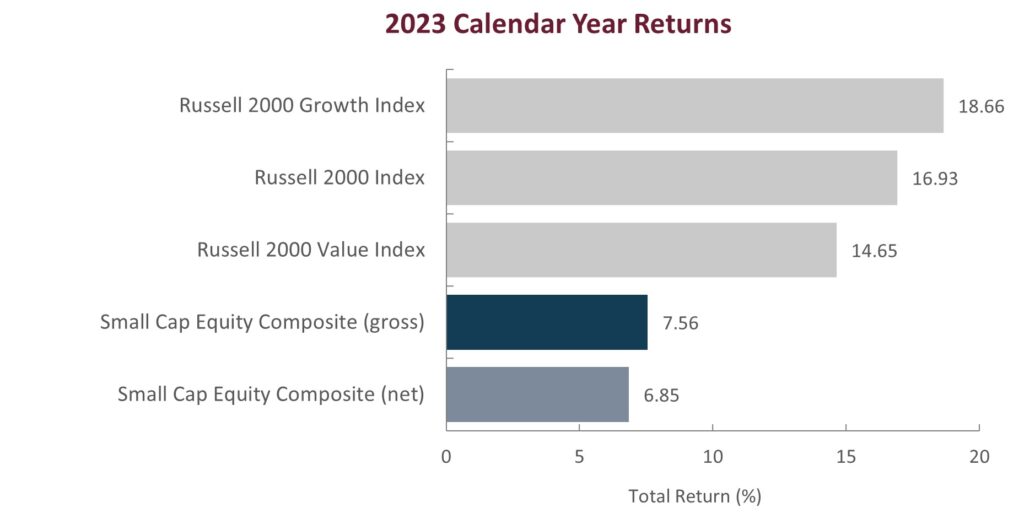
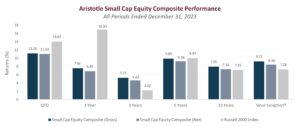
For the first quarter of 2023, the Aristotle Small Cap Equity Composite posted a total return of 0.97% net of fees (1.10% gross of fees), trailing the 2.74% total return of the Russell 2000 Index. Underperformance was driven by security selection while allocation effects positively contributed. Overall, security selection was weakest within the Financials, Industrials and Information Technology sectors and strongest in Energy, Utilities and Communication Services. From an allocation perspective, the portfolio benefited from an underweight in Financials and an overweight in Industrials, however, this was partially offset by underweights in Consumer Discretionary and Materials.

Relative ContributorsRelative Detractors
Insight EnterprisesSignature Bank
World Wrestling EntertainmentAcadia Healthcare
U.S. Xpress EnterprisesNational Bank Holdings
BeldenVeritex Holdings
Euronet WorldwidePacWest Bancorp

CONTRIBUTORS

Insight Enterprises (NSIT), a provider of branded IT products and services to businesses, appreciated during the quarter as the company’s transition from a transaction-oriented reseller to a services and solutions integrator continues to march on. We maintain a position as we believe the company’s focus on higher value-add areas like Cloud and Digital Solutions can continue to benefit shareholders as its customers seek to refresh and digitally transform their IT systems.

World Wrestling Entertainment (WWE), a media and entertainment company that operates, promotes, merchandises, and licenses live wrestling events worldwide, appreciated amid heightened investor sentiment surrounding the company’s upcoming TV rights renewal cycle and growing expectations that the company would be sold to a strategic buyer. We maintain our position ahead of the company’s anticipated business combination with Endeavor Group, a global sports and entertainment company and owner of UFC, which was announced shortly after quarter end.

DETRACTORS

Signature Bank (SBNY), a full-service commercial bank with offices across the U.S., declined after the New York Department of Financial Services took possession of the bank and appointed the Federal Deposit Insurance Corporation (FDIC) as the receiver in mid-March. Shortly thereafter the FDIC entered into an agreement with Flagstar Bank, a subsidiary of New York Community Bancorp (NYSE: NYCB) for substantially all deposits and certain loan portfolios of Signature Bridge Bank on March 20, 2023. We liquidated our remaining position late in the quarter and have provided additional color in the Recent Portfolio Activity section of the commentary below.

Acadia Healthcare (ACHC), a provider of behavioral health and addiction services to patients in a variety of inpatient and outpatient settings, declined following the company’s quarterly earnings results released during the period. While the company’s fundamentals continue to advance, it appears the share price overreaction following the release of company’s earnings can be attributed to some near-term labor cost headwinds that came in higher than expected during the period. Nevertheless, we maintain a position as we believe the company remains well positioned to capitalize on the favorable supply/demand outlook for behavioral health, positive reimbursement trends and continued execution of its growth strategy.

Recent Portfolio Activity

Buys/AcquisitionsSells/Liquidations
Hannon Armstrong Sustainable Infrastructure CapitalAltra Industrial Motion
iStar
PacWest Bancorp
Signature Bank

BUYS/ACQUISITIONS

Hannon Armstrong Sustainable Infrastructure Capital (HASI), a Maryland-based sustainable asset financing and investing company, was added to the portfolio. We believe the company remains uniquely positioned to benefit as the demand for sustainable energy and infrastructure continues to grow. Additionally, we believe the company’s diverse portfolio, emphasis on proven technologies and long-term partnerships will result in less cyclical, lower risk, more predictable cash flows which can drive shareholder value in periods to come.

SELLS/LIQUIDATIONS

Altra Industrial Motion (AIMC), a global manufacturer and supplier of motion control, power transmission and automation products was removed from the portfolio after being acquired by Regal Rexnord Corporation (NYSE: RRX).

iStar (STAR), an internally-managed real estate investment trust specializing in ground leases, was removed from the portfolio following the completion of its merger with Safehold Inc. and the spinoff of the company’s non-ground lease assets. We maintain a position in the newly created business entity which now trades under the ticker “SAFE” and operates as the only self-managed, pure-play ground lease company in the public markets.

PacWest Bancorp (PACW), a West Coast relationship-based community bank focused on providing business banking and treasury management services to small, middle-market, and venture-backed businesses, was sold from the portfolio due to our belief that future shareholder value creation may be impeded by uncertainties related to the bank’s exposure to late-stage venture capital sponsored clients, and that the company’s risk/reward potential was no longer justified.

Signature Bank (SBNY), a full-service commercial bank with offices across the U.S, was sold from the portfolio following the FDIC takeover and subsequent carve-out of Signature Bridge Bank. Having followed Signature Bank for almost two decades, our investment thesis was predicated on the belief that Signature Bank was a traditional commercial bank with a diversified clientele and business model. The bank has a history of finding attractive industries/ecosystems that have robust deposit needs, and serving these areas well. Its unique operating model of acquiring experienced private client teams drove strong deposit and loan growth, while the autonomy provided to the teams helped keep overhead costs low. The company continued to acquire teams to further its growth, and we expected its successful integration of these teams to continue, particularly on the West Coast. On a fundamental basis, we believed the company had been executing well, highlighted by record annual earnings in 2022, expanding margins, loan growth, new teams added, and clean credit metrics. However, given the heightened scrutiny of the recent events involving Silicon Valley Bank and Silvergate Capital, some of the bank’s depositors opted to pull their money creating a run on the bank despite significant qualitative and quantitative differences between those two entities and Signature Bank. The company’s digital payments platform appeared to be a source of investor confusion despite its limited financial impact on the bank’s overall business. As part of this business, Signature Bank facilitated crypto-based transactions by holding customer’s U.S. Dollar-backed crypto tokens as deposits. The bank did not, however, engage in crypto-backed lending or trading and did not hold any cryptocurrencies on its balance sheet. Moreover, the company had recently announced its plans to intentionally reduce its digital assets exposure, a move we expected to reduce future earnings power from 2022 levels but would help alleviate some of the negative investor sentiment. Many finite details that prompted regulators to step in, eventually leading to the downfall of Signature Bank, are still unknown, however, we ultimately liquidated our remaining position late in the quarter after shares reopened for trading.

Outlook

After inflationary pressures, rising borrowing costs, and geopolitical turmoil created headwinds for investors in 2022, fears of an impending banking crisis and a slowing economy pose new threats in 2023. While sentiment moderately stabilized into quarter end, continued uncertainty and increased risks of recession will likely keep market participants on edge for the foreseeable future. Against this backdrop, we continue to believe the Federal Reserve will be a key driver of market volatility going forward. Specifically, now that the Fed’s initial batch rate increases are in the rearview mirror, the ongoing debate and positioning around any future Fed activity (or lack thereof) is likely to create continued bouts of volatility in both the equity and fixed income markets due to the implications on the strength of the U.S. economy, inflation expectations, and the resulting impact on corporate profitability. Another key item to watch over the coming months will be the extent to which recent events cause banks to reduce lending. This in turn may weigh on consumer demand and business investment and therefore accelerate any slowdown in the economy. As such, we will be paying close attention to management commentary and financial disclosures throughout this upcoming earnings season, which may unearth or dispel many of these ongoing concerns. Either way, it’s not a stretch to assume that there’s likely to be more volatility in the coming months, making this a good time to remember the benefits of portfolio diversification, remaining disciplined, and staying focused on companies with higher-quality characteristics such as stable earnings, clean balance sheets, and reasonable valuations.

From an asset class perspective, valuations of small versus large remain near multi-decade lows, which we believe suggests a more favorable setup for small caps relative to large caps in the periods to come (11.1x P/E for the Russell 2000 Index vs. 19.2x P/E for the Russell 1000 Index). Small caps, as represented by the Russell 2000, also remain historically attractive on an absolute basis and are trading near their lowest levels in over 30 years, in-line with lows during the GFC and below the COVID-19 recession and 2001 recession lows. Additional benefits from re-shoring efforts, investments in automation amid wage inflation/tight labor markets, and spending to reduce emissions also favor small caps which are beneficiaries of U.S. capex cycles. High and falling inflationary environments have also been favorable market environments for the asset class historically, a scenario we may find ourselves in this year. So, while the near-term outlook remains uncertain, along with the length and severity of any upcoming downturn, decades of investing have taught us that these can be the most rewarding times to be invested in small caps for the long-term. When the dust settles, we are reminded that small caps typically start moving up before many of us know for sure that the economy has begun to reaccelerate, and that missing these early stages of a market recovery can be costly*.

Positioning

As always, our current positioning is a function of our bottom-up security selection process and our ability to identify what we view as attractive investment candidates, regardless of economic sector definitions. Overweights in Industrials and Information Technology are mostly a function of recent portfolio activity and the relative performance of our holdings in these sectors over the past few periods. Conversely, we continue to be underweight in Consumer Discretionary, as we have been unable to identify what we consider to be compelling long-term opportunities that fit our discipline given the rising risk profiles of many retail businesses and a potential deceleration in goods spending following a period of strength fueled in part by government backed stimulus payments. We are also underweight in Financials as of quarter end, as we await further details on the potential impact to future bank earnings power amid the recent developments in the sector. Given our focus on long-term business fundamentals, patient investment approach and low portfolio turnover, the strategy’s sector positioning generally does not change significantly from quarter to quarter. However, we may take advantage of periods of volatility by adding selectively to certain companies when appropriate.

*As measured by the average return of the Russell 2000 Index the year following periods of GDP growth <0% since 1980.

Disclosures

The opinions expressed herein are those of Aristotle Capital Boston, LLC (Aristotle Boston) and are subject to change without notice.

Past performance is not indicative of future results. The information provided in this report should not be considered financial advice or a recommendation to purchase or sell any particular security. There is no assurance that any securities discussed herein will remain in an account’s portfolio at the time you receive this report or that securities sold have not been repurchased. The securities discussed may not represent an account’s entire portfolio and, in the aggregate, may represent only a small percentage of an account’s portfolio holdings. The performance attribution presented is of a representative account from Aristotle Boston’s Small Cap Equity Composite. The representative account is a discretionary client account which was chosen to most closely reflect the investment style of the strategy. The criteria used for representative account selection is based on the account’s period of time under management and its similarity of holdings in relation to the strategy. It should not be assumed that any of the securities transactions, holdings or sectors discussed were or will be profitable, or that the investment recommendations or decisions Aristotle Boston makes in the future will be profitable or equal the performance of the securities discussed herein. Aristotle Boston reserves the right to modify its current investment strategies and techniques based on changing market dynamics or client needs. Recommendations made in the last 12 months are available upon request.

Returns are presented gross and net of investment advisory fees and include the reinvestment of all income. Gross returns will be reduced by fees and other expenses that may be incurred in the management of the account. Net returns are presented net of actual investment advisory fees and after the deduction of all trading expenses.

Effective January 1, 2022, the Aristotle Small Cap Equity Composite has been redefined to exclude accounts with meaningful industry-specific restrictions or substantial values-based screens hampering implementation of the small cap strategy.

Effective January 1, 2022, the Russell 2000 Value Index was removed as the secondary benchmark for the Aristotle Capital Boston Small Cap Equity strategy.

All investments carry a certain degree of risk, including the possible loss of principal. Investments are also subject to political, market, currency and regulatory risks or economic developments. International investments involve special risks that may in particular cause a loss in principal, including currency fluctuation, lower liquidity, different accounting methods and economic and political systems, and higher transaction costs.

These risks typically are greater in emerging markets. Securities of small‐ and medium‐sized companies tend to have a shorter history of operations, be more volatile and less liquid. Value stocks can perform differently from the market as a whole and other types of stocks. The material is provided for informational and/or educational purposes only and is not intended to be and should not be construed as investment, legal or tax advice and/or a legal opinion. Investors should consult their financial and tax adviser before making investments.

The opinions referenced are as of the date of publication, may be modified due to changes in the market or economic conditions, and may not necessarily come to pass.

The firm’s coverage of Signature Bank includes time at a predecessor firm.

Aristotle Capital Boston, LLC is an independent investment adviser registered under the Investment Advisers Act of 1940, as amended. Registration does not imply a certain level of skill or training. More information about Aristotle Boston, including our investment strategies, fees and objectives, can be found in our Form ADV Part 2, which is available upon request. ACB-2304-16

Performance Disclosures

Sources: SS&C Advent, Russell Investments

Composite returns for periods ended March 31, 2023 are preliminary pending final account reconciliation.

*The Aristotle Small Cap Equity Composite has an inception date of November 1, 2006 at a predecessor firm. During this time, Jack McPherson and Dave Adams had primary responsibility for managing the strategy. Performance starting January 1, 2015 was achieved at Aristotle Boston.

**For the period November 2006 through December 2006.

Past performance is not indicative of future results. Performance results for periods greater than one year have been annualized.

Effective January 1, 2022, the Aristotle Small Cap Equity Composite has been redefined to exclude accounts with meaningful industry-specific restrictions or substantial values-based screens hampering implementation of the small cap strategy.

Effective January 1, 2022, the Russell 2000 Value was removed as the secondary benchmark for the Aristotle Capital Boston Small Cap Equity strategy.

Returns are presented gross and net of investment advisory fees and include the reinvestment of all income. Gross returns will be reduced by fees and other expenses that may be incurred in the management of the account. Net returns are presented net of actual investment advisory fees and after the deduction of all trading expenses. Please see important disclosures enclosed within this document.

Index Disclosures

The Russell 2000® Index measures the performance of the small cap segment of the U.S. equity universe. The Russell 2000 Index is a subset of the Russell 3000® Index representing approximately 10% of the total market capitalization of that index. It includes approximately 2000 of the smallest securities based on a combination of their market cap and current index membership. The Russell 2000 Growth® Index measures the performance of the small cap companies located in the United States that also exhibit a growth probability. The Russell 2000 Value® Index measures the performance of the small cap companies located in the United States that also exhibit a value probability. The Russell 1000® Index measures the performance of the large cap segment of the U.S. equity universe. The Russell 1000 Index is a subset of the Russell 3000® Index, representing approximately 90% of the total market capitalization of that index. It includes approximately 1,000 of the largest securities based on a combination of their market capitalization and current index membership. The volatility (beta) of the composite may be greater or less than the benchmarks. It is not possible to invest directly in these indices.

For more on Small Cap Equity, access the latest resources.

ARISTOTLE CAPITAL BOSTON, LLC

Markets Review

SMID cap equities began the year on a positive note, with the Russell 2500 rising over 14% through the first 22 trading days of the year amid renewed investor optimism, moderating inflation data, and hopes that the Federal Reserve would soon alter their stance. This jolt of enthusiasm translated into outperformance for speculative segments of the SMID market in January, many of which were last year’s losers. Non-profitable and heavily shorted stocks also surged in January—notching gains reminiscent of those experienced during the meme frenzy in early 2021. This rally, however, was short-lived as rising rates, tighter lending conditions, and the banking system turmoil that emerged near the end of the quarter all contributed to an unsettling backdrop for investors and a 13.9% intra-quarter decline in the Russell 2500 Index. SMID cap markets stabilized towards the end of March, however, moving back into positive territory during the final week of the quarter and closing out a volatile period with a modest gain.

Stylistically, growth outperformed value during the quarter, as evidenced by the Russell 2500 Growth Index’s total return of 6.54% versus the 1.40% total return of the Russell 2500 Value Index. The outperformance of growth-oriented companies (as defined by Russell) during the quarter is a reversal of the recent trend that has been in place for much of the past two years. Moreover, Q1 was among the Russell 2500 Growth’s best relative quarters versus the Russell 2500 Value on record (of 149 quarters) making it a top quintile relative quarter for Growth over Value. This dispersion was driven in large part by the value index’s higher weightings in the Financials and Energy sectors, which underperformed the broader Index in the face of regional bank related turmoil and falling energy prices.

On a sector basis, Information Technology, Consumer Discretionary and Communication Services led first quarter returns, up 13.58%, 10.38%, and 8.56% respectively, with Information Technology outperforming the broader index for the first time in five quarters. Energy (-9.08%) and Financials (-7.11%) were the worst performing sectors during the quarter followed by Health Care (-0.08%) which was negatively impacted by the performance of Biotechnology companies within the sector.

Sources: SS&C Advent; Russell Investments

Past performance is not indicative of future results. Returns are presented gross and net of investment advisory fees and include the reinvestment of all income. Gross returns will be reduced by fees and other expenses that may be incurred in the management of the account. Net returns are presented net of actual investment advisory fees and after the deduction of all trading expenses. Aristotle Small Cap Equity Composite returns are preliminary pending final account reconciliation. Please see important disclosures at the end of this document.

Performance Review

For the first quarter of 2023, the Aristotle Small/Mid Cap Equity Composite generated a total return of 0.93% net of fees (1.08% gross of fees), trailing the 3.39% total return of the Russell 2500 Index. Underperformance was driven by security selection while allocation effects positively contributed. Overall, security selection was weakest within the Financials, Information Technology, and Industrials sectors and strongest in Energy, Communication Services and Health Care. From an allocation perspective, the portfolio benefited from overweight exposures in Information Technology and Industrials, however, this was partially offset by underweights in Consumer Discretionary and Communication Services.

Relative ContributorsRelative Detractors
FTI ConsultingSignature Bank
CatalentBankUnited
Wolverine WorldwideNational Bank Holdings
BeldenAcadia Healthcare
World Wrestling EntertainmentPacWest Bancorp

CONTRIBUTORS

FTI Consulting (FCN), a global business advisory firm that provides a variety of consulting services to large corporations, benefited from strong fundamental performance driven by increased demand for the company’s services as its clients navigate through increased regulatory scrutiny, corporate finance and restructuring activity, and a proliferation of corporate litigation. We maintain a position, as we believe the firm’s diversified business mix, global reach and management’s efforts to optimize the business can create value for shareholders going forward.

Catalent (CTLT), a pharmaceutical contract development and manufacturing organization, appreciated amid positive momentum within the company’s Biologics segment, a renewed focus on improving efficiencies, and rumblings that the company may be acquired. We maintain a position, as we believe the long-term value creation opportunity for the company remains intact, driven by favorable outsourcing trends and the company’s competitive position in biologics, particularly within the company’s cell and gene therapy sub-segments.

DETRACTORS

Signature Bank (SBNY), a full-service commercial bank with offices across the U.S., declined after the New York Department of Financial Services took possession of the bank and appointed the Federal Deposit Insurance Corporation (FDIC) as the receiver in mid-March. Shortly thereafter the FDIC entered into an agreement with Flagstar Bank, a subsidiary of New York Community Bancorp (NYSE: NYCB) for substantially all deposits and certain loan portfolios of Signature Bridge Bank on March 20, 2023. We liquidated our remaining position late in the quarter and have provided additional color in the Recent Portfolio Activity section of the commentary below.

BankUnited (BKU), a bank holding company that provides commercial and consumer banking services in select regions nationally, declined amid broader industry wide pressures that impacted regional banking sentiment during the quarter. We maintain a position, as we believe the company can weather this period of volatility given the diversified nature of its business, strong asset quality metrics, and favorable geographic exposures.

Recent Portfolio Activity

Buys/AcquisitionsSells/Liquidations
Hannon Armstrong Sustainable Infrastructure CapitalAltra Industrial Motion
TeleflexiStar
PacWest Bancorp
Signature Bank

BUYS/ACQUISITIONS

Hannon Armstrong Sustainable Infrastructure Capital (HASI), a Maryland-based sustainable asset financing and investing company was added to the portfolio. We believe the company remains uniquely positioned to benefit as the demand for sustainable energy and infrastructure continues to grow. Additionally, we believe the company’s diverse portfolio, emphasis on proven technologies and long-term partnerships will result in less cyclical, lower risk, more predictable cash flows which can drive shareholder value in periods to come.

Teleflex (TFX), a global provider of primarily single-use medical devices used by hospitals and healthcare providers for common diagnostic, therapeutic procedures, and surgical applications was added to the portfolio on our belief that the company’s diverse portfolio of industry leading brands can drive shareholder value as procedure volumes continue to recover. Furthermore, company specific margin improvement initiatives, product mix shift towards faster growing, more profitable products, and increased penetration internationally should also benefit shareholders over the next several years, in our view.

SELLS/LIQUIDATIONS

Altra Industrial Motion (AIMC), a global manufacturer and supplier of motion control, power transmission and automation products was removed from the portfolio after being acquired by Regal Rexnord Corporation (NYSE: RRX).

iStar (STAR), an internally-managed real estate investment trust specializing in ground leases, was removed from the portfolio following the completion of its merger with Safehold Inc. and the spinoff of the company’s non-ground lease assets. We maintain a position in the newly created business entity which now trades under the ticker “SAFE” and operates as the only self-managed, pure-play ground lease company in the public markets.

PacWest Bancorp (PACW), a West Coast relationship-based community bank focused on providing business banking and treasury management services to small, middle-market, and venture-backed businesses, was sold from the portfolio due to our belief that future shareholder value creation may be impeded by uncertainties related to the bank’s exposure to late-stage venture capital sponsored clients, and that the company’s risk/reward potential was no longer justified.

Signature Bank (SBNY), a full-service commercial bank with offices across the U.S, was sold from the portfolio following the FDIC takeover and subsequent carve-out of Signature Bridge Bank. Having followed Signature Bank for almost two decades, our investment thesis was predicated on the belief that Signature Bank was a traditional commercial bank with a diversified clientele and business model. The bank has a history of finding attractive industries/ecosystems that have robust deposit needs and serving these areas well. Its unique operating model of acquiring experienced private client teams drove strong deposit and loan growth, while the autonomy provided to the teams helped keep overhead costs low. The company continued to acquire teams to further its growth, and we expected its successful integration of these teams to continue, particularly on the West Coast. On a fundamental basis, we believed the company had been executing well, highlighted by record annual earnings in 2022, expanding margins, loan growth, new teams added, and clean credit metrics. However, given the heightened scrutiny of the recent events involving Silicon Valley Bank and Silvergate Capital, some of the bank’s depositors opted to pull their money creating a run on the bank despite significant qualitative and quantitative differences between those two entities and Signature Bank. The company’s digital payments platform appeared to be the source of investor confusion despite its limited financial impact on the bank’s overall business. As part of this business, Signature Bank facilitated crypto-based transactions by holding customer’s U.S. Dollar-backed crypto tokens as deposits. The bank did not, however, engage in crypto-backed lending or trading and did not hold any cryptocurrencies on its balance sheet. Moreover, the company had recently announced its plans to intentionally reduce its digital assets exposure a move we expected to reduce future earnings power from 2022 levels but would help alleviate some of the negative investor sentiment. Many specific details of what prompted regulators to step in, eventually leading to the downfall of Signature Bank, are still unknown, however, we ultimately liquidated our remaining position late in the quarter after shares reopened for trading.

Outlook

After inflationary pressures, rising borrowing costs, and geopolitical turmoil created headwinds for investors in 2022, fears of an impending banking crisis and a slowing economy pose new threats in 2023. While sentiment moderately stabilized into quarter end, continued uncertainty and increased risks of recession will likely keep market participants on edge for the foreseeable future. Against this backdrop, we continue to believe the Federal Reserve will be a key driver of market volatility going forward. Specifically, now that the Fed’s initial batch rate increases are in the rearview mirror, the ongoing debate and positioning around any future Fed activity (or lack thereof) is likely to create continued bouts of volatility in both the equity and fixed income markets due to the implications on the strength of the U.S. economy, inflation expectations, and the resulting impact on corporate profitability. Another key item to watch over the coming months will be the extent to which recent events cause banks to reduce lending. This in turn may weigh on consumer demand and business investment and therefore accelerate any slowdown in the economy. As such, we will be paying close attention to management commentary and financial disclosures throughout this upcoming earnings season, which may unearth or dispel many of these ongoing concerns. Either way, it’s not a stretch to assume that there’s likely to be more volatility in the coming months, making this a good time to remember the benefits of portfolio diversification, remaining disciplined, and staying focused on companies with higher-quality characteristics such as stable earnings, clean balance sheets, and reasonable valuations.

From an asset class perspective, valuations of SMID versus large cap remain near multi-decade lows, which we believe suggests a more favorable setup for SMID caps relative to large caps in the periods to come (12.9x P/E for the Russell 2500 Index vs. 19.2x P/E for the Russell 1000 Index). SMID caps, as represented by the Russell 2500, also remain historically attractive on an absolute basis and are trading near their lowest levels in over 30 years, slightly above the lows during the GFC and below the COVID-19 recession and 2001 recession lows. Additional benefits from re-shoring efforts, investments in automation amid wage inflation/tight labor markets, and spending to reduce emissions also favor small & mid caps which are beneficiaries of U.S. capex cycles. High and falling inflationary environments have also been favorable market environments for the asset class historically, a scenario we may find ourselves in this year. So, while the near-term outlook remains uncertain, along with the length and severity of any upcoming downturn, decades of investing have taught us that these can be the most rewarding times to be invested in SMID cap companies for the long-term. When the dust settles, we are reminded that small & mid cap companies typically start moving up before many of us know for sure that the economy has begun to reaccelerate, and that missing these early stages of a market recovery can be costly*.

Positioning

As always, our current positioning is a function of our bottom-up security selection process and our ability to identify what we view as attractive investment candidates, regardless of economic sector definitions. Overweights in Industrials and Information Technology are mostly a function of recent portfolio activity and the relative performance of our holdings in these sectors over the past few periods. Conversely, we continue to be underweight in Consumer Discretionary, as we have been unable to identify what we consider to be compelling long-term opportunities that fit our discipline given the rising risk profiles of many retail businesses and a potential deceleration in goods spending following a period of strength fueled in part by government backed stimulus payments. We also continue to be underweight in Real Estate as a result of structural challenges for various end markets within the sector. Given our focus on long-term business fundamentals, patient investment approach and low portfolio turnover, the strategy’s sector positioning generally does not change significantly from quarter to quarter. However, we may take advantage of periods of volatility by adding selectively to certain companies when appropriate.

*As measured by the average return of the Russell 2500 Index the year following periods of GDP growth <0% since 1980.

Disclosures

The opinions expressed herein are those of Aristotle Capital Boston, LLC (Aristotle Boston) and are subject to change without notice.

Past performance is not indicative of future results. The information provided in this report should not be considered financial advice or a recommendation to purchase or sell any particular security. There is no assurance that any securities discussed herein will remain in an account’s portfolio at the time you receive this report or that securities sold have not been repurchased. The securities discussed may not represent an account’s entire portfolio and, in the aggregate, may represent only a small percentage of an account’s portfolio holdings. The performance attribution presented is of a representative account from Aristotle Boston’s Small/Mid Cap Equity Composite. The representative account is a discretionary client account which was chosen to most closely reflect the investment style of the strategy. The criteria used for representative account selection is based on the account’s period of time under management and its similarity of holdings in relation to the strategy. It should not be assumed that any of the securities transactions, holdings or sectors discussed were or will be profitable, or that the investment recommendations or decisions Aristotle Boston makes in the future will be profitable or equal the performance of the securities discussed herein. Aristotle Boston reserves the right to modify its current investment strategies and techniques based on changing market dynamics or client needs. Recommendations made in the last 12 months are available upon request.

Returns are presented gross and net of investment advisory fees and include the reinvestment of all income. Gross returns will be reduced by fees and other expenses that may be incurred in the management of the account. Net returns are presented net of actual investment advisory fees and after the deduction of all trading expenses.

Effective January 1, 2022, the Russell 2500 Value Index was removed as the secondary benchmark for the Aristotle Boston Small/Mid Cap Equity strategy.

Non-fee-paying accounts represented less than 5% of the SMID Cap Composite assets from December 31, 2010 to December 31, 2013. As of December 31, 2014, there were no non-fee-paying accounts in the Composite. In instances where non-fee paying accounts were included in the SMID Cap Composite, the highest model fee was applied to recalculate the net returns for composite purposes and the impact on the since inception return of the composite was deemed immaterial.

All investments carry a certain degree of risk, including the possible loss of principal. Investments are also subject to political, market, currency and regulatory risks or economic developments. International investments involve special risks that may in particular cause a loss in principal, including currency fluctuation, lower liquidity, different accounting methods and economic and political systems, and higher transaction costs.

These risks typically are greater in emerging markets. Securities of small‐ and medium‐sized companies tend to have a shorter history of operations, be more volatile and less liquid. Value stocks can perform differently from the market as a whole and other types of stocks.

The material is provided for informational and/or educational purposes only and is not intended to be and should not be construed as investment, legal or tax advice and/or a legal opinion. Investors should consult their financial and tax adviser before making investments.

The opinions referenced are as of the date of publication, may be modified due to changes in the market or economic conditions, and may not necessarily come to pass.

The firm’s coverage of Signature Bank includes time at a predecessor firm.

Aristotle Capital Boston, LLC is an independent investment adviser registered under the Investment Advisers Act of 1940, as amended. Registration does not imply a certain level of skill or training. More information about Aristotle Boston, including our investment strategies, fees and objectives, can be found in our Form ADV Part 2, which is available upon request. ACB-2304-17

Performance Disclosures

Sources: SS&C Advent, Russell Investments

Composite returns for periods ended March 31, 2023 are preliminary pending final account reconciliation.

*The Aristotle Small/Mid Cap Equity Composite has an inception date of January 1, 2008 at a predecessor firm. During this time, Jack McPherson and Dave Adams had primary responsibility for managing the strategy. Performance starting January 1, 2015 was achieved at Aristotle Boston.

Effective January 1, 2022, the Russell 2500 Value Index was removed as the secondary benchmark for the Aristotle Boston Small/Mid Cap Equity Strategy.  Non-fee-paying accounts represented less than 5% of the SMID Cap Composite assets from December 31, 2010 to December 31, 2013. As of December 31, 2014, there were no non-fee-paying accounts in the Composite. In instances where non-fee paying accounts were included in the SMID Cap Composite, the highest model fee was applied to recalculate the net returns for composite purposes and the impact on the since inception return of the composite was deemed immaterial. Past performance is not indicative of future results. Performance results for periods greater than one year have been annualized.

Returns are presented gross and net of investment advisory fees and include the reinvestment of all income. Gross returns will be reduced by fees and other expenses that may be incurred in the management of the account. Net returns are presented net of actual investment advisory fees and after the deduction of all trading expenses. Please see important disclosures enclosed within this document.

Index Disclosures

The Russell 2500 Index is a subset of the Russell 3000® Index representing approximately 10% of the total market capitalization of that index. It includes approximately 2000 of the smallest securities based on a combination of their market cap and current index membership. The Russell 2500 Growth® Index measures the performance of the small/mid cap companies located in the United States that also exhibit a growth probability. The Russell 2500 Value® Index measures the performance of the small/mid cap companies located in the United States that also exhibit a value probability. The Russell 1000 Index is a subset of the Russell 3000® Index, representing approximately 90% of the total market capitalization of that index. It includes approximately 1,000 of the largest securities based on a combination of their market capitalization and current index membership. The volatility (beta) of the composite may be greater or less than the benchmarks. It is not possible to invest directly in these indices.

For more on Small Cap Equity, access the latest resources.

(All MSCI index returns are shown net and in U.S. dollars unless otherwise noted.)

Markets Review

Sources: SS&C Advent, Bloomberg
Past performance is not indicative of future results. Aristotle International Equity Composite returns are presented gross and net of investment advisory fees and include the reinvestment of all income. Gross returns will be reduced by fees and other expenses that may be incurred in the management of the account. Net returns are presented net of actual investment advisory fees and after the deduction of all trading expenses. Aristotle Capital Composite returns are preliminary pending final account reconciliation. Please see important disclosures at the end of this document.

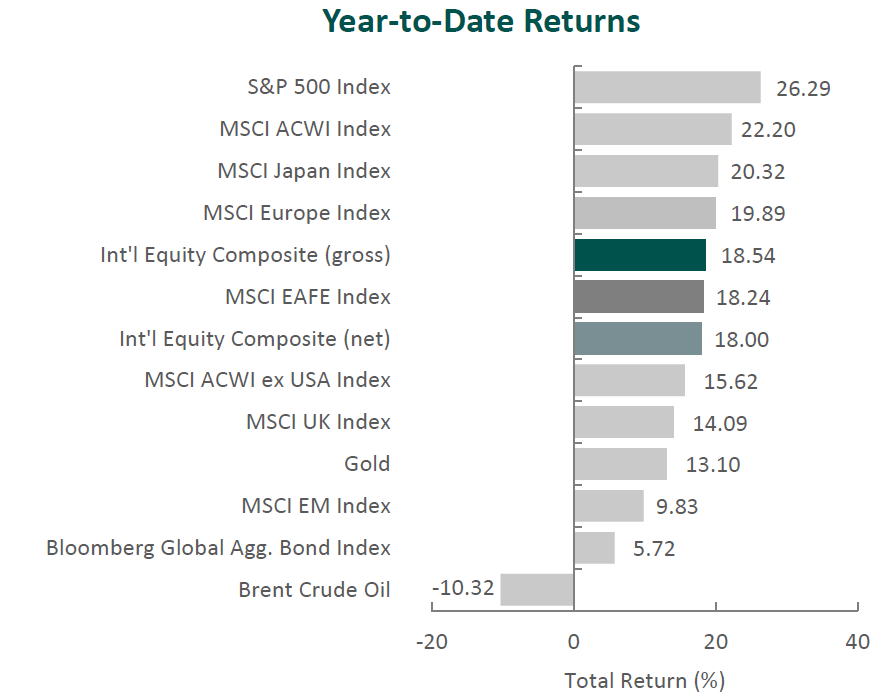
Global equity markets rose in the first quarter of the year, as the MSCI ACWI Index increased 7.31% during the period. Concurrently, the Bloomberg Global Aggregate Bond Index increased 3.01%. In terms of style, growth stocks outperformed their value counterparts during the quarter, with the MSCI ACWI Growth Index beating the MSCI ACWI Value Index by 12.54%.

The MSCI EAFE Index climbed by 8.47% during the first quarter, while the MSCI ACWI ex USA Index increased 6.87%. Within the MSCI EAFE Index, Europe & Middle East and the U.K. were the strongest-performing regions, while Asia gained the least. On a sector basis, ten out of the eleven sectors within the MSCI EAFE Index posted positive returns, with Information Technology, Consumer Discretionary and Industrials generating the largest gains. Conversely, Real Estate was the only sector to finish in the red, while Energy and Financials gained the least.

Despite continued geopolitical tensions, persistent inflation and new concerns in the banking industry, the global economy proved to be resilient. This was seen by strong labor markets, robust household consumption and business investment in addition to effective management of Europe’s energy crisis. Additionally, China continued its relaxation of strict COVID rules by fully reopening its borders to travelers with all types of visas. As a result, the IMF increased its growth forecasts and now projects global growth of 3.4%, 2.9% and 3.1% in 2022, 2023 and 2024, respectively.

Inflation remained elevated in many regions, with the U.K. and eurozone reporting a 10.4% and 8.5% rate, respectively. Meanwhile, in Asia, Japan’s core consumer inflation hit a 41-year high of 4.2%. However, the pace of price increases moderated for other countries. This was the case for China and South Korea, where inflation rates declined to their lowest levels in 12 and 10 months, repectively. On a forward-looking basis, the IMF estimates global inflation will fall from 8.8% in 2022 to 6.6% in 2023 and 4.3% in 2024. The organization believes restrictive monetary policy and cooling commodity prices due to weaker demand will contribute to the pattern of disinflation.

During the quarter, the failure of U.S.-based, mid-sized institutions Silicon Valley Bank (SVB) and Signature Bank reverberated into the international market, adding a layer of complexity to restrictive central bank policies. After SVB’s closure due to a run on deposits, Credit Suisse also experienced withdrawals, further exacerbated by a subsequent plunging share price that led Swiss regulators to orchestrate a takeover by UBS. As a result of the turmoil in the banking sector, central banks in the U.S. and Europe have commented that credit conditions may have tightened more than some economic indicators currently suggest.

Lastly, on the geopolitical front, the war in Ukraine rages on in the eastern side of the country while southern lines have largely stabilized. Though China continues to align itself with Russia, China’s Ministry of Foreign Affairs released a paper calling for all parties to support dialogue to “gradually deescalate the situation.” Meanwhile, Western nations continue to support Ukraine, with commitments from the U.S., Germany and Britain to supply armored vehicles.

Performance and Attribution Summary

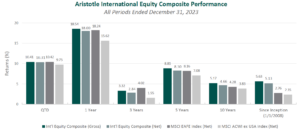
For the first quarter of 2023, Aristotle Capital’s International Equity Composite posted a total return of 7.10% gross of fees (6.98% net of fees), underperforming the MSCI EAFE Index, which returned 8.47%, and outperforming the MSCI ACWI ex USA Index, which returned 6.87%. Please refer to the table below for detailed performance

Performance (%) 1Q231 Year3 Years5 Years10 Years Since Inception*
International Equity Composite (gross)7.10-5.0713.254.165.395.21
International Equity Composite (net)6.98-5.5212.713.664.884.71
MSCI EAFE Index (net)8.47-1.3812.993.525.002.32
MSCI ACWI ex USA Index (net)6.87-5.0711.802.474.161.94
*The inception date for the International Equity Composite is January 1, 2008. Past performance is not indicative of future results. Aristotle International Equity Composite returns are presented gross and net of investment advisory fees and include the reinvestment of all income. Gross returns will be reduced by fees and other expenses that may be incurred in the management of the account. Net returns are presented net of actual investment advisory fees and after the deduction of all trading expenses. Aristotle Capital Composite returns are preliminary pending final account reconciliation. Please see important disclosures at the end of this document.

Source: FactSet

Past performance is not indicative of future results. Attribution results are based on sector returns which are gross of investment advisory fees. Attribution is based on performance that is gross of investment advisory fees and includes the reinvestment of income.

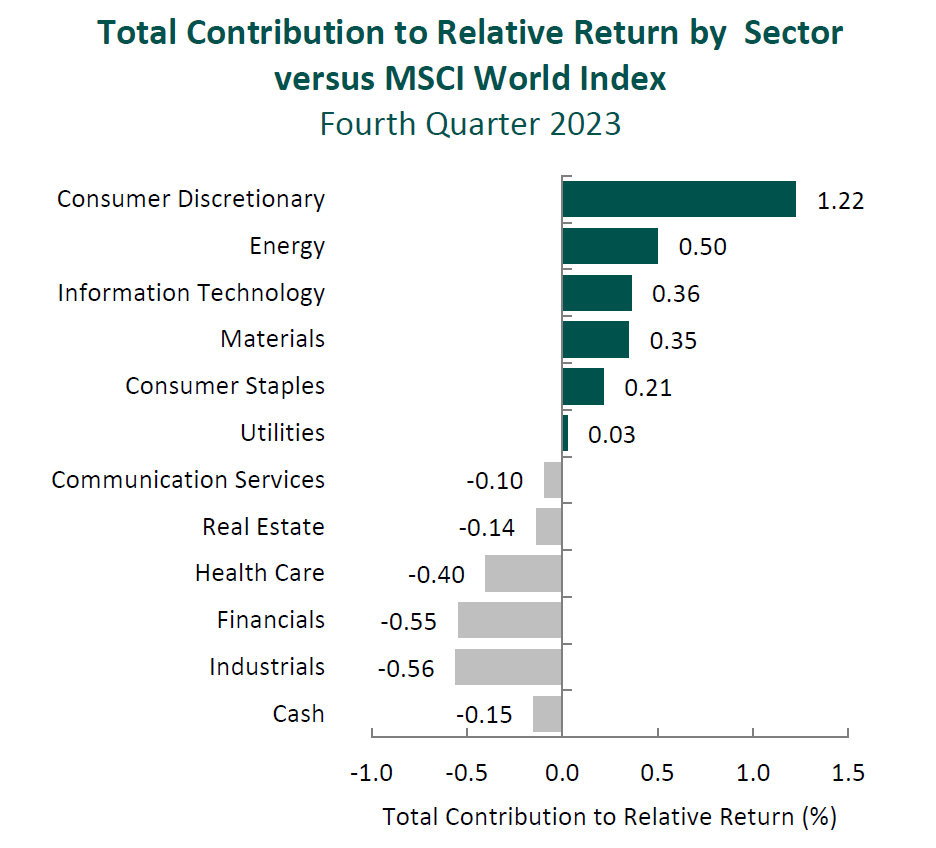
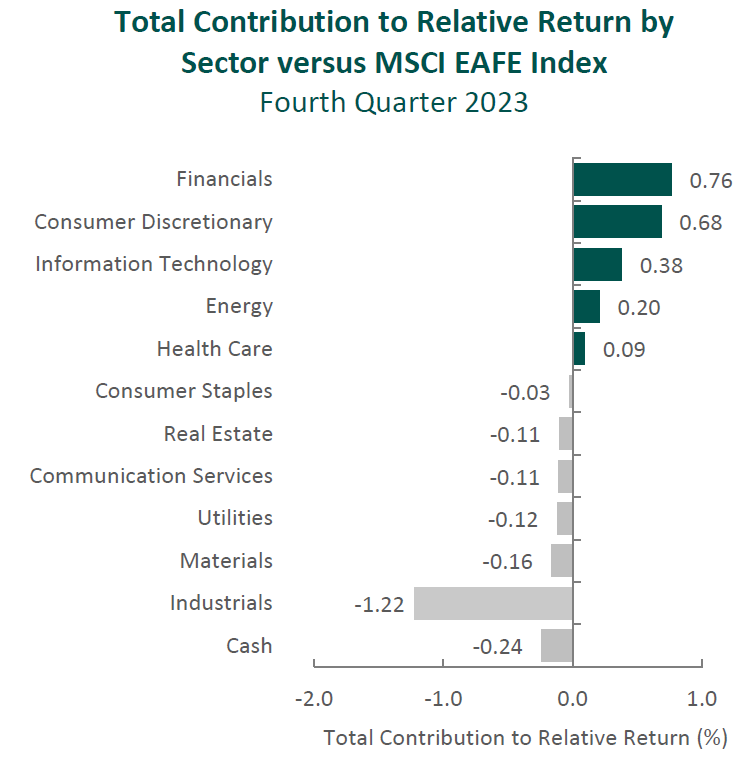
From a sector perspective in the first quarter, the portfolio’s underperformance relative to the MSCI EAFE Index can be attributed to security selection, while allocation effects had a positive impact. Security selection in Consumer Discretionary, Information Technology and Materials detracted the most from the portfolio’s relative performance. Conversely, overweights in Information Technology and Consumer Discretionary and a lack of exposure to Real Estate contributed to relative return.

Regionally, both security selection and allocation effects were responsible for the portfolio’s underperformance. Security selection in Europe and exposure to Canada detracted the most from relative performance, while an underweight and security selection in Asia contributed.

Contributors and Detractors for 1Q 2023

Relative ContributorsRelative Detractors
NemetschekMagna International
LVMHCredicorp
SonyDBS Group
Rentokil InitialKoninklijke DSM
FANUCAIA Group

Magna International, a Canada-based global auto parts, systems and assembly company, was a leading detractor during the quarter. The company continues to be impacted by the volatile production schedules of auto OEMs, primarily caused by semiconductor supply constraints. For some of Magna’s major customers, volumes are as low as 50%-60% of the contracted plan. This has created short-term inefficiencies in Magna’s ability to manage labor and its overall cost structure. However, we believe these headwinds are temporary in nature, as supply chains and car production levels will normalize over time. We instead remain focused on Magna’s unique capability of supplying parts for an increasingly electrified and autonomous fleet of vehicles. This includes Magna’s specialty in lightweighting vehicles—a necessity for heavy electric cars—as well as its years of investment in self-driving technologies. In addition, Magna signed an agreement in December 2022 to acquire Veoneer Active Safety for approximately $1.5 billion in cash. Veoneer’s advanced driver-assistance system (ADAS) technologies and Magna’s existing ADAS group, in our view, will benefit from enhanced scale and a larger product portfolio, ultimately allowing the company to reach a broader customer base.

AIA Group, a pan-Asian life insurance company headquartered in Hong Kong, was one of the largest detractors for the quarter. As a result of bank failures in both the U.S. and Europe, insurance companies were also scrutinized as potential vulnerabilities within the global financial system. However, given AIA’s strong capital position and ample liquidity, we believe the company is well positioned to withstand market volatility. In contrast to banks, life insurance companies like AIA have longer-duration liabilities than assets. This avoids liquidity pressure when interest rates rise and fixed-income portfolios are marked-to-market. We also see AIA’s investment exposure as limited due to its highly diversified corporate bond portfolio (with more than 1,900 issuers) and less than 5% of total invested assets in equities. As such, we remain focused on the company’s ability to benefit from its increasingly technology-enabled and productive agency salesforce. In fact, AIA’s VONB increased 6% in the second half of 2022, with growth across all of its largest markets. Moreover, we expect the company to further establish its direct presence in mainland China, a catalyst we previously identified, as it plans to reach another 10-12 affluent cities in the country by 2026.

LVMH Moët Hennessy Louis Vuitton, the luxury goods company, was a primary contributor for the quarter. China, one of the world’s largest luxury goods markets, has reopened following three years of various COVID lockdown policies and provided a boost for LVMH. While we are pleased to see the company (and industry) benefit from an improved macroeconomic environment, this is not, and was not, our focus when analyzing the fundamentals of LVMH’s business. Instead of attempting to time short-term factors out of the company’s control, we remain fixated on what LVMH can control. This includes the company’s progress on initiatives such as integrating the acquisitions of Tiffany & Co. and, most recently, the Pedemonte Group to bolster its Jewelry division; market share gains within the Fashion & Leather Goods segment; continued market leadership with the likes of Dior’s Sauvage being named the world leader in perfumes for 2022; and the expansion of the company’s store network and the development of production facilities. These improvements, we believe, more directly impact the company’s long-term fundamental outlook, regardless of the short-term macroeconomic landscape. Lastly, LVMH appointed Pharrell Williams as its new Men’s Creative Director, filling the role following the tragic passing of Virgil Abloh in 2021.

Rentokil Initial, the U.K.-based pest control and hygiene services company, was a leading contributor for the quarter. In late 2022, the company completed its previously announced $6.7 billion acquisition of Terminix to further solidify its position in the North American pest control market. We believed the acquisition, its largest ever, would provide operational synergies from scale efficiencies and in-market densification, as well as accelerate the consolidation of the U.S. pest control market. Initially, Rentokil estimated $150 million in cost synergies by 2025, and the company recently upgraded its target to at least $200 million. We are encouraged by the company’s integration progress and operations, which in turn have led to Rentokil’s highest operating margin in 20 years. We believe the fundamental improvements, combined with the resilient nature of the pest control business, will allow Rentokil to continue to unlock value in the years ahead.

Recent Portfolio Activity

BuysSells
NoneBrookfield Asset Management

During the quarter, we sold our position in Brookfield Asset Management.

We have been owners of Brookfield for well over a decade, having first invested in the fourth quarter of 2009. In December 2022, the company completed the spinoff of 25% of its asset management business, now known as Brookfield Asset Management (“Manager,” ticker: BAM). As part of the spinoff, the parent company, Brookfield Corporation (“Corporation,” ticker: BN), retained a 75% interest in the Manager. As such, we decided to sell our stake in the Manager and use the proceeds to top-up our investment in the Corporation. While we continue to find the Manager’s business attractive, we view Brookfield Corporation as a more optimal investment.

Conclusion

A core tenet of our investment philosophy is the commitment to understand businesses with a long-term perspective. For us, this is especially important during times of heightened uncertainty when macroeconomic events dominate headlines. We remain aware of short-term topics such as inflation, monetary policy and the recent shock to the banking system. However, we believe a competitive advantage of our investment process lies in the fact that, instead of reacting and repositioning our portfolio based on unknowns and unfolding events, our focus remains on business fundamentals. Fundamentals, we are convinced, are what dictate shareholder value in the long term. As such, we continue to attentively study what we believe are high-quality companies with sustainable competitive advantages poised to outperform their peers over full market cycles.

Disclosures

The opinions expressed herein are those of Aristotle Capital Management, LLC (Aristotle Capital) and are subject to change without notice. Past performance is not a guarantee or indicator of future results. This material is not financial advice or an offer to buy or sell any product. You should not assume that any of the securities transactions, sectors or holdings discussed in this report were or will be profitable, or that recommendations Aristotle Capital makes in the future will be profitable or equal the performance of the securities listed in this report. The portfolio characteristics shown relate to the Aristotle International Equity strategy. Not every client’s account will have these characteristics. Aristotle Capital reserves the right to modify its current investment strategies and techniques based on changing market dynamics or client needs. There is no assurance that any securities discussed herein will remain in an account’s portfolio at the time you receive this report or that securities sold have not been repurchased. The securities discussed may not represent an account’s entire portfolio and, in the aggregate, may represent only a small percentage of an account’s portfolio holdings. The performance attribution presented is of a representative account from Aristotle Capital’s International Equity Composite. The representative account is a discretionary client account which was chosen to most closely reflect the investment style of the strategy. The criteria used for representative account selection is based on the account’s period of time under management and its similarity of holdings in relation to the strategy. Recommendations made in the last 12 months are available upon request.

Returns are presented gross and net of investment advisory fees and include the reinvestment of all income. Gross returns will be reduced by fees and other expenses that may be incurred in the management of the account. Net returns are presented net of actual investment advisory fees and after the deduction of all trading expenses.

All investments carry a certain degree of risk, including the possible loss of principal. Investments are also subject to political, market, currency and regulatory risks or economic developments. International investments involve special risks that may in particular cause a loss in principal, including currency fluctuation, lower liquidity, different accounting methods and economic and political systems, and higher transaction costs. These risks typically are greater in emerging markets. Securities of small‐ and medium‐sized companies tend to have a shorter history of operations, be more volatile and less liquid. Value stocks can perform differently from the market as a whole and other types of stocks.

The material is provided for informational and/or educational purposes only and is not intended to be and should not be construed as investment, legal or tax advice and/or a legal opinion. Investors should consult their financial and tax adviser before making investments. The opinions referenced are as of the date of publication, may be modified due to changes in the market or economic conditions, and may not necessarily come to pass. Information and data presented has been developed internally and/or obtained from sources believed to be reliable. Aristotle Capital does not guarantee the accuracy, adequacy or completeness of such information.

Aristotle Capital Management, LLC is an independent registered investment adviser under the Advisers Act of 1940, as amended. Registration does not imply a certain level of skill or training. More information about Aristotle Capital, including our investment strategies, fees and objectives, can be found in our Form ADV Part 2, which is available upon request. ACM-2304-42

Performance Disclosures

Composite returns for all periods ended March 31, 2023 are preliminary pending final account reconciliation.

Past performance is not indicative of future results. The information provided should not be considered financial advice or a recommendation to purchase or sell any particular security or product. Performance results for periods greater than one year have been annualized.

Returns are presented gross and net of investment advisory fees and include the reinvestment of all income. Gross returns will be reduced by fees and other expenses that may be incurred in the management of the account. Net returns are presented net of actual investment advisory fees and after the deduction of all trading expenses.

Index Disclosures

The MSCI EAFE Index (Europe, Australasia, Far East) is a free float-adjusted market capitalization-weighted index that is designed to measure the equity market performance of developed markets, excluding the United States and Canada. The MSCI EAFE Index consists of the following 21 developed market country indices: Australia, Austria, Belgium, Denmark, Finland, France, Germany, Hong Kong, Ireland, Israel, Italy, Japan, the Netherlands, New Zealand, Norway, Portugal, Singapore, Spain, Sweden, Switzerland and the United Kingdom. The MSCI ACWI captures large and mid-cap representation across 23 developed market countries and 24 emerging markets countries. With approximately 3,000 constituents, the Index covers approximately 85% of the global investable equity opportunity set. The MSCI ACWI Growth Index captures large and mid-cap securities exhibiting overall growth style characteristics across 23 developed markets countries and 24 emerging markets countries. The MSCI ACWI Value Index captures large and mid-cap securities exhibiting overall value style characteristics across 23 developed markets countries and 24 emerging markets countries. The MSCI ACWI ex USA Index captures large and mid-cap representation across 22 of 23 developed markets countries (excluding the United States) and 24 emerging markets countries. With approximately 2,300 constituents, the Index covers approximately 85% of the global equity opportunity set outside the United States. The MSCI Emerging Markets Index is a free float-adjusted market capitalization-weighted index that is designed to measure the equity market performance of emerging markets. The MSCI Emerging Markets Index consists of the following 24 emerging market country indexes: Brazil, Chile, China, Colombia, Czech Republic, Egypt, Greece, Hungary, India, Indonesia, Korea, Kuwait, Malaysia, Mexico, Peru, Philippines, Poland, Qatar, Saudi Arabia, South Africa, Taiwan, Thailand, Turkey and United Arab Emirates. The S&P 500® Index is the Standard & Poor’s Composite Index of 500 stocks and is a widely recognized, unmanaged index of common stock prices. The Brent Crude Oil Index is a major trading classification of sweet light crude oil that serves as a major benchmark price for purchases of oil worldwide. The MSCI Japan Index is designed to measure the performance of the large and mid-cap segments of the Japanese market. With approximately 250 constituents, the Index covers approximately 85% of the free float-adjusted market capitalization in Japan. The Bloomberg Global Aggregate Bond Index is a flagship measure of global investment grade debt from 28 local currency markets. This multi-currency benchmark includes treasury, government-related, corporate and securitized fixed-rate bonds from both developed and emerging markets issuers. The MSCI United Kingdom Index is designed to measure the performance of the large and mid-cap segments of the U.K. market. With nearly 100 constituents, the Index covers approximately 85% of the free float-adjusted market capitalization in the United Kingdom. The MSCI Europe Index captures large and mid-cap representation across 15 developed markets countries in Europe. With approximately 430 constituents, the Index covers approximately 85% of the free float-adjusted market capitalization across the European developed markets equity universe. These indices have been selected as the benchmarks and are used for comparison purposes only. The volatility (beta) of the Composite may be greater or less than the respective benchmarks. It is not possible to invest directly in these indices.

For more on International Equity, access the latest resources.

Markets Review

Sources: SS&C Advent, Bloomberg
Past performance is not indicative of future results. Aristotle Value Equity Composite returns are presented gross and net of investment advisory fees and include the reinvestment of all income. Gross returns will be reduced by fees and other expenses that may be incurred in the management of the account. Net returns are presented net of actual investment advisory fees and after the deduction of all trading expenses. Aristotle Capital Composite returns are preliminary pending final account reconciliation. Please see important disclosures at the end of this document.

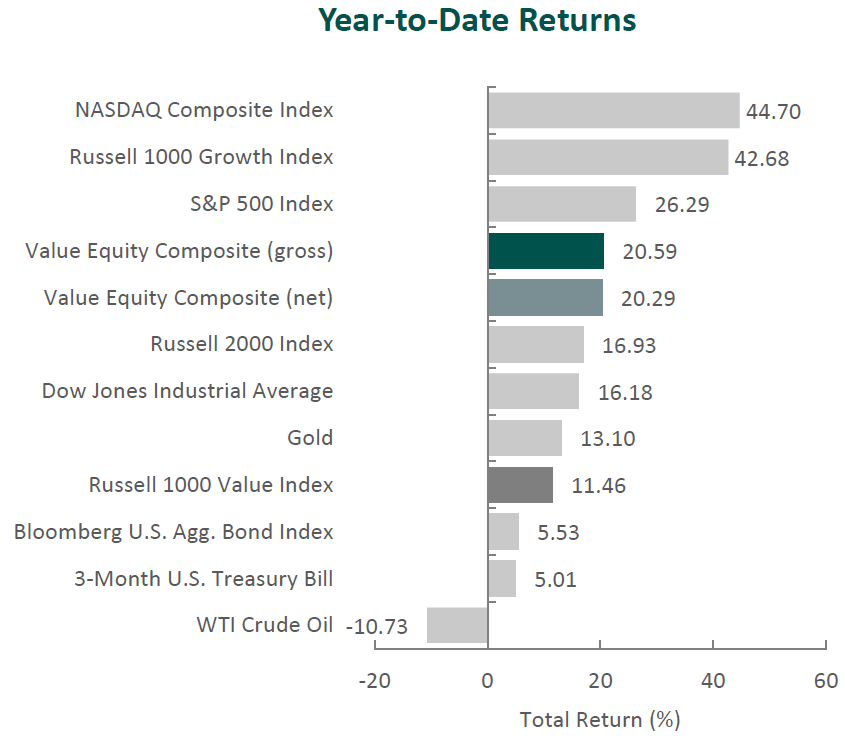
The U.S. equity market finished higher for the first quarter of the year, as the S&P 500 Index rose 7.50% during the period. Concurrently, the Bloomberg U.S. Aggregate Bond Index increased 2.96% for the quarter. In terms of style, the Russell 1000 Growth Index outperformed its value counterpart by 13.36% during the quarter.

Seven out of the eleven sectors within the Russell 1000 Value Index finished higher for the quarter, with Communication Services, Information Technology and Consumer Discretionary gaining the most. Meanwhile, Health Care, Financials and Energy were the worst-performing sectors.

Although inflation remained well above its historical average of 3.26%, the pace of price increases moderated during the quarter. As such, for the 12-month periods ending in January and February, annualized CPI figures declined from 6.4% to 6.0%, respectively. The pattern of disinflation was partly driven by decreases in the price of fuel, used vehicles and medical care services. The government also reported a deceleration in U.S. economic growth, as GDP increased 2.6% in the fourth quarter following the third quarter’s 3.2% increase. Weaker consumer spending and business investment were significant factors in the softer results. However, retail sales in January jumped 3%, and the labor market remained tight, with an unemployment rate of 3.6%.

While some economic data points trended in a positive direction, the market was shocked with the regulatory shutdown of Silicon Valley Bank (SVB), the second-largest bank failure by assets in U.S. history. The value of SVB’s bond holdings had plunged amid rapidly increasing interest rates, creating a shortfall as clients (largely composed of tech startups) withdrew their deposits, eventually leading to a run on the bank’s deposits. Just days later, regulators also took control of New York-based Signature Bank. The speed and size of the bank failures sent U.S. bank share prices tumbling. To provide stability, the Federal Reserve announced the creation of an emergency lending facility that would allow banks to deposit high-quality assets (e.g., Treasuries and mortgage-backed securities) in exchange for a cash advance worth the face value of the asset (instead of the market value). Additionally, First Citizens Bank announced that it had made an agreement with the Federal Deposit Insurance Corporation (FDIC) for a whole bank purchase with loss share coverage of Silicon Valley Bridge Bank.

Despite the turmoil in the banking system, the Federal Reserve (Fed) stayed its course, increasing its benchmark rate by 0.25% in March (its ninth consecutive rate hike) to a range of 4.75% to 5.00%. However, noting that banking events may contribute to a more restrictive credit environment, the Fed tempered its stance that further rate increases are necessary to restore price stability and achieve its 2% inflation target. Rather, Fed Chair Powell emphasized the reliance on incoming data to inform the future path of monetary policy, as conditions may have tightened more than economic indices currently suggest.

On the corporate earnings front, results and guidance were broadly underwhelming, with only 68% of S&P 500 companies exceeding EPS estimates (below the five-year average of 77%) and 67% of companies providing negative EPS guidance (above the five-year average of 59%). Overall, the S&P 500 companies reported a decline in earnings of 4.9% as inflation and recession remained prevalent topics, with 332 and 148 companies mentioning those words on earnings calls, respectively. Nevertheless, in spite of the weaker-than-expected results, there have also been positive remarks of cost cutting, moderating input price pressures and better supply-chain dynamics.

Performance and Attribution Summary

For the first quarter of 2023, Aristotle Capital’s Value Equity Composite posted a total return of 3.88% gross of fees (3.82% net of fees), outperforming the 1.01% return of the Russell 1000 Value Index and underperforming the 7.50% return of the S&P 500 Index. Please refer to the table for detailed performance.

Performance (%) 1Q23 1 Year3 Years5 Years10 Years
Value Equity Composite (gross)3.88-4.3819.179.7011.98
Value Equity Composite (net)3.82-4.6218.879.3911.63
Russell 1000 Value Index1.01-5.9117.937.499.12
S&P 500 Index7.50-7.7318.6011.1812.23
Past performance is not indicative of future results. Aristotle Value Equity Composite returns are presented gross and net of investment advisory fees and include the reinvestment of all income. Gross returns will be reduced by fees and other expenses that may be incurred in the management of the account. Net returns are presented net of actual investment advisory fees and after the deduction of all trading expenses. Aristotle Capital Composite returns are preliminary pending final account reconciliation. Please see important disclosures at the end of this document.

Source: FactSet
Past performance is not indicative of future results. Attribution results are based on sector returns which are gross of investment advisory fees. Attribution is based on performance that is gross of investment advisory fees and includes the reinvestment of income.

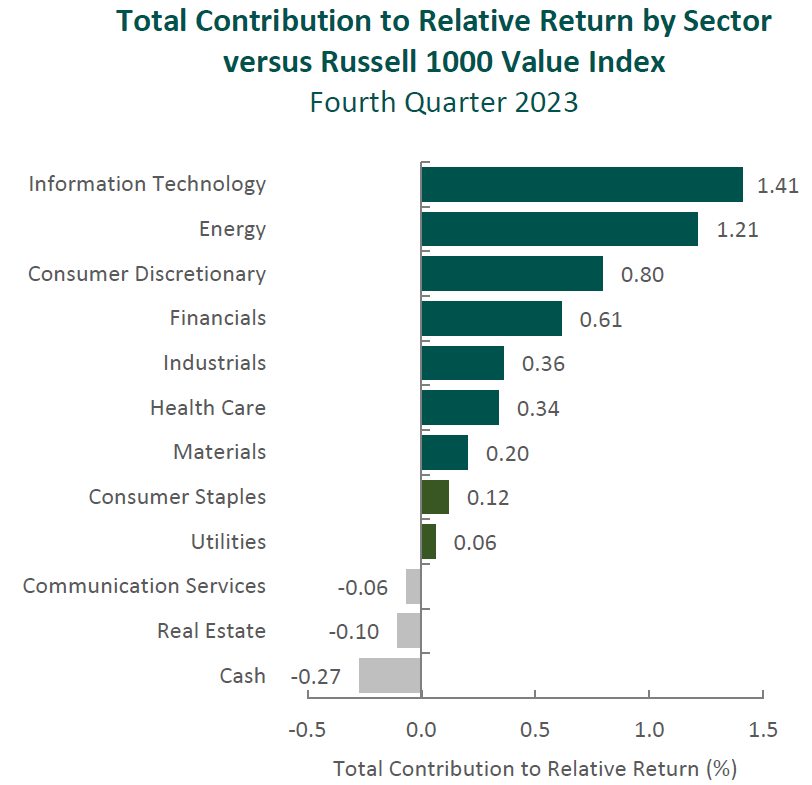
The portfolio’s outperformance relative to the Russell 1000 Value Index in the first quarter can be attributed to both security selection and allocation effects. An overweight in Information Technology and security selection in Consumer Discretionary and Information Technology contributed the most to relative performance. Conversely, an underweight in Communication Services and security selection in Industrials and Materials detracted. (Relative weights are the result of bottom-up security selection.)

Contributors and Detractors for 1Q 2023

Relative ContributorsRelative Detractors
ANSYSCullen/Frost Bankers
MicrosoftPNC Financial Services
Microchip TechnologyRPM International
LennarHoneywell
SonyCommerce Bancshares

ANSYS, an industry leader in engineering simulation software, was the top contributor during the quarter. The company reported strong results, with its annual contract value (ACV) advancing 14% to $2 billion in 2022, supported by broad-based growth across all major industries and geographies. This, in our opinion, exemplifies the significant value ANSYS’s software provides, enabling its customers (that include automotive, aerospace, consumer goods, energy and health care firms) to save time and money by testing products before the design process is complete. The applications for ANSYS’s software suite have expanded over the years, as even the simplest products have increased in complexity, continuously elevating the need for simulation. Meanwhile,  the market for ANSYS products remains underpenetrated, with only a fraction of design engineers currently utilizing simulation software. Given the scale of its user base, high switching costs, network effects, technological leadership and overall reputation across many disciplines (from fluid dynamics to electromagnetics), we believe the company is uniquely positioned to further increase its market share, as simulation becomes more ubiquitous across industries and product types.

Lennar, one of the nation’s largest homebuilders, was a primary contributor for the quarter. Following a housing surge supported by low mortgage rates and government stimulus, U.S. home sales activity began to decline in 2022 as rapidly rising mortgage rates reduced affordability. Over our decade-plus investment in Lennar, we have admired the management team’s ability to quickly respond to changing housing dynamics. Recent times were no exception, as Lennar adopted a dynamic pricing model that, in combination with its digital-marketing platform, helped to protect its backlog and prevent cancellations. As a result, fiscal first-quarter orders declined 10% year-over-year compared to a 38% decline for the homebuilder industry. The company has also made progress on its transition to a lighter asset strategy, a catalyst we previously identified, now controlling 68% of its land through options (up from 39% in 2020). Less capital tied up in land and the ability to acquire parcels on a just-in-time basis, in our opinion, should support enhanced FREE cash flow generation. As such, we believe Lennar’s strong balance sheet, prudent inventory management and further ability to implement cost and production efficiencies position it well to both overcome near-term housing market softness and benefit from the decade-long undersupply of homes in the U.S.

Cullen/Frost Bankers, the Texas-based bank, was the largest detractor for the period. Given the heightened levels of uncertainty after the collapse of SVB and Signature Bank, regional banks were scrutinized as potential vulnerabilities within the U.S. banking system. Despite the recent events, we remain confident in Cullen/Frost’s ability to withstand short-term volatility based on its long and proven history and strong capital position. Since the company’s inception in 1868, Cullen/Frost has employed a conservative strategy and a client service-centric model that allowed it to be the only Texas bank to survive the 1980s Texas banking collapse, oil crisis and real estate market crash without federal assistance or a takeover, and it was also the first bank to decline TARP (Troubled Asset Relief Program) bailout funds during the Global Financial Crisis of 2008. Cullen/Frost continues to utilize this strategy, with a relatively low loan-to-deposit ratio of 38% and current capital ratios in excess of well-capitalized levels. The company’s strong balance sheet management and steady, relationship-based approach have led to consistent levels of profitability and 29 consecutive years of dividend increases. We believe Cullen/Frost remains in a strong position to navigate the current short-term environment, continue to win market share in areas such as Houston and Dallas, and generate returns for shareholders in the long run.

RPM International, the coatings, sealants and building materials manufacturer, was one of the biggest detractors for the quarter. The combination of higher interest rates (which have negatively impacted construction activity and existing home sales), temporarily moderating customer purchases and cost inflation has weighed on the company and the overall coatings industry. Despite the challenging short-term macroeconomic landscape, RPM continues to demonstrate fundamental improvement. In response to inflation, the company has successfully increased pricing while simultaneously launching and executing on its latest Margin Achievement Plan (MAP 2025), which aims to make operational improvements by optimizing RPM’s manufacturing footprint, expanding categories of centralized procurement and executing on value-added selling. We believe the company’s ongoing focus on operational efficiency should allow it to continue to enhance its long-term FREE cash flow generation, which it can use to innovate new products and opportunistically deploy capital in the form of accretive acquisitions or returning value back to shareholders, as demonstrated by RPM’s ability to increase its dividend for 49 consecutive years.

Recent Portfolio Activity

During the quarter, we exited our investment in PayPal Holdings.

We first invested in PayPal, the online and mobile e-commerce payments company, during the third quarter of 2015. Over the past decade, we have studied PayPal’s ability to grow its extensive dual network (difficult to replicate, in our opinion) while navigating numerous competitors entering the industry.

BuysSells
NonePayPal Holdings

During our ownership period, the company has increased its payment volumes and made progress on many of its strategic initiatives, including adding partnerships with various companies (e.g., Walmart and American Express). We believe this has made the company a stronger force in the payments ecosystem. More recently, PayPal has shifted from its prior strategy of growing its user base to instead focusing on increasing transactions per user. The company has also seen an ongoing mix shift away from the PayPal branded checkout business toward its non-branded business Braintree. The non-branded business has a lower take rate, as its customers are primarily large enterprises (like Uber, Airbnb and Live Nation) with which bespoke rates are negotiated. In addition, PayPal has experienced recent leadership changes, including the 2022 departure of then-CFO John Rainey and CEO Dan Schulman’s announced retirement at the end of 2023. We will continue our research on the payments business and take our time to better understand these transitions. In the meantime, we decided PayPal was the best candidate for sale to fund the purchase of a what we believe to be a more optimal investment (which we will discuss at a later date).

Conclusion

A core tenet of our investment philosophy is the commitment to understand businesses with a long-term perspective. For us, this is especially important during times of heightened uncertainty when macroeconomic events dominate headlines. We remain aware of short-term topics such as inflation, monetary policy and the recent shock to the banking system. However, we believe a competitive advantage of our investment process lies in the fact that, instead of reacting and repositioning our portfolio based on unknowns and unfolding events, our focus remains on business fundamentals. Fundamentals, we are convinced, are what dictate shareholder value in the long term. As such, we continue to attentively study what we believe are high-quality companies with sustainable competitive advantages poised to outperform their peers over full market cycles.

Disclosures

The opinions expressed herein are those of Aristotle Capital Management, LLC (Aristotle Capital) and are subject to change without notice. Past performance is not a guarantee or indicator of future results. This material is not financial advice or an offer to purchase or sell any product. You should not assume that any of the securities transactions, sectors or holdings discussed in this report were or will be profitable, or that recommendations Aristotle Capital makes in the future will be profitable or equal the performance of the securities listed in this report. The portfolio characteristics shown relate to the Aristotle Value Equity strategy. Not every client’s account will have these characteristics. Aristotle Capital reserves the right to modify its current investment strategies and techniques based on changing market dynamics or client needs. There is no assurance that any securities discussed herein will remain in an account’s portfolio at the time you receive this report or that securities sold have not been repurchased. The securities discussed may not represent an account’s entire portfolio and, in the aggregate, may represent only a small percentage of an account’s portfolio holdings. The performance attribution presented is of a representative account from Aristotle Capital’s Value Equity Composite. The representative account is a discretionary client account which was chosen to most closely reflect the investment style of the strategy. The criteria used for representative account selection is based on the account’s period of time under management and its similarity of holdings in relation to the strategy. Recommendations made in the last 12 months are available upon request.

Returns are presented gross and net of investment advisory fees and include the reinvestment of all income. Gross returns will be reduced by fees and other expenses that may be incurred in the management of the account. Net returns are presented net of actual investment advisory fees and after the deduction of all trading expenses.

All investments carry a certain degree of risk, including the possible loss of principal. Investments are also subject to political, market, currency and regulatory risks or economic developments. International investments involve special risks that may in particular cause a loss in principal, including currency fluctuation, lower liquidity, different accounting methods and economic and political systems, and higher transaction costs. These risks typically are greater in emerging markets. Securities of small‐ and medium‐sized companies tend to have a shorter history of operations, be more volatile and less liquid. Value stocks can perform differently from the market as a whole and other types of stocks.

The material is provided for informational and/or educational purposes only and is not intended to be and should not be construed as investment, legal or tax advice and/or a legal opinion. Investors should consult their financial and tax adviser before making investments. The opinions referenced are as of the date of publication, may be modified due to changes in the market or economic conditions, and may not necessarily come to pass. Information and data presented has been developed internally and/or obtained from sources believed to be reliable. Aristotle Capital does not guarantee the accuracy, adequacy or completeness of such information.

Aristotle Capital Management, LLC is an independent registered investment adviser under the Advisers Act of 1940, as amended. Registration does not imply a certain level of skill or training. More information about Aristotle Capital, including our investment strategies, fees and objectives, can be found in our ADV Part 2, which is available upon request. ACM-2304-20

Performance Disclosures

Composite returns for all periods ended March 31, 2023 are preliminary pending final account reconciliation.

Past performance is not indicative of future results. The information provided should not be considered financial advice or a recommendation to purchase or sell any particular security or product. Performance results for periods greater than one year have been annualized. The Aristotle Value Equity strategy has an inception date of November 1, 2010; however, the strategy initially began at Mr. Gleicher’s predecessor firm in October 1997. A supplemental performance track record from January 1, 2001 through October 31, 2010 is provided above. The returns are based on two separate accounts and performance results are based on custodian data. During this time, Mr. Gleicher had primary responsibility for managing the two accounts. Mr. Gleicher began managing one account in November 2000 and the other December 2000.

Returns are presented gross and net of investment advisory fees and include the reinvestment of all income. Gross returns will be reduced by fees and other expenses that may be incurred in the management of the account. Net returns are presented net of actual investment advisory fees and after the deduction of all trading expenses.

Index Disclosures

The Russell 1000 Value® Index measures the performance of the large cap value segment of the U.S. equity universe. It includes those Russell 1000 Index companies with lower price-to-book ratios and lower expected growth values. The S&P 500® Index is the Standard & Poor’s Composite Index of 500 stocks and is a widely recognized, unmanaged index of common stock prices. The Russell 1000® Growth Index measures the performance of the large cap growth segment of the U.S. equity universe. It includes those Russell 1000 companies with higher price-to-book ratios and higher forecasted growth values. The Russell 2000® Index measures the performance of the small cap segment of the U.S. equity universe. The Russell 2000 Index is a subset of the Russell 3000® Index representing approximately 10% of the total market capitalization of that index. It includes approximately 2,000 of the smallest securities based on a combination of their market cap and current index membership. The Dow Jones Industrial Average® is a price-weighted measure of 30 U.S. blue-chip companies. The Index covers all industries except transportation and utilities. The NASDAQ Composite Index measures all NASDAQ domestic and international based common type stocks listed on The NASDAQ Stock Market. The NASDAQ Composite includes over 3,000 companies, more than most other stock market indexes. The Bloomberg U.S. Aggregate Bond Index is an unmanaged index of domestic investment grade bonds, including corporate, government and mortgage-backed securities. The WTI Crude Oil Index is a major trading classification of sweet light crude oil that serves as a major benchmark price for oil consumed in the United States. The 3-Month U.S. Treasury Bill is a short-term debt obligation backed by the U.S. Treasury Department with a maturity of three months. Consumer Price Index is a measure of the average change over time in the prices paid by urban consumers for a market basket of consumer goods and services. The volatility (beta) of the Composite may be greater or less than its respective benchmarks. It is not possible to invest directly in these indices.


(All MSCI index returns are shown net and in U.S. dollars unless otherwise noted.)

Markets Review

Sources: SS&C Advent, Bloomberg
Past performance is not indicative of future results. Aristotle Global Equity Composite returns are presented gross and net of investment advisory fees and include the reinvestment of all income. Gross returns will be reduced by fees and other expenses that may be incurred in the management of the account. Net returns are presented net of actual investment advisory fees and after the deduction of all trading expenses. Aristotle Capital Composite returns are preliminary pending final account reconciliation. Please see important disclosures at the end of this document.

Global equity markets rose in the first quarter of the year, as the MSCI ACWI Index increased 7.31% during the period. Concurrently, the Bloomberg Global Aggregate Bond Index increased 3.01%. In terms of style, growth stocks outperformed their value counterparts during the quarter, with the MSCI ACWI Growth Index beating the MSCI ACWI Value Index by 12.54%.

Regionally, Latin America and Europe were the strongest performers during the quarter. On the other hand, Asia/Pacific ex-Japan and Emerging Markets were the weakest performers. On a sector basis, seven out of the eleven sectors within the MSCI ACWI Index posted gains, with Information Technology, Communication Services and Consumer Discretionary being the best performers. The worst performers were Energy, Health Care and Utilities.

Despite continued geopolitical tensions, persistent inflation and new concerns in the banking industry, the global economy proved to be resilient. This was seen by strong labor markets, robust household consumption and business investment in addition to effective management of Europe’s energy crisis. Additionally, China continued its relaxation of strict COVID rules by fully reopening its borders to travelers with all types of visas. As a result, the IMF increased its growth forecasts and now projects global growth of 3.4%, 2.9% and 3.1% in 2022, 2023 and 2024, respectively.

Inflation remained elevated in many regions, with the U.K, eurozone and U.S. reporting a 10.4%, 8.5% and 6.0% rate, respectively. Meanwhile, in Asia, Japan’s core consumer inflation hit a 41-year high of 4.2%. However, the pace of price increases moderated for other countries. This was the case for China and South Korea, where inflation rates declined to their lowest levels in 12 and 10 months, repectively. On a forward-looking basis, the IMF estimates global inflation will fall from 8.8% in 2022 to 6.6% in 2023 and 4.3% in 2024. The organization believes restrictive monetary policy and cooling commodity prices due to weaker demand will contribute to the pattern of disinflation.

During the quarter, the failure of U.S.-based, mid-sized institutions Silicon Valley Bank (SVB) and Signature Bank reverberated into the international market, adding a layer of complexity to restrictive central bank policies. After SVB’s closure due to a run on deposits, Credit Suisse also experienced withdrawals, further exacerbated by a subsequent plunging share price that led Swiss regulators to orchestrate a takeover by UBS. As a result of the turmoil in the banking sector, central banks in the U.S. and Europe have commented that credit conditions may have tightened more than some economic indicators currently suggest.

Lastly, on the geopolitical front, the war in Ukraine rages on in the eastern side of the country while southern lines have largely stabilized. Though China continues to align itself with Russia, China’s Ministry of Foreign Affairs released a paper calling for all parties to support dialogue to “gradually deescalate the situation.” Meanwhile, Western nations continue to support Ukraine, with commitments from the U.S., Germany and Britain to supply armored vehicles.

Performance and Attribution Summary

For the first quarter of 2023, Aristotle Capital’s Global Equity Composite posted a total return of 6.11% gross of fees (6.03% net of fees), underperforming the MSCI World Index, which returned 7.73%, and the MSCI ACWI Index, which returned 7.31%. Please refer to the table below for detailed performance.

Performance (%) 1Q231 Year3 Years5 Years10 YearsSince Inception*
Global Equity Composite (gross)6.11-3.3217.047.999.579.55
Global Equity Composite (net)6.03-3.6216.677.629.179.11
MSCI World Index (net)7.73-7.0216.408.008.858.92
MSCI ACWI Index (net)7.31-7.4415.366.928.058.03
*The inception date for the Global Equity Composite is November 1, 2010. Past performance is not indicative of future results. Aristotle Global Equity Composite returns are presented gross and net of investment advisory fees and include the reinvestment of all income. Gross returns will be reduced by fees and other expenses that may be incurred in the management of the account. Net returns are presented net of actual investment advisory fees and after the deduction of all trading expenses. Aristotle Capital Composite returns are preliminary pending final account reconciliation. Please see important disclosures at the end of this document.

Source: FactSet

Past performance is not indicative of future results. Attribution results are based on sector returns which are gross of investment advisory fees. Attribution is based on performance that is gross of investment advisory fees and includes the reinvestment of income.

From a sector perspective, the portfolio’s underperformance relative to the MSCI World Index can be attributed to security selection, while allocation effects had a slightly positive impact. Security selection in Materials, Information Technology and Consumer Discretionary detracted the most from the portfolio’s relative performance. Conversely, security selection in Financials and Energy and an overweight in Consumer Discretionary contributed to relative return.

Regionally, both allocation effects and security selection were responsible for the portfolio’s underperformance relative to the MSCI World Index. Security selection in North America and Asia/Pacific ex-Japan detracted the most from relative performance, while an overweight in Europe and security selection in Japan contributed.

Contributors and Detractors for 1Q 2023

Relative ContributorsRelative Detractors
NemetschekRPM International
Microchip TechnologyAmgen
LVMHDanaher
LennarHoneywell
SonyGeneral Dynamics

RPM International, the coatings, sealants and building materials manufacturer, was one of the biggest detractors for the quarter. The combination of higher interest rates (which have negatively impacted construction activity and existing home sales), temporarily moderating customer purchases and cost inflation has weighed on the company and the overall coatings industry. Despite the challenging short-term macroeconomic landscape, RPM continues to demonstrate fundamental improvement. In response to inflation, the company has successfully increased pricing while simultaneously launching and executing on its latest Margin Achievement Plan (MAP 2025), which aims to make operational improvements by optimizing RPM’s manufacturing footprint, expanding categories of centralized procurement and executing on value-added selling. We believe the company’s ongoing focus on operational efficiency should allow it to continue to enhance its long-term FREE cash flow generation, which it can use to innovate new products and opportunistically deploy capital in the form of accretive acquisitions or returning value back to shareholders, as demonstrated by RPM’s ability to increase its dividend for 49 consecutive years.

Honeywell, the U.S.-based multinational industrial conglomerate, was one of the largest detractors during the quarter. Shares declined as management highlighted temporary issues affecting margins and the ability to meet demand in some of the company’s segments. These issues included component shortages in its Aerospace division, as well as severe cold weather that impacted production of its performance chemicals business. Despite the short-term setbacks, Honeywell continues to benefit from strong demand for its products across its various business segments. This is evidenced by the company’s record backlog, which grew to $29.6 billion in the fourth quarter—up 7% year-over-year. Additionally, during the quarter, CEO Darius Adamczyk announced he will step down in June of 2023 and hand the reins to current COO Vimal Kapur. Mr. Adamczyk built upon the work of his predecessor, famed former CEO David Cote, in the transformation of the business from what was once an over-leveraged, old-line industrial company to one poised for the digital age. We are impressed by Mr. Kapur’s 34-year tenure at Honeywell in increasingly important positions, including his leadership of Performance Materials and Technologies and Honeywell Building Technologies divisions. As such, we look forward to Mr. Kapur’s efforts to further advance Honeywell’s ability to leverage software across its massive industrial installed base and increase energy efficiency, productivity and connectivity (aka Industrial Internet of Things) for the company’s wide array of customers.

LVMH Moët Hennessy Louis Vuitton, the luxury goods company, was a primary contributor for the quarter. China, one of the world’s largest luxury goods markets, has reopened following three years of various COVID lockdown policies and provided a boost for LVMH. While we are pleased to see the company (and industry) benefit from an improved macroeconomic environment, this is not, and was not, our focus when analyzing the fundamentals of LVMH’s business. Instead of attempting to time short-term factors out of the company’s control, we remain fixated on what LVMH can control. This includes the company’s progress on initiatives such as integrating the acquisitions of Tiffany & Co. and, most recently, the Pedemonte Group to bolster its Jewelry division; market share gains within the Fashion & Leather Goods segment; continued market leadership with the likes of Dior’s Sauvage being named the world leader in perfumes for 2022; and the expansion of the company’s store network and the development of production facilities. These improvements, we believe, more directly impact the company’s long-term fundamental outlook, regardless of the short-term macroeconomic landscape. Lastly, LVMH appointed Pharrell Williams as its new Men’s Creative Director, filling the role following the tragic passing of Virgil Abloh in 2021.

Lennar, one of the nation’s largest homebuilders, was a primary contributor for the quarter. Following a housing surge supported by low mortgage rates and government stimulus, U.S. home sales activity began to decline in 2022 as rapidly rising mortgage rates reduced affordability. Over our decade-plus investment in Lennar, we have admired the management team’s ability to quickly respond to changing housing dynamics. Recent times were no exception, as Lennar adopted a dynamic pricing model that, in combination with its digital-marketing platform, helped to protect its backlog and prevent cancellations. As a result, fiscal first-quarter orders declined 10% year-over-year compared to a 38% decline for the homebuilder industry. The company has also made progress on its transition to a lighter asset strategy, a catalyst we previously identified, now controlling 68% of its land through options (up from 39% in 2020). Less capital tied up in land and the ability to acquire parcels on a just-in-time basis, in our opinion, should support enhanced FREE cash flow generation. As such, we believe Lennar’s strong balance sheet, prudent inventory management, and further ability to implement cost and production efficiencies position it well to both overcome near-term housing market softness and benefit from the decade-long undersupply of homes in the U.S.

Recent Portfolio Activity

BuysSells
NoneBrookfield Asset Management

During the quarter, we sold our position in Brookfield Asset Management.

The strategy has been invested in Brookfield since the first quarter of 2022. In December 2022, the company completed the spinoff of 25% of its asset management business, now known as Brookfield Asset Management (“Manager,” ticker: BAM). As part of the spinoff, the parent company, Brookfield Corporation (“Corporation,” ticker: BN), retained a 75% interest in the Manager. As such, we decided to sell our stake in the Manager and use the proceeds to top-up our investment in the Corporation. While we continue to find the Manager’s business attractive, we view Brookfield Corporation as a more optimal investment.

Conclusion

A core tenet of our investment philosophy is the commitment to understand businesses with a long-term perspective. For us, this is especially important during times of heightened uncertainty when macroeconomic events dominate headlines. We remain aware of short-term topics such as inflation, monetary policy and the recent shock to the banking system. However, we believe a competitive advantage of our investment process lies in the fact that, instead of reacting and repositioning our portfolio based on unknowns and unfolding events, our focus remains on business fundamentals. Fundamentals, we are convinced, are what dictate shareholder value in the long term. As such, we continue to attentively study what we believe are high-quality companies with sustainable competitive advantages poised to outperform their peers over full market cycles.

Disclosures

The opinions expressed herein are those of Aristotle Capital Management, LLC (Aristotle Capital) and are subject to change without notice. Past performance is not a guarantee or indicator of future results. This material is not financial advice or an offer to buy or sell any product. You should not assume that any of the securities transactions, sectors or holdings discussed in this report were or will be profitable, or that recommendations Aristotle Capital makes in the future will be profitable or equal the performance of the securities listed in this report. The portfolio characteristics shown relate to the Aristotle Global Equity strategy. Not every client’s account will have these characteristics. Aristotle Capital reserves the right to modify its current investment strategies and techniques based on changing market dynamics or client needs. There is no assurance that any securities discussed herein will remain in an account’s portfolio at the time you receive this report or that securities sold have not been repurchased. The securities discussed may not represent an account’s entire portfolio and, in the aggregate, may represent only a small percentage of an account’s portfolio holdings. The performance attribution presented is of a representative account from Aristotle Capital’s Global Equity Composite. The representative account is a discretionary client account which was chosen to most closely reflect the investment style of the strategy. The criteria used for representative account selection is based on the account’s period of time under management and its similarity of holdings in relation to the strategy. Recommendations made in the last 12 months are available upon request.

Returns are presented gross and net of investment advisory fees and include the reinvestment of all income. Gross returns will be reduced by fees and other expenses that may be incurred in the management of the account. Net returns are presented net of actual investment advisory fees and after the deduction of all trading expenses.

All investments carry a certain degree of risk, including the possible loss of principal. Investments are also subject to political, market, currency and regulatory risks or economic developments. International investments involve special risks that may in particular cause a loss in principal, including currency fluctuation, lower liquidity, different accounting methods and economic and political systems, and higher transaction costs. These risks typically are greater in emerging markets. Securities of small‐ and medium‐sized companies tend to have a shorter history of operations, be more volatile and less liquid. Value stocks can perform differently from the market as a whole and other types of stocks.

The material is provided for informational and/or educational purposes only and is not intended to be and should not be construed as investment, legal or tax advice and/or a legal opinion. Investors should consult their financial and tax adviser before making investments. The opinions referenced are as of the date of publication, may be modified due to changes in the market or economic conditions, and may not necessarily come to pass. Information and data presented has been developed internally and/or obtained from sources believed to be reliable. Aristotle Capital does not guarantee the accuracy, adequacy or completeness of such information.

Aristotle Capital Management, LLC is an independent investment adviser registered under the Investment Advisers Act of 1940, as amended. Registration does not imply a certain level of skill or training. More information about Aristotle Capital, including our investment strategies, fees and objectives, can be found in our Form ADV Part 2, which is available upon request. ACM-2304-95

Performance Disclosures

Composite returns for all periods ended March 31, 2023 are preliminary pending final account reconciliation.

The Aristotle Global Equity Composite has an inception date of November 1, 2010; however, the strategy initially began at Howard Gleicher’s predecessor firm in July 2007. A supplemental performance track record from January 1, 2008 through October 31, 2010 is provided on this page and complements the Global Equity Composite presentation that is located at the end of this presentation. The performance results were achieved while Mr. Gleicher managed the strategy at a prior firm. The returns are those of a publicly available mutual fund from the fund’s inception through Mr. Gleicher’s departure from the firm. During that time, Mr. Gleicher had primary responsibility for managing the fund.

Past performance is not indicative of future results. The information provided should not be considered financial advice or a recommendation to purchase or sell any particular security or product. Performance results for periods greater than one year have been annualized.

Returns are presented gross and net of investment advisory fees and include the reinvestment of all income. Gross returns will be reduced by fees and other expenses that may be incurred in the management of the account. Net returns are presented net of actual investment advisory fees and after the deduction of all trading expenses.

Index Disclosures

The MSCI World Index is a free float-adjusted market capitalization weighted index that is designed to measure the equity market performance of developed markets. The MSCI World Index consists of the following 23 developed market country indices: Australia, Austria, Belgium, Canada, Denmark, Finland, France, Germany, Hong Kong, Ireland, Israel, Italy, Japan, Netherlands, New Zealand, Norway, Portugal, Singapore, Spain, Sweden, Switzerland, the United Kingdom and the United States. The MSCI Emerging Markets Index is a free float-adjusted market capitalization-weighted index that is designed to measure equity market performance of emerging markets. The MSCI Emerging Markets Index consists of the following 24 emerging market country indexes: Brazil, Chile, China, Colombia, Czech Republic, Egypt, Greece, Hungary, India, Indonesia, Korea, Kuwait, Malaysia, Mexico, Peru, Philippines, Poland, Qatar, Saudi Arabia, South Africa, Taiwan, Thailand, Turkey and United Arab Emirates. The MSCI ACWI captures large and mid-cap representation across 23 developed markets and 24 emerging markets countries. With approximately 3,000 constituents, the Index covers approximately 85% of the global investable equity opportunity set. The MSCI ACWI Growth Index captures large and mid-cap securities exhibiting overall growth style characteristics across 23 developed markets countries and 24 emerging markets countries. The MSCI ACWI Value Index captures large and mid-cap securities exhibiting overall value style characteristics across 23 developed markets countries and 24 emerging markets countries. The MSCI Europe Index captures large and mid-cap representation across 15 developed markets countries in Europe. With more than 400 constituents, the Index covers approximately 85% of the free float-adjusted market capitalization across the European developed markets equity universe. The MSCI Japan Index is designed to measure the performance of the large and mid-cap segments of the Japanese market. With approximately 250 constituents, the Index covers approximately 85% of the free float-adjusted market capitalization in Japan. The S&P 500® Index is the Standard & Poor’s Composite Index of 500 stocks and is a widely recognized, unmanaged index of common stock prices. The NYSE FAANG+ Index is an equal-dollar-weighted index designed to represent a segment of the Information Technology and Consumer Discretionary sectors consisting of highly traded growth stocks of technology and tech-enabled companies, such as Facebook, Apple, Amazon, Netflix and Alphabet’s Google. The Bloomberg Global Aggregate Bond Index is a flagship measure of global investment grade debt from 28 local currency markets. This multi-currency benchmark includes Treasury, government-related, corporate and securitized fixed rate bonds from both developed and emerging markets issuers. The Brent Crude Oil Index is a major trading classification of sweet light crude oil that serves as a major benchmark price for purchases of oil worldwide. The volatility (beta) of the Composite may be greater or less than the benchmarks. It is not possible to invest directly in these indices.

(All MSCI index returns are shown net and in U.S. dollars unless otherwise noted.)

Markets Review

Sources: SS&C Advent, Bloomberg
Past performance is not indicative of future results. Aristotle International Equity Composite returns are presented gross and net of investment advisory fees and include the reinvestment of all income. Gross returns will be reduced by fees and other expenses that may be incurred in the management of the account. Net returns are presented net of actual investment advisory fees and after the deduction of all trading expenses. Aristotle Capital Composite returns are preliminary pending final account reconciliation. Please see important disclosures at the end of this document.

Global equity markets rose in the first quarter of the year, as the MSCI ACWI Index increased 7.31% during the period. Concurrently, the Bloomberg Global Aggregate Bond Index increased 3.01%. In terms of style, growth stocks outperformed their value counterparts during the quarter, with the MSCI ACWI Growth Index beating the MSCI ACWI Value Index by 12.54%.

The MSCI EAFE Index climbed by 8.47% during the first quarter, while the MSCI ACWI ex USA Index increased 6.87%. Within the MSCI EAFE Index, Europe & Middle East and the U.K. were the strongest-performing regions, while Asia gained the least. On a sector basis, ten out of the eleven sectors within the MSCI EAFE Index posted positive returns, with Information Technology, Consumer Discretionary and Industrials generating the largest gains. Conversely, Real Estate was the only sector to finish in the red, while Energy and Financials gained the least.

Despite continued geopolitical tensions, persistent inflation and new concerns in the banking industry, the global economy proved to be resilient. This was seen by strong labor markets, robust household consumption and business investment in addition to effective management of Europe’s energy crisis. Additionally, China continued its relaxation of strict COVID rules by fully reopening its borders to travelers with all types of visas. As a result, the IMF increased its growth forecasts and now projects global growth of 3.4%, 2.9% and 3.1% in 2022, 2023 and 2024, respectively.

Inflation remained elevated in many regions, with the U.K. and eurozone reporting a 10.4% and 8.5% rate, respectively. Meanwhile, in Asia, Japan’s core consumer inflation hit a 41-year high of 4.2%. However, the pace of price increases moderated for other countries. This was the case for China and South Korea, where inflation rates declined to their lowest levels in 12 and 10 months, repectively. On a forward-looking basis, the IMF estimates global inflation will fall from 8.8% in 2022 to 6.6% in 2023 and 4.3% in 2024. The organization believes restrictive monetary policy and cooling commodity prices due to weaker demand will contribute to the pattern of disinflation.

During the quarter, the failure of U.S.-based, mid-sized institutions Silicon Valley Bank (SVB) and Signature Bank reverberated into the international market, adding a layer of complexity to restrictive central bank policies. After SVB’s closure due to a run on deposits, Credit Suisse also experienced withdrawals, further exacerbated by a subsequent plunging share price that led Swiss regulators to orchestrate a takeover by UBS. As a result of the turmoil in the banking sector, central banks in the U.S. and Europe have commented that credit conditions may have tightened more than some economic indicators currently suggest.

Lastly, on the geopolitical front, the war in Ukraine rages on in the eastern side of the country while southern lines have largely stabilized. Though China continues to align itself with Russia, China’s Ministry of Foreign Affairs released a paper calling for all parties to support dialogue to “gradually deescalate the situation.” Meanwhile, Western nations continue to support Ukraine, with commitments from the U.S., Germany and Britain to supply armored vehicles.

Performance and Attribution Summary

For the first quarter of 2023, Aristotle Capital’s International Equity ADR Composite posted a total return of 6.59% gross of fees (6.43% net of fees), underperforming the MSCI EAFE Index, which returned 8.47%, and underperforming the MSCI ACWI ex USA Index, which returned 6.87%. Please refer to the table below for detailed performance.

Performance (%) 1Q231 Year3 Years5 Years Since Inception*
International Equity ADR Composite (gross)6.59-2.6814.584.595.54
International Equity ADR Composite (net)6.43-3.2314.024.125.03
MSCI EAFE Index (net)8.47-1.3812.993.524.80
MSCI ACWI ex USA Index (net)6.87-5.0711.802.474.10
*The inception date for the International Equity ADR Composite is June 1, 2013. Past performance is not indicative of future results. Aristotle International Equity ADR Composite returns are presented gross and net of investment advisory fees and include the reinvestment of all income. Gross returns will be reduced by fees and other expenses that may be incurred in the management of the account. Net returns are presented net of actual investment advisory fees and after the deduction of all trading expenses. Aristotle Capital Composite returns are preliminary pending final account reconciliation. Please see important disclosures at the end of this document.

Source: FactSet

Past performance is not indicative of future results. Attribution results are based on sector returns which are gross of investment advisory fees. Attribution is based on performance that is gross of investment advisory fees and includes the reinvestment of income.

From a sector perspective in the first quarter, the portfolio’s underperformance relative to the MSCI EAFE Index can be attributed to security selection, while allocation effects had a positive impact. Security selection in Consumer Discretionary, Information Technology and Financials detracted the most from the portfolio’s relative performance. Conversely, an overweight in Consumer Discretionary, a lack of exposure to Real Estate and security selection in Energy contributed to relative return.

Regionally, both security selection and allocation effects were responsible for the portfolio’s underperformance. Security selection in Europe and exposure to Emerging Markets detracted the most from relative performance, while an underweight and security selection in Asia contributed.

Contributors and Detractors for 1Q 2023

Relative ContributorsRelative Detractors
LVMHAIA Group
SonyTotalEnergies
SafranOtsuka Holdings
Rentokil InitialING Groep
Dassault SystèmesMagna International

AIA Group, a pan-Asian life insurance company headquartered in Hong Kong, was the largest detractor for the quarter. As a result of bank failures in both the U.S. and Europe, insurance companies were also scrutinized as potential vulnerabilities within the global financial system. However, given AIA’s strong capital position and ample liquidity, we believe the company is well positioned to withstand market volatility. In contrast to banks, life insurance companies like AIA have longer-duration liabilities than assets. This avoids liquidity pressure when interest rates rise and fixed-income portfolios are marked-to-market. We also see AIA’s investment exposure as limited due to its highly diversified corporate bond portfolio (with more than 1,900 issuers) and less than 5% of total invested assets in equities. As such, we remain focused on the company’s ability to benefit from its increasingly technology-enabled and productive agency salesforce. In fact, AIA’s VONB1 increased 6% in the second half of 2022, with growth across all of its largest markets. Moreover, we expect the company to further establish its direct presence in mainland China, a catalyst we previously identified, as it plans to reach another 10-12 affluent cities in the country by 2026.

1Value of New Business (VONB) is an insurance term for the present value of new business written during a period.

Magna International, a Canada-based global auto parts, systems and assembly company, was a leading detractor during the quarter. The company continues to be impacted by the volatile production schedules of auto OEMs, primarily caused by semiconductor supply constraints. For some of Magna’s major customers, volumes are as low as 50%-60% of the contracted plan. This has created short-term inefficiencies in Magna’s ability to manage labor and its overall cost structure. However, we believe these headwinds are temporary in nature, as supply chains and car production levels will normalize over time. We instead remain focused on Magna’s unique capability of supplying parts for an increasingly electrified and autonomous fleet of vehicles. This includes Magna’s specialty in lightweighting vehicles—a necessity for heavy electric cars—as well as its years of investment in self-driving technologies. In addition, Magna signed an agreement in December 2022 to acquire Veoneer Active Safety for approximately $1.5 billion in cash. Veoneer’s advanced driver-assistance system (ADAS) technologies and Magna’s existing ADAS group, in our view, will benefit from enhanced scale and a larger product portfolio, ultimately allowing the company to reach a broader customer base.

LVMH Moët Hennessy Louis Vuitton, the luxury goods company, was the primary contributor for the quarter. China, one of the world’s largest luxury goods markets, has reopened following three years of various COVID lockdown policies and provided a boost for LVMH. While we are pleased to see the company (and industry) benefit from an improved macroeconomic environment, this is not, and was not, our focus when analyzing the fundamentals of LVMH’s business. Instead of attempting to time short-term factors out of the company’s control, we remain fixated on what LVMH can control. This includes the company’s progress on initiatives such as integrating the acquisitions of Tiffany & Co. and, most recently, the Pedemonte Group to bolster its Jewelry division; market share gains within the Fashion & Leather Goods segment; continued market leadership with the likes of Dior’s Sauvage being named the world leader in perfumes for 2022; and the expansion of the company’s store network and the development of production facilities. These improvements, we believe, more directly impact the company’s long-term fundamental outlook, regardless of the short-term macroeconomic landscape. Lastly, LVMH appointed Pharrell Williams as its new Men’s Creative Director, filling the role following the tragic passing of Virgil Abloh in 2021.

Rentokil Initial, the U.K.-based pest control and hygiene services company, was a leading contributor for the quarter. In late 2022, the company completed its previously announced $6.7 billion acquisition of Terminix to further solidify its position in the North American pest control market. We believed the acquisition, its largest ever, would provide operational synergies from scale efficiencies and in-market densification, as well as accelerate the consolidation of the U.S. pest control market. Initially, Rentokil estimated $150 million in cost synergies by 2025, and the company recently upgraded its target to at least $200 million. We are encouraged by the company’s integration progress and operations, which in turn have led to Rentokil’s highest operating margin in 20 years. We believe the fundamental improvements, combined with the resilient nature of the pest control business, will allow Rentokil to continue to unlock value in the years ahead.

Recent Portfolio Activity

BuysSells
NoneBrookfield Asset Management

During the quarter, we sold our position in Brookfield Asset Management.

We have been owners of Brookfield since the strategy’s inception. In December 2022, the company completed the spinoff of 25% of its asset management business, now known as Brookfield Asset Management (“Manager,” ticker: BAM). As part of the spinoff, the parent company, Brookfield Corporation (“Corporation,” ticker: BN), retained a 75% interest in the Manager. As such, we decided to sell our stake in the Manager and use the proceeds to top-up our investment in the Corporation. While we continue to find the Manager’s business attractive, we view Brookfield Corporation as a more optimal investment.

Conclusion

A core tenet of our investment philosophy is the commitment to understand businesses with a long-term perspective. For us, this is especially important during times of heightened uncertainty when macroeconomic events dominate headlines. We remain aware of short-term topics such as inflation, monetary policy and the recent shock to the banking system. However, we believe a competitive advantage of our investment process lies in the fact that, instead of reacting and repositioning our portfolio based on unknowns and unfolding events, our focus remains on business fundamentals. Fundamentals, we are convinced, are what dictate shareholder value in the long term. As such, we continue to attentively study what we believe are high-quality companies with sustainable competitive advantages poised to outperform their peers over full market cycles.

Disclosures

The opinions expressed herein are those of Aristotle Capital Management, LLC (Aristotle Capital) and are subject to change without notice. Past performance is not a guarantee or indicator of future results. This material is not financial advice or an offer to buy or sell any product. You should not assume that any of the securities transactions, sectors or holdings discussed in this report were or will be profitable, or that recommendations Aristotle Capital makes in the future will be profitable or equal the performance of the securities listed in this report. The portfolio characteristics shown relate to the Aristotle International Equity ADR strategy. Not every client’s account will have these characteristics. Aristotle Capital reserves the right to modify its current investment strategies and techniques based on changing market dynamics or client needs. There is no assurance that any securities discussed herein will remain in an account’s portfolio at the time you receive this report or that securities sold have not been repurchased. The securities discussed may not represent an account’s entire portfolio and, in the aggregate, may represent only a small percentage of an account’s portfolio holdings. The performance attribution presented is of a representative account from Aristotle Capital’s International Equity ADR Composite. The representative account is a discretionary client account which was chosen to most closely reflect the investment style of the strategy. The criteria used for representative account selection is based on the account’s period of time under management and its similarity of holdings in relation to the strategy. Recommendations made in the last 12 months are available upon request.

Returns are presented gross and net of investment advisory fees and include the reinvestment of all income. Gross returns will be reduced by fees and other expenses that may be incurred in the management of the account. Net returns are presented net of actual investment advisory fees and after the deduction of all trading expenses.

All investments carry a certain degree of risk, including the possible loss of principal. Investments are also subject to political, market, currency and regulatory risks or economic developments. International investments involve special risks that may in particular cause a loss in principal, including currency fluctuation, lower liquidity, different accounting methods and economic and political systems, and higher transaction costs. These risks typically are greater in emerging markets. Securities of small‐ and medium‐sized companies tend to have a shorter history of operations, be more volatile and less liquid. Value stocks can perform differently from the market as a whole and other types of stocks.

The material is provided for informational and/or educational purposes only and is not intended to be and should not be construed as investment, legal or tax advice and/or a legal opinion. Investors should consult their financial and tax adviser before making investments. The opinions referenced are as of the date of publication, may be modified due to changes in the market or economic conditions, and may not necessarily come to pass. Information and data presented has been developed internally and/or obtained from sources believed to be reliable. Aristotle Capital does not guarantee the accuracy, adequacy or completeness of such information.

Aristotle Capital Management, LLC is an independent registered investment adviser under the Advisers Act of 1940, as amended. Registration does not imply a certain level of skill or training. More information about Aristotle Capital, including our investment strategies, fees and objectives, can be found in our Form ADV Part 2, which is available upon request. ACM-2304-133

Performance Disclosures

Composite returns for all periods ended March 31, 2023 are preliminary pending final account reconciliation.

Past performance is not indicative of future results. The information provided should not be considered financial advice or a recommendation to purchase or sell any particular security or product.  Performance results for periods greater than one year have been annualized.

Returns are presented gross and net of investment advisory fees and include the reinvestment of all income. Gross returns will be reduced by fees and other expenses that may be incurred in the management of the account. Net returns are presented net of actual investment advisory fees and after the deduction of all trading expenses.

Index Disclosures

The MSCI EAFE Index (Europe, Australasia, Far East) is a free float-adjusted market capitalization-weighted index that is designed to measure the equity market performance of developed markets, excluding the United States and Canada. The MSCI EAFE Index consists of the following 21 developed market country indices: Australia, Austria, Belgium, Denmark, Finland, France, Germany, Hong Kong, Ireland, Israel, Italy, Japan, the Netherlands, New Zealand, Norway, Portugal, Singapore, Spain, Sweden, Switzerland and the United Kingdom. The MSCI ACWI captures large and mid-cap representation across 23 developed market countries and 24 emerging markets countries. With approximately 3,000 constituents, the Index covers approximately 85% of the global investable equity opportunity set. The MSCI ACWI Growth Index captures large and mid-cap securities exhibiting overall growth style characteristics across 23 developed markets countries and 24 emerging markets countries. The MSCI ACWI Value Index captures large and mid-cap securities exhibiting overall value style characteristics across 23 developed markets countries and 24 emerging markets countries. The MSCI ACWI ex USA Index captures large and mid-cap representation across 22 of 23 developed markets countries (excluding the United States) and 24 emerging markets countries. With approximately 2,300 constituents, the Index covers approximately 85% of the global equity opportunity set outside the United States. The MSCI Emerging Markets Index is a free float-adjusted market capitalization-weighted index that is designed to measure the equity market performance of emerging markets. The MSCI Emerging Markets Index consists of the following 24 emerging market country indexes: Brazil, Chile, China, Colombia, Czech Republic, Egypt, Greece, Hungary, India, Indonesia, Korea, Kuwait, Malaysia, Mexico, Peru, Philippines, Poland, Qatar, Saudi Arabia, South Africa, Taiwan, Thailand, Turkey and United Arab Emirates. The S&P 500® Index is the Standard & Poor’s Composite Index of 500 stocks and is a widely recognized, unmanaged index of common stock prices. The Brent Crude Oil Index is a major trading classification of sweet light crude oil that serves as a major benchmark price for purchases of oil worldwide. The MSCI Japan Index is designed to measure the performance of the large and mid-cap segments of the Japanese market. With approximately 250 constituents, the Index covers approximately 85% of the free float-adjusted market capitalization in Japan. The Bloomberg Global Aggregate Bond Index is a flagship measure of global investment grade debt from 28 local currency markets. This multi-currency benchmark includes treasury, government-related, corporate and securitized fixed-rate bonds from both developed and emerging markets issuers. The MSCI United Kingdom Index is designed to measure the performance of the large and mid-cap segments of the U.K. market. With nearly 100 constituents, the Index covers approximately 85% of the free float-adjusted market capitalization in the United Kingdom. The MSCI Europe Index captures large and mid-cap representation across 15 developed markets countries in Europe. With approximately 430 constituents, the Index covers approximately 85% of the free float-adjusted market capitalization across the European developed markets equity universe. These indices have been selected as the benchmarks and are used for comparison purposes only. The volatility (beta) of the Composite may be greater or less than the respective benchmarks. It is not possible to invest directly in these indices.
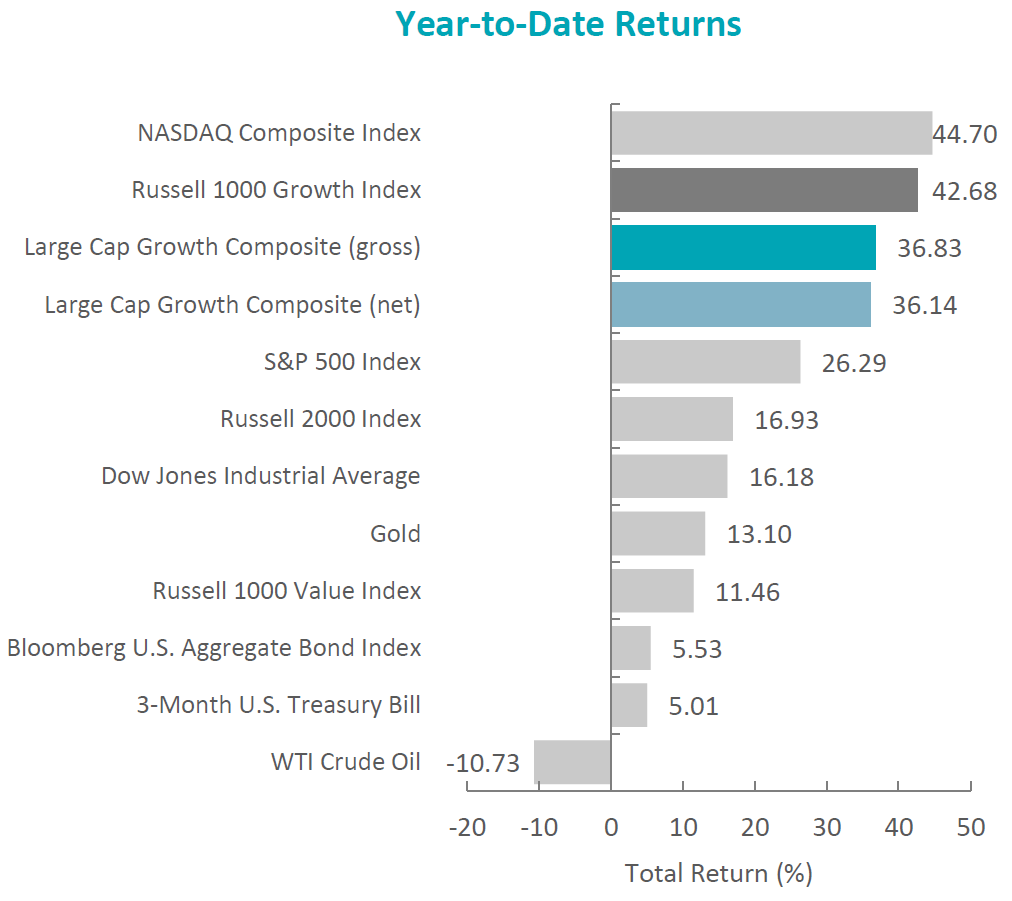
For more on International Equity, access the latest resources.

Rebrands acquired firm to Aristotle Pacific Capital, LLC

Reorganizes Certain Pacific Funds into new Aristotle Funds

LOS ANGELES, CA and NEWPORT BEACH, CA – APRIL 17, 2023 – Aristotle Capital Management, LLC (“Aristotle”) today announced it has completed the acquisition of Pacific Asset Management LLC, a leader in liquid credit investments, from Pacific Life Insurance Company (“Pacific Life”). Pacific Asset Management has officially been rebranded to Aristotle Pacific Capital, LLC (“Aristotle Pacific”) and currently manages over $20 billion in assets.

Aristotle Pacific will maintain its investment team and will continue to be led by Dominic Nolan, CFA, Chief Executive Officer, ensuring continuity of investment management expertise and nurturing the trusted connections they have built servicing their clients.

In addition, Aristotle further announces the reorganization of certain funds of Pacific Funds, Pacific Life’s publicly offered mutual fund complex, into new Aristotle Funds, following approval by shareholders of such certain Pacific Funds.  A newly formed Aristotle affiliate, Aristotle Investment Services, LLC, will serve as the Advisor and Administrator to the new Aristotle Funds.

As we reflect on the year that just ended, we realize that we have much to celebrate and are excited to share our initiatives and the progress we have made to support our clients, people and communities. 2022 was a year of expansion, as we have continued to invest in our people, with 30 members joining us across our departments, affiliates and locations. As we bring on board new members, we are committed to inspiring them by sharing our purpose and reinforcing our corporate values, which include maintaining a culture of transparency and integrity with our clients’ interests at the top of our minds.

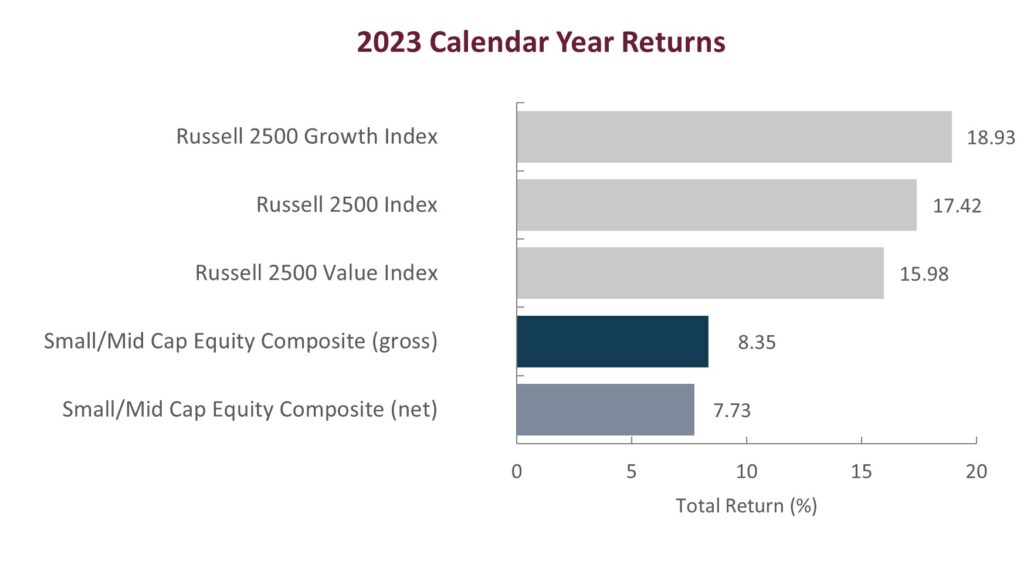
In this letter, we highlight updates on our growing Aristotle family; department enhancements; Diversity, Equity and Inclusion Council initiatives; our new podcast; and more.

Growing Aristotle Family and Expanding Capabilities

We are delighted to share the news that Aristotle Capital Management, LLC (Aristotle Capital) is acquiring Pacific Asset Management, LLC (PAM), Pacific Life’s credit asset management firm, whose clients include Pacific Funds and which is based in Newport Beach, California. We believe this is an extraordinary opportunity to join forces with a group of people who share our firm’s values and purpose.

To read the full letter, please use the link below. 

Host: Catalina Llinás, CFA

Guest: Alberto Jimenez Crespo

December 13, 2022

Episode Length: 21:00

In this episode, Catalina Llinás, CFA, Co-Chief Investment Officer of Aristotle Capital talks to Alberto Jimenez Crespo, Portfolio Manager and Senior Research Analyst about uranium, what it is and why it is important.

Alberto gives an educational overview of what Uranium is, how it is mined, where it can be found and why it is important in the climate change discussion as a clean energy alternative. He also dispels the myths about the danger of its use as an energy source and shares a story about visiting uranium mines in Kazakhstan.

SHOW NOTES
  • Disclosures (00:00 – 00:30)
  • Host introduction (00:31 – 0:46)
  • Episode Introduction (0:47-1:01)
  • Introduction to the episode’s guest: Alberto Jimenez Crespo (01:02 – 2.00)
  • What is Uranium? (2.01 – 03:36)
  • What is Uranium used for? (03:37 – 04:58)
  • Where is Uranium found? (04:59 – 6:06)
  • Alberto’s trip to a Uranium mine (6:07 – 6:34)
  • Mismatch between Uranium production location and its consumption location (6.35 – 7.33)
  • How is Uranium mined? (7.34 – 10:36)
  • Do we need to worry about the use of Uranium and radiation? (10.37 – 15.50)
  • Nuclear energy as a Climate Change solution (15.51 – 17:24)
  • Why is the price of Uranium so low? (17.25 – 20.24)
  • Does we invest in this industry? (20.25 – 20.43)
  • Conclusion (20.44 – 21.41)
TRANSCRIPT

Alex Warren: The term Aristotle is used to represent a family of affiliates, which is comprised of Aristotle Capital Management, Aristotle Capital Boston, Aristotle Credit Partners, and Aristotle Atlantic Partners, which collectively operate under a unified platform known as Aristotle. Each firm is an independent investment advisor registered under the Investment Advisors Act of 1940, as amended.

Catalina Llinás: Welcome to the Power of Patience, Aristotle’s podcast, where we cover different topics of interest. I’m Catalina Llinás, Co-Chief Investment Officer of Aristotle Capital, and I will be your host today. In today’s episode, we’re going to be learning about uranium. What is it used for? Why is it important for nuclear energy? We’re also going to talk about fear surrounding nuclear energy, and why we think this is an important source of clean energy for the world. So for this, I will be speaking with Alberto Jimenez Crespo. Alberto is a senior member of Aristotle Capital’s investment team. His experience includes being a portfolio manager, also a research analyst. Welcome to the episode. It’s great having you here, Alberto.

Alberto Jimenez Crespo: Thank you for having me, Catalina. It’s great to be here.

Catalina Llinás: Why don’t you tell us a little bit about yourself?

Alberto Jimenez Crespo: Well first, I’m from Spain, that’s where I grew up. My technical background relevant to what I think we’re going to talk about today is that I am a mining engineer, and I have a Master’s in Colorado School of Mines as well. For those of you who might not be familiar with natural resources, think of Colorado School of Mines as the Harvard of rocks.

Catalina Llinás: Oh, Harvard of rocks.

Alberto Jimenez Crespo: So, I’m very happy that you chose this topic, because uranium is actually a very different commodity. It’s a very differentiated industry.

Catalina Llinás: Well, great. So why don’t we start with that? What is uranium?

Alberto Jimenez Crespo: So, uranium is a … Think of a silvery white metal. If you imagine an element that is very dense, think of lead. I think we are all familiar with lead. Well, uranium would be 70% denser than that. So, the feature that is also very unique is that it is the only naturally occurring fissile element on Earth. So, what does that mean? It means that it’s a material capable of sustaining a chain reaction of nuclear fission. That is very important to what we’re going to talk about today. Even though it’s pretty much everywhere, think of that in your soil and water and your house and everywhere, typically it occurs in higher concentrations in the mineral, it’s called uraninite, and so the majority of the isotopes of uranium, what we call U-238, call it 99.3% of the world uranium, occurs in this isotope.

Catalina Llinás: So, there’s uranium everywhere, but the one we’re going to talk about is, what, 0.7% of that uranium is the one that is relevant for our discussion today?

Alberto Jimenez Crespo: Yeah, yeah. Good point. So much for rounding. If it wasn’t for that 0.7%, that is really what we called U-235, we wouldn’t be talking today. The life as we know it, it would just not exist. It would not be possible. So that is really the importance of that huge minority of the 0.7%.

Catalina Llinás: So, what is this U-235, we’re just going to call uranium, what is it used for?

Alberto Jimenez Crespo: The only significant commercial use of uranium is really to power nuclear plants, so the generation of electricity. There’re about 427 reactors globally today, and 56 or so are under construction. If you drive throughout California, you wouldn’t think that this is such a growing industry because you will not see any. In fact, in the U.S. we’ve been shutting down some of our reactors. But if you travel throughout Asia, the Middle East and some other parts of the world, you will see that there is a recognition which is growing, that nuclear role is really a must when it comes to providing safe, affordable, carbon-free, base load, reliable electricity. And that is a key word, reliable. So, despite all these massive investments that we’ve seen, including in the U.S., in clean energies renewables, in the last, call it 15 years, the reality is that about 85% of global electricity grid is run by carbon emitting sources of thermal power. We have a huge work to do in order to diversify away from that.

Catalina Llinás: So before we get too much into the discussion of nuclear, which we will, why don’t you tell us a little bit about where is this uranium found? Where can we find some of that uranium?

Alberto Jimenez Crespo: Yeah. For the purpose of commercial use, that’s what they call a mining ore grade uranium, there are only three countries that you can go to. That is Australia, Kazakhstan and Canada. If you think of high grade deposits, those will be deposits that will provide uranium with a very low cost. There’s only one country, which is Canada. If you’re looking for high-grade deposits, that’s where you have to go. Then the interesting thing about this industry is that it’s highly consolidated. There’re only eight companies that provide, call it 83% of the global supply. So, everybody’s familiar with, or many people are familiar with the OPEC in oil and gas. So, this is significantly more consolidated than that.

Catalina Llinás: So those operators will have mines that… The same operator may have mines in Kazakhstan, Australian and Canada, right? They diversify that way I guess, geographically?

Alberto Jimenez Crespo: Yeah. Yeah.

Catalina Llinás: Have you been to a uranium mine?

Alberto Jimenez Crespo: Yeah, I’ve been actually in the three countries. In Kazakhstan, I was being chased by a sandstorm, so as we landed in Almaty and we had to go to visit the engineers in the uranium field, that’s the first time I’ve been chased by a sandstorm. It was not fun, but it was exciting.

Catalina Llinás: Something to be able to tell a story about. Going back to the topic, I do remember in some of our investment meetings, you were once talking about that there was a mismatch between where the uranium that is produced and where the uranium is going to be consumed. Why don’t you tell us a little bit about that?

Alberto Jimenez Crespo: Yeah, that’s a good point because this is a very strategic commodity as you can imagine. You cannot just buy this in the futures market just like you would trade orange juice or copper or any other commodity. Yeah, believe me, there will not be delivery. So don’t go to Amazon and try to order uranium. It will not come. That I guarantee.

Catalina Llinás: No, hopefully not.

Alberto Jimenez Crespo: So, 80% or so of the production, it’s in the hands of state-owned enterprises. This is very strategic. You’re right, the mismatch in the planet is very significant in that 70% or so comes from countries that have very little consumption because they have no nuclear plants, while 90% of the consumption comes from countries with very little production, including the United States.

Catalina Llinás: Interesting. So how is uranium mined?

Alberto Jimenez Crespo: Yeah, so there are mainly three ways. Now, once the orebody is discovered by and defined by exploration, which takes a while, up until the ’80s, the 1980s, the main way was what we call open-pit mining, which is a hole in the ground. As geological properties change, underground mining is being used when the ore is too deep, so it doesn’t make sense economically to open-pit. But most recently, in the last two decades, the majority of the uranium more so is coming from what’s called in-situ recovery. What that is, is that you have a hole that is drilled into the ore, and then a solution is used to dissolve that uranium, then you pump it up to the surface. Think of this as a commodity that has to be processed. You cannot just bring it up to the surface and then ship it to the nuclear reactor. You have to go through three main processes. The first one would be, call it the mining, then you mill it. You crush it and you add some chemicals. That’s what you will probably hear in the movies when they talk about yellowcake, or in the media. It is really not scary, and it is not something that is dangerous. It’s just a yellow-colored powder, and there’s not much you can do with it. It sounds pretty scary when you think of, oh, it has yellowcake, it’s not really a big deal. But then in order for you to be able to start thinking of utilizing this powder, you have to transform it into a gas, what’s called uranium hexafluoride, or UF6. That will be brought to the enrichment facilities. This is a very key part of the value chain. It’s probably the highest buyers of entry business in the world. This is very secretive. You cannot just copy the blueprints or you go to YouTube. You know how everybody now goes to YouTube to get things done and say, “How do I build an enrichment machine?” No, you cannot do that. It’s very secretive. It is very strategic, and there are very few facilities around the world. So, if you really have an enrichment plant, it is a very hard business to replicate. Once you take it there, the reason why enrichment is needed is that the majority of the reactors around the world is what we call light-water reactors. Those are the majority that you’re going to see, certainly in the United States. They require, remember we talked about U-35 earlier, that 0.7%?

Catalina Llinás: Yep.

Alberto Jimenez Crespo: Okay, so you need about 3 to 5% concentration of U-235 in order to use that into a reactor. But then by nature, you only get 0.7% concentration. So, you have to spin it into these machines to bring up the concentration. That’s what enrichment is. Finally, the last part of the process is, you form these pellets of uranium that have massive energy density, put them in a tube made of zirconium, create like a tower, and that’s what you ship to the nuclear reactor. You probably fuel the reactor twice a year. So, this is a very efficient way of generating energy.

Catalina Llinás: When you were talking about the yellowcake, that didn’t sound so scary, but as you kept talking more and more about this enrichment, I do have to say that sounds a little bit scary. So maybe that’s a good segue. People have strong opinions about nuclear energy, nuclear plants. It sounds scary. People don’t want to have it next to their homes. Also, people have flashbacks of more recent images like what happened in Fukushima, but also back in the day with the Chernobyl nuclear disaster and accident. So, tell us what you think about that and whether those concerns, are those real concerns, should they be?

Alberto Jimenez Crespo: Yeah, you’re right. Nuclear radiation freaks people out. It’s just something you can’t see. We’ve been shaped, our opinions, into having a lot of fear about this. Yeah, if you talk to environmental groups and people that are drafting energy policy, you’ll see that they feed into people’s emotions. What that has created, in our opinion, is that there’s a big gap between perception and reality. We find that there’s a significant, embedded biases in the thinking of people, particularly when these debates occur in public about what you just mentioned, about the issue of radioactivity and whether nuclear energy is safe or not. So, we at Aristotle like to do our own research, our own independent analysis, and we try to stay away from psychological biases that might create what we call blind spots, and that can impair your judgment. So, that’s what we’ve done in this case as well. What we found is that the reality is that natural substances contain some form of radioactive material, whether you like it or not. Soil, rocks, rivers and oceans. Since we are in LA, think about Catalina, think about your backyard. Every time you’re going to go and do a barbecue or whatever, you can tell your friends there, next time try this, that they’re going to be on top of few hundred grams of uranium. So, you could think of your backyard being slightly radioactive, but that shouldn’t scare you because, call it 80% or so of all the ionizing radiation that people are exposed to, you and I, everybody are exposed to, occurs naturally.

Catalina Llinás: Really? No, no me lo puedo crear, radiación en el jardin [Translation: I can’t believe it, radiation in the garden]. We have radiation in the backyard? I’m not scared about that radiation. I’m scared about then the other 20%.

Alberto Jimenez Crespo: Yes, there’s this whole notion about artificial radiation, as you know, and that is radiation that we have created. But there’s huge benefits to humanity that we have to think about. How so? Well in medicine, if you think about diagnostics, treatment and research, agriculture, food preservation, manufacturing engines, think about radioactive tracers also help analyze pollutants. If you talk to archeologists, paleontologists, people running a museum, consumer products, for example, in smoke detectors, I’m sure you have smoke detection in your house, right? They will not insure your house if you don’t. So, you cannot exclude that from the system. You cannot have the lives that we have today and function without these forms of artificial radiation.

Catalina Llinás: I’m going to keep pushing back a little bit because I get that, and also if I have to get an x-ray, fine, I’ll get some radiation. But that’s different from radiation of a nuclear plant. I would guess that if I had a nuclear plant two miles from my house, I would probably be concerned about that radiation on my family and not so much about the x-ray or when I have to go to the dentist and get an x-ray.

Alberto Jimenez Crespo: Good point. Let’s say you include all the military testing and all the accidents that we have in the nuclear industry, it accounts for 1% of all the radiation people are routinely exposed to. In fact, if you were to think about the nuclear fuel cycle, which is what we’re talking about here, it only accounts for 0.01% of the total radiation. So, the main issue that every policymaker should be thinking as in a society, is that whether we like it or not today, call it 37%, almost 40% of the global electricity that we’re consuming is coming from coal. A lot of my friends think, oh, well, isn’t that coal something from the Middle Ages and something from the past, while there’s so much coal that we are consuming in today’s world. So why is that an issue? Well, first because it kills a lot of people. If we think about the WHO as a source, World Health Organization, they claim that pollution related sicknesses kill over 7 million people a year. Think about it. In the life of a nuclear reactor, call it a few decades, you’re just killing a whole country, a big country. It’s just huge. We cannot operate like that, killing so many people.

Catalina Llinás: A nuclear accident is very, very rare, is what you’re saying?

Alberto Jimenez Crespo: Very rare.

Catalina Llinás: Of course, we don’t want to diminish what those cause, but it’s extremely rare. The pollution generated by coal, it’s much more deadly. I guess that gets us to the climate change. When we talk about nuclear as being part of the solution, it has to be part of the solution in order to help with climate change.

Alberto Jimenez Crespo: Yes, you’re right. We don’t want to downplay any loss of life. What we want to do is we want to prevent massive losses of life with the technology that we do have today. So according to the IEA, the International Energy Agency, they know this. They’re projecting that we will need to double the world’s nuclear output by 2050 to reach the net zero energy targets that every government now is talking about. As much as we have invested massively into renewables, particularly in the last 15 years, it’s been very significant, and that’s all good, but that cannot be the only solution. The resources that are needed, the land, the unreliability, the investments in grid that we need to support that. Any way you analyze this issue, you’re going to come out with the conclusion that nuclear is a must. We have to have that into the power mix. One statistic that I think is interesting is that since I was born in the 1970s, is that if we were to replace all the coal fire plants, dirty plants we were talking about earlier, with nuclear, we will reduce the CO2 emissions back to the level when I was born. So that’s like going back to the world when I was a baby. I think that’s just wonderful. So, we should be embracing anything that has to do with lowering the carbon footprint in their climate.

Catalina Llinás: It’s interesting that you were saying, yes, a lot of countries have come out with their plans for net zero. So, you would think then that, and there is currently under construction, there are nuclear plants around the world that are being constructed. Why has the price of uranium then been so low for so long? For a while it was very low.

Alberto Jimenez Crespo: That is a good point. You would think that with all the stuff that we’ve talked about today, all the attributes and all the benefits and all these things, that in the last 14 years though it seems we’ve seen a massive amount of liquidity pumped into the financial markets. We would’ve seen massive investments into making sure that we have enough investment in the supply chain in nuclear. The opposite has been the case, unfortunately. If I gave you an energy option, think about, let’s just visualize this for a second, for the energy density of what we’re talking about here. Think about 0.24 ounces of pellet. Many people say, “What does that mean, 0.24 ounces?” So, think about the tip of your nail and the energy provided by that pellet from uranium will be equivalent to 2000 pounds of coal. So, with that sort of magic and energy transformation, you will think that we would’ve been all very excited, and to your point, uranium price would’ve gone to the moon and we would be talking about a booming industry in terms of investments. Let me give you this, a statistic that will convince you that the opposite has occurred. Over the last five years, the nuclear reactors around the world, they have consumed 800 million pounds. We know that because if you own a nuclear reactor, you’re a utility company, you don’t purchase this on a spot market. This is a very sensitive thing for your chain. You have to contract this from the miners. So, the book of business is transparent, and you can see the material. We know that. So, they have consumed 800 million pounds, and guess what? They only contracted 400. So going forward, there’s a gap between what they need, because you don’t shut down a nuclear plant, this is based on 24 hours, between what they need and what they have in their books. If you go to 2035, it’s 1.4 billion pounds of unsecure material that they need. Think of an industry of 160 million pounds. That’s what 800 divided by five is, 160 million pounds consumption per year. With a gap of 1.4 billion pounds, it’s huge. So why is this an issue? Because it cannot be solved short term. Normally if you talk to mining engineers, you’re going to see that the average life of a mine is about 16 years from discovery to production. For uranium, as you could imagine, being more difficult, more regulated, more strategic, it’s at least two decades. So, we should be investing, to your point, massively into this now, but we’re not. That, to me, is the big gap and the big opportunity.

Catalina Llinás: Alberto, I have one last question that would be. Does Aristotle invest in this industry that we’ve talked about today?

Alberto Jimenez Crespo: Yes, we do. In our portfolios, we have exposure to the uranium industry, and we specifically invested in a company that have what we believe to be a sustainable, long-term competitive advantage.

Catalina Llinás: Thank you, Alberto. This was very interesting. I think this concludes our episode for today. I’m sure we will have some follow-up questions as there’s so much to learn about the world of uranium, the world of nuclear, and at Aristotle, we’ll continue to understand these industries and all other sources of clean energy. We’ll do that with a long-term perspective as we always do. Thank you, Alberto. This has been very interesting. We appreciate you joining.

Alberto Jimenez Crespo: Thank you for having me.

Catalina Llinás: We appreciate your time. Thank you.

Alex Warren: We hope you’ve enjoyed this episode and learned more about Aristotle. Thank you for listening to the Power of Patience. To learn more about Aristotle, please visit  www.aristotlecap.com or follow the link in the show notes. If you enjoyed this episode, please rate and review us on Spotify and Apple Podcast. Come back next time for discussion on cybersecurity with Nick Daft, Director and Senior Research Analyst at Aristotle Atlantic Partners. Until then, on behalf of Aristotle, thank you for listening.

DISCLOSURE

For additional disclosures please refer to www.aristotlecap.com

Host: Carla Price

Guest: John Quan

December 12, 2022

Episode Length: 12:00

In this episode, we speak with John Quan, Managing Director and Chief Technology Officer at Aristotle Capital. John discusses what is cybersecurity, what are the threats and where are they coming from, and some steps to mount an effective defense, and technologies and policies to keep data and systems safe.

SHOW NOTES
  • Disclosures (0:00 – 0:30)
  • Host introduction (0:34 – 1:18)
  • Episode introduction (1:19-1:55)
  • Introduction to the episode’s guest: John Quan (1:20 – 2:59)
  • The current environment of cybersecurity and the actors involved (3:00 – 4:20)
  • Low barrier to entry for cybercriminals (4:21 – 4:28)
  • How are attackers getting into companies? (4:29 – 5:13)
  • What are cybercriminals trying to target at investment firms? (5:14 – 5:50)
  • Bank of Bangladesh cyber-attack (5:51 – 7.53)
  • Business disruption via Ransomware (7.54 – 8:28)
  • Targeting investment data (8:29 – 8:42)
  • Zero Trust Security Architecture (8:43 – 10:20)
  • How to build a culture of cyber awareness (10:21 – 11:35)
  • Conclusion (11:36 – 12:20)
TRANSCRIPT

Carla Price: The term Aristotle is used to represent a family of affiliates, which is comprised of Aristotle Capital Management, Aristotle Capital Boston, Aristotle Credit Partners, and Aristotle Atlantic Partners, which collectively operate under a unified platform known as Aristotle. Each firm is an independent investment advisor registered under the Investment Advisors Act of 1940 as amended.

Welcome to The Power of Patience, Aristotle’s podcast, where we share our reviews on topics actively explored by our investment teams and across our organization. I’m Carla Price, Director of Risk Management at Aristotle Capital, and I will be your host today. I have over 20 years of experience in the investment management industry. In that time, I’ve worked with over 50 registered investment advisors assessing these organizations’ internal controls, including cybersecurity. Additionally, I’ve led due diligence and remediation efforts resulting from actual cyber breaches and near misses across the industry. Coming up on today’s episode, we’ll be speaking with John Quan, Managing Director and Chief Technology Officer here at Aristotle Capital. If you enjoy this podcast, please like and share it on LinkedIn to help us spread the word. Today on the show, we’ll discuss what is cybersecurity, what are the threats today, and where are they coming from? How do small and mid-size organizations address the spending needs for effective defense? And lastly, what are some of the technologies companies are using to keep their data and systems safe? John, thank you so much for speaking with me today. To lead off the discussion, can you please introduce yourself and describe your role as Chief Technology Officer here at Aristotle Capital?

John Quan: Hi, Carla. First of all, I really want to take the opportunity to stress how important this topic is because it affects every individual, be it your personal life, your professional life, as well as affecting every company out there. We’re all fighting the same adversaries. So I think this type of knowledge sharing is going to be very beneficial to our listeners here as well as to those practitioners who are designing and executing on their own cybersecurity strategy. I’m John Quan. I’m the Chief Technology Officer here at Aristotle. I oversee all aspects of technology as well as cybersecurity. And before coming here, I was also the Chief Information Security Officer for a global asset manager where we led the development, the design, and the implementation of a comprehensive cybersecurity program while also dealing with numerous threats, potential attacks and investigations of potential breaches there.

Carla Price: Thank you, John. That’s helpful. You mentioned the current environment on cyber breaches being in the news on a regular basis for U.S. companies. Can you talk a little bit more about that for the listeners? What does the current environment look like for businesses and individuals today?

John Quan: Yeah, Carla. I think it’s important to talk about the who and the how when we consider what’s going on in the current environment around cybersecurity. So when you think about who, these are the range of attackers that are out there trying to penetrate various systems, companies and people, home, email. And so, on one end of the spectrum, we have very comprehensive and complex and well-funded nation states such as North Korea, Russia, India, as examples, who are deploying very complex attacks such as the one that we saw in the colonial pipeline. And then moving down the spectrum there, we’ve got criminal organizations and it’s very much as simple as just saying it’s organized crime behind cyber attacks because they appreciate the potential financial gain from these attacks that they’re conducting. And then finally, and this might be the one that people are most familiar with, but we just have bad individuals that are out there or people who are being opportunistic, trying to take advantage of a market, trying to take advantage of vulnerabilities out there and committing financial crimes and really for their own financial gain. One of the reasons why cyber is such an important topic is because there’s such a low barrier to entry. It’s about 50 bucks that you need to spend really to buy a ransomware type of package. And that just shows you how easy it is for anyone to get into the business of exploiting individuals and companies for their own financial gain. And then secondly, when you think about the how, how are these attackers like nation states and criminal organizations and individuals, how are they getting into these companies? It’s not going to be a surprise, but it’s 90% of all attacks originate via phishing email. So, when we think of phishing, this is not the click here and win a free iPad, those days are gone. Today, these are very sophisticated phish attacks that are utilizing social engineering to go and create a profile of their target. Where do they like to eat? Where do they go on vacation? Where do they work? Who are their friends? Things like that, that will help them craft an attack that will resonate with that individual.

Carla Price: What do you think the cyber criminals are trying to target at investment firms like Aristotle?

John Quan: Carla, that’s a great question because what you’re hitting on there is that these criminals, they don’t take one attack and believe that one size fits all, because it doesn’t. Our industry is different from any other industry, but there are very specific things that resonate with us, very specific lingo, for example, that when we hear, we go, “Oh, we know what that means.” That’s what they’re trying to target when they think about certain industries. So, with respect to the investment management space, I think there’s really three motivators for these bad actors. It’s financial gain, it’s disruption of operations, and it’s acquiring usable information. Let me give you a quick example there. Back in 2016, the Bank of Bangladesh suffered a hack. Hackers out there were trying to extract $1 billion from them via 35 swift transactions. Fortunately, many of them got stopped, but the hackers were able to walk away with about a hundred million dollars from that hack. And so, you would think, okay, was it a smash and grab type of attack? Well, no, it really wasn’t. I mean, for something as meaningful as that, if you’re going to try to steal a billion dollars, you’re going to take your time. You’re going to do your research. The organization that conducted this crime planned and prepared for years. In fact, they actually got into the Bank of Bangladesh in January of 2015. And so, you think, okay, January 2015, so they’re going to start hacking around that time, January, February, March. The answer is no. They actually stayed in their network for a year, and they were there quietly and they were there hiding, and they were there learning, and they were there trying to understand what is normal behavior for this institution, because if they are going to try to steal money, last thing they want to do is to, for example, try to send a wire of a hundred million dollars out from an account that generally sends out wires in the range of 10 to $20,000. That would raise a red flag immediately. So that’s why they had to hide so they could learn and ultimately craft such a large attack. And one other thing I want to point out too, and this might seem straightforward to many of our listeners, but I think it also just shows you the type of thinking that our adversaries are going through. The attack that they committed, they actually committed it on a Thursday night. And the reason they did that was because Thursday night in Bangladesh would then translate to New York opening on a Friday morning of which time Bangladesh would be on weekend. What does that mean? That means it gives them essentially three days of time before anyone potentially could have spotted this, before anybody potentially could have reached out to someone at the Bank of Bangladesh just to verify that these swift messages were indeed true. So, when you think about all that combined, these organizations going after companies like ours, they’re sophisticated, they understand swift, they understand how to comprise a swift message. They know thresholds not to go over. Financial gain is most likely the number one motivator for these attackers. But when you think about other aspects like disruption, so we’ve all heard of ransomware, what ransomware does, it will encrypt all your files, and without a secure key to unlock them, you’re not going to get access to those files ever again. And so, think about that from an investment management standpoint and frankly from a business standpoint. If your Excel models, if your financial statement, if your client records are all inaccessible to you, how do we expect to run our business? So, from a disruption standpoint, this is extremely, extremely highly disruptive. And then lastly, because we sit on so much information within the IM space, we’re also another target for information and secrets. So that could mean the research information that we have that we’ve been building to make investment decisions, they likely will want to get their hands on that.

Carla Price: Current cybersecurity buzzword, John, that I know is going around, and I’ve heard it and I’m sure some of our listeners have heard it, is Zero Trust security architecture. Can you explain for the listeners what this is, and describe the purpose of a Zero Trust architecture?

John Quan: Yeah, I’m happy to, and really glad that you brought that up too, because I think it really shows the maturing and the maturity of the cybersecurity industry. So, Zero Trust, it’s really a recent phenomenon maybe in the last five to seven years that has gotten a lot of traction out there. And so, what Zero Trust is, is a challenge to an outdated premise that everything within our network can be trusted. That is, if we have a sound perimeter, think of it as a circle. If we have a sound circle surrounding our building here and we keep all the bad guys out, that means everything in the building can be trusted. So, what Zero Trust is saying is we can no longer rely on that notion that if we have a sound circle out there that everything inside is safe. Because take the Bank of Bangladesh example again. They hid in there for a year. They hid in there for a year, so they could have been on a server watching activity and no one would be any smarter to it. So, can we trust that? No, that’s what Zero Trust is talking about. We can’t trust that. It’s really challenging, this premise of does a perimeter even exist as well? And so, in the past, before work from home, before the COVID situation occurred, we might all be in the same building, we might have a sound perimeter around us, but fast forward to where we are today and where we’re going to be going, you really have to challenge, do we have a perimeter anymore?

Carla Price: Thanks John. How would you say organizations can empower employees and create a culture where employees aren’t afraid to raise their hand or raise potential issues out to the cyber team or senior managers, which ultimately helped prevent cyber threats and identify them?

John Quan: That’s a great question because I think that building a culture of cyber awareness is critical to every organization. And when I say that, I’m not saying that cyber is the only priority within that organization. No, what I’m saying is it’s part of our culture, where you think about cyber, cyber first. You see somebody within your building and they don’t have a badge on, for example, that should make you suspicious. That should make you want to either report it or tell someone about it so that we can make sure that that’s not a person who’s unauthorized to be in that room. So, when we think about how do we empower our people, how do we put them in these positions to be our eyes and ears on the ground on a day-to-day basis, well, it’s very simple. Transparency about what’s happening in our industry. We also know that education and awareness and frequent testing, like testing our own employees when it comes to phishing emails is a good practice to give our employees a couple of at bats so that when the real phishing email comes, that they’ll be ready to identify it and to do something about it.

Carla Price: Yeah. Thank you, John, and thanks for all you do for our organization and the clients. Well, that brings us to the end of the episode. Thanks, John, for joining us today. We hope you enjoyed this podcast and learned more about Aristotle and cybersecurity. Thank you for listening to The Power of Patience.

Alex Warren: To learn more about Aristotle, please visit www.aristotlecap.com or follow the link in the show notes. If you enjoyed this episode, please rate and review us on Spotify and Apple Podcasts. Be sure to come back next time for discussion on uranium with Aristotle Capital’s Alberto Jimenez Crespo, Portfolio Manager and Senior Global Research Analyst. Until then, on behalf of Aristotle, thank you for listening.

DISCLOSURE

For additional disclosures please refer to www.aristotlecap.com