ARISTOTLE CAPITAL BOSTON, LLC

Markets Review

Small caps enjoyed strong gains in the third quarter with the Russell 2000 index delivering a total return of 9.27% but the performance belies the volatile path taken during the period. Equities rallied in July as a below consensus CPI print lent credence to the soft-landing narrative. However, the risk on environment was punctuated in early August as an interest rate hike by the Bank of Japan and the resulting unwind of the levered Yen carry trade rattled global markets. The second half of the quarter was influenced by softening economic data and the Federal Reserve (Fed). Following comments made at the August Jackson Hole economic symposium that the time had come for policy to adjust, the Federal Reserve voted to cut the Fed Funds by 50 basis points (bps). Markets embraced the decision, ending the inversion of the U.S. Treasury yield curve, and the front end is now pricing in roughly 100 bps of easing in 2024.

Stylistically, value stocks outperformed their growth counterparts during the quarter as evidenced by the Russell 2000 Value Index returning 10.15% compared to 8.41% for the Russell 2000 Growth Index. Energy was the only negative sector in both indices with much of the relative outperformance of the value index coming from interest rate-sensitive sectors such as Financials, Utilities, and Real Estate. Looking under the hood, the knock-on effects of lower interest rates could be seen in the value index, as three of the top ten performers during the quarter were home builders. While AI enthusiasm has subsided in the second half of 2024, pockets can still be seen in parts of the small cap market. Lumen Technologies, a languishing communications company, rallied in August and was the top third-quarter performer in the Russell 2000 index when the company announced $5 billion in new business to provide private networks for AI scalers along with the potential for increased customer demand.

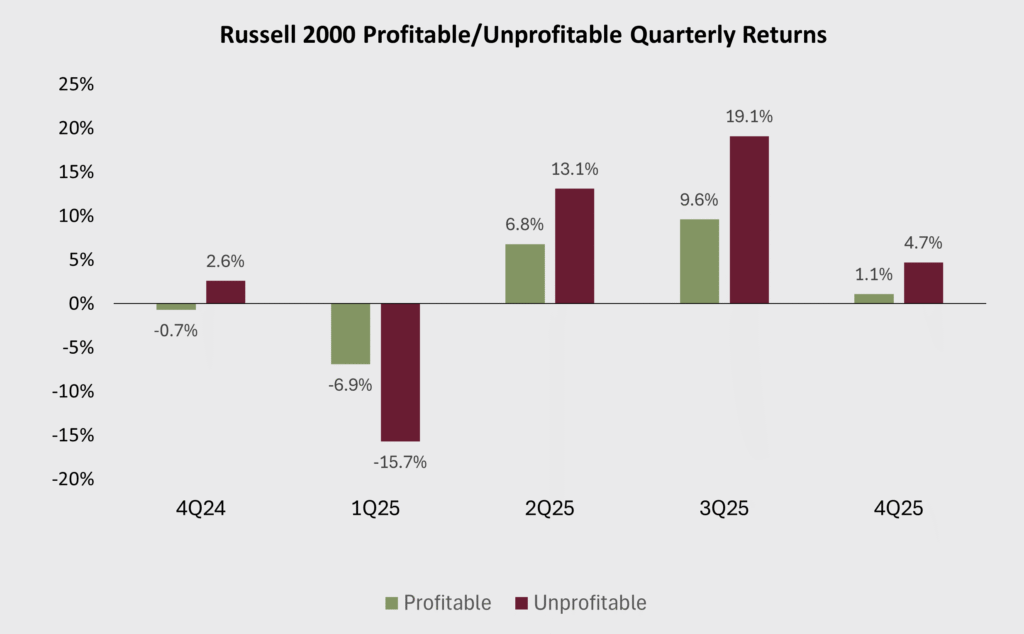
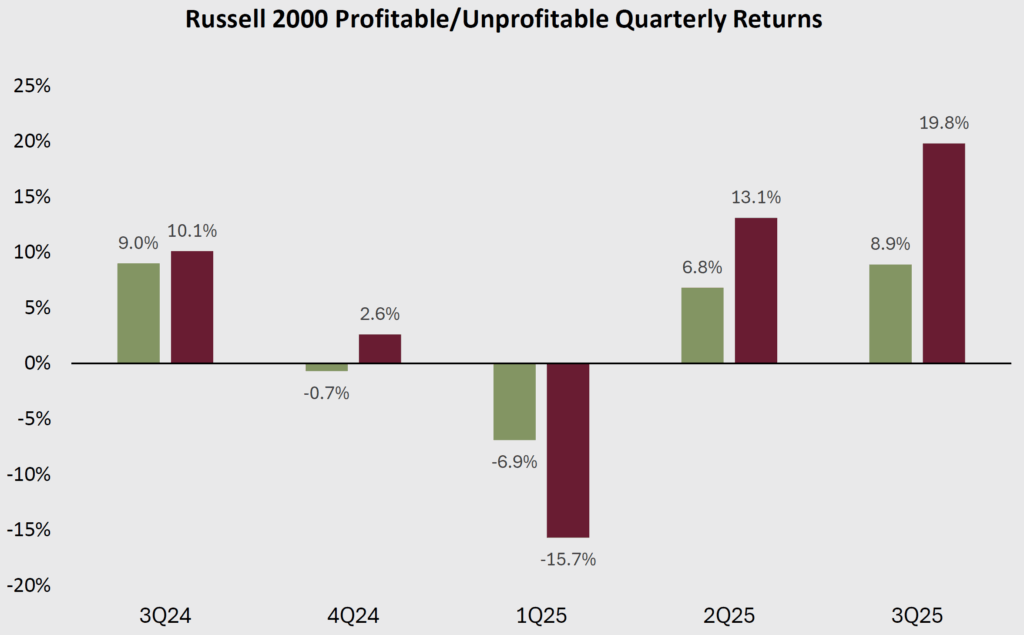
At the sector level, ten of the eleven sectors in the Russell 2000 Index recorded positive returns during the third quarter, led by the Real Estate (+18.16%), Communication Services (+17.79%), and Financials (15.14%) sectors. Conversely, Energy (-8.31%), Information Technology (+4.30%), and Materials (+8.14%) all lagged. Looking at market factors, profitable companies outperformed loss makers by nearly 125 bps during the quarter.

Sources: CAPS Composite Hub, Russell Investments
Past performance is not indicative of future results. Returns are presented gross and net of investment advisory fees and include the reinvestment of all income. Gross returns will be reduced by fees and other expenses that may be incurred in the management of the account. Net returns are presented net of actual investment advisory fees and after the deduction of all trading expenses. Aristotle Small Cap Equity Composite returns are preliminary pending final account reconciliation. Please see important disclosures at the end of this document.

Performance Review

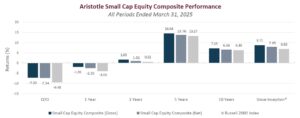
For the third quarter of 2024, the Aristotle Small Cap Equity Composite posted a total return of 7.40% net of fees (7.57% gross of fees), trailing the 9.27% total return of the Russell 2000 Index. Underperformance was driven by both security selection and allocation effects. Overall, security selection was weakest in the Industrials and Health Care sectors and strongest in Information Technology and Materials. From an allocation perspective, an underweight in Real Estate and an overweight in Information Technology detracted from relative performance but this was partially offset by underweights in Materials and Health Care.

Relative ContributorsRelative Detractors
Baldwin Insurance GroupArdmore Shipping
ACI WorldwideAcadia Healthcare
PetIQModivCare
BeldenPatterson-UTI Energy
Mercury SystemsCommunity Healthcare Trust

CONTRIBUTORS

Baldwin Insurance Group (BWIN), a Florida-based insurance company operating in the advisory, underwriting, and Mainstreet (consumer/small business) segments, built on second-quarter momentum with above consensus earnings on account of business line growth and margin improvement. We believe the company is starting to benefit from investments in talent made over the past year as well as the launch of new products. We maintain a position as we believe the company should continue to benefit from a positive inflection in free cash flow, improving margins, and deleveraging.

ACI Worldwide (ACIW), a provider of software solutions to facilitate payment transactions for financial institutions, retailers, and payment processors around the world, benefited from strong second-quarter results largely driven by growth in the bank segment along with the announcement of a $400 million stock buyback program. We maintain our investment as we believe the company is executing its strategy to maintain a strong market position in the payments software niche while upgrading its technology in select areas. With ongoing cost controls and high incremental margins on new revenue, we expect the company can drive additional growth with continued debt reduction and share repurchases.

DETRACTORS

Ardmore Shipping (ASC), a product and chemical transportation company focused on modern mid-sized vessels, drifted lower during the quarter as concerns over oil production and potentially weak Chinese growth weighed on the broader energy sector. We maintain a position, as we believe the company continues to operate from a position of strength, driven by recent shareholder-friendly capital allocation decisions, strong operating performance, and a favorable industry supply-demand backdrop.

Acadia Healthcare (ACHC), a behavioral healthcare and substance abuse treatment services company, declined in late September as a result of two negative news headlines related to patient care and questions about billing practices. While we take these developments seriously, we believe investors’ reaction to the news has been more severe than warranted. Industry peers have faced similar levels of scrutiny in the past with limited fundamental impact, and unless additional information is uncovered, we believe the current scrutiny will be resolved without much of an impact on their business. We continue to believe the company is well positioned to be an important part of the solution to an unfortunately growing need for behavioral health services.

Recent Portfolio Activity

Buys/AcquisitionsSells/Liquidations
First Interstate BancSystemEnviri
PetIQ

BUYS/ACQUISITIONS

First Interstate BancSystem (FIBK), a financial holding company, provides community banking solutions to individuals, businesses, and municipalities. The company is selling at attractive valuations as we believe company specific self-help initiatives such as repositioning their balance sheet to take advantage of the Fed’s forward curve are underappreciated by the market and not reflected in the current valuation.

SELLS/LIQUIDATIONS

Enviri (NVRI), an industrial services provider, was sold due to a change in our thesis arising from the company’s inability to de-lever its balance sheet leading to muted forward growth projections.

PetIQ (PETQ), a manufacturer and distributor of pet health and wellness products, was sold as the stock had appreciated, causing its reward-to-risk profile to compress as it reached our valuation target.

Outlook

We continue to remain optimistic about the long-term potential for the small-cap segment of the U.S. market as valuations and potential tailwinds bode well for the asset class. As we look out to the final months of 2024, we are cautiously constructive as encouraging signs of economic stability are balanced by now consensus expectations of a soft landing scenario and risk pricing. While rate-cutting cycles have historically been constructive for small caps, there remains a long list of items creating uncertainty that could lead to greater volatility in the final months of the year. This includes but is not limited to, the reignition of inflationary pressures, labor strikes in key industries and ports, geopolitical tensions, U.S. equity index concentration issues, ongoing commercial real estate and regional banking concerns, and the looming presidential election. We are aware that most of these issues are well known, but the timing and magnitude of the impact of any and all of these issues remains unpredictable. Therefore, as we always have, we will continue to avoid the temptation to forecast their outcome in favor of assessing the potential impact from a range of potential outcomes within our company‐specific, bottom-up analysis, and quality focus.

From an asset class perspective, valuations of small versus large continue to remain near multi-decade lows, which we believe suggests a more favorable setup for small caps relative to large caps in the periods to come (16.7x P/E for the Russell 2000 Index vs. 25.8x P/E for the Russell 1000 Index). Against a backdrop of disinflation, normalized interest rates, and a still growing U.S. economy, it looks to us that small-cap’s stretch of underperformance has the potential to end. If the economy continues to stabilize, our view is that valuations are likely to rise for those businesses that have largely sat out the mega-cap performance regime. Lastly, we believe small caps remain better positioned to benefit from the reshoring of U.S. manufacturing, a pickup in M&A activity,  fiscal policy bills passed in the last few years such as the IRA and Jobs Act, and several infrastructure projects on the horizon.

Positioning

Our current positioning is a function of our bottom-up security selection process and our ability to identify what we view as attractive investment candidates, regardless of economic sector definitions. Overweights in Industrials and Information Technology are mostly a function of our underlying company specific views rather than any top-down predictions for each sector. Conversely, we continue to be underweight in Consumer Discretionary, as we have been unable to identify what we consider to be compelling long-term opportunities that fit our discipline given the rising risk profiles of many retail businesses and a potential deceleration in goods spending following a period of strength. While the portfolio’s allocation to Health Care is modestly below that of the benchmark, we continue to remain underweight the Biotechnology industry as many companies within that group do not fit our discipline due to their elevated levels of binary risk. Given our focus on long-term business fundamentals, patient investment approach and low portfolio turnover, the strategy’s sector positioning generally does not change significantly from quarter to quarter. However, we may take advantage of periods of volatility by adding selectively to certain companies when appropriate.

Disclosures

The opinions expressed herein are those of Aristotle Capital Boston, LLC (Aristotle Boston) and are subject to change without notice.

Past performance is not indicative of future results. The information provided in this report should not be considered financial advice or a recommendation to purchase or sell any particular security. There is no assurance that any securities discussed herein will remain in an account’s portfolio at the time you receive this report or that securities sold have not been repurchased. The securities discussed may not represent an account’s entire portfolio and, in the aggregate, may represent only a small percentage of an account’s portfolio holdings. The performance attribution presented is of a representative account from Aristotle Boston’s Small Cap Equity Composite. The representative account is a discretionary client account which was chosen to most closely reflect the investment style of the strategy. The criteria used for representative account selection is based on the account’s period of time under management and its similarity of holdings in relation to the strategy. It should not be assumed that any of the securities transactions, holdings or sectors discussed were or will be profitable, or that the investment recommendations or decisions Aristotle Boston makes in the future will be profitable or equal the performance of the securities discussed herein. Aristotle Boston reserves the right to modify its current investment strategies and techniques based on changing market dynamics or client needs. Recommendations made in the last 12 months are available upon request.

Returns are presented gross and net of investment advisory fees and include the reinvestment of all income. Gross returns will be reduced by fees and other expenses that may be incurred in the management of the account. Net returns are presented net of actual investment advisory fees and after the deduction of all trading expenses.

Effective January 1, 2022, the Aristotle Small Cap Equity Composite has been redefined to exclude accounts with meaningful industry-specific restrictions or substantial values-based screens hampering implementation of the small cap strategy.

All investments carry a certain degree of risk, including the possible loss of principal. Investments are also subject to political, market, currency and regulatory risks or economic developments. International investments involve special risks that may in particular cause a loss in principal, including currency fluctuation, lower liquidity, different accounting methods and economic and political systems, and higher transaction costs.

These risks typically are greater in emerging markets. Securities of small‐ and medium‐sized companies tend to have a shorter history of operations, be more volatile and less liquid. Value stocks can perform differently from the market as a whole and other types of stocks. The material is provided for informational and/or educational purposes only and is not intended to be and should not be construed as investment, legal or tax advice and/or a legal opinion. Investors should consult their financial and tax adviser before making investments.

The opinions referenced are as of the date of publication, may be modified due to changes in the market or economic conditions, and may not necessarily come to pass.

Aristotle Capital Boston, LLC is an independent investment adviser registered under the Investment Advisers Act of 1940, as amended. Registration does not imply a certain level of skill or training. More information about Aristotle Boston, including our investment strategies, fees and objectives, can be found in our Form ADV Part 2, which is available upon request. ACB-2410-19

Performance Disclosures

Sources: CAPS Composite Hub, Russell Investments

Composite returns for periods ended September 30, 2024,  are preliminary pending final account reconciliation.

*The Aristotle Small Cap Equity Composite has an inception date of November 1, 2006, at a predecessor firm. During this time, Jack McPherson and Dave Adams had primary responsibility for managing the strategy. Performance starting January 1, 2015, was achieved at Aristotle Boston.

**For the period November 2006 through December 2006.

Past performance is not indicative of future results. Performance results for periods greater than one year have been annualized.

Effective January 1, 2022, the Aristotle Small Cap Equity Composite has been redefined to exclude accounts with meaningful industry-specific restrictions or substantial values-based screens hampering implementation of the small cap strategy.

Returns are presented gross and net of investment advisory fees and include the reinvestment of all income. Gross returns will be reduced by fees and other expenses that may be incurred in the management of the account. Net returns are presented net of actual investment advisory fees and after the deduction of all trading expenses. Please see important disclosures enclosed within this document.

Index Disclosures

The Russell 2000® Index measures the performance of the small cap segment of the U.S. equity universe. The Russell 2000 Index is a subset of the Russell 3000® Index representing approximately 10% of the total market capitalization of that index. It includes approximately 2000 of the smallest securities based on a combination of their market cap and current index membership. The Russell 2000 Growth® Index measures the performance of the small cap companies located in the United States that also exhibit a growth probability. The Russell 2000 Value® Index measures the performance of the small cap companies located in the United States that also exhibit a value probability. The Russell 1000® Index measures the performance of the large cap segment of the U.S. equity universe. The Russell 1000 Index is a subset of the Russell 3000® Index, representing approximately 90% of the total market capitalization of that index. It includes approximately 1,000 of the largest securities based on a combination of their market capitalization and current index membership. The Consumer Price Index (CPI) is a measure of the average change over time in the prices paid by urban consumers for a market basket of consumer goods and services. The volatility (beta) of the composite may be greater or less than the benchmarks. It is not possible to invest directly in these indices.

For more on Small Cap Equity, access the latest resources.

(All MSCI index returns are shown net and in U.S. dollars unless otherwise noted.)

Markets Review
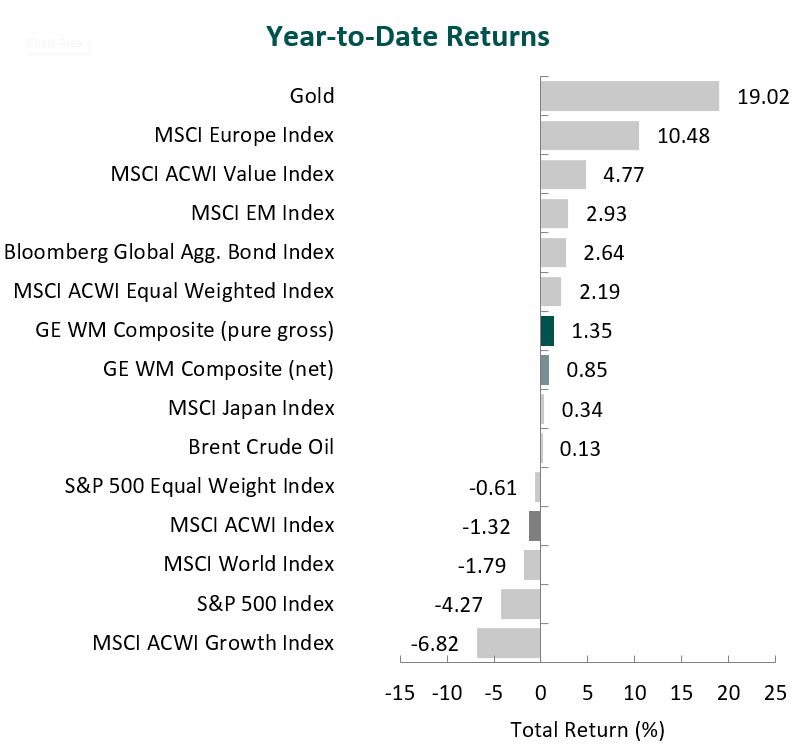
Sources: CAPS CompositeHubTM, Bloomberg
Past performance is not indicative of future results. Aristotle Global Equity Composite returns are presented gross and net of investment advisory fees and include the reinvestment of all income. Gross returns will be reduced by fees and other expenses that may be incurred in the management of the account. Net returns are presented net of actual investment advisory fees and after the deduction of all trading expenses. Aristotle Capital Composite returns are preliminary pending final account reconciliation. Please see important disclosures at the end of this document.

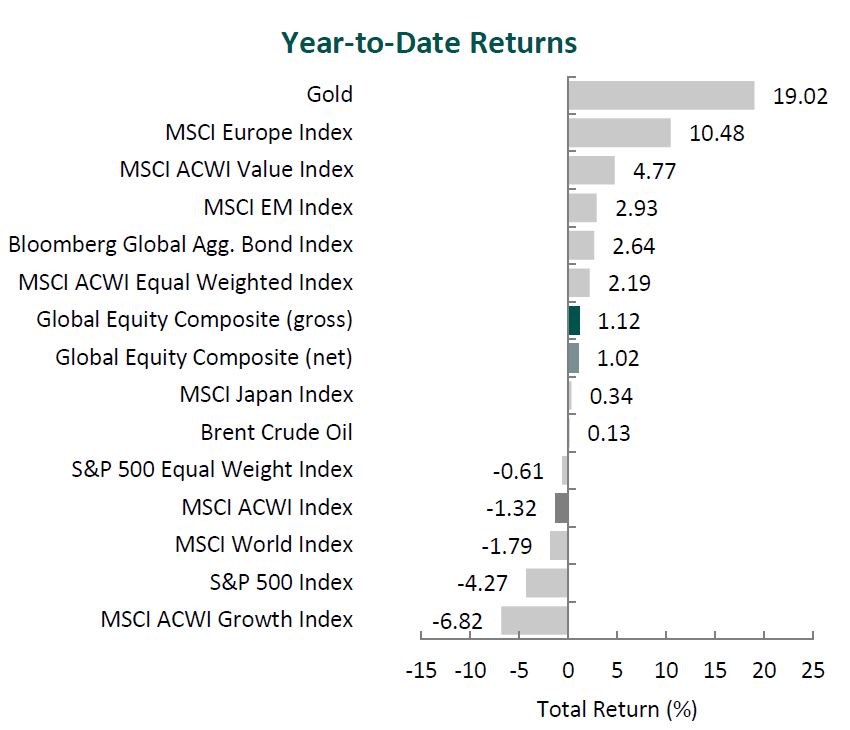
Global equity markets reached record highs during the quarter. The MSCI ACWI Index rose 6.61%, while the Bloomberg Global Aggregate Bond Index rallied 6.98%. Value outperformed growth, with the MSCI ACWI Value Index outperforming the MSCI ACWI Growth Index by 5.35% during the quarter.

Latin America and Asia/Pacific ex-Japan were the strongest regions, while Japan and North America gained the least. On a sector basis, ten out of the eleven sectors within the MSCI ACWI Index finished in the green, with Real Estate, Utilities and Financials increasing the most. Meanwhile, Energy (the only sector to post a negative return), Information Technology and Communication Services were the weakest performers.

The global economy continued to improve, with the IMF projecting global GDP to rise to 3.3% in 2025 as economic indicators trended positively. Both the U.K. and eurozone reported annualized inflation at 2.2% in August, while U.S. inflation fell below the 3.0% mark for the first time in over three years. To maintain economic growth and employment, the Bank of England cut its bank rate 25 basis points, the European Central Bank reduced its deposit facility rate 25 basis points and the U.S. Federal Reserve slashed its federal funds rate 50 basis points.

In Asia, the Bank of Japan announced its second rate hike of the year to a short-term policy rate of 0.25%, marking its highest level since 2008. With rising inflation, a weak yen and a push for policy normalization, Bank of Japan Governor Kazuo Ueda has not ruled out an additional rate hike by the end of the year. Meanwhile, China is grappling with deflationary pressures, as consumer prices rose just 0.6% year-over-year in August. In response, the People’s Bank of China unveiled a monetary stimulus package worth 1 trillion to 2 trillion yuan, which included reducing a key short-term interest rate and lowering banks’ reserve requirements.

On the geopolitical front, the ongoing wars in Ukraine-Russia and the Middle East continued with escalations of various magnitudes. At the time of this writing, oil markets responded with Brent Crude rising over 12% in the first five trading days of October to more than $80 per barrel.

Performance and Attribution Summary

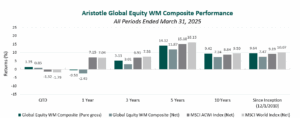
For the third quarter of 2024, Aristotle Capital’s Global Equity Composite posted a total return of 6.64% gross of fees (6.54% net of fees), underperforming the MSCI ACWI Index, which returned 6.61%, and outperforming the MSCI World Index, which returned 6.36%. Please refer to the table below for detailed performance.

Performance (%) 3Q24YTD1 Year3 Years5 Years10 Years Since Inception*
Global Equity Composite (gross)6.6412.3425.815.9011.4910.5310.37
Global Equity Composite (net)6.5412.0725.415.5811.1310.159.94
MSCI ACWI Index (net)6.6118.6631.768.0912.199.399.48
MSCI World Index (net)6.3618.8632.439.0813.0410.0710.37
*The inception date for the Global Equity Composite is November 1, 2010. Past performance is not indicative of future results. Aristotle Global Equity Composite returns are presented gross and net of investment advisory fees and include the reinvestment of all income. Gross returns will be reduced by fees and other expenses that may be incurred in the management of the account. Net returns are presented net of actual investment advisory fees and after the deduction of all trading expenses. Aristotle Capital Composite returns are preliminary pending final account reconciliation. MSCI ACWI (Net) was stated as the primary benchmark on June 1, 2024 and MSCI World (Net) became the secondary benchmark. Please see important disclosures at the end of this document.

Source: FactSet
Past performance is not indicative of future results. Attribution results are based on sector returns which are gross of investment advisory fees. Attribution is based on performance that is gross of investment advisory fees and includes the reinvestment of income.

From a sector perspective, the portfolio’s performance relative to the MSCI ACWI Index can be primarily attributed to allocation effects. Security selection in Financials, Health Care and Consumer Discretionary contributed the most to the portfolio’s relative performance. Conversely, security selection in Information Technology and Industrials and a lack of exposure to Utilities detracted from relative return.

Regionally, security selection was primarily responsible for the portfolio’s performance relative to the MSCI ACWI Index. Security selection in Japan and Asia/Pacific ex-Japan contributed the most to relative performance, while security selection in North America and Emerging Markets detracted.

Contributors and Detractors for 3Q 2024

Relative ContributorsRelative Detractors
LennarQualcomm
MonotaROMicrochip Technology
Otsuka HoldingsSamsung Electronics
BrookfieldRentokil Initial
AIA GroupAdobe

MonotaRO, the Japanese online business-to-business (B2B) e-commerce platform, was a main contributor during quarter. The company, which serves as a one-stop solution, allowing customers to shop for millions of products via a centralized location, reported an increase in order value and sales per shipment. It also continues to gain traction on orders coming from large corporations—a catalyst we previously identified—which now represent more than 30% of total sales, up from 25% at the end of last year. Large “enterprise” customers have a higher lifetime value and can afford to pay for value-added services that MonotaRO offers (e.g., purchase management systems), which in turn has the potential to increase the stickiness of clients. Moreover, we believe that the market underappreciates the importance that convenience (rather than price) plays in the B2B segment, where MonotaRO’s curation skills and execution capabilities are difficult to replicate.

Microchip Technology, the microcontroller (MCU) and analog semiconductor producer, was a primary detractor for the period. The company reported results in line with guidance, but its short-term outlook remains challenged. Between 2021-2023, amid a global chip shortage, Microchip implemented a preferred supply program to meet the large demands of its clients, who overestimated their needs and are now working through their inventory levels. While management has started to see some positive signs pointing toward a recovery (e.g., higher expedited orders and fewer order cancelations), it is taking longer than anticipated. Longer term, Microchip has been able to generate 15+ years of robust FREE cash flow and margins, while lowering its debt and consistently returning money to shareholders. This, we believe, speaks to the company’s proven ability to manage the business through economic cycles, while taking advantage of its broad portfolio to continue gaining share in areas including IoT, 5G infrastructure, autonomous driving and data centers.

Rentokil Initial, the U.K.-based pest control and hygiene services company, was one of the largest detractors for the quarter. In an unscheduled update, management provided a revised outlook for the North American pest control business, with 2024 revenue growth from the region now expected to be just 1%, a significant reduction from the prior guidance of 2%-4%. The company is experiencing temporary disruption due to the ongoing integration of Terminix into Rentokil’s existing branch network, with recent investments in sales and marketing requiring additional time to deliver results. However, while these integration efforts are weighing on short-term results, we believe they are precisely the foundation of Rentokil’s long-term value proposition. Once integration challenges are resolved, the combination should provide operational synergies through scale efficiencies and improved density in key markets, paving the way for a faster consolidation of the U.S. pest control industry and positioning the company to capture even more market share in the coming years. This “Right Way 2” operational plan underscores management’s focus on increasing customer retention and driving productivity gains via technology and data utilization. The ongoing branch integration and market densification initiatives represent key catalysts already in motion. Given its scale, operational excellence and strategic acquisitions, we believe Rentokil is well positioned to deliver both revenue growth and margin expansion over time.

Recent Portfolio Activity

BuysSells
Tokyo CenturyNone

During the quarter we invested in Tokyo Century.

Tokyo Century Corporation

Tokyo Century is a leading Japanese financial services company that specializes in leasing and financing. Formed in 2009 through the merger of Century Leasing System and Tokyo Leasing, the company offers a broad spectrum of services that consist of specialty financing for areas such as aviation, shipping and real estate (~50% of FY 2024 revenues), equipment leasing (~22% percent), auto leasing and rental car services (~8%), and various other services from IT leasing to financing for environmental infrastructure (~20%).

Tokyo Century’s services allow its customers the necessary funding to grow, as well as operate and manage, fleets of vehicles and necessary equipment without the need for large capital expenditures. The company has also been expanding its global presence outside of Japan, predominately through partnerships and joint ventures, with operations today in more than 30 countries and regions.

High-Quality Business

Some of the quality characteristics we have identified for Tokyo Century include:

  • Economies of scale allow for operational efficiencies and greater bargaining power with equipment manufacturers;
  • Global partnerships with industry leaders allow the company to not only expand its offerings but also enhance its reach across geographies and adapt to local customer needs; and
  • Strong balance sheet enables the company to secure favorable financing terms, which is crucial for its capital-intensive business model.

Attractive Valuation

Based on our estimates of normalized earnings, we believe Tokyo Century’s stock price is offered at a discount to the company’s intrinsic value. In our view, the market has underappreciated both company and industry-specific dynamics which provides an attractive valuation.

Compelling Catalysts

Catalysts we have identified for Tokyo Century, which we believe will cause its stock price to appreciate over our three- to five-year investment horizon, include:

  • Enhanced revenue and profitability from aviation leasing as manufacturing constraints, and the resulting supply and demand imbalance, allow for increasing lease rates and higher values of aircrafts;
  • Continued benefits from prior acquisitions, joint ventures and partnerships (e.g., Tokyo Century’s investment in NTT Data’s North American build-out of data centers); and
  • Improvements in IT leasing through its subsidiary CSI Leasing as companies increasingly rely on technology assets and seek to optimize IT infrastructure spending.

Conclusion

With the evolving global macroeconomic landscape, increasing geopolitical tensions and the approaching U.S. elections, there are plenty of headlines to follow. At Aristotle Capital, our priority is determining whether these events provide valuable insights for long-term investors. Instead of repositioning our portfolios based on predictions of how the market may or may not respond to such events, we focus on identifying and owning companies that, we believe, can succeed in the face of global uncertainty. It is our belief and experience that well-managed, high-quality companies will take appropriate actions to respond to the ever-changing world.

Disclosures

The opinions expressed herein are those of Aristotle Capital Management, LLC (Aristotle Capital) and are subject to change without notice. Past performance is not a guarantee or indicator of future results. This material is not financial advice or an offer to buy or sell any product. You should not assume that any of the securities transactions, sectors or holdings discussed in this report were or will be profitable, or that recommendations Aristotle Capital makes in the future will be profitable or equal the performance of the securities listed in this report. The portfolio characteristics shown relate to the Aristotle Global Equity strategy. Not every client’s account will have these characteristics. Aristotle Capital reserves the right to modify its current investment strategies and techniques based on changing market dynamics or client needs. There is no assurance that any securities discussed herein will remain in an account’s portfolio at the time you receive this report or that securities sold have not been repurchased. The securities discussed may not represent an account’s entire portfolio and, in the aggregate, may represent only a small percentage of an account’s portfolio holdings. The performance attribution presented is of a representative account from Aristotle Capital’s Global Equity Composite. The representative account is a discretionary client account which was chosen to most closely reflect the investment style of the strategy. The criteria used for representative account selection is based on the account’s period of time under management and its similarity of holdings in relation to the strategy. Recommendations made in the last 12 months are available upon request.

Returns are presented gross and net of investment advisory fees and include the reinvestment of all income. Gross returns will be reduced by fees and other expenses that may be incurred in the management of the account. Net returns are presented net of actual investment advisory fees and after the deduction of all trading expenses.

All investments carry a certain degree of risk, including the possible loss of principal. Investments are also subject to political, market, currency and regulatory risks or economic developments. International investments involve special risks that may in particular cause a loss in principal, including currency fluctuation, lower liquidity, different accounting methods and economic and political systems, and higher transaction costs. These risks typically are greater in emerging markets. Securities of small‐ and medium‐sized companies tend to have a shorter history of operations, be more volatile and less liquid. Value stocks can perform differently from the market as a whole and other types of stocks.

The material is provided for informational and/or educational purposes only and is not intended to be and should not be construed as investment, legal or tax advice and/or a legal opinion. Investors should consult their financial and tax adviser before making investments. The opinions referenced are as of the date of publication, may be modified due to changes in the market or economic conditions, and may not necessarily come to pass. Information and data presented has been developed internally and/or obtained from sources believed to be reliable. Aristotle Capital does not guarantee the accuracy, adequacy or completeness of such information.

Aristotle Capital Management, LLC is an independent investment adviser registered under the Investment Advisers Act of 1940, as amended. Registration does not imply a certain level of skill or training. More information about Aristotle Capital, including our investment strategies, fees and objectives, can be found in our Form ADV Part 2, which is available upon request. ACM-2410-101

Performance Disclosures

Sources: CAPS CompositeHubTM, MSCI

Composite returns for all periods ended September 30, 2024 are preliminary pending final account reconciliation. MSCI ACWI (Net) was stated as the primary benchmark on June 1, 2024 and MSCI World (Net) became the secondary benchmark. 

The Aristotle Global Equity Composite has an inception date of November 1, 2010; however, the strategy initially began at Howard Gleicher’s predecessor firm in July 2007. A supplemental performance track record from January 1, 2008 through October 31, 2010 is provided on this page and complements the Global Equity Composite presentation that is located at the end of this presentation. The performance results were achieved while Mr. Gleicher managed the strategy at a prior firm. The returns are those of a publicly available mutual fund from the fund’s inception through Mr. Gleicher’s departure from the firm. During that time, Mr. Gleicher had primary responsibility for managing the fund.

Past performance is not indicative of future results. The information provided should not be considered financial advice or a recommendation to purchase or sell any particular security or product. Performance results for periods greater than one year have been annualized.

Returns are presented gross and net of investment advisory fees and include the reinvestment of all income. Gross returns will be reduced by fees and other expenses that may be incurred in the management of the account. Net returns are presented net of actual investment advisory fees and after the deduction of all trading expenses.

Index Disclosures

MSCI ACWI (Net) was stated as the primary benchmark on June 1, 2024 and MSCI World (Net) became the secondary benchmark. The MSCI ACWI captures large and mid-cap representation across 23 developed markets and 24 emerging markets countries. With approximately 2,700 constituents, the Index covers approximately 85% of the global investable equity opportunity set. The MSCI ACWI Equal Weighted Index represents an alternative weighting scheme to its market cap weighted parent index, MSCI ACWI. The Index includes the same constituents as its parent (large and mid-cap securities from 23 developed markets and 24 emerging markets countries. However, at each quarterly rebalance date, all index constituents are weighted equally, effectively removing the influence of each constituent’s current price (high or low). Between rebalances, index constituent weightings will fluctuate due to price performance. The MSCI World Index is a free float-adjusted market capitalization weighted index that is designed to measure the equity market performance of developed markets. The MSCI World Index consists of the following 23 developed market country indexes: Australia, Austria, Belgium, Canada, Denmark, Finland, France, Germany, Hong Kong, Ireland, Israel, Italy, Japan, Netherlands, New Zealand, Norway, Portugal, Singapore, Spain, Sweden, Switzerland, the United Kingdom and the United States. The MSCI Emerging Markets Index is a free float-adjusted market capitalization-weighted index that is designed to measure equity market performance of emerging markets. The MSCI Emerging Markets Index consists of the following 24 emerging market country indexes: Brazil, Chile, China, Colombia, Czech Republic, Egypt, Greece, Hungary, India, Indonesia, Korea, Kuwait, Malaysia, Mexico, Peru, Philippines, Poland, Qatar, Saudi Arabia, South Africa, Taiwan, Thailand, Turkey and United Arab Emirates. The MSCI ACWI Growth Index captures large and mid-cap securities exhibiting overall growth style characteristics across 23 developed markets countries and 24 emerging markets countries. The MSCI ACWI Value Index captures large and mid-cap securities exhibiting overall value style characteristics across 23 developed markets countries and 24 emerging markets countries. The MSCI Europe Index captures large and mid-cap representation across 15 developed markets countries in Europe. With more than 400 constituents, the Index covers approximately 85% of the free float-adjusted market capitalization across the European developed markets equity universe. The MSCI Japan Index is designed to measure the performance of the large and mid-cap segments of the Japanese market. With approximately 200 constituents, the Index covers approximately 85% of the free float-adjusted market capitalization in Japan. The S&P 500® Index is the Standard & Poor’s Composite Index of 500 stocks and is a widely recognized, unmanaged index of common stock prices. The Bloomberg Global Aggregate Bond Index is a flagship measure of global investment grade debt from 28 local currency markets. This multi-currency benchmark includes Treasury, government-related, corporate and securitized fixed rate bonds from both developed and emerging markets issuers. The Brent Crude Oil Index is a major trading classification of sweet light crude oil that serves as a major benchmark price for purchases of oil worldwide. The volatility (beta) of the Composite may be greater or less than the benchmarks. It is not possible to invest directly in these indexes.
Markets Review

Sources: CAPS CompositeHubTM, Bloomberg
Past performance is not indicative of future results. Aristotle Value Equity Composite returns are presented gross and net of investment advisory fees and include the reinvestment of all income. Gross returns will be reduced by fees and other expenses that may be incurred in the management of the account. Net returns are presented net of actual investment advisory fees and after the deduction of all trading expenses. Aristotle Capital Composite returns are preliminary pending final account reconciliation. Please see important disclosures at the end of this document.

The U.S. equity market continued its ascent to new record highs, with the S&P 500 Index increasing 5.89% during the period. However, unlike last quarter, the market showed broader gains, with the S&P 500 Equal Weight Index outperforming the cap-weighted S&P 500 Index by 3.71%. Concurrently, the Bloomberg U.S. Aggregate Bond Index rose 5.20% for the quarter as interest rates declined. In terms of style, the Russell 1000 Value Index outperformed its growth counterpart by 6.24%.

Across sectors, gains were broad-based, as ten out of eleven within the Russell 1000 Value Index finished higher. Sector leaders included Utilities, Real Estate and Consumer Discretionary. Meanwhile, Energy (the only sector to finish in the red), Information Technology and Communication Services were the worst.

After slowing down for two consecutive quarters, U.S. economic growth accelerated to an annualized rate of 3.0%, as consumer spending and private inventory investments increased. Additionally, inflation inched closer to the Federal Reserve’s 2.0% target, with the CPI increasing at an annualized rate of 2.5% in August and 2.9% in July. Meanwhile, the U.S. labor market cooled slightly, with unemployment at 4.2% and nominal wage growth moderating during the period.

Given the ongoing progress toward target inflation and a softening labor market, the Federal Reserve lowered the target range of the federal funds rate by 50 basis points to 4.75% to 5.00%. Fed Chair Powell acknowledged that loosening policy restraint too quickly could undo progress on inflation, whereas moving too slowly could undermine economic activity and weaken employment. Therefore, Powell stressed the importance of monitoring economic data before making further adjustments to monetary policy.

Corporate earnings remained strong, with S&P 500 companies reporting earnings growth of 11.3%, the highest year-over-year improvement since 2021. Furthermore, only 67 S&P 500 companies issued negative EPS guidance, and about 80% exceeded estimates. Reflecting the general trend of disinflation and a resilient domestic economy, fewer companies mentioned topics like “inflation” and “recession” during earnings calls.

In political news, President Biden announced he would not seek re-election. Vice President Kamala Harris was subsequently named the official Democratic presidential nominee for the 2024 election. In geopolitics, tensions in the Middle East escalated as clashes between Israeli forces and Hezbollah fighters intensified. In response, the U.S. announced the urgent deployment of additional troops to the region in case of a wider regional conflict, while simultaneously mediating a potential ceasefire between the groups.

Performance and Attribution Summary

For the third quarter of 2024, Aristotle Capital’s Value Equity Composite posted a total return of 6.47% gross of fees (6.39% net of fees), underperforming the 9.43% return of the Russell 1000 Value Index and outperforming the 5.89% return of the S&P 500 Index. Please refer to the table for detailed performance.

Performance (%) 3Q24YTD1 Year3 Years5 Years10 Years
Value Equity Composite (gross)6.4712.8229.107.8212.9012.37
Value Equity Composite (net)6.3912.5928.757.5512.6112.03
Russell 1000 Value Index9.4316.6827.769.0310.699.23
S&P 500 Index5.8922.0836.3511.9115.9813.38
Past performance is not indicative of future results. Aristotle Value Equity Composite returns are presented gross and net of investment advisory fees and include the reinvestment of all income. Gross returns will be reduced by fees and other expenses that may be incurred in the management of the account. Net returns are presented net of actual investment advisory fees and after the deduction of all trading expenses. Aristotle Capital Composite returns are preliminary pending final account reconciliation. Please see important disclosures at the end of this document.

Source: FactSet
Past performance is not indicative of future results. Attribution results are based on sector returns which are gross of investment advisory fees. Attribution is based on performance that is gross of investment advisory fees and includes the reinvestment of income.

The portfolio’s underperformance relative to the Russell 1000 Value Index in the third quarter can be primarily attributed to security selection, while allocation effects also had a slightly negative impact. Security selection in Information Technology and Industrials and an overweight in Information Technology detracted the most from relative performance. Conversely, security selection in Consumer Discretionary, an underweight in Energy and an overweight in Utilities contributed. (Relative weights are the result of bottom-up security selection.)

Contributors and Detractors for 3Q 2024

Relative ContributorsRelative Detractors
Parker HannifinQualcomm
LennarMicrochip Technology
BlackstoneAdobe
Atmos EnergyMicrosoft
Xcel EnergyMerck

Microchip Technology, the microcontroller (MCU) and analog semiconductor producer, was a primary detractor for the period. The company reported results in line with guidance, but its short-term outlook remains challenged. Between 2021-2023, amid a global chip shortage, Microchip implemented a preferred supply program to meet the large demands of its clients, who overestimated their needs and are now working through their inventory levels. While management has started to see some positive signs pointing toward a recovery (e.g., higher expedited orders and fewer order cancelations), it is taking longer than anticipated. Longer term, Microchip has been able to generate 15+ years of robust FREE cash flow and margins, while lowering its debt and consistently returning money to shareholders. This, we believe, speaks to the company’s proven ability to manage the business through economic cycles, while taking advantage of its broad portfolio to continue gaining share in areas including IoT, 5G infrastructure, autonomous driving and data centers.

Blackstone, one of the world’s largest alternative asset managers, was a leading contributor for the period. Blackstone reported nearly $40 billion in inflows and deployed $34 billion during the quarter, its highest investment activity in two years. With over $180 billion in dry powder, the company possesses significant purchasing power to invest in attractive opportunities such as its recent $24 billion acquisition of data center platform AirTrunk, its largest investment in the Asia/Pacific region. Moreover, Blackstone continues to make progress in penetrating the retail and private wealth channels, as the company raised $7.5 billion overall during the quarter, with assets raised in perpetual vehicles over the first half of 2024 eclipsing full-year totals in 2023. BCRED (a private credit vehicle), BREIT (a private real estate vehicle) and the newly launched BXPE (a private equity vehicle) have all seen encouraging signs with new inflows. Despite BREIT’s challenges last year, all redemption requests since February have been fulfilled at 100%, and requests in June were down 85% from the peak of 2023. As the overall industry fundamentals improve, we believe Blackstone’s first-mover and distribution advantages in its retail initiatives and its overall reputation as a best-in-class operator will continue to create shareholder value.

Recent Portfolio Activity

BuysSells
American International GroupAutodesk
Verizon Communications

During the quarter, we sold our position in Autodesk and invested in American International Group and Verizon Communications.

We first invested in Autodesk—the global industry standard for computer‐aided design in the architecture, engineering and construction industry (AEC)—during the second quarter of 2022. During our holding period, the company remained at the cutting edge of enabling improvement through innovation and promoting the use of open standards, or open building information modeling (BIM). The company also improved its profitability, supported by further adoption of its cloud offerings. We continue to believe the company is uniquely positioned to benefit, as the AEC industry has increasingly sought to resolve the inefficiencies that arise when many parties are needed to complete a building project. However, we decided Autodesk was the best candidate for sale to fund what we believe to be a more optimal investment in Verizon Communications.

Verizon Communications Inc.

Headquartered in New York, Verizon is one of the largest telecommunications companies in the U.S. The company was formed in 2000 with the combination of Bell Atlantic Corp. and GTE Corp., businesses with roots dating back to the late 19th century and the beginning of the telephone business.

Over the years, Verizon has expanded through strategic acquisitions and innovations, particularly in wireless technology, which has become the cornerstone of its business. Unlike its competitor AT&T’s strategy of vertical integration through the acquisition of media and entertainment companies, which AT&T is now unwinding, Verizon has instead focused on expanding its fiber networks in major cities and acquiring wireless spectrum to increase network capacity and performance. Today, Verizon’s wireless services account for approximately 70% of its revenue (serving over 90 million postpaid and 20 million prepaid phone customers), making it the country’s largest wireless carrier. Verizon also offers fixed-line operations with local networks in the Northeastern U.S., serving over 30 million homes and businesses and nine million broadband customers. In early September, Verizon announced the $20 billion all-cash acquisition of Frontier, the largest pure-play fiber internet provider in the U.S. Upon closing (expected within 18 months), Verizon’s fiber network will expand to 31 states.

High-Quality Business

Some of the quality characteristics we have identified for Verizon include:

  • Strong brand reputation for network reliability and speed, along with the broadest wireless coverage in the industry, supports premium pricing and customer loyalty in the form of low churn;
  • Leading market share in wireless and economies of scale allow Verizon to generate high margins and returns on invested capital; and
  • Verizon’s position at the forefront of 5G technology, combined with its spectrum licenses and the capital-intensive nature of building and maintaining network infrastructure, creates high barriers to entry.

Attractive Valuation

Based on our estimates of normalized earnings, we believe Verizon’s current stock price is offered at a discount to the company’s intrinsic value. More specifically, we believe the company is trading at a CFRoEV greater than 10%, which translates to an attractive discount to intrinsic value.

Compelling Catalysts

Catalysts we have identified for Verizon, which we believe will cause its stock price to appreciate over our three- to five-year investment horizon, include:

  • Higher FREE cash flow generation as prior large investments (e.g., 5G rollout and spectrum purchases) season, resulting in lower capital intensity;
  • Enhanced revenue as more consumers upgrade to 5G-enabled devices, which should lead to increased data usage, higher-value service plans and an expanded customer base;
  • Market share gains in broadband internet service as customers switch from traditional cable companies; and
  • Increased connections per account and higher ARPU by way of Verizon’s ability to bundle services (like wireless, home internet and media content), which encourages adding more devices and drives higher overall spending.

American International Group, Inc.

Established in 1919 and headquartered in New York, American International Group (AIG) is one of the largest global insurance companies. AIG provides a comprehensive range of property and casualty (P&C) insurance to businesses and individuals in over 190 countries and jurisdictions around the world. The company also has a ~48% stake in Corebridge Financial (Corebridge), AIG’s old Life & Retirement segment.

AIG’s government bailout following the 2008 global financial crisis left the company on a 10+ year journey to transform its business (including five CEOs) by streamlining operations and attempting to improve its image with the public and investor community. Since taking over the General Insurance business in 2017 and assuming the role of CEO in 2021, Peter Zaffino has restructured underwriting and increased levels of reinsurance to reduce risk and control volatility, implemented a new structure for its High Net Worth business, divested non-core divisions such as crop risk and personal travel, and separated its Life & Retirement segment into the independently publicly traded company Corebridge. Following these actions, AIG will be a purely General Insurance focused business, with roughly 75% of its premiums tied to commercial and 25% to personal policies. We believe with Mr. Zaffino’s emphasis on risk-adjusted returns, AIG has become a stronger, more focused organization.

High-Quality Business

Some of the quality characteristics we have identified for AIG include:

  • Robust brand, market position and client relationships give it scale, with over $160 billion in assets and over $25 billion in net written premiums[1];
  • Well diversified across product lines, sectors and geographies; and
  • Innovative management team led by Chairman and CEO Peter Zaffino, whose focus has shifted from remediation (e.g., enhancing the underwriting culture and improving the financial profile) to preparing the company for future growth.

Attractive Valuation

We believe AIG is poised to improve underwriting, reduce expenses and return greater capital to shareholders, resulting in higher normalized earnings that correspond to a CFRoEV of around 8%. Moreover, AIG is one of the uncommon (for Aristotle Capital) investments where the discount to intrinsic value we see is due to both improved earnings and multiple expansion.

Compelling Catalysts

Catalysts we have identified for AIG, which we believe will cause its stock price to appreciate over our three- to five-year investment horizon, include:

  • Completion of Peter Zaffino’s business transformation (i.e., focus on General Insurance following divestitures, including the complete exit of Corebridge; improving underwriting culture; and disciplined capital management) should result in higher normalized earnings, cash flow and return on equity;
  • Further expense management through operational initiatives (e.g., AIG Next) and tighter underwriting;
  • Continued transformation of the firm’s High Net Worth business, utilizing a managing general agent model, should result in higher volumes and more efficiencies; and
  • Enhanced financial flexibility following a reduction in leverage as well as excess capital, which we believe will continue to allow for greater returns of capital to shareholders (e.g., the ongoing $10 billion share repurchase program and consecutive years of 10% dividend growth).

Conclusion

With the evolving global macroeconomic landscape, increasing geopolitical tensions and the approaching U.S. elections, there are plenty of headlines to follow. At Aristotle Capital, our priority is determining whether these events provide valuable insights for long-term investors. Instead of repositioning our portfolios based on predictions of how the market may or may not respond to such events, we focus on identifying and owning companies that, we believe, can succeed in the face of global uncertainty. It is our belief and experience that well-managed, high-quality companies will take appropriate actions to respond to the ever-changing world.


[1] These figures are estimated based on the run rate as of June 30th after the deconsolidation of AIG’s Life & Retirement segment.

Disclosures

The opinions expressed herein are those of Aristotle Capital Management, LLC (Aristotle Capital) and are subject to change without notice. Past performance is not a guarantee or indicator of future results. This material is not financial advice or an offer to purchase or sell any product. You should not assume that any of the securities transactions, sectors or holdings discussed in this report were or will be profitable, or that recommendations Aristotle Capital makes in the future will be profitable or equal the performance of the securities listed in this report. The portfolio characteristics shown relate to the Aristotle Value Equity strategy. Not every client’s account will have these characteristics. Aristotle Capital reserves the right to modify its current investment strategies and techniques based on changing market dynamics or client needs. There is no assurance that any securities discussed herein will remain in an account’s portfolio at the time you receive this report or that securities sold have not been repurchased. The securities discussed may not represent an account’s entire portfolio and, in the aggregate, may represent only a small percentage of an account’s portfolio holdings. The performance attribution presented is of a representative account from Aristotle Capital’s Value Equity Composite. The representative account is a discretionary client account which was chosen to most closely reflect the investment style of the strategy. The criteria used for representative account selection is based on the account’s period of time under management and its similarity of holdings in relation to the strategy. Recommendations made in the last 12 months are available upon request.

Returns are presented gross and net of investment advisory fees and include the reinvestment of all income. Gross returns will be reduced by fees and other expenses that may be incurred in the management of the account. Net returns are presented net of actual investment advisory fees and after the deduction of all trading expenses.

All investments carry a certain degree of risk, including the possible loss of principal. Investments are also subject to political, market, currency and regulatory risks or economic developments. International investments involve special risks that may in particular cause a loss in principal, including currency fluctuation, lower liquidity, different accounting methods and economic and political systems, and higher transaction costs. These risks typically are greater in emerging markets. Securities of small‐ and medium‐sized companies tend to have a shorter history of operations, be more volatile and less liquid. Value stocks can perform differently from the market as a whole and other types of stocks.

The material is provided for informational and/or educational purposes only and is not intended to be and should not be construed as investment, legal or tax advice and/or a legal opinion. Investors should consult their financial and tax adviser before making investments. The opinions referenced are as of the date of publication, may be modified due to changes in the market or economic conditions, and may not necessarily come to pass. Information and data presented has been developed internally and/or obtained from sources believed to be reliable. Aristotle Capital does not guarantee the accuracy, adequacy or completeness of such information.

Aristotle Capital Management, LLC is an independent registered investment adviser under the Advisers Act of 1940, as amended. Registration does not imply a certain level of skill or training. More information about Aristotle Capital, including our investment strategies, fees and objectives, can be found in our ADV Part 2, which is available upon request. ACM-2410-38

Performance Disclosures


Sources:  CAPS CompositeHubTM, Russell Investments, Standard & Poor’s

Composite returns for all periods ended September 30, 2024 are preliminary pending final account reconciliation.

Past performance is not indicative of future results. The information provided should not be considered financial advice or a recommendation to purchase or sell any particular security or product. Performance results for periods greater than one year have been annualized. The Aristotle Value Equity strategy has an inception date of November 1, 2010; however, the strategy initially began at Mr. Gleicher’s predecessor firm in October 1997. A supplemental performance track record from January 1, 2001 through October 31, 2010 is provided above. The returns are based on two separate accounts and performance results are based on custodian data. During this time, Mr. Gleicher had primary responsibility for managing the two accounts, one account starting in November 2000 and the other December 2000.

Returns are presented gross and net of investment advisory fees and include the reinvestment of all income. Gross returns will be reduced by fees and other expenses that may be incurred in the management of the account. Net returns are presented net of actual investment advisory fees and after the deduction of all trading expenses.

Index Disclosures

The Russell 1000 Value® Index measures the performance of the large cap value segment of the U.S. equity universe. It includes those Russell 1000 Index companies with lower price-to-book ratios and lower expected growth values. The S&P 500® Index is the Standard & Poor’s Composite Index of 500 stocks and is a widely recognized, unmanaged index of common stock prices. The S&P 500 Equal Weight Index is designed to be the size-neutral version of the S&P 500. It includes the same constituents as the cap-weighted S&P 500, but each company in the S&P 500 Equal Weight Index is allocated the same weight at each quarterly rebalance. The Russell 1000® Growth Index measures the performance of the large cap growth segment of the U.S. equity universe. It includes those Russell 1000 companies with higher price-to-book ratios and higher forecasted growth values. The Russell 2000® Index measures the performance of the small cap segment of the U.S. equity universe. The Russell 2000 Index is a subset of the Russell 3000® Index representing approximately 10% of the total market capitalization of that index. It includes approximately 2,000 of the smallest securities based on a combination of their market cap and current index membership. The Dow Jones Industrial Average® is a price-weighted measure of 30 U.S. blue-chip companies. The Index covers all industries except transportation and utilities. The NASDAQ Composite Index measures all NASDAQ domestic and international based common type stocks listed on The NASDAQ Stock Market. The NASDAQ Composite includes over 3,000 companies, more than most other stock market indexes. The Bloomberg U.S. Aggregate Bond Index is an unmanaged index of domestic investment grade bonds, including corporate, government and mortgage-backed securities. The WTI Crude Oil Index is a major trading classification of sweet light crude oil that serves as a major benchmark price for oil consumed in the United States. The 3-Month U.S. Treasury Bill is a short-term debt obligation backed by the U.S. Treasury Department with a maturity of three months. The Consumer Price Index is a measure of the average change over time in the prices paid by urban consumers for a market basket of consumer goods and services. The volatility (beta) of the Composite may be greater or less than its respective benchmarks. It is not possible to invest directly in these indexes.

(All MSCI index returns are shown net and in U.S. dollars unless otherwise noted.)

Markets Review

Sources: CAPS CompositeHubTM, Bloomberg
Past performance is not indicative of future results. Aristotle International Equity Composite returns are presented gross and net of investment advisory fees and include the reinvestment of all income. Gross returns will be reduced by fees and other expenses that may be incurred in the management of the account. Net returns are presented net of actual investment advisory fees and after the deduction of all trading expenses. Aristotle Capital Composite returns are preliminary pending final account reconciliation. Please see important disclosures at the end of this document.

Global equity markets reached record highs during the quarter. The MSCI ACWI Index rose 6.61%, while the Bloomberg Global Aggregate Bond Index rallied 6.98%. Value outperformed growth, with the MSCI ACWI Value Index outperforming the MSCI ACWI Growth Index by 5.35% during the quarter.

The MSCI EAFE Index climbed 7.26% during the third quarter, while the MSCI ACWI ex USA Index went up 8.06%. Within the MSCI EAFE Index, Asia/Pacific ex-Japan gained the most, while Japan gained the least. On a sector basis, nine of the eleven sectors within the MSCI EAFE Index posted  positive returns, with Real Estate, Utilities and Communication Services recording the largest gains. Conversely, Energy, Information Technology and Health Care performed the worst.

The global economy continued to improve, with the IMF projecting global GDP to rise to 3.3% in 2025 as economic indicators trended positively. Both the U.K. and eurozone reported annualized inflation at 2.2% in August, while U.S. inflation fell below the 3.0% mark for the first time in over three years. To maintain economic growth and employment, the Bank of England cut its bank rate 25 basis points, the European Central Bank reduced its deposit facility rate 25 basis points and the U.S. Federal Reserve slashed its federal funds rate 50 basis points.

In Asia, the Bank of Japan announced its second rate hike of the year to a short-term policy rate of 0.25%, marking its highest level since 2008. With rising inflation, a weak yen and a push for policy normalization, Bank of Japan Governor Kazuo Ueda has not ruled out an additional rate hike by the end of the year. Meanwhile, China is grappling with deflationary pressures, as consumer prices rose just 0.6% year-over-year in August. In response, the People’s Bank of China unveiled a monetary stimulus package worth 1 trillion to 2 trillion yuan, which included reducing a key short-term interest rate and lowering banks’ reserve requirements.

On the geopolitical front, the ongoing wars in Ukraine-Russia and the Middle East continued with escalations of various magnitudes. At the time of this writing, oil markets responded with Brent Crude rising over 12% in the first five trading days of October to more than $80 per barrel.

Performance and Attribution Summary

For the third quarter of 2024, Aristotle Capital’s International Equity Composite posted a total return of 10.97% gross of fees (10.82% net of fees), outperforming the MSCI EAFE Index, which returned 7.26%, and the MSCI ACWI ex USA Index, which returned 8.06%. Please refer to the table below for detailed performance.

Performance (%) 3Q24YTD1 Year3 Years5 Years10 Years Since Inception*
International Equity Composite (gross)10.9714.1826.074.318.356.676.21
International Equity Composite (net)10.8213.7525.473.817.846.165.70
MSCI EAFE Index (net)7.2612.9924.775.488.205.713.39
MSCI ACWI ex USA Index (net)8.0614.2125.354.147.595.223.06
*The inception date for the International Equity Composite is January 1, 2008. Past performance is not indicative of future results. Aristotle International Equity Composite returns are presented gross and net of investment advisory fees and include the reinvestment of all income. Gross returns will be reduced by fees and other expenses that may be incurred in the management of the account. Net returns are presented net of actual investment advisory fees and after the deduction of all trading expenses. Aristotle Capital Composite returns are preliminary pending final account reconciliation. Please see important disclosures at the end of this document.

Source: FactSet
Past performance is not indicative of future results. Attribution results are based on sector returns which are gross of investment advisory fees. Attribution is based on performance that is gross of investment advisory fees and includes the reinvestment of income.

From a sector perspective, the portfolio’s outperformance relative to the MSCI EAFE Index can be attributed to security selection, while allocation effects had a negative impact. Security selection in Financials, Health Care and Information Technology contributed the most to the portfolio’s relative performance. Conversely, an overweight in Energy and a lack of exposure to Utilities and Real Estate detracted from relative returns.

Regionally, security selection was responsible for the portfolio’s outperformance, while allocation effects had a negative impact. Security selection in Europe & Middle East and Asia contributed the most to relative performance, while exposure to Emerging Markets and an underweight in Asia detracted.

Contributors and Detractors for 3Q 2024

Relative ContributorsRelative Detractors
BrookfieldSamsung Electronics
HaleonRentokil Initial
MonotaROCameco
Otsuka HoldingsHeineken
AccentureTotalEnergies

Brookfield, one of the world’s largest and most diversified private market investors, was the top contributor for the period. Several key factors contributed to this success, which are linked to both catalysts currently underway and the company’s long-term strategic positioning. In the near term, the company reported significant fundraising strength, with over $68 billion in inflows during the second quarter of 2024. This capital influx was bolstered by an expanded credit platform, positioning Brookfield to return substantial cash to shareholders through more than $800 million in share buybacks so far this year. Additionally, Brookfield advanced its energy transition strategy, particularly through its renewable power and infrastructure businesses. A notable development was the company’s agreement to acquire a majority stake in Neoen, a leading global renewables platform operating in Australia, France and the Nordics. Neoen specializes in solar, wind and energy storage projects, sectors that are critical to the global shift toward clean energy. Looking at Brookfield from a long-term perspective, the company is uniquely positioned to capitalize on its scale, expertise and diverse business model. Its ability to attract large amounts of capital, combined with its experience in managing high-quality assets, gives Brookfield a competitive edge in both the traditional and renewable energy markets. Brookfield’s long-standing reputation as a successful owner-operator and its ability to quickly act on opportunities further strengthen our outlook for the company.

Rentokil Initial, the U.K.-based pest control and hygiene services company, was one of the largest detractors for the quarter. In an unscheduled update, management provided a revised outlook for the North American pest control business, with 2024 revenue growth from the region now expected to be just 1%, a significant reduction from the prior guidance of 2%-4%. The company is experiencing temporary disruption due to the ongoing integration of Terminix into Rentokil’s existing branch network, with recent investments in sales and marketing requiring additional time to deliver results. However, while these integration efforts are weighing on short-term results, we believe they are precisely the foundation of Rentokil’s long-term value proposition. Once integration challenges are resolved, the combination should provide operational synergies through scale efficiencies and improved density in key markets, paving the way for a faster consolidation of the U.S. pest control industry and positioning the company to capture even more market share in the coming years. This “Right Way 2” operational plan underscores management’s focus on increasing customer retention and driving productivity gains via technology and data utilization. The ongoing branch integration and market densification initiatives represent key catalysts already in motion. Given its scale, operational excellence and strategic acquisitions, we believe Rentokil is well positioned to deliver both revenue growth and margin expansion over time.

Recent Portfolio Activity

BuysSells
DiageoKDDI
MonotaRO

During the quarter, we sold our position in KDDI and invested in two new positions: Diageo and MonotaRO.

We first invested in KDDI during the third quarter of 2013. When we originally invested, smartphone penetration in Japan was only about 40%, which is low for a developed economy. In contrast, the U.S. was at approximately 70% at the time. Our estimate of normalized penetration in Japan was closer to 70%, and today it is over 85%. (The U.S. is over 90%.) We view the Japanese telecom industry as unique because the spectrum is “owned by the people.” As a result, telecommunications providers like KDDI are not required to participate in expensive spectrum auctions as are their U.S. peers. This results in lower capital intensity and higher normalized FREE cash flow for the Japanese companies. Additionally, KDDI has benefited from a competitive environment best described as a rational oligopoly. Over the years, government-controlled NTT has been ceding market share to KDDI and Softbank. Softbank has seemingly been continuously distracted and required to divert FREE cash flow to fund its venture investments. These circumstances created a favorable decade for KDDI, as the company executed well, increasing average revenue per user (“ARPU”) and ancillary services. However, KDDI now has ambitions to enter “new areas,” as its core wireless business has become saturated and increasingly competitive with the entrance of a fourth player, Rakuten. While many of our catalysts played out as expected, we view the company’s recent multibillion-dollar acquisition (in conjunction with Mitsubishi Corp.) of Japanese retailer Lawson as a suboptimal allocation of capital. Lawson operates approximately 14,600 stores in Japan, which KDDI intends to utilize to promote banking and insurance products. Although we continue to believe KDDI shares are inexpensive, we exited the investment, as we see few catalysts remaining and have questions on strategy that we prefer to monitor from the sidelines.

Diageo plc

Headquartered in London, England, Diageo is a global leader in the alcoholic beverages industry. The company has a vast portfolio of over 200 well-recognized premium spirits (~80% of FY 2024 sales), beers (~15% and mostly Guinness) and other beverages (~5%) that are sold in nearly 180 countries. Led by its Johnnie Walker brand, Diageo is the world’s largest exporter of Scotch whiskey—its largest category at ~25% of sales—followed by other spirits such as tequila and vodka (~10% each). Diageo also owns a ~34% stake in the premium champagne and cognac maker Moët Hennessy (a subsidiary of LVMH Moët Hennessy Louis Vuitton).

The company is the product of the 1997 merger between Grand Metropolitan and Guinness and the subsequent divestiture of its food-related businesses. M&A continues to be a part of Diageo’s strategy, as regional brands often dominate local markets (which provides further opportunities for mergers and industry consolidation). Over the last decade, Diageo has also meaningfully increased its presence in the rapidly growing tequila market with the acquisitions of Don Julio and Casamigos.

High-Quality Business

Some of the quality characteristics we have identified for Diageo include:

  • Strong portfolio of some of the world’s most iconic alcohol brands (e.g., Johnnie Walker, Crown Royal, Guinness, Smirnoff, Captain Morgan, Baileys and Tanqueray, among others), which supports pricing power and promotes customer loyalty;
  • Global reach and distribution networks provide Diageo with operational flexibility and economies of scale; and
  • Well diversified across product categories and geographies, with a history of fairly consistent results even in difficult economic environments.

Given our estimates of higher future earnings through market share gains in alcoholic beverages, we believe shares of the company are undervalued. At our purchase price, we believe shares were valued at a price to normalized earnings of ~13x, an attractive price for this high-quality business, and a discount to our estimate of intrinsic value.

Catalysts we have identified for Diageo, which we believe will cause its stock price to appreciate over our three- to five-year investment horizon, include:

  • Well positioned to benefit from the global consumer mix shift toward premium alcoholic beverages;
  • Continued market share gains in Scotch whiskey and tequila given the company’s scale advantage;
  • Further penetration in emerging markets (e.g., India, China, Brazil, Mexico and African countries); and
  • Enhanced FREE cash flow should result in dividend increases and benefits of further consolidation through selective acquisitions.

MonotaRO Co., Ltd. plc

Established in Japan in 2000, MonotaRO operates a business-to-business (B2B) e-commerce platform, selling approximately 20 million items (over 650,000 SKUs) to more than 8 million customers (mostly in Japan). The company is an MRO (maintenance, repair and operations) distributor focused on small- and mid-sized companies (~two-thirds of customers), with manufacturing, construction and auto repair industries accounting for the majority of sales. MonotaRO’s business may seem simple; however, the company’s unique profile (>95% of sales are online) and innovative solutions, we believe, provide its customers a distinct value proposition and its shareholders a compelling opportunity to own a leader in a fragmented industry.

MonotaRO serves as a one-stop solution, allowing customers to shop for millions of products via a centralized location. Its transparent pricing saves clients time and reduces costs by removing the need to rely on independent catalogs, individual quotes or separate orders. The company sources its merchandise from thousands of suppliers (i.e., manufacturers and wholesalers) in ten countries and carries over 500,000 products in stock, ready for same-day shipment from its own distribution centers. In addition, its ONE SOURCE Lite service allows large clients to link their purchasing management systems to MonotaRO’s, providing company-wide visibility of items and purchases and an integrated experience.

MonotaRO operates as a consolidated subsidiary of U.S.-based Grainger (an industrials supplier) and provides consulting services to the parent’s e-commerce businesses in the U.S., Germany and the U.K.

High-Quality Business

Some of the quality characteristics we have identified for MonotaRO include:

  • High barriers to entry given that scale is essential to most products in the MRO market, which requires high variety yet small lot ordering, making it imperative to offer a high number of SKUs while investing in technology to provide easier curation and shorter delivery times;
  • The company’s vast product breadth, combined with its advanced data analytics, allows it to analyze procurement behaviors and better predict which items to keep in inventory. The client is able to spend less time ordering and can count on reliable delivery;
  • Attractive business fundamentals, as ordering can be cumbersome, and clients value reliability, convenience and variety more so than price. The MRO market is also highly fragmented and inefficient. As MonotaRO expands, the more difficult it becomes for others to compete; and
  • Expertise in database marketing leads to high repeat order rates, while its integrated purchasing management system (primarily for large corporate customers) increases retention.

Using our estimates of normalized sales attained through continued market share gains, we believe MonotaRO’s current stock price is offered at a discount to our estimate of the company’s intrinsic value.

Catalysts we have identified for MonotaRO, which we believe will cause its stock price to appreciate over our three- to five-year investment horizon, include:

  • Ability to continue gaining share from inefficient small players (e.g., door-to-door dealers relying on people, catalogs and even fax machines);
  • Increasing existing customers’ sales through technological improvements (e.g., website personalization and recommendation displays) aimed at reducing the time it takes to (1) find, (2) purchase and (3) receive products;
  • Further penetration into enterprise customers should provide a larger source for sales growth, as this segment represents a higher customer lifetime value as well as stickiness; and
  • Growth in sales of MonotaRO’s private label offering of approximately 300,000 products that are higher margin yet provide savings to clients.

Conclusion

With the evolving global macroeconomic landscape, increasing geopolitical tensions and the approaching U.S. elections, there are plenty of headlines to follow. At Aristotle Capital, our priority is determining whether these events provide valuable insights for long-term investors. Instead of repositioning our portfolios based on predictions of how the market may or may not respond to such events, we focus on identifying and owning companies that, we believe, can succeed in the face of global uncertainty. It is our belief and experience that well-managed, high-quality companies will take appropriate actions to respond to the ever-changing world.

Disclosures

The opinions expressed herein are those of Aristotle Capital Management, LLC (Aristotle Capital) and are subject to change without notice. Past performance is not a guarantee or indicator of future results. This material is not financial advice or an offer to buy or sell any product. You should not assume that any of the securities transactions, sectors or holdings discussed in this report were or will be profitable, or that recommendations Aristotle Capital makes in the future will be profitable or equal the performance of the securities listed in this report. The portfolio characteristics shown relate to the Aristotle International Equity strategy. Not every client’s account will have these characteristics. Aristotle Capital reserves the right to modify its current investment strategies and techniques based on changing market dynamics or client needs. There is no assurance that any securities discussed herein will remain in an account’s portfolio at the time you receive this report or that securities sold have not been repurchased. The securities discussed may not represent an account’s entire portfolio and, in the aggregate, may represent only a small percentage of an account’s portfolio holdings. The performance attribution presented is of a representative account from Aristotle Capital’s International Equity Composite. The representative account is a discretionary client account which was chosen to most closely reflect the investment style of the strategy. The criteria used for representative account selection is based on the account’s period of time under management and its similarity of holdings in relation to the strategy. Recommendations made in the last 12 months are available upon request.

Returns are presented gross and net of investment advisory fees and include the reinvestment of all income. Gross returns will be reduced by fees and other expenses that may be incurred in the management of the account. Net returns are presented net of actual investment advisory fees and after the deduction of all trading expenses.

All investments carry a certain degree of risk, including the possible loss of principal. Investments are also subject to political, market, currency and regulatory risks or economic developments. International investments involve special risks that may in particular cause a loss in principal, including currency fluctuation, lower liquidity, different accounting methods and economic and political systems, and higher transaction costs. These risks typically are greater in emerging markets. Securities of small‐ and medium‐sized companies tend to have a shorter history of operations, be more volatile and less liquid. Value stocks can perform differently from the market as a whole and other types of stocks.

The material is provided for informational and/or educational purposes only and is not intended to be and should not be construed as investment, legal or tax advice and/or a legal opinion. Investors should consult their financial and tax adviser before making investments. The opinions referenced are as of the date of publication, may be modified due to changes in the market or economic conditions, and may not necessarily come to pass. Information and data presented has been developed internally and/or obtained from sources believed to be reliable. Aristotle Capital does not guarantee the accuracy, adequacy or completeness of such information.

Aristotle Capital Management, LLC is an independent registered investment adviser under the Advisers Act of 1940, as amended. Registration does not imply a certain level of skill or training. More information about Aristotle Capital, including our investment strategies, fees and objectives, can be found in our Form ADV Part 2, which is available upon request. ACM-2410-41

Performance Disclosures

Sources: CAPS CompositeHubTM, MSCI

Composite returns for all periods ended September 30, 2024 are preliminary pending final account reconciliation.

Past performance is not indicative of future results. The information provided should not be considered financial advice or a recommendation to purchase or sell any particular security or product. Performance results for periods greater than one year have been annualized.

Returns are presented gross and net of investment advisory fees and include the reinvestment of all income. Gross returns will be reduced by fees and other expenses that may be incurred in the management of the account. Net returns are presented net of actual investment advisory fees and after the deduction of all trading expenses.

Index Disclosures

The MSCI EAFE Index (Europe, Australasia, Far East) is a free float-adjusted market capitalization-weighted index that is designed to measure the equity market performance of developed markets, excluding the United States and Canada. The MSCI EAFE Index consists of the following 21 developed market country indexes: Australia, Austria, Belgium, Denmark, Finland, France, Germany, Hong Kong, Ireland, Israel, Italy, Japan, the Netherlands, New Zealand, Norway, Portugal, Singapore, Spain, Sweden, Switzerland and the United Kingdom. The MSCI ACWI captures large and mid-cap representation across 23 developed market countries and 24 emerging markets countries. With approximately 2,700 constituents, the Index covers approximately 85% of the global investable equity opportunity set. The MSCI ACWI Growth Index captures large and mid-cap securities exhibiting overall growth style characteristics across 23 developed markets countries and 24 emerging markets countries. The MSCI ACWI Value Index captures large and mid-cap securities exhibiting overall value style characteristics across 23 developed markets countries and 24 emerging markets countries. The MSCI ACWI ex USA Index captures large and mid-cap representation across 22 of 23 developed markets countries (excluding the United States) and 24 emerging markets countries. With approximately 2,100 constituents, the Index covers approximately 85% of the global equity opportunity set outside the United States. The MSCI Emerging Markets Index is a free float-adjusted market capitalization-weighted index that is designed to measure the equity market performance of emerging markets. The MSCI Emerging Markets Index consists of the following 24 emerging market country indexes: Brazil, Chile, China, Colombia, Czech Republic, Egypt, Greece, Hungary, India, Indonesia, Korea, Kuwait, Malaysia, Mexico, Peru, Philippines, Poland, Qatar, Saudi Arabia, South Africa, Taiwan, Thailand, Turkey and United Arab Emirates. The S&P 500® Index is the Standard & Poor’s Composite Index of 500 stocks and is a widely recognized, unmanaged index of common stock prices. The Brent Crude Oil Index is a major trading classification of sweet light crude oil that serves as a major benchmark price for purchases of oil worldwide. The MSCI Japan Index is designed to measure the performance of the large and mid-cap segments of the Japanese market. With approximately 200 constituents, the Index covers approximately 85% of the free float-adjusted market capitalization in Japan. The Bloomberg Global Aggregate Bond Index is a flagship measure of global investment grade debt from 28 local currency markets. This multi-currency benchmark includes treasury, government-related, corporate and securitized fixed-rate bonds from both developed and emerging markets issuers. The MSCI United Kingdom Index is designed to measure the performance of the large and mid-cap segments of the U.K. market. With nearly 100 constituents, the Index covers approximately 85% of the free float-adjusted market capitalization in the United Kingdom. The MSCI Europe Index captures large and mid-cap representation across 15 developed markets countries in Europe. With approximately 400 constituents, the Index covers approximately 85% of the free float-adjusted market capitalization across the European developed markets equity universe. These indexes have been selected as the benchmarks and are used for comparison purposes only. The volatility (beta) of the Composite may be greater or less than the respective benchmarks. It is not possible to invest directly in these indexes.

For more on International Equity, access the latest resources.

July 16, 2024 – On June 9 2024, Roger Federer gave an insightful graduation speech at Dartmouth College: “In tennis, perfection is impossible…in the 1,526 singles matches I played in my career, I won almost 80% of those matches… Now, I have a question for all of you… what percentage of the POINTS do you think I won in those matches? Only 54%. In other words, even top-ranked tennis players win barely more than half of the points they play. When you lose every second point, on average, you learn not to dwell on every shot. You teach yourself to think: OK, I double-faulted. It’s only a point. OK, I came to the net and I got passed again. It’s only a point… Here’s why I am telling you this. When you’re playing a point, it is the most important thing in the world. But when it’s behind you, it’s behind you… This mindset is really crucial, because it frees you to fully commit to the next point… and the next one after that… with intensity, clarity and focus… You want to become a master at overcoming hard moments. That to me is the sign of a champion… You move on. Be relentless. Adapt and grow. Work harder. Work smarter.

In investing, as in tennis, perfection is impossible. We encountered this truism with humility this quarter. Since inception of the Global Equity strategy in November 2010 there have been 105 months of rolling 5-year periods, and prior to the second quarter of 2024 the strategy had outperformed the MSCI ACWI Index (ACWI) in 100% of those periods (net of all fees, see chart below). What made this feat so notable was the fact that it was accomplished despite the significant regional (U.S. > Non-U.S.) and style (Growth > Value) headwinds over the last decade.

To read the full piece, please use the link below. 

(All MSCI index returns are shown net and in U.S. dollars unless otherwise noted.)

Markets Review

Sources: CAPS CompositeHubTM, Bloomberg
Past performance is not indicative of future results. Aristotle International Equity ADR Composite returns are presented gross and net of investment advisory fees and include the reinvestment of all income. Gross returns will be reduced by fees and other expenses that may be incurred in the management of the account. Net returns are presented net of actual investment advisory fees and after the deduction of all trading expenses. Aristotle Capital Composite returns are preliminary pending final account reconciliation. Please see important disclosures at the end of this document.

Global equity markets were mixed during the second quarter. Overall, the MSCI ACWI Index rose 2.87% during the period. Concurrently, the Bloomberg Global Aggregate Bond Index fell 1.10%. In terms of style, value stocks underperformed their growth counterparts during the quarter, with the MSCI ACWI Value Index trailing the MSCI ACWI Growth Index by 6.79%.

The MSCI EAFE Index fell 0.42% during the second quarter, while the MSCI ACWI ex USA Index increased 0.96%. Within the MSCI EAFE Index, Asia was the largest detractor, while the U.K. gained the most. On a sector basis, five of the eleven sectors within the MSCI EAFE Index posted negative returns, with Consumer Discretionary, Real Estate and Materials recording the largest losses. Conversely, Health Care, Financials and Energy performed the best.

The global economy remained resilient, with the IMF estimating global growth to remain steady at 3.2% as inflation converges toward targeted levels. The U.K. hit the 2.0% annual inflation target in May, while the eurozone and U.S. were close behind at 2.6% and 3.3%, respectively. Given the improved inflation outlook, the European Central Bank announced its first rate cut in almost five years, lowering its key rate by 25 basis points to 3.75%. However, the U.K. and U.S. left rates unchanged, citing lingering economic uncertainty and the need for greater confidence that lower levels of inflation would be sustainable.

In Asia, after making a historic change in monetary policy in March, Japan kept its benchmark interest rate unchanged at 0.0% to 0.1% and announced an upcoming plan to unwind its $5 trillion balance sheet. However, with the yen hitting a 34-year low in April, Governor Kazuo Ueda did not rule out an additional rate hike in July. Meanwhile, China also kept its benchmark lending rates unchanged, highlighting the PBOC’s limited policy options as the economy struggles to recover.

In geopolitics, tensions remained high, as Hamas rejected the U.S.-led ceasefire proposal and Israel continued attacks in central and southern Gaza. Conflict between Israel and Hezbollah continued, prompting concerns from U.S. Defenese Secretary Lloyd Austin that heightened activity between the two groups could escalate into a regional war. In Ukraine, conditions in northern Kharkiv stabilized after Russia’s offensive in May, aided by additional weapons and permissions provided by Ukraine’s Western allies. However, a new Russian front line in the north and pressure in the east continues to stretch Ukrainian forces, leading to more civilian deaths. Lastly, trade tensions between the U.S. and China flared, as President Biden announced an increase in tarrifs on $18 billion of Chinese imports.

Performance and Attribution Summary

For the second quarter of 2024, Aristotle Capital’s International Equity ADR Composite posted a total return of -0.48% gross of fees (-0.58% net of fees), underperforming the MSCI EAFE Index, which returned -0.42%, and the MSCI ACWI ex USA Index, which returned 0.96%. Please refer to the table below for detailed performance.

Performance (%) 2Q24YTD1 Year3 Years5 Years10 Years Since Inception*
International Equity ADR Composite (gross)-0.483.388.931.916.255.086.20
International Equity ADR Composite (net)-0.583.138.411.385.744.585.69
MSCI EAFE Index (net)-0.425.3411.542.896.464.335.56
MSCI ACWI ex USA Index (net)0.965.6911.620.465.543.844.89
*The inception date for the International Equity ADR Composite is June 1, 2013. Past performance is not indicative of future results. Aristotle International Equity ADR Composite returns are presented gross and net of investment advisory fees and include the reinvestment of all income. Gross returns will be reduced by fees and other expenses that may be incurred in the management of the account. Net returns are presented net of actual investment advisory fees and after the deduction of all trading expenses. Aristotle Capital Composite returns are preliminary pending final account reconciliation. Please see important disclosures at the end of this document.

Source: FactSet
Past performance is not indicative of future results. Attribution results are based on sector returns which are gross of investment advisory fees. Attribution is based on performance that is gross of investment advisory fees and includes the reinvestment of income.

From a sector perspective, the portfolio’s underperformance relative to the MSCI EAFE Index can be attributed to both allocation effects and security selection. Security selection in Information Technology, Health Care and Industrials detracted the most from the portfolio’s relative performance. Conversely, security selection in Consumer Staples, Financials and Energy contributed to relative return.

Regionally, security selection was responsible for the portfolio’s underperformance, while allocation effects had a positive impact. Security selection in the U.K. detracted the most from relative performance, while an underweight in Asia and security selection in Europe & Middle East contributed.

Contributors and Detractors for 2Q 2024

Relative ContributorsRelative Detractors
CamecoAccenture
ING GroepMagna International
DBS Group Pan Pacific International
Erste Group Bank AkzoNobel
Munich ReinsuranceLVMH

Accenture, the global IT services and consulting firm, was the largest detractor during the quarter. The broader consulting industry has seen a softening of demand as corporate clients have reined in spending amid higher interest rates and macroeconomic uncertainty. While we understand the cyclical nature of the industry, with Accenture’s revenue down just 1% year-over-year, we believe the recent pressure on the company’s share price to be overdone. Bookings have remained strong in the first half of the year, especially for large deals, while generative AI sales surpassed $2 billion for the same period. Accenture’s end-to-end services, functional and geographic scale, industry expertise, and integration within client systems make it uniquely able to perform the large-scale digital transformations its corporate customers’ demand. Moreover, we believe Accenture’s breadth of research and development resources make it well positioned to continue to provide solutions and deepen its partnerships with many of the world’s largest companies as they respond to and seek to implement constantly evolving technologies (including generative AI).

Magna International, a Canada‐based global auto parts, systems and assembly company, was one of the largest detractors for the period. The company lowered its 2024 sales guidance, having seen a slowdown in electric vehicle (EV) adoption across its customer base and expecting a halt in Fisker Ocean production. Despite concerns over automakers delaying EV rollouts, we continue to believe in the longer-term investment catalysts for Magna. These include the company’s ability to enhance margins from operational improvements and leverage its distinctive capabilities to supply parts for an increasingly electrified and autonomous fleet of vehicles. Magna specializes in lightweighting—a necessity for heavy internal combustion engines and electric vehicles—and has made years of investments in self-driving technologies. In addition, with leading market share positions in many of its core markets and products, we believe Magna remains well positioned to benefit as content‐per‐vehicle increases and automotive parts and systems become more complex.

Cameco, one of the world’s largest publicly traded uranium producers, was the top contributor during the period. Support from governments and policymakers for nuclear energy has continued to increase in 2024 as countries realize it can play a crucial role in both promoting energy security and lowering dependence on fossil fuels to meet environmental goals. With higher demand for uranium across the world, Cameco’s production was up more than 25% year-over-year, and its long-term supply contracts have increased (annual commitments now standing at 28 million pounds per year through 2028). We view these fundamental improvements as further proof Cameco is making progress on our catalyst of increasing its uranium volume sold at higher prices, all while lowering production costs through scale and its access to some of the highest-grade ore on the planet. In addition, we believe the company’s continued integration of Westinghouse Electric Company’s market-leading downstream capabilities will allow it to offer a highly competitive nuclear fuel solution. In our opinion, this puts Cameco on track to enjoy higher levels of FREE cash flow and the ability to de-risk its balance sheet as it meets global energy needs.

DBS Group, Singapore’s largest bank[1],was a leading contributor. The bank reported strong results, with net interest margins (NIMs) expanding due to the higher-for-longer rate environment and net fee income surpassing $1 billion for the first time. We view these improvements as evidence DBS is executing on previously identified catalysts, including market share gains in wealth management and profitable expansion outside of Singapore. As such, wealth management fees were up ~47% year-over-year as the unit experienced inflows, as well as continued growth in AUM. A large portion of this increase was supported by its 2023 acquisition of Citigroup’s consumer banking business in Taiwan. We continue to admire DBS’s leadership in digital banking and believe it will allow the company to drive further efficiency gains, improve the customer experience, and increase its footprint and penetration both domestically and across Asia.

[1] As measured by assets as of June 30, 2024.

Recent Portfolio Activity

BuysSells
RocheNovartis

During the quarter, we sold our position in Novartis and invested the proceeds in Roche.

We have been investors in the Swiss pharmaceutical company Novartis for over a decade. During our holding period, the company has undergone significant changes. Vasant (“Vas”) Narasimhan was promoted to CEO in 2018 and, we believe, has positively influenced the company’s culture and helped shift the business more toward innovative medicines. Examples include the sale of Novartis’s consumer (over-the-counter) joint venture; the divestiture of its vaccines and animal health businesses; the spinoff of Alcon, a global leader in the treatment of eye diseases and eye conditions (also an International Equity holding); and most recently, the spinoff of generics manufacturer Sandoz. As part of its portfolio transformation, Novartis has been able to improve its margins and gain share of branded pharmaceuticals. With many catalysts having neared completion, we decided to sell Novartis to fund the purchase of what we believe is a more optimal investment in Roche.

Roche Holding AG

Founded in 1896 and headquartered in Switzerland, Roche is one of the world’s largest biotechnology and diagnostics companies. The company produced over CHF 58 billion in revenue in 2023, just under half of which was generated in the United States. Roche’s drugs are used to treat conditions in a variety of areas, including oncology (~43% of pharmaceuticals sales), neuroscience (~19%), immunology (~14%), hemophilia (~9%) and others (~15%). The company is also the leading provider of in-vitro diagnostics, with approximately 20% global market share.

Roche’s scale and unique structure, having both a pharmaceutical portfolio (~75% of group revenue) and a diagnostics business (~25%), positions it as a pioneer in personalized healthcare. This evolving field uses diagnostic tests to determine which treatments will work best for patients. Approximately two-thirds of Roche’s R&D projects focus on combining targeted therapies with companion diagnostics.

Some of the quality characteristics we have identified for Roche include:

  • Long and proven history in the research and development of innovative medicines;
  • Economies of scale allow for cost advantages, with more than 29 billion diagnostic tests delivered and millions of patients treated with Roche medicines in 2023;
  • Significant expertise in creating molecularly targeted therapies, particularly to fight cancer; and
  • Roche’s ability to pair drugs with diagnostics can reduce up-front investments, shorten development timelines and boost the commercial potential of new products.

We believe increased sales of certain products will lead to higher levels of FREE cash flow than are currently appreciated by the market. Considering Roche’s ~4% dividend yield and our projections of higher future earnings, we view the company to be attractively valued with a normalized P/E of ~14x. We estimate this provides an approximately 30% upside to the share price at time of purchase.

Catalysts we have identified for Roche, which we believe will cause its stock price to appreciate over our three- to five-year investment horizon, include:

  • Continued market share gains within oncology, including for Perjeta to treat breast cancer, Tecentriq for lung cancer, Venclexta for blood cancer and others;
  • Increased penetration of Hemlibra for hemophilia and Ocrevus for multiple sclerosis;
  • Further recognition of value and incremental use cases for portions of the diagnostics division; and

Potential Future Catalysts: Pipeline of possible blockbuster developments, such as Roche’s Brainshuttle technology used to deliver antibodies to treat neurological diseases, could become catalysts. While the pipeline assets are not (yet) reflected in our estimate of intrinsic value, at present we view these assets as “free options.”

Conclusion

As economic data points fluctuate from quarter to quarter and the macroeconomic outlook remains uncertain, we focus on individual businesses. This quarter we highlighted some of the unique characteristics of Roche which, we believe, afford the company a competitive advantage relative to peers. Rather than attempt to predict central bank policy, GDP, or elections, we will continue to identify and study what we deem to be high-quality companies. It is our core belief that the fundamentals of a business are the most important determinates of its long-term worth.

Disclosures

The opinions expressed herein are those of Aristotle Capital Management, LLC (Aristotle Capital) and are subject to change without notice. Past performance is not a guarantee or indicator of future results. This material is not financial advice or an offer to buy or sell any product. You should not assume that any of the securities transactions, sectors or holdings discussed in this report were or will be profitable, or that recommendations Aristotle Capital makes in the future will be profitable or equal the performance of the securities listed in this report. The portfolio characteristics shown relate to the Aristotle International Equity ADR strategy. Not every client’s account will have these characteristics. Aristotle Capital reserves the right to modify its current investment strategies and techniques based on changing market dynamics or client needs. There is no assurance that any securities discussed herein will remain in an account’s portfolio at the time you receive this report or that securities sold have not been repurchased. The securities discussed may not represent an account’s entire portfolio and, in the aggregate, may represent only a small percentage of an account’s portfolio holdings. The performance attribution presented is of a representative account from Aristotle Capital’s International Equity ADR Composite. The representative account is a discretionary client account which was chosen to most closely reflect the investment style of the strategy. The criteria used for representative account selection is based on the account’s period of time under management and its similarity of holdings in relation to the strategy. Recommendations made in the last 12 months are available upon request.

Returns are presented gross and net of investment advisory fees and include the reinvestment of all income. Gross returns will be reduced by fees and other expenses that may be incurred in the management of the account. Net returns are presented net of actual investment advisory fees and after the deduction of all trading expenses.

All investments carry a certain degree of risk, including the possible loss of principal. Investments are also subject to political, market, currency and regulatory risks or economic developments. International investments involve special risks that may in particular cause a loss in principal, including currency fluctuation, lower liquidity, different accounting methods and economic and political systems, and higher transaction costs. These risks typically are greater in emerging markets. Securities of small‐ and medium‐sized companies tend to have a shorter history of operations, be more volatile and less liquid. Value stocks can perform differently from the market as a whole and other types of stocks.

The material is provided for informational and/or educational purposes only and is not intended to be and should not be construed as investment, legal or tax advice and/or a legal opinion. Investors should consult their financial and tax adviser before making investments. The opinions referenced are as of the date of publication, may be modified due to changes in the market or economic conditions, and may not necessarily come to pass. Information and data presented has been developed internally and/or obtained from sources believed to be reliable. Aristotle Capital does not guarantee the accuracy, adequacy or completeness of such information.

Aristotle Capital Management, LLC is an independent registered investment adviser under the Advisers Act of 1940, as amended. Registration does not imply a certain level of skill or training. More information about Aristotle Capital, including our investment strategies, fees and objectives, can be found in our Form ADV Part 2, which is available upon request. ACM-2407-111

Performance Disclosures

Sources: CAPS CompositeHubTM, MSCI

Composite returns for all periods ended June 30, 2024 are preliminary pending final account reconciliation.

Past performance is not indicative of future results. The information provided should not be considered financial advice or a recommendation to purchase or sell any particular security or product. Performance results for periods greater than one year have been annualized.

Returns are presented gross and net of investment advisory fees and include the reinvestment of all income. Gross returns will be reduced by fees and other expenses that may be incurred in the management of the account. Net returns are presented net of actual investment advisory fees and after the deduction of all trading expenses.

Index Disclosures

The MSCI EAFE Index (Europe, Australasia, Far East) is a free float-adjusted market capitalization-weighted index that is designed to measure the equity market performance of developed markets, excluding the United States and Canada. The MSCI EAFE Index consists of the following 21 developed market country indexes: Australia, Austria, Belgium, Denmark, Finland, France, Germany, Hong Kong, Ireland, Israel, Italy, Japan, the Netherlands, New Zealand, Norway, Portugal, Singapore, Spain, Sweden, Switzerland and the United Kingdom. The MSCI ACWI captures large and mid-cap representation across 23 developed market countries and 24 emerging markets countries. With approximately 2,800 constituents, the Index covers approximately 85% of the global investable equity opportunity set. The MSCI ACWI Growth Index captures large and mid-cap securities exhibiting overall growth style characteristics across 23 developed markets countries and 24 emerging markets countries. The MSCI ACWI Value Index captures large and mid-cap securities exhibiting overall value style characteristics across 23 developed markets countries and 24 emerging markets countries. The MSCI ACWI ex USA Index captures large and mid-cap representation across 22 of 23 developed markets countries (excluding the United States) and 24 emerging markets countries. With approximately 2,200 constituents, the Index covers approximately 85% of the global equity opportunity set outside the United States. The MSCI Emerging Markets Index is a free float-adjusted market capitalization-weighted index that is designed to measure the equity market performance of emerging markets. The MSCI Emerging Markets Index consists of the following 24 emerging market country indexes: Brazil, Chile, China, Colombia, Czech Republic, Egypt, Greece, Hungary, India, Indonesia, Korea, Kuwait, Malaysia, Mexico, Peru, Philippines, Poland, Qatar, Saudi Arabia, South Africa, Taiwan, Thailand, Turkey and United Arab Emirates. The S&P 500® Index is the Standard & Poor’s Composite Index of 500 stocks and is a widely recognized, unmanaged index of common stock prices. The Brent Crude Oil Index is a major trading classification of sweet light crude oil that serves as a major benchmark price for purchases of oil worldwide. The MSCI Japan Index is designed to measure the performance of the large and mid-cap segments of the Japanese market. With approximately 200 constituents, the Index covers approximately 85% of the free float-adjusted market capitalization in Japan. The Bloomberg Global Aggregate Bond Index is a flagship measure of global investment grade debt from 28 local currency markets. This multi-currency benchmark includes treasury, government-related, corporate and securitized fixed-rate bonds from both developed and emerging markets issuers. The MSCI United Kingdom Index is designed to measure the performance of the large and mid-cap segments of the U.K. market. With nearly 100 constituents, the Index covers approximately 85% of the free float-adjusted market capitalization in the United Kingdom. The MSCI Europe Index captures large and mid-cap representation across 15 developed markets countries in Europe. With approximately 400 constituents, the Index covers approximately 85% of the free float-adjusted market capitalization across the European developed markets equity universe. These indexes have been selected as the benchmarks and are used for comparison purposes only. The volatility (beta) of the Composite may be greater or less than the respective benchmarks. It is not possible to invest directly in these indexes.

For more on International Equity, access the latest resources.

(All MSCI index returns are shown net and in U.S. dollars unless otherwise noted.)

Markets Review

Sources: CAPS CompositeHubTM, Bloomberg
Past performance is not indicative of future results. Aristotle Global Equity Composite returns are presented gross and net of investment advisory fees and include the reinvestment of all income. Gross returns will be reduced by fees and other expenses that may be incurred in the management of the account. Net returns are presented net of actual investment advisory fees and after the deduction of all trading expenses. Aristotle Capital Composite returns are preliminary pending final account reconciliation. Please see important disclosures at the end of this document.

Global equity markets were mixed during the second quarter. Overall, the MSCI ACWI Index rose 2.87% during the period. Concurrently, the Bloomberg Global Aggregate Bond Index fell 1.10%. In terms of style, value stocks underperformed their growth counterparts during the quarter, with the MSCI ACWI Value Index trailing the MSCI ACWI Growth Index by 6.79%.

Emerging Markets and North America were the strongest regions, while Japan posted a negative return. On a sector basis, five out of the eleven sectors within the MSCI ACWI Index finished in the green, with Information Technology, Communication Services and Utilities increasing the most. Meanwhile, Materials, Real Estate and Industrials were the weakest performers.

The global economy remained resilient, with the IMF estimating global growth to remain steady at 3.2% as inflation converges toward targeted levels. The U.K. hit the 2.0% annual inflation target in May, while the eurozone and U.S. were close behind at 2.6% and 3.3%, respectively. Given the improved inflation outlook, the European Central Bank announced its first rate cut in almost five years, lowering its key rate by 25 basis points to 3.75%. However, the U.K. and U.S. left rates unchanged, citing lingering economic uncertainty and the need for greater confidence that lower levels of inflation would be sustainable.

In Asia, after making a historic change in monetary policy in March, Japan kept its benchmark interest rate unchanged at 0.0% to 0.1% and announced an upcoming plan to unwind its $5 trillion balance sheet. However, with the yen hitting a 34-year low in April, Governor Kazuo Ueda did not rule out an additional rate hike in July. Meanwhile, China also kept its benchmark lending rates unchanged, highlighting the PBOC’s limited policy options as the economy struggles to recover.

In geopolitics, tensions remained high, as Hamas rejected the U.S.-led ceasefire proposal and Israel continued attacks in central and southern Gaza. Conflict between Israel and Hezbollah continued, prompting concerns from U.S. Defenese Secretary Lloyd Austin that heightened activity between the two groups could escalate into a regional war. In Ukraine, conditions in northern Kharkiv stabilized after Russia’s offensive in May, aided by additional weapons and permissions provided by Ukraine’s Western allies. However, a new Russian front line in the north and pressure in the east continues to stretch Ukrainian forces, leading to more civilian deaths. Lastly, trade tensions between the U.S. and China flared, as President Biden announced an increase in tarrifs on $18 billion of Chinese imports.

Performance and Attribution Summary

For the second quarter of 2024, Aristotle Capital’s Global Equity Composite posted a total return of -0.76% gross of fees (-0.84% net of fees), underperforming the MSCI ACWI Index, which returned 2.87%, and the MSCI World Index, which returned 2.63%. Please refer to the table below for detailed performance.

Performance (%) 2Q24YTD1 Year3 Years5 Years10 Years Since Inception*
Global Equity Composite (gross)-0.765.3513.193.7110.119.2910.05
Global Equity Composite (net)-0.845.1912.853.379.768.929.62
MSCI ACWI Index (net)2.8711.3019.385.4310.748.439.14
MSCI World Index (net)2.6311.7520.196.8511.769.1510.07
*The inception date for the Global Equity Composite is November 1, 2010. Past performance is not indicative of future results. Aristotle Global Equity Composite returns are presented gross and net of investment advisory fees and include the reinvestment of all income. Gross returns will be reduced by fees and other expenses that may be incurred in the management of the account. Net returns are presented net of actual investment advisory fees and after the deduction of all trading expenses. Aristotle Capital Composite returns are preliminary pending final account reconciliation. MSCI ACWI (Net) was stated as the primary benchmark on June 1, 2024 and MSCI World (Net) became the secondary benchmark. Please see important disclosures at the end of this document.

Source: FactSet
Past performance is not indicative of future results. Attribution results are based on sector returns which are gross of investment advisory fees. Attribution is based on performance that is gross of investment advisory fees and includes the reinvestment of income.

From a sector perspective, the portfolio’s underperformance relative to the MSCI ACWI Index can be attributed to both security selection and allocation effects. Security selection in Information Technology, Consumer Discretionary and Materials detracted the most from the portfolio’s relative performance. Conversely, security selection in Energy and Consumer Staples and a lack of exposure to Real Estate contributed to relative return.

Regionally, both security selection and allocation effects were responsible for the portfolio’s underperformance relative to the MSCI ACWI Index. Security selection in North America and an overweight in Japan detracted the most from relative performance, while security selection in Japan and Asia/Pacific ex-Japan contributed.

Contributors and Detractors for 2Q 2024

Relative ContributorsRelative Detractors
CamecoLennar
QualcommFirstCash
AdobeMartin Marietta Materials
DBS GroupOshkosh
AmgenLVMH

Lennar, one of the nation’s largest homebuilders, was the biggest detractor for the quarter. Despite executing on previously identified catalysts, including shifting toward a capital-light business model (i.e., 79% of land controlled via options versus 21% owned, an improvement from 70/30 just one year ago), formal plans for a spinoff of $6 billion to $8 billion of land assets, and monetizing non-core assets such as the recently announced sale of multifamily housing assets, Lennar’s share price declined during the quarter. Management has called out affordability pressures (e.g., higher prices and mortgage rates) as challenges that have pressured gross margins and may continue to do so. Lennar has navigated affordability issues through more efficient operations (i.e., leveraging scale, as well as accelerating and matching production and sales volumes to lower construction costs) and increased incentives, the latter of which we view as unsustainable. As always, we are closely monitoring these cyclical dynamics with an eye to what is truly “normal.” Moreover, we take (some) comfort in Lennar’s excess net cash position and its potential to redeploy capital in the business and/or return cash to shareholders. Lastly, we remain sanguine on the U.S housing market, as well as Lennar’s ability to manage through the inevitable housing cycles. 

Oshkosh, a manufacturer of purpose-built vehicles worldwide, was a main detractor during the quarter. Despite a decline in share price, the company has seen fundamental improvements and strong demand for its vehicles, including an increasing backlog of orders for fire trucks. As such, revenue for Oshkosh’s Vocational segment was up over 35% year-over-year. We believe this segment should be able to expand its margins, particularly as the company was awarded a contract to produce the “Next Generation Delivery Vehicle” for the U.S. Postal Service, which should begin to ramp up at the beginning of next year. This contract could generate in excess of $6 billion in revenue for the company. Furthermore, we continue to believe that Oshkosh is a high-quality business that should be able to create innovative equipment and gain market share across segments. This includes its aerial work platforms as global safety standards increase around the world.

Cameco, one of the world’s largest publicly traded uranium producers, was the top contributor during the period. Support from governments and policymakers for nuclear energy has continued to increase in 2024 as countries realize it can play a crucial role in both promoting energy security and lowering dependence on fossil fuels to meet environmental goals. With higher demand for uranium across the world, Cameco’s production was up more than 25% year-over-year, and its long-term supply contracts have increased (annual commitments now standing at 28 million pounds per year through 2028). We view these fundamental improvements as further proof Cameco is making progress on our catalyst of increasing its uranium volume sold at higher prices, all while lowering production costs through scale and its access to some of the highest-grade ore on the planet. In addition, we believe the company’s continued integration of Westinghouse Electric Company’s market-leading downstream capabilities will allow it to offer a highly competitive nuclear fuel solution. In our opinion, this puts Cameco on track to enjoy higher levels of FREE cash flow and the ability to de-risk its balance sheet as it meets global energy needs.

Qualcomm, a leading wireless communications technology company, was a leading contributor for the quarter.After a period of weaker global demand for smartphones (driven by a slowdown in China) and elevated channel inventory, demand from Chinese handset manufacturers accelerated 40% year-over-year. More importantly, in our opinion, Qualcomm continues to execute on a previously identified catalyst of shifting its business mix beyond smartphones. The company announced increased progress for its automotive and Internet of Things (IoT) solutions. Within auto, the increase in vehicle content has resulted in 35% year-over-year revenue growth, with a design win pipeline of ~$45 billion, keeping the company on track to achieving ~$4 billion in auto-related revenues by 2026. In recent years, despite persistent threats of insourcing from large clients (most notably Apple), Qualcomm has been able to retain its high market share in handsets while simultaneously expanding in non-smartphone devices. We believe this progress is a testament to Qualcomm’s history of high (and productive) R&D spending, resulting in technological superiority. We believe Qualcomm’s technologies will continue to benefit as the world stays on a path toward a proliferation of connectivity between varying devices and as AI applications extend from the cloud to on-device.

Recent Portfolio Activity

BuysSells
NoneKDDI
Veralto

During the quarter, we sold our positions in KDDI and Veralto.

We first invested in KDDI, the Japanese telecom company, in the third quarter of 2013. We have long been attracted to the unique structure of Japan’s telecom industry since the spectrum is “owned by the people.” KDDI therefore benefits from lower capital intensity and higher FREE cash flow when compared to U.S. peers that are required to participate in expensive spectrum auctions. During our ownership, the company has taken advantage of what we once viewed as abnormally low penetration of smartphones in Japan (increasing from ~40% in 2013 to ~85% today). This shift, combined with the oligopolistic competitive environment in which government-controlled NTT has ceded market share, paved the way for a favorable decade for KDDI, allowing it to increase average revenue per user (“ARPU”) and offer additional ancillary services. Though we continue to view shares of the company as inexpensive, we decided to exit our investment for Global Equity clients, as we believe several of our catalysts have neared completion.

In the fourth quarter of 2023, we received shares of the water and product quality company Veralto when Danaher, a current Global Equity holding, spun off the business. After further assessing the now independently operated Veralto, we decided to exit our position.

Conclusion

As economic data points fluctuate from quarter to quarter and the macroeconomic outlook remains uncertain, we focus on individual businesses. By identifying high-quality businesses that are undervalued with actionable catalysts on the horizon, we aim to withstand short-term volatility associated with the ever-changing macroeconomic landscape. It is our core belief that the fundamentals of a business are the most important determinates of its long-term worth.

Disclosures

The opinions expressed herein are those of Aristotle Capital Management, LLC (Aristotle Capital) and are subject to change without notice. Past performance is not a guarantee or indicator of future results. This material is not financial advice or an offer to buy or sell any product. You should not assume that any of the securities transactions, sectors or holdings discussed in this report were or will be profitable, or that recommendations Aristotle Capital makes in the future will be profitable or equal the performance of the securities listed in this report. The portfolio characteristics shown relate to the Aristotle Global Equity strategy. Not every client’s account will have these characteristics. Aristotle Capital reserves the right to modify its current investment strategies and techniques based on changing market dynamics or client needs. There is no assurance that any securities discussed herein will remain in an account’s portfolio at the time you receive this report or that securities sold have not been repurchased. The securities discussed may not represent an account’s entire portfolio and, in the aggregate, may represent only a small percentage of an account’s portfolio holdings. The performance attribution presented is of a representative account from Aristotle Capital’s Global Equity Composite. The representative account is a discretionary client account which was chosen to most closely reflect the investment style of the strategy. The criteria used for representative account selection is based on the account’s period of time under management and its similarity of holdings in relation to the strategy. Recommendations made in the last 12 months are available upon request.

Returns are presented gross and net of investment advisory fees and include the reinvestment of all income. Gross returns will be reduced by fees and other expenses that may be incurred in the management of the account. Net returns are presented net of actual investment advisory fees and after the deduction of all trading expenses.

All investments carry a certain degree of risk, including the possible loss of principal. Investments are also subject to political, market, currency and regulatory risks or economic developments. International investments involve special risks that may in particular cause a loss in principal, including currency fluctuation, lower liquidity, different accounting methods and economic and political systems, and higher transaction costs. These risks typically are greater in emerging markets. Securities of small‐ and medium‐sized companies tend to have a shorter history of operations, be more volatile and less liquid. Value stocks can perform differently from the market as a whole and other types of stocks.

The material is provided for informational and/or educational purposes only and is not intended to be and should not be construed as investment, legal or tax advice and/or a legal opinion. Investors should consult their financial and tax adviser before making investments. The opinions referenced are as of the date of publication, may be modified due to changes in the market or economic conditions, and may not necessarily come to pass. Information and data presented has been developed internally and/or obtained from sources believed to be reliable. Aristotle Capital does not guarantee the accuracy, adequacy or completeness of such information.

Aristotle Capital Management, LLC is an independent investment adviser registered under the Investment Advisers Act of 1940, as amended. Registration does not imply a certain level of skill or training. More information about Aristotle Capital, including our investment strategies, fees and objectives, can be found in our Form ADV Part 2, which is available upon request. ACM-2407-62

Performance Disclosures

Sources: CAPS CompositeHubTM, MSCI

Composite returns for all periods ended June 30, 2024 are preliminary pending final account reconciliation. MSCI ACWI (Net) was stated as the primary benchmark on June 1, 2024 and MSCI World (Net) became the secondary benchmark. 

The Aristotle Global Equity Composite has an inception date of November 1, 2010; however, the strategy initially began at Howard Gleicher’s predecessor firm in July 2007. A supplemental performance track record from January 1, 2008 through October 31, 2010 is provided on this page and complements the Global Equity Composite presentation that is located at the end of this presentation. The performance results were achieved while Mr. Gleicher managed the strategy at a prior firm. The returns are those of a publicly available mutual fund from the fund’s inception through Mr. Gleicher’s departure from the firm. During that time, Mr. Gleicher had primary responsibility for managing the fund.

Past performance is not indicative of future results. The information provided should not be considered financial advice or a recommendation to purchase or sell any particular security or product. Performance results for periods greater than one year have been annualized.

Returns are presented gross and net of investment advisory fees and include the reinvestment of all income. Gross returns will be reduced by fees and other expenses that may be incurred in the management of the account. Net returns are presented net of actual investment advisory fees and after the deduction of all trading expenses.

Index Disclosures

MSCI ACWI (Net) was stated as the primary benchmark on June 1, 2024 and MSCI World (Net) became the secondary benchmark. The MSCI ACWI captures large and mid-cap representation across 23 developed markets and 24 emerging markets countries. With approximately 2,800 constituents, the Index covers approximately 85% of the global investable equity opportunity set. The MSCI ACWI Equal Weighted Index represents an alternative weighting scheme to its market cap weighted parent index, MSCI ACWI. The index includes the same constituents as its parent (large and mid cap securities from 23 Developed Markets (DM) and 24 Emerging Markets (EM) countries*). However, at each quarterly rebalance date, all index constituents are weighted equally, effectively removing the influence of each constituent’s current price (high or low). Between rebalances, index constituent weightings will fluctuate due to price performance. The MSCI World Index is a free float-adjusted market capitalization weighted index that is designed to measure the equity market performance of developed markets. The MSCI World Index consists of the following 23 developed market country indexes: Australia, Austria, Belgium, Canada, Denmark, Finland, France, Germany, Hong Kong, Ireland, Israel, Italy, Japan, Netherlands, New Zealand, Norway, Portugal, Singapore, Spain, Sweden, Switzerland, the United Kingdom and the United States. The MSCI Emerging Markets Index is a free float-adjusted market capitalization-weighted index that is designed to measure equity market performance of emerging markets. The MSCI Emerging Markets Index consists of the following 24 emerging market country indexes: Brazil, Chile, China, Colombia, Czech Republic, Egypt, Greece, Hungary, India, Indonesia, Korea, Kuwait, Malaysia, Mexico, Peru, Philippines, Poland, Qatar, Saudi Arabia, South Africa, Taiwan, Thailand, Turkey and United Arab Emirates. The MSCI ACWI Growth Index captures large and mid-cap securities exhibiting overall growth style characteristics across 23 developed markets countries and 24 emerging markets countries. The MSCI ACWI Value Index captures large and mid-cap securities exhibiting overall value style characteristics across 23 developed markets countries and 24 emerging markets countries. The MSCI Europe Index captures large and mid-cap representation across 15 developed markets countries in Europe. With more than 400 constituents, the Index covers approximately 85% of the free float-adjusted market capitalization across the European developed markets equity universe. The MSCI Japan Index is designed to measure the performance of the large and mid-cap segments of the Japanese market. With approximately 200 constituents, the Index covers approximately 85% of the free float-adjusted market capitalization in Japan. The S&P 500® Index is the Standard & Poor’s Composite Index of 500 stocks and is a widely recognized, unmanaged index of common stock prices. The Bloomberg Global Aggregate Bond Index is a flagship measure of global investment grade debt from 28 local currency markets. This multi-currency benchmark includes Treasury, government-related, corporate and securitized fixed rate bonds from both developed and emerging markets issuers. The Brent Crude Oil Index is a major trading classification of sweet light crude oil that serves as a major benchmark price for purchases of oil worldwide. The volatility (beta) of the Composite may be greater or less than the benchmarks. It is not possible to invest directly in these indexes.
It was September 24, 1966. The wealthy and well-connected Vanger family hosted a party at their home which took up much of Hedeby Island in northern Sweden. When it came time for dinner, the Patriarch of the family, Henrik Vanger, noticed an empty chair, that of his grandniece, 16-year-old Harriet. The next morning she was still missing at breakfast.

Frantic, the family literally called out the dogs and a massive search of the island ensued.  She was not to be found.  “No, she would not have just run off like that. We were too close; how shameful I was for not taking those few seconds to speak with her that day when she asked to see me. She must have been in trouble, and I could have protected her. No, it’s foul play for certain.  ALL her belongings were still in her room, surrounding her bed, unslept in.

Fast forward to the year 2005, Stockholm, Sweden. It was a typically cold and frosty winter. Henrik Vanger never lost his devotion to finding out what happened to (likely who killed) Harriet on that day she went missing. He noticed on the evening news one day a report that Swedish journalist – and part owner of the small, but acclaimed, Millennium Magazine – Mikael Blomkvist, had lost a libel suit, not being able to sufficiently prove allegations made against a local businessman. “This is going to bankrupt the Millennium,” said Henrik to his friend, confidante and legal counsel, standing by his side. “Go hire that Blomkvist. He’s one helluva good investigative journalist. Perhaps he can figure out whatever happened to Harriet.

To read the full article, please use the link below. 

ARISTOTLE CAPITAL BOSTON, LLC

Markets Review

Small caps gave back some of their first quarter gains with the Russell 2000 index delivering a total return of -3.28%. Potential slowing in the US economy weighed on investor sentiment but lent credence to a soft landing scenario in 2024. The Consumer Price Index (CPI) drifted lower during the quarter, coming in below expectations at 3.0% as inflationary pressures have eased. Employment was muddled during the period as non-farm payroll growth was positive but volatile while unemployment steadily climbed to 4.1%. Despite softening data, the Federal Reserve (Fed) held its ground on easing at its June meeting, forecasting only one Fed funds rate cut in 2024, down from 3 cuts from its March meeting. The U.S. Treasury yield curve steepened with the yield on the 10-year note rising 16 basis points (bps) to end June at 4.36%.

Stylistically, growth stocks outperformed their value counterparts during the quarter as evidenced by the Russell 2000 Growth Index returning -2.92% compared to -3.64% for the Russell 2000 Value Index. There were three sectors that posted a positive absolute return in the growth index while all sectors in the value index were negative. Two of the largest names in the growth index for the first quarter, Super Micro and MicroStrategy, were the worst performers in the second quarter. Whether the underperformance was a function of decreasing AI enthusiasm or selling in advance of the two companies graduating to the larger Russell 1000 Index, it’s fair to say that the concentration and performance impact from both companies will be discussed by active small cap managers and academics for years to come. Pockets of exuberance can still be seen in the small cap universe as noted by the fact that Carvana, a volatile used car selling platform that had completed a distressed debt exchange in the fall of 2023, was the top contributor in the Russell 2000 Value Index as well as a top contributor in the Growth Index.

At the sector level, only two of the eleven sectors in the Russell 2000 Index recorded positive returns during the second quarter, led by the Consumer Staples (+2.28%), Utilities (+0.13%), and Communication Services (-0.63%) sectors. Conversely, Consumer Discretionary (-5.99%), Industrials (-4.41%), and Health Care (-4.29%) all lagged. Looking at market factors, profitable companies outperformed loss makers by nearly 200 bps during the quarter.

Sources: CAPS Composite Hub, Russell Investments


Past performance is not indicative of future results. Returns are presented gross and net of investment advisory fees and include the reinvestment of all income. Gross returns will be reduced by fees and other expenses that may be incurred in the management of the account. Net returns are presented net of actual investment advisory fees and after the deduction of all trading expenses. Aristotle Small Cap Equity Composite returns are preliminary pending final account reconciliation. Please see important disclosures at the end of this document.

Performance Review

For the second quarter of 2024, the Aristotle Small Cap Equity Composite posted a total return of -1.56% net of fees (-1.41% gross of fees), outperforming the -3.28% total return of the Russell 2000 Index. Outperformance was primarily driven by security selection while allocation effects also contributed. Overall, security selection was strongest within the Information Technology, Energy, and Financials sectors and weakest in Consumer Discretionary, Health Care, and Materials. From an allocation perspective, the portfolio benefitted from an underweight in Consumer Discretionary and an overweight in Information Technology, however, this was partially offset by an overweight in Industrials and an underweight in Financials.

Relative ContributorsRelative Detractors
Ardmore ShippingCarter’s
Dycom IndustriesCerence
Baldwin Insurance GroupAcadia Healthcare
TKO Group HoldingsCharles River Laboratories
Benchmark ElectronicsThe AZEK Company  

CONTRIBUTORS

Ardmore Shipping (ASC), a product and chemical transportation company focused on modern mid-sized vessels, appreciated amid global refinery shifts and geopolitical factors, boosted voyage lengths and demand for product tankers. We maintain a position, as we believe the company continues to operate from a position of strength, driven by recent shareholder-friendly capital allocation decisions, strong operating performance, and a favorable industry supply-demand backdrop.

Dycom Industries (DY), a provider of engineering and construction services to the telecommunications and cable television industries, benefitted from continued growth in its core business, funding tailwinds, and expanding margins as demand for wireline services continues to grow. We maintain a position as we believe the company remains well positioned for longer-term growth alongside secular trends for expanding fiber deployments to support faster broadband connectivity speeds and opportunities to deploy fiber to rural or underserved areas across the country.

DETRACTORS

Carter’s (CRI), a leading marketer of baby and young children’s apparel in North America, declined amid a cautious consumer spending environment and weak direct-to-consumer trends for the business during the quarter. We maintain our position as we believe the company has a strong brand in a stable category and that store rationalization efforts and an improving demographic backdrop can drive a sales recovery in the business in periods to come.

Cerence (CRNC), a developer of voice-connected technology for the transportation market, declined after guiding down the full-year revenue forecast along with the CFO’s departure. As discussed later, the investment team decided to sell the full position during the quarter.

Recent Portfolio Activity

Buys/AcquisitionsSells/Liquidations
Chart IndustriesAZZ
LittelfuseCerence
PowerSchool

BUYS/ACQUISITIONS

Chart Industries (GTLS), an industrial equipment manufacturer that provides cryogenic equipment for storage, distribution, and other processes within the industrial gas and LNG, hydrogen, helium, carbon capture and water treatment industries was added to the portfolio. Strong forward demand for LNG and accelerating hydrogen opportunities coupled with company-specific improvement initiatives should benefit the company moving forward.

Littelfuse (LFUS), a designer and manufacturer of circuit protection, power control, and sensing products for the automotive, industrial, medical, and consumer end markets, was added to the portfolio. We believe the company’s dominant position in circuit protection and growing presence in automotive sensors and power semiconductors/components should benefit from ongoing efforts to solve power control and connection problems between the digital and physical worlds.

SELLS/LIQUIDATIONS

AZZ (AZZ), a provider of hot dip galvanizing and coil coating solutions, was sold during the quarter as the company’s stock price appreciated significantly since our initial purchase causing the reward to risk ratio to compress.

Cerence (CRNC), a provider of speech recognition and voice technologies for automotive applications was sold as the company embarked on a strategic shift to capitalize on the AI opportunity disrupting the financial progress we were anticipating.

PowerSchool (PWSC), a leading provider of cloud-based software for K-12 education in North America, was removed from the portfolio following the announcement the company was being taken private by investment firm Bain Capital.

Outlook

We continue to remain optimistic about the long-term potential for the small-cap segment of the U.S. market as valuations and potential tailwinds bode well for the asset class. As we look out to the second half of 2024,  we are cautiously constructive as encouraging signs of economic stability are balanced by now consensus expectations of a soft landing scenario and the pricing of risk. So, despite greater clarity over the Fed’s path from here, there remains a long list of items creating uncertainty that could lead to greater volatility in 2024 including, but not limited to, signs that inflationary pressures have not yet fully dissipated, geopolitical tensions, U.S. equity index concentration issues, ongoing commercial real estate and regional banking concerns, and the looming presidential election. We are well aware that most of these issues are well known, but the timing and magnitude of the impact of any and all of these issues remains unpredictable. Therefore, as we always have, we will continue to avoid the temptation to forecast their outcome in favor of assessing the potential impact from a range of potential outcomes within our company‐specific, bottom-up analysis, and quality focus.

From an asset class perspective, valuations of small versus large continue to remain near multi-decade lows, which we believe suggests a more favorable setup for small caps relative to large caps in the periods to come (15.6x P/E for the Russell 2000 Index vs. 24.8x P/E for the Russell 1000 Index). Against a backdrop of moderating inflation, normalized interest rates, and a still growing U.S. economy, it looks to us that small-cap’s stretch of underperformance has the potential to end. If the economy continues to stabilize, our view is that valuations are likely to rise for those businesses that have largely sat out the mega-cap performance regime. It also helps that the well-noted concentration in large caps is reaching 50-year highs and small cap valuation relative to large cap is at multi-decade lows, therefore any fundamentally driven repositioning is likely to benefit small caps more than larger companies, in our view. Lastly, we believe smaller caps remain better positioned to benefit from the reshoring of U.S. manufacturing, a pickup in M&A activity,  the CHIPS Act, and several infrastructure projects on the horizon.

Positioning

Our current positioning is a function of our bottom-up security selection process and our ability to identify what we view as attractive investment candidates, regardless of economic sector definitions. Overweights in Industrials and Information Technology are mostly a function of our underlying company specific views rather than any top-down predictions for each sector. Conversely, we continue to be underweight in Consumer Discretionary, as we have been unable to identify what we consider to be compelling long-term opportunities that fit our discipline given the rising risk profiles of many retail businesses and a potential deceleration in goods spending following a period of strength. While the portfolio’s allocation to Health Care is modestly below that of the benchmark, we continue to remain underweight the Biotechnology industry as many companies within that group do not fit our discipline due to their elevated levels of binary risk. Given our focus on long-term business fundamentals, patient investment approach and low portfolio turnover, the strategy’s sector positioning generally does not change significantly from quarter to quarter. However, we may take advantage of periods of volatility by adding selectively to certain companies when appropriate.

Disclosures

The opinions expressed herein are those of Aristotle Capital Boston, LLC (Aristotle Boston) and are subject to change without notice.

Past performance is not indicative of future results. The information provided in this report should not be considered financial advice or a recommendation to purchase or sell any particular security. There is no assurance that any securities discussed herein will remain in an account’s portfolio at the time you receive this report or that securities sold have not been repurchased. The securities discussed may not represent an account’s entire portfolio and, in the aggregate, may represent only a small percentage of an account’s portfolio holdings. The performance attribution presented is of a representative account from Aristotle Boston’s Small Cap Equity Composite. The representative account is a discretionary client account which was chosen to most closely reflect the investment style of the strategy. The criteria used for representative account selection is based on the account’s period of time under management and its similarity of holdings in relation to the strategy. It should not be assumed that any of the securities transactions, holdings or sectors discussed were or will be profitable, or that the investment recommendations or decisions Aristotle Boston makes in the future will be profitable or equal the performance of the securities discussed herein. Aristotle Boston reserves the right to modify its current investment strategies and techniques based on changing market dynamics or client needs. Recommendations made in the last 12 months are available upon request.

Returns are presented gross and net of investment advisory fees and include the reinvestment of all income. Gross returns will be reduced by fees and other expenses that may be incurred in the management of the account. Net returns are presented net of actual investment advisory fees and after the deduction of all trading expenses.

Effective January 1, 2022, the Aristotle Small Cap Equity Composite has been redefined to exclude accounts with meaningful industry-specific restrictions or substantial values-based screens hampering implementation of the small cap strategy.

All investments carry a certain degree of risk, including the possible loss of principal. Investments are also subject to political, market, currency and regulatory risks or economic developments. International investments involve special risks that may in particular cause a loss in principal, including currency fluctuation, lower liquidity, different accounting methods and economic and political systems, and higher transaction costs.

These risks typically are greater in emerging markets. Securities of small‐ and medium‐sized companies tend to have a shorter history of operations, be more volatile and less liquid. Value stocks can perform differently from the market as a whole and other types of stocks. The material is provided for informational and/or educational purposes only and is not intended to be and should not be construed as investment, legal or tax advice and/or a legal opinion. Investors should consult their financial and tax adviser before making investments.

The opinions referenced are as of the date of publication, may be modified due to changes in the market or economic conditions, and may not necessarily come to pass.

Aristotle Capital Boston, LLC is an independent investment adviser registered under the Investment Advisers Act of 1940, as amended. Registration does not imply a certain level of skill or training. More information about Aristotle Boston, including our investment strategies, fees and objectives, can be found in our Form ADV Part 2, which is available upon request. ACB-2407-11

Performance Disclosures


Sources: CAPS Composite Hub, Russell Investments

Composite returns for periods ended June 30, 2024,  are preliminary pending final account reconciliation.

*The Aristotle Small Cap Equity Composite has an inception date of November 1, 2006 at a predecessor firm. During this time, Jack McPherson and Dave Adams had primary responsibility for managing the strategy. Performance starting January 1, 2015 was achieved at Aristotle Boston.

**For the period November 2006 through December 2006.

Past performance is not indicative of future results. Performance results for periods greater than one year have been annualized.

Effective January 1, 2022, the Aristotle Small Cap Equity Composite has been redefined to exclude accounts with meaningful industry-specific restrictions or substantial values-based screens hampering implementation of the small cap strategy.

Returns are presented gross and net of investment advisory fees and include the reinvestment of all income. Gross returns will be reduced by fees and other expenses that may be incurred in the management of the account. Net returns are presented net of actual investment advisory fees and after the deduction of all trading expenses. Please see important disclosures enclosed within this document.

Index Disclosures

The Russell 2000® Index measures the performance of the small cap segment of the U.S. equity universe. The Russell 2000 Index is a subset of the Russell 3000® Index representing approximately 10% of the total market capitalization of that index. It includes approximately 2000 of the smallest securities based on a combination of their market cap and current index membership. The Russell 2000 Growth® Index measures the performance of the small cap companies located in the United States that also exhibit a growth probability. The Russell 2000 Value® Index measures the performance of the small cap companies located in the United States that also exhibit a value probability. The Russell 1000® Index measures the performance of the large cap segment of the U.S. equity universe. The Russell 1000 Index is a subset of the Russell 3000® Index, representing approximately 90% of the total market capitalization of that index. It includes approximately 1,000 of the largest securities based on a combination of their market capitalization and current index membership. The volatility (beta) of the composite may be greater or less than the benchmarks. It is not possible to invest directly in these indices. The Consumer Price Index (CPI) is a measure of the average change over time in the prices paid by urban consumers for a market basket of consumer goods and services.

For more on Small Cap Equity, access the latest resources.