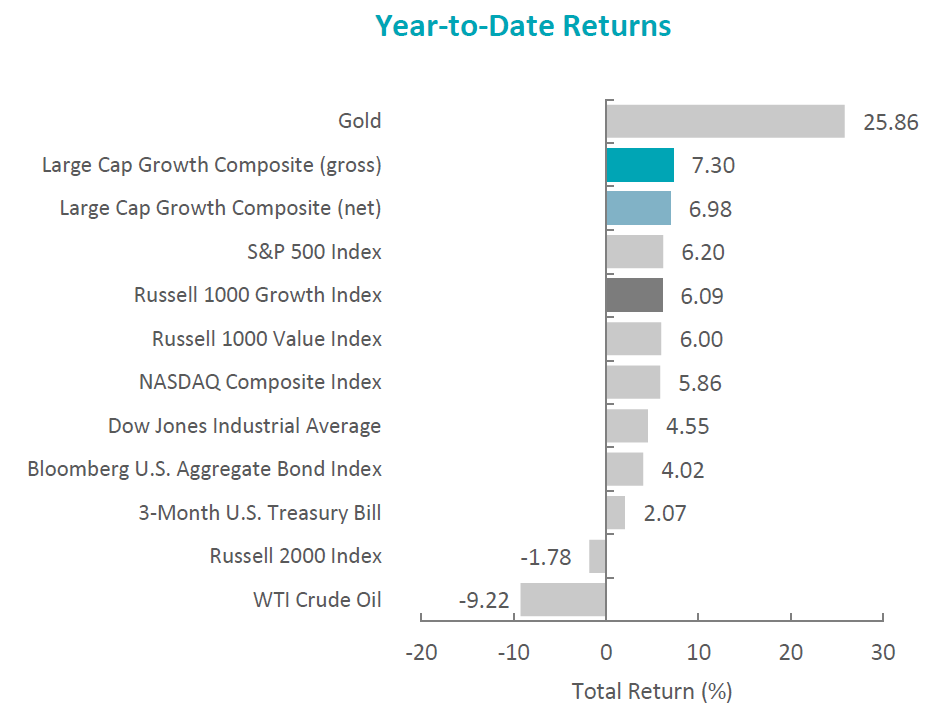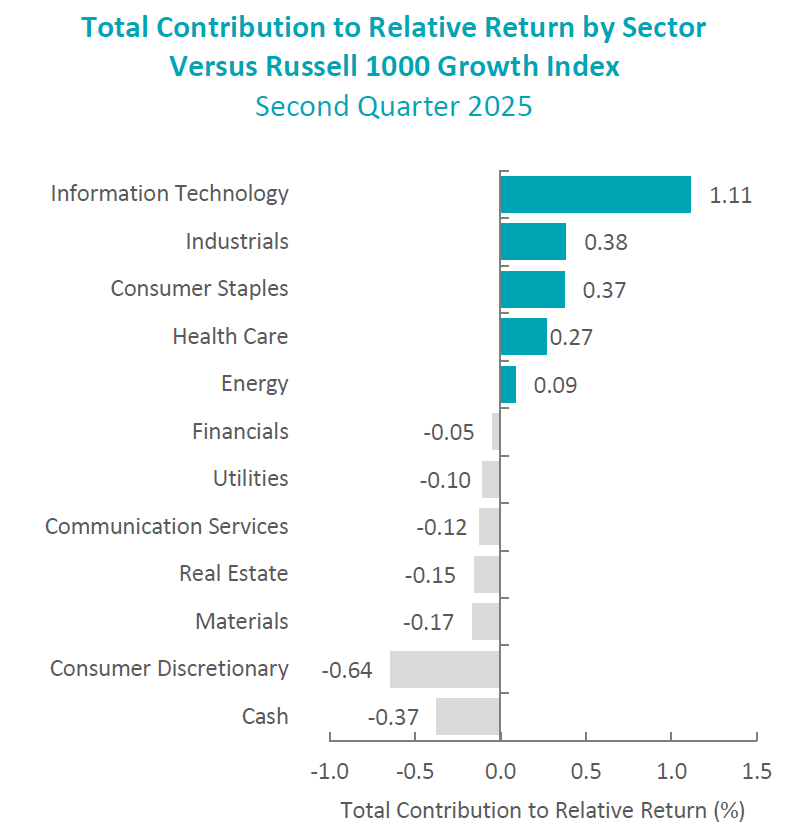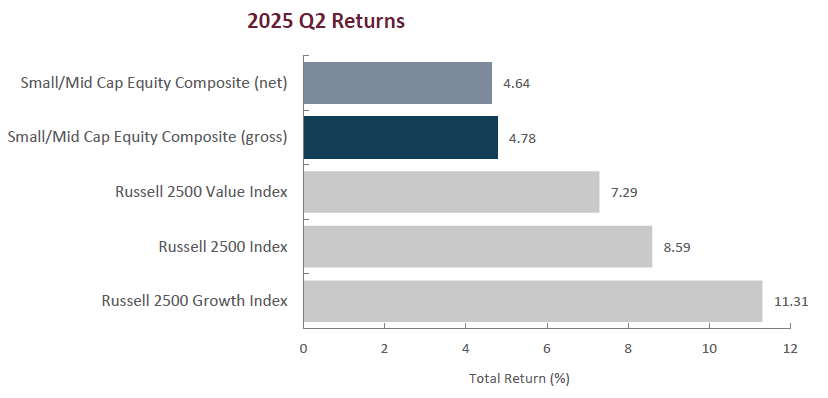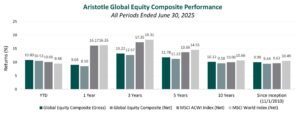
Markets Review

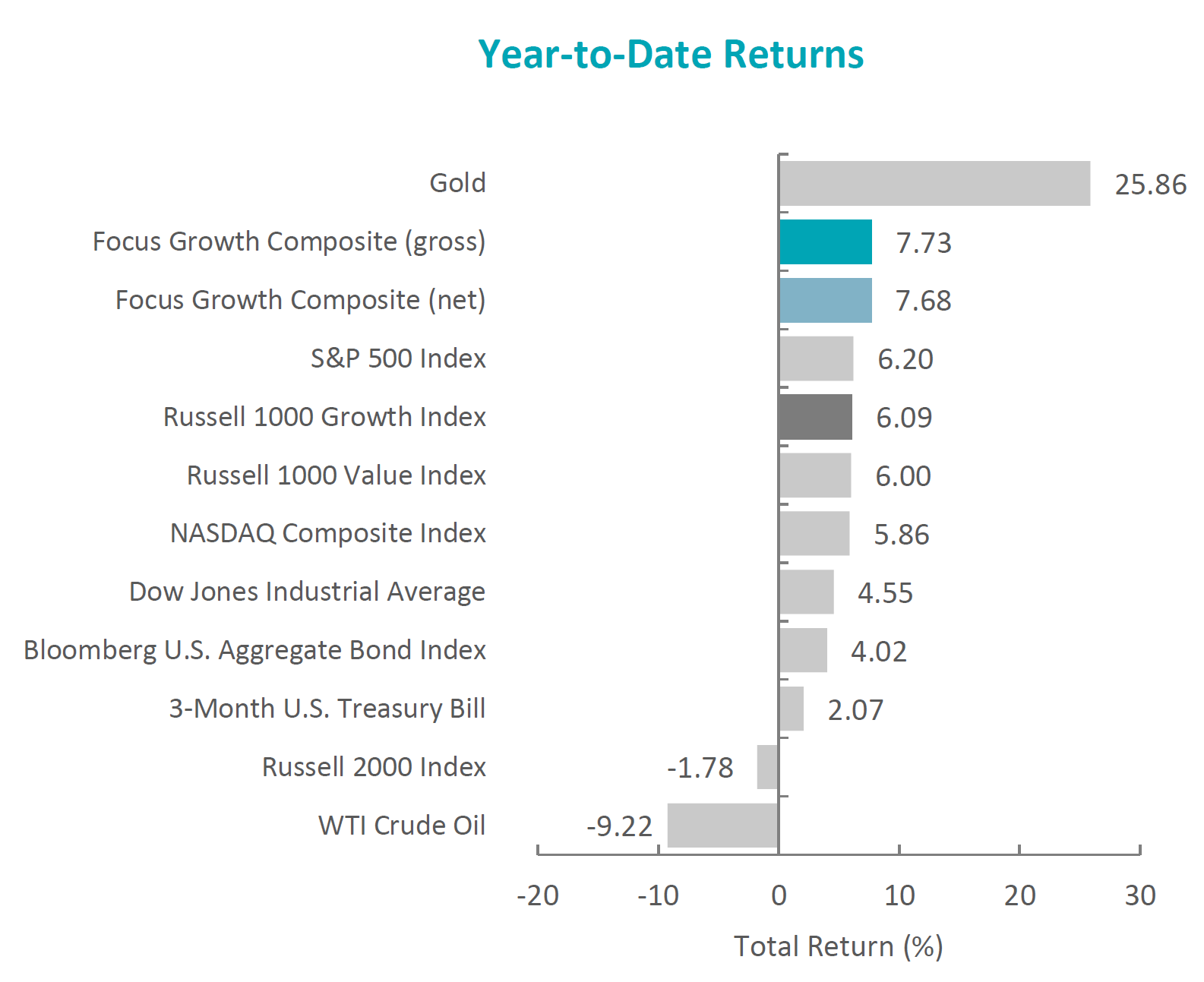
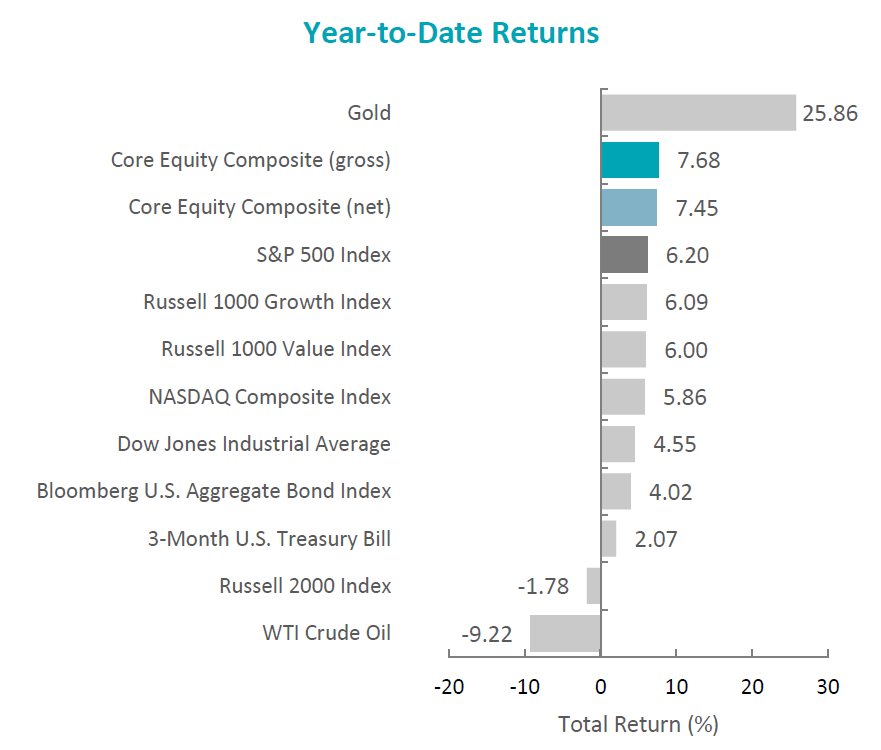
The U.S. equity market began 2025 with a modest decline, with the S&P 500 Index falling 4.27% during the first quarter. In contrast, bonds provided a measure of stability, as the Bloomberg U.S. Aggregate Bond Index rose 2.78%.

On a sector basis, negative performance was led by four of the eleven sectors within the S&P 500 Index in the first quarter of 2025. The weakest sectors were Consumer Discretionary and Information Technology. The best-performing sectors were Energy and Health Care.

Sources: CAPS CompositeHubTM, Bloomberg
Past performance is not indicative of future results. Aristotle Atlantic Core Equity Composite returns are presented gross and net of investment advisory fees and include the reinvestment of all income. Gross returns will be reduced by fees and other expenses that may be incurred in the management of the account. Net returns are presented net of actual investment advisory fees and after the deduction of all trading expenses. Aristotle Atlantic Composite returns are preliminary pending final account reconciliation. Please see important disclosures at the end of this document.

U.S. economic data reported during the quarter presented a mixed picture. Real GDP growth slowed to an annualized rate of 2.4%, while inflation remained stable. The Consumer Price Index (CPI) rose 2.8% year-over-year in February, reflecting moderate inflationary pressures. Meanwhile, the labor market remained resilient, with the unemployment rate hovering around 4%. However, consumer strength showed signs of strain, as retail sales slowed from levels seen late last year, potentially impacted by adverse weather and broader macroeconomic uncertainty.

Trade policy was a major source of uncertainty during the quarter. President Trump announced a series of new tariffs on imports from Canada, Mexico and China, citing concerns over illegal immigration, drug trafficking and intellectual property theft. Targeted industries included autos, steel, aluminum and energy, particularly Venezuelan oil. While tariffs initially raised concerns, the administration’s selective enforcement and flexible implementation approach helped ease market anxiety. In response to the evolving economic landscape, the Federal Reserve (Fed) maintained its target range for the federal funds rate at 4.25% to 4.50%. The central bank acknowledged potential inflationary pressures from tariffs and moderated expectations for economic growth in 2025.

Despite broader economic headwinds, corporate earnings remained strong. S&P 500 companies reported impressive 17.8% year-over-year earnings growth, the highest rate since 2021. However, tariff-related uncertainties loomed large, with more than 220 companies referencing tariffs in their earnings calls and nearly 15% issuing negative earnings guidance.

On the domestic front, a government shutdown was averted, as President Trump signed a six-month funding bill. Senate Democratic Leader Chuck Schumer supported the measure, believing that a shutdown would have allowed the Department of Government Efficiency (DOGE) to terminate government services at a faster rate.

Geopolitically, the U.S. continued its mediation efforts in the Middle East and Ukraine. While a temporary ceasefire agreement was reached between Israel and Hamas in January, tensions flared again in March over disputes regarding hostage releases in Gaza. In Ukraine, U.S. aid was briefly paused following a contentious White House meeting between presidents Trump and Zelensky. Financial and intelligence support resumed after Ukraine signaled it was open to a ceasefire and agreed to revisit terms of a potential mineral deal, aiming to offset the costs of U.S. assistance.

Performance and Attribution Summary

For the first quarter of 2025, Aristotle Atlantic’s Core Equity Composite posted a total return of -5.90% gross of fees (-5.99% net of fees), underperforming the S&P 500 Index, which recorded a total return of -4.27%.

Performance (%)1Q251 Year3 Years5 Years10 YearsSince Inception*
Core Equity Composite (gross)-5.906.767.5917.1912.5813.41
Core Equity Composite (net)-5.996.327.1516.7212.1012.90
S&P 500 Index-4.278.259.0618.5912.1012.92
*The Core Equity Composite has an inception date of August 1, 2013. Past performance is not indicative of future results. Aristotle Atlantic Core Equity Composite returns are presented gross and net of investment advisory fees and include the reinvestment of all income. Gross returns will be reduced by fees and other expenses that may be incurred in the management of the account. Net returns are presented net of actual investment advisory fees and after the deduction of all trading expenses. Aristotle Atlantic Composite returns are preliminary pending final account reconciliation. Please see important disclosures at the end of this document.

Source: FactSet
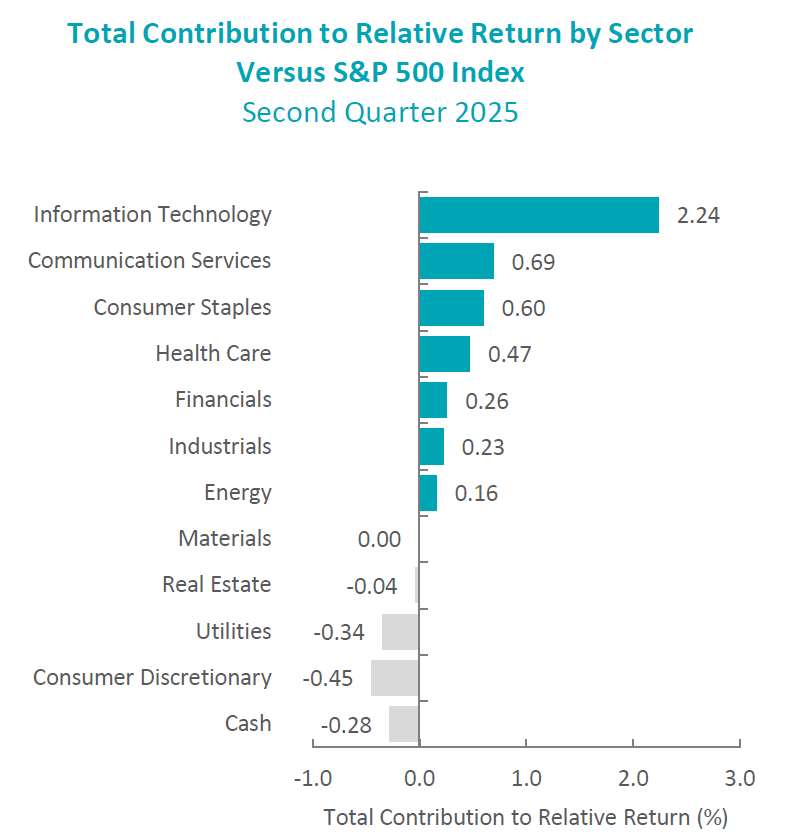
Past performance is not indicative of future results. Sector attribution shows how much of a portfolio’s overall return is directly attributable to stock selection and asset allocation decisions within the portfolio, highlighting which sectors contributed or detracted to the total return. Attribution includes the reinvestment of income. Please see important disclosures at the end of this document.

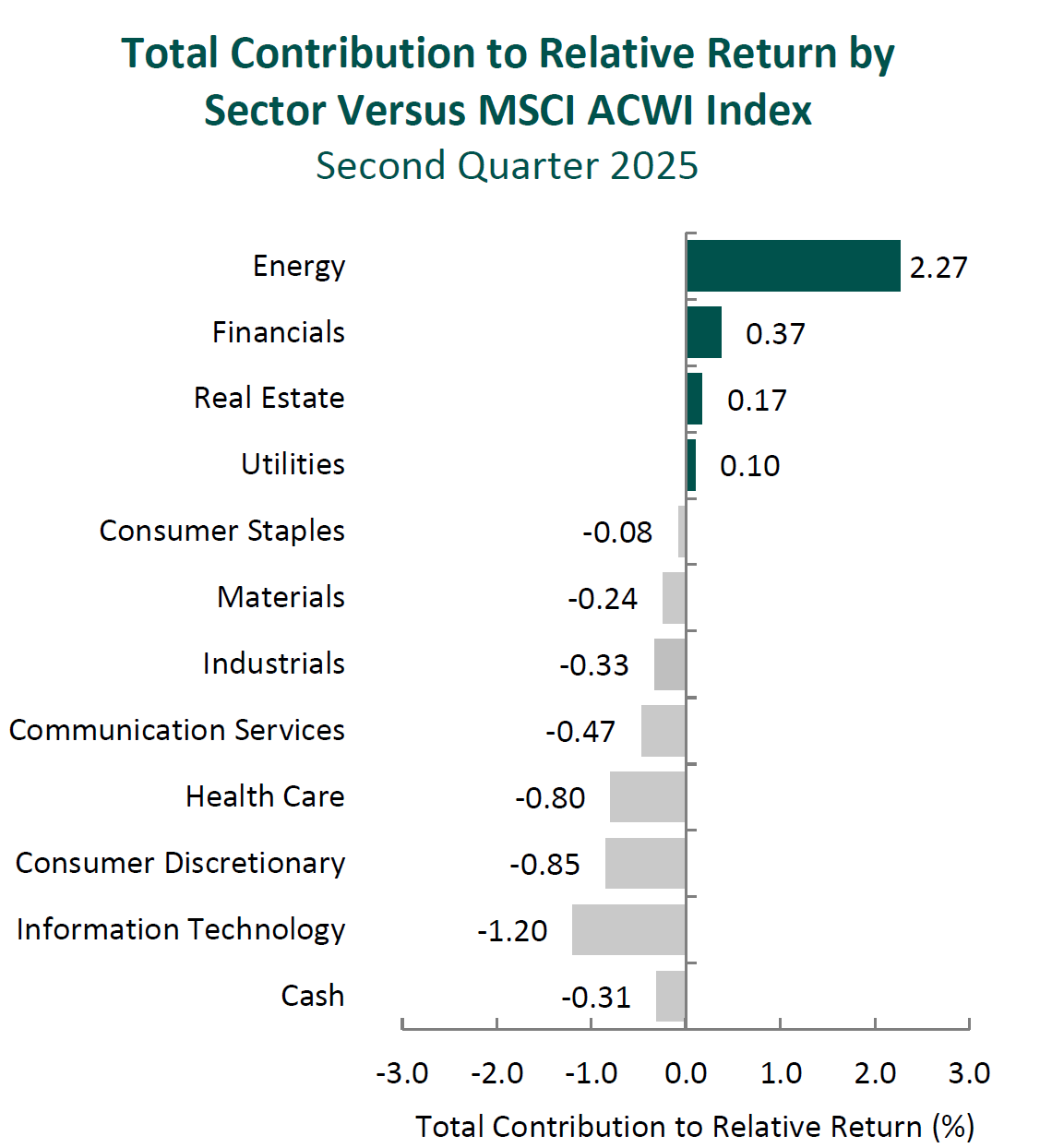
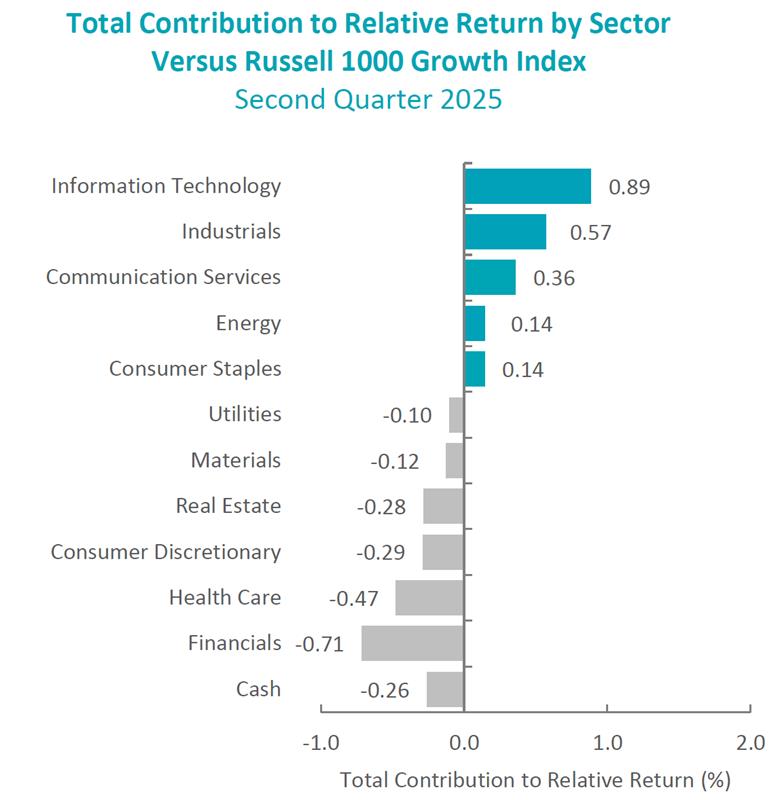
During the first quarter, the portfolio’s underperformance relative to the S&P 500 Index was due to a mix of security selection and allocation effects. Security selection in Information Technology and Industrials detracted the most from relative performance; conversely, security selection in Consumer Discretionary and Utilities contributed the most to relative performance.

Contributors and Detractors for 1Q 2025

Relative ContributorsRelative Detractors
Intercontinental ExchangeBroadcom
Guardant HealthServiceNow
O’Reilly AutomotiveBio-Techne
Antero ResourcesOracle
Vertex PharmaceuticalsChart Industries

Detractors

Boradcom

Broadcom detracted from performance in the first quarter. The release of the DeepSeek AI model and analysis of technological specifications stunned investors. This raised concerns about a rapid decline in AI model development costs and the effect that will have on capex spending for new infrastructure and advanced semiconductors used for accelerated computing needs. The entire AI infrastructure investment space saw significant declines in the final week of January following the DeepSeek announcements and continued to see further weakness in March as concerns around AI capex cuts increased.

ServiceNow

ServiceNow detracted from performance in the first quarter, as the company reported guidance during the fourth quarter earnings call that was below investor expectations. Investors have also begun to incorporate tougher macroeconomic headwinds and negative impacts from the DOGE government spending cuts into their weaker outlook for software revenue growth in 2025.

Contributors

Intercontinental Exchange

Intercontinental Exchange was a relative contributor in the first quarter following a solid fourth quarter earnings report highlighted by continued strong trading activity in energy and interest rate products, additional efficiency gains, and positive commentary about the Mortgage Technology business. In addition, optimism improved following the company’s annual ICE Experience conference, which highlighted new AI solutions in its Mortgage Technology product suite. The company’s AI efforts in Mortgage Technology are accelerating progress toward improving and digitizing workflows and positioning it to gain an increasing share of the long-term market opportunity in the mortgage industry.

Guardant Health

Guardant Health was a relative contributor in the first quarter following several positive announcements and solid fourth quarter earnings. Guardant announced Advanced Diagnostic Laboratory Test (ADLT) pricing from Medicare on its Guardant Shield test and a contract with the VA hospital system to cover patients over 45 years of age. This follows strong momentum and positive full-year revenue guidance.

Recent Portfolio Activity

The table below shows all buys and sells completed during the quarter, followed by a brief rationale.

BuysSells
Analog Devices

Buys

Analog Devices

Analog Devices is a global semiconductor leader dedicated to solving customers’ most complex engineering challenges. The company delivers innovations that connect technology to human breakthroughs and play a critical role at the intersection of the physical and digital worlds by providing the building blocks to sense, measure, interpret, connect and power. Analog designs, manufactures, tests and markets a broad portfolio of solutions. These solutions include integrated circuits, software and subsystems that leverage high-performance analog, mixed-signal and digital signal processing technologies. Its comprehensive product portfolio, deep domain expertise and advanced manufacturing span high-performance precision and high-speed mixed-signal, power management and processing technologies, including data converters, amplifiers, power management, radio frequency, integrated circuits, edge processors and other sensors. The company’s customers include original equipment manufacturers and customers that build electronic subsystems for integration into larger systems.

We see the company’s analog products providing exposure to high-growth trends, including automotive electrification and driver assistance systems, factory intelligence and automation, the Intelligent Edge, Internet of Things device proliferation and sustainable energy. We expect the company to return excess free cash flow, benefiting shareholders.

Sells

There were no sales in the first quarter of 2025.

Outlook

The equity markets in the first quarter declined as investors digested the potential impact of wide-ranging tariffs, along with concerns of a peak in the capital spending cycle around AI. Interest rates declined in the quarter, with the 10-year U.S. Treasury yield down about 35 basis points. The prospects of tariffs pushing prices higher could put the Fed on hold in a period when the economy starts to weaken. Economic data was mostly in line with expectations, reflecting a moderately growing economy. Although equity market valuations have pulled back, they are still in elevated territory with growing concerns of a slowdown in corporate profits. Our focus will continue to be at the company level, with an emphasis on seeking to invest in companies with secular tailwinds or strong product-driven cycles.

Disclosures

The opinions expressed herein are those of Aristotle Atlantic Partners, LLC (Aristotle Atlantic) and are subject to change without notice. Past performance is not a guarantee or indicator of future results. This material is not financial advice or an offer to purchase or sell any product. You should not assume that any of the securities transactions, sectors or holdings discussed in this report were or will be profitable, or that recommendations Aristotle Atlantic makes in the future will be profitable or equal the performance of the securities listed in this report. The portfolio characteristics shown relate to the Aristotle Atlantic Core Equity strategy. Not every client’s account will have these characteristics. Aristotle Atlantic reserves the right to modify its current investment strategies and techniques based on changing market dynamics or client needs. There is no assurance that any securities discussed herein will remain in an account’s portfolio at the time you receive this report or that securities sold have not been repurchased. The securities discussed may not represent an account’s entire portfolio and, in the aggregate, may represent only a small percentage of an account’s portfolio holdings. The performance attribution presented is of a representative account from Aristotle Atlantic’s Core Equity Composite. The representative account is a discretionary client account which was chosen to most closely reflect the investment style of the strategy. The criteria used for representative account selection is based on the account’s period of time under management and its similarity of holdings in relation to the strategy. Recommendations made in the last 12 months are available upon request.

Returns are presented gross and net of investment advisory fees and include the reinvestment of all income. Gross returns will be reduced by fees and other expenses that may be incurred in the management of the account. Net returns are presented net of actual investment advisory fees and after the deduction of all trading expenses.

All investments carry a certain degree of risk, including the possible loss of principal. Investments are also subject to political, market, currency and regulatory risks or economic developments. International investments involve special risks that may in particular cause a loss in principal, including currency fluctuation, lower liquidity, different accounting methods and economic and political systems, and higher transaction costs. These risks typically are greater in emerging markets. Securities of small‐ and medium‐sized companies tend to have a shorter history of operations, be more volatile and less liquid. Value stocks can perform differently from the market as a whole and other types of stocks.

The material is provided for informational and/or educational purposes only and is not intended to be and should not be construed as investment, legal or tax advice and/or a legal opinion. Investors should consult their financial and tax adviser before making investments. The opinions referenced are as of the date of publication, may be modified due to changes in the market or economic conditions, and may not necessarily come to pass. Information and data presented has been developed internally and/or obtained from sources believed to be reliable. Aristotle Atlantic does not guarantee the accuracy, adequacy or completeness of such information.

Aristotle Atlantic Partners, LLC is an independent registered investment adviser under the Advisers Act of 1940, as amended. Registration does not imply a certain level of skill or training. More information about Aristotle Atlantic, including our investment strategies, fees and objectives, can be found in our Form ADV Part 2, which is available upon request. AAP-2504-17

Performance Disclosures

Sources: CAPS Composite Hub

Composite returns for all periods ended March 31, 2025 are preliminary pending final account reconciliation.

The Aristotle Core Equity Composite has an inception date of August 1, 2013 at a predecessor firm. During this time, Mr. Fitzpatrick had primary responsibility for managing the strategy. Performance starting November 1, 2016 was achieved at Aristotle Atlantic.

Past performance is not indicative of future results. Performance results for periods greater than one year have been annualized. Returns are presented gross and net of investment advisory fees and include the reinvestment of all income. Gross returns will be reduced by fees and other expenses that may be incurred in the management of the account. Net returns are presented net of actual investment advisory fees and after the deduction of all trading expenses.

Index Disclosures

The Russell 1000® Growth Index measures the performance of the large cap growth segment of the U.S. equity universe. It includes those Russell 1000 companies with higher price-to-book ratios and higher forecasted growth values. This index has been selected as the benchmark and is used for comparison purposes only. The Russell 1000® Value Index measures the performance of the large cap value segment of the U.S. equity universe. It includes those Russell 1000 companies with lower price-to-book ratios and lower expected growth values. The S&P 500® Index is the Standard & Poor’s Composite Index of 500 stocks and is a widely recognized, unmanaged index of common stock prices. The Dow Jones Industrial Average® is a price-weighted measure of 30 U.S. blue-chip companies. The Index covers all industries except transportation and utilities. The NASDAQ Composite Index measures all NASDAQ domestic and international based common type stocks listed on The NASDAQ Stock Market. The NASDAQ Composite includes over 3,000 companies, more than most other stock market indices. The Bloomberg U.S. Aggregate Bond Index is an unmanaged index of domestic investment grade bonds, including corporate, government and mortgage-backed securities. The WTI Crude Oil Index is a major trading classification of sweet light crude oil that serves as a major benchmark price for oil consumed in the United States. The Russell 2000® Index measures the performance of the small cap segment of the U.S. equity universe. The Russell 2000 Index is a subset of the Russell 3000® Index representing approximately 10% of the total market capitalization of that index. It includes approximately 2000 of the smallest securities based on a combination of their market cap and current index membership. The 3-Month U.S. Treasury Bill is a short-term debt obligation backed by the U.S. Treasury Department with a maturity of three months. The Consumer Price Index (CPI) is a measure of the average change over time in the prices paid by urban consumers for a market basket of consumer goods and services. While stock selection is not governed by quantitative rules, a stock typically is added only if the company has an excellent reputation, demonstrates sustained growth and is of interest to a large number of investors. The volatility (beta) of the Composite may be greater or less than its respective benchmarks. It is not possible to invest directly in these indices.

Markets Review

Sources: CAPS CompositeHubTM, Bloomberg
Past performance is not indicative of future results. Aristotle Value Equity WM Composite returns are presented pure gross and net of the maximum wrap fee and include the reinvestment of all income. Pure gross returns do not reflect the deduction of any trading costs or other fees and are supplemental to the net returns. Net returns are calculated by subtracting the highest applicable wrap/SMA fee, which includes trading costs and custodial fees, from the pure gross composite return. (From inception to 12/31/2015, the highest applicable wrap/SMA fee is 3.00% on an annual basis, or 0.75% quarterly. From 1/1/2016 to 12/31/2023, the highest applicable wrap/SMA fee is 2.00% on an annual basis, or 0.50% quarterly and 0.17% monthly from 1/1/2024 to present.) Aristotle Capital Composite returns are preliminary pending final account reconciliation. Please see important disclosures at the end of this document.

The U.S. equity market began 2025 with a modest decline, with the S&P 500 Index falling 4.27% during the first quarter. In contrast, bonds provided a measure of stability, as the Bloomberg U.S. Aggregate Bond Index rose 2.78%.

From a style perspective, the Russell 1000 Value Index outperformed its growth counterpart by 12.11%. On a sector basis, eight out of the eleven sectors within the Russell 1000 Value Index posted positive returns. The best-performing sectors were Energy, Communication Services and Health Care, while Information Technology, Consumer Discretionary and Industrials were the worst.

U.S. economic data reported during the quarter presented a mixed picture. Real GDP growth slowed to an annualized rate of 2.4%, while inflation remained stable. The Consumer Price Index (CPI) rose 2.8% year-over-year in February, reflecting moderate inflationary pressures. Meanwhile, the labor market remained resilient, with the unemployment rate hovering around 4%. However, consumer strength showed signs of strain, as retail sales slowed from levels seen late last year, potentially impacted by adverse weather and broader macroeconomic uncertainty.

Trade policy was a major source of uncertainty during the quarter. President Trump announced a series of new tariffs on imports from Canada, Mexico and China, citing concerns over illegal immigration, drug trafficking and intellectual property theft. Targeted industries included autos, steel, aluminum and energy, particularly Venezuelan oil. While tariffs initially raised concerns, the administration’s selective enforcement and flexible implementation approach helped ease market anxiety. In response to the evolving economic landscape, the Federal Reserve (Fed) maintained its target range for the federal funds rate at 4.25% to 4.50%. The central bank acknowledged potential inflationary pressures from tariffs and moderated expectations for economic growth in 2025.

Despite broader economic headwinds, corporate earnings remained strong. S&P 500 companies reported impressive 17.8% year-over-year earnings growth, the highest rate since 2021. However, tariff-related uncertainties loomed large, with more than 220 companies referencing tariffs in their earnings calls and nearly 15% issuing negative earnings guidance.

On the domestic front, a government shutdown was averted, as President Trump signed a six-month funding bill. Senate Democratic Leader Chuck Schumer supported the measure, believing that a shutdown would have allowed the Department of Government Efficiency (DOGE) to terminate government services at a faster rate.

Geopolitically, the U.S. continued its mediation efforts in the Middle East and Ukraine. While a temporary ceasefire agreement was reached between Israel and Hamas in January, tensions flared again in March over disputes regarding hostage releases in Gaza. In Ukraine, U.S. aid was briefly paused following a contentious White House meeting between presidents Trump and Zelensky. Financial and intelligence support resumed after Ukraine signaled it was open to a ceasefire and agreed to revisit terms of a potential mineral deal, aiming to offset the costs of U.S. assistance.

Performance and Attribution Summary

For the first quarter of 2025, Aristotle Capital’s Value Equity WM Composite posted a total return of 0.68% pure gross of fees (0.19% net of fees), underperforming the 2.14% return of the Russell 1000 Value Index and outperforming the -4.27% return of the S&P 500 Index. Please refer to the table for detailed performance. 

Performance (%) 1Q251 Year3 Years5 Years10 Years
Value Equity WM Composite (pure gross)0.681.015.9716.3311.07
Value Equity WM Composite (net)0.19-0.973.8514.028.86
Russell 1000 Value Index2.147.186.6416.158.79
S&P 500 Index-4.278.259.0618.5912.50
Past performance is not indicative of future results. Aristotle Value Equity WM Composite returns are presented pure gross and net of the maximum wrap fee and include the reinvestment of all income. Pure gross returns do not reflect the deduction of any trading costs or other fees and are supplemental to the net returns. Net returns are calculated by subtracting the highest applicable wrap/SMA fee, which includes trading costs and custodial fees, from the pure gross composite return. (From inception to 12/31/2015, the highest applicable wrap/SMA fee is 3.00% on an annual basis, or 0.75% quarterly. From 1/1/2016 to 12/31/2023, the highest applicable wrap/SMA fee is 2.00% on an annual basis, or 0.50% quarterly and 0.17% monthly from 1/1/2024 to present.) Aristotle Capital Composite returns are preliminary pending final account reconciliation. Please see important disclosures at the end of this document.

Source: FactSet

Past performance is not indicative of future results. Sector attribution shows how much of a portfolio’s overall return is directly attributable to stock selection and asset allocation decisions within the portfolio, highlighting which sectors contributed or detracted to the total return. Attribution includes the reinvestment of income.

The portfolio’s underperformance relative to the Russell 1000 Value Index in the first quarter can be attributed to both allocation effects and security selection. Security selection in Financials, an overweight in Information Technology and an underweight in Health Care detracted the most from relative performance. Conversely, security selection in Consumer Discretionary, Utilities and Energy contributed. (Relative weights are the result of bottom-up security selection.)

Contributors and Detractors for 1Q 2025

Relative ContributorsRelative Detractors
SonyBlackstone
AmgenMicrosoft
American International GroupAmeriprise Financial
American Water WorksLennar
Mitsubishi UFJ FinancialAdobe

Adobe, the leading provider of content creation and publishing software, was a notable detractor during the quarter. This came despite the company reporting record revenue of over $5.7 billion in the first quarter—a 10% year-over-year increase, with double-digit increases across both its Digital Media and Digital Experience segments. The disconnect between strong fundamentals and share price weakness reflects ongoing market concerns around intensifying competitive threats from generative AI and lower-cost design platforms. Market sentiment has remained cautious around the perceived disruption risk posed by new AI-driven entrants, including OpenAI’s Sora for video generation and platforms like Canva, which cater to the broader prosumer and small and medium-sized business segment. However, we continue to view these as largely non-overlapping with Adobe’s core base of creative professionals, enterprises and agencies—audiences that demand precision, control and integration within larger workflows. Canva, while expanding its feature set, remains limited in its enterprise readiness and depth. Sora, meanwhile, remains early-stage and experimental, with limited commercial application at this point. Crucially, Adobe is not standing still. The company is actively embedding generative AI across its ecosystem through Firefly, which is commercially safe (i.e., free of copyrighted sources to train its models) and integrated natively into Creative Cloud applications like Photoshop and Illustrator. Firefly has shown strong early traction, generating $125 million in annualized recurring revenue, with management expecting that figure to double by year-end. While modest in size relative to Adobe’s total revenue, Firefly’s monetization strategy is still in its early innings, with further potential through upselling, usage-based pricing and expanded use cases. Beyond monetization, AI integration enhances Adobe’s long-term competitive moat through product functionality, stronger customer engagement and increased switching costs. Adobe’s unique access to proprietary data, content workflows and creative content allows it to fine-tune models that serve the high-end needs of professionals—capabilities that generic AI models lack. Strategic partnerships with Microsoft (e.g., Firefly in Microsoft 365 Copilot) and ongoing momentum in Adobe Express further extend its reach into new user segments. Ultimately, we believe Adobe has a durable competitive advantage, underpinned by a large installed base, subscription-led business model, strong brand equity and a long track record of innovation. While short-term concerns over AI disruption have weighed on the stock price, we believe Adobe is well-positioned to harness AI as a driver of value rather than being displaced by it.

Sony, the global leader in video games, image sensors, music and movies, was the top contributor for the period. The company delivered strong quarterly results, driven primarily by its gaming and music businesses, and announced a new executive leadership structure. In gaming, Sony reported a record-high 129 million monthly active users, a 20% year-over-year increase in PlayStation Plus revenue and an expanding user base, as 40% of new PS5 console buyers were new to the platform. The Music segment also continued to benefit from global streaming tailwinds, delivering double-digit profit growth. In a significant leadership transition, Sony announced that, effective April 1, 2025, Hiroki Totoki, currently COO and CFO, would succeed Kenichiro Yoshida as CEO. Our original investment in Sony was grounded in the strategic transformation led by Yoshida-san, where Totoki-san was an instrumental partner in driving Sony’s pivot away from commoditized businesses whilespearheading investments in content IP and semiconductors. Looking ahead, we continue to see opportunity for Sony to capitalize on its unique position as both a content creator and platform owner. The company’s ability to integrate gaming, music, anime and film and leverage IP across platforms (e.g., Crunchyroll and its recent partnership with Kadokawa) should position it well for long-term value creation.

Recent Portfolio Activity

BuysSells
Air Products and ChemicalsHoneywell
AlphabetMichelin
Millrose Properties

During the quarter, we sold our positions in Honeywell, Michelin and Millrose Properties and invested in Air Products and Chemicals and Alphabet.

We first invested in Honeywell, the multinational industrial conglomerate, in the third quarter of 2021. Throughout our ownership period, the company made meaningful progress in its transformation into a modern, innovation-driven enterprise, with a focus on energy efficiency, productivity and connectivity—commonly referred to as the Industrial Internet of Things (IIoT). Supported by a disciplined capital allocation strategy, Honeywell continued to reshape its product portfolio, emphasizing higher-margin, technology-enabled offerings, such as aerospace software and industrial automation—catalysts we had previously identified. As one of the last remaining diversified U.S. conglomerates, and following years of pressure from activist investors, Honeywell announced in February its decision to split into three independent, publicly listed companies: Honeywell Automation, Honeywell Aerospace and Advanced Materials. We believe this move has the potential to enhance operational focus and unlock shareholder value, in line with similar breakups by other large conglomerates. However, the process is expected to take time and is not anticipated to be completed until the second half of 2026. Given this long runway and the limited near-term visibility, we elected to exit our stake in Honeywell and will continue to monitor the business as further details emerge. We used the proceeds from the sale to fund what we believe is a more attractive investment in Alphabet.

Our team initially invested in Michelin, one of the world’s largest tire manufacturers, in the first quarter of 2021. In our view, the company benefits from a strong competitive position driven by its global scale, brand strength and continued leadership in cutting-edge tire technology. We believe Michelin is well-positioned to enhance profitability through an ongoing shift in its product mix toward higher-margin specialty and large-diameter tires, along with improved SG&A efficiency supported by process optimization initiatives. While Michelin continues to meet all of our core investment criteria, we chose to exit our position in order to fund what we believe is a more compelling opportunity in Air Products and Chemicals.

We received shares of Millrose Properties after it was spun off from Lennar on February 7. Millrose is a new publicly traded company focused on land banking and development. As part of the spinoff, Lennar transferred $6 billion worth of land inventory to Millrose. We believe this spinoff will allow Lennar to be a more capital efficient homebuilder, as less land inventory should lead to stronger FREE cash flow generation and better returns on invested capital. As such, we decided to sell our shares of Millrose and continue with our investment in Lennar’s core homebuilding operations, which we view as a more optimal investment.

Air Products and Chemicals, Inc.

Founded in 1940 and with headquarters in Pennsylvania, Air Products and Chemicals is a leading global supplier of industrial gases, including oxygen, nitrogen, helium, hydrogen and others.  These essential gases serve critical roles across a wide range of industries, such as refining, chemicals, metals, electronics, manufacturing, healthcare, and food manufacturing and packaging.  Air Products is the leading global supplier of hydrogen, with a robust distribution network across North America.     

Roughly 50% of the company’s revenue is generated through onsite delivery. This method usually entails 15- to 20-year contracts where Air Products builds a facility at the customer’s site or nearby (or delivers the gases through pipeline systems). These long-term contracts tend to include pass-through and take-or-pay provisions, which provide stability and predictability of cash flows. The company’s merchant gases (roughly 35% of revenue) are delivered in bulk by tanker in either liquid or gas form, usually under five-year contracts, providing a steady but more variable revenue stream. Smaller quantities can also be delivered to customers, usually packaged in cylinders. (This business represents less than 15% of revenue.) 

Over the last several years, Air Products has pursued opportunities in clean hydrogen, including the construction of two megaprojects in Saudi Arabia (NEOM) and Louisiana. Unlike its traditional model, these projects were started without offtake agreements, a shift that raised concerns. Amid delays and rising costs, activist investor Mantle Ridge took a stake in the company, advocating for a more disciplined approach to capital allocation and succession planning. In response, Eduardo Menezes joined as CEO from Linde, where he led the company’s EMEA operations. Mr. Menezes quickly refocused the company by divesting non-core assets and exiting three projects outside its industrial gases and hydrogen expertise. We view these changes positively, as they enhance strategic focus and align the company with its core strengths.   

Some of the quality characteristics we have identified for Air Products include:

  • Attractive oligopoly industry with high barriers to entry and high switching costs;    
  • Global scale, network of production facilities and distribution infrastructure, as well as engineering expertise;    
  • Mission-critical products that represent a small fraction of a client’s costs. As such, clients are willing to pay a premium and sign long-term contracts to ensure uninterrupted operations, leading to consistent FREE cash flow generation over time;  
  • Favorable business mix relative to peers. Higher proportion of onsite production, which can be more profitable and predictable than merchant and packaged gases; and
  • History of steady shareholder returns as demonstrated by 43 years of consecutive dividend growth.      

Attractive Valuation

While normalizing cash earnings power is always a focus at Aristotle Capital, it is especially important when valuing a capital-intensive business like Air Products. The company is currently in a heavy investment period, with large projects underway. To arrive at an estimate of intrinsic value, in a normal environment, we believe capital expenditures will moderate to just 18% of sales.  Moreover, we estimate a modest return of 12% on all projects fully contracted and under construction. Under these key assumptions and others, we purchased shares of Air Products at an attractive discount to our estimate of intrinsic value.

Compelling Catalysts   

  • Refocused strategy and portfolio optimization. Recent divestitures of non-core businesses, including the sale of its LNG process technology, allow management to focus on industrial gases and clean hydrogen, reinforcing the company’s core strengths;
  • New and experienced leadership. New CEO Eduardo Menezes brings deep industry expertise from competitor Linde, where he led the EMEA practice and was responsible for operations in more than 40 countries.  His leadership seeks to refocus the company on higher-return projects with clearer paths to operational success; and 
  • Megaprojects nearing completion. Completion of the green/blue hydrogen megaprojects (NEOM and Louisiana) should significantly enhance earnings and FREE cash flow generation in the years ahead amid increased demand driven by decarbonization polices in Europe and Asia (Japan and Korea).   

Alphabet, Inc. 

Headquartered in Mountain View, California and founded by Larry Page and Sergey Brin, Alphabet is one of the world’s most dominant and innovative technology companies. Best known as the parent company of Google, Alphabet generates most of its revenue from digital advertising, particularly search. Google currently holds an estimated 87% market share in U.S. search and nearly 90% globally, underpinning a highly profitable ad business that accounts for roughly 75% of Alphabet’s total revenue.

While Google was founded in 1998 and became public in 2004, Alphabet was created in 2015 to provide greater transparency and operational independence across its varied business lines. Beyond its core, the company has increasingly diversified into accelerating products, including Google Cloud and YouTube’s suite of subscription services (YouTube Premium, YouTube TV and YouTube Music). Today, Google Services (Search, YouTube, Chrome, Android and the Play Store) makes up ~87% of total revenue, while Google Cloud represents ~13%. Alphabet also invests in longer-term innovation through its Other Bets segment, which includes autonomous driving (Waymo), life sciences (Verily) and advanced AI research (DeepMind).

Some of the quality characteristics we have identified for Alphabet include:

  • Unrivaled scale in global search and digital advertising, protected by powerful network effects and vast proprietary data;
  • An integrated ecosystem—across Search, YouTube, Android, Chrome and Gmail—that supports user retention and ad targeting efficiency;
  • Category leadership in digital media, with YouTube generating over $45 billion in revenue in 2024 and expanding rapidly through ad-supported and subscription models;
  • Emerging strength in cloud computing, with Google Cloud now profitable and scaling meaningfully; and
  • A culture of innovation, supported by its Other Bets incubator, which allows Alphabet to invest in moonshot ideas while maintaining financial discipline.

Attractive Valuation

We believe shares of Alphabet are significantly undervalued at less than 12x our estimate of normalized earnings. The company continues to scale high-margin businesses like Google Cloud and YouTube’s subscription offerings while maintaining robust FREE cash flow generation from its dominant advertising segment.

Compelling Catalysts

Catalysts we have identified for Alphabet, which we believe will cause its stock price to appreciate over our three- to five-year investment horizon, include:

  • Sustained leadership in search and digital advertising, reinforced by Google’s unmatched first-party data and adtech platform;
  • Improving profitability, margin expansion and market share gains for Google Cloud as it effectively competes at scale with AWS and Microsoft Azure; and
  • Continued growth in YouTube subscription revenues as YouTube TV—which is on track to become the largest U.S. pay-TV provider by 2026—captures share from traditional cable providers and premium, ad-free content attracts a broader audience.

Potential Future Catalyst: Alphabet’s deep expertise and resources in AI, particularly through the Gemini model family (the company’s flagship large language model), could enhance monetization across Ads, Search and Cloud. Though this is not explicitly included in our valuation estimates, we view the possibility as a “free option.”

Conclusion

As we progress through the early stages of 2025, the convergence of persistent macroeconomic forces with the renewed presence of trade conflicts has added to the uncertainty facing equity markets. While there certainly was no shortage of headlines during the quarter, we believe trying to time the market or to predict the impact of these developments is a futile task. Instead, our focus remains on evaluating whether these events are truly analyzable, materially differentiated and meaningful to long-term investors—or simply noise that fuels short-term speculation.

At Aristotle Capital, we do not aim to capture short-term gains by “trading” portfolios based on the news of the day. Rather, we remain committed to identifying companies we believe exhibit high-quality characteristics and the resilience to perform across full market cycles. In our experience, breaking news is often fleeting and not quite as impactful as many market participants believe it to be. On the contrary, during periods of economic uncertainty high-quality companies are oftentimes able to make decisions that result in market share gains, thus, potentially, increasing their longer-term intrinsic worth. As such, we will continue to study the microeconomic decisions of individual businesses rather than attempt to predict macroeconomic events or outcomes. 

Disclosures

The opinions expressed herein are those of Aristotle Capital Management, LLC (Aristotle Capital) and are subject to change without notice. Past performance is not a guarantee or indicator of future results. This material is not financial advice or an offer to purchase or sell any product. You should not assume that any of the securities transactions, sectors or holdings discussed in this report were or will be profitable, or that recommendations Aristotle Capital makes in the future will be profitable or equal the performance of the securities listed in this report. The portfolio characteristics shown relate to the Aristotle Value Equity strategy. Not every client’s account will have these characteristics. Aristotle Capital reserves the right to modify its current investment strategies and techniques based on changing market dynamics or client needs. There is no assurance that any securities discussed herein will remain in an account’s portfolio at the time you receive this report or that securities sold have not been repurchased. The securities discussed may not represent an account’s entire portfolio and, in the aggregate, may represent only a small percentage of an account’s portfolio holdings. The performance attribution presented is of a representative account from Aristotle Capital’s Value Equity strategy. The representative account is a discretionary client account which was chosen to most closely reflect the investment style of the strategy. The criteria used for representative account selection is based on the account’s period of time under management and its similarity of holdings in relation to the strategy. Recommendations made in the last 12 months are available upon request.

Composite returns are presented pure gross and net of the maximum wrap fee and include the reinvestment of all income. Pure gross returns do not reflect the deduction of any trading costs or other fees and are supplemental to the net returns. Net returns are calculated by subtracting the highest applicable wrap/SMA fee, which includes trading costs and custodial fees, from the pure gross composite return. (From inception to 12/31/2015, the highest applicable wrap/SMA fee is 3.00% on an annual basis, or 0.75% quarterly. From 1/1/2016 to 12/31/2023, the highest applicable wrap/SMA fee is 2.00% on an annual basis, or 0.50% quarterly and 0.17% monthly from 1/1/2024 to present.)

All investments carry a certain degree of risk, including the possible loss of principal. Investments are also subject to political, market, currency and regulatory risks or economic developments. International investments involve special risks that may in particular cause a loss in principal, including currency fluctuation, lower liquidity, different accounting methods and economic and political systems, and higher transaction costs. These risks typically are greater in emerging markets. Securities of small‐ and medium‐sized companies tend to have a shorter history of operations, be more volatile and less liquid. Value stocks can perform differently from the market as a whole and other types of stocks.

The material is provided for informational and/or educational purposes only and is not intended to be and should not be construed as investment, legal or tax advice and/or a legal opinion. Investors should consult their financial and tax adviser before making investments. The opinions referenced are as of the date of publication, may be modified due to changes in the market or economic conditions, and may not necessarily come to pass. Information and data presented has been developed internally and/or obtained from sources believed to be reliable. Aristotle Capital does not guarantee the accuracy, adequacy or completeness of such information.

Aristotle Capital Management, LLC is an independent registered investment adviser under the Advisers Act of 1940, as amended. Registration does not imply a certain level of skill or training. More information about Aristotle Capital, including our investment strategies, fees and objectives, can be found in our ADV Part 2, which is available upon request. ACM-2504-65

Performance Disclosures

Sources: CAPS CompositeHubTM, Russell Investments, Standard & Poor’s

Composite returns for all periods ended March 31, 2025 are preliminary pending final account reconciliation.

Past performance is not indicative of future results. The information provided should not be considered financial advice or a recommendation to purchase or sell any particular security or product. Performance results for periods greater than one year have been annualized.

The Aristotle Value Equity WM Composite has an inception date of 10/1/1979. As of 1/1/2024, the composite was renamed from the Value Equity Wrap Composite and the inception date was updated to 1/1/2012. This update was implemented to align the start date of the composite track record with the start date of the current decision maker. Performance achieved by the firm prior to that date is available upon request.

Composite returns are presented pure gross and net of the maximum wrap fee and include the reinvestment of all income. Pure gross returns do not reflect the deduction of any trading costs or other fees and are supplemental to the net returns. Net returns are calculated by subtracting the highest applicable wrap/SMA fee, which includes trading costs and custodial fees, from the pure gross composite return. (From inception to 12/31/2015, the highest applicable wrap/SMA fee is 3.00% on an annual basis, or 0.75% quarterly. From 1/1/2016 to 12/31/2023, the highest applicable wrap/SMA fee is 2.00% on an annual basis, or 0.50% quarterly and 0.17% monthly from 1/1/2024 to present.)

Index Disclosures

The Russell 1000 Value® Index measures the performance of the large cap value segment of the U.S. equity universe. It includes those Russell 1000 Index companies with lower price-to-book ratios and lower expected growth values. The S&P 500® Index is the Standard & Poor’s Composite Index of 500 stocks and is a widely recognized, unmanaged index of common stock prices. The S&P 500 Equal Weight Index is designed to be the size-neutral version of the S&P 500. It includes the same constituents as the cap-weighted S&P 500, but each company in the S&P 500 Equal Weight Index is allocated the same weight at each quarterly rebalance. The Russell 1000® Growth Index measures the performance of the large cap growth segment of the U.S. equity universe. It includes those Russell 1000 companies with higher price-to-book ratios and higher forecasted growth values. The Russell 2000® Index measures the performance of the small cap segment of the U.S. equity universe. The Russell 2000 Index is a subset of the Russell 3000® Index representing approximately 10% of the total market capitalization of that index. It includes approximately 2,000 of the smallest securities based on a combination of their market cap and current index membership. The Dow Jones Industrial Average® is a price-weighted measure of 30 U.S. blue-chip companies. The Index covers all industries except transportation and utilities. The NASDAQ Composite Index measures all NASDAQ domestic and international based common type stocks listed on The NASDAQ Stock Market. The NASDAQ Composite includes over 3,000 companies, more than most other stock market indexes. The Bloomberg U.S. Aggregate Bond Index is an unmanaged index of domestic investment grade bonds, including corporate, government and mortgage-backed securities. The WTI Crude Oil Index is a major trading classification of sweet light crude oil that serves as a major benchmark price for oil consumed in the United States. The 3-Month U.S. Treasury Bill is a short-term debt obligation backed by the U.S. Treasury Department with a maturity of three months. The Consumer Price Index is a measure of the average change over time in the prices paid by urban consumers for a market basket of consumer goods and services. The volatility (beta) of the Composite may be greater or less than its respective benchmarks. It is not possible to invest directly in these indexes.

Related Resources

Markets Review

Sources: CAPS CompositeHubTM, Bloomberg
Past performance is not indicative of future results. Aristotle Value Equity Composite returns are presented gross and net of investment advisory fees and include the reinvestment of all income. Gross returns will be reduced by fees and other expenses that may be incurred in the management of the account. Net returns are presented net of actual investment advisory fees and after the deduction of all trading expenses. Aristotle Capital Composite returns are preliminary pending final account reconciliation. Please see important disclosures at the end of this document.

The U.S. equity market began 2025 with a modest decline, with the S&P 500 Index falling 4.27% during the first quarter. In contrast, bonds provided a measure of stability, as the Bloomberg U.S. Aggregate Bond Index rose 2.78%.

From a style perspective, the Russell 1000 Value Index outperformed its growth counterpart by 12.11%. On a sector basis, eight out of the eleven sectors within the Russell 1000 Value Index posted positive returns. The best-performing sectors were Energy, Communication Services and Health Care, while Information Technology, Consumer Discretionary and Industrials were the worst.

U.S. economic data reported during the quarter presented a mixed picture. Real GDP growth slowed to an annualized rate of 2.4%, while inflation remained stable. The Consumer Price Index (CPI) rose 2.8% year-over-year in February, reflecting moderate inflationary pressures. Meanwhile, the labor market remained resilient, with the unemployment rate hovering around 4%. However, consumer strength showed signs of strain, as retail sales slowed from levels seen late last year, potentially impacted by adverse weather and broader macroeconomic uncertainty.

Trade policy was a major source of uncertainty during the quarter. President Trump announced a series of new tariffs on imports from Canada, Mexico and China, citing concerns over illegal immigration, drug trafficking and intellectual property theft. Targeted industries included autos, steel, aluminum and energy, particularly Venezuelan oil. While tariffs initially raised concerns, the administration’s selective enforcement and flexible implementation approach helped ease market anxiety. In response to the evolving economic landscape, the Federal Reserve (Fed) maintained its target range for the federal funds rate at 4.25% to 4.50%. The central bank acknowledged potential inflationary pressures from tariffs and moderated expectations for economic growth in 2025.

Despite broader economic headwinds, corporate earnings remained strong. S&P 500 companies reported impressive 17.8% year-over-year earnings growth, the highest rate since 2021. However, tariff-related uncertainties loomed large, with more than 220 companies referencing tariffs in their earnings calls and nearly 15% issuing negative earnings guidance.

On the domestic front, a government shutdown was averted, as President Trump signed a six-month funding bill. Senate Democratic Leader Chuck Schumer supported the measure, believing that a shutdown would have allowed the Department of Government Efficiency (DOGE) to terminate government services at a faster rate.

Geopolitically, the U.S. continued its mediation efforts in the Middle East and Ukraine. While a temporary ceasefire agreement was reached between Israel and Hamas in January, tensions flared again in March over disputes regarding hostage releases in Gaza. In Ukraine, U.S. aid was briefly paused following a contentious White House meeting between presidents Trump and Zelensky. Financial and intelligence support resumed after Ukraine signaled it was open to a ceasefire and agreed to revisit terms of a potential mineral deal, aiming to offset the costs of U.S. assistance.

Performance and Attribution Summary

For the first quarter of 2025, Aristotle Capital’s Value Equity Composite posted a total return of 0.78% gross of fees (0.73% net of fees), underperforming the 2.14% return of the Russell 1000 Value Index and outperforming the -4.27% return of the S&P 500 Index. Please refer to the table for detailed performance. 

Performance (%) 1Q251 Year3 Years5 Years10 Years
Value Equity Composite (gross)0.781.326.5716.4611.18
Value Equity Composite (net)0.731.086.3116.1710.86
Russell 1000 Value Index2.147.186.6416.158.79
S&P 500 Index-4.278.259.0618.5912.50
Past performance is not indicative of future results. Aristotle Value Equity Composite returns are presented gross and net of investment advisory fees and include the reinvestment of all income. Gross returns will be reduced by fees and other expenses that may be incurred in the management of the account. Net returns are presented net of actual investment advisory fees and after the deduction of all trading expenses. Aristotle Capital Composite returns are preliminary pending final account reconciliation. Please see important disclosures at the end of this document.

Source: FactSet
Past performance is not indicative of future results. Attribution results are based on sector returns which are gross of investment advisory fees. Attribution is based on performance that is gross of investment advisory fees and includes the reinvestment of income.

The portfolio’s underperformance relative to the Russell 1000 Value Index in the first quarter can be attributed to both allocation effects and security selection. Security selection in Financials, an overweight in Information Technology and an underweight in Health Care detracted the most from relative performance. Conversely, security selection in Consumer Discretionary, Utilities and Energy contributed. (Relative weights are the result of bottom-up security selection.)

Contributors and Detractors for 1Q 2025

Relative ContributorsRelative Detractors
SonyBlackstone
AmgenMicrosoft
American International GroupAmeriprise Financial
American Water WorksLennar
Mitsubishi UFJ FinancialAdobe

Adobe, the leading provider of content creation and publishing software, was a notable detractor during the quarter. This came despite the company reporting record revenue of over $5.7 billion in the first quarter—a 10% year-over-year increase, with double-digit increases across both its Digital Media and Digital Experience segments. The disconnect between strong fundamentals and share price weakness reflects ongoing market concerns around intensifying competitive threats from generative AI and lower-cost design platforms. Market sentiment has remained cautious around the perceived disruption risk posed by new AI-driven entrants, including OpenAI’s Sora for video generation and platforms like Canva, which cater to the broader prosumer and small and medium-sized business segment. However, we continue to view these as largely non-overlapping with Adobe’s core base of creative professionals, enterprises and agencies—audiences that demand precision, control and integration within larger workflows. Canva, while expanding its feature set, remains limited in its enterprise readiness and depth. Sora, meanwhile, remains early-stage and experimental, with limited commercial application at this point. Crucially, Adobe is not standing still. The company is actively embedding generative AI across its ecosystem through Firefly, which is commercially safe (i.e., free of copyrighted sources to train its models) and integrated natively into Creative Cloud applications like Photoshop and Illustrator. Firefly has shown strong early traction, generating $125 million in annualized recurring revenue, with management expecting that figure to double by year-end. While modest in size relative to Adobe’s total revenue, Firefly’s monetization strategy is still in its early innings, with further potential through upselling, usage-based pricing and expanded use cases. Beyond monetization, AI integration enhances Adobe’s long-term competitive moat through product functionality, stronger customer engagement and increased switching costs. Adobe’s unique access to proprietary data, content workflows and creative content allows it to fine-tune models that serve the high-end needs of professionals—capabilities that generic AI models lack. Strategic partnerships with Microsoft (e.g., Firefly in Microsoft 365 Copilot) and ongoing momentum in Adobe Express further extend its reach into new user segments. Ultimately, we believe Adobe has a durable competitive advantage, underpinned by a large installed base, subscription-led business model, strong brand equity and a long track record of innovation. While short-term concerns over AI disruption have weighed on the stock price, we believe Adobe is well-positioned to harness AI as a driver of value rather than being displaced by it.

Sony, the global leader in video games, image sensors, music and movies, was the top contributor for the period. The company delivered strong quarterly results, driven primarily by its gaming and music businesses, and announced a new executive leadership structure. In gaming, Sony reported a record-high 129 million monthly active users, a 20% year-over-year increase in PlayStation Plus revenue and an expanding user base, as 40% of new PS5 console buyers were new to the platform. The Music segment also continued to benefit from global streaming tailwinds, delivering double-digit profit growth. In a significant leadership transition, Sony announced that, effective April 1, 2025, Hiroki Totoki, currently COO and CFO, would succeed Kenichiro Yoshida as CEO. Our original investment in Sony was grounded in the strategic transformation led by Yoshida-san, where Totoki-san was an instrumental partner in driving Sony’s pivot away from commoditized businesses whilespearheading investments in content IP and semiconductors. Looking ahead, we continue to see opportunity for Sony to capitalize on its unique position as both a content creator and platform owner. The company’s ability to integrate gaming, music, anime and film and leverage IP across platforms (e.g., Crunchyroll and its recent partnership with Kadokawa) should position it well for long-term value creation.

Recent Portfolio Activity

BuysSells
Air Products and ChemicalsHoneywell
AlphabetMichelin
Millrose Properties

During the quarter, we sold our positions in Honeywell, Michelin and Millrose Properties and invested in Air Products and Chemicals and Alphabet.

We first invested in Honeywell, the multinational industrial conglomerate, in the third quarter of 2021. Throughout our ownership period, the company made meaningful progress in its transformation into a modern, innovation-driven enterprise, with a focus on energy efficiency, productivity and connectivity—commonly referred to as the Industrial Internet of Things (IIoT). Supported by a disciplined capital allocation strategy, Honeywell continued to reshape its product portfolio, emphasizing higher-margin, technology-enabled offerings, such as aerospace software and industrial automation—catalysts we had previously identified. As one of the last remaining diversified U.S. conglomerates, and following years of pressure from activist investors, Honeywell announced in February its decision to split into three independent, publicly listed companies: Honeywell Automation, Honeywell Aerospace and Advanced Materials. We believe this move has the potential to enhance operational focus and unlock shareholder value, in line with similar breakups by other large conglomerates. However, the process is expected to take time and is not anticipated to be completed until the second half of 2026. Given this long runway and the limited near-term visibility, we elected to exit our stake in Honeywell and will continue to monitor the business as further details emerge. We used the proceeds from the sale to fund what we believe is a more attractive investment in Alphabet.

Our team initially invested in Michelin, one of the world’s largest tire manufacturers, in the first quarter of 2021. In our view, the company benefits from a strong competitive position driven by its global scale, brand strength and continued leadership in cutting-edge tire technology. We believe Michelin is well-positioned to enhance profitability through an ongoing shift in its product mix toward higher-margin specialty and large-diameter tires, along with improved SG&A efficiency supported by process optimization initiatives. While Michelin continues to meet all of our core investment criteria, we chose to exit our position in order to fund what we believe is a more compelling opportunity in Air Products and Chemicals.

We received shares of Millrose Properties after it was spun off from Lennar on February 7. Millrose is a new publicly traded company focused on land banking and development. As part of the spinoff, Lennar transferred $6 billion worth of land inventory to Millrose. We believe this spinoff will allow Lennar to be a more capital efficient homebuilder, as less land inventory should lead to stronger FREE cash flow generation and better returns on invested capital. As such, we decided to sell our shares of Millrose and continue with our investment in Lennar’s core homebuilding operations, which we view as a more optimal investment.

Air Products and Chemicals, Inc.

Founded in 1940 and with headquarters in Pennsylvania, Air Products and Chemicals is a leading global supplier of industrial gases, including oxygen, nitrogen, helium, hydrogen and others.  These essential gases serve critical roles across a wide range of industries, such as refining, chemicals, metals, electronics, manufacturing, healthcare, and food manufacturing and packaging.  Air Products is the leading global supplier of hydrogen, with a robust distribution network across North America.    

Roughly 50% of the company’s revenue is generated through onsite delivery. This method usually entails 15- to 20-year contracts where Air Products builds a facility at the customer’s site or nearby (or delivers the gases through pipeline systems). These long-term contracts tend to include pass-through and take-or-pay provisions, which provide stability and predictability of cash flows. The company’s merchant gases (roughly 35% of revenue) are delivered in bulk by tanker in either liquid or gas form, usually under five-year contracts, providing a steady but more variable revenue stream. Smaller quantities can also be delivered to customers, usually packaged in cylinders. (This business represents less than 15% of revenue.) 

Over the last several years, Air Products has pursued opportunities in clean hydrogen, including the construction of two megaprojects in Saudi Arabia (NEOM) and Louisiana. Unlike its traditional model, these projects were started without offtake agreements, a shift that raised concerns. Amid delays and rising costs, activist investor Mantle Ridge took a stake in the company, advocating for a more disciplined approach to capital allocation and succession planning. In response, Eduardo Menezes joined as CEO from Linde, where he led the company’s EMEA operations. Mr. Menezes quickly refocused the company by divesting non-core assets and exiting three projects outside its industrial gases and hydrogen expertise. We view these changes positively, as they enhance strategic focus and align the company with its core strengths.   

Some of the quality characteristics we have identified for Air Products include:

  • Attractive oligopoly industry with high barriers to entry and high switching costs;   
  • Global scale, network of production facilities and distribution infrastructure, as well as engineering expertise;  
  • Mission-critical products that represent a small fraction of a client’s costs. As such, clients are willing to pay a premium and sign long-term contracts to ensure uninterrupted operations, leading to consistent FREE cash flow generation over time;  
  • Favorable business mix relative to peers. Higher proportion of onsite production, which can be more profitable and predictable than merchant and packaged gases; and
  • History of steady shareholder returns as demonstrated by 43 years of consecutive dividend growth.   

Attractive Valuation

While normalizing cash earnings power is always a focus at Aristotle Capital, it is especially important when valuing a capital-intensive business like Air Products. The company is currently in a heavy investment period, with large projects underway. To arrive at an estimate of intrinsic value, in a normal environment, we believe capital expenditures will moderate to just 18% of sales.  Moreover, we estimate a modest return of 12% on all projects fully contracted and under construction. Under these key assumptions and others, we purchased shares of Air Products at an attractive discount to our estimate of intrinsic value.

Compelling Catalysts   

  • Refocused strategy and portfolio optimization. Recent divestitures of non-core businesses, including the sale of its LNG process technology, allow management to focus on industrial gases and clean hydrogen, reinforcing the company’s core strengths;
  • New and experienced leadership. New CEO Eduardo Menezes brings deep industry expertise from competitor Linde, where he led the EMEA practice and was responsible for operations in more than 40 countries.  His leadership seeks to refocus the company on higher-return projects with clearer paths to operational success; and 
  • Megaprojects nearing completion. Completion of the green/blue hydrogen megaprojects (NEOM and Louisiana) should significantly enhance earnings and FREE cash flow generation in the years ahead amid increased demand driven by decarbonization polices in Europe and Asia (Japan and Korea).   

Alphabet, Inc. 

Headquartered in Mountain View, California and founded by Larry Page and Sergey Brin, Alphabet is one of the world’s most dominant and innovative technology companies. Best known as the parent company of Google, Alphabet generates most of its revenue from digital advertising, particularly search. Google currently holds an estimated 87% market share in U.S. search and nearly 90% globally, underpinning a highly profitable ad business that accounts for roughly 75% of Alphabet’s total revenue.

While Google was founded in 1998 and became public in 2004, Alphabet was created in 2015 to provide greater transparency and operational independence across its varied business lines. Beyond its core, the company has increasingly diversified into accelerating products, including Google Cloud and YouTube’s suite of subscription services (YouTube Premium, YouTube TV and YouTube Music). Today, Google Services (Search, YouTube, Chrome, Android and the Play Store) makes up ~87% of total revenue, while Google Cloud represents ~13%. Alphabet also invests in longer-term innovation through its Other Bets segment, which includes autonomous driving (Waymo), life sciences (Verily) and advanced AI research (DeepMind).

Some of the quality characteristics we have identified for Alphabet include:

  • Unrivaled scale in global search and digital advertising, protected by powerful network effects and vast proprietary data;
  • An integrated ecosystem—across Search, YouTube, Android, Chrome and Gmail—that supports user retention and ad targeting efficiency;
  • Category leadership in digital media, with YouTube generating over $45 billion in revenue in 2024 and expanding rapidly through ad-supported and subscription models;
  • Emerging strength in cloud computing, with Google Cloud now profitable and scaling meaningfully; and
  • A culture of innovation, supported by its Other Bets incubator, which allows Alphabet to invest in moonshot ideas while maintaining financial discipline.

Attractive Valuation

We believe shares of Alphabet are significantly undervalued at less than 12x our estimate of normalized earnings. The company continues to scale high-margin businesses like Google Cloud and YouTube’s subscription offerings while maintaining robust FREE cash flow generation from its dominant advertising segment.

Compelling Catalysts

Catalysts we have identified for Alphabet, which we believe will cause its stock price to appreciate over our three- to five-year investment horizon, include:

  • Sustained leadership in search and digital advertising, reinforced by Google’s unmatched first-party data and adtech platform;
  • Improving profitability, margin expansion and market share gains for Google Cloud as it effectively competes at scale with AWS and Microsoft Azure; and
  • Continued growth in YouTube subscription revenues as YouTube TV—which is on track to become the largest U.S. pay-TV provider by 2026—captures share from traditional cable providers and premium, ad-free content attracts a broader audience.

Potential Future Catalyst: Alphabet’s deep expertise and resources in AI, particularly through the Gemini model family (the company’s flagship large language model), could enhance monetization across Ads, Search and Cloud. Though this is not explicitly included in our valuation estimates, we view the possibility as a “free option.”

Conclusion

As we progress through the early stages of 2025, the convergence of persistent macroeconomic forces with the renewed presence of trade conflicts has added to the uncertainty facing equity markets. While there certainly was no shortage of headlines during the quarter, we believe trying to time the market or to predict the impact of these developments is a futile task. Instead, our focus remains on evaluating whether these events are truly analyzable, materially differentiated and meaningful to long-term investors—or simply noise that fuels short-term speculation.

At Aristotle Capital, we do not aim to capture short-term gains by “trading” portfolios based on the news of the day. Rather, we remain committed to identifying companies we believe exhibit high-quality characteristics and the resilience to perform across full market cycles. In our experience, breaking news is often fleeting and not quite as impactful as many market participants believe it to be. On the contrary, during periods of economic uncertainty high-quality companies are oftentimes able to make decisions that result in market share gains, thus, potentially, increasing their longer-term intrinsic worth. As such, we will continue to study the microeconomic decisions of individual businesses rather than attempt to predict macroeconomic events or outcomes. 

Disclosures

The opinions expressed herein are those of Aristotle Capital Management, LLC (Aristotle Capital) and are subject to change without notice. Past performance is not a guarantee or indicator of future results. This material is not financial advice or an offer to purchase or sell any product. You should not assume that any of the securities transactions, sectors or holdings discussed in this report were or will be profitable, or that recommendations Aristotle Capital makes in the future will be profitable or equal the performance of the securities listed in this report. The portfolio characteristics shown relate to the Aristotle Value Equity strategy. Not every client’s account will have these characteristics. Aristotle Capital reserves the right to modify its current investment strategies and techniques based on changing market dynamics or client needs. There is no assurance that any securities discussed herein will remain in an account’s portfolio at the time you receive this report or that securities sold have not been repurchased. The securities discussed may not represent an account’s entire portfolio and, in the aggregate, may represent only a small percentage of an account’s portfolio holdings. The performance attribution presented is of a representative account from Aristotle Capital’s Value Equity Composite. The representative account is a discretionary client account which was chosen to most closely reflect the investment style of the strategy. The criteria used for representative account selection is based on the account’s period of time under management and its similarity of holdings in relation to the strategy. Recommendations made in the last 12 months are available upon request.

Returns are presented gross and net of investment advisory fees and include the reinvestment of all income. Gross returns will be reduced by fees and other expenses that may be incurred in the management of the account. Net returns are presented net of actual investment advisory fees and after the deduction of all trading expenses.

All investments carry a certain degree of risk, including the possible loss of principal. Investments are also subject to political, market, currency and regulatory risks or economic developments. International investments involve special risks that may in particular cause a loss in principal, including currency fluctuation, lower liquidity, different accounting methods and economic and political systems, and higher transaction costs. These risks typically are greater in emerging markets. Securities of small‐ and medium‐sized companies tend to have a shorter history of operations, be more volatile and less liquid. Value stocks can perform differently from the market as a whole and other types of stocks.

The material is provided for informational and/or educational purposes only and is not intended to be and should not be construed as investment, legal or tax advice and/or a legal opinion. Investors should consult their financial and tax adviser before making investments. The opinions referenced are as of the date of publication, may be modified due to changes in the market or economic conditions, and may not necessarily come to pass. Information and data presented has been developed internally and/or obtained from sources believed to be reliable. Aristotle Capital does not guarantee the accuracy, adequacy or completeness of such information.

Aristotle Capital Management, LLC is an independent registered investment adviser under the Advisers Act of 1940, as amended. Registration does not imply a certain level of skill or training. More information about Aristotle Capital, including our investment strategies, fees and objectives, can be found in our ADV Part 2, which is available upon request. ACM-2503-129

Performance Disclosures

Sources: CAPS CompositeHubTM, Russell Investments, Standard & Poor’s

Composite returns for all periods ended March 31, 2025 are preliminary pending final account reconciliation.

Past performance is not indicative of future results. The information provided should not be considered financial advice or a recommendation to purchase or sell any particular security or product. Performance results for periods greater than one year have been annualized. The Aristotle Value Equity strategy has an inception date of November 1, 2010; however, the strategy initially began at Mr. Gleicher’s predecessor firm in October 1997. A supplemental performance track record from January 1, 2001 through October 31, 2010 is provided above. The returns are based on two separate accounts and performance results are based on custodian data. During this time, Mr. Gleicher had primary responsibility for managing the two accounts, one account starting in November 2000 and the other December 2000.

Returns are presented gross and net of investment advisory fees and include the reinvestment of all income. Gross returns will be reduced by fees and other expenses that may be incurred in the management of the account. Net returns are presented net of actual investment advisory fees and after the deduction of all trading expenses.

Index Disclosures

The Russell 1000 Value® Index measures the performance of the large cap value segment of the U.S. equity universe. It includes those Russell 1000 Index companies with lower price-to-book ratios and lower expected growth values. The S&P 500® Index is the Standard & Poor’s Composite Index of 500 stocks and is a widely recognized, unmanaged index of common stock prices. The S&P 500 Equal Weight Index is designed to be the size-neutral version of the S&P 500. It includes the same constituents as the cap-weighted S&P 500, but each company in the S&P 500 Equal Weight Index is allocated the same weight at each quarterly rebalance. The Russell 1000® Growth Index measures the performance of the large cap growth segment of the U.S. equity universe. It includes those Russell 1000 companies with higher price-to-book ratios and higher forecasted growth values. The Russell 2000® Index measures the performance of the small cap segment of the U.S. equity universe. The Russell 2000 Index is a subset of the Russell 3000® Index representing approximately 10% of the total market capitalization of that index. It includes approximately 2,000 of the smallest securities based on a combination of their market cap and current index membership. The Dow Jones Industrial Average® is a price-weighted measure of 30 U.S. blue-chip companies. The Index covers all industries except transportation and utilities. The NASDAQ Composite Index measures all NASDAQ domestic and international based common type stocks listed on The NASDAQ Stock Market. The NASDAQ Composite includes over 3,000 companies, more than most other stock market indexes. The Bloomberg U.S. Aggregate Bond Index is an unmanaged index of domestic investment grade bonds, including corporate, government and mortgage-backed securities. The WTI Crude Oil Index is a major trading classification of sweet light crude oil that serves as a major benchmark price for oil consumed in the United States. The 3-Month U.S. Treasury Bill is a short-term debt obligation backed by the U.S. Treasury Department with a maturity of three months. The Consumer Price Index is a measure of the average change over time in the prices paid by urban consumers for a market basket of consumer goods and services. The volatility (beta) of the Composite may be greater or less than its respective benchmarks. It is not possible to invest directly in these indexes.

The subscription ecosystem represents a transformative shift in how businesses engage with customers and generate revenue, moving from one-time transactional-based models to longer-term subscription-based relationships. This emerging business model delivers consistent customer value over extended periods, providing businesses with predictable revenue streams, deeper customer insights, and enhanced scalability opportunities. As the ecosystem continues to grow, subscription-based revenues are projected to encompass nearly $1 trillion in spending by the end of 2028, driven by a range of business models such as SaaS, streaming media, e-commerce and consumer products. With the ability to collect and analyze customer data, companies can tailor product or service offerings, predict customer behavior and optimize marketing strategies, ultimately improving customer satisfaction and reducing churn. Despite challenges from consumers and regulators, the subscription ecosystem presents attractive long-term investment opportunities, driven by enhanced revenue generation, scalability and enduring customer loyalty.

To read the full thought piece, please use the link below. 

Markets Review

The U.S. equity market ended the year on a strong note, with the S&P 500 Index rising 2.41% during the period. In contrast, the Bloomberg U.S. Aggregate Bond Index declined, falling 3.06% for the quarter.

Sources: CAPS CompositeHubTM, Bloomberg
Past performance is not indicative of future results. Aristotle Atlantic Focus Growth Composite returns are presented gross and net of investment advisory fees and include the reinvestment of all income. Gross returns will be reduced by fees and other expenses that may be incurred in the management of the account. Net returns are presented net of actual investment advisory fees and after the deduction of all trading expenses. Aristotle Atlantic Composite returns are preliminary pending final account reconciliation. Please see important disclosures at the end of this document.

On a sector basis, gains were made from six of the eleven sectors within the Russell 1000 Growth Index, led by Consumer Discretionary and Energy. The worst-performing sectors were Real Estate and Materials.

The U.S. economy continued to demonstrate resilience, with real GDP growing at an annualized rate of 3.1%, according to the BEA’s most recent report. Increases in consumer spending, exports, nonresidential fixed investment and federal government spending drove the economic expansion. Retail sales rose 3.8% year-over-year in November, supported by a 2.7% increase in disposable personal income for the most recent quarter.

The labor market remained tight but showed signs of softening, as the unemployment rate edged up to 4.2% in November. Inflation remained relatively stable, rising modestly to an annual rate of 2.7%, as measured by the Consumer Price Index (CPI).

As was widely expected, the Federal Reserve (Fed) implemented two rate cuts during the quarter, setting the federal funds target rate at 4.25% to 4.50%. Fed Chair Jerome Powell emphasized the importance of finding a balance—reducing policy restraint too rapidly could hinder progress on inflation, while acting too slowly could weaken economic activity and the labor market. Still, he indicated that both the economy and monetary policy are on solid footing.

Corporate earnings also showed strength, as S&P 500 companies reported 5.8% earnings growth, marking the fifth consecutive quarter of positive results. A majority of companies exceeded EPS expectations, with only 61 companies issuing negative EPS guidance—the lowest figure since the fourth quarter of 2021. Looking ahead to 2025, consensus estimates project earnings growth of 14.8% for the calendar year, signaling optimism among analysts.

On the political front, Donald Trump was elected as the 47th president of the United States, becoming the first Republican to win the popular vote since 2004. The Republican Party also won the Senate and kept control of the House of Representatives, though with narrow majorities.

Performance and Attribution Summary

For the fourth quarter of 2024, Aristotle Atlantic’s Focus Growth Composite posted a total return of 5.05% gross of fees (5.03% net of fees), underperforming the 7.07% total return of the Russell 1000 Growth Index.

Performance (%)4Q241 Year3 Years5 YearsSince Inception*
Focus Growth Composite (gross)5.0529.695.9015.5614.89
Focus Growth Composite (net)5.0329.575.7915.4514.65
Russell 1000 Growth Index7.0733.3610.4718.9617.83
*The Focus Growth Composite has an inception date of March 1, 2018. Past performance is not indicative of future results. Aristotle Atlantic Focus Growth Composite returns are presented gross and net of investment advisory fees and include the reinvestment of all income. Gross returns will be reduced by fees and other expenses that may be incurred in the management of the account. Net returns are presented net of actual investment advisory fees and after the deduction of all trading expenses. Aristotle Atlantic Composite returns are preliminary pending final account reconciliation. Please see important disclosures at the end of this document.

Sources: FactSet
Past performance is not indicative of future results. Attribution results are based on sector returns which are gross of investment advisory fees. Attribution is based on performance that is gross of investment advisory fees and includes the reinvestment of income. Please see important disclosures at the end of this document.

During the fourth quarter, the portfolio’s underperformance relative to the Russell 1000 Growth index was due to a combination of allocation effects and security selection. Security selection in Consumer Discretionary and Information Technology detracted the most from relative performance. Conversely, security selection in Health Care and Communication Services contributed.

Contributors and Detractors for 4Q 2024

Relative ContributorsRelative Detractors
ExpediaUnitedHealth
Eli LillyTrane Technologies
VisaPrologis
ServiceNowBio-Techne
NetflixS&P Global

Detractors

UnitedHealth

UnitedHealth Group detracted from performance in the fourth quarter following the tragic shooting of its insurance division CEO and increased focus on health insurance industry practices. A bipartisan bill was introduced that could force companies that own pharmacy benefit managers to divest their pharmacy operations, which would impact United’s Optum unit.

Trane Technologies

Trane Technologies detracted from performance in the fourth quarter of 2024. The company reported better than expected revenue and earnings growth at the end of October. The stock declined in December despite two investor conferences early in the month where the company reiterated expectations that current strong trends in commercial HVAC will continue into 2025, the service business is continuing to experience low double-digit growth, and the residential business is expected to improve from a lull in 2024. Higher interest rates have been a drag on industrial stock performance generally in December. Strength in the US dollar in 2025 will impact large cap companies like Trane, which have international exposure.

Contributors

Expedia

Expedia contributed to performance in the fourth quarter of 2024. In early November, the company reported better-than-expected EBITDA and EPS for the third quarter. Full-year guidance for 2024 was increased. The vacation rental business, Vrbo, returned to modest growth after a few quarters of decline. The balance sheet is close to target leverage ratio. There is a share repurchase authorization for approximately 13% of outstanding shares.

Eli Lilly

Eli Lilly contributed to performance in the fourth quarter. While shares underperformed, our underweight position versus the benchmark resulted in a positive contribution to relative returns. Lilly shares were weak following an uncharacteristic third quarter earnings miss driven by softer-than-expected sales of its blockbuster diabetes and obesity drugs. The company blamed this partly on wholesaler destocking. Lilly reinforced its view that end demand for the drugs remains strong.

Recent Portfolio Activity

The table below shows all buys and sells completed during the quarter, followed by a brief rationale.

BuysSells
Eli LillyDexCom

Buys

Eli Lilly

Eli Lilly is a leading pharmaceutical company that develops diabetes, oncology, immunology and neuroscience medicines. The company generates over half of its revenue in the U.S. from its leading drugs Trulicity, Verzenio and Taltz. The company operates in a single business segment: human pharmaceutical products.

Eli Lilly has a deep pipeline in treatment areas focused on metabolic disorders, oncology, immunology and central nervous system disorders. Currently, there are two phase-three assets: orforglipron, an oral GLP-1, and retatrutide, a triple incretin agonist, which could possibly expand upon the potential success of Mounjaro. We believe that Mounjaro has the potential to commercialize beyond Type 2 diabetes and obesity, potentially in the areas of heart disease, sleep apnea, fatty liver disease and chronic kidney disease. We believe the premium valuation is supported by this outsized growth profile.

Sells

Dexcom

We sold Dexcom after the surprisingly weak second quarter earnings report and only a modest recovery in the third quarter. The U.S. sales trends remain weak, and we believe that it could take a while for Dexcom to regain the premium multiple it has historically enjoyed. Dexcom is working to fix the durable medical equipment (DME) sales channel, and this could take time. The recently announced Stelo product for non-diabetic users could add an additional level of variability to quarterly earnings reports as well.

Outlook

The equity markets in the fourth quarter moved higher as investors anticipated a market benefit from a full sweep by Republicans in the November election. Interest rates for the quarter were little changed but did move sharply intraquarter due to a shift in the Fed away from a more accommodative policy. Expectations for 2025 include a couple of further rate reductions by the Fed and earnings increasing over 10% for the year. The markets will track closely the new administration’s stance on certain policies, along with the pace and level of reductions in regulations. Tariffs will be a focal point, as any action could add to concerns for higher inflation. Valuation levels remain elevated, and equity price appreciation will largely be dependent on earnings growth for the year. Our focus will continue to be at the company level, with an emphasis on seeking to invest in companies with secular tailwinds or strong product-driven cycles.

Disclosures

The opinions expressed herein are those of Aristotle Atlantic Partners, LLC (Aristotle Atlantic) and are subject to change without notice. Past performance is not a guarantee or indicator of future results. This material is not financial advice or an offer to purchase or sell any product. You should not assume that any of the securities transactions, sectors or holdings discussed in this report were or will be profitable, or that recommendations Aristotle Atlantic makes in the future will be profitable or equal the performance of the listed in this report. The portfolio characteristics shown relate to the Aristotle Atlantic Focus Growth strategy. Not every client’s account will have these characteristics. Aristotle Atlantic reserves the right to modify its current investment strategies and techniques based on changing market dynamics or client needs. There is no assurance that any securities discussed herein will remain in an account’s portfolio at the time you receive this report or that securities sold have not been repurchased. The securities discussed may not represent an account’s entire portfolio and, in the aggregate, may represent only a small percentage of an account’s portfolio holdings. The performance attribution presented is of a representative account from Aristotle Atlantic’s Focus Growth Composite. The representative account is a discretionary client account which was chosen to most closely reflect the investment style of the strategy. The criteria used for representative account selection is based on the account’s period of time under management and its similarity of holdings in relation to the strategy. Recommendations made in the last 12 months are available upon request. Returns are presented gross and net of investment advisory fees and include the reinvestment of all income. Gross returns will be reduced by fees and other expenses that may be incurred in the management of the account. Net returns are presented net of actual investment advisory fees and after the deduction of all trading expenses.

All investments carry a certain degree of risk, including the possible loss of principal. Investments are also subject to political, market, currency and regulatory risks or economic developments. International investments involve special risks that may in particular cause a loss in principal, including currency fluctuation, lower liquidity, different accounting methods and economic and political systems, and higher transaction costs. These risks typically are greater in emerging markets. Securities of small‐ and medium‐sized companies tend to have a shorter history of operations, be more volatile and less liquid. Value stocks can perform differently from the market as a whole and other types of stocks.

The material is provided for informational and/or educational purposes only and is not intended to be and should not be construed as investment, legal or tax advice and/or a legal opinion. Investors should consult their financial and tax adviser before making investments. The opinions referenced are as of the date of publication, may be modified due to changes in the market or economic conditions, and may not necessarily come to pass. Information and data presented has been developed internally and/or obtained from sources believed to be reliable. Aristotle Atlantic does not guarantee the accuracy, adequacy or completeness of such information.

Aristotle Atlantic Partners, LLC is an independent registered investment adviser under the Advisers Act of 1940, as amended. Registration does not imply a certain level of skill or training. More information about Aristotle Atlantic, including our investment strategies, fees and objectives, can be found in our Form ADV Part 2, which is available upon request. AAP-2501-42

Performance Disclosures

Sources: CAPS CompositeHubTM

Composite returns for all periods ended December 31, 2024 are preliminary pending final account reconciliation.

Past performance is not indicative of future results. Performance results for periods greater than one year have been annualized. Returns are presented gross and net of investment advisory fees and include the reinvestment of all income. Gross returns will be reduced by fees and other expenses that may be incurred in the management of the account. Net returns are presented net of actual investment advisory fees and after the deduction of all trading expenses.

Index Disclosures

The Russell 1000® Growth Index measures the performance of the large cap growth segment of the U.S. equity universe. It includes those Russell 1000 companies with higher price-to-book ratios and higher forecasted growth values. This index has been selected as the benchmark and is used for comparison purposes only. The Russell 1000® Value Index measures the performance of the large cap value segment of the U.S. equity universe. It includes those Russell 1000 companies with lower price-to-book ratios and lower expected growth values. The S&P 500® Index is the Standard & Poor’s Composite Index of 500 stocks and is a widely recognized, unmanaged index of common stock prices. The Russell 2000® Index measures the performance of the small cap segment of the U.S. equity universe. The Russell 2000 Index is a subset of the Russell 3000® Index representing approximately 10% of the total market capitalization of that index. It includes approximately 2,000 of the smallest securities based on a combination of their market cap and current index membership. The Dow Jones Industrial Average® is a price-weighted measure of 30 U.S. blue-chip companies. The Index covers all industries except transportation and utilities. The NASDAQ Composite Index measures all NASDAQ domestic and international based common type stocks listed on The NASDAQ Stock Market. The NASDAQ Composite includes over 3,000 companies, more than most other stock market indices. The Bloomberg U.S. Aggregate Bond Index is an unmanaged index of domestic investment grade bonds, including corporate, government and mortgage-backed securities. The WTI Crude Oil Index is a major trading classification of sweet light crude oil that serves as a major benchmark price for oil consumed in the United States. The 3-Month U.S. Treasury Bill is a short-term debt obligation backed by the U.S. Treasury Department with a maturity of three months. The Consumer Price Index (CPI) is a measure of the average change over time in the prices paid by urban consumers for a market basket of consumer goods and services. While stock selection is not governed by quantitative rules, a stock typically is added only if the company has an excellent reputation, demonstrates sustained growth and is of interest to a large number of investors. The volatility (beta) of the Composite may be greater or less than its respective benchmarks. It is not possible to invest directly in these indices.

Markets Review

The U.S. equity market ended the year on a strong note, with the S&P 500 Index rising 2.41% during the period. In contrast, the Bloomberg U.S. Aggregate Bond Index declined, falling 3.06% for the quarter.

On a sector basis, gains were made from six of the eleven sectors within the Russell 1000 Growth Index, led by Consumer Discretionary and Energy. The worst-performing sectors were Real Estate and Materials.

Sources: CAPS CompositeHubTM, Bloomberg
Past performance is not indicative of future results. Aristotle Atlantic Large Cap Growth Composite returns are presented gross and net of investment advisory fees and include the reinvestment of all income. Gross returns will be reduced by fees and other expenses that may be incurred in the management of the account. Net returns are presented net of actual investment advisory fees and after the deduction of all trading expenses. Aristotle Atlantic Composite returns are preliminary pending final account reconciliation. Please see important disclosures at the end of this document.

The U.S. economy continued to demonstrate resilience, with real GDP growing at an annualized rate of 3.1%, according to the BEA’s most recent report. Increases in consumer spending, exports, nonresidential fixed investment and federal government spending drove the economic expansion. Retail sales rose 3.8% year-over-year in November, supported by a 2.7% increase in disposable personal income for the most recent quarter.

The labor market remained tight but showed signs of softening, as the unemployment rate edged up to 4.2% in November. Inflation remained relatively stable, rising modestly to an annual rate of 2.7%, as measured by the Consumer Price Index (CPI).

As was widely expected, the Federal Reserve (Fed) implemented two rate cuts during the quarter, setting the federal funds target rate at 4.25% to 4.50%. Fed Chair Jerome Powell emphasized the importance of finding a balance—reducing policy restraint too rapidly could hinder progress on inflation, while acting too slowly could weaken economic activity and the labor market. Still, he indicated that both the economy and monetary policy are on solid footing.

Corporate earnings also showed strength, as S&P 500 companies reported 5.8% earnings growth, marking the fifth consecutive quarter of positive results. A majority of companies exceeded EPS expectations, with only 61 companies issuing negative EPS guidance—the lowest figure since the fourth quarter of 2021. Looking ahead to 2025, consensus estimates project earnings growth of 14.8% for the calendar year, signaling optimism among analysts.

On the political front, Donald Trump was elected as the 47th president of the United States, becoming the first Republican to win the popular vote since 2004. The Republican Party also won the Senate and kept control of the House of Representatives, though with narrow majorities.

Performance and Attribution Summary

For the fourth quarter of 2024, Aristotle Atlantic’s Large Cap Growth Composite posted a total return of 6.29% gross of fees (6.15% net of fees), underperforming the 7.07% return of the Russell 1000 Growth Index.

Performance (%) 4Q241 Year3 Years5 YearsSince Inception*
Large Cap Growth Composite (gross)6.2928.486.4616.0717.91
Large Cap Growth Composite (net)6.1527.905.9915.5817.43
Russell 1000 Growth Index7.0733.3610.4718.9619.59

*The Large Cap Growth Composite has an inception date of November 1, 2016. Past performance is not indicative of future results. Aristotle Atlantic Large Cap Growth Equity Composite returns are presented gross and net of investment advisory fees and include the reinvestment of all income. Gross returns will be reduced by fees and other expenses that may be incurred in the management of the account. Net returns are presented net of actual investment advisory fees and after the deduction of all trading expenses. Aristotle Atlantic Composite returns are preliminary pending final account reconciliation. Please see important disclosures at the end of this document.

Sources: FactSet
Past performance is not indicative of future results. Attribution results are based on sector returns which are gross of investment advisory fees. Attribution is based on performance that is gross of investment advisory fees and includes the reinvestment of income. Please see important disclosures at the end of this document.

During the fourth quarter, the portfolio’s underperformance relative to the Russell 1000 Growth Index was due to a combination of allocation effects and security selection. Security selection in Information Technology and Consumer Discretionary detracted the most from relative performance. Conversely, security selection in Health Care and Industrials contributed.

Contributors and Detractors for 4Q 2024

Relative ContributorsRelative Detractors
ExpediaTesla
Eli LillyUnitedHealth Group
Chart IndustriesKLA Corporation
ServiceNowBio-Techne
Guardant HealthBroadcom

Detractors

Tesla

Tesla detracted from performance in the fourth quarter of 2024. The stock had a strong performance in the fourth quarter, and our portfolio has an underweight position relative to the benchmark weight. Tesla reported better-than-expected third quarter earnings in late October. Given the CEO of Tesla’s position as an advisor to President-elect Trump, performance in the shares accelerated following the U.S. presidential election. There are expectations that regulation for autonomous driving will be centralized with the federal government. There have been reports in the press that tax incentives for electric vehicles will be eliminated or reduced, which could have a negative impact on Tesla’s subscale competitors.

UnitedHealth Group

UnitedHealth Group detracted from performance in the fourth quarter following the tragic shooting of its insurance division CEO and increased focus on health insurance industry practices. A bipartisan bill was introduced that could force companies that own pharmacy benefit managers to divest their pharmacy operations, which would impact United’s Optum unit.

Contributors

Expedia

Expedia contributed to performance in the fourth quarter of 2024. In early November, the company reported better-than-expected EBITDA and EPS for the third quarter. Full-year guidance for 2024 was increased. The vacation rental business, Vrbo, returned to modest growth after a few quarters of decline. The balance sheet is close to target leverage ratio. There is a share repurchase authorization for approximately 13% of outstanding shares.

Eli Lilly

Eli Lilly was a relative contributor in the fourth quarter, as shares underperformed and we are underweight versus the benchmark. Lilly shares were weak following an uncharacteristic third quarter earnings miss driven by softer-than-expected sales of its blockbuster diabetes and obesity drugs. The company blamed this partly on wholesaler destocking. Lilly reinforced its view that end demand for the drugs remains strong.

Recent Portfolio Activity

The table below shows all buys and sells completed during the quarter, followed by a brief rationale.

BuysSells
AmphenolHoneywell
Dexcom

Buys

Amphenol

Amphenol is one of the world’s largest designers, manufacturers and marketers of electrical, electronic and fiber optic connectors and interconnect systems; antennas; sensors and sensor-based products; and coaxial and high-speed specialty cable. The company estimates, based on recent reports of industry analysts, that worldwide sales of interconnect and sensor-related products were approximately $235 billion in 2023. The company aligns its businesses into three reportable business segments: Harsh Environment Solutions, Communications Solutions, and Interconnect and Sensor Systems. The company sells products to customers in a diversified set of end markets.

We see Amphenol benefiting from increased spending by cloud service providers, hyperscalers and enterprises on new datacenter architectures that enable AI computing technologies. The increased interconnect content that AI-enabled datacenters require, we believe, will underpin a double-digit sales growth outlook for the company over the next few years. The company has attractive end-market diversification, with exposure to both short-cycle and long-cycle, and no single end-market vertical represents more than 25% of revenues. Additionally, Amphenol has strong free cash flow generation, which has supported a successful M&A strategy that has driven enhanced advancement.

Sells

Dexcom

We sold Dexcom after the surprisingly weak second quarter earnings report and only a modest recovery in the third quarter. The U.S. sales trends remain weak, and we believe that it could take a while for Dexcom to regain the premium multiple it has historically enjoyed. Dexcom is working to fix the durable medical equipment (DME) sales channel, and this could take time. The recently announced Stelo product for non-diabetic users could add an additional level of variability to quarterly earnings reports as well.

Honeywell

We sold Honeywell in the Large Cap Growth strategy to reduce our overweight in Industrials. We plan to reallocate the proceeds into Information Technology companies with what we consider to be better growth prospects.

Outlook

The equity markets in the fourth quarter moved higher as investors anticipated a market benefit from a full sweep by Republicans in the November election. Interest rates for the quarter were little changed but did move sharply intraquarter due to a shift in the Fed away from a more accommodative policy. Expectations for 2025 include a couple of further rate reductions by the Fed and earnings increasing over 10% for the year. The markets will track closely the new administration’s stance on certain policies, along with the pace and level of reductions in regulations. Tariffs will be a focal point, as any action could add to concerns for higher inflation. Valuation levels remain elevated, and equity price appreciation will largely be dependent on earnings growth for the year. Our focus will continue to be at the company level, with an emphasis on seeking to invest in companies with secular tailwinds or strong product-driven cycles.

Disclosures

The opinions expressed herein are those of Aristotle Atlantic Partners, LLC (Aristotle Atlantic) and are subject to change without notice. Past performance is not a guarantee or indicator of future results. This material is not financial advice or an offer to purchase or sell any product. You should not assume that any of the securities transactions, sectors or holdings discussed in this report were or will be profitable, or that recommendations Aristotle Atlantic makes in the future will be profitable or equal the performance of the securities listed in this report. The portfolio characteristics shown relate to the Aristotle Atlantic Large Cap Growth strategy. Not every client’s account will have these characteristics. Aristotle Atlantic reserves the right to modify its current investment strategies and techniques based on changing market dynamics or client needs. There is no assurance that any securities discussed herein will remain in an account’s portfolio at the time you receive this report or that securities sold have not been repurchased. The securities discussed may not represent an account’s entire portfolio and, in the aggregate, may represent only a small percentage of an account’s portfolio holdings. The performance attribution presented is of a representative account from Aristotle Atlantic’s Large Cap Growth Composite. The representative account is a discretionary client account which was chosen to most closely reflect the investment style of the strategy. The criteria used for representative account selection is based on the account’s period of time under management and its similarity of holdings in relation to the strategy. Recommendations made in the last 12 months are available upon request. Returns are presented gross and net of investment advisory fees and include the reinvestment of all income. Gross returns will be reduced by fees and other expenses that may be incurred in the management of the account. Net returns are presented net of actual investment advisory fees and after the deduction of all trading expenses.

All investments carry a certain degree of risk, including the possible loss of principal. Investments are also subject to political, market, currency and regulatory risks or economic developments. International investments involve special risks that may in particular cause a loss in principal, including currency fluctuation, lower liquidity, different accounting methods and economic and political systems, and higher transaction costs. These risks typically are greater in emerging markets. Securities of small‐ and medium‐sized companies tend to have a shorter history of operations, be more volatile and less liquid. Value stocks can perform differently from the market as a whole and other types of stocks.

The material is provided for informational and/or educational purposes only and is not intended to be and should not be construed as investment, legal or tax advice and/or a legal opinion. Investors should consult their financial and tax adviser before making investments. The opinions referenced are as of the date of publication, may be modified due to changes in the market or economic conditions, and may not necessarily come to pass. Information and data presented has been developed internally and/or obtained from sources believed to be reliable. Aristotle Atlantic does not guarantee the accuracy, adequacy or completeness of such information.

Aristotle Atlantic Partners, LLC is an independent registered investment adviser under the Advisers Act of 1940, as amended. Registration does not imply a certain level of skill or training. More information about Aristotle Atlantic, including our investment strategies, fees and objectives, can be found in our Form ADV Part 2, which is available upon request. AAP-2501-35

Performance Disclosure

Sources: CAPS CompositeHubTM

Composite returns for all periods ended December 31, 2024 are preliminary pending final account reconciliation.

Past performance is not indicative of future results. Performance results for periods greater than one year have been annualized. Returns are presented gross and net of investment advisory fees and include the reinvestment of all income. Gross returns will be reduced by fees and other expenses that may be incurred in the management of the account. Net returns are presented net of actual investment advisory fees and after the deduction of all trading expenses.

Index Disclosure

The Russell 1000® Growth Index measures the performance of the large cap growth segment of the U.S. equity universe. It includes those Russell 1000 companies with higher price-to-book ratios and higher forecasted growth values. This index has been selected as the benchmark and is used for comparison purposes only. The Russell 1000® Value Index measures the performance of the large cap value segment of the U.S. equity universe. It includes those Russell 1000 companies with lower price-to-book ratios and lower expected growth values. The Russell 2000® Index measures the performance of the small cap segment of the U.S. equity universe. The Russell 2000 Index is a subset of the Russell 3000® Index representing approximately 10% of the total market capitalization of that index. It includes approximately 2000 of the smallest securities based on a combination of their market cap and current index membership. The S&P 500® Index is the Standard & Poor’s Composite Index of 500 stocks and is a widely recognized, unmanaged index of common stock prices. The Dow Jones Industrial Average® is a price-weighted measure of 30 U.S. blue-chip companies. The Index covers all industries except transportation and utilities. The NASDAQ Composite Index measures all NASDAQ domestic and international based common type stocks listed on The NASDAQ Stock Market. The NASDAQ Composite includes over 3,000 companies, more than most other stock market indices. The Bloomberg U.S. Aggregate Bond Index is an unmanaged index of domestic investment grade bonds, including corporate, government and mortgage-backed securities. The WTI Crude Oil Index is a major trading classification of sweet light crude oil that serves as a major benchmark price for oil consumed in the United States. The 3-Month U.S. Treasury Bill is a short-term debt obligation backed by the U.S. Treasury Department with a maturity of three months. The Consumer Price Index (CPI) is a measure of the average change over time in the prices paid by urban consumers for a market basket of consumer goods and services. While stock selection is not governed by quantitative rules, a stock typically is added only if the company has an excellent reputation, demonstrates sustained growth and is of interest to a large number of investors. The volatility (beta) of the Composite may be greater or less than its respective benchmarks. It is not possible to invest directly in these indices.

(All MSCI index returns are shown net and in U.S. dollars unless otherwise noted.)

Markets Review
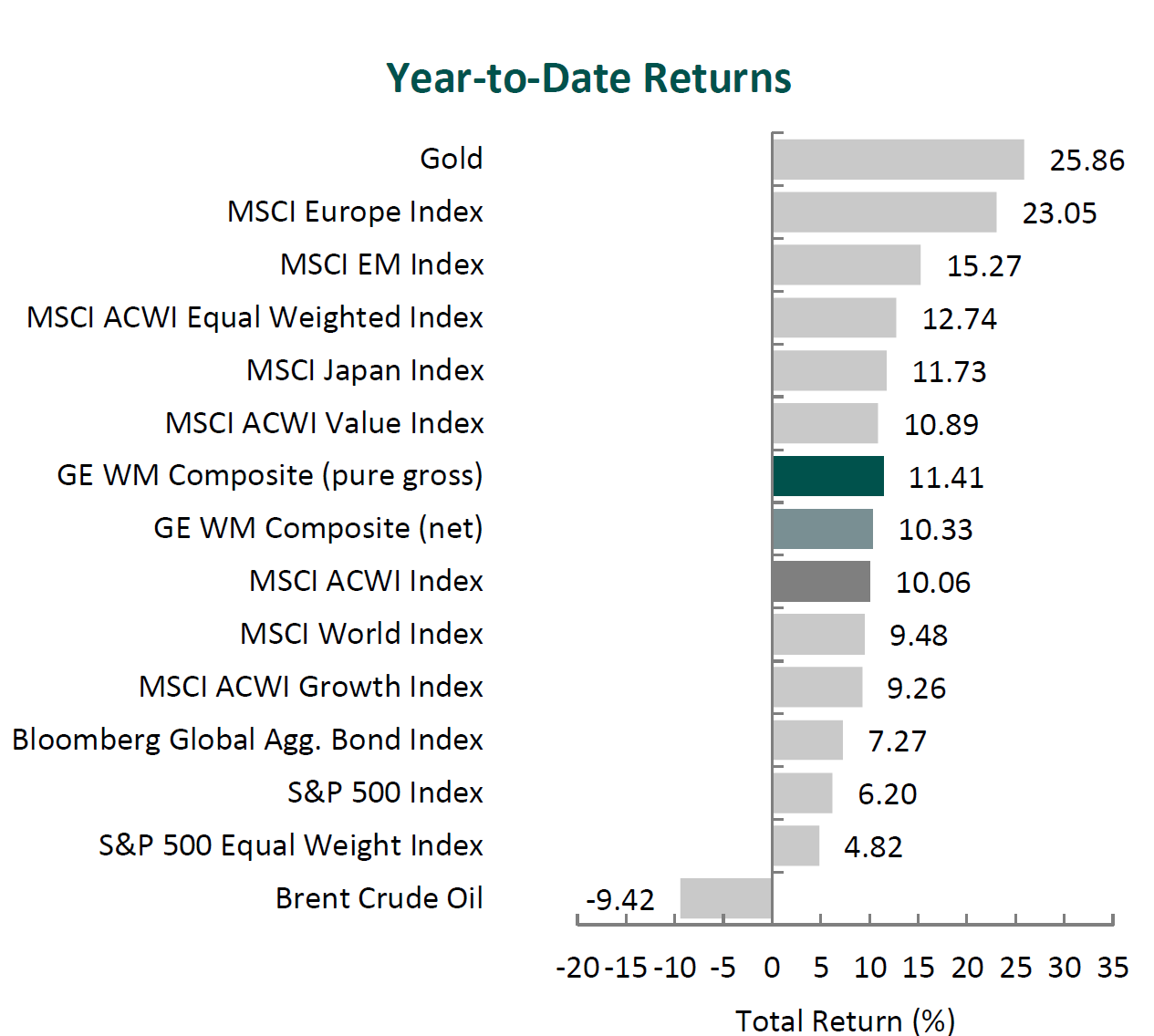
Sources: CAPS CompositeHubTM, Bloomberg
Past performance is not indicative of future results. Aristotle International Equity ADR Composite returns are presented gross and net of investment advisory fees and include the reinvestment of all income. Gross returns will be reduced by fees and other expenses that may be incurred in the management of the account. Net returns are presented net of actual investment advisory fees and after the deduction of all trading expenses. Aristotle Capital Composite returns are preliminary pending final account reconciliation. Please see important disclosures at the end of this document.

Global equity markets ended the year slightly down, with the MSCI ACWI Index returning -0.99% in the fourth quarter. Concurrently, the Bloomberg Global Aggregate Bond Index fell by 5.10%. In terms of style, value stocks lagged their growth counterparts during the quarter, with the MSCI ACWI Value Index underperforming the MSCI ACWI Growth Index by 7.35%.

The MSCI EAFE Index fell 8.11% during the fourth quarter, while the MSCI ACWI ex USA Index dropped 7.60%. Within the MSCI EAFE Index, Europe & Middle East was the weakest performer, while Asia declined the least. On a sector basis, all eleven sectors within the MSCI EAFE Index posted negative returns, with Materials, Health Care and Real Estate generating the largest losses. Conversely, Financials, Consumer Discretionary and Communication Services fell the least.

Geopolitics continued to make headlines, as the conflicts in Ukraine and the Middle East escalated. For the first time during the war, Ukraine launched U.S.-made missiles deep into Russian territory, while Russia continued to bombard Ukraine’s power grid in the midst of winter. Russian President Vladimir Putin announced that aggression from a non-nuclear country – with the direct or indirect participation of a nuclear country – would be considered a joint attack on Russia, lowering the bar for the use of nuclear weapons.

In the Middle East, a tenuous ceasefire was made between Israel and Hezbollah, as well as seeming progress toward a ceasefire between Israel and Hamas. However, tensions also escalated as Israel, in response to an Iranian missile attack, conducted a precision strike on military targets in Iran. Concerns over a regional conflict have intensified, as the two countries have drawn closer to a potentially more forceful direct encounter. The Middle East also experienced a shock in politics, as the Islamist militant group Hayat Tahrir al-Sham overthrew the Iranian and Russian-backed dictator Bashar al-Assad in Syria. Europe and Asia were not immune to instability, as the French parliament passed a vote of no confidence against Prime Minister Michel Barnier, and the South Korean National Assembly voted to impeach President Yoon Suk Yeol after he declared martial law.

Even with the continued uncertainty stoked by geopolitical conflicts and political regime changes across the globe, the IMF projects global economic growth to hold steady at 3.2% for 2024 and 2025. Additionally, global inflation continues to decline, resulting in global headline inflation projections of 3.5% for 2025 – below the 2000-2019 average of 3.6%. As western countries continue to target a 2% annual rate of inflation, the Federal Reserve, European Central Bank and Bank of England all cut key interest rates during the period. In Asia, Japan’s index of service-sector inflation hit its highest level since 1995, as rising wages have caused companies to pass on higher costs. Though the Bank of Japan did not raise rates at its most recent meeting, Governor Kazuo Ueda has indicated that the central bank would continue to raise rates if inflation sustainably hit a 2% annual rate. Meanwhile, China announced a $1.4 trillion stimulus package to address local government debt issues and support its economy. The Chinese government hopes to repair municipal balance sheets rather than directly injecting money into the economy (which it has done in the past).

Annual Markets Review

Global equity markets continued climbing in 2024 following a strong year in 2023, as the MSCI ACWI posted a full-year return of 17.49%. Additionally, growth outperformed value, as the MSCI ACWI Growth Index outperformed the MSCI ACWI Value Index by 13.46% in 2024. Meanwhile, fixed income markets lagged, as the Bloomberg Global Aggregate Bond Index fell by 1.69%.

Although the equity market remained strong in 2024 amid resilient global growth, uncertainty heading into 2025 is high, as geopolitical conflicts remain unsolved, central bank policy effects have yet to fully play out and countries’ governments are changing leadership.

Therefore, rather than trying to predict the unpredictable, we choose to focus on individual businesses and their long-term prospects. We believe by focusing on what is analyzable in the long run, we will be able to weather short-term volatility and provide attractive returns over the long term for our clients.

Performance and Attribution Summary

For the fourth quarter of 2024, Aristotle Capital’s International Equity ADR Composite posted a total return of -7.28% gross of fees (-7.34% net of fees), outperforming the MSCI EAFE Index, which returned -8.11%, and the MSCI ACWI ex USA Index, which returned -7.60%. Please refer to the table below for detailed performance.

Performance (%) 4Q241 Year3 Years5 Years10 Years Since Inception*
International Equity ADR Composite (gross)-7.287.461.535.976.666.28
International Equity ADR Composite (net)-7.347.001.035.476.165.78
MSCI EAFE Index (net)-8.113.821.654.735.205.18
MSCI ACWI ex USA Index (net)-7.605.530.824.104.804.66
*The inception date for the International Equity ADR Composite is June 1, 2013. Past performance is not indicative of future results. Aristotle International Equity ADR Composite returns are presented gross and net of investment advisory fees and include the reinvestment of all income. Gross returns will be reduced by fees and other expenses that may be incurred in the management of the account. Net returns are presented net of actual investment advisory fees and after the deduction of all trading expenses. Aristotle Capital Composite returns are preliminary pending final account reconciliation. Please see important disclosures at the end of this document.

Source: FactSet
Past performance is not indicative of future results. Attribution results are based on sector returns which are gross of investment advisory fees. Attribution is based on performance that is gross of investment advisory fees and includes the reinvestment of income.

From a sector perspective, the portfolio’s outperformance relative to the MSCI EAFE Index can be attributed to both security selection and allocation effects. Security selection in Energy, Consumer Staples and Health Care contributed the most to the portfolio’s relative performance. Conversely, security selection in Industrials and Materials, as well as an overweight in Consumer Staples, detracted from relative returns.

Regionally, allocation effects were responsible for the portfolio’s outperformance, while security selection had a negative impact. Exposure to Canada and security selection in Asia contributed the most to relative performance, while security selection in the Europe & Middle East, as well as U.K., detracted.

Contributors and Detractors for 4Q 2024

Relative ContributorsRelative Detractors
BrookfieldDSM-Firmenich
CamecoAshtead Group
DBS GroupSymrise
Sony GroupMichelin
Erste Group BankExperian

Cameco, one of the world’s largest uranium producers, was a major contributor during the period. With the continued focus on artificial intelligence and clean energy, the demand for nuclear energy remained robust. Some of the largest companies in the world, such as Amazon, Google and Meta, announced nuclear power agreements in the quarter. Given Cameco’s tier-one assets in reliable jurisdictions, proven operating experience and strong reputation, we believe the company is in a unique position to benefit as various industries and governments pursue clean, reliable and scalable sources of energy. Correspondingly, Cameco increased its production outlook, having already secured commitments that net an average of 29 million pounds per year over the next four years. We believe Cameco’s continued ability to efficiently increase production while securing long-term contracts will lead to sustainably higher levels of normalized FREE cash flow. While its Canada-based mines and Westinghouse unit are executing well, production was recently suspended at Cameco’s Inkai joint venture in Kazakhstan. We believe production will restart soon and note that Cameco’s share of Inkai’s production amounts to less than 10% of total Cameco volumes, a figure that can be offset with increased production at the company’s MacArthur River and Key Lake mines in Canada.

Sony, the global provider of videogames and consoles, image sensors, music, and movies, was a top contributor for the period. The company reported strong results driven by third-party gaming revenue and record PlayStation 5 console profitability. This was achieved despite lower console sales, which, in our view, exemplifies the strength of PlayStation’s network effects. PlayStation is the world’s largest gaming platform with 116 million monthly active users, making it an attractive market for game developers and allowing users to play the most advanced games at lower costs than PCs. In its Pictures segment, Crunchyroll (the anime business Sony acquired from AT&T in 2020) signed a distribution agreement with YouTube Primetime Channels, the market share leader in streaming services, which we believe will increase Crunchyroll’s subscriber base. Though a singular example, it illustrates management’s ability to better execute and further improve the segment’s profitability, a catalyst we previously identified. In addition, Sony reported improved sales of image sensors for mobile products as the global smartphone market continued its gradual recovery. Sony’s image sensor business has the largest global market share, and we believe, longer term, it is uniquely positioned to benefit from increasing demand for both autonomous driving technology in vehicles and improved image quality in smartphone cameras. As such, we continue to admire Sony’s capacity to build on its industry leadership and optimize its operations, which includes its plan for a partial spinoff of its Financial Services segment in October 2025.

DSM-Firmenich (DSM), the Dutch-Swiss nutrition, health and bioscience company, was the leading detractor for the quarter. Despite a decline in share price, the company continued to increase its sales across segments following customer destocking in 2023. Within its largest segment – Perfumery & Beauty – we believe DSM will uniquely benefit, as customers look to differentiate their products and increase fragrance dosage levels. The company has also made progress on the integration of its 2023 merger with Firmenich, a catalyst we previously identified, which we expect to create further sales and product development synergies. With low leverage, the company is in a strong position to pursue additional bolt-on acquisitions and return cash to shareholders, all while it executes on shedding lower-margin segments. As such, during the quarter, the company completed the sale of its yeast extracts and marine lipid business and remains on track with plans to divest its Animal Nutrition & Health segment. We believe this should enhance overall profitability, as DSM’s global scale, close relationships with customers and ability to innovate allow the company to continue to gain global market share across the businesses it operates.

Ashtead Group, a U.K.-headquartered equipment rental company, was one of the largest detractors. Though rental revenues grew 2% year-over-year, shares declined as weaker local commercial construction markets weighed on growth and fleet utilization. In December, Ashtead also announced its intention to move to a U.S. primary listing (while retaining a U.K. listing), a reflection of the company’s large U.S. footprint. This process will take time, as management intends to first discuss the proposal with shareholders before putting forward a formal resolution. Despite the cyclical nature of the construction industry, which can impact short-term results, we believe Ashtead will continue to gain market share in North America as more customers choose to rent rather than purchase equipment. We estimate rental penetration in the U.S. (~90% of EBITDA) is roughly 55% compared to 75% in the U.K., which provides ample runway. During our nearly four years as shareholders, Ashtead has further consolidated the rental industry, which we believe should result in a more disciplined and attractive market. The company also continues to make progress on the catalyst of growing its higher-margin specialty business, which includes HVAC equipment and scaffolding. Moreover, we believe Ashtead will be able to further utilize its national footprint and procurement power to increase its market share and enhance its FREE cash flow (of which it plans to return up to $1.5 billion to shareholders via buybacks over the next 18 months).

Recent Portfolio Activity

BuysSells
NoneNone

Consistent with our long-term horizon and low turnover, there were no new purchases or sales completed during the quarter.

Conclusion

While investment managers are typically judged by their performance, we often remind our clients and prospects that performance is an outcome of an investment process. Short-term performance, in particular, can be fleeting.  We are proud to report that our strategy outperformed its benchmarks in 2024; however, we highlight that this is a result of our focus on the inputs of our time-tested investment process, not a focus on performance. Our process involves identifying what we believe to be high-quality businesses that are trading at a discount to their intrinsic value. While there are myriad variables – both micro and macro – that influence stock prices on a short-term basis, we believe the ultimate worth of a business is determined by company specific fundamentals. As such, regardless of short-term market influences or performance outcomes, we will remain true to our investment process.  

Disclosures

The opinions expressed herein are those of Aristotle Capital Management, LLC (Aristotle Capital) and are subject to change without notice. Past performance is not a guarantee or indicator of future results. This material is not financial advice or an offer to buy or sell any product. You should not assume that any of the securities transactions, sectors or holdings discussed in this report were or will be profitable, or that recommendations Aristotle Capital makes in the future will be profitable or equal the performance of the securities listed in this report. The portfolio characteristics shown relate to the Aristotle International Equity ADR strategy. Not every client’s account will have these characteristics. Aristotle Capital reserves the right to modify its current investment strategies and techniques based on changing market dynamics or client needs. There is no assurance that any securities discussed herein will remain in an account’s portfolio at the time you receive this report or that securities sold have not been repurchased. The securities discussed may not represent an account’s entire portfolio and, in the aggregate, may represent only a small percentage of an account’s portfolio holdings. The performance attribution presented is of a representative account from Aristotle Capital’s International Equity ADR Composite. The representative account is a discretionary client account which was chosen to most closely reflect the investment style of the strategy. The criteria used for representative account selection is based on the account’s period of time under management and its similarity of holdings in relation to the strategy. Recommendations made in the last 12 months are available upon request.

Returns are presented gross and net of investment advisory fees and include the reinvestment of all income. Gross returns will be reduced by fees and other expenses that may be incurred in the management of the account. Net returns are presented net of actual investment advisory fees and after the deduction of all trading expenses.

All investments carry a certain degree of risk, including the possible loss of principal. Investments are also subject to political, market, currency and regulatory risks or economic developments. International investments involve special risks that may in particular cause a loss in principal, including currency fluctuation, lower liquidity, different accounting methods and economic and political systems, and higher transaction costs. These risks typically are greater in emerging markets. Securities of small‐ and medium‐sized companies tend to have a shorter history of operations, be more volatile and less liquid. Value stocks can perform differently from the market as a whole and other types of stocks.

The material is provided for informational and/or educational purposes only and is not intended to be and should not be construed as investment, legal or tax advice and/or a legal opinion. Investors should consult their financial and tax adviser before making investments. The opinions referenced are as of the date of publication, may be modified due to changes in the market or economic conditions, and may not necessarily come to pass. Information and data presented has been developed internally and/or obtained from sources believed to be reliable. Aristotle Capital does not guarantee the accuracy, adequacy or completeness of such information.

Aristotle Capital Management, LLC is an independent registered investment adviser under the Advisers Act of 1940, as amended. Registration does not imply a certain level of skill or training. More information about Aristotle Capital, including our investment strategies, fees and objectives, can be found in our Form ADV Part 2, which is available upon request. ACM-2501-136

Performance Disclosures

Sources: CAPS CompositeHubTM, MSCI

Composite returns for all periods ended December 31, 2024 are preliminary pending final account reconciliation.

Past performance is not indicative of future results. The information provided should not be considered financial advice or a recommendation to purchase or sell any particular security or product. Performance results for periods greater than one year have been annualized.

Returns are presented gross and net of investment advisory fees and include the reinvestment of all income. Gross returns will be reduced by fees and other expenses that may be incurred in the management of the account. Net returns are presented net of actual investment advisory fees and after the deduction of all trading expenses.

Index Disclosures

The MSCI EAFE Index (Europe, Australasia, Far East) is a free float-adjusted market capitalization-weighted index that is designed to measure the equity market performance of developed markets, excluding the United States and Canada. The MSCI EAFE Index consists of the following 21 developed market country indexes: Australia, Austria, Belgium, Denmark, Finland, France, Germany, Hong Kong, Ireland, Israel, Italy, Japan, the Netherlands, New Zealand, Norway, Portugal, Singapore, Spain, Sweden, Switzerland and the United Kingdom. The MSCI ACWI captures large and mid-cap representation across 23 developed market countries and 24 emerging markets countries. With approximately 2,700 constituents, the Index covers approximately 85% of the global investable equity opportunity set. The MSCI ACWI Growth Index captures large and mid-cap securities exhibiting overall growth style characteristics across 23 developed markets countries and 24 emerging markets countries. The MSCI ACWI Value Index captures large and mid-cap securities exhibiting overall value style characteristics across 23 developed markets countries and 24 emerging markets countries. The MSCI ACWI ex USA Index captures large and mid-cap representation across 22 of 23 developed markets countries (excluding the United States) and 24 emerging markets countries. With approximately 2,100 constituents, the Index covers approximately 85% of the global equity opportunity set outside the United States. The MSCI Emerging Markets Index is a free float-adjusted market capitalization-weighted index that is designed to measure the equity market performance of emerging markets. The MSCI Emerging Markets Index consists of the following 24 emerging market country indexes: Brazil, Chile, China, Colombia, Czech Republic, Egypt, Greece, Hungary, India, Indonesia, Korea, Kuwait, Malaysia, Mexico, Peru, Philippines, Poland, Qatar, Saudi Arabia, South Africa, Taiwan, Thailand, Turkey and United Arab Emirates. The S&P 500® Index is the Standard & Poor’s Composite Index of 500 stocks and is a widely recognized, unmanaged index of common stock prices. The Brent Crude Oil Index is a major trading classification of sweet light crude oil that serves as a major benchmark price for purchases of oil worldwide. The MSCI Japan Index is designed to measure the performance of the large and mid-cap segments of the Japanese market. With approximately 200 constituents, the Index covers approximately 85% of the free float-adjusted market capitalization in Japan. The Bloomberg Global Aggregate Bond Index is a flagship measure of global investment grade debt from 28 local currency markets. This multi-currency benchmark includes treasury, government-related, corporate and securitized fixed-rate bonds from both developed and emerging markets issuers. The MSCI United Kingdom Index is designed to measure the performance of the large and mid-cap segments of the U.K. market. With nearly 100 constituents, the Index covers approximately 85% of the free float-adjusted market capitalization in the United Kingdom. The MSCI Europe Index captures large and mid-cap representation across 15 developed markets countries in Europe. With approximately 400 constituents, the Index covers approximately 85% of the free float-adjusted market capitalization across the European developed markets equity universe. These indexes have been selected as the benchmarks and are used for comparison purposes only. The volatility (beta) of the Composite may be greater or less than the respective benchmarks. It is not possible to invest directly in these indexes.

For more on International Equity, access the latest resources.

(All MSCI index returns are shown net and in U.S. dollars unless otherwise noted.)

Markets Review

Sources: CAPS CompositeHubTM, Bloomberg
Past performance is not indicative of future results. Aristotle Global Equity Composite returns are presented gross and net of investment advisory fees and include the reinvestment of all income. Gross returns will be reduced by fees and other expenses that may be incurred in the management of the account. Net returns are presented net of actual investment advisory fees and after the deduction of all trading expenses. Aristotle Capital Composite returns are preliminary pending final account reconciliation. Please see important disclosures at the end of this document.

Global equity markets ended the year slightly down, with the MSCI ACWI Index returning -0.99% in the fourth quarter. Concurrently, the Bloomberg Global Aggregate Bond Index fell by 5.10%. In terms of style, value stocks lagged their growth counterparts during the quarter, with the MSCI ACWI Value Index underperforming the MSCI ACWI Growth Index by 7.35%.

Latin America and Europe were the weakest regions, while North America was the only positive performer and Japan declined the least. On a sector basis, seven out of the eleven sectors within the MSCI ACWI Index finished lower, with Materials, Health Care and Real Estate falling the most. Meanwhile, Consumer Discretionary, Communication Services and Information Technology were the strongest performers.

Geopolitics continued to make headlines, as the conflicts in Ukraine and the Middle East escalated. For the first time during the war, Ukraine launched U.S.-made missiles deep into Russian territory, while Russia continued to bombard Ukraine’s power grid in the midst of winter. Russian President Vladimir Putin announced that aggression from a non-nuclear country – with the direct or indirect participation of a nuclear country – would be considered a joint attack on Russia, lowering the bar for the use of nuclear weapons.

In the Middle East, a tenuous ceasefire was made between Israel and Hezbollah, as well as seeming progress toward a ceasefire between Israel and Hamas. However, tensions also escalated as Israel, in response to an Iranian missile attack, conducted a precision strike on military targets in Iran. Concerns over a regional conflict have intensified, as the two countries have drawn closer to a potentially more forceful direct encounter. The Middle East also experienced a shock in politics, as the Islamist militant group Hayat Tahrir al-Sham overthrew the Iranian and Russian-backed dictator Bashar al-Assad in Syria. Europe and Asia were not immune to instability, as the French parliament passed a vote of no confidence against Prime Minister Michel Barnier, and the South Korean National Assembly voted to impeach President Yoon Suk Yeol after he declared martial law.

Even with the continued uncertainty stoked by geopolitical conflicts and political regime changes across the globe, the IMF projects global economic growth to hold steady at 3.2% for 2024 and 2025. Additionally, global inflation continues to decline, resulting in global headline inflation projections of 3.5% for 2025 – below the 2000-2019 average of 3.6%. As western countries continue to target a 2% annual rate of inflation, the Federal Reserve, European Central Bank and Bank of England all cut key interest rates during the period. In Asia, Japan’s index of service-sector inflation hit its highest level since 1995, as rising wages have caused companies to pass on higher costs. Though the Bank of Japan did not raise rates at its most recent meeting, Governor Kazuo Ueda has indicated that the central bank would continue to raise rates if inflation sustainably hit a 2% annual rate. Meanwhile, China announced a $1.4 trillion stimulus package to address local government debt issues and support its economy. The Chinese government hopes to repair municipal balance sheets rather than directly injecting money into the economy (which it has done in the past).

Annual Markets Review

Global equity markets continued climbing in 2024 following a strong year in 2023, as the MSCI ACWI posted a full-year return of 17.49%. Additionally, growth outperformed value, as the MSCI ACWI Growth Index outperformed the MSCI ACWI Value Index by 13.46% in 2024. Meanwhile, fixed income markets lagged, as the Bloomberg Global Aggregate Bond Index fell by 1.69%.

Although the equity market remained strong in 2024 amid resilient global growth, uncertainty heading into 2025 is high, as geopolitical conflicts remain unsolved, central bank policy effects have yet to fully play out and countries’ governments are changing leadership.

Therefore, rather than trying to predict the unpredictable, we choose to focus on individual businesses and their long-term prospects. We believe by focusing on what is analyzable in the long run, we will be able to weather short-term volatility and provide attractive returns over the long term for our clients.

Performance and Attribution Summary

For the fourth quarter of 2024, Aristotle Capital’s Global Equity Composite posted a total return of -7.72% gross of fees (-7.80% net of fees), underperforming the MSCI ACWI Index, which returned -0.99%, and the MSCI World Index, which returned -0.16%. Please refer to the table below for detailed performance.

Performance (%) 4Q24YTD1 Year3 Years5 Years10 Years Since Inception*
Global Equity Composite (gross)-7.723.671.017.939.459.459.56
Global Equity Composite (net)-7.803.340.697.599.089.089.13
MSCI ACWI Index (net)-0.9917.495.4410.069.239.239.23
MSCI World Index (net)-0.1618.676.3411.179.959.9510.17
*The inception date for the Global Equity Composite is November 1, 2010. Past performance is not indicative of future results. Aristotle Global Equity Composite returns are presented gross and net of investment advisory fees and include the reinvestment of all income. Gross returns will be reduced by fees and other expenses that may be incurred in the management of the account. Net returns are presented net of actual investment advisory fees and after the deduction of all trading expenses. Aristotle Capital Composite returns are preliminary pending final account reconciliation. MSCI ACWI (Net) was stated as the primary benchmark on June 1, 2024 and MSCI World (Net) became the secondary benchmark. Please see important disclosures at the end of this document.

Source: FactSet
Past performance is not indicative of future results. Attribution results are based on sector returns which are gross of investment advisory fees. Attribution is based on performance that is gross of investment advisory fees and includes the reinvestment of income.

From a sector perspective, the portfolio’s underperformance relative to the MSCI ACWI Index can be primarily attributed to security selection, while allocation effects also had a negative impact. Security selection in Information Technology and Consumer Discretionary and an overweight in Materials detracted the most from the portfolio’s relative performance. Conversely, security selection in Materials, an overweight in Consumer Discretionary and a lack of exposure to Utilities contributed to relative return.

Regionally, security selection was primarily responsible for the portfolio’s underperformance relative to the MSCI ACWI Index, while allocation effects also had a negative impact. Security selection in North America and Europe detracted the most from relative performance, while security selection in Japan and an underweight in Emerging Markets contributed.

Contributors and Detractors for 4Q 2024

Relative ContributorsRelative Detractors
CamecoLennar
Norwegian Cruise Line HoldingsMicrochip Technology
SonyDSM-Firmenich
DBS GroupAmgen
BrookfieldMichelin

Microchip Technology, the microcontroller (MCU) and analog semiconductor producer, was one of the largest detractors for the period. Revenues continued to decline amid the severe inventory correction, which has persisted in most end markets other than defense and aerospace since early 2023. In addition, Microchip’s board unexpectedly announced that CEO Ganesh Moorthy (who led the company since 2021) would retire with the current chairman and long-tenured former CEO Steve Sanghi returning. Mr. Sanghi returned on an interim basis, allowing the company to focus on turnaround efforts without near-term plans to search for a replacement. We have admired Mr. Sanghi’s skill at navigating past chip cycles and will closely track the company’s ability to execute on restructuring initiatives, which aim to resize its manufacturing footprint and reduce inventory. This includes plans to soon shut down the company’s wafer fabrication facility in Arizona, which the company expects should generate annual cash savings of approximately $90 million. Despite recent missteps in inventory management that were exacerbated by cyclical headwinds, we are optimistic about management’s plans to right-size its business. Moreover, we remain confident that Microchip’s broad portfolio is uniquely positioned to increase its market share in 16- and 32-bit MCUs and areas including IoT, 5G infrastructure, autonomous driving and data centers.

DSM-Firmenich (DSM), the Dutch-Swiss nutrition, health and bioscience company, was one of the largest detractors. Despite a decline in share price, the company continued to increase its sales across segments following customer destocking in 2023. Within its largest segment – Perfumery & Beauty – we believe DSM will uniquely benefit, as customers look to differentiate their products and increase fragrance dosage levels. The company has also made progress on the integration of its 2023 merger with Firmenich, a catalyst we previously identified, which we expect to create further sales and product development synergies. With low leverage, the company is in a strong position to pursue additional bolt-on acquisitions and return cash to shareholders, all while it executes on shedding lower-margin segments. As such, during the quarter, the company completed the sale of its yeast extracts and marine lipid business and remains on track with plans to divest its Animal Nutrition & Health segment. We believe this should enhance overall profitability, as DSM’s global scale, close relationships with customers and ability to innovate allow the company to continue to gain global market share across the businesses it operates.

Norwegian Cruise Line Holdings, one of the world’s largest cruise ship operators, was a major contributor during the quarter. With post pandemic consumer sentiment regarding the cruise industry continuing to improve, the company has seen strong advanced booking trends, improving occupancy levels and an upward momentum in pricing. Norwegian Cruise Line has also simultaneously executed on optimizing ship operating costs and instituting a new fuel purchasing program, which has allowed the company to offset inflation. Furthermore, the company continues to make progress on its multibillion-dollar efforts to upgrade and expand its fleet, with one of the company’s newest ships, Allura, ready to set sail in 2025. We believe the company’s cost-saving initiatives and fleet improvements will lead to higher levels of profitability and FREE cash flow, allowing the company to continue to reduce debt and increase its intrinsic value.

Sony, the global provider of videogames and consoles, image sensors, music, and movies, was a top contributor for the period. The company reported strong results driven by third-party gaming revenue and record PlayStation 5 console profitability. This was achieved despite lower console sales, which, in our view, exemplifies the strength of PlayStation’s network effects. PlayStation is the world’s largest gaming platform with 116 million monthly active users, making it an attractive market for game developers and allowing users to play the most advanced games at lower costs than PCs. In its Pictures segment, Crunchyroll (the anime business Sony acquired from AT&T in 2020) signed a distribution agreement with YouTube Primetime Channels, the market share leader in streaming services, which we believe will increase Crunchyroll’s subscriber base. Though a singular example, it illustrates management’s ability to better execute and further improve the segment’s profitability, a catalyst we previously identified. In addition, Sony reported improved sales of image sensors for mobile products as the global smartphone market continued its gradual recovery. Sony’s image sensor business has the largest global market share, and we believe, longer term, it is uniquely positioned to benefit from increasing demand for both autonomous driving technology in vehicles and improved image quality in smartphone cameras. As such, we continue to admire Sony’s capacity to build on its industry leadership and optimize its operations, which includes its plan for a partial spinoff of its Financial Services segment in October 2025.

Recent Portfolio Activity

BuysSells
NoneNone

Consistent with our long-term horizon and low turnover, there were no new purchases or sales completed during the quarter.

Conclusion

While in 2024 we delivered positive absolute returns, our portfolio’s relative performance is nevertheless disappointing. Despite this, we remain confident in our time-tested investment process which has a longer-term orientation. By definition, value investors often seek to invest in companies that are not “in vogue” with investors. As a result, we believe our quality oriented approach to intrinsic value investing is best measured over a full market cycle, which we define as three to five years. While the market in 2024 was largely driven by narrowly focused investment themes, we remain confident that, over the long term, stock prices will track business fundamentals. 

Disclosures

The opinions expressed herein are those of Aristotle Capital Management, LLC (Aristotle Capital) and are subject to change without notice. Past performance is not a guarantee or indicator of future results. This material is not financial advice or an offer to buy or sell any product. You should not assume that any of the securities transactions, sectors or holdings discussed in this report were or will be profitable, or that recommendations Aristotle Capital makes in the future will be profitable or equal the performance of the securities listed in this report. The portfolio characteristics shown relate to the Aristotle Global Equity strategy. Not every client’s account will have these characteristics. Aristotle Capital reserves the right to modify its current investment strategies and techniques based on changing market dynamics or client needs. There is no assurance that any securities discussed herein will remain in an account’s portfolio at the time you receive this report or that securities sold have not been repurchased. The securities discussed may not represent an account’s entire portfolio and, in the aggregate, may represent only a small percentage of an account’s portfolio holdings. The performance attribution presented is of a representative account from Aristotle Capital’s Global Equity Composite. The representative account is a discretionary client account which was chosen to most closely reflect the investment style of the strategy. The criteria used for representative account selection is based on the account’s period of time under management and its similarity of holdings in relation to the strategy. Recommendations made in the last 12 months are available upon request.

Returns are presented gross and net of investment advisory fees and include the reinvestment of all income. Gross returns will be reduced by fees and other expenses that may be incurred in the management of the account. Net returns are presented net of actual investment advisory fees and after the deduction of all trading expenses.

All investments carry a certain degree of risk, including the possible loss of principal. Investments are also subject to political, market, currency and regulatory risks or economic developments. International investments involve special risks that may in particular cause a loss in principal, including currency fluctuation, lower liquidity, different accounting methods and economic and political systems, and higher transaction costs. These risks typically are greater in emerging markets. Securities of small‐ and medium‐sized companies tend to have a shorter history of operations, be more volatile and less liquid. Value stocks can perform differently from the market as a whole and other types of stocks.

The material is provided for informational and/or educational purposes only and is not intended to be and should not be construed as investment, legal or tax advice and/or a legal opinion. Investors should consult their financial and tax adviser before making investments. The opinions referenced are as of the date of publication, may be modified due to changes in the market or economic conditions, and may not necessarily come to pass. Information and data presented has been developed internally and/or obtained from sources believed to be reliable. Aristotle Capital does not guarantee the accuracy, adequacy or completeness of such information.

Aristotle Capital Management, LLC is an independent investment adviser registered under the Investment Advisers Act of 1940, as amended. Registration does not imply a certain level of skill or training. More information about Aristotle Capital, including our investment strategies, fees and objectives, can be found in our Form ADV Part 2, which is available upon request. ACM-2501-64

Performance Disclosures

Sources: CAPS CompositeHubTM, MSCI

Composite returns for all periods ended December 31, 2024 are preliminary pending final account reconciliation. MSCI ACWI (Net) was stated as the primary benchmark on June 1, 2024 and MSCI World (Net) became the secondary benchmark. 

The Aristotle Global Equity Composite has an inception date of November 1, 2010; however, the strategy initially began at Howard Gleicher’s predecessor firm in July 2007. A supplemental performance track record from January 1, 2008 through October 31, 2010 is provided on this page and complements the Global Equity Composite presentation that is located at the end of this presentation. The performance results were achieved while Mr. Gleicher managed the strategy at a prior firm. The returns are those of a publicly available mutual fund from the fund’s inception through Mr. Gleicher’s departure from the firm. During that time, Mr. Gleicher had primary responsibility for managing the fund.

Past performance is not indicative of future results. The information provided should not be considered financial advice or a recommendation to purchase or sell any particular security or product. Performance results for periods greater than one year have been annualized. Returns are presented gross and net of investment advisory fees and include the reinvestment of all income. Gross returns will be reduced by fees and other expenses that may be incurred in the management of the account. Net returns are presented net of actual investment advisory fees and after the deduction of all trading expenses.

Index Disclosures

MSCI ACWI (Net) was stated as the primary benchmark on June 1, 2024 and MSCI World (Net) became the secondary benchmark. The MSCI ACWI captures large and mid-cap representation across 23 developed markets and 24 emerging markets countries. With approximately 2,700 constituents, the Index covers approximately 85% of the global investable equity opportunity set. The MSCI ACWI Equal Weighted Index represents an alternative weighting scheme to its market cap weighted parent index, MSCI ACWI. The Index includes the same constituents as its parent (large and mid-cap securities from 23 developed markets and 24 emerging markets countries. However, at each quarterly rebalance date, all index constituents are weighted equally, effectively removing the influence of each constituent’s current price (high or low). Between rebalances, index constituent weightings will fluctuate due to price performance. The MSCI World Index is a free float-adjusted market capitalization weighted index that is designed to measure the equity market performance of developed markets. The MSCI World Index consists of the following 23 developed market country indexes: Australia, Austria, Belgium, Canada, Denmark, Finland, France, Germany, Hong Kong, Ireland, Israel, Italy, Japan, Netherlands, New Zealand, Norway, Portugal, Singapore, Spain, Sweden, Switzerland, the United Kingdom and the United States. The MSCI Emerging Markets Index is a free float-adjusted market capitalization-weighted index that is designed to measure equity market performance of emerging markets. The MSCI Emerging Markets Index consists of the following 24 emerging market country indexes: Brazil, Chile, China, Colombia, Czech Republic, Egypt, Greece, Hungary, India, Indonesia, Korea, Kuwait, Malaysia, Mexico, Peru, Philippines, Poland, Qatar, Saudi Arabia, South Africa, Taiwan, Thailand, Turkey and United Arab Emirates. The MSCI ACWI Growth Index captures large and mid-cap securities exhibiting overall growth style characteristics across 23 developed markets countries and 24 emerging markets countries. The MSCI ACWI Value Index captures large and mid-cap securities exhibiting overall value style characteristics across 23 developed markets countries and 24 emerging markets countries. The MSCI Europe Index captures large and mid-cap representation across 15 developed markets countries in Europe. With more than 400 constituents, the Index covers approximately 85% of the free float-adjusted market capitalization across the European developed markets equity universe. The MSCI Japan Index is designed to measure the performance of the large and mid-cap segments of the Japanese market. With approximately 200 constituents, the Index covers approximately 85% of the free float-adjusted market capitalization in Japan. The S&P 500® Index is the Standard & Poor’s Composite Index of 500 stocks and is a widely recognized, unmanaged index of common stock prices. The S&P 500 Equal Weight Index is designed to be the size-neutral version of the S&P 500. It includes the same constituents as the cap-weighted S&P 500, but each company in the S&P 500 Equal Weight Index is allocated the same weight at each quarterly rebalance. The Bloomberg Global Aggregate Bond Index is a flagship measure of global investment grade debt from 28 local currency markets. This multi-currency benchmark includes Treasury, government-related, corporate and securitized fixed rate bonds from both developed and emerging markets issuers. The Brent Crude Oil Index is a major trading classification of sweet light crude oil that serves as a major benchmark price for purchases of oil worldwide. The volatility (beta) of the Composite may be greater or less than the benchmarks. It is not possible to invest directly in these indexes.

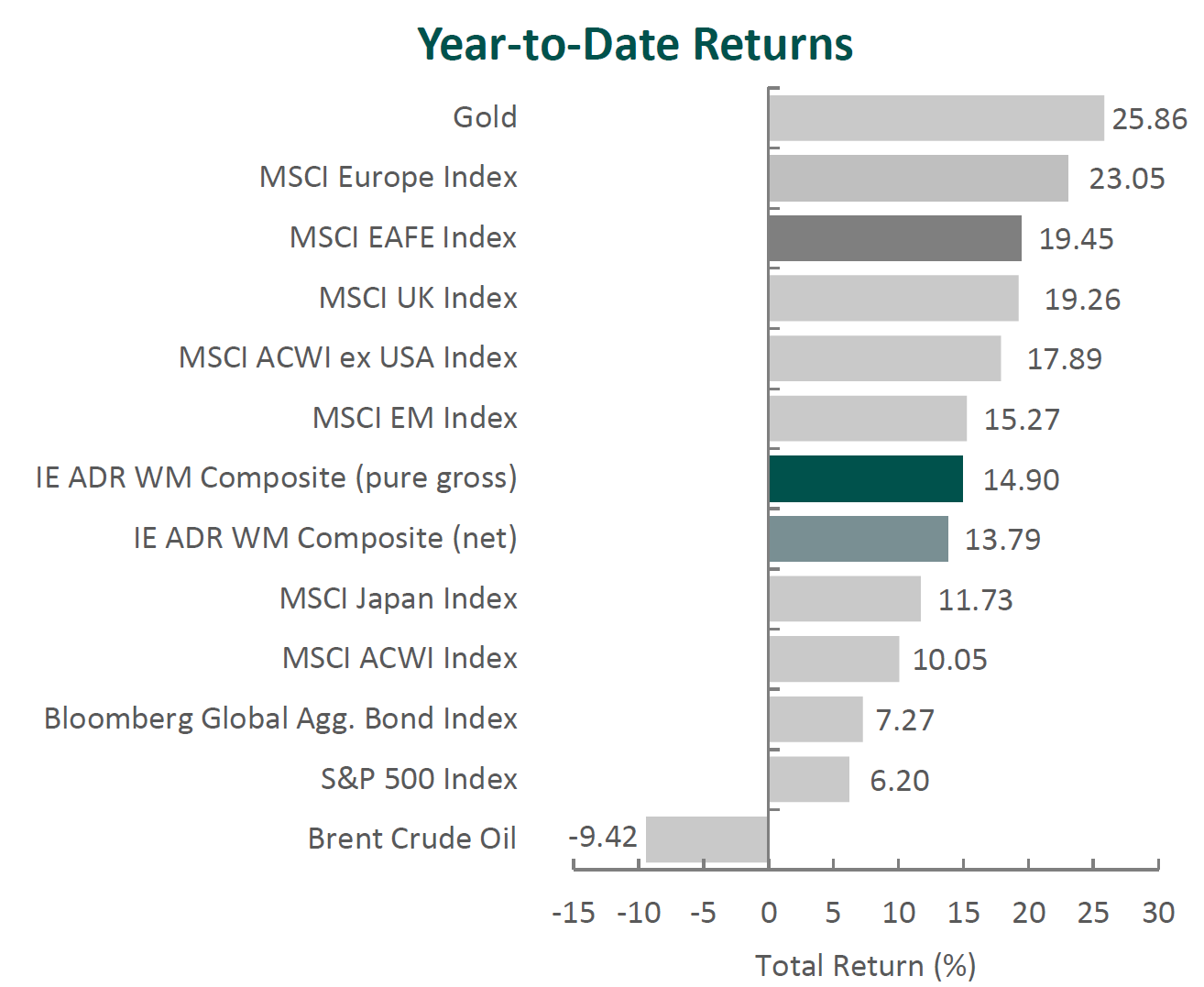
Markets Review

The U.S. equity market ended the year on a strong note, with the S&P 500 Index rising 2.41% during the period. In contrast, the Bloomberg U.S. Aggregate Bond Index declined, falling 3.06% for the quarter.

On a sector basis, gains were made in four of the eleven sectors within the S&P 500 Index, led by Consumer Discretionary and Communication Services. The worst-performing sectors were Materials and Health Care.

Sources: CAPS CompositeHubTM, Bloomberg
Past performance is not indicative of future results. Aristotle Atlantic Core Equity Composite returns are presented gross and net of investment advisory fees and include the reinvestment of all income. Gross returns will be reduced by fees and other expenses that may be incurred in the management of the account. Net returns are presented net of actual investment advisory fees and after the deduction of all trading expenses. Aristotle Atlantic Composite returns are preliminary pending final account reconciliation. Please see important disclosures at the end of this document.

The U.S. economy continued to demonstrate resilience, with real GDP growing at an annualized rate of 3.1%, according to the BEA’s most recent report. Increases in consumer spending, exports, nonresidential fixed investment and federal government spending drove the economic expansion. Retail sales rose 3.8% year-over-year in November, supported by a 2.7% increase in disposable personal income for the most recent quarter.

The labor market remained tight but showed signs of softening, as the unemployment rate edged up to 4.2% in November. Inflation remained relatively stable, rising modestly to an annual rate of 2.7%, as measured by the Consumer Price Index (CPI).

As was widely expected, the Federal Reserve (Fed) implemented two rate cuts during the quarter, setting the federal funds target rate at 4.25% to 4.50%. Fed Chair Jerome Powell emphasized the importance of finding a balance—reducing policy restraint too rapidly could hinder progress on inflation, while acting too slowly could weaken economic activity and the labor market. Still, he indicated that both the economy and monetary policy are on solid footing.

Corporate earnings also showed strength, as S&P 500 companies reported 5.8% earnings growth, marking the fifth consecutive quarter of positive results. A majority of companies exceeded EPS expectations, with only 61 companies issuing negative EPS guidance—the lowest figure since the fourth quarter of 2021. Looking ahead to 2025, consensus estimates project earnings growth of 14.8% for the calendar year, signaling optimism among analysts.

On the political front, Donald Trump was elected as the 47th president of the United States, becoming the first Republican to win the popular vote since 2004. The Republican Party also won the Senate and kept control of the House of Representatives, though with narrow majorities.

Performance and Attribution Summary

For the fourth quarter of 2024, Aristotle Atlantic’s Core Equity Composite posted a total return of 4.11% gross of fees (4.00% net of fees), outperforming the S&P 500 Index, which recorded a total return of 2.41%.

Performance (%)4Q241 Year3 Years5 Years10 YearsSince Inception*
Core Equity Composite (gross)4.1127.087.2514.3613.7014.33
Core Equity Composite (net)4.0026.636.8313.9113.2113.82
S&P 500 Index2.4125.028.9414.5313.1013.65
*The Core Equity Composite has an inception date of August 1, 2013. Past performance is not indicative of future results. Aristotle Atlantic Core Equity Composite returns are presented gross and net of investment advisory fees and include the reinvestment of all income. Gross returns will be reduced by fees and other expenses that may be incurred in the management of the account. Net returns are presented net of actual investment advisory fees and after the deduction of all trading expenses. Aristotle Atlantic Composite returns are preliminary pending final account reconciliation. Please see important disclosures at the end of this document.

Source: FactSet
Past performance is not indicative of future results. Sector attribution shows how much of a portfolio’s overall return is directly attributable to stock selection and asset allocation decisions within the portfolio, highlighting which sectors contributed or detracted to the total return. Attribution includes the reinvestment of income. Please see important disclosures at the end of this document.

During the fourth quarter, the portfolio’s outperformance relative to the S&P 500 Index was due to a mix of security selection and allocation effects. Security selection in Information Technology and Industrials contributed the most to relative performance. Conversely, security selection in Utilities and Consumer Discretionary detracted the most from relative performance.

Contributors and Detractors for 4Q 2024

Relative ContributorsRelative Detractors
BroadcomCigna
Chart IndustriesAvery Dennison
ServiceNowNextEra Energy
ExpediaDarling Ingredients
Ameriprise FinancialZoetis

Detractors

Cigna

Cigna detracted from performance in the fourth quarter following the tragic shooting of the CEO of UnitedHealthcare and increased focus on insurance industry practices. A bipartisan bill was introduced that could force companies that own pharmacy benefit managers to divest their pharmacy operations, which would impact Cigna’s Evernorth unit.

Avery Dennison

Avery Dennison detracted from performance in the fourth quarter following the company’s third quarter earnings results, which highlighted slower-than-expected growth of the company’s Intelligent Label business unit. In addition, the threat of tariffs from the incoming Trump administration could affect global apparel sales, impacting Avery Dennison’s volumes and earnings growth.

Contributors

Broadcom

Broadcom contributed to performance in the fourth quarter as the company’s third quarter results demonstrated continuing strength for its AI networking and custom accelerator semiconductor business. The company also gave long-term guidance for the service addressable market (SAM) opportunity for its AI-related business, indicating a market opportunity of $60 billion to $90 billion, which only includes contributions from its current three customers. This long-term outlook for AI semiconductor content exceeded investor expectations. Broadcom’s quarterly results also showed the company is ahead on its VMware integration timeline to achieve $8.5 billion in EBITDA, which will support long-term gross and operating margin expansion for the company.

Chart Industries

Chart Industries contributed to performance in the fourth quarter of 2024. Although the company missed consensus estimates for both revenue and earnings when it reported third quarter earnings in early November, the preliminary guidance for 2025 was in line with consensus estimates, and it implies 39% EPS growth. In addition, the company hosted a capital markets day on November 12, where management provided strong medium-term outlooks for most of the company’s end markets. Chart Industries is making progress toward reducing its balance sheet leverage and achieving its 2026 financial targets that were first given back in 2023.

Recent Portfolio Activity

The table below shows all buys and sells completed during the quarter, followed by a brief rationale.

BuysSells
GE AerospaceSpirit AeroSystems Holdings
CrowdStrike HoldingsMicrochip Technology

Buys

GE Aerospace

GE Aerospace designs and produces commercial and defense aircraft engines, integrated engine components, electric power, and mechanical aircraft systems. The industry has high entry barriers and is concentrated among few players. Despite its cyclical nature, the demand for travel is driven by global middle-class growth. Boeing and Airbus have long order books, ensuring steady demand for engines and spare parts. The company also benefits from high-margin services for existing aircraft fleets, with services accounting for 70% of its commercial engine business. GE Aerospace serves customers worldwide.

We see GE Aerospace making significant strides in its commercial engine business, which is expected to boost future services revenue growth. Over the past five years, the company has undergone substantial restructuring and simplification, including divesting its healthcare and energy businesses. The company now operates in three segments: Commercial Engines & Services (CES), Defense & Propulsion Technologies (DPT) and Insurance. Long-term revenue guidance is for high single-digit growth, and management has a goal of $10 billion in annual operating profit by 2028, with an expected 20% annual earnings growth. Following years of restructuring, we see GE Aerospace now positioned to return capital to shareholders through dividends and share repurchases.

CrowdStrike Holdings

CrowdStrike provides cybersecurity products and services that offer endpoint protection and threat intelligence solutions, enabling customers to prevent damage from targeted attacks, detect advanced malware and search all endpoints. The company’s open cloud architecture enables it and third-party partners to rapidly innovate, build and deploy new cloud modules that can provide customers with enhanced functionality across a myriad of use cases.

We see the cloud cybersecurity market as positioned to experience strong growth over the next few years, driven by continued migration from on-premises to cloud-based architecture. We believe CrowdStrike can benefit from this trend due to its early-mover advantage, multiple product offerings and native integrations with leading cloud platforms. The increasing threats from state-sanctioned cybercriminals using high-performance computing and AI necessitate higher spending on advanced cybersecurity products. The total addressable market (TAM) is projected to grow significantly over the next four calendar years. Additionally, CrowdStrike’s cloud-native architecture and unified platform approach provide competitive advantages, resulting in high customer retention and widespread adoption of multiple modules.

Sells

Spirit AeroSystems Holdings

We sold Spirit AeroSystems following the disclosure that the company reported in its 10-Q that there is a “growing concern risk” that has been driven by the disruption from the Boeing machinists’ strike. Although the strike has been settled, it will be several months before production returns to normal. We are also concerned that Boeing’s agreement to acquire Spirit could be renegotiated at a lower price. Finally, in the unlikely event of a disapproval of the Spirit acquisition by regulators, the shares may be subject to a significant decline.

Microchip Technology

We sold Microchip and see the recovery in industrial and automotive microcontroller and analog semiconductors taking longer to materialize than we expected. The slower recovery has seen multiple cuts in earnings estimates. While the whole semiconductor space is seeing an impact from lower end-market demand for products, we are concerned by the magnitude of revenue and earnings cuts relative to peers. We thus believe there may be market share and pricing headwinds in the longer term and view Microchip’s lack of exposure to high-growth AI datacenter as a competitive disadvantage.

Outlook

The equity markets in the fourth quarter moved higher as investors anticipated a market benefit from a full sweep by Republicans in the November election. Interest rates for the quarter were little changed but did move sharply intraquarter due to a shift in the Fed away from a more accommodative policy. Expectations for 2025 include a couple of further rate reductions by the Fed and earnings increasing over 10% for the year. The markets will track closely the new administration’s stance on certain policies, along with the pace and level of reductions in regulations. Tariffs will be a focal point, as any action could add to concerns for higher inflation. Valuation levels remain elevated, and equity price appreciation will largely be dependent on earnings growth for the year. Our focus will continue to be at the company level, with an emphasis on seeking to invest in companies with secular tailwinds or strong product-driven cycles.

Disclosures

The opinions expressed herein are those of Aristotle Atlantic Partners, LLC (Aristotle Atlantic) and are subject to change without notice. Past performance is not a guarantee or indicator of future results. This material is not financial advice or an offer to purchase or sell any product. You should not assume that any of the securities transactions, sectors or holdings discussed in this report were or will be profitable, or that recommendations Aristotle Atlantic makes in the future will be profitable or equal the performance of the securities listed in this report. The portfolio characteristics shown relate to the Aristotle Atlantic Core Equity strategy. Not every client’s account will have these characteristics. Aristotle Atlantic reserves the right to modify its current investment strategies and techniques based on changing market dynamics or client needs. There is no assurance that any securities discussed herein will remain in an account’s portfolio at the time you receive this report or that securities sold have not been repurchased. The securities discussed may not represent an account’s entire portfolio and, in the aggregate, may represent only a small percentage of an account’s portfolio holdings. The performance attribution presented is of a representative account from Aristotle Atlantic’s Core Equity Composite. The representative account is a discretionary client account which was chosen to most closely reflect the investment style of the strategy. The criteria used for representative account selection is based on the account’s period of time under management and its similarity of holdings in relation to the strategy. Recommendations made in the last 12 months are available upon request.

Returns are presented gross and net of investment advisory fees and include the reinvestment of all income. Gross returns will be reduced by fees and other expenses that may be incurred in the management of the account. Net returns are presented net of actual investment advisory fees and after the deduction of all trading expenses.

All investments carry a certain degree of risk, including the possible loss of principal. Investments are also subject to political, market, currency and regulatory risks or economic developments. International investments involve special risks that may in particular cause a loss in principal, including currency fluctuation, lower liquidity, different accounting methods and economic and political systems, and higher transaction costs. These risks typically are greater in emerging markets. Securities of small‐ and medium‐sized companies tend to have a shorter history of operations, be more volatile and less liquid. Value stocks can perform differently from the market as a whole and other types of stocks.

The material is provided for informational and/or educational purposes only and is not intended to be and should not be construed as investment, legal or tax advice and/or a legal opinion. Investors should consult their financial and tax adviser before making investments. The opinions referenced are as of the date of publication, may be modified due to changes in the market or economic conditions, and may not necessarily come to pass. Information and data presented has been developed internally and/or obtained from sources believed to be reliable. Aristotle Atlantic does not guarantee the accuracy, adequacy or completeness of such information.

Aristotle Atlantic Partners, LLC is an independent registered investment adviser under the Advisers Act of 1940, as amended. Registration does not imply a certain level of skill or training. More information about Aristotle Atlantic, including our investment strategies, fees and objectives, can be found in our Form ADV Part 2, which is available upon request. AAP-2501-30

Performance Disclosures

Sources: CAPS Composite Hub

Composite returns for all periods ended December 31, 2024 are preliminary pending final account reconciliation.

The Aristotle Core Equity Composite has an inception date of August 1, 2013 at a predecessor firm. During this time, Mr. Fitzpatrick had primary responsibility for managing the strategy. Performance starting November 1, 2016 was achieved at Aristotle Atlantic.

Past performance is not indicative of future results. Performance results for periods greater than one year have been annualized. Returns are presented gross and net of investment advisory fees and include the reinvestment of all income. Gross returns will be reduced by fees and other expenses that may be incurred in the management of the account. Net returns are presented net of actual investment advisory fees and after the deduction of all trading expenses.

Index Disclosures

The Russell 1000® Growth Index measures the performance of the large cap growth segment of the U.S. equity universe. It includes those Russell 1000 companies with higher price-to-book ratios and higher forecasted growth values. This index has been selected as the benchmark and is used for comparison purposes only. The Russell 1000® Value Index measures the performance of the large cap value segment of the U.S. equity universe. It includes those Russell 1000 companies with lower price-to-book ratios and lower expected growth values. The S&P 500® Index is the Standard & Poor’s Composite Index of 500 stocks and is a widely recognized, unmanaged index of common stock prices. The Dow Jones Industrial Average® is a price-weighted measure of 30 U.S. blue-chip companies. The Index covers all industries except transportation and utilities. The NASDAQ Composite Index measures all NASDAQ domestic and international based common type stocks listed on The NASDAQ Stock Market. The NASDAQ Composite includes over 3,000 companies, more than most other stock market indices. The Bloomberg U.S. Aggregate Bond Index is an unmanaged index of domestic investment grade bonds, including corporate, government and mortgage-backed securities. The WTI Crude Oil Index is a major trading classification of sweet light crude oil that serves as a major benchmark price for oil consumed in the United States. The Russell 2000® Index measures the performance of the small cap segment of the U.S. equity universe. The Russell 2000 Index is a subset of the Russell 3000® Index representing approximately 10% of the total market capitalization of that index. It includes approximately 2000 of the smallest securities based on a combination of their market cap and current index membership. The 3-Month U.S. Treasury Bill is a short-term debt obligation backed by the U.S. Treasury Department with a maturity of three months. The Consumer Price Index (CPI) is a measure of the average change over time in the prices paid by urban consumers for a market basket of consumer goods and services. While stock selection is not governed by quantitative rules, a stock typically is added only if the company has an excellent reputation, demonstrates sustained growth and is of interest to a large number of investors. The volatility (beta) of the Composite may be greater or less than its respective benchmarks. It is not possible to invest directly in these indices.

(All MSCI index returns are shown net and in U.S. dollars unless otherwise noted.)

Markets Review

Sources: CAPS CompositeHubTM, Bloomberg
Past performance is not indicative of future results. Aristotle International Equity Composite returns are presented gross and net of investment advisory fees and include the reinvestment of all income. Gross returns will be reduced by fees and other expenses that may be incurred in the management of the account. Net returns are presented net of actual investment advisory fees and after the deduction of all trading expenses. Aristotle Capital Composite returns are preliminary pending final account reconciliation. Please see important disclosures at the end of this document.

Global equity markets ended the year slightly down, with the MSCI ACWI Index returning -0.99% in the fourth quarter. Concurrently, the Bloomberg Global Aggregate Bond Index fell by 5.10%. In terms of style, value stocks lagged their growth counterparts during the quarter, with the MSCI ACWI Value Index underperforming the MSCI ACWI Growth Index by 7.35%.

The MSCI EAFE Index fell 8.11% during the fourth quarter, while the MSCI ACWI ex USA Index dropped 7.60%. Within the MSCI EAFE Index, Europe & Middle East was the weakest performer, while Asia declined the least. On a sector basis, all eleven sectors within the MSCI EAFE Index posted negative returns, with Materials, Health Care and Real Estate generating the largest losses. Conversely, Financials, Consumer Discretionary and Communication Services fell the least.

Geopolitics continued to make headlines, as the conflicts in Ukraine and the Middle East escalated. For the first time during the war, Ukraine launched U.S.-made missiles deep into Russian territory, while Russia continued to bombard Ukraine’s power grid in the midst of winter. Russian President Vladimir Putin announced that aggression from a non-nuclear country – with the direct or indirect participation of a nuclear country – would be considered a joint attack on Russia, lowering the bar for the use of nuclear weapons.

In the Middle East, a tenuous ceasefire was made between Israel and Hezbollah, as well as seeming progress toward a ceasefire between Israel and Hamas. However, tensions also escalated as Israel, in response to an Iranian missile attack, conducted a precision strike on military targets in Iran. Concerns over a regional conflict have intensified, as the two countries have drawn closer to a potentially more forceful direct encounter. The Middle East also experienced a shock in politics, as the Islamist militant group Hayat Tahrir al-Sham overthrew the Iranian and Russian-backed dictator Bashar al-Assad in Syria. Europe and Asia were not immune to instability, as the French parliament passed a vote of no confidence against Prime Minister Michel Barnier, and the South Korean National Assembly voted to impeach President Yoon Suk Yeol after he declared martial law.

Even with the continued uncertainty stoked by geopolitical conflicts and political regime changes across the globe, the IMF projects global economic growth to hold steady at 3.2% for 2024 and 2025. Additionally, global inflation continues to decline, resulting in global headline inflation projections of 3.5% for 2025 – below the 2000-2019 average of 3.6%. As western countries continue to target a 2% annual rate of inflation, the Federal Reserve, European Central Bank and Bank of England all cut key interest rates during the period. In Asia, Japan’s index of service-sector inflation hit its highest level since 1995, as rising wages have caused companies to pass on higher costs. Though the Bank of Japan did not raise rates at its most recent meeting, Governor Kazuo Ueda has indicated that the central bank would continue to raise rates if inflation sustainably hit a 2% annual rate. Meanwhile, China announced a $1.4 trillion stimulus package to address local government debt issues and support its economy. The Chinese government hopes to repair municipal balance sheets rather than directly injecting money into the economy (which it has done in the past).

Annual Markets Review

Global equity markets continued climbing in 2024 following a strong year in 2023, as the MSCI ACWI posted a full-year return of 17.49%. Additionally, growth outperformed value, as the MSCI ACWI Growth Index outperformed the MSCI ACWI Value Index by 13.46% in 2024. Meanwhile, fixed income markets lagged, as the Bloomberg Global Aggregate Bond Index fell by 1.69%.

Although the equity market remained strong in 2024 amid resilient global growth, uncertainty heading into 2025 is high, as geopolitical conflicts remain unsolved, central bank policy effects have yet to fully play out and countries’ governments are changing leadership.

Therefore, rather than trying to predict the unpredictable, we choose to focus on individual businesses and their long-term prospects. We believe by focusing on what is analyzable in the long run, we will be able to weather short-term volatility and provide attractive returns over the long term for our clients.

Performance and Attribution Summary

For the fourth quarter of 2024, Aristotle Capital’s International Equity Composite posted a total return of -6.91% gross of fees (-7.02% net of fees), outperforming the MSCI EAFE Index, which returned -8.11%, and the MSCI ACWI ex USA Index, which returned -7.60%. Please refer to the table below for detailed performance.

Performance (%) 4Q241 Year3 Years5 Years10 Years Since Inception*
International Equity Composite (gross)-6.916.240.055.316.345.67
International Equity Composite (net)-7.025.76-0.424.825.835.17
MSCI EAFE Index (net)-8.113.821.654.735.202.83
MSCI ACWI ex USA Index (net)-7.605.530.824.104.802.53
*The inception date for the International Equity Composite is January 1, 2008. Past performance is not indicative of future results. Aristotle International Equity Composite returns are presented gross and net of investment advisory fees and include the reinvestment of all income. Gross returns will be reduced by fees and other expenses that may be incurred in the management of the account. Net returns are presented net of actual investment advisory fees and after the deduction of all trading expenses. Aristotle Capital Composite returns are preliminary pending final account reconciliation. Please see important disclosures at the end of this document.

Source: FactSet
Past performance is not indicative of future results. Attribution results are based on sector returns which are gross of investment advisory fees. Attribution is based on performance that is gross of investment advisory fees and includes the reinvestment of income.

From a sector perspective, the portfolio’s outperformance relative to the MSCI EAFE Index can be attributed to both security selection and allocation effects. Security selection in Financials, Energy and Consumer Staples contributed the most to the portfolio’s relative performance. Conversely, security selection in Industrials and Materials, as well as an overweight in Consumer Staples, detracted from relative returns.

Regionally, allocation effects were responsible for the portfolio’s outperformance, while security selection had a negative impact. Exposure to Canada and security selection in Asia contributed the most to relative performance, while security selection in the U.K., as well as Europe & Middle East, detracted.

Contributors and Detractors for 4Q 2024

Relative ContributorsRelative Detractors
BrookfieldAshtead Group
CamecoDSM-Firmenich
SonySymrise
Pan Pacific InternationalMichelin
Erste Group BankSamsung Electronics

Cameco, one of the world’s largest uranium producers, was a major contributor during the period. With the continued focus on artificial intelligence and clean energy, the demand for nuclear energy remained robust. Some of the largest companies in the world, such as Amazon, Google and Meta, announced nuclear power agreements in the quarter. Given Cameco’s tier-one assets in reliable jurisdictions, proven operating experience and strong reputation, we believe the company is in a unique position to benefit as various industries and governments pursue clean, reliable and scalable sources of energy. Correspondingly, Cameco increased its production outlook, having already secured commitments that net an average of 29 million pounds per year over the next four years. We believe Cameco’s continued ability to efficiently increase production while securing long-term contracts will lead to sustainably higher levels of normalized FREE cash flow. While its Canada-based mines and Westinghouse unit are executing well, production was recently suspended at Cameco’s Inkai joint venture in Kazakhstan. We believe production will restart soon and note that Cameco’s share of Inkai’s production amounts to less than 10% of total Cameco volumes, a figure that can be offset with increased production at the company’s MacArthur River and Key Lake mines in Canada.

Sony, the global provider of videogames and consoles, image sensors, music, and movies, was a top contributor for the period. The company reported strong results driven by third-party gaming revenue and record PlayStation 5 console profitability. This was achieved despite lower console sales, which, in our view, exemplifies the strength of PlayStation’s network effects. PlayStation is the world’s largest gaming platform with 116 million monthly active users, making it an attractive market for game developers and allowing users to play the most advanced games at lower costs than PCs. In its Pictures segment, Crunchyroll (the anime business Sony acquired from AT&T in 2020) signed a distribution agreement with YouTube Primetime Channels, the market share leader in streaming services, which we believe will increase Crunchyroll’s subscriber base. Though a singular example, it illustrates management’s ability to better execute and further improve the segment’s profitability, a catalyst we previously identified. In addition, Sony reported improved sales of image sensors for mobile products as the global smartphone market continued its gradual recovery. Sony’s image sensor business has the largest global market share, and we believe, longer term, it is uniquely positioned to benefit from increasing demand for both autonomous driving technology in vehicles and improved image quality in smartphone cameras. As such, we continue to admire Sony’s capacity to build on its industry leadership and optimize its operations, which includes its plan for a partial spinoff of its Financial Services segment in October 2025.

Ashtead Group, a U.K.-headquartered equipment rental company, was the leading detractor for the quarter. Though rental revenues grew 2% year-over-year, shares declined as weaker local commercial construction markets weighed on growth and fleet utilization. In December, Ashtead also announced its intention to move to a U.S. primary listing (while retaining a U.K. listing), a reflection of the company’s large U.S. footprint. This process will take time, as management intends to first discuss the proposal with shareholders before putting forward a formal resolution. Despite the cyclical nature of the construction industry, which can impact short-term results, we believe Ashtead will continue to gain market share in North America as more customers choose to rent rather than purchase equipment. We estimate rental penetration in the U.S. (~90% of EBITDA) is roughly 55% compared to 75% in the U.K., which provides ample runway. During our nearly four years as shareholders, Ashtead has further consolidated the rental industry, which we believe should result in a more disciplined and attractive market. The company also continues to make progress on the catalyst of growing its higher-margin specialty business, which includes HVAC equipment and scaffolding. Moreover, we believe Ashtead will be able to further utilize its national footprint and procurement power to increase its market share and enhance its FREE cash flow (of which it plans to return up to $1.5 billion to shareholders via buybacks over the next 18 months).

DSM-Firmenich (DSM), the Dutch-Swiss nutrition, health and bioscience company, was one of the largest detractors. Despite a decline in share price, the company continued to increase its sales across segments following customer destocking in 2023. Within its largest segment – Perfumery & Beauty – we believe DSM will uniquely benefit, as customers look to differentiate their products and increase fragrance dosage levels. The company has also made progress on the integration of its 2023 merger with Firmenich, a catalyst we previously identified, which we expect to create further sales and product development synergies. With low leverage, the company is in a strong position to pursue additional bolt-on acquisitions and return cash to shareholders, all while it executes on shedding lower-margin segments. As such, during the quarter, the company completed the sale of its yeast extracts and marine lipid business and remains on track with plans to divest its Animal Nutrition & Health segment. We believe this should enhance overall profitability, as DSM’s global scale, close relationships with customers and ability to innovate allow the company to continue to gain global market share across the businesses it operates.

Recent Portfolio Activity

BuysSells
NoneNone

Consistent with our long-term horizon and low turnover, there were no new purchases or sales completed during the quarter.

Conclusion

While investment managers are typically judged by their performance, we often remind our clients and prospects that performance is an outcome of an investment process. Short-term performance, in particular, can be fleeting.  We are proud to report that our strategy outperformed its benchmarks in 2024; however, we highlight that this is a result of our focus on the inputs of our time-tested investment process, not a focus on performance. Our process involves identifying what we believe to be high-quality businesses that are trading at a discount to their intrinsic value. While there are myriad variables – both micro and macro – that influence stock prices on a short-term basis, we believe the ultimate worth of a business is determined by company specific fundamentals. As such, regardless of short-term market influences or performance outcomes, we will remain true to our investment process.  

Disclosures

The opinions expressed herein are those of Aristotle Capital Management, LLC (Aristotle Capital) and are subject to change without notice. Past performance is not a guarantee or indicator of future results. This material is not financial advice or an offer to buy or sell any product. You should not assume that any of the securities transactions, sectors or holdings discussed in this report were or will be profitable, or that recommendations Aristotle Capital makes in the future will be profitable or equal the performance of the securities listed in this report. The portfolio characteristics shown relate to the Aristotle International Equity strategy. Not every client’s account will have these characteristics. Aristotle Capital reserves the right to modify its current investment strategies and techniques based on changing market dynamics or client needs. There is no assurance that any securities discussed herein will remain in an account’s portfolio at the time you receive this report or that securities sold have not been repurchased. The securities discussed may not represent an account’s entire portfolio and, in the aggregate, may represent only a small percentage of an account’s portfolio holdings. The performance attribution presented is of a representative account from Aristotle Capital’s International Equity Composite. The representative account is a discretionary client account which was chosen to most closely reflect the investment style of the strategy. The criteria used for representative account selection is based on the account’s period of time under management and its similarity of holdings in relation to the strategy. Recommendations made in the last 12 months are available upon request.

Returns are presented gross and net of investment advisory fees and include the reinvestment of all income. Gross returns will be reduced by fees and other expenses that may be incurred in the management of the account. Net returns are presented net of actual investment advisory fees and after the deduction of all trading expenses.

All investments carry a certain degree of risk, including the possible loss of principal. Investments are also subject to political, market, currency and regulatory risks or economic developments. International investments involve special risks that may in particular cause a loss in principal, including currency fluctuation, lower liquidity, different accounting methods and economic and political systems, and higher transaction costs. These risks typically are greater in emerging markets. Securities of small‐ and medium‐sized companies tend to have a shorter history of operations, be more volatile and less liquid. Value stocks can perform differently from the market as a whole and other types of stocks.

The material is provided for informational and/or educational purposes only and is not intended to be and should not be construed as investment, legal or tax advice and/or a legal opinion. Investors should consult their financial and tax adviser before making investments. The opinions referenced are as of the date of publication, may be modified due to changes in the market or economic conditions, and may not necessarily come to pass. Information and data presented has been developed internally and/or obtained from sources believed to be reliable. Aristotle Capital does not guarantee the accuracy, adequacy or completeness of such information.

Aristotle Capital Management, LLC is an independent registered investment adviser under the Advisers Act of 1940, as amended. Registration does not imply a certain level of skill or training. More information about Aristotle Capital, including our investment strategies, fees and objectives, can be found in our Form ADV Part 2, which is available upon request. ACM-2501-38

Performance Disclosures

Sources: CAPS CompositeHubTM, MSCI

Composite returns for all periods ended December 31, 2024 are preliminary pending final account reconciliation.

Past performance is not indicative of future results. The information provided should not be considered financial advice or a recommendation to purchase or sell any particular security or product. Performance results for periods greater than one year have been annualized.

Returns are presented gross and net of investment advisory fees and include the reinvestment of all income. Gross returns will be reduced by fees and other expenses that may be incurred in the management of the account. Net returns are presented net of actual investment advisory fees and after the deduction of all trading expenses.

Index Disclosures

The MSCI EAFE Index (Europe, Australasia, Far East) is a free float-adjusted market capitalization-weighted index that is designed to measure the equity market performance of developed markets, excluding the United States and Canada. The MSCI EAFE Index consists of the following 21 developed market country indexes: Australia, Austria, Belgium, Denmark, Finland, France, Germany, Hong Kong, Ireland, Israel, Italy, Japan, the Netherlands, New Zealand, Norway, Portugal, Singapore, Spain, Sweden, Switzerland and the United Kingdom. The MSCI ACWI captures large and mid-cap representation across 23 developed market countries and 24 emerging markets countries. With approximately 2,700 constituents, the Index covers approximately 85% of the global investable equity opportunity set. The MSCI ACWI Growth Index captures large and mid-cap securities exhibiting overall growth style characteristics across 23 developed markets countries and 24 emerging markets countries. The MSCI ACWI Value Index captures large and mid-cap securities exhibiting overall value style characteristics across 23 developed markets countries and 24 emerging markets countries. The MSCI ACWI ex USA Index captures large and mid-cap representation across 22 of 23 developed markets countries (excluding the United States) and 24 emerging markets countries. With approximately 2,100 constituents, the Index covers approximately 85% of the global equity opportunity set outside the United States. The MSCI Emerging Markets Index is a free float-adjusted market capitalization-weighted index that is designed to measure the equity market performance of emerging markets. The MSCI Emerging Markets Index consists of the following 24 emerging market country indexes: Brazil, Chile, China, Colombia, Czech Republic, Egypt, Greece, Hungary, India, Indonesia, Korea, Kuwait, Malaysia, Mexico, Peru, Philippines, Poland, Qatar, Saudi Arabia, South Africa, Taiwan, Thailand, Turkey and United Arab Emirates. The S&P 500® Index is the Standard & Poor’s Composite Index of 500 stocks and is a widely recognized, unmanaged index of common stock prices. The Brent Crude Oil Index is a major trading classification of sweet light crude oil that serves as a major benchmark price for purchases of oil worldwide. The MSCI Japan Index is designed to measure the performance of the large and mid-cap segments of the Japanese market. With approximately 200 constituents, the Index covers approximately 85% of the free float-adjusted market capitalization in Japan. The Bloomberg Global Aggregate Bond Index is a flagship measure of global investment grade debt from 28 local currency markets. This multi-currency benchmark includes treasury, government-related, corporate and securitized fixed-rate bonds from both developed and emerging markets issuers. The MSCI United Kingdom Index is designed to measure the performance of the large and mid-cap segments of the U.K. market. With nearly 100 constituents, the Index covers approximately 85% of the free float-adjusted market capitalization in the United Kingdom. The MSCI Europe Index captures large and mid-cap representation across 15 developed markets countries in Europe. With approximately 400 constituents, the Index covers approximately 85% of the free float-adjusted market capitalization across the European developed markets equity universe. These indexes have been selected as the benchmarks and are used for comparison purposes only. The volatility (beta) of the Composite may be greater or less than the respective benchmarks. It is not possible to invest directly in these indexes.
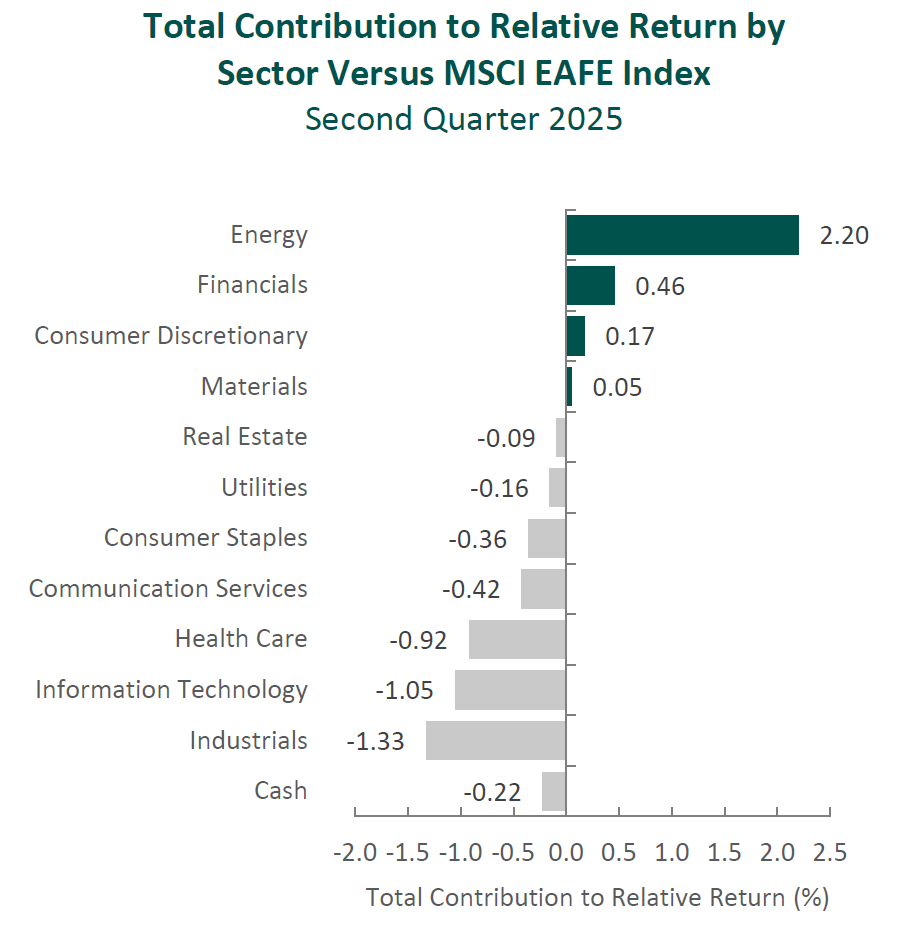
For more on International Equity, access the latest resources.