

Markets Review
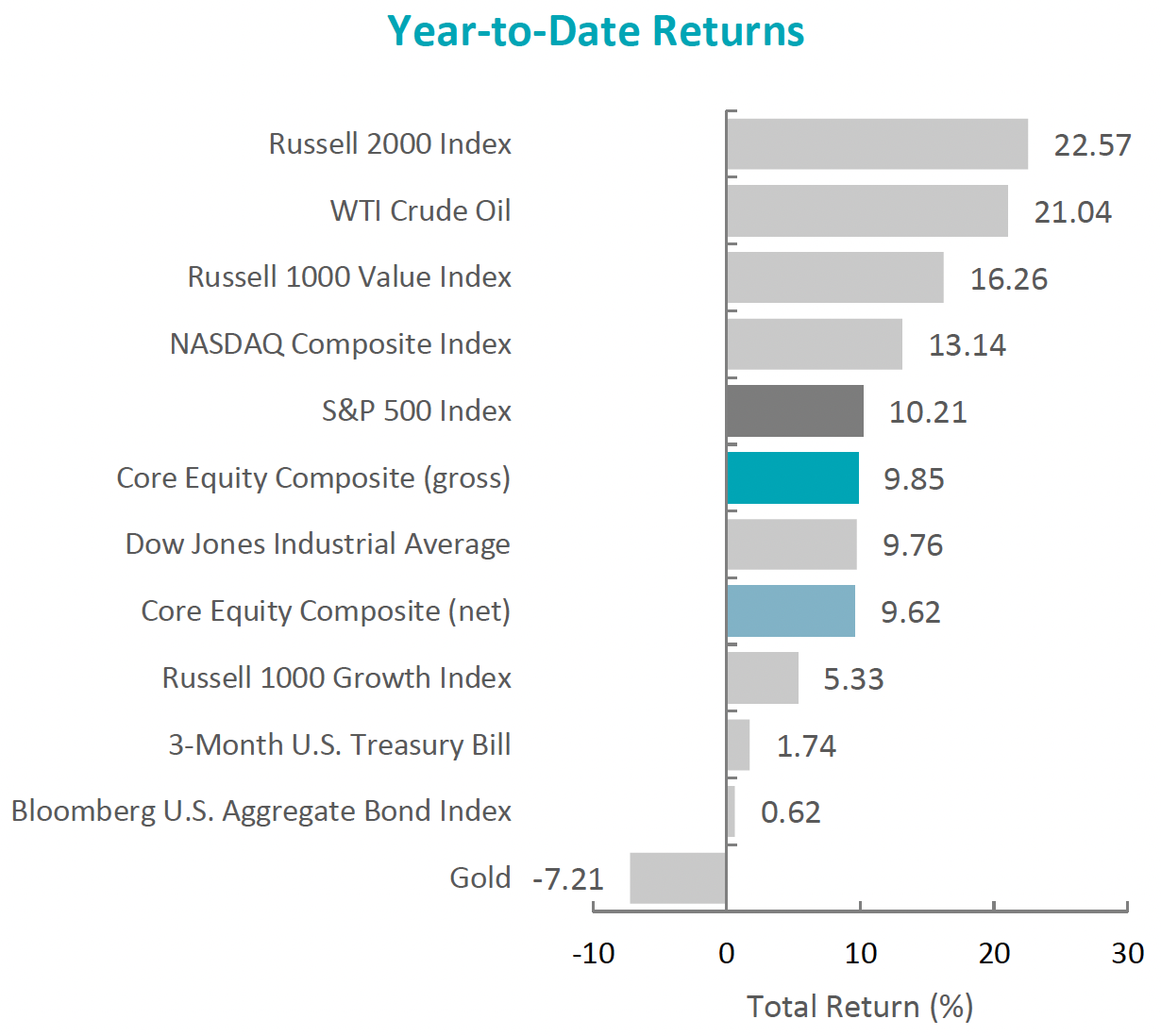
The U.S. equity market rebounded during the second quarter and reached new all-time highs, with the S&P 500 Index rising 15.20% during the period. Surging demand for artificial intelligence (AI) processing power and expansive capital expenditure plans continued to support AI-related businesses, which drove a substantial portion of benchmark returns and contributed meaningfully to earnings growth. Fixed income markets also advanced, as the Bloomberg U.S. Aggregate Bond Index increased 0.67%.
On a sector basis, ten of the eleven sectors within the Russell 1000 Growth Index posted gains in the second quarter of 2026. The strongest-performing sectors were Information Technology and Industrials. The weakest sectors were Energy and Consumer Staples.
Market leadership remained narrow and increasingly tied to the AI infrastructure buildout. Significant investment in semiconductors, memory and data center infrastructure continued to benefit a concentrated group of companies. While these themes supported benchmark returns, they also contributed to significant dispersion beneath the surface, as many resilient, cash-generative businesses outside the AI infrastructure ecosystem did not participate to the same degree.
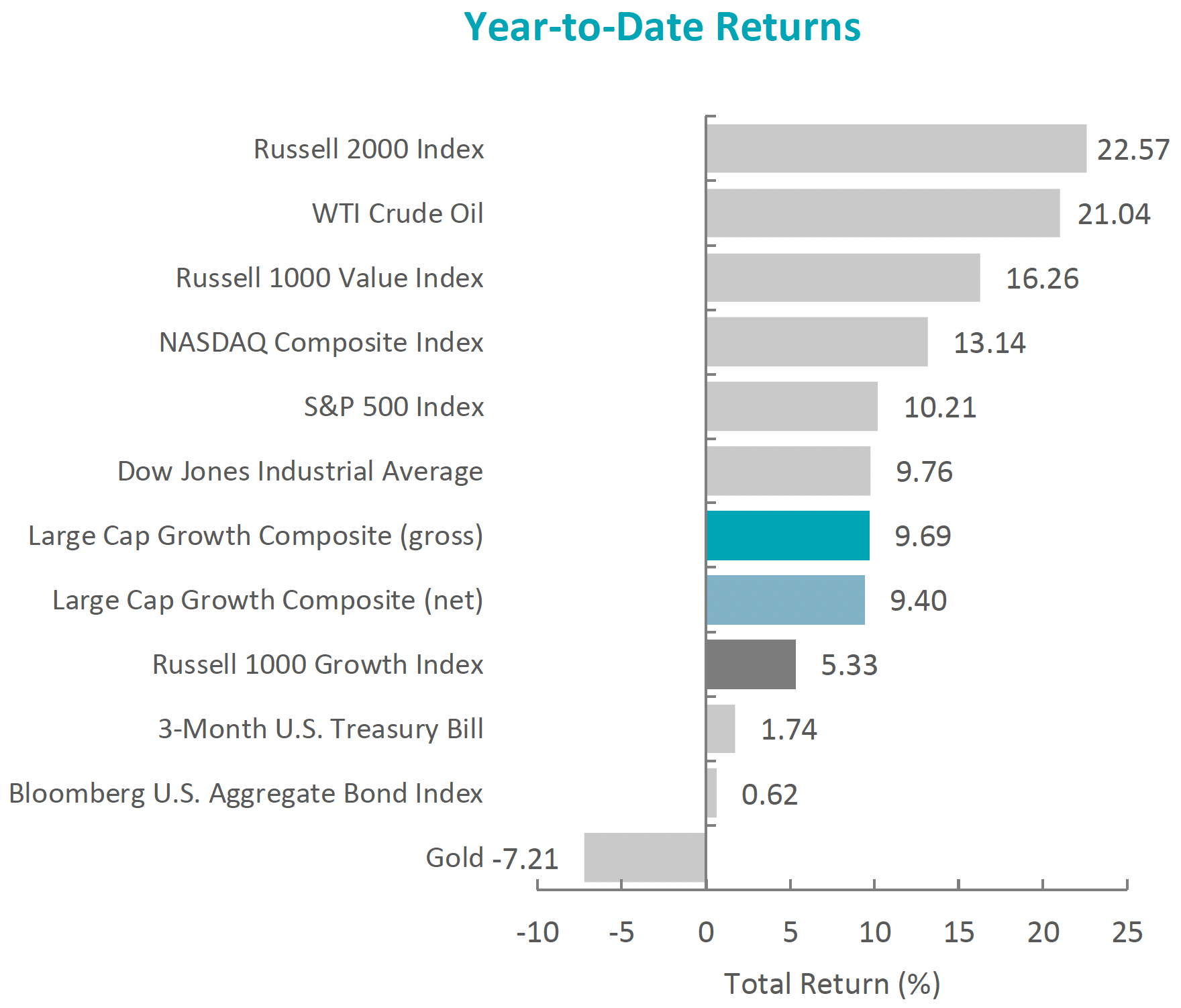
Sources: CAPS CompositeHubTM, Bloomberg
Past performance is not indicative of future results. Aristotle Atlantic Large Cap Growth Composite returns are presented gross and net of investment advisory fees and include the reinvestment of all income. Gross returns will be reduced by fees and other expenses that may be incurred in the management of the account. Net returns are presented net of actual investment advisory fees and after the deduction of all trading expenses. Please see important disclosures at the end of this document.
Geopolitics remained a key source of market uncertainty during the quarter. Peace negotiations between the U.S. and Iran proved volatile, with the reopening of the Strait of Hormuz, nuclear commitments, asset sanctions and regional economic development as primary points of discussion. An interim understanding between the two countries helped establish a ceasefire framework and restore maritime shipping in the region. However, tensions remained elevated, as both sides accused the other of violations, contributing to renewed U.S. strikes on Iran.
Against this backdrop, oil prices were volatile and continued to put upward pressure on inflation. The Consumer Price Index rose 4.2% for the 12 months ended May, compared with 3.8% for the 12 months ended April. Despite elevated inflation, real GDP growth accelerated, the unemployment rate remained stable at 4.3%, and consumer confidence improved in June from May’s record low. Given these conditions, the Federal Reserve maintained the target range for the federal funds rate as the Committee continued to balance its dual mandate of maximum employment and price stability.
Performance and Attribution Summary
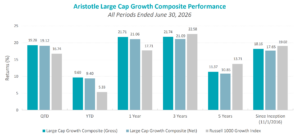
For the second quarter of 2026, Aristotle Atlantic’s Large Cap Growth Composite posted a total return of 19.28% gross of fees (19.12% net of fees), outperforming the 16.74% return of the Russell 1000 Growth Index.
| Performance (%) | QTD | YTD | 1 Year | 3 Years | 5 Years | Since Inception* |
|---|---|---|---|---|---|---|
| Large Cap Growth Composite (gross) | 19.28 | 9.69 | 21.71 | 21.74 | 11.37 | 18.16 |
| Large Cap Growth Composite (net) | 19.12 | 9.40 | 21.06 | 21.09 | 10.85 | 17.65 |
| Russell 1000 Growth Index | 16.74 | 5.33 | 17.71 | 22.58 | 13.71 | 19.02 |
Sources: FactSet
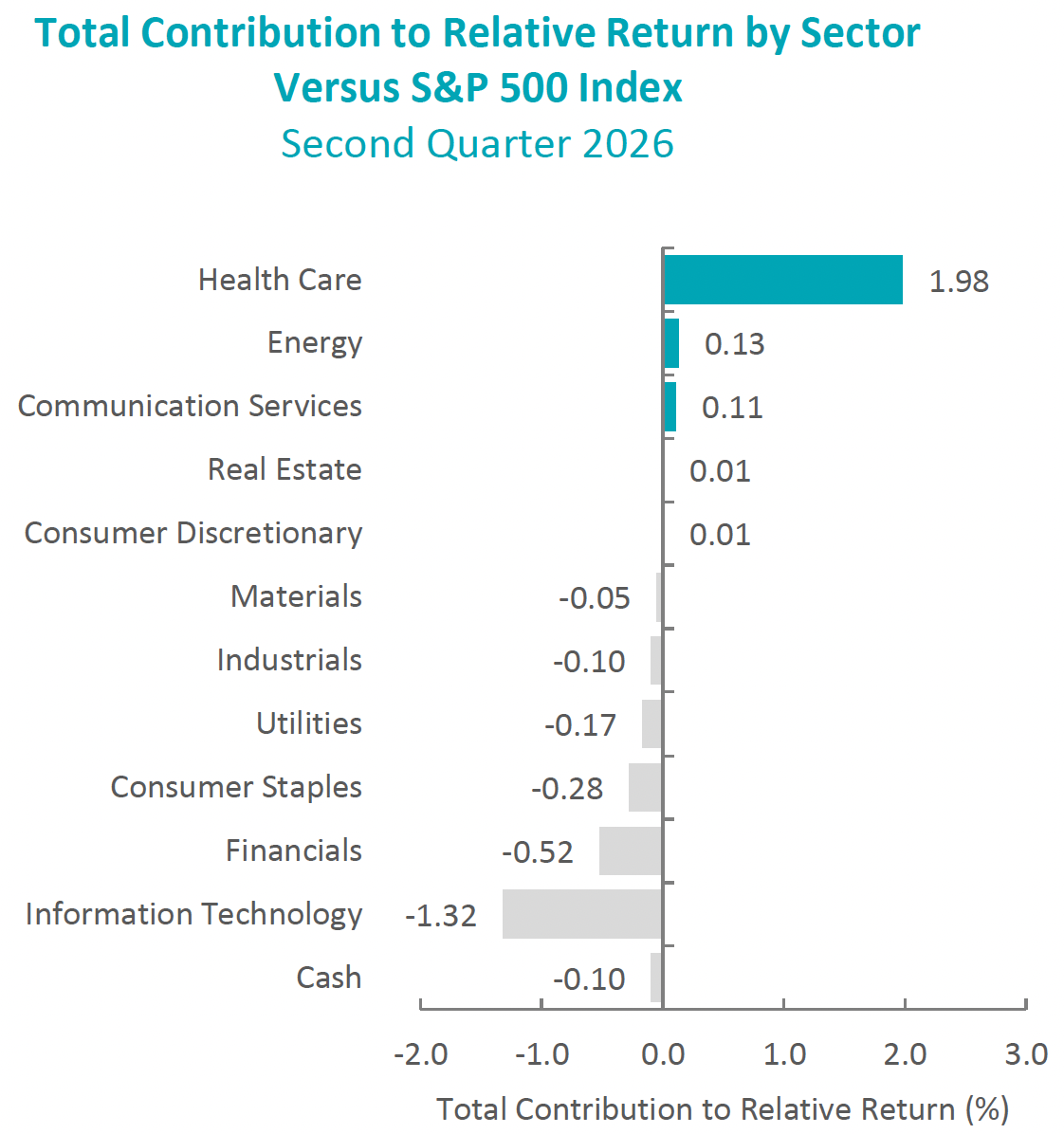
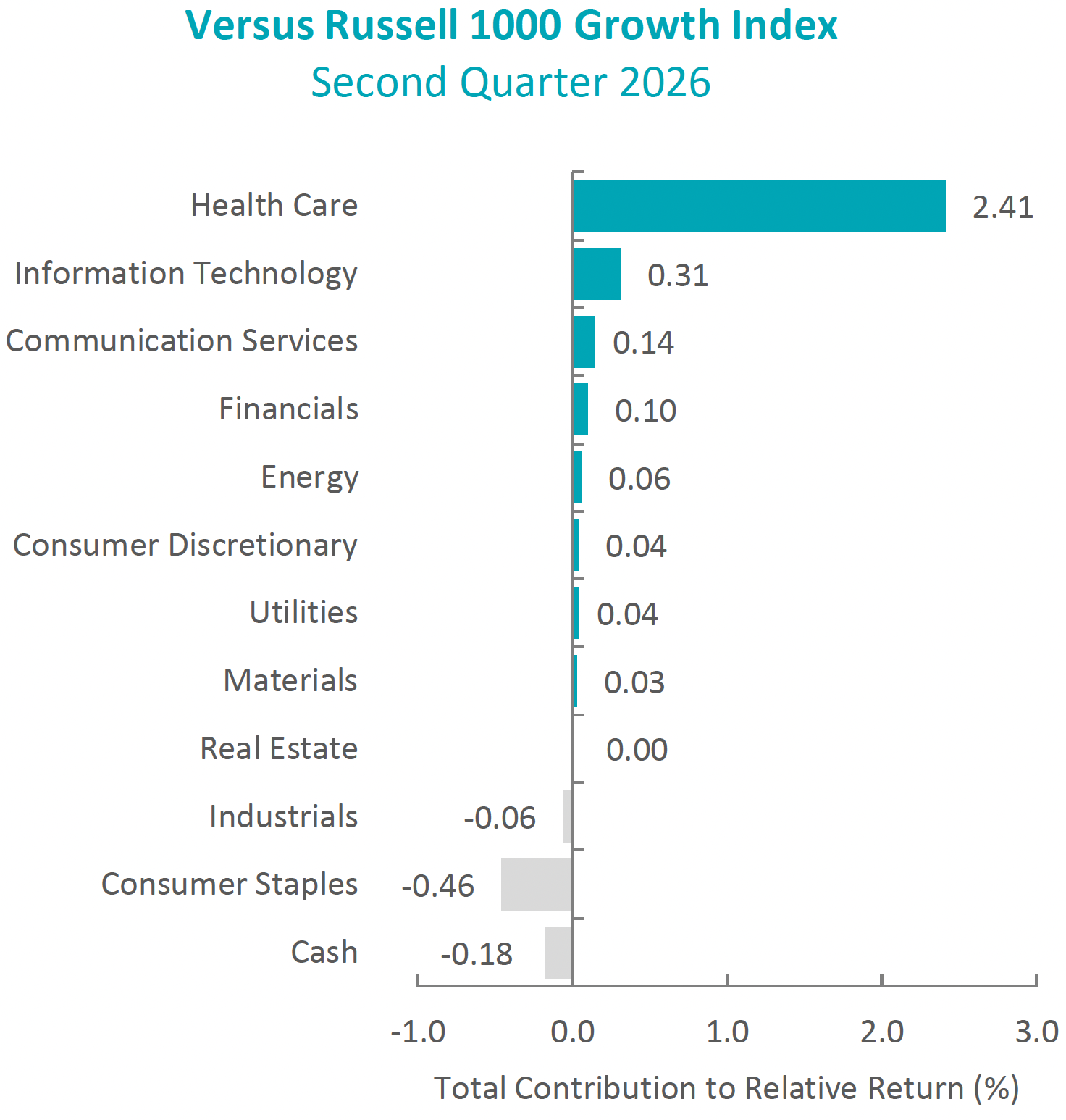
Past performance is not indicative of future results. Sector attribution shows how much of a portfolio’s overall return is directly attributable to stock selection and asset allocation decisions within the portfolio, highlighting which sectors contributed or detracted to the total return. Attribution includes the reinvestment of income. Attribution is presented gross of fees and does not include the deduction of all fees and expenses that a client or investor has paid or would have paid. Please refer to the gross and net composite returns included within to understand the overall impact of fees. Please see important disclosures at the end of this document.
During the second quarter, the portfolio’s outperformance relative to the Russell 1000 Growth Index was due to security selection, while allocation effects detracted. Security selection in Health Care and Information Technology contributed the most to relative performance. Conversely, security selection and an overweight in Consumer Staples detracted from relative performance.
Contributors and Detractors for 2Q 2026
| Relative Contributors | Relative Detractors |
|---|---|
| KLA Corporation | Darling Ingredients |
| Guardant Health | Oracle |
| CrowdStrike Holdings | Amphenol |
| Adaptive Biotechnologies | O’Reilly Automotive |
| Snowflake | S&P Global |
Relative contributors and detractors are based on attribution total effect and exclude benchmark securities not held in the portfolio.
Contributors
KLA Corporation
KLA Corporation contributed to performance in the second quarter, benefiting from the AI-driven WFE upcycle and reinforcing its position as the leading process control beneficiary of rising semiconductor manufacturing complexity. The company’s quarterly results highlighted the broad-based strength across process control, specialty process tools and advanced packaging tied to AI logic and high-bandwidth memory (HBM). Management raised its long-term outlook, underpinned by process control market share that has expanded to approximately 58%, over 4x its nearest competitor, as rising chip complexity (GAA, advanced nodes, HBM stacking) continues to lift process control intensity as a share of fab spend. This positioning was further validated in June, as Samsung and SK Hynix’s $515-$518 billion capacity expansion plan to double South Korean DRAM output drove strength in KLA’s shares, reinforcing the read-through from accelerating WFE spend (~$145B in 2026 toward ~$250B by 2028) directly into the company’s process control business.
Guardant Health
Guardant Health contributed to performance in the second quarter following a string of positive developments, as several catalysts played out during the quarter. These developments include FDA approval of an updated version of the Guardant360 liquid biopsy test, American Cancer Society inclusion of the company’s Shield test for colorectal cancer screening, and a report of stronger-than-expected first quarter earnings driven by volume growth and coverage expansion.
Detractors
Darling Ingredients
Darling Ingredients detracted from performance in the second quarter as the market digested outsized gains in Darling’s stock during the first quarter of 2026. In the second quarter, Darling announced better-than-expected earnings and raised full-year guidance. Several commodity-based indicators tied to Darling’s earnings drivers, including fat prices, renewable diesel margins and renewable identification numbers (RINs), remained supportive of the company’s earnings outlook for the remainder of 2026 and into 2027.
Oracle
Oracle detracted from performance in the second quarter amid a broader reversal in software sentiment, as investors continued to question SaaS durability and pricing power in an AI-native world following the “SaaSpocalypse” scare earlier in the year. Investors also remain cautious about the company’s AI spending plans and negative FCF, with fourth quarter 2025 results highlighting a surge in capex to nearly $56 billion and negative FCF of $24 billion. We continue to maintain a positive view on the name due to the large AI contracted RPO, attractive growth of its multi-cloud database business, and the view that fiscal year 2027 will mark the peak in capex intensity and a trough in negative FCF.
Recent Portfolio Activity
The table below shows all buys and sells completed during the quarter, followed by a brief rationale.
| Buys | Sells |
|---|---|
| Amphenol | Amphenol |
| Coherent | Antero Resources |
| ServiceNow | HubSpot |
| Sandisk | |
| Western Digital |
Buys
Amphenol
Amphenol is one of the world’s largest designers, manufacturers and marketers of electrical, electronic and fiber optic connectors and interconnect systems; antennas; sensors and sensor-based products; and coaxial, high-speed and specialty cable. Based on recent reports of industry analysts, the company estimates that worldwide sales of interconnect and sensor-related products were approximately $250 billion in 2024, reflecting continued growth driven by data communications, electrification, and aerospace and defense demand. The company aligns its businesses into three reportable business segments: (i) Harsh Environment Solutions, (ii) Communications Solutions and (iii) Interconnect and Sensor Systems. The company sells products to customers in a diversified set of end markets.
Our view on Amphenol centers on its diversified exposure across automotive, aerospace, defense, information technology datacom, mobile networks, industrial and other end markets, which provides resilience while positioning the company to benefit from multiple long-term growth themes. The company is a consolidator in a fragmented interconnect market, supported by a global manufacturing footprint, disciplined acquisition strategy and a track record of integrating deals that expand capabilities in fiber optics, defense interconnects, cable solutions, active optics and building connectivity. Its decentralized operating model, cost discipline, strong incremental margins, high returns on invested capital and equity, and robust free cash flow can support profitability and earnings growth. We believe demand from AI data centers and cloud infrastructure is a major growth driver, with Amphenol now spanning the full data center signal path across copper, power, fiber and optics, while broader electrification, factory automation, Industrial Internet of Things adoption, defense modernization and aerospace electronics provide additional multi-year demand tailwinds. Together, these factors can create a resilient, high-quality growth profile supported by disciplined capital allocation and continued opportunities for organic and acquisition-driven expansion. Amphenol trades above its recent historical valuation range after re-rating on the strength of its AI and data center business, as well as strong execution. We view the premium as justified given the company’s long record of trading at a meaningfully higher earnings multiple than the broader market. The main drivers of future valuation will likely be the durability of AI and data center growth, the pace of recovery in industrial demand, and continued value creation from acquisitions.
Coherent
Coherent is a vertically integrated manufacturing company that develops, manufactures and markets lasers, transceivers, and other optical and optoelectronic devices, modules, and systems, as well as engineered materials, for use in the communications, industrial, instrumentation and electronics markets. The company has broad technical expertise and a deep technology stack in areas of importance to its products. This includes materials growth and fabrication of specialty materials, semiconductor lasers and passive optics, including isolators, transceivers, transport equipment, higher-powered lasers for semiconductor capital equipment, display manufacturing, precision manufacturing and scientific research. Many of Coherent’s products include custom integrated software that it develops internally, leveraging the company’s deep domain expertise.
We believe Coherent offers a compelling long-term investment thesis as AI data centers shift from electrical copper connections to optical networking, creating a structural multi-year growth opportunity across scale-out, scale-up and data center interconnect applications. The company benefits from vertical integration across key photonic components, expanding indium phosphide manufacturing capacity, a geographically diversified and U.S.-centered supply chain, and a strategic partnership with NVIDIA that validates its position in co-packaged optics for next-generation data center architectures. In addition, Coherent has a large and expanding addressable market, a high-margin industrial business with recurring service and replacement revenue, and a portfolio streamlining program that reallocates investment toward higher-growth opportunities while using divestiture proceeds to reduce debt and support earnings growth.
Sandisk
We initiated Sandisk as a complementary picks-and-shovels investment opportunity tied to the AI memory bottleneck, with hard disk drives and flash memory now capacity-constrained inputs for AI data center expansion. These components are shifting away from commoditized consumer technology inputs, and we believe Sandisk can benefit from stronger pricing power, multi-year customer agreements, higher earnings and potential valuation multiple expansion.
Sandisk is a global developer and manufacturer of flash memory storage solutions headquartered in Milpitas, California, following its spinoff from Western Digital in February 2025. The company serves enterprise data centers, personal computers, smartphones and consumer devices through products including enterprise solid-state drives, client solid-state drives, embedded mobile storage, and branded removable and retail storage. Sandisk manufactures through its Flash Ventures joint venture with Kioxia, giving it access to advanced three-dimensional flash memory production at low-cost, capital-efficient economics, while retaining vertical integration in controller and firmware intellectual property, supported by a large patent portfolio. The company is increasingly focused on higher-value storage demand tied to AI data center growth.
We see Sandisk offering leveraged exposure to the AI-driven memory bottleneck, as flash memory and enterprise solid-state drives shift from commoditized components to strategically constrained inputs for data center growth. The investment case rests on stronger and more visible demand from hyperscale customers, improved industry supply discipline, multi-year customer agreements that provide floor-protected revenue, and a cleaner standalone structure following the separation from Western Digital. The company also benefits from its long-standing Flash Ventures partnership with Kioxia, which provides a cost and capital advantage, while new data center platform qualifications, high-bandwidth flash optionality and geopolitical support for trusted supply chains can create additional paths for earnings growth and valuation multiple expansion.
We believe Sandisk trades at a valuation that appears reasonable given improving earnings expectations, stronger AI memory demand and rising pricing power. We believe disciplined supply, contracted demand and a debt-free, cash-returning balance sheet should reduce earnings volatility and support a higher valuation over time.
ServiceNow
ServiceNow provides cloud-based software solutions that help enterprises worldwide define, structure, manage and automate services through its unified Now Platform, which serves as both the system of record and system of action for enterprise workflows across information technology operations, employee experience, customer operations and low-code development. The company’s revenue model is predominantly subscription-based, representing approximately 97% of total revenue, with subscriptions typically sold under multi-year contracts priced according to users, devices or capacity-based metrics. In fiscal year 2025, ServiceNow generated $13.3 billion in total revenue and $12.8 billion in subscription revenue, reflecting approximately 21% year-over-year growth. The platform supports approximately 100 billion workflows and trillions of transactions annually and serves many of the world’s largest enterprises across virtually every industry.
We think ServiceNow offers a compelling investment opportunity as the leading enterprise workflow automation platform, with deeply embedded, mission-critical software that creates high switching costs across information technology, human resources, customer service, security, risk, data analytics and AI orchestration. The company is positioned to benefit from AI rather than be disrupted by it, as its platform can serve as the governance and execution layer for enterprise agents, while products such as Now Assist, Artificial Intelligence Control Tower and Action Fabric expand usage-based monetization and cross-sell opportunities. Management is targeting more than $30 billion in subscription revenue by fiscal year 2030, supported by a large and expanding total addressable market, multiple growth vectors compounding at more than 25% annually, strong free cash flow generation, margin expansion, and a net cash balance sheet, potentially making ServiceNow one of the most durable and efficient large-scale software growth companies. The current valuation appears to overstate AI disruption risk and understate the durability of the company’s growth and cash generation.
Western Digital
We initiated Western Digital because we view the company as providing picks-and-shovels exposure to the AI memory bottleneck, with hard disk drives and NAND flash memory now serving as capacity-constrained inputs to AI data center buildout. These components are no longer commoditized inputs in consumer technology goods, and we see both Western Digital and Sandisk benefiting from stronger pricing power and multi-year customer agreements, resulting in upward earnings inflection and multiple expansion.
Western Digital is a pure-play developer and manufacturer of hard disk drives and data storage solutions focused on high-capacity storage for cloud and AI infrastructure. Following the February 2025 separation of its flash memory business into the independent company Sandisk, Western Digital has become one of the leading suppliers of nearline hard disk drives used by hyperscale cloud service providers to store large volumes of data economically. The company is vertically integrated across key components such as recording heads and magnetic media, operates a global manufacturing and testing footprint, and supports its product roadmap with advanced recording technologies and a large patent portfolio. With only three remaining global hard disk drive manufacturers and two scaled industry participants, Western Digital operates in a consolidated and supply-disciplined market that benefits from growing demand for AI data storage.
We believe Western Digital represents a compelling investment opportunity as hard disk drive demand shifts from a personal computer-driven cycle to a durable AI and cloud infrastructure growth story. The company benefits from a structurally improved industry with limited competition, disciplined capacity, multi-year customer agreements and rising pricing power as hyperscale customers prioritize secure storage supply for rapidly expanding data needs. This stronger market backdrop can translate into higher margins, improved earnings visibility, significant free cash flow generation and increased shareholder returns through dividends and share repurchases. With limited capital investment requirements, a cleaner balance sheet and sustained demand for economical mass storage, we believe Western Digital is positioned to compound earnings and cash flow over multiple years.
Western Digital Corporation has earned a higher valuation because its business profile has shifted from a cyclical hardware supplier to a more disciplined, cash-generative infrastructure company with stronger demand visibility. Continued growth in data storage needs, improved pricing power, durable margins, modest reinvestment requirements and meaningful shareholder returns support further earnings and cash flow compounding over time.
Sells
Amphenol
During the quarter, we sold Amphenol to reposition the portfolio toward more direct exposure to the optical interconnect transition. The sale reflected an evolving view of AI data center architecture rather than a negative view of Amphenol’s overall business quality. As rack-level power and bandwidth density requirements increase, we believed data center architectures could shift increasingly toward optics, creating uncertainty around the durability and valuation of Amphenol’s copper-related data center growth. After reassessing the company’s optical positioning and concluding that it is not simply at risk of being displaced by optics, but is increasingly positioned to participate directly in that transition, we subsequently repurchased the company. The CommScope Connectivity and Cable Solutions acquisition, together with Amphenol’s active-optics capabilities through XGiga and Halo, broadened its offering across high-speed copper, power, passive fiber and active optics. That reassessment was particularly relevant within the Large Cap Growth portfolio, where the emphasis is on durable, high-quality compounders with multiple growth drivers. Re-establishing the position allowed us to maintain exposure to the optical transition while restoring ownership of a company with diversified end markets, attractive margins, accretive M&A optionality and robust free cash flow generation.
Antero Resources
We sold Antero Resources, using the proceeds to increase our sector weighting in Information Technology.
HubSpot
We sold HubSpot because its core value proposition—an easy-to-use, all-in-one go-to-market platform—is becoming increasingly replicable by AI-native agents that can autonomously manage prospecting, lead nurturing and pipeline workflows without the need for a dedicated SaaS layer. HubSpot’s SMB-heavy customer base is especially price-sensitive and more exposed to churn as lower-cost AI-native alternatives emerge, creating risk to both net revenue retention and new logo growth. With the stock still valued for durable double-digit growth, we view the risk/reward as skewed to the downside.
Outlook
The equity markets in the second quarter increased mid-teens on the strength in technology and related companies tied into the AI infrastructure spend. Interest rates rose slightly for the quarter, as inflation continues to run above the Federal Reserve’s target level. There was a sizable decline in energy-related equities on the pullback in energy commodity prices. We view equity valuations on forward earnings expectations as reasonable, as the growth in earnings has continued to surprise to the upside. The economic data points to a moderately growing economy with lingering inflation, putting the Federal Reserve on hold with a bias toward a rate increase in the latter half of the year. The conflicts in Iran and Ukraine will likely continue to drive uncertainty, especially in the energy commodity space. Our focus will continue to be at the company level, with an emphasis on seeking to invest in companies with secular tailwinds or strong product-driven cycles.
The opinions expressed herein are those of Aristotle Atlantic Partners, LLC (Aristotle Atlantic) and are subject to change without notice. Past performance is not a guarantee or indicator of future results. This material is not financial advice or an offer to purchase or sell any product. You should not assume that any of the securities transactions, sectors or holdings discussed in this report were or will be profitable, or that recommendations Aristotle Atlantic makes in the future will be profitable or equal the performance of the securities listed in this report. The portfolio characteristics shown relate to the Aristotle Atlantic Large Cap Growth strategy. Not every client’s account will have these characteristics. Aristotle Atlantic reserves the right to modify its current investment strategies and techniques based on changing market dynamics or client needs. There is no assurance that any securities discussed herein will remain in an account’s portfolio at the time you receive this report or that securities sold have not been repurchased. The securities discussed may not represent an account’s entire portfolio and, in the aggregate, may represent only a small percentage of an account’s portfolio holdings. The performance attribution presented is of a representative account from Aristotle Atlantic’s Large Cap Growth Composite. The representative account is a discretionary client account which was chosen to most closely reflect the investment style of the strategy. The criteria used for representative account selection is based on the account’s period of time under management and its similarity of holdings in relation to the strategy. Recommendations made in the last 12 months are available upon request.
Past performance is not indicative of future results. Returns are presented gross and net of investment advisory fees and include the reinvestment of all income. Gross returns will be reduced by fees and other expenses that may be incurred in the management of the account. Net returns are presented net of actual investment advisory fees and after the deduction of all trading expenses.
All investments carry a certain degree of risk, including the possible loss of principal. Investments are also subject to political, market, currency and regulatory risks or economic developments. International investments involve special risks that may in particular cause a loss in principal, including currency fluctuation, lower liquidity, different accounting methods and economic and political systems, and higher transaction costs. These risks typically are greater in emerging markets. While Large-capitalization companies may have more stable prices than smaller, less established companies, they are still subject to equity securities risk. In addition, large-capitalization equity security prices may not rise as much as prices of equity securities of small-capitalization companies. Securities of small- and medium-sized companies tend to have a shorter history of operations and can be more volatile and less liquid. Value stocks can perform differently from the market as a whole and other types of stocks. The material is provided for informational and/or educational purposes only and is not intended to be and should not be construed as investment, legal or tax advice and/or a legal opinion. Investors should consult their financial and tax adviser before making investments. The opinions referenced are as of the date of publication, may be modified due to changes in the market or economic conditions, and may not necessarily come to pass. Information and data presented has been developed internally and/or obtained from sources believed to be reliable. Aristotle Atlantic does not guarantee the accuracy, adequacy or completeness of such information.
Aristotle Atlantic Partners, LLC is an independent registered investment adviser under the Advisers Act of 1940, as amended. Registration does not imply a certain level of skill or training. More information about Aristotle Atlantic, including our investment strategies, fees and objectives, can be found in our Form ADV Part 2, which is available upon request. AAP-2607-8
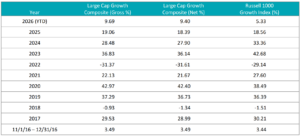
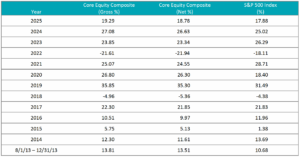
Sources: CAPS CompositeHubTM
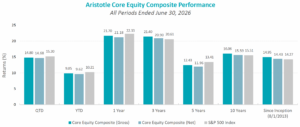
Past performance is not indicative of future results. Performance results for periods greater than one year have been annualized. Returns are presented gross and net of investment advisory fees and include the reinvestment of all income. Gross returns will be reduced by fees and other expenses that may be incurred in the management of the account. Net returns are presented net of actual investment advisory fees and after the deduction of all trading expenses.
The Russell 1000® Growth Index measures the performance of the large cap growth segment of the U.S. equity universe. It includes those Russell 1000 companies with higher price-to-book ratios and higher forecasted growth values. This index has been selected as the benchmark and is used for comparison purposes only. The Russell 1000® Value Index measures the performance of the large cap value segment of the U.S. equity universe. It includes those Russell 1000 companies with lower price-to-book ratios and lower expected growth values. The Russell 2000® Index measures the performance of the small cap segment of the U.S. equity universe. The Russell 2000 Index is a subset of the Russell 3000® Index representing approximately 10% of the total market capitalization of that index. It includes approximately 2000 of the smallest securities based on a combination of their market cap and current index membership. The S&P 500® Index is the Standard & Poor’s Composite Index of 500 stocks and is a widely recognized, unmanaged index of common stock prices. The Dow Jones Industrial Average® is a price-weighted measure of 30 U.S. blue-chip companies. The Index covers all industries except transportation and utilities. The NASDAQ Composite Index measures all NASDAQ domestic and international based common type stocks listed on The NASDAQ Stock Market. The NASDAQ Composite includes over 3,000 companies, more than most other stock market indices. The Bloomberg U.S. Aggregate Bond Index is an unmanaged index of domestic investment grade bonds, including corporate, government and mortgage-backed securities. The WTI Crude Oil Index is a major trading classification of sweet light crude oil that serves as a major benchmark price for oil consumed in the United States. The 3-Month U.S. Treasury Bill is a short-term debt obligation backed by the U.S. Treasury Department with a maturity of three months. The Consumer Price Index (CPI) is a measure of the average change over time in the prices paid by urban consumers for a market basket of consumer goods and services. While stock selection is not governed by quantitative rules, a stock typically is added only if the company has an excellent reputation, demonstrates sustained growth and is of interest to a large number of investors. The volatility (beta) of the Composite may be greater or less than its respective benchmarks. It is not possible to invest directly in these indices.