ARISTOTLE CAPITAL BOSTON, LLC

Markets Review

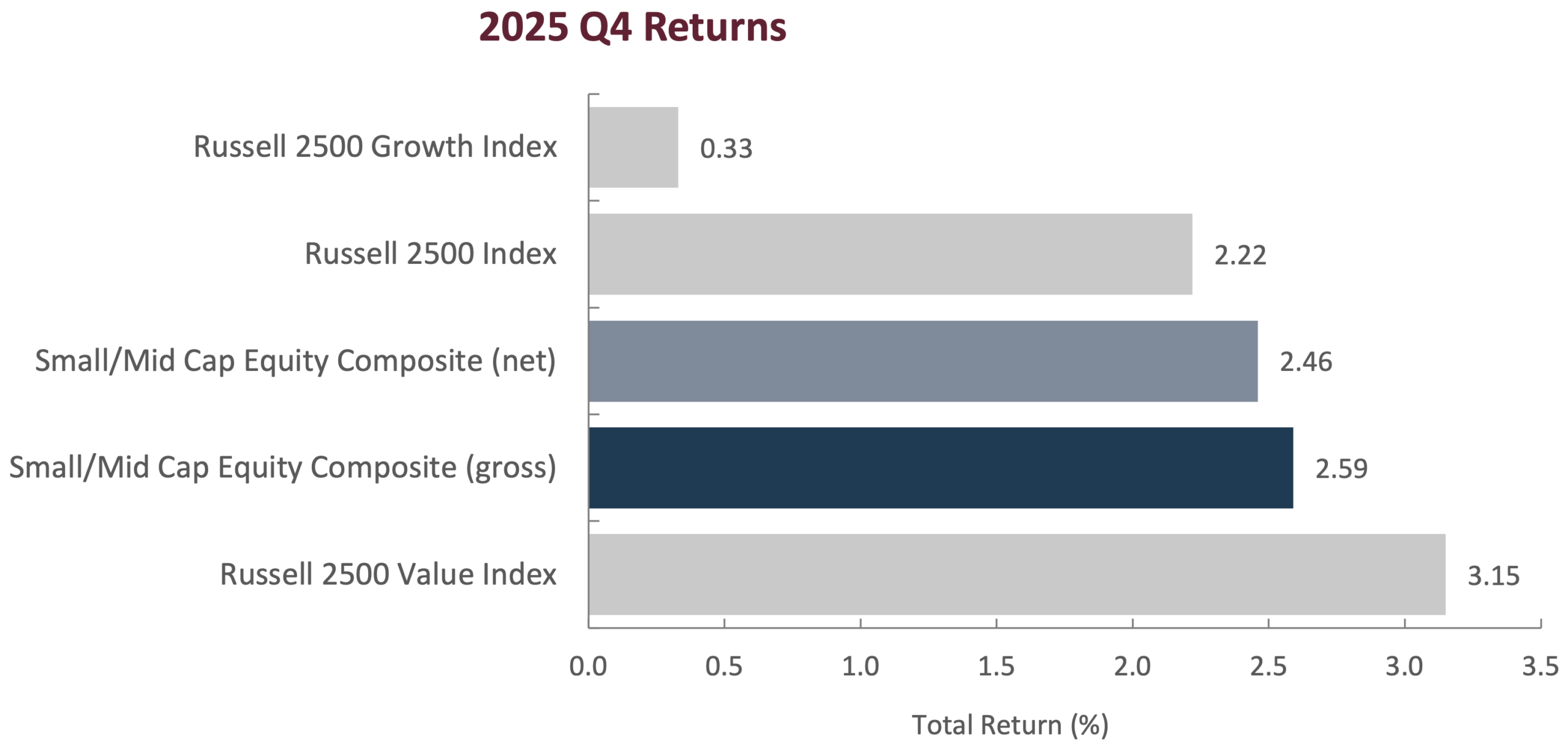
U.S. small/mid cap equities delivered moderate performance in the fourth quarter of 2025. The quarter began with a continuation of the post-Liberation Day risk-on market environment before a brief November sell-off due to growing concerns about a potential artificial intelligence capex bubble, valuations, and the market re-pricing the probability of December Fed rate cuts. The Russell 2500 ultimately rallied to a new all-time high in mid-December and finished the quarter +2.22% and +11.91% for the full year. The index posted a strong return despite geopolitical uncertainty and tariff concerns as optimism around AI-driven productivity and resilient consumer spending helped sustain gains. The rally occurred with a generally favorable macroeconomic backdrop, including a 25 basis point rate cut by the Federal Reserve in December. U.S. GDP growth remained strong at 4.3% in Q3, supported by stronger than anticipated consumer spending and positive trade developments. Inflation edged higher to 3.1%, driven in part by higher energy costs and tariff passthroughs, but remained within a manageable range for businesses and consumers. Small/mid caps benefited from attractive relative valuations, broadening of market breadth, earnings recovery and a rotation away from mega cap stocks.

Stylistically, value stocks outperformed their growth counterparts during the quarter as the Russell 2500 Value Index returned 3.15% compared to the 0.33% return of the Russell 2500 Growth index. This continues the 2024 trend where growth significantly outperformed value.

From a factor perspective, lower quality companies outperformed higher quality companies during the quarter. Factors that had the strongest payoffs were high bankruptcy risk, low sales growth, low enterprise value to EBITDA, high beta, low price to earnings, negative free cash flow, and non-earners.

At the sector level, there was mixed performance between cyclical and defensive stocks. The best performing sectors were Health Care (+12.37%), Communication Services (+3.51%), and Materials (+3.38%), while the worst performing sectors were Consumer Staples (-7.43%), Consumer Discretionary (-2.78%), and Utilities (-1.48%).
Sources: CAPS Composite Hub, Russell Investments

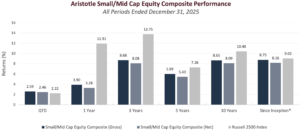
Sources: CAPS Composite Hub, Russell InvestmentsPast performance is not indicative of future results. Returns are presented gross and net of investment advisory fees and include the reinvestment of all income. Gross returns will be reduced by fees and other expenses that may be incurred in the management of the account. Net returns are presented net of actual investment advisory fees and after the deduction of all trading expenses. Aristotle Small/Mid Cap Equity Composite returns are preliminary pending final account reconciliation. Please see important disclosures at the end of this document.

Performance Review

For the fourth quarter of 2025, the Aristotle Small/Mid Cap Equity Composite generated a total return of 2.46% net of fees (2.59% gross of fees), outperforming the 2.22% total return of the Russell 2500 Index. The largest contributor to relative performance was security selection in Industrials and Information Technology coupled with underweight allocations to Consumer Discretionary and Real Estate. Security selection in Health Care (a combination of stocks we owned coupled with not owning biotechnology) and Consumer Discretionary coupled with overweight allocations to Consumer Staples and Energy detracted from performance.

Relative ContributorsRelative Detractors
CienaItron
MACOM Technology SolutionsEncompass Health
HaemoneticsWolverine World Wide
Advanced Energy IndustriesAcadia Healthcare
Huron Consulting GroupACI Worldwide

CONTRIBUTORS

Ciena (CIEN), is an optical networking equipment manufacturer for telecommunications and web scale network operators. The stock was bolstered due to strong earnings results and optimistic forward guidance driven by AI-related demand and technological innovation including dominating the market share for scale across data center projects in 2026. We believe the company is well-positioned to benefit from strong demand for bandwidth given its differentiated product portfolio and history of technological innovation, which should lead to strong operating results and shareholder value creation.

MACOM Technology Solutions (MTSI), is a designer and manufacturer of high-performance semiconductor products. The stock benefitted from strong quarterly results beating analyst expectations. We maintain our position, as we believe the company’s meaningful exposure to growing demand from Data Center and 5G end market applications along with the integration of recent acquisitions and domestic manufacturing footprint should continue to drive shareholder value.

DETRACTORS

Itron (ITRI), is a global manufacturer and distributor of electric, water and gas meters and advanced meter systems. Shares sold off following the 3Q25 earnings print due to slower than anticipated regulatory approvals; however, we believe that these challenges will be short-lived and expect an acceleration in 2026. We maintain a position, as we believe the company remains well-positioned to benefit from power grid modernization efforts, which should continue to drive demand for the company’s smart metering and grid monitoring solutions.

Encompass Health (EHC), is a provider of post-acute specialized rehabilitative inpatient treatment healthcare services. The company delivered mixed Q3 results, however management raised forward guidance and continues to execute on their plan to strategically add capacity with the anticipated roll out of small format hospitals in 2027. We maintain our position, as we believe favorable demographics trends and a stable reimbursement outlook will provide attractive growth potential for the company.

Recent Portfolio Activity

Buys/AcquisitionsSells/Liquidations
Atlantic Union BanksharesCarlisle Companies
BJ’s Wholesale Club HoldingsChart Industries
IDACORPeHealth
NovantaNorthWestern
Perella Weinberg PartnersNu Skin Enterprises
UGI CorporationPatterson-UTI Energy
TreeHouse Foods
Westinghouse Air Brake Technologies

BUYS/ACQUISITIONS

Atlantic Union Bankshares (AUB), is a VA-based, bank holding company serving the VA, DC, MD and NC markets.  Concerns about the potential negative impact to banking customers in their served markets from DOGE-related cuts created an opportunity to build a position in the company.  Given the company’s diversified customer base, growing market share from increased scale following a meaningful market expanding acquisition and solid balance sheet, we believe that the DOGE-related overhang presents an attractive opportunity to own a high-quality bank led by a strong management team that should drive capital appreciation for shareholders.

BJ’s Wholesale Club Holdings (BJ), is a MA-based retailer operating membership warehouse clubs that sell a wide variety of goods from groceries and housewares to electronics, appliances and jewelry. With the company benefitting from better than expected performance from recently opened stores that highlights their strong fundamental execution and a pipeline of new stores in development, we believe that management should be able to continue these efforts to grow shareholder value over the next several years.

IDACORP (IDA), is an ID-based, vertically integrated electric utility that provides service to customers in southern Idaho and eastern Oregon. Strong industrial load growth and robust population migration into its service territory, combined with critical regional transmission opportunities, underpin the company’s robust five-year capital plan and double-digit rate base growth outlook. We believe this expansion, facilitated by a constructive regulatory environment and a proven management team, should drive consistent earnings growth and long-term capital appreciation for shareholders.

Novanta (NOVT), is a MA-based supplier of advanced photonics, vision, and precision motion technologies that power high‑performance medical, life science, and industrial automation applications. Supply chain disruption, tariffs, and soft end-markets have weighed on gross margin expansion over the last two years. With these headwinds abating and a strong pipeline of new design wins, the company is expected to return to solid, above average revenue and earnings growth driven, in part, by higher-margin new products, site consolidation, and lean initiatives.

Perella Weinberg Partners (PWP), is a boutique investment bank that has been investing in incremental deal capacity through strategic hires of experienced investment bankers. An expected upturn in M&A activity over the next several years following a period of below average activity should allow the company to operationally leverage the investments they’ve been making during the downturn. Deal pipelines remain near all-time highs, activity is increasing, and the market is pricing in future modest interest rate cuts, which increases confidence that sustained M&A volume recovery is growing. This environment should allow the company to generate shareholder value over the coming years.

UGI Corporation (UGI), is a PA-based energy infrastructure company operating regulated natural gas utilities, midstream and marketing assets, AmeriGas retail propane distribution, and international LPG services. Under the leadership of a new, highly experienced and highly respected CEO, UGI is implementing an operational reset at AmeriGas while executing a strategic pivot toward its stable utility footprint and underappreciated Midstream assets that we believe are well positioned to capitalize on regional demand. This management-led transformation, coupled with non-core divestitures and an improving balance sheet, should drive greater predictability and support a more durable long-term earnings growth profile.

SELLS/LIQUIDATIONS

Carlisle Companies (CSL), is a diversified industrial manufacturer of nonresidential roofing materials and industrial connectivity products. The position appreciated during the holding period and was liquidated to redeploy capital to new opportunities for future upside potential.

Chart Industries (GTLS), is a manufacturer of engineering equipment for the industrial gas, energy, and biomedical industries. The company is being acquired by Baker Hughes (BKR).

eHealth (EHTH), is a provider of Internet-based health insurance agency services for individuals, families, and small businesses operating through Medicare, employer and individual business segments. The position was liquidated due to deteriorated fundamental performance and an uncertain strategic outlook.

NorthWestern (NWE), generates, transmits, and distributes regulated electricity and natural gas to customers across Montana, South Dakota, and Nebraska. The position was sold following its all-stock merger announcement with Black Hills (BKH). We decided to step aside while we evaluate the combined entity’s integration timeline and future regulatory considerations from the sidelines.

Nu Skin Enterprises (NUS), is a developer and distributor of beauty and wellness solutions. The position was liquidated due to deteriorated fundamental performance and an ongoing strategic transformation with an uncertain fundamental outlook.

Patterson-UTI Energy (PTEN), is an oilfield services company focused on drilling and pressure pumping solutions for both major oil companies and independent operators. The position was liquidated due to the energy market outlook weakening thus deteriorating fundamental performance.

TreeHouse Foods (THS), is a manufacturer and distributor of private label packaged foods and beverages in North America. Its product portfolio includes snacking, beverages, and meal preparation products, available in shelf stable, refrigerated, frozen, and fresh formats. The position was liquidated ahead of its pending acquisition by a private equity consortium.

Westinghouse Air Brake Technologies (WAB), is provider of equipment, systems, and value-added services for the rail industry. This was a long-time position that successfully grew from the small cap space to a large cap company beyond the strategy’s intended investment universe. We redeployed the capital to new positions that we believe present the opportunity for future upside potential.

Outlook

We remain optimistic about the long-term potential for the small/mid-cap segment of the U.S. market. Valuations remain compelling relative to large caps, with the Russell 2500 Index trading near the lower end of its historical range. Potential tailwinds, including deregulation, lower corporate tax rates, increased M&A activity, continued reshoring of U.S. manufacturing, and infrastructure-related spending, could provide additional support for small/mid-cap stocks. Volatility remains elevated over concerns around inflationary risks, geopolitical tensions, and potential U.S. economic and labor weakness.

Positioning

Our current positioning is a function of our bottom-up security selection process and our ability to identify what we view as attractive investment candidates, regardless of economic sector definitions. Overweights in Information Technology and Materials are mostly a function of our underlying company specific views rather than any top-down predictions for each sector. Conversely, we continue to be underweight in Consumer Discretionary, as we have been unable to identify what we consider to be compelling long-term opportunities that fit our discipline given the rising risk profiles of many retail businesses and a potential deceleration in goods spending following a period of strength. We are also underweight in Financials as the sector has experienced strong returns, leading us to harvest gains and redeploy the proceeds to what we consider to be more attractive reward to risk opportunities. Given our focus on long-term business fundamentals, our patient investment approach and low portfolio turnover, the strategy’s sector positioning generally does not change significantly from quarter to quarter. However, we may take advantage of periods of volatility by adding selectively to certain companies when appropriate.

Disclosures

The opinions expressed herein are those of Aristotle Capital Boston, LLC (Aristotle Boston) and are subject to change without notice.

Past performance is not indicative of future results. The information provided in this report should not be considered financial advice or a recommendation to purchase or sell any particular security. There is no assurance that any securities discussed herein will remain in an account’s portfolio at the time you receive this report or that securities sold have not been repurchased. The securities discussed may not represent an account’s entire portfolio and, in the aggregate, may represent only a small percentage of an account’s portfolio holdings. The performance attribution presented is of a representative account from Aristotle Boston’s Small/Mid Cap Equity Composite. The representative account is a discretionary client account which was chosen to most closely reflect the investment style of the strategy. The criteria used for representative account selection is based on the account’s period of time under management and its similarity of holdings in relation to the strategy. It should not be assumed that any of the securities transactions, holdings or sectors discussed were or will be profitable, or that the investment recommendations or decisions Aristotle Boston makes in the future will be profitable or equal the performance of the securities discussed herein. Aristotle Boston reserves the right to modify its current investment strategies and techniques based on changing market dynamics or client needs. Recommendations made in the last 12 months are available upon request.

Returns are presented gross and net of investment advisory fees and include the reinvestment of all income. Gross returns will be reduced by fees and other expenses that may be incurred in the management of the account. Net returns are presented net of actual investment advisory fees and after the deduction of all trading expenses.

As of December 31, 2014, there were no non-fee-paying accounts in the Composite.

All investments carry a certain degree of risk, including the possible loss of principal. Investments are also subject to political, market, currency and regulatory risks or economic developments. International investments involve special risks that may in particular cause a loss in principal, including currency fluctuation, lower liquidity, different accounting methods and economic and political systems, and higher transaction costs. These risks typically are greater in emerging markets. While Large-capitalization companies may have more stable prices than smaller, less established companies, they are still subject to equity securities risk. In addition, large-capitalization equity security prices may not rise as much as prices of equity securities of small-capitalization companies. Securities of small- and medium-sized companies tend to have a shorter history of operations, be more volatile and less liquid. Value stocks can perform differently from the market as a whole and other types of stocks. The material is provided for informational and/or educational purposes only and is not intended to be and should not be construed as investment, legal or tax advice and/or a legal opinion. Investors should consult their financial and tax adviser before making investments. The opinions referenced are as of the date of publication, may be modified due to changes in the market or economic conditions, and may not necessarily come to pass. Information and data presented has been developed internally and/or obtained from sources believed to be reliable. Aristotle Boston does not guarantee the accuracy, adequacy or completeness of such information.

Aristotle Capital Boston, LLC is an independent investment adviser registered under the Investment Advisers Act of 1940, as amended. Registration does not imply a certain level of skill or training. More information about Aristotle Boston, including our investment strategies, fees and objectives, can be found in our Form ADV Part 2, which is available upon request. ACB-2601-12
Performance Disclosures

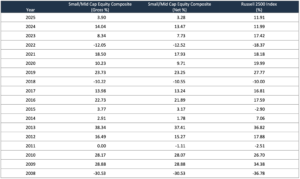
Sources: CAPS Composite Hub, Russell Investments

Composite returns for periods ended December 31, 2025, are final.

*The Aristotle Small/Mid Cap Equity Composite has an inception date of January 1, 2008, at a predecessor firm. During this time, Jack McPherson and Dave Adams had primary responsibility for managing the strategy. Performance starting January 1, 2015, was achieved at Aristotle Boston.

As of December 31, 2014, there were no non-fee-paying accounts in the Composite. Past performance is not indicative of future results. Performance results for periods greater than one year have been annualized.

Returns are presented gross and net of investment advisory fees and include the reinvestment of all income. Gross returns will be reduced by fees and other expenses that may be incurred in the management of the account. Net returns are presented net of actual investment advisory fees and after the deduction of all trading expenses. Please see important disclosures enclosed within this document.

Index Disclosures

The Russell 2500® Index measures the performance of the small to mid cap segment of the U.S. equity universe. The Russell 2500 Index is a subset of the Russell 3000® Index. It includes approximately 2500 of the smallest securities based on a combination of their market cap and current index membership. The Russell 2500 Growth® Index measures the performance of the small/mid cap companies located in the United States that also exhibit a growth probability. The Russell 2500 Value® Index measures the performance of the small/mid cap companies located in the United States that also exhibit a value probability. The volatility (beta) of the composite may be greater or less than the benchmarks. It is not possible to invest directly in these indices.

For more on Small Cap Equity, access the latest resources.

ARISTOTLE CAPITAL BOSTON, LLC

Markets Review

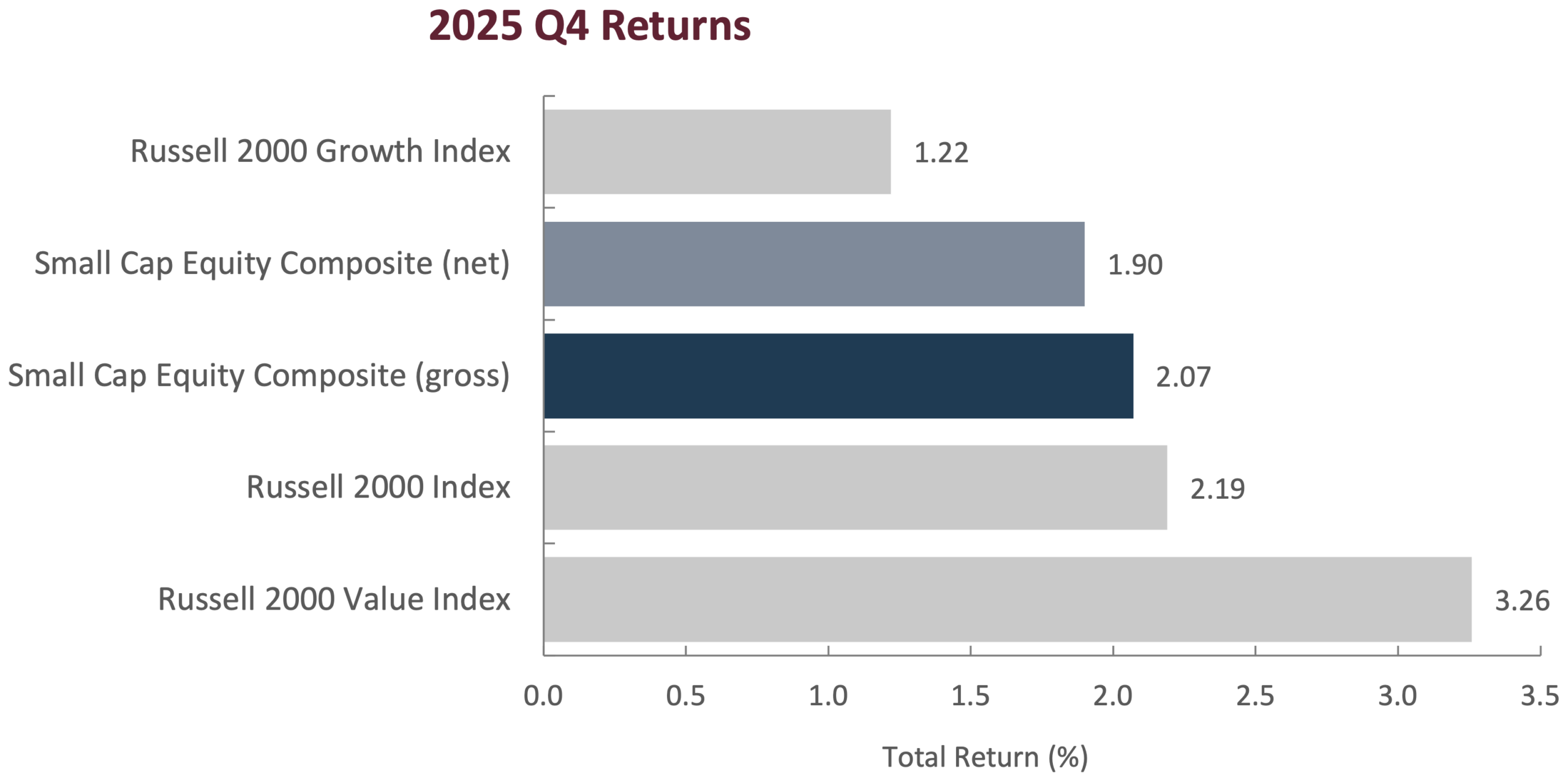
U.S. small cap equities delivered moderate performance in the fourth quarter of 2025. The quarter began with a continuation of the post-Liberation Day risk-on market environment before a brief November sell-off due to growing concerns about a potential artificial intelligence capex bubble, valuations, and the market re-pricing the probability of December Fed rate cuts. The Russell 2000 ultimately rallied to a new all-time high in mid-December and finished the quarter +2.19% and +12.81% for the full year. The index posted a strong return despite geopolitical uncertainty and tariff concerns as optimism around AI-driven productivity and resilient consumer spending helped sustain gains. The rally occurred with a generally favorable macroeconomic backdrop, including a 25 basis point rate cut by the Federal Reserve in December. U.S. GDP growth remained strong at 4.3% in Q3, supported by stronger than anticipated consumer spending and positive trade developments. Inflation edged higher to 3.1%, driven in part by higher energy costs and tariff passthroughs, but remained within a manageable range for businesses and consumers. Small caps benefited from attractive relative valuations, broadening of market breadth, earnings recovery and a rotation away from mega cap stocks.

Stylistically, value stocks outperformed their growth counterparts during the quarter as the Russell 2000 Value Index returned 3.26% compared to the 1.22% return of the Russell 2000 Growth index. This may be counterintuitive as growth factors mainly drove the market but the Russell 2000 Value Index’s financials sector weight (2.6x larger than the Russell 2000 Growth Index) significantly benefitted from the cut in interest rates.

From a factor perspective, lower quality companies outperformed higher quality companies during the quarter. Factors that had the strongest payoffs were high bankruptcy risk, low sales growth, low enterprise value to EBITDA, high beta, low price to earnings, negative free cash flow, and non-earners.

At the sector level, there was mixed performance between cyclical and defensive stocks. The best performing sectors were Health Care (+18.54%), Materials (+5.05%), and Communication Services (+4.24%) while the worst performing sectors were Consumer Staples (-4.57%), Information Technology (-4.52%), and Consumer Discretionary (-4.16%).


Sources: CAPS Composite Hub, Russell Investments
Past performance is not indicative of future results. Returns are presented gross and net of investment advisory fees and include the reinvestment of all income. Gross returns will be reduced by fees and other expenses that may be incurred in the management of the account. Net returns are presented net of actual investment advisory fees and after the deduction of all trading expenses. Aristotle Small Cap Equity Composite returns are preliminary pending final account reconciliation. Please see important disclosures at the end of this document.

Performance Review

For the fourth quarter of 2025, the Aristotle Small Cap Equity Composite posted a total return of 1.90% net of fees (2.07% gross of fees), underperforming the 2.19% total return of the Russell 2000 Index. Security selection aided overall performance while allocation effects detracted. The largest detractors from relative performance at the sector level were security selection coupled with an underweight allocation to Health Care (a combination of stocks we owned and not owning biotechnology), security selection in Energy, and an overweight allocation to Industrials. This was largely offset by strong security selection in the Industrials and Information Technology (not owning quantum computing stocks and non-earning SaaS companies) sectors coupled with underweight allocations to Consumer Discretionary and Utilities.

Relative ContributorsRelative Detractors
MACOM Technology SolutionsItron
HaemoneticsAcadia Healthcare
Huron Consulting GroupCross Country Healthcare
Advanced Energy IndustriesACI Worldwide
AerCap HoldingsValvoline

CONTRIBUTORS

MACOM Technology Solutions (MTSI), is a designer and manufacturer of high-performance semiconductor products. The stock benefitted from strong quarterly results beating analyst expectations. We maintain our position, as we believe the company’s meaningful exposure to growing demand from Data Center and 5G end market applications along with the integration of recent acquisitions and domestic manufacturing footprint should continue to drive shareholder value.

Haemonetics (HAE), is a global provider of hematology and blood management products and solutions. The company reported strong earnings beating analyst expectations. We believe that the company’s strong competitive position within the plasmapheresis market along with increased investment in research and development should create value for shareholders over a multi-year period.

DETRACTORS

Itron (ITRI), is a global manufacturer and distributor of electric, water and gas meters and advanced meter systems. Shares sold off following the 3Q25 earnings print due to slower than anticipated regulatory approvals; however, we believe that these challenges will be short-lived and expect an acceleration in 2026. We maintain a position, as we believe the company remains well-positioned to benefit from power grid modernization efforts, which should continue to drive demand for the company’s smart metering and grid monitoring solutions.

Acadia Healthcare (ACHC), is a behavioral healthcare and substance abuse treatment services company. Shares sold off following mixed 3Q25 earnings results. While earnings beat estimates, management reduced forward guidance causing the stock to sell-off. The company expects to reduce capex plans and focus on improving the operational strength of the business, which should improve free cash flow. We continue to believe the company is well positioned to be an important part of the solution to an unfortunately growing need for behavioral health services.

Recent Portfolio Activity

Buys/AcquisitionsSells/Liquidations
AptarGroupChart Industries
Atlantic Union BankshareseHealth
Cohen & SteersNu Skin Enterprises
IDACORPPatterson-UTI Energy
LKQ CorporationTitan Machinery
Perella Weinberg PartnersTreeHouse Foods
Primo BrandsVeeco Instruments
WesBancoVeritex Holdings
Westinghouse Air Brake Technologies

BUYS/ACQUISITIONS

AptarGroup (ATR), is a global packaging company focused on the design and manufacturing of dosing, dispensing, and protection technologies, serving multiple industries, including pharmaceutical, beauty, personal care, home care, and food and beverage. A combination of a cyclical rebound in demand plus the growth and financial benefits of the company’s continued investment in its pharmaceutical products division should position the company to create shareholder value over the next several years.

Atlantic Union Bankshares (AUB), is a VA-based, bank holding company serving the VA, DC, MD and NC markets.  Concerns about the potential negative impact to banking customers in their served markets from DOGE-related cuts created an opportunity to build a position in the company.  Given the company’s diversified customer base, growing market share from increased scale following a meaningful market expanding acquisition and solid balance sheet, we believe that the DOGE-related overhang presents an attractive opportunity to own a high-quality bank led by a strong management team that should drive capital appreciation for shareholders.

Cohen & Steers (CNS), is a real estate-focused investment management firm with products targeting both institutional and retail investors. The move higher in interest rates over the past several years combined with strong equity market performance led to a period of anemic new business flows for the company.  With interest rates moving lower and equity market valuations near all-time highs, the company has begun to see improved new business activity, which should allow them to begin to grow earnings again. The company also maintains solid cash and cash equivalent levels that position it to potentially take advantage of acquisition or share repurchase opportunities.

IDACORP (IDA), is an ID-based, vertically integrated electric utility that provides service to customers in southern Idaho and eastern Oregon. Strong industrial load growth and robust population migration into its service territory, combined with critical regional transmission opportunities, underpin the company’s robust five-year capital plan and double-digit rate base growth outlook. We believe this expansion, facilitated by a constructive regulatory environment and a proven management team, should drive consistent earnings growth and long-term capital appreciation for shareholders.

LKQ Corporation (LKQ), is a North American market leader in alternative collision repair parts with expertise stemming across used, recycled, refurbished, and remanufactured collision repair parts as well as the market for (new) aftermarket collision repair, was added to the portfolio. Overall, we believe the company maintains favorable scale advantages that allow for volume purchase discounts from suppliers and a wider distribution network, higher fill rates, and faster response times relative to competition. Furthermore, the company has made investments in improving its technology and logistics network beyond that of its smaller competitors, which we believe will further cement its market position through technological sophistication.

Perella Weinberg Partners (PWP), is a boutique investment bank that has been investing in incremental deal capacity through strategic hires of experienced investment bankers. An expected upturn in M&A activity over the next several years following a period of below average activity should allow the company to operationally leverage the investments they’ve been making during the downturn. Deal pipelines remain near all-time highs, activity is increasing, and the market is pricing in future modest interest rate cuts, which increases confidence that sustained M&A volume recovery is growing. This environment should allow the company to generate shareholder value over the coming years.

Primo Brands (PRMB), is a branded beverage company focused on healthy hydration. The company is the top player in U.S. bottled water with approximately 19% market share. The portfolio of brands is well diversified across distribution channels, product format, sizes and price points that allow the company to cost efficiently reach 90% of the U.S. population. Increasing consumption of bottled water should be supported by concerns about municipal tap water quality, the wellness movement leading to lower consumption of soda, juice, and alcoholic beverages, and innovation in water flavors and premium products attracting consumers toward the category.

WesBanco (WSBC), is a WV-based, bank holding company serving WV, OH, Western PA, KY, Southern IN and MD.  that provides financial services to regional community banks. The company’s regional strength in the Mid-Atlantic and Midwest markets is bolstered by a stable financial base, deep local roots, and a diversified product mix spanning personal, commercial, and institutional services. We believe the company is well positioned to capitalize on trust and deposit opportunities, ramp up small business and middle market C&I growth, add high-quality lenders by leveraging their cheap deposit base to expand into new markets, and remain engaged in potential M&A opportunities which should drive capital appreciation for shareholders.

SELLS/LIQUIDATIONS

Chart Industries (GTLS), is a manufacturer of engineering equipment for the industrial gas, energy, and biomedical industries. The company is being acquired by Baker Hughes (BKR).

eHealth (EHTH), is a provider of Internet-based health insurance agency services for individuals, families, and small businesses operating through Medicare, employer and individual business segments. The position was liquidated due to deteriorated fundamental performance and an uncertain strategic outlook.

Nu Skin Enterprises (NUS), is a developer and distributor of beauty and wellness solutions. The position was liquidated due to deteriorated fundamental performance and an ongoing strategic transformation with an uncertain fundamental outlook.

Patterson-UTI Energy (PTEN), is an oilfield services company focused on drilling and pressure pumping solutions for both major oil companies and independent operators. The position was liquidated due to the energy market outlook weakening thus deteriorating fundamental performance.

Titan Machinery (TITN), is a manager of agricultural and construction equipment stores operating through the agriculture, construction, European, and Australian market segments. The position was liquidated due to deteriorated fundamental performance and an uncertain strategic outlook.

TreeHouse Foods (THS), is a manufacturer and distributor of private label packaged foods and beverages in North America. Its product portfolio includes snacking, beverages, and meal preparation products, available in shelf stable, refrigerated, frozen, and fresh formats. The position was liquidated ahead of its pending acquisition by a private equity consortium.

Veeco Instruments (VECO), is a company focused on the development, manufacture, sale, and support of semiconductor process equipment. The company is being acquired by Axcelis Technologies (ACLS).

Veritex Holdings (VBTX), is the holding company for Veritex Community Bank that provides various commercial banking products and services to small and medium-sized businesses, and professionals. The company was acquired by Huntington Bancshares (HBAN).

Westinghouse Air Brake Technologies (WAB), is provider of equipment, systems, and value-added services for the rail industry. This was a long-time position that successfully grew from the small cap space to a large cap company beyond the strategy’s intended investment universe. We redeployed the capital to new positions that we believe present the opportunity for future upside potential.

Outlook

We continue to remain optimistic about the long-term potential for the small-cap segment of the U.S. market. Valuations remain compelling relative to large caps, with the Russell 2000 Index trading near multi-decade lows on a relative basis. Potential tailwinds, including deregulation, lower corporate tax rates, increased M&A activity, continued reshoring of U.S. manufacturing, and infrastructure-related spending, could provide additional support for small-cap stocks. Volatility remains elevated over concerns around inflationary risks, geopolitical tensions, and potential U.S. economic and labor weakness.

Positioning

Our current positioning is a function of our bottom-up security selection process and our ability to identify what we view as attractive investment candidates, regardless of economic sector definitions. Overweight allocations in Industrials and Information Technology are mostly a function of our underlying company specific views rather than any top-down predictions for each sector. Conversely, we continue to be underweight in Health Care as we do not hold Biotechnology companies as that industry has significant binary risk. We are also underweight in Consumer Discretionary, as we have been unable to identify what we consider to be compelling long-term opportunities that fit our discipline given the rising risk profiles of many retail businesses and a potential deceleration in goods spending following a period of strength. Given our focus on long-term business fundamentals, our patient investment approach and low portfolio turnover, the strategy’s positioning generally does not change significantly from quarter to quarter. However, we may take advantage of periods of volatility by adding selectively to certain companies when appropriate.

Disclosures

The opinions expressed herein are those of Aristotle Capital Boston, LLC (Aristotle Boston) and are subject to change without notice.

Past performance is not indicative of future results. The information provided in this report should not be considered financial advice or a recommendation to purchase or sell any particular security. There is no assurance that any securities discussed herein will remain in an account’s portfolio at the time you receive this report or that securities sold have not been repurchased. The securities discussed may not represent an account’s entire portfolio and, in the aggregate, may represent only a small percentage of an account’s portfolio holdings. The performance attribution presented is of a representative account from Aristotle Boston’s Small Cap Equity Composite. The representative account is a discretionary client account which was chosen to most closely reflect the investment style of the strategy. The criteria used for representative account selection is based on the account’s period of time under management and its similarity of holdings in relation to the strategy. It should not be assumed that any of the securities transactions, holdings or sectors discussed were or will be profitable, or that the investment recommendations or decisions Aristotle Boston makes in the future will be profitable or equal the performance of the securities discussed herein. Aristotle Boston reserves the right to modify its current investment strategies and techniques based on changing market dynamics or client needs. Recommendations made in the last 12 months are available upon request.

Returns are presented gross and net of investment advisory fees and include the reinvestment of all income. Gross returns will be reduced by fees and other expenses that may be incurred in the management of the account. Net returns are presented net of actual investment advisory fees and after the deduction of all trading expenses.

Effective January 1, 2022, the Aristotle Small Cap Equity Composite has been redefined to exclude accounts with meaningful industry-specific restrictions or substantial values-based screens hampering implementation of the small cap strategy.

All investments carry a certain degree of risk, including the possible loss of principal. Investments are also subject to political, market, currency and regulatory risks or economic developments. International investments involve special risks that may in particular cause a loss in principal, including currency fluctuation, lower liquidity, different accounting methods and economic and political systems, and higher transaction costs. These risks typically are greater in emerging markets. While Large-capitalization companies may have more stable prices than smaller, less established companies, they are still subject to equity securities risk. In addition, large-capitalization equity security prices may not rise as much as prices of equity securities of small-capitalization companies. Securities of small- and medium-sized companies tend to have a shorter history of operations, be more volatile and less liquid. Value stocks can perform differently from the market as a whole and other types of stocks. The material is provided for informational and/or educational purposes only and is not intended to be and should not be construed as investment, legal or tax advice and/or a legal opinion. Investors should consult their financial and tax adviser before making investments. The opinions referenced are as of the date of publication, may be modified due to changes in the market or economic conditions, and may not necessarily come to pass. Information and data presented has been developed internally and/or obtained from sources believed to be reliable. Aristotle Boston does not guarantee the accuracy, adequacy or completeness of such information.

Aristotle Capital Boston, LLC is an independent investment adviser registered under the Investment Advisers Act of 1940, as amended. Registration does not imply a certain level of skill or training. More information about Aristotle Boston, including our investment strategies, fees and objectives, can be found in our Form ADV Part 2, which is available upon request. ACB-2601-11

Performance Disclosures

Sources: CAPS Composite Hub, Russell Investments

Composite returns for periods ended December 31, 2025, are final.

*The Aristotle Small Cap Equity Composite has an inception date of November 1, 2006, at a predecessor firm. During this time, Jack McPherson and Dave Adams had primary responsibility for managing the strategy. Performance starting January 1, 2015, was achieved at Aristotle Boston.

**For the period November 2006 through December 2006.

Past performance is not indicative of future results. Performance results for periods greater than one year have been annualized.

Effective January 1, 2022, the Aristotle Small Cap Equity Composite has been redefined to exclude accounts with meaningful industry-specific restrictions or substantial values-based screens hampering implementation of the small cap strategy.

Returns are presented gross and net of investment advisory fees and include the reinvestment of all income. Gross returns will be reduced by fees and other expenses that may be incurred in the management of the account. Net returns are presented net of actual investment advisory fees and after the deduction of all trading expenses. Please see important disclosures enclosed within this document.

Index Disclosures

The Russell 2000® Index measures the performance of the small cap segment of the U.S. equity universe. The Russell 2000 Index is a subset of the Russell 3000® Index. It includes approximately 2,000 of the smallest securities based on a combination of their market capitalization and current index membership. The Russell 2000 Growth® Index measures the performance of the small cap companies located in the United States that also exhibit a growth probability. The Russell 2000 Value® Index measures the performance of the small cap companies located in the United States that also exhibit a value probability. The volatility (beta) of the composite may be greater or less than the benchmarks. It is not possible to invest directly in these indices.

For more on Small Cap Equity, access the latest resources.

Markets Review

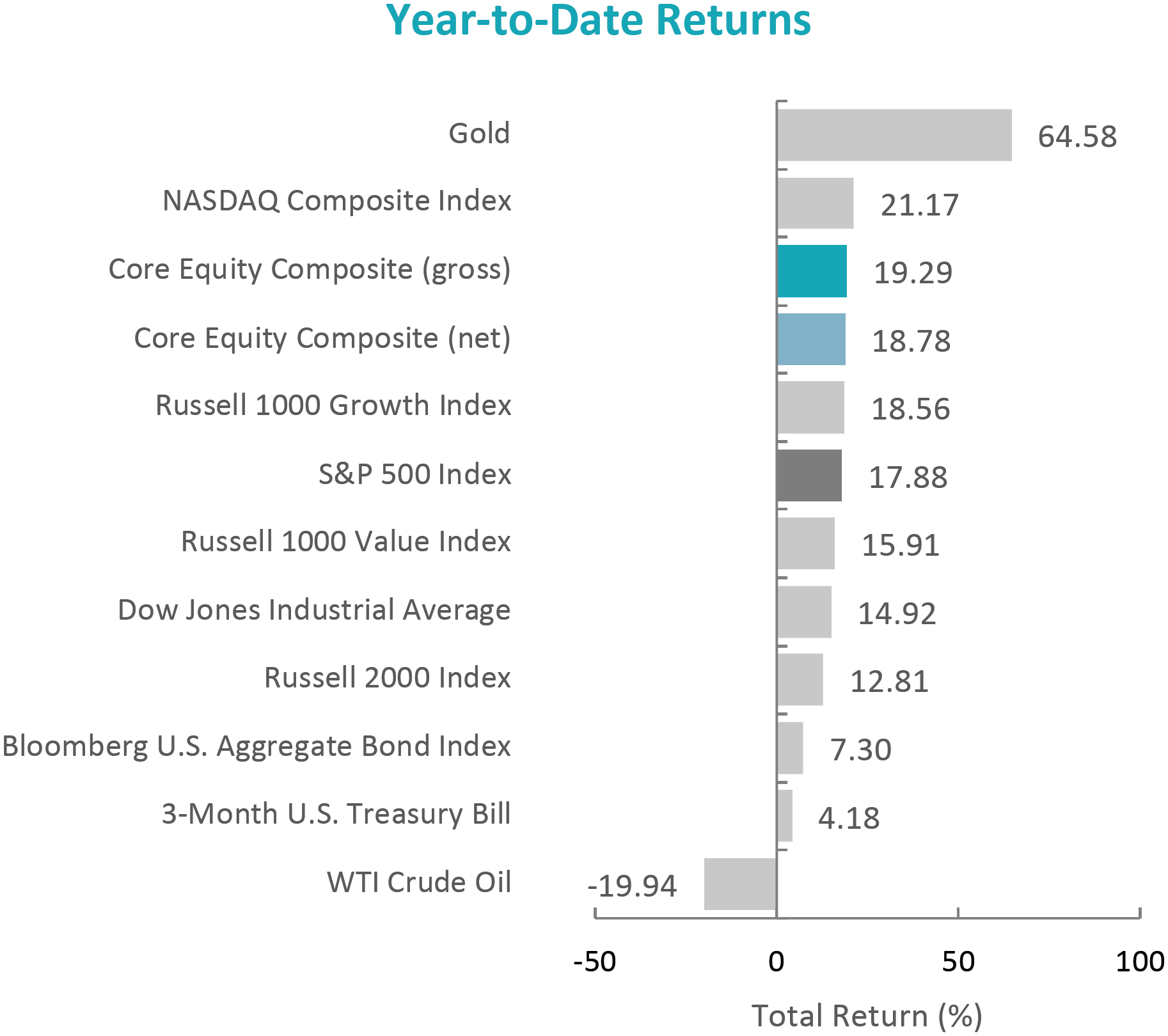
U.S. equity markets reached new all-time highs in the fourth quarter of 2025. The S&P 500 Index rose 2.66%, while fixed income markets also finished higher, with the Bloomberg U.S. Aggregate Bond Index up 1.10% for the quarter.

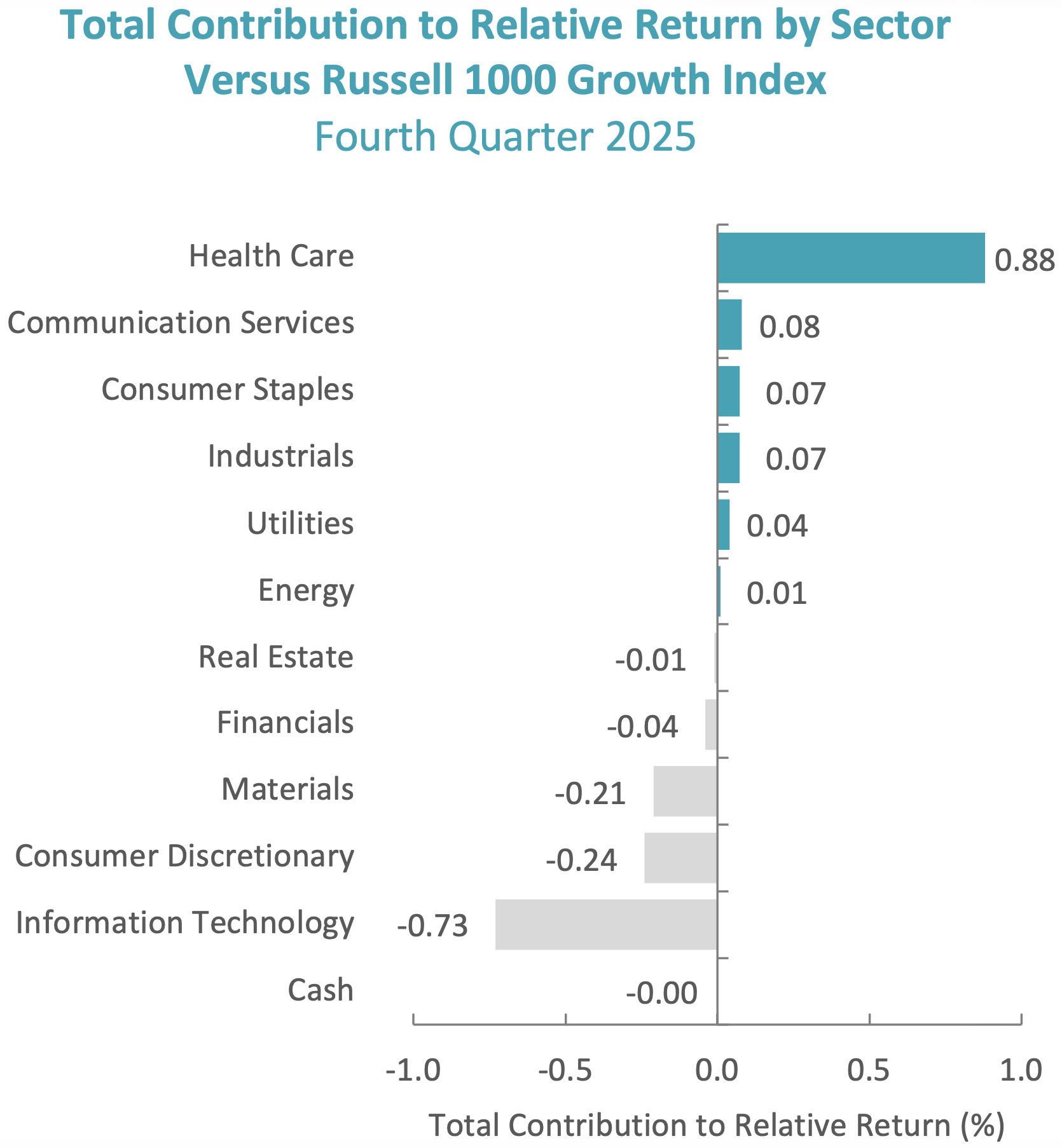
Within the Russell 1000 Growth Index, four out of the eleven sectors posted positive returns. The best-performing sectors were Health Care, Communication Services and Financials, whereas Utilities, Real Estate, and Materials were the weakest segments.

The U.S. economy continued to demonstrate resilience. Data released during the period showed that real GDP surged at a 4.3% annualized rate in the third quarter—the fastest quarterly growth in two years—driven primarily by robust consumer spending, with additional contributions from rising exports and increased government outlays. Despite this strength, consumer confidence deteriorated toward year-end; economists projected a moderation in spending, and concerns about the labor market persisted. The unemployment rate ticked up to 4.6% in November (a four-year high), though this level remains low by historical standards and is still consistent with an economy operating near full employment. Meanwhile, inflation moderated—the Consumer Price Index was up just 2.7% year-over-year in November, reaching its lowest level since July. Economists cautioned that recent unemployment and inflation figures were likely skewed by technical factors related to the 43-day government shutdown, which disrupted data reporting. This shutdown—the longest in U.S. history—forced approximately 1.4 million federal employees to go without pay and even led to temporary layoffs at some agencies before Congress passed a continuing resolution to reopen on November 12.

Sources: CAPS CompositeHubTM, Bloomberg
Past performance is not indicative of future results. Aristotle Atlantic Large Cap Growth Composite returns are presented gross and net of investment advisory fees and include the reinvestment of all income. Gross returns will be reduced by fees and other expenses that may be incurred in the management of the account. Net returns are presented net of actual investment advisory fees and after the deduction of all trading expenses. Aristotle Atlantic Composite returns are preliminary pending final account reconciliation. Please see important disclosures at the end of this document.

Given the mixed economic signals and uncertainty around the data, the Federal Reserve took a cautious stance. The Fed implemented two 0.25% interest rate cuts during the quarter, lowering the federal funds target range to 3.50%-3.75%. Fed Chair Powell emphasized a data-dependent approach, acknowledging risks to both sides of the Fed’s dual mandate. He noted the need to carefully assess incoming information, highlighting that policy would remain cautious and measured going into 2026.

Trade relations between the U.S. and China remained a key focus for markets. Early in the fourth quarter, tensions flared with tariff escalations and export controls. (China had dramatically expanded export controls on rare earth minerals, and the U.S. threatened 100% tariffs in retaliation.) Ultimately, President Trump and President Xi met at the Asia-Pacific Economic Cooperation (APEC) summit in South Korea and reached a one-year trade truce.

Corporate earnings remained robust. S&P 500 companies reported earnings growth of 13.6%, marking the fourth consecutive quarter of double-digit expansion. Of the 11 sectors within the S&P 500 Index, Information Technology recorded the strongest earnings growth of 29%. Artificial intelligence continued to be a major theme—more than 300 S&P 500 companies mentioned “AI” on their earnings calls during the fall. This enthusiasm helped propel mega-cap tech stocks higher and drive the market’s gains. However, as the quarter progressed, scrutiny increased around AI-related revenue circularity (companies buying AI services from each other to boost sales), the massive scale of AI-related capital spending, and the durability of longer-term returns on investment.

Performance and Attribution Summary

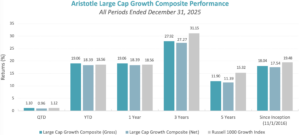
For the fourth quarter of 2025, Aristotle Atlantic’s Large Cap Growth Composite posted a total return of 1.10% gross of fees (0.96% net of fees), underperforming the 1.12% return of the Russell 1000 Growth Index.

Performance (%) QTDYTD1 Year3 Years5 YearsSince Inception*
Large Cap Growth Composite (gross)1.1019.0619.0627.9211.9018.04
Large Cap Growth Composite (net)0.9618.3918.3927.2711.3917.54
Russell 1000 Growth Index1.1218.5618.5631.2515.3219.48

*The Large Cap Growth Composite has an inception date of November 1, 2016. Past performance is not indicative of future results. Aristotle Atlantic Large Cap Growth Equity Composite returns are presented gross and net of investment advisory fees and include the reinvestment of all income. Gross returns will be reduced by fees and other expenses that may be incurred in the management of the account. Net returns are presented net of actual investment advisory fees and after the deduction of all trading expenses. Aristotle Atlantic Composite returns are preliminary pending final account reconciliation. Please see important disclosures at the end of this document.

Sources: FactSet
Past performance is not indicative of future results. Sector attribution shows how much of a portfolio’s overall return is directly attributable to stock selection and asset allocation decisions within the portfolio, highlighting which sectors contributed or detracted to the total return. Attribution includes the reinvestment of income. Attribution is presented gross of fees and does not include the deduction of all fees and expenses that a client or investor has paid or would have paid. Please refer to the gross and net composite returns included within to understand the overall impact of fees. Please see important disclosures at the end of this document.

During the fourth quarter, the portfolio’s underperformance relative to the Russell 1000 Growth Index was due to security selection. Security selection in Information Technology and Consumer Discretionary detracted the most from relative performance. Conversely, security selection and an overweight in Health Care contributed to relative performance.

Contributors and Detractors for 4Q 2025

Relative ContributorsRelative Detractors
Guardant HealthOracle
Analog DevicesAdvanced Micro Devices
KLA CorporationLinde
Darling IngredientsEli Lilly
Adaptive BiotechnologiesO’Reilly Automotive

Detractors

Oracle

Oracle detracted from performance in the fourth quarter as investors focused on the OpenAI backlog concentration risk and the significant amount of debt required to fund the company’s datacenter commitments over the next 3-4 years. Negative concerns about overinvestment and funding needs for AI infrastructure were key debates in the quarter and Oracle remains more leveraged to OpenAI than its peers with an approximately ~55% backlog exposure.

Advanced Micro Devices

Advanced Micro Devices detracted from performance in the fourth quarter as investors began to question the viability of OpenAI’s massive capital spending plans and discounted the future revenues associated with those spending plans for companies such as AMD. Overall sentiment towards AI semiconductor companies turned negative in December contributing to multiple compression for AMD and weakness relative to other technology stocks.

Contributors

Guardant Health

Guardant contributed to performance in the fourth quarter after better-than-expected third-quarter earnings results driven by volume growth and news of an acquisition of a competitor. General market sentiment in the industry has been improving throughout the year as business momentum grows. 

KLA Corporation

KLA contributed to performance in the fourth quarter as leading-edge logic and memory customers accelerated capital spending to support advanced-node transitions. The company is benefiting from increased adoption of advanced packaging and EUV-related inspection, where KLAC maintains a technology leadership position, and investors continued to increase estimates for semiconductor capital equipment spending growth in 2026 and 2027 from prior consensus. 

Recent Portfolio Activity

The table below shows all buys and sells completed during the quarter, followed by a brief rationale.

BuysSells
Advanced Micro DevicesAlexandria Real Estate Equities
Comfort Systems USAChart Industries
DexComLinde
Howmet AerospaceSynopsys
Revolution MedicinesUnitedHealth Group
Snowflake

Buys

Advanced Micro Devices

Advanced Micro Devices is a global leader in high-performance and adaptive computing, offering a broad portfolio of products and solutions including CPUs, GPUs, APUs, SoCs, FPGAs, and software stacks—that power data centers, cloud computing, client devices, gaming platforms, and embedded systems. Through its four business segments—Data Center, Client, Gaming, and Embedded, the company delivers innovative, differentiated technologies that accelerate computing performance for a wide range of industries, driving advancements in artificial intelligence, machine learning, and next-generation connectivity.

We believe Advanced Micro Devices is well-positioned for long-term growth, driven by secular trends in AI and cloud computing, massive expansion of its addressable market, and strong momentum in both AI accelerators and server CPUs. With ambitious revenue and profitability targets, validated partnerships, and a maturing AI software ecosystem, the company stands to benefit from accelerating enterprise and cloud adoption, robust demand for high-performance computing, and ongoing gains in client PC and gaming markets. Its comprehensive product roadmap and strategic execution suggest significant upside and resilience as AI-driven workloads proliferate across industries. We believe a slight premium to Advanced Micro Devices shares are justified as they are seeing a multi-year acceleration in revenue and earnings from AI hyperscalers and other areas of the AI infrastructure buildout.

Comfort Systems USA

Comfort Systems USA is a leading provider of mechanical and electrical contracting services, serving a wide range of commercial, industrial, and institutional clients across the United States. The company specializes in building, installing, maintaining, and repairing mechanical, electrical, and plumbing systems, with expertise in HVAC, plumbing, piping, controls, and electrical work. With numerous operating units and locations nationwide, Comfort Systems supports end markets such as technology, manufacturing, health care, education, office buildings, retail, and government facilities. In addition to traditional services, the company also constructs modular systems, prebuilding complex components in a factory setting to enhance efficiency and quality for its clients.

We see Comfort Systems USA as presenting a compelling investment case due to its strong exposure to high-growth technology and manufacturing sectors, bolstered by favorable government policies such as the CHIPS Act and the Inflation Reduction Act. The company benefits from recurring service and maintenance revenue, a skilled and well-trained workforce, and ongoing investments in expanding its service business. Its proven track record of successful acquisitions, supported by a robust balance sheet with low leverage and substantial cash reserves, further enhance its growth prospects and ability to capitalize on future opportunities in the commercial and industrial construction markets. Comfort Systems USA is currently valued at a higher level compared to its historical averages. We see this premium as justified due to the company’s improving growth rate.

DexCom

DexCom is a leading medical device company specializing in the design and development of continuous glucose monitoring (CGM) systems for people with diabetes. Founded in 1999, DexCom has pioneered innovative technology such as the implantable sensor and external receiver, empowering individuals to track and manage their glucose levels more effectively. Its key products, including the Dexcom G7 CGM system and Stelo Glucose Biosensor, serve a wide range of users from those with Type 1 or Type 2 diabetes to adults with prediabetes, and are marketed primarily to health care professionals in the U.S. and select international markets.

We see DexCom as representing a compelling investment opportunity due to its leadership in the rapidly expanding CGM market, supported by strong reimbursement trends, growing patient coverage, and ongoing product innovation such as the transition to the G7 system and the upcoming 15-day sensor. With low penetration rates among both Type 1 and Type 2 diabetes patients and significant untapped markets in the U.S. and internationally, DexCom is well-positioned for sustained growth. The company’s successful launch of Stelo for non-diabetics, robust new patient growth, clean balance sheet, and guidance for double-digit organic revenue and earnings growth further reinforce its attractive outlook for investors. DexCom trades at a price-to-forward earnings per share multiple that, while higher than the overall market, is lower than the company’s historical average. Furthermore, we believe this premium valuation is justified by their large and expanding total addressable market and their strong growth potential.

Howmet Aerospace

Howmet Aerospace is a leading global provider of advanced engineered products for the aerospace, power generation, and transportation industries, specializing in jet engine components, aerospace fastening systems, airframe structural parts, and forged aluminum wheels. With operations in 19 countries and a workforce of 24,000 employees, the company manufactures most of its products in North America and Europe. Howmet’s business is structured into four segments—Engine Products, Fastening Systems, Engineered Structures, and Forged Wheels—serving key markets such as commercial aerospace, defense, commercial transportation, and institutional sectors.

We believe Howmet Aerospace stands out as a compelling investment opportunity due to its critical role in the aerospace, defense, and industrial markets. As global travel and air freight continue to grow, and major aircraft manufacturers ramp up production to meet surging demand, Howmet is well-positioned to benefit from increasing orders for its essential aircraft components and engine parts. The company is also set to capitalize on rising defense budgets worldwide and the expanding need for industrial gas turbines driven by the growth of artificial intelligence and data centers. While heavy-duty truck production remains weak, Howmet Aerospace maintains strong market share and is poised to benefit from future cyclical recovery. Ongoing capacity expansions further reinforce the company’s ability to capture opportunities across its diversified end markets. Shares are valued at higher multiples compared to their recent historical averages, but we believe this is justified by the company’s strong earnings growth outlook and consistent track record of exceeding expectations.

Revolution Medicines

Revolution Medicines is a company focused on developing new treatments for cancer, specifically for patients whose cancers are driven by changes in RAS proteins. Their research and development is centered on creating drugs called RAS(ON) inhibitors, which aim to block the growth signals from these proteins. The company’s main drugs—Daraxonrasib, Elironrasib, and Zoldonrasib—are already being tested in clinical trials. Revolution Medicines is working on bringing a new drug, RMC-5127, into trials soon. In addition, the company is developing more targeted treatments for other types of RAS mutations.

We see Revolution as presenting a compelling investment case driven by the robust clinical performance of its lead candidate, Daraxonrasib (RMD-6236), currently in phase 3 trials for advanced NSCLC and PDAC. The drug has demonstrated impressive efficacy in hard-to-treat cancers, with high objective response and disease control rates, significantly outperforming existing standard treatments. Daraxonrasib’s FDA Breakthrough Therapy Designation and inclusion in the FDA Commissioner’s National Priority Review Voucher program highlight its promise and potential for accelerated approval. With ongoing expansion into earlier lines of therapy and multiple combination studies in solid tumors, as well as a pipeline of additional agents in development, Revolution is well positioned for future growth and value creation in the oncology space. As a clinical-stage biotechnology company, valuation can be challenging given no commercial products. Sell-side analysts have projected that Daraxonrasib’s PDAC-only revenue could reach several billion dollars by the mid-2030s. This would result in a current value that is just over one times potential peak revenue, which is lower than the multiple typically seen in historical biotech M&A transactions.

Snowflake

Snowflake is a leading cloud-based data platform that empowers organizations to consolidate, manage, and analyze their data securely and efficiently. Through its AI Data Cloud, Snowflake enables customers to eliminate data silos, apply AI and analytics, build data-driven applications, and share data across organizations, all while leveraging a flexible, consumption-based pricing model. With a scalable architecture spanning compute, storage, and cloud services, Snowflake supports diverse industry-specific solutions and serves a global customer base, including many of the world’s largest enterprises.

Snowflake stands out as a leading data cloud platform, capitalizing on the shift of enterprise analytics to the cloud and serving a vast addressable market. Its cloud-neutral, multi-cloud approach and deepened partnerships, especially with Microsoft Azure, drive strong market adoption and insulate growth. The company’s consumption-based pricing model supports impressive retention and expansion, while also providing the potential for upsell traction among an expanding roster of large enterprise clients. With rapid growth in generative AI and new workloads, Snowflake is capturing substantial AI-related revenue and customer interest. We believe its robust financial profile, featuring strong margins and a clear path to profitable growth at scale, positions Snowflake as a compelling long-term investment opportunity. It trades at a premium valuation compared to the broader group of infrastructure peers, but we view this as justified by the multi-year outlook and opportunity for revenue growth and margin expansion. 

Sells

Alexandria Real Estate

We sold the position in Alexandria Real Estate Equities because the weak market in laboratory real estate is expected to persist for longer than our previous expectations. There is an oversupply of vacant lab space and demand for the space is weak due to weak capital markets for biotech fundraising, slow approvals on new medications by the FDA and less funding for the National Institutes of Health (NIH). ARE has developments under construction that will be delivered into a weak leasing environment. The company is selling assets to fund these developments, which will likely reduce future earnings power.    

Chart Industries

We sold Chart Industries as the company is being acquired by Baker Hughes Co. for $210 per share. The acquisition is expected to close in the middle of 2026. There was only a 3% spread between the agreed upon deal price and the share price so we sold the position.   

Linde

We sold the position in Linde following a longer-than-expected trend of negative base volumes for the company due to soft industrial activity in Europe. The current high exposure to North American industrial markets does create increased risks if the U.S. economy enters a prolonged slowdown.  

Synopsys

We sold Synopsys in the portfolio following the disappointing recent quarterly earnings, which highlighted a lower revenue outlook for the business due to significant weakness in the IP segment. We expect the business to take a number of quarters to realign resources and business objectives and see more attractive growth opportunities in the semiconductor space.   

UnitedHealth Group

We sold UnitedHeath Group as the company lowered guidance on several occasions last year and they have seen increased utilization and acuity across many of their insured business lines resulting in a higher-than-expected medical cost ratio and thus lowered earnings. The CEO was replaced by the former CEO and the CFO was recently replaced as well. The shares have bounced back considerably, rising over 50% from the early August lows. We believe it could take several years for UnitedHealth Groups’ earnings to return to prior year levels. The stock is now trading at a premium multiple, despite solid evidence of a recovery in earnings.  

Outlook

The equity markets in the fourth quarter rose modestly with all but two sectors posting positive returns. Interest rates were close to flat in December and have been in a tight range since the summer. Investors started to question the ability to fund the large commitments associated with the buildout of AI data centers which resulted in a change in market leadership. Equity valuations remain elevated and continue to be supported by the prospects for lower interest rates and higher corporate profits. The economic data continues to point toward a moderately growing economy, a softening job market and moderate but sticky inflation. A broadening out of economic activity beyond just AI focused capital should help push corporate profit growth over 10% for 2026. Our focus will continue to be at the company level, with an emphasis on seeking to invest in companies with secular tailwinds or strong product-driven cycles. 

Disclosures

The opinions expressed herein are those of Aristotle Atlantic Partners, LLC (Aristotle Atlantic) and are subject to change without notice. Past performance is not a guarantee or indicator of future results. This material is not financial advice or an offer to purchase or sell any product. You should not assume that any of the securities transactions, sectors or holdings discussed in this report were or will be profitable, or that recommendations Aristotle Atlantic makes in the future will be profitable or equal the performance of the securities listed in this report. The portfolio characteristics shown relate to the Aristotle Atlantic Large Cap Growth strategy. Not every client’s account will have these characteristics. Aristotle Atlantic reserves the right to modify its current investment strategies and techniques based on changing market dynamics or client needs. There is no assurance that any securities discussed herein will remain in an account’s portfolio at the time you receive this report or that securities sold have not been repurchased. The securities discussed may not represent an account’s entire portfolio and, in the aggregate, may represent only a small percentage of an account’s portfolio holdings. The performance attribution presented is of a representative account from Aristotle Atlantic’s Large Cap Growth Composite. The representative account is a discretionary client account which was chosen to most closely reflect the investment style of the strategy. The criteria used for representative account selection is based on the account’s period of time under management and its similarity of holdings in relation to the strategy. Recommendations made in the last 12 months are available upon request.

Past performance is not indicative of future results. Returns are presented gross and net of investment advisory fees and include the reinvestment of all income. Gross returns will be reduced by fees and other expenses that may be incurred in the management of the account. Net returns are presented net of actual investment advisory fees and after the deduction of all trading expenses.

All investments carry a certain degree of risk, including the possible loss of principal. Investments are also subject to political, market, currency and regulatory risks or economic developments. International investments involve special risks that may in particular cause a loss in principal, including currency fluctuation, lower liquidity, different accounting methods and economic and political systems, and higher transaction costs. These risks typically are greater in emerging markets. While Large-capitalization companies may have more stable prices than smaller, less established companies, they are still subject to equity securities risk. In addition, large-capitalization equity security prices may not rise as much as prices of equity securities of small-capitalization companies. Securities of small- and medium-sized companies tend to have a shorter history of operations, and can be more volatile and less liquid. Value stocks can perform differently from the market as a whole and other types of stocks. The material is provided for informational and/or educational purposes only and is not intended to be and should not be construed as investment, legal or tax advice and/or a legal opinion. Investors should consult their financial and tax adviser before making investments. The opinions referenced are as of the date of publication, may be modified due to changes in the market or economic conditions, and may not necessarily come to pass. Information and data presented has been developed internally and/or obtained from sources believed to be reliable. Aristotle Atlantic does not guarantee the accuracy, adequacy or completeness of such information.

Aristotle Atlantic Partners, LLC is an independent registered investment adviser under the Advisers Act of 1940, as amended. Registration does not imply a certain level of skill or training. More information about Aristotle Atlantic, including our investment strategies, fees and objectives, can be found in our Form ADV Part 2, which is available upon request. AAP-2601-2

Performance Disclosure


Sources: CAPS CompositeHubTM

Composite returns for all periods ended December 31, 2025 are preliminary pending final account reconciliation.

Past performance is not indicative of future results. Performance results for periods greater than one year have been annualized. Returns are presented gross and net of investment advisory fees and include the reinvestment of all income. Gross returns will be reduced by fees and other expenses that may be incurred in the management of the account. Net returns are presented net of actual investment advisory fees and after the deduction of all trading expenses.

Index Disclosure

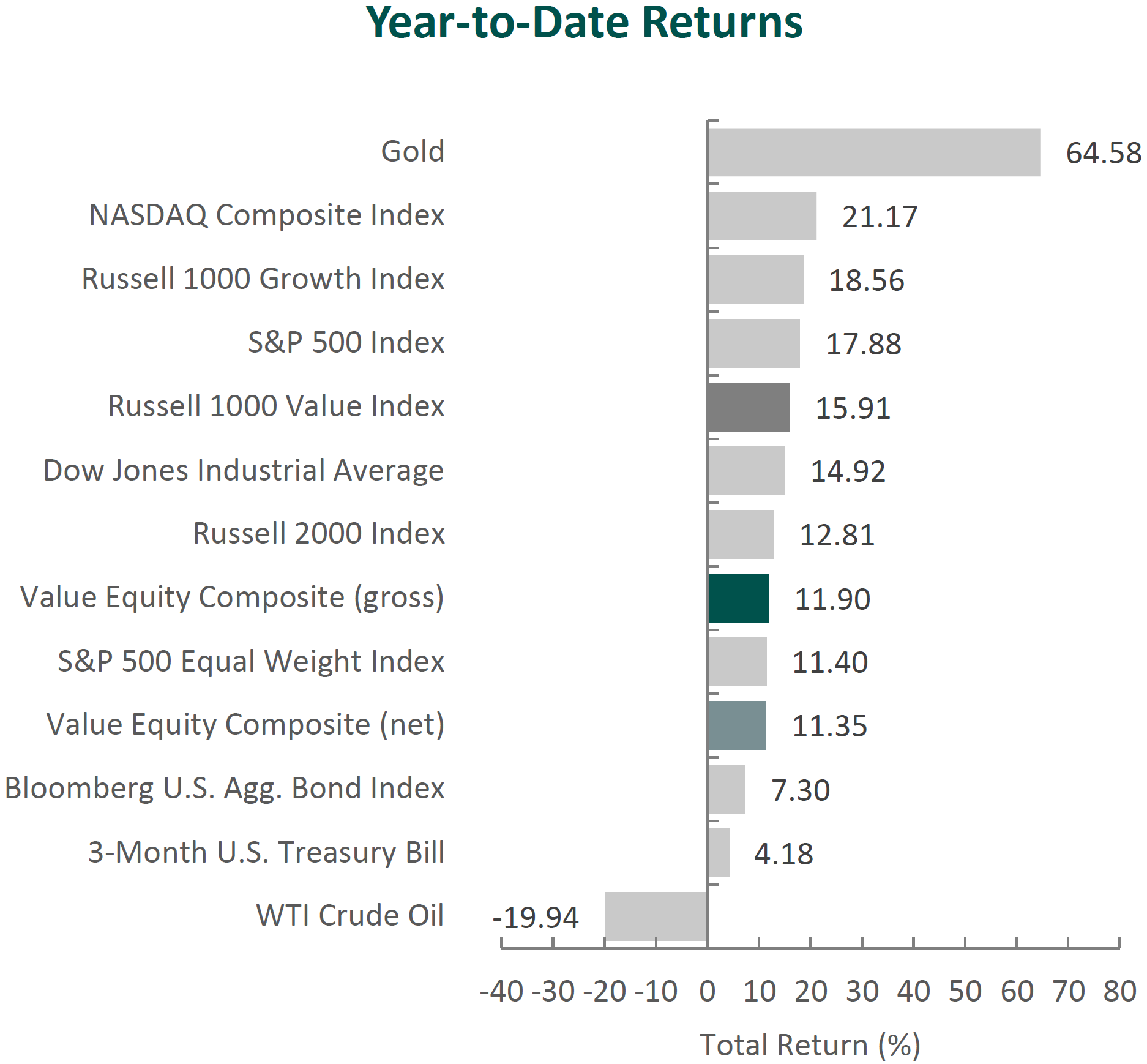
The Russell 1000® Growth Index measures the performance of the large cap growth segment of the U.S. equity universe. It includes those Russell 1000 companies with higher price-to-book ratios and higher forecasted growth values. This index has been selected as the benchmark and is used for comparison purposes only. The Russell 1000® Value Index measures the performance of the large cap value segment of the U.S. equity universe. It includes those Russell 1000 companies with lower price-to-book ratios and lower expected growth values. The Russell 2000® Index measures the performance of the small cap segment of the U.S. equity universe. The Russell 2000 Index is a subset of the Russell 3000® Index representing approximately 10% of the total market capitalization of that index. It includes approximately 2000 of the smallest securities based on a combination of their market cap and current index membership. The S&P 500® Index is the Standard & Poor’s Composite Index of 500 stocks and is a widely recognized, unmanaged index of common stock prices. The Dow Jones Industrial Average® is a price-weighted measure of 30 U.S. blue-chip companies. The Index covers all industries except transportation and utilities. The NASDAQ Composite Index measures all NASDAQ domestic and international based common type stocks listed on The NASDAQ Stock Market. The NASDAQ Composite includes over 3,000 companies, more than most other stock market indices. The Bloomberg U.S. Aggregate Bond Index is an unmanaged index of domestic investment grade bonds, including corporate, government and mortgage-backed securities. The WTI Crude Oil Index is a major trading classification of sweet light crude oil that serves as a major benchmark price for oil consumed in the United States. The 3-Month U.S. Treasury Bill is a short-term debt obligation backed by the U.S. Treasury Department with a maturity of three months. The Consumer Price Index (CPI) is a measure of the average change over time in the prices paid by urban consumers for a market basket of consumer goods and services. While stock selection is not governed by quantitative rules, a stock typically is added only if the company has an excellent reputation, demonstrates sustained growth and is of interest to a large number of investors. The volatility (beta) of the Composite may be greater or less than its respective benchmarks. It is not possible to invest directly in these indices.
Markets Review

U.S. equity markets reached new all-time highs in the fourth quarter of 2025. The S&P 500 Index rose 2.66%, while fixed income markets also finished higher, with the Bloomberg U.S. Aggregate Bond Index up 1.10% for the quarter.

Within the S&P 500 Index, nine out of the eleven sectors posted positive returns. The best-performing sectors were Health Care, Communication Services and Financials, whereas Real Estate, Utilities and Consumer Staples were the weakest segments.

Sources: CAPS CompositeHubTM, Bloomberg
Past performance is not indicative of future results. Aristotle Atlantic Core Equity Composite returns are presented gross and net of investment advisory fees and include the reinvestment of all income. Gross returns will be reduced by fees and other expenses that may be incurred in the management of the account. Net returns are presented net of actual investment advisory fees and after the deduction of all trading expenses. Aristotle Atlantic Composite returns are preliminary pending final account reconciliation. Please see important disclosures at the end of this document.

The U.S. economy continued to demonstrate resilience. Data released during the period showed that real GDP surged at a 4.3% annualized rate in the third quarter—the fastest quarterly growth in two years—driven primarily by robust consumer spending, with additional contributions from rising exports and increased government outlays. Despite this strength, consumer confidence deteriorated toward year-end; economists projected a moderation in spending, and concerns about the labor market persisted. The unemployment rate ticked up to 4.6% in November (a four-year high), though this level remains low by historical standards and is still consistent with an economy operating near full employment. Meanwhile, inflation moderated—the Consumer Price Index was up just 2.7% year-over-year in November, reaching its lowest level since July. Economists cautioned that recent unemployment and inflation figures were likely skewed by technical factors related to the 43-day government shutdown, which disrupted data reporting. This shutdown—the longest in U.S. history—forced approximately 1.4 million federal employees to go without pay and even led to temporary layoffs at some agencies before Congress passed a continuing resolution to reopen on November 12.

Given the mixed economic signals and uncertainty around the data, the Federal Reserve took a cautious stance. The Fed implemented two 0.25% interest rate cuts during the quarter, lowering the federal funds target range to 3.50%-3.75%. Fed Chair Powell emphasized a data-dependent approach, acknowledging risks to both sides of the Fed’s dual mandate. He noted the need to carefully assess incoming information, highlighting that policy would remain cautious and measured going into 2026.

Trade relations between the U.S. and China remained a key focus for markets. Early in the fourth quarter, tensions flared with tariff escalations and export controls. (China had dramatically expanded export controls on rare earth minerals, and the U.S. threatened 100% tariffs in retaliation.) Ultimately, President Trump and President Xi met at the Asia-Pacific Economic Cooperation (APEC) summit in South Korea and reached a one-year trade truce.

Corporate earnings remained robust. S&P 500 companies reported earnings growth of 13.6%, marking the fourth consecutive quarter of double-digit expansion. Of the 11 sectors within the S&P 500 Index, Information Technology recorded the strongest earnings growth of 29%. Artificial intelligence continued to be a major theme—more than 300 S&P 500 companies mentioned “AI” on their earnings calls during the fall. This enthusiasm helped propel mega-cap tech stocks higher and drive the market’s gains. However, as the quarter progressed, scrutiny increased around AI-related revenue circularity (companies buying AI services from each other to boost sales), the massive scale of AI-related capital spending, and the durability of longer-term returns on investment.

Performance and Attribution Summary

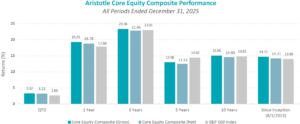
For the fourth quarter of 2025, Aristotle Atlantic’s Core Equity Composite posted a total return of 3.32% gross of fees (3.21% net of fees), outperforming the S&P 500 Index, which recorded a total return of 2.66%.

Performance (%)QTDYTD1 Year3 Years5 Years10 YearsSince Inception*
Core Equity Composite (gross)3.3219.2919.2923.3612.9815.0814.72
Core Equity Composite (net)3.2118.7818.7822.8612.5114.6014.21
S&P 500 Index2.6617.8817.8823.0114.4214.8213.99
*The Core Equity Composite has an inception date of August 1, 2013. Past performance is not indicative of future results. Aristotle Atlantic Core Equity Composite returns are presented gross and net of investment advisory fees and include the reinvestment of all income. Gross returns will be reduced by fees and other expenses that may be incurred in the management of the account. Net returns are presented net of actual investment advisory fees and after the deduction of all trading expenses. Aristotle Atlantic Composite returns are preliminary pending final account reconciliation. Please see important disclosures at the end of this document.

Source: FactSet
Past performance is not indicative of future results. Sector attribution shows how much of a portfolio’s overall return is directly attributable to stock selection and asset allocation decisions within the portfolio, highlighting which sectors contributed or detracted to the total return. Attribution includes the reinvestment of income. Attribution is presented gross of fees and does not include the deduction of all fees and expenses that a client or investor has paid or would have paid. Please refer to the gross and net composite returns included within to understand the overall impact of fees. Please see important disclosures at the end of this document.

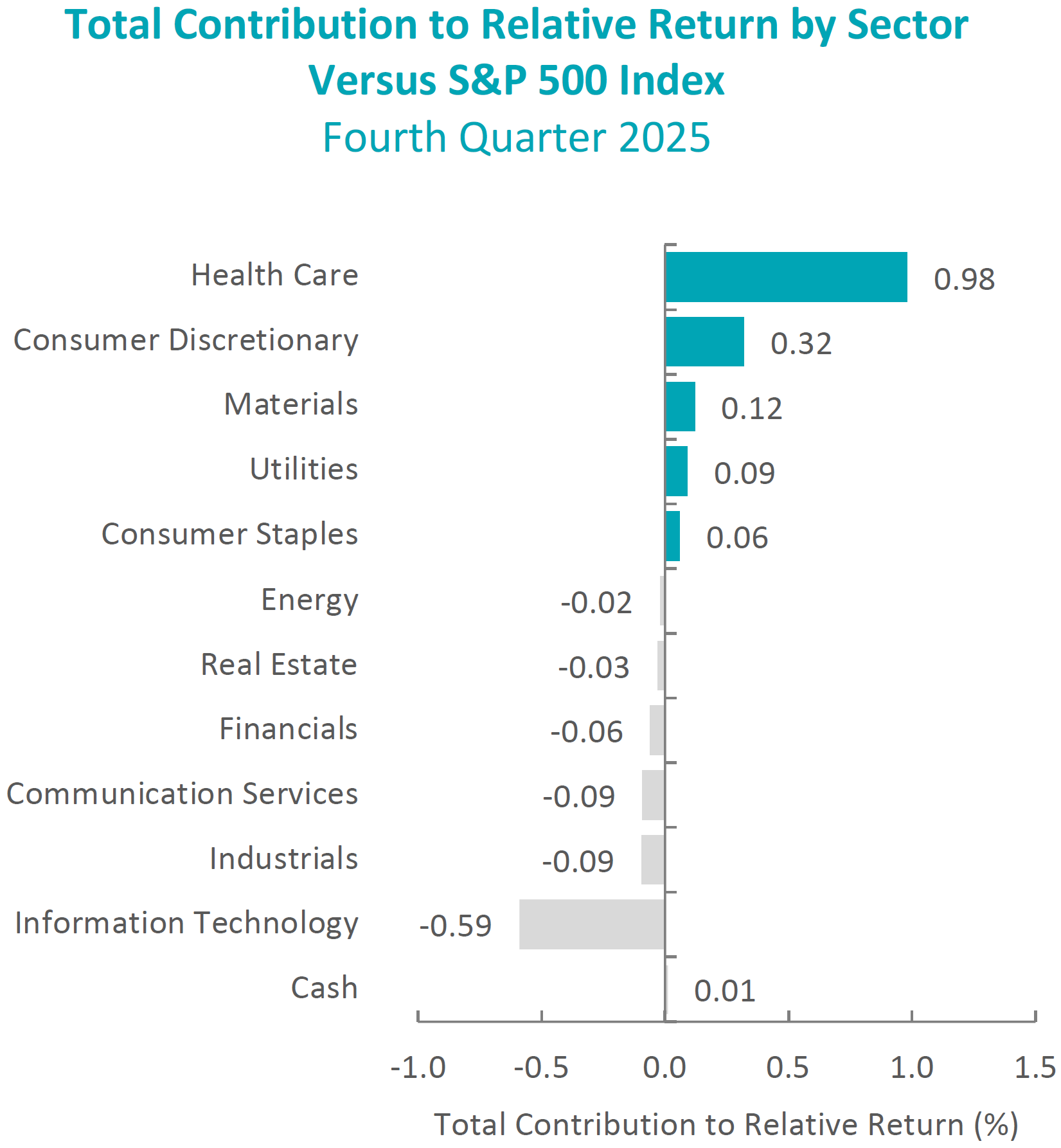
During the fourth quarter, the portfolio’s outperformance relative to the S&P 500 was due to both allocation effects and security selection. Security selection in Health Care and Consumer Discretionary contributed the most to relative performance. Conversely, security selection in Information Technology and Communication Services detracted from relative performance.

Contributors and Detractors for 4Q 2025

Relative ContributorsRelative Detractors
Guardant HealthOracle
General MotorsO’Reilly Automotive
Marriott InternationalMeta Platforms
Thermo Fisher ScientificNetflix
AlphabetTrane Technologies

Contributors

Guardant Health

Guardant contributed to performance in the fourth quarter after better-than-expected third-quarter earnings results driven by volume growth and news of an acquisition of a competitor. General market sentiment in the industry has been improving throughout the year as business momentum grows. 

General Motors

General Motors contributed to performance in the fourth quarter of 2025. Estimates for the year 2026 have been increasing following GM’s third quarter earnings report at the end of October. The company has been more effective in mitigating tariff expenses than originally planned earlier in 2025. The elimination of tax credits for electric vehicles may increase relative demand for internal combustion engine vehicles, which are more profitable sales for General Motors than the sales of electric vehicles.

Detractors

Oracle

Oracle detracted from performance in the fourth quarter as investors focused on the OpenAI backlog concentration risk and the significant amount of debt required to fund the company’s datacenter commitments over the next 3-4 years.  Negative concerns about overinvestment and funding needs for AI infrastructure were key debates in the quarter and Oracle remains more leveraged to OpenAI than its peers with an approximately ~55% backlog exposure.

O’Reilly Automotive

O’Reilly Automotive detracted from performance in the fourth quarter of 2025. Although the company exceeded consensus expectations when the company reported its third quarter results at the end of October, comments on the weakening do-it-yourself (DIY) business were a concern. Inflation, which has largely been driven by tariffs, is weighing on the DIY portion of the business. The professional business, which is much larger than the DIY business, remains strong. The company is increasing the pace of new store openings in 2026.

Recent Portfolio Activity

The table below shows all buys and sells completed during the quarter, followed by a brief rationale.

BuysSells
APi GroupAlexandria Real Estate Equities
Coinbase GlobalChart Industries
Performance Food Group

Buys

APi Group

APi Group is a global business services provider specializing in fire and life safety, security, elevator and escalator services, as well as specialty infrastructure solutions. The company operates through two main segments: Safety Services, which accounts for the majority of revenue and profit and focuses on fire protection and building systems across North America, Europe, and Asia-Pacific; and Specialty Services, which delivers critical infrastructure and industrial plant services, including maintenance and repair for utilities and energy sectors. With 29,000 employees in over 500 locations across 20 countries, APi Group serves a diverse range of end markets such as commercial, health care, industrial, utilities, and government agencies, generating substantial recurring revenue through statutory and contracted services.

APi Group’s investment case centers on its strong position in industries driven by regulatory compliance and recurring service requirements, notably fire safety inspections and elevator maintenance. The company benefits from government incentives, such as those provided by the Infrastructure Investment and Jobs Act and the CHIPS Act, which contribute to increased infrastructure spending and growth opportunities in the U.S. APi’s strategy of acquiring service-focused companies with stable, non-discretionary revenue streams has supported its expansion, including its recent entry into the elevator market. The company funds acquisitions through free cash flow and has set ambitious three-year financial goals targeting revenue growth, margin improvement, and robust free cash flow conversion, positioning APi for sustained profitability and operational efficiency. Although APi stock is trading above the five-year average multiple, we believe the higher valuation is justified by the anticipated mid-teen annual earnings growth over the next three years.

Coinbase Global

Coinbase Global was founded in 2012 and is a leading United States cryptocurrency exchange and infrastructure provider. With over $425 billion in assets across its platform, the company supports trading in more than 250 crypto currencies, catering to retail investors, institutions and fintech developers through a diversified cryptocurrency product and service platform. Coinbase operates as a remote-first (no physical headquarters) entity with a focus on regulatory compliance, strong cybersecurity and proactive regulatory engagement, differentiating it within the cryptocurrency ecosystem.

We see Coinbase as the dominant player in the United States cryptocurrency market, holding over 65% of the trading volume share due to its strong commitment to compliance, security, and customer trust. The company’s expansion into derivatives and international markets, including the acquisition of Deribit, positions it as a leading global crypto derivatives provider. Coinbase’s diversified business model, which includes transaction-based activities and subscription-based offerings, is shifting towards more predictable revenue streams. The recent passage of the GENIUS Act and the anticipated CLARITY Act are expected to provide regulatory clarity, boosting institutional adoption and trading volumes. Additionally, Coinbase’s unique infrastructure and partnerships with traditional finance institutions enable it to monetize the comprehensive cryptocurrency value chain. Shares trade at modest premium to traditional exchange peers. We view this premium as justified by the company’s dominant U.S. market position, scalable crypto infrastructure and ongoing shift toward recurring revenue streams, supported by strong secular tailwinds and upcoming catalysts, while reflecting competitive and regulatory risks.

Performance Food Group

Performance Food Group is a leading North American distributor of food and related products, serving over 300,000 customer locations through about 155 distribution centers. The company offers a vast range of items, including food, beverages, disposables, and cleaning supplies, to various customers such as restaurants, retailers, schools, and health care facilities. Performance Food Group operates through three main segments: Foodservice, Convenience, and Specialty, each catering to different markets with a comprehensive selection of products and value-added services.

We believe Performance Food Group presents a compelling investment case due to its diversified operations, defensiveness during uncertain consumer periods, and insulation from inflation through cost-plus contracts. The company’s presence in less cyclical markets such as schools, government, and health care, combined with steady industry growth and opportunities for market consolidation, supports ongoing top-line and margin expansion. Performance Food Group’s success in the independent restaurant channel and focus on private label products further enhance profitability. Recent strategic actions, including cooperation agreements with activist investors and potential merger discussions, could also provide additional catalysts for future growth. Shares trade in-line with their historical averages. Consensus estimates call for topline growth of mid- to high-single digits, with leverage to mid-teens EPS growth. 

Sells

Alexandria Real Estate

We sold the position in Alexandria Real Estate Equities because the weak market in laboratory real estate is expected to persist for longer than our previous expectations. There is an oversupply of vacant lab space and demand for the space is weak due to weak capital markets for biotech fund raising, slow approvals on new medications by the FDA and less funding for the National Institutes of Health (NIH). ARE has developments under construction that will be delivered into a weak leasing environment. The company is selling assets to fund these developments, which will reduce future earnings power.    

Chart Industries

We sold Chart Industries as the company is being acquired by Baker Hughes Co. for $210 per share. The acquisition is expected to close in the middle of 2026. There was only a 3% spread between the agreed upon deal price and the share price so we sold the position.

Outlook

The equity markets in the fourth quarter rose modestly with all but two sectors posting positive returns. Interest rates were close to flat in December and have been in a tight range since the summer. Investors started to question the ability to fund the large commitments associated with the buildout of AI data centers which resulted in a change in market leadership. Equity valuations remain elevated and continue to be supported by the prospects for lower interest rates and higher corporate profits. The economic data continues to point toward a moderately growing economy, a softening job market and moderate but sticky inflation. A broadening out of economic activity beyond just AI focused capital should help push corporate profit growth over 10% for 2026. Our focus will continue to be at the company level, with an emphasis on seeking to invest in companies with secular tailwinds or strong product-driven cycles. 

Disclosures

The opinions expressed herein are those of Aristotle Atlantic Partners, LLC (Aristotle Atlantic) and are subject to change without notice. Past performance is not a guarantee or indicator of future results. This material is not financial advice or an offer to purchase or sell any product. You should not assume that any of the securities transactions, sectors or holdings discussed in this report were or will be profitable, or that recommendations Aristotle Atlantic makes in the future will be profitable or equal the performance of the securities listed in this report. The portfolio characteristics shown relate to the Aristotle Atlantic Core Equity strategy. Not every client’s account will have these characteristics. Aristotle Atlantic reserves the right to modify its current investment strategies and techniques based on changing market dynamics or client needs. There is no assurance that any securities discussed herein will remain in an account’s portfolio at the time you receive this report or that securities sold have not been repurchased. The securities discussed may not represent an account’s entire portfolio and, in the aggregate, may represent only a small percentage of an account’s portfolio holdings. The performance attribution presented is of a representative account from Aristotle Atlantic’s Core Equity Composite. The representative account is a discretionary client account which was chosen to most closely reflect the investment style of the strategy. The criteria used for representative account selection is based on the account’s period of time under management and its similarity of holdings in relation to the strategy. Recommendations made in the last 12 months are available upon request.

Returns are presented gross and net of investment advisory fees and include the reinvestment of all income. Gross returns will be reduced by fees and other expenses that may be incurred in the management of the account. Net returns are presented net of actual investment advisory fees and after the deduction of all trading expenses.

All investments carry a certain degree of risk, including the possible loss of principal. Investments are also subject to political, market, currency and regulatory risks or economic developments. International investments involve special risks that may in particular cause a loss in principal, including currency fluctuation, lower liquidity, different accounting methods and economic and political systems, and higher transaction costs. These risks typically are greater in emerging markets. While Large-capitalization companies may have more stable prices than smaller, less established companies, they are still subject to equity securities risk. In addition, large-capitalization equity security prices may not rise as much as prices of equity securities of small-capitalization companies. Securities of small- and medium-sized companies tend to have a shorter history of operations, be more volatile and less liquid. Value stocks can perform differently from the market as a whole and other types of stocks. The material is provided for informational and/or educational purposes only and is not intended to be and should not be construed as investment, legal or tax advice and/or a legal opinion. Investors should consult their financial and tax adviser before making investments. The opinions referenced are as of the date of publication, may be modified due to changes in the market or economic conditions, and may not necessarily come to pass. Information and data presented has been developed internally and/or obtained from sources believed to be reliable. Aristotle Atlantic does not guarantee the accuracy, adequacy or completeness of such information.

Aristotle Atlantic Partners, LLC is an independent registered investment adviser under the Advisers Act of 1940, as amended. Registration does not imply a certain level of skill or training. More information about Aristotle Atlantic, including our investment strategies, fees and objectives, can be found in our Form ADV Part 2, which is available upon request. AAP-2601-3

Performance Disclosures

Sources: CAPS CompositeHubTM

Composite returns for all periods ended December 31, 2025 are preliminary pending final account reconciliation.

The Aristotle Core Equity Composite has an inception date of August 1, 2013 at a predecessor firm. During this time, Mr. Fitzpatrick had primary responsibility for managing the strategy. Performance starting November 1, 2016 was achieved at Aristotle Atlantic.

Past performance is not indicative of future results. Performance results for periods greater than one year have been annualized. Returns are presented gross and net of investment advisory fees and include the reinvestment of all income. Gross returns will be reduced by fees and other expenses that may be incurred in the management of the account. Net returns are presented net of actual investment advisory fees and after the deduction of all trading expenses.

Index Disclosures

The Russell 1000® Growth Index measures the performance of the large cap growth segment of the U.S. equity universe. It includes those Russell 1000 companies with higher price-to-book ratios and higher forecasted growth values. This index has been selected as the benchmark and is used for comparison purposes only. The Russell 1000® Value Index measures the performance of the large cap value segment of the U.S. equity universe. It includes those Russell 1000 companies with lower price-to-book ratios and lower expected growth values. The S&P 500® Index is the Standard & Poor’s Composite Index of 500 stocks and is a widely recognized, unmanaged index of common stock prices. The Dow Jones Industrial Average® is a price-weighted measure of 30 U.S. blue-chip companies. The Index covers all industries except transportation and utilities. The NASDAQ Composite Index measures all NASDAQ domestic and international based common type stocks listed on The NASDAQ Stock Market. The NASDAQ Composite includes over 3,000 companies, more than most other stock market indices. The Bloomberg U.S. Aggregate Bond Index is an unmanaged index of domestic investment grade bonds, including corporate, government and mortgage-backed securities. The WTI Crude Oil Index is a major trading classification of sweet light crude oil that serves as a major benchmark price for oil consumed in the United States. The Russell 2000® Index measures the performance of the small cap segment of the U.S. equity universe. The Russell 2000 Index is a subset of the Russell 3000® Index representing approximately 10% of the total market capitalization of that index. It includes approximately 2000 of the smallest securities based on a combination of their market cap and current index membership. The 3-Month U.S. Treasury Bill is a short-term debt obligation backed by the U.S. Treasury Department with a maturity of three months. The Consumer Price Index (CPI) is a measure of the average change over time in the prices paid by urban consumers for a market basket of consumer goods and services. While stock selection is not governed by quantitative rules, a stock typically is added only if the company has an excellent reputation, demonstrates sustained growth and is of interest to a large number of investors. The volatility (beta) of the Composite may be greater or less than its respective benchmarks. It is not possible to invest directly in these indices.
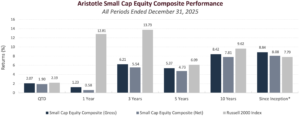
(All MSCI index returns are shown net and in U.S. dollars unless otherwise noted.)

Markets Review

Sources: CAPS CompositeHubTM, Bloomberg

Past performance is not indicative of future results. Aristotle International Equity Composite returns are presented gross and net of investment advisory fees and include the reinvestment of all income. Gross returns will be reduced by fees and other expenses that may be incurred in the management of the account. Net returns are calculated by subtracting a model fee of 0.50% on an annual basis or 0.04167% on a monthly basis, which includes trading costs and the revinvestment of all income. Please see important disclosures at the end of this document.

Global equity markets posted strong gains in the fourth quarter. The MSCI ACWI Index returned 3.29%, while bonds advanced in tandem (the Bloomberg Global Aggregate Bond Index increased 0.24%). Value stocks outperformed growth during the quarter, with the MSCI ACWI Value Index exceeding the MSCI ACWI Growth Index by 0.82%.

Outside the U.S., international equities delivered solid gains relative to their U.S. counterparts. The MSCI EAFE Index gained 4.86% for the quarter, while the MSCI ACWI ex USA Index returned 5.05%. Within the MSCI EAFE Index, the U.K. and Europe & Middle East were the strongest-performing markets, while Asia posted the weakest returns. From a sector perspective, ten out of the eleven sectors within the MSCI EAFE Index delivered positive returns, led by Utilities, Health Care and Financials. Conversely, Communication Services, Real Estate and Consumer Discretionary were the worst-performing sectors. In contrast to the U.S., where value stocks outperformed growth stocks for the quarter but lagged for the year, international value stocks led in both periods.

On the whole, the macroeconomic outlook continued to gradually improve in late 2025. The IMF modestly upgraded its 2025 forecast for global GDP growth to 3.2%, citing resilience in many economies. However, growth is expected to decelerate in 2026 as the world economy adjusts to the cumulative impact of new policies (such as higher tariffs and industrial policies) and as one-off boosts fade. Temporary factors that propped up activity in 2025—for example, the front-loading of imports to get ahead of tariff changes and the reconfiguration of supply chains—are likely to wane. The IMF also warned that near-term risks are tilted to the downside. Key concerns include the sustainability of the AI-driven boom (fears of a potential bubble or abrupt repricing), persistent economic struggles in China, and increased fiscal vulnerabilities in many countries (which could pressure central banks). Policymakers have been urged to shore up confidence with credible, transparent strategies, such as rebuilding fiscal buffers and preserving central bank independence.

Global inflation rates were mixed across regions but generally showed signs of easing. In the U.K., inflation unexpectedly eased to an eight-month low of 3.2%, but the unemployment rate rose to a four-year high and private-sector wage growth fell to a five-year low. As U.K. macro indicators weakened, the Bank of England cut its policy rate by 0.25% to 3.75%. In contrast, the European Central Bank left policy rates unchanged for the fourth consecutive meeting, as inflation remained near its 2% target and underlying growth proved resilient. Specifically, Germany finally showed signs of stabilization, with industrial production rising for two consecutive months (September and October), following GDP growth of 0.3% year-over-year in the third quarter. Even politically embattled France, whose Prime Minister Lecornu briefly resigned during the quarter, exceeded expectations and reported 0.9% annual growth.

In Asia, the quarter’s news cycle was dominated by the U.S.-China trade saga and evolving security postures. While tensions escalated early in the quarter, the two countries reached a one-year trade truce following a meeting between Presidents Trump and Xi at the Asia-Pacific Economic Cooperation (APEC) summit in South Korea. Under the agreement, China’s effective tariff rate declined to 47%, and export controls on critical rare earth materials were deferred. The timing may prove important, as China continues to contend with persistent deflationary pressures, declining fixed-asset investment and weak retail sales ahead of the implementation of its next Five-Year Plan in 2026. However, while relations with the U.S. improved, China’s relationship with Japan became strained after Japan’s first female prime minister, Sanae Takaichi, stated that Japan would militarily intervene if Beijing used force against Taiwan. Chinese officials warned that the comments had “severely damaged” trade cooperation, raising the risk of economic repercussions. These tensions emerged just as Japan reported its first economic contraction in six quarters. In response, Japan finalized a ¥21.3 trillion stimulus package; meanwhile, the Bank of Japan raised its policy rate to 0.75%, the highest level in three decades.

Beyond U.S.-China and Japan-China tensions, other geopolitical issues were in focus. In Europe, hopes rose for a resolution in Ukraine as diplomatic efforts intensified (with direct U.S. involvement in talks). In the Middle East, the Israel-Hamas ceasefire brokered by the U.S. in October largely held, allowing the release of all surviving Israeli hostages, an increase in humanitarian aid into Gaza and a lull in hostilities. Yet new flashpoints emerged in the Western Hemisphere: the U.S.-Venezuela confrontation escalated when the U.S. conducted a drone strike on a Venezuelan port used by cartels. While this action raised concerns about a broader conflict, analysts noted it could also embolden China in its territorial posturing (citing that U.S. actions set precedents, even though an analog in Taiwan is still seen as unlikely in the near term). In summary, by the end of 2025, many geopolitical conflicts that had unsettled markets earlier in the year showed tentative progress or containment, while new uncertainties arose that will carry into 2026.

Annual Markets Review

Global equity markets continued their upward trajectory in 2025, with the MSCI ACWI delivering a full-year return of 22.34%. Growth stocks outperformed value during the year, as the MSCI ACWI Growth Index exceeded the MSCI ACWI Value Index by 0.46%. Meanwhile, fixed income markets rallied, as the Bloomberg Global Aggregate Bond Index advanced 8.17%.

As markets digested new trade agreements, economic data and policy decisions by central banks, 2025 proved to be a resilient year for risk assets. However, even strong markets presented their own set of challenges. Factors such as momentum and volatility outperformed quality, and while economic indicators and corporate earnings were broadly supportive, central banks and corporate management teams struck a more cautious tone heading into 2026.

Given the risks and uncertainties surrounding macroeconomic conditions and market narratives, we believe it remains prudent to focus on individual businesses and their long-term fundamentals. By concentrating on what is analyzable, we believe our approach is well suited to navigating a range of market environments while remaining disciplined through full market cycles.

Performance and Attribution Summary

For the fourth quarter of 2025, Aristotle Capital’s International Equity Composite posted a total return of 5.60% gross of fees (5.47% net of fees), outperforming the MSCI EAFE Index, which returned 4.86%, and the MSCI ACWI ex USA Index, which returned 5.05%. Please refer to the table below for detailed performance.

Performance (%) 4Q251 Year3 Years5 Years10 Years Since Inception*
International Equity Composite (gross)5.6023.3115.807.648.486.58
International Equity Composite (net)5.4722.7115.237.117.946.05
MSCI EAFE Index (net)4.8631.2217.228.928.184.23
MSCI ACWI ex USA Index (net)5.0532.3917.337.918.414.00
*The inception date for the International Equity Composite is January 1, 2008. Past performance is not indicative of future results. Aristotle International Equity Composite returns are presented gross and net of model fees and include the reinvestment of all income. Gross returns will be reduced by fees and other expenses that may be incurred in the management of the account. Net returns are presented net of model fees. Net returns are calculated by subtracting a model fee of .50% on an annual basis or .04167% on a monthly basis, which includes trading costs and the reinvestment of all income. Please see important disclosures at the end of this document.

Source: FactSet

Past performance is not indicative of future results. Sector attribution shows how much of a portfolio’s overall return is directly attributable to stock selection and asset allocation decisions within the portfolio, highlighting which sectors contributed or detracted to the total return. Attribution includes the reinvestment of income. Attribution is presented gross of fees and does not include the deduction of all fees and expenses that a client or investor has paid or would have paid. Please refer to the gross and net composite returns included within to understand the overall impact of fees.

From a sector perspective, the portfolio’s outperformance relative to the MSCI EAFE Index can be attributed to both security selection and allocation effects. A lack of exposure to Communication Services, as well as security selection in Health Care and Industrials, contributed most to the portfolio’s relative performance. Conversely, security selection in Materials, Consumer Discretionary and Consumer Staples detracted from relative returns.

Regionally, both security selection and allocation effects were responsible for the portfolio’s outperformance. Exposure to Emerging Markets and security selection in Asia contributed the most to relative performance, while both an underweight and security selection in Europe & Middle East detracted.

Contributors and Detractors for 4Q 2025

Relative ContributorsRelative Detractors
Erste Group BankNemetschek
Samsung ElectronicsSony
RochePan Pacific International
FANUCExperian
Fast RetailingMichelin

Erste Group Bank, a leading retail and commercial bank in Central and Eastern Europe, was the top contributor during the quarter. The company reported strong operating performance, driven by healthy loan growth across core markets, resilient net interest income and solid fee income, with contributions from securities, asset management and payments. Its diversified, retail-oriented banking model, leading market positions across core geographies and strong deposit franchise anchored in household customers continue to support the business. During the quarter, Erste cleared key milestones related to its previously announced acquisition of a 49% stake in Santander Bank Polska. With regulatory conditions satisfied late in the quarter, the transaction is expected to close in early 2026. We view this transaction as strategically attractive, expanding Erste’s footprint into Poland, one of the region’s largest and most dynamic banking markets, while enhancing scale and diversification. More broadly, Erste’s exposure to underbanked Central and Eastern European economies positions the company to benefit as incomes rise and demand for credit, savings and financial services continues to grow. Ongoing investment in technology and digital capabilities supports efficiency, customer engagement and long-term profitability.

FANUC, the Japanese leader in factory automation and industrial robotics, was a top contributor during the quarter. The company operates across factory automation systems, industrial robots and precision machining centers, serving automotive, electronics and general industrial end markets. Results through the first half of fiscal year 2025 marked a clear inflection, with operating margin expanding to 21% as factory utilization and pricing discipline held firm. Performance was further supported by a sharp rebound in China, where robot sales grew over 80% year-over-year, more than offsetting softer demand in Europe and Japan. Beyond the cyclical recovery, FANUC continues to deepen its competitive advantages. Its dominant position in computer numerical control (CNC) systems, the “brains” of machine tools, underpins a large and highly sticky installed base. During the quarter, the company highlighted an increasingly open software strategy that allows third parties to develop applications directly on FANUC’s platform while maintaining safety and reliability at the controller level. This approach is reinforced by FANUC’s collaboration with NVIDIA, announced during the quarter and linking FANUC’s robot simulation tools with NVIDIA’s Omniverse software to enable highly accurate digital twins and accelerate deployment of AI-driven robotics. This leadership extends across its Robot and Robomachine segments, supported by an integrated hardware, software and service ecosystem that is difficult to replicate and highly valued in mission-critical applications. As global automation adoption accelerates amid labor shortages, rising wages and increasing manufacturing complexity, we believe FANUC is well-positioned to grow alongside its customers while sustaining attractive margins, supported by disciplined capital allocation and a growing mix of higher-margin service and software revenues.

Sony, the global leader in video games, image sensors, music and movies, was a primary detractor for the period. Shares declined following the recognition of a one-time, non-cash charge of approximately ¥50 billion in the Game & Network Services segment related to an impairment and accounting correction of previously capitalized development costs. Importantly, this charge was not recurring and did not reflect a deterioration in underlying operating performance. Excluding this item, operating income would have increased approximately 23% year-over-year, supported by healthy gaming engagement, continued growth in network services and software sales, and strong results in the Music segment driven by streaming growth and recent theatrical releases. The company’s image sensor business also benefited from a favorable product mix and steady end-market demand. Looking ahead, we continue to see opportunity for Sony to capitalize on its unique position as both a content creator and platform owner. The company’s ability to integrate gaming, music, anime and film—and to leverage IP across its ecosystem—supports sustained engagement and recurring revenue. In addition, the recent spinoff of Sony’s Financial Services segment further sharpens management’s focus on its core content, technology and entertainment operations. We believe Sony’s industry leadership and continued focus on operational execution position the company well for long-term value creation.

Experian, one of the world’s largest credit bureau companies, was a primary detractor during the quarter. Shares declined despite continued solid execution in the core business. Results in North America remained strong, with broad-based growth across financial services, consumer, automotive and health verticals, but performance in certain international markets, particularly Latin America, was constrained by high interest rates and elevated consumer indebtedness, which tempered near-term revenue growth expectations. We continue to view Experian as a uniquely advantaged big data and analytics business with a durable competitive position. The company maintains credit and identity data on approximately 1.5 billion consumers and about 200 million businesses globally, a depth and breadth that would be extremely difficult to replicate. This scale underpins powerful network effects, high switching costs and limited competition in its core markets. Importantly, the cost of Experian’s data is negligible relative to the financial risk it helps clients manage, supporting strong pricing power and resilient margins across credit cycles. Over our more than 15-year ownership period, Experian has consistently expanded beyond its traditional bureau roots by monetizing its proprietary datasets through software, analytics, fraud prevention and direct-to-consumer offerings. We believe the company will continue to benefit from rising penetration of its higher-value decisioning and analytics platforms, expanding consumer engagement, new monetization of “positive” data in markets such as Brazil, and the continued rollout of data-driven solutions into adjacent verticals, including healthcare, automotive and marketing services.

Recent Portfolio Activity

BuysSells
Aristocrat LeisureKubota
Nidec
Sony Financial

During the quarter, we sold our positions in Kubota, Nidec and Sony Financial and invested in Aristocrat Leisure.

We first invested in Kubota, the maker of tractors and construction machinery, during the second quarter of 2015. During our holding period, the company gained share in small tractors and construction machinery in North America, expanded in Southeast Asia, and restructured its water and environment segment. While Kubota maintains strong market positions in Japan, the U.S. and Thailand, share gains in these markets appear to be maturing. More recently, the industry has become increasingly promotional, requiring greater use of customer financing, which has raised capital intensity and pressured margins as interest rates have increased. Meanwhile, India remains an attractive long-term tractor market, but Kubota has yet to demonstrate an ability to take meaningful share. We exited the position in favor of what we considered to be a more compelling opportunity but continue to view Kubota as a high-quality company.

We invested in Nidec more than a decade ago, initially attracted by the company’s position as a global leader in precision motors, its strong market share across hard disk drive, its growing presence in industrial and automotive applications, and its ability to consolidate a fragmented industry while generating attractive margins and returns on invested capital. Over our holding period, Nidec maintained leadership in several core motor categories and benefited from long-term demand for energy-efficient solutions across industrial, appliance and data center markets. However, several anticipated catalysts were slower to materialize. The company’s expansion into electric vehicle traction motors proved more competitive and less profitable than expected, while frequent leadership changes, strategic shifts and, more recently, manufacturing and accounting issues introduced persistent uncertainty. Despite efforts to improve discipline and profitability, ongoing investigations and questions around business quality and controls reduced the clarity and predictability of the business. Given these unresolved issues, we concluded that Nidec no longer offered an attractive risk-adjusted return and exited the position.

We received shares of Sony Financial Group following its spin-off from our long-term holding, Sony Group, in October 2025. Sony Financial is a Japan-based financial services company with operations in life insurance, banking and digital payments. While we view Sony Financial as an attractive, well-managed business, we already have meaningful exposure to the global insurance industry through holdings such as AIA Group and Munich Re. Given our existing positioning, we elected to sell the shares received in the spinoff.

Aristocrat Leisure Limited

Founded in 1953 and headquartered in Sydney, Australia, Aristocrat Leisure is a global gaming company that designs and manufactures slot machines and casino systems alongside digital and mobile gaming content. While Australian-domiciled, North America accounts for more than half of total revenue, where Aristocrat holds strong positions across both commercial and tribal gaming markets.

The company operates through three distinct segments: Gaming (~63% of revenue), which includes physical slot machines and gaming systems installed in casinos; Product Madness (~29%), which consists of free-to-play social casino games distributed on mobile platforms; and Interactive (~9%), which houses the company’s regulated real-money digital gaming activities, including iGaming and iLottery. Aristocrat’s 2024 acquisition of NeoGames materially expanded this digital footprint, adding capabilities across the value chain such as player account management platforms and enhanced content distribution.

Some of the quality characteristics we have identified for Aristocrat include:

  • A leading position in the global gaming machine market, supported by a large installed base of machines and a business model in which more than 70% of revenue is now recurring in nature, significantly reducing cyclicality and reliance on casino capital spending relative to the past;
  • An oligopolistic industry structure, with the three leading gaming machine manufacturers controlling more than 75% of total industry volume, creating high barriers to entry, rational competition and attractive long-term economics for incumbents;
  • A meaningful design and development advantage, underpinned by sustained investment well above industry peers, which supports a differentiated content pipeline, reinforces long-lived franchises such as Lightning Link, Dragon Link, and Buffalo, and contributes to strong returns on invested capital; and
  • Deep, long-standing relationships with casino operators—particularly tribal customers—supported by proprietary content, long-lived installations and high switching costs. 

We believe shares of Aristocrat are attractively valued relative to our estimate of intrinsic value. Despite strong market positions, a growing mix of recurring revenue and improving margins, the stock appears to be priced as a more cyclical and less-durable business than is warranted, in our view. Therefore, we believe the current valuation does not fully reflect Aristocrat’s underlying earnings power or its ability to compound FREE cash flow over time.

Catalysts we have identified for Aristocrat, which we believe will drive stock price appreciation over our three- to five-year investment horizon, include:

  • Continued share gains in the North American gaming machine market, particularly within the premium-leased segment, which should support higher margins over time;
  • A continued shift toward recurring revenue sources across gaming operations and digital platforms, resulting in greater earnings predictability and stronger FREE cash flow generation; and
  • The integration of NeoGames, which enables a more end-to-end iGaming and iLottery offering, improves content distribution, and positions Aristocrat to benefit from ongoing consolidation in highly regulated, annuity-like digital lottery and gaming markets.

Conclusion

Markets and economic conditions will continue to evolve, often in ways that are difficult to anticipate. While we remain attentive to these developments, our work is ultimately centered on understanding individual businesses—how they compete, how they allocate capital and how their economics change over time. We recognize that progress in business fundamentals and investment outcomes do not always align over shorter periods. Thus, we approach our investment process with patience and a willingness to reassess our views as circumstances change. Rather than react impulsively to every macro headline or try to time short-term market moves, we focus on what is analyzable and enduring: the long-term fundamentals of the companies we own. We believe this careful, fundamental approach remains the most reliable way to add value for our clients over the long run, across a wide range of market environments.

Disclosures

The opinions expressed herein are those of Aristotle Capital Management, LLC (Aristotle Capital) and are subject to change without notice. Past performance is not a guarantee or indicator of future results. This material is not financial advice or an offer to buy or sell any product. You should not assume that any of the securities transactions, sectors or holdings discussed in this report were or will be profitable, or that recommendations Aristotle Capital makes in the future will be profitable or equal the performance of the securities listed in this report. The portfolio characteristics shown relate to the Aristotle International Equity strategy. Not every client’s account will have these characteristics. Aristotle Capital reserves the right to modify its current investment strategies and techniques based on changing market dynamics or client needs. There is no assurance that any securities discussed herein will remain in an account’s portfolio at the time you receive this report or that securities sold have not been repurchased. The securities discussed may not represent an account’s entire portfolio and, in the aggregate, may represent only a small percentage of an account’s portfolio holdings. The performance attribution presented is of a representative account from Aristotle Capital’s International Equity Composite. The representative account is a discretionary client account which was chosen to most closely reflect the investment style of the strategy. The criteria used for representative account selection is based on the account’s period of time under management and its similarity of holdings in relation to the strategy. Recommendations made in the last 12 months are available upon request.

Returns are presented gross and net of model fees and include the reinvestment of all income. Gross returns will be reduced by fees and other expenses that may be incurred in the management of the account. Net returns are presented net of model fees. Net returns are calculated by subtracting a model fee of .50% on an annual basis or .04167% on a monthly basis, which includes trading costs and the reinvestment of all income.

All investments carry a certain degree of risk, including the possible loss of principal. Investments are also subject to political, market, currency and regulatory risks or economic developments. International investments involve special risks that may in particular cause a loss in principal, including currency fluctuation, lower liquidity, different accounting methods and economic and political systems, and higher transaction costs. These risks typically are greater in emerging markets. While Large-capitalization companies may have more stable prices than smaller, less established companies, they are still subject to equity securities risk. In addition, large-capitalization equity security prices may not rise as much as prices of equity securities of small-capitalization companies. Securities of small- and medium-sized companies tend to have a shorter history of operations and be more volatile and less liquid. Value stocks can perform differently from the market as a whole and other types of stocks. The material is provided for informational and/or educational purposes only and is not intended to be and should not be construed as investment, legal or tax advice and/or a legal opinion. Investors should consult their financial and tax adviser before making investments. The opinions referenced are as of the date of publication, may be modified due to changes in the market or economic conditions, and may not necessarily come to pass. Information and data presented has been developed internally and/or obtained from sources believed to be reliable. Aristotle Capital does not guarantee the accuracy, adequacy or completeness of such information.

Aristotle Capital Management, LLC is an independent registered investment adviser under the Advisers Act of 1940, as amended. Registration does not imply a certain level of skill or training. More information about Aristotle Capital, including our investment strategies, fees and objectives, can be found in our Form ADV Part 2, which is available upon request. ACM-2601-32

Performance Disclosures

Sources: CAPS CompositeHubTM, MSCI

Past performance is not indicative of future results. The information provided should not be considered financial advice or a recommendation to purchase or sell any particular security or product. Performance results for periods greater than one year have been annualized. Returns are presented gross and net of model fees and include the reinvestment of all income. Gross returns will be reduced by fees and other expenses that may be incurred in the management of the account. Net returns are presented net of model fees. Net returns are calculated by subtracting a model fee of .50% on an annual basis or .04167% on a monthly basis, which includes trading costs and the reinvestment of all income.

Index Disclosures

The MSCI EAFE Index (Europe, Australasia, Far East) is a free float-adjusted market capitalization-weighted index that is designed to measure the equity market performance of developed markets, excluding the United States and Canada. The MSCI EAFE Index consists of the following 21 developed market country indexes: Australia, Austria, Belgium, Denmark, Finland, France, Germany, Hong Kong, Ireland, Israel, Italy, Japan, the Netherlands, New Zealand, Norway, Portugal, Singapore, Spain, Sweden, Switzerland and the United Kingdom. The MSCI ACWI captures large and mid-cap representation across 23 developed market countries and 24 emerging markets countries. With approximately 2,500 constituents, the Index covers approximately 85% of the global investable equity opportunity set. The MSCI ACWI Growth Index captures large and mid-cap securities exhibiting overall growth style characteristics across 23 developed markets countries and 24 emerging markets countries. The MSCI ACWI Value Index captures large and mid-cap securities exhibiting overall value style characteristics across 23 developed markets countries and 24 emerging markets countries. The MSCI ACWI ex USA Index captures large and mid-cap representation across 22 of 23 developed markets countries (excluding the United States) and 24 emerging markets countries. With approximately 2,000 constituents, the Index covers approximately 85% of the global equity opportunity set outside the United States. The MSCI Emerging Markets Index is a free float-adjusted market capitalization-weighted index that is designed to measure the equity market performance of emerging markets. The MSCI Emerging Markets Index consists of the following 24 emerging market country indexes: Brazil, Chile, China, Colombia, Czech Republic, Egypt, Greece, Hungary, India, Indonesia, Korea, Kuwait, Malaysia, Mexico, Peru, Philippines, Poland, Qatar, Saudi Arabia, South Africa, Taiwan, Thailand, Turkey and United Arab Emirates. The S&P 500® Index is the Standard & Poor’s Composite Index of 500 stocks and is a widely recognized, unmanaged index of common stock prices. The Brent Crude Oil Index is a major trading classification of sweet light crude oil that serves as a major benchmark price for purchases of oil worldwide. The MSCI Japan Index is designed to measure the performance of the large and mid-cap segments of the Japanese market. With approximately 200 constituents, the Index covers approximately 85% of the free float-adjusted market capitalization in Japan. The Bloomberg Global Aggregate Bond Index is a flagship measure of global investment grade debt from 27 local currency markets. This multi-currency benchmark includes treasury, government-related, corporate and securitized fixed-rate bonds from both developed and emerging markets issuers. The MSCI United Kingdom Index is designed to measure the performance of the large and mid-cap segments of the U.K. market. With nearly 100 constituents, the Index covers approximately 85% of the free float-adjusted market capitalization in the United Kingdom. The MSCI Europe Index captures large and mid-cap representation across 15 developed markets countries in Europe. With approximately 400 constituents, the Index covers approximately 85% of the free float-adjusted market capitalization across the European developed markets equity universe. These indexes have been selected as the benchmarks and are used for comparison purposes only. The volatility (beta) of the Composite may be greater or less than the respective benchmarks. It is not possible to invest directly in these indexes.

For more on International Equity, access the latest resources.

Markets Review

Sources: CAPS CompositeHubTM, Bloomberg
Past performance is not indicative of future results. Aristotle Value Equity Composite returns are presented gross and net of investment advisory fees and include the reinvestment of all income. Gross returns will be reduced by fees and other expenses that may be incurred in the management of the account. Net returns are presented net of model fees. Net returns are calculated by subtracting a model fee of 0.50% on an annual basis or 0.04167% on a monthly basis, which includes trading costs and the reinvestment of all income. Aristotle Capital Composite returns are preliminary pending final account reconciliation. Please see important disclosures at the end of this document.

U.S. equity markets reached new all-time highs in the fourth quarter of 2025. The S&P 500 Index rose 2.66%, while fixed income markets also finished higher, with the Bloomberg U.S. Aggregate Bond Index up 1.10% for the quarter. Value stocks handily outperformed growth stocks—the Russell 1000 Value Index outperformed its Growth counterpart by 2.69%. Within the Russell 1000 Value Index, eight out of the eleven sectors posted positive returns. The best-performing sectors were Information Technology, Communication Services and Health Care, whereas Real Estate, Utilities and Consumer Discretionary were the weakest segments.

The U.S. economy continued to demonstrate resilience. Data released during the period showed that real GDP surged at a 4.3% annualized rate in the third quarter—the fastest quarterly growth in two years—driven primarily by robust consumer spending, with additional contributions from rising exports and increased government outlays. Despite this strength, consumer confidence deteriorated toward year-end; economists projected a moderation in spending, and concerns about the labor market persisted. The unemployment rate ticked up to 4.6% in November (a four-year high), though this level remains low by historical standards and is still consistent with an economy operating near full employment. Meanwhile, inflation moderated—the Consumer Price Index was up just 2.7% year-over-year in November, reaching its lowest level since July. Economists cautioned that recent unemployment and inflation figures were likely skewed by technical factors related to the 43-day government shutdown, which disrupted data reporting. This shutdown—the longest in U.S. history—forced approximately 1.4 million federal employees to go without pay and even led to temporary layoffs at some agencies before Congress passed a continuing resolution to reopen on November 12.

Given the mixed economic signals and uncertainty around the data, the Federal Reserve took a cautious stance. The Fed implemented two 0.25% interest rate cuts during the quarter, lowering the federal funds target range to 3.50%-3.75%. Fed Chair Powell emphasized a data-dependent approach, acknowledging risks to both sides of the Fed’s dual mandate. He noted the need to carefully assess incoming information, highlighting that policy would remain cautious and measured going into 2026.

Trade relations between the U.S. and China remained a key focus for markets. Early in the fourth quarter, tensions flared with tariff escalations and export controls. (China had dramatically expanded export controls on rare earth minerals, and the U.S. threatened 100% tariffs in retaliation.) Ultimately, President Trump and President Xi met at the Asia-Pacific Economic Cooperation (APEC) summit in South Korea and reached a one-year trade truce.

Corporate earnings remained robust. S&P 500 companies reported earnings growth of 13.6%, marking the fourth consecutive quarter of double-digit expansion. Of the 11 sectors within the S&P 500 Index, Information Technology recorded the strongest earnings growth of 29%. Artificial intelligence continued to be a major theme—more than 300 S&P 500 companies mentioned “AI” on their earnings calls during the fall. This enthusiasm helped propel mega-cap tech stocks higher and drive the market’s gains. However, as the quarter progressed, scrutiny increased around AI-related revenue circularity (companies buying AI services from each other to boost sales), the massive scale of AI-related capital spending, and the durability of longer-term returns on investment.

Annual Markets Review

The U.S. equity markets extended their momentum in 2025, with the S&P 500 Index posting a full-year return of 17.88%. Similar to recent years, Communication Services and Information Technology were the strongest-performing sectors, rising 33.65% and 24.04%, respectively, as enthusiasm around AI remained a dominant market theme. Reflecting this leadership, the Russell 1000 Growth Index outperformed the Russell 1000 Value Index by 2.65% for the year.

Fixed income markets also delivered strong performance, with the Bloomberg U.S. Aggregate Bond Index advancing 7.30% over the period.

While trends such as AI continued to propel markets forward, 2025 was not without challenges, both new and existing. President Trump’s tariffs, ongoing geopolitical conflicts, mixed economic data and a government shutdown all contributed to heightened uncertainty.

Factors such as momentum and volatility outperformed quality, and while the economic and earnings backdrop was generally supportive, both the Fed and corporate management teams adopted a more cautious tone heading into 2026.

Given the risks and uncertainties surrounding macroeconomic conditions and market narratives, we believe it remains prudent to focus on individual businesses and their long-term fundamentals. By concentrating on what is analyzable, we believe our approach is well suited to navigating a range of market environments while remaining disciplined through full market cycles.

Performance and Attribution Summary

For the fourth quarter of 2025, Aristotle Capital’s Value Equity Composite posted a total return of 1.44% gross of fees (1.31% net of fees), underperforming the 3.81% return of the Russell 1000 Value Index and the 2.66% return of the S&P 500 Index. Please refer to the table for detailed performance.

Performance (%) 4Q251 Year3 Years5 Years10 Years
Value Equity Composite (gross)1.4411.9013.449.4412.34
Value Equity Composite (net)1.3111.3512.888.9011.78
Russell 1000 Value Index3.8115.9113.9011.3310.53
S&P 500 Index2.6617.8823.0114.4214.82
Past performance is not indicative of future results. Aristotle Value Equity Composite returns are presented gross and net of model fees and include the reinvestment of all income. Gross returns will be reduced by fees and other expenses that may be incurred in the management of the account. Net returns are presented net of model fees. Net returns are calculated by subtracting a model fee of .50% on an annual basis or .04167% on a monthly basis, which includes trading costs and the reinvestment of all income. Aristotle Capital Composite returns are preliminary pending final account reconciliation. Please see important disclosures at the end of this document.

Source: FactSet
Past performance is not indicative of future results. Sector attribution shows how much of a portfolio’s overall return is directly attributable to stock selection and asset allocation decisions within the portfolio, highlighting which sectors contributed or detracted to the total return. Attribution includes the reinvestment of income. Attribution is presented gross of fees and does not include the deduction of all fees and expenses that a client or investor has paid or would have paid. Please refer to the gross and net composite returns included within to understand the overall impact of fees.

The portfolio’s underperformance relative to the Russell 1000 Value Index in the fourth quarter can be attributed to security selection, while allocation effects contributed. Security selection in Information Technology, Consumer Discretionary and Materials detracted the most from relative performance. Conversely, security selection in Financials, Health Care and Energy contributed. (Relative weights are the result of bottom-up security selection.)

Contributors and Detractors for 4Q 2025

Relative ContributorsRelative Detractors
Parker HannifinLennar
Capital One FinancialSony
AmgenUber
MerckMicrosoft
U.S. BancorpTeledyne Technologies

Sony, the global leader in video games, image sensors, music and movies, was a primary detractor for the period. Shares declined following the recognition of a one-time, non-cash charge of approximately ¥50 billion in the Game & Network Services segment related to an impairment and accounting correction of previously capitalized development costs. Importantly, this charge was not recurring and did not reflect a deterioration in underlying operating performance. Excluding this item, operating income would have increased approximately 23% year-over-year, supported by healthy gaming engagement, continued growth in network services and software sales, and strong results in the Music segment driven by streaming growth and recent theatrical releases. The company’s image sensor business also benefited from a favorable product mix and steady end-market demand. Looking ahead, we continue to see opportunity for Sony to capitalize on its unique position as both a content creator and platform owner. The company’s ability to integrate gaming, music, anime and film—and to leverage IP across its ecosystem—supports sustained engagement and recurring revenue. In addition, the recent spinoff of Sony’s Financial Services segment further sharpens management’s focus on its core content, technology and entertainment operations. We believe Sony’s industry leadership and continued focus on operational execution position the company well for long-term value creation.

Uber, a leading rideshare, delivery and shipping technology platform, was one of the largest detractors during the period. Trip volumes reached record levels, and gross bookings grew significantly year-over-year, yet the stock underperformed as investor focus shifted from growth to margin trajectory, regulatory risk and autonomous vehicle (AV) uncertainty. The primary near-term concern among market participants was management’s guidance around profitability. While results exceeded expectations on bookings and FREE cash flow, Uber signaled a deliberate moderation in margin expansion, as incremental profits are reinvested into affordability, cross-platform engagement and early AV initiatives. Regulatory concerns also resurfaced, particularly in Europe, where ongoing debates around driver classification and data protection continue to pose potential cost (and therefore margin) headwinds. At the same time, competitive anxiety around AVs intensified following Lyft’s expanded partnership with Waymo and continued investor focus on Tesla’s long-term robotaxi ambitions. Management acknowledged that autonomous initiatives will pressure near-term margins, as Uber invests to build supply and data infrastructure, even as utilization in early AV markets has been encouraging. Over the long term, however, our thesis remains intact. Uber’s global scale, deepening network effects, growing FREE cash flow and expanding cross-platform ecosystem position the company to compound value as profitability improves and new mobility technologies mature.

Parker Hannifin, the manufacturer of motion and control technologies, was the top contributor during the quarter. The company continues to benefit from strength in its aerospace business, where demand for original equipment and aftermarket services has driven organic growth and margin expansion. The ongoing integration of Meggitt, which Parker Hannifin acquired in 2022, has further expanded the company’s aerospace and defense capabilities while increasing exposure to higher-margin aftermarket revenue—a catalyst we previously identified. Alongside this progress, management has continued to strengthen the company’s balance sheet following a period of elevated acquisition activity, with net debt-to-EBITDA trending lower. In addition, Parker Hannifin’s broad portfolio of motion and control technologies positions the company to benefit from secular trends such as factory automation, electrification of industrial equipment, digitization, and increased complexity and modernization across commercial and defense aerospace platforms. The company continues to execute its Win Strategy, driving operational excellence, pricing discipline and strong cash flow generation. We believe these catalysts support a more resilient earnings profile and will allow Parker Hannifin to continue improving profitability and FREE cash flow generation over time.

Capital One Financial was a primary contributor during the quarter. Following the completion of its all-stock acquisition of Discover, the company reported strong results in its first full quarter post-transaction, including net interest margin expansion driven primarily by the addition of Discover’s credit card portfolio. The acquisition positions Capital One as one of the largest U.S. credit card issuers and adds ownership of the Discover payment network, which we believe has the potential to improve payment economics and enhance operating leverage over time. During the quarter, the company also announced increased capital returns through a new share buyback program and a higher quarterly dividend, reflecting confidence in its balance sheet and earnings power. In addition, resilient consumer spending, stable credit quality and a strengthening deposit base contributed to performance. We believe Capital One’s scale and integrated payments capabilities support a more resilient earnings profile and position the company to continue generating attractive returns over time.

Recent Portfolio Activity

BuysSells
NoneCommerce Bancshares
Constellation Brands
Sony Financial

During the quarter, we sold our positions in Commerce Bancshares, Constellation Brands and Sony Financial.

We first invested in Commerce Bancshares, the Kansas City-based bank, in the fourth quarter of 2019. We were attracted to the bank’s conservatively run franchise, disciplined approach to credit, well-diversified revenue mix with a meaningful contribution from fee-based businesses, and long-tenured management team that has historically operated with a “private company” mindset. At the time of purchase, we identified several catalysts, including continued loan growth—particularly in core Kansas markets—prudent expense management, sustained strong credit underwriting, and the accretive deployment of excess capital through dividends and share repurchases. Over our holding period, Commerce executed consistently against these objectives, demonstrating resilience through multiple operating environments while maintaining strong credit quality, disciplined cost control and steady capital returns, including a long history of dividend increases. As these catalysts played out, we chose to sell our position and redeployed the proceeds into what we view as a more attractive investment opportunity in Wells Fargo, which we purchased in the third quarter of 2025.

We first invested in Constellation Brands, the premium beer, wine and spirits company, in the fourth quarter of 2021. At the time, we believed the company was well positioned to benefit from its dominant share of the fast-growing Mexican imports segment of U.S. beer, supported by iconic brands such as Modelo, Corona and Pacifico, hard-to-replicate production assets in Mexico, and a management team with a strong track record of building brands and marketing imported brands to mainstream U.S. consumers and expanding  distribution. Over our holding period, Constellation continued to benefit from the growing popularity of Mexican beer in the U.S and its core beer segment remained a clear source of strength.  However, the timing and magnitude of several key catalysts evolved. Expansion of shelf space and overall distribution progressed more slowly than expected, while improvement in the Wine & Spirits segment proved more challenging, pushing meaningful margin recovery further into the future. As a result, while the long-term strategic rationale for the business remains intact, we determined that Constellation was the most appropriate candidate for sale to fund a new investment in the first quarter of 2026, to be discussed in greater detail next quarter.

We received shares of Sony Financial following its spinoff from our long-term holding Sony in October 2025. Sony Financial is a Japan-based financial services company with operations in life insurance, banking and digital payments. While we view Sony Financial as an attractive, well-managed business, its operations are focused primarily on the Japanese market. Given this focus, we elected to sell the shares received in the spinoff.

Conclusion

Markets and economic conditions will continue to evolve, often in ways that are difficult to anticipate. While we remain attentive to these developments, our work is ultimately centered on understanding individual businesses—how they compete, how they allocate capital and how their economics change over time. We recognize that progress in business fundamentals and investment outcomes do not always align over shorter periods. Thus, we approach our investment process with patience and a willingness to reassess our views as circumstances change. Rather than react impulsively to every macro headline or try to time short-term market moves, we focus on what is analyzable and enduring: the long-term fundamentals of the companies we own. We believe this careful, fundamental approach remains the most reliable way to add value for our clients over the long run, across a wide range of market environments.

Disclosures

The opinions expressed herein are those of Aristotle Capital Management, LLC (Aristotle Capital) and are subject to change without notice. Past performance is not a guarantee or indicator of future results. This material is not financial advice or an offer to purchase or sell any product. You should not assume that any of the securities transactions, sectors or holdings discussed in this report were or will be profitable, or that recommendations Aristotle Capital makes in the future will be profitable or equal the performance of the securities listed in this report. The portfolio characteristics shown relate to the Aristotle Value Equity strategy. Not every client’s account will have these characteristics. Aristotle Capital reserves the right to modify its current investment strategies and techniques based on changing market dynamics or client needs. There is no assurance that any securities discussed herein will remain in an account’s portfolio at the time you receive this report or that securities sold have not been repurchased. The securities discussed may not represent an account’s entire portfolio and, in the aggregate, may represent only a small percentage of an account’s portfolio holdings. The performance attribution presented is of a representative account from Aristotle Capital’s Value Equity Composite. The representative account is a discretionary client account which was chosen to most closely reflect the investment style of the strategy. The criteria used for representative account selection is based on the account’s period of time under management and its similarity of holdings in relation to the strategy. Recommendations made in the last 12 months are available upon request.

Returns are presented gross and net of model fees and include the reinvestment of all income. Gross returns will be reduced by fees and other expenses that may be incurred in the management of the account. Net returns are presented net of model fees. Net returns are calculated by subtracting a model fee of .50% on an annual basis or .04167% on a monthly basis, which includes trading costs and the reinvestment of all income.

All investments carry a certain degree of risk, including the possible loss of principal. Investments are also subject to political, market, currency and regulatory risks or economic developments. International investments involve special risks that may in particular cause a loss in principal, including currency fluctuation, lower liquidity, different accounting methods and economic and political systems, and higher transaction costs. These risks typically are greater in emerging markets. While Large-capitalization companies may have more stable prices than smaller, less established companies, they are still subject to equity securities risk. In addition, large-capitalization equity security prices may not rise as much as prices of equity securities of small-capitalization companies. Securities of small- and medium-sized companies tend to have a shorter history of operations and be more volatile and less liquid. Value stocks can perform differently from the market as a whole and other types of stocks. The material is provided for informational and/or educational purposes only and is not intended to be and should not be construed as investment, legal or tax advice and/or a legal opinion. Investors should consult their financial and tax adviser before making investments. The opinions referenced are as of the date of publication, may be modified due to changes in the market or economic conditions, and may not necessarily come to pass. Information and data presented has been developed internally and/or obtained from sources believed to be reliable. Aristotle Capital does not guarantee the accuracy, adequacy or completeness of such information.

Aristotle Capital Management, LLC is an independent registered investment adviser under the Advisers Act of 1940, as amended. Registration does not imply a certain level of skill or training. More information about Aristotle Capital, including our investment strategies, fees and objectives, can be found in our ADV Part 2, which is available upon request. ACM-2601-23

Performance Disclosures


Sources: CAPS CompositeHubTM, Russell Investments, Standard & Poor’s

Past performance is not indicative of future results. The information provided should not be considered financial advice or a recommendation to purchase or sell any particular security or product. Performance results for periods greater than one year have been annualized. The Aristotle Value Equity strategy has an inception date of November 1, 2010; however, the strategy initially began at Mr. Gleicher’s predecessor firm in October 1997. A supplemental performance track record from January 1, 2001 through October 31, 2010 is provided above. The returns are based on two separate accounts and performance results are based on custodian data. During this time, Mr. Gleicher had primary responsibility for managing the two accounts, one account starting in November 2000 and the other in December 2000.

Composite and supplemental returns are presented gross and net of model fees and include the reinvestment of all income. Gross returns will be reduced by fees and other expenses that may be incurred in the management of the account. Net returns are presented net of model fees. Net returns are calculated by subtracting a model fee of .50% on an annual basis or .04167% on a monthly basis, which includes trading costs and the reinvestment of all income.

Index Disclosures

The Russell 1000® Value Index measures the performance of the large cap value segment of the U.S. equity universe. It includes those Russell 1000 Index companies with lower price-to-book ratios and lower expected growth values. The S&P 500® Index is the Standard & Poor’s Composite Index of 500 stocks and is a widely recognized, unmanaged index of common stock prices. The S&P 500 Equal Weight Index is designed to be the size-neutral version of the S&P 500. It includes the same constituents as the cap-weighted S&P 500, but each company in the S&P 500 Equal Weight Index is allocated the same weight at each quarterly rebalance. The Russell 1000® Growth Index measures the performance of the large cap growth segment of the U.S. equity universe. It includes those Russell 1000 companies with higher price-to-book ratios and higher forecasted growth values. The Russell 2000® Index measures the performance of the small cap segment of the U.S. equity universe. The Russell 2000 Index is a subset of the Russell 3000® Index representing approximately 10% of the total market capitalization of that index. It includes approximately 2,000 of the smallest securities based on a combination of their market cap and current index membership. The Dow Jones Industrial Average® is a price-weighted measure of 30 U.S. blue-chip companies. The Index covers all industries except transportation and utilities. The NASDAQ Composite Index measures all NASDAQ domestic and international based common type stocks listed on The NASDAQ Stock Market. The NASDAQ Composite includes over 3,000 companies, more than most other stock market indexes. The Bloomberg U.S. Aggregate Bond Index is an unmanaged index of domestic investment grade bonds, including corporate, government and mortgage-backed securities. The WTI Crude Oil Index is a major trading classification of sweet light crude oil that serves as a major benchmark price for oil consumed in the United States. The 3-Month U.S. Treasury Bill is a short-term debt obligation backed by the U.S. Treasury Department with a maturity of three months. The Consumer Price Index is a measure of the average change over time in the prices paid by urban consumers for a market basket of consumer goods and services. The volatility (beta) of the Composite may be greater or less than its respective benchmarks. It is not possible to invest directly in these indices.
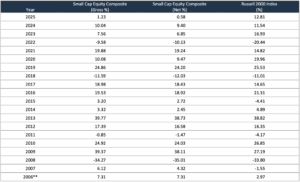
One of our Portfolio Managers has a beloved brother and family. The PM tries to spend quality time with them on every occasion. Birthdays are a good time to hang out and celebrate. Recently, on the brother’s birthday, the family was all together, early one Saturday.

What shall we do today, to make it special?” asked our PM.

The brother replied … “Of course, we need to begin by going to IHOP for breakfast. You get free pancakes on your birthday!

Um, pancakes, OK for a start. Then what?

You can then come with me to that car dealer I told you of, the one that gives away free pens for each test drive.

Oh, you’re buying a new car? Great day for that!

To read the full article, please use the link below.

As we reflect on our journey and the progress made since the inception of our Council, we are proud of the strides we have made to expand our Diversity, Equity and Inclusion efforts. In 2024, we emphasized this expansion by strengthening our partnership with Human Resources and together adding depth to our employee programs and community engagement. We believe embracing diverse experiences and perspectives enhances decision-making and ultimately leads to better outcomes for our clients, employees and communities.

Robotics marks a foundational shift in how industries perform physical work, blending mechanical systems with intelligent software to automate tasks once reserved for humans. As automation scales from factory floors to hospitals, farms, highways and defense systems, demand is accelerating in response to long-term shifts in labor availability, sustainability priorities and technological capability. The rapid evolution of robotics is no longer theoretical—it is now an investable reality. We estimate that the total addressable market (TAM) for robotics in 2025 was $107 billion and project it to grow to $711 billion in 2035, implying a compound annual growth rate (CAGR) of 21% (see Appendix). While estimates differ depending on how broadly or narrowly robotics is defined, this forecast illustrates the substantial long-term market growth potential and underscores the scale of opportunity for investors. Companies that integrate robotics into their operations are gaining competitive advantages through efficiency and scalable growth models. While deployment challenges and regulatory considerations remain, we believe robotics is positioned to become one of the most important enablers of economic transformation in the decades ahead.

To read the full thought piece, please use the link below.