FOR PRESENTATION TO MERRILL LYNCH WEALTH MANAGEMENT FINANCIAL ADVISORS ONLY

Markets Review

The U.S. equity market finished in the red, ending seven consecutive quarters of positive performance. Overall, the S&P 500 Index fell 4.60% during the period. Concurrently, the Bloomberg U.S. Aggregate Bond Index dropped 5.93% for the quarter. In terms of style, the Russell 1000 Value Index outperformed its growth counterpart by 8.30% during the quarter.
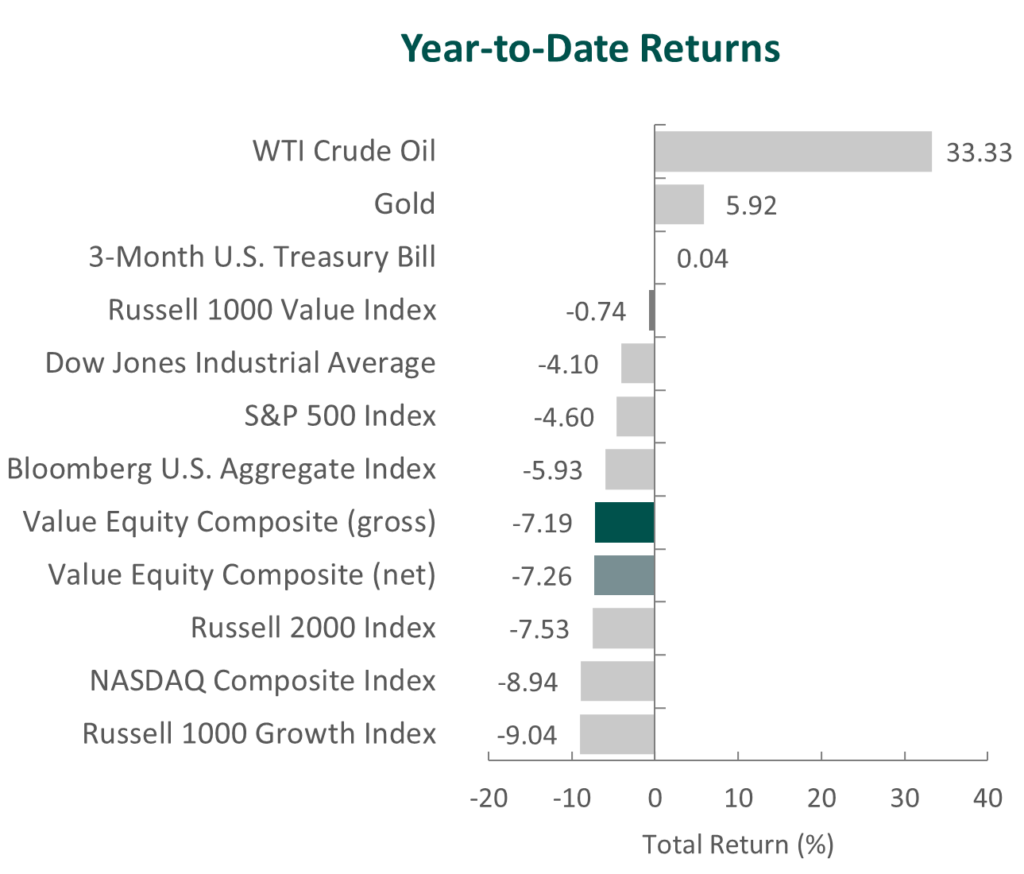
Sources: SS&C Advent, Bloomberg
Past performance is not indicative of future results. Aristotle Value Equity Composite returns are presented gross and net of investment advisory fees and include the reinvestment of all income. Aristotle Capital Composite returns are preliminary pending final account reconciliation. Please see important disclosures at the end of this document.

On a sector basis, seven out of eleven sectors within the Russell 1000 Value Index finished lower for the quarter, with Consumer Discretionary, Information Technology and Real Estate posting the largest declines. The strongest performers were Energy, Materials and Utilities.

On the economic front, the labor market continued to improve and inflation continued to rise, resulting in tighter monetary policy. Specifically, the unemployment rate continued its descent, falling to 3.8%, while the CPI rose 7.9% — the fastest pace of annual inflation in 40 years – amid increases in gasoline, food and housing rental prices. Inflation remained at elevated levels due to factors such as supply-chain disruptions, a tight labor market and increasing commodity prices. In turn, the Federal Reserve (Fed) voted to raise the target for its benchmark federal funds rate by a quarter percentage point to a range of 0.25% to 0.50%, the first rate increase since 2018. Fed officials reiterated their mandate of achieving maximum employment and 2% inflation in the long run and expect that ongoing interest rate hikes will be needed. Additionally, the central bank ended its bond-buying program and will begin reducing its holdings of Treasury securities, agency debt and agency mortgage-backed securities.

Geopolitical tensions spiked as Russia’s invasion of Ukraine created a grave humanitarian crisis that also impacted world economies. An unprecedented level of sanctions has been placed on Russia by Western governments, paired with a disruption of commodity supplies – with oil at one point eclipsing $130 a barrel – and renewed tensions between the U.S. and China. Policymakers have thus acknowledged the likely continued upward pressure on inflation and adverse impact on global economic activity.

In corporate earnings, supply-chain disruptions, input price pressures and wage growth remained major talking points for management teams. Nevertheless, the S&P 500 constituents continued to push past pre-pandemic levels, reporting ~26% earnings growth since 2019, as businesses across a wide range of industries continued to benefit from strong demand.

Performance and Attribution Summary

For the first quarter of 2022, Aristotle Capital’s Value Equity Composite posted a total return of -7.19% gross of fees (-7.26% net of fees), underperforming the -0.74% return of the Russell 1000 Value Index and the -4.60% return of the S&P 500 Index. Please refer to the table for detailed performance.

Performance (%) 1Q22 1 Year3 Years5 Years10 Years
Value Equity Composite (gross)-7.196.1616.9713.6614.53
Value Equity Composite (net)-7.265.9016.6513.3214.15
Russell 1000 Value Index-0.7411.6713.0110.2811.69
S&P 500 Index-4.6015.6518.9115.9814.63
Past performance is not indicative of future results. Returns are presented gross and net of investment advisory fees and include the reinvestment of all income. Aristotle Capital Composite returns are preliminary pending final account reconciliation. Please see important disclosures at the end of this document.

Source: FactSet
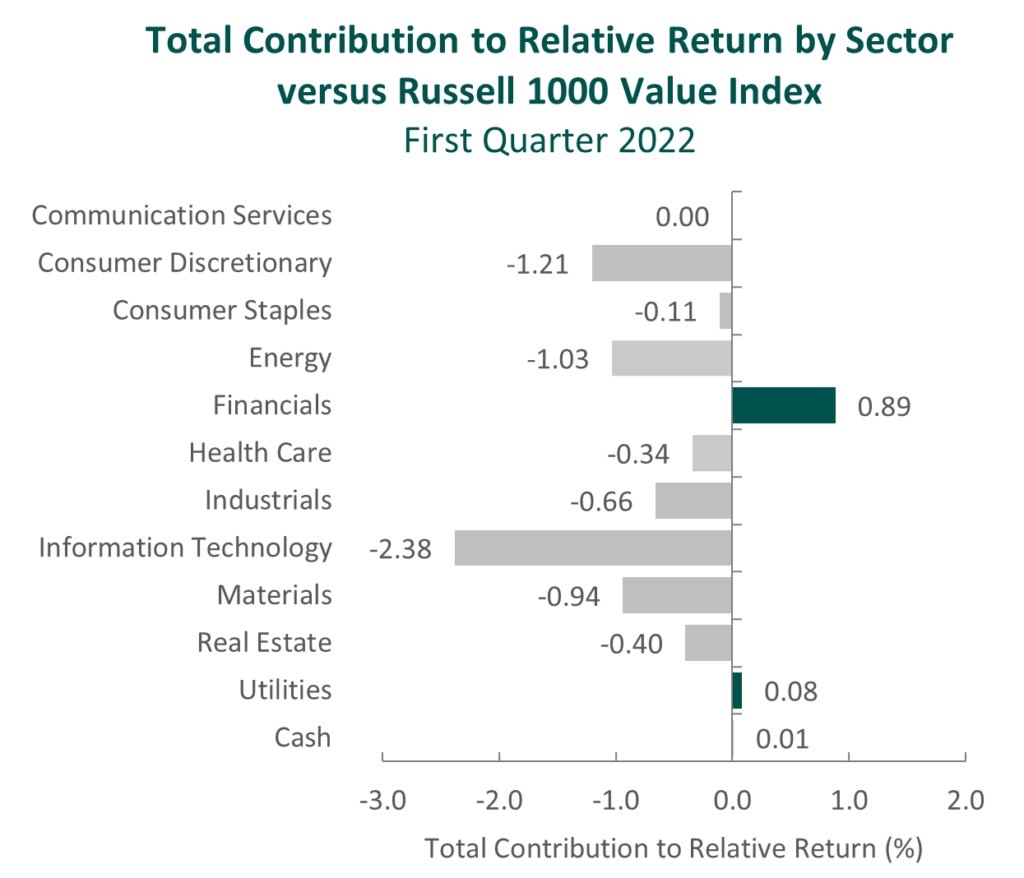
Past performance is not indicative of future results. Attribution results are based on sector returns, which are gross of investment advisory fees and include the reinvestment of all income. Please see important disclosures at the end of this document.

The portfolio’s underperformance relative to the Russell 1000 Value Index this quarter can be attributed to both security selection and allocation effects. Security selection in Information Technology and Materials and an underweight in Energy detracted the most from relative performance. Conversely, security selection in Financials, an overweight in Materials and an underweight in Communication Services contributed. (Relative weights are the result of bottom-up security selection.)

Contributors and Detractors for 1Q 2022

ContributorsDetractors
Coterra EnergyLennar
Corteva AgriscienceAdobe
Cincinnati FinancialANSYS
BlackstoneXylem
Atmos EnergySony

Lennar, one of the nation’s largest homebuilders, was a primary detractor for the quarter. The combination of rising home values and higher mortgage rates in the U.S. has reduced homeownership affordability, causing concern of a slowdown in the housing market. While we recognize higher mortgage rates reduce affordability, we also recognize there is a supply deficit caused by nearly 10 years of new home construction lagging demand. Despite rising construction and land costs, Lennar’s profitability has increased, with the company’s year-over-year home sales gross margin expanding 190 basis points to 26.9%. First-quarter new orders and home deliveries also exceeded management’s expectations, and the firm raised its home delivery target for fiscal year 2022. With increased FREE cash flow as both margins and volume increased, Lennar continued to buy back shares, and the Board approved a 50% increase in the annual dividend, as well as an additional $2 billion stock repurchase authorization (over 8% of the current market cap). Lennar’s conservative capital allocation and prudent inventory management have allowed, and we believe will continue to allow, the company to overcome higher interest rates.

Corteva Agriscience, one of the world’s largest seed and crop protection companies, was a primary contributor for the quarter. Due to its respected brand and the value-added benefits of its patented seeds and crop protection solutions for farmers, Corteva has been able to more than offset input cost inflation with sustainable price increases. In addition, the company’s ongoing mix shift to higher-margin, premium products, a catalyst we previously identified, is aiding both sales and profit growth. Shares were likely also buoyed by the rise in crop prices. Market participants, perhaps eager to chase short-term trends, poured into the sector. At Aristotle Capital, we look past such gyrations and, as long-term investors, do not attempt to predict short-term changes in commodity prices. We remain excited about what we view to be high-quality characteristics and fundamental improvements that permeate Corteva’s business, not the least of which include its pricing power.

Recent Portfolio Activity

During the quarter, we sold our positions in Chubb, East West Bancorp, Johnson Controls and Walgreens Boots Alliance and invested in Atmos Energy, Blackstone, Oshkosh and Xcel Energy.

Although we were more active than normal this quarter, we want to stress that this is not a reaction to the current economic conditions. All portfolio activity is a reflection of our underlying investment philosophy and process.

BuysSells
Atmos EnergyChubb
BlackstoneEast West Bancorp
OshkoshJohnson Controls
Xcel EnergyWalgreens Boots Alliance

Our investment in Chubb began in the fourth quarter of 2015, shortly after ACE Limited announced it would acquire the Chubb Corporation, creating the largest global property and casualty insurance company by underwriting income. During our nearly seven-year holding period, the company’s combination progressed leading to the realization of main catalysts we had identified. These included cost savings, broadened product offerings and an expanded customer base, as well as enhanced distribution capabilities and improved pricing due to scale. In addition, Chubb successfully grew its profitable high-net-worth personal lines. While we still consider Chubb to be a high-quality business, few catalysts remain after what was, in our opinion, a remarkable run of successful business execution. As such, we decided to step aside in favor of what we believe to be a more optimal investment in Blackstone.

We purchased East West Bancorp in the third quarter of 2017; however, our history with the business stretches back further having twice previously invested. Companies we consider to be high-quality like East West tend to remain high quality, and we have long admired the business for its uniqueness among the otherwise homogenous U.S. banking industry. Its dominant market share built over generations in Asian communities – and difficult-to-replicate experience due to culture, geography and business practices – create distinct competitive advantages in our view. During our most recent holding period, the bank achieved sustained loan growth, a catalyst we identified, through its continued leadership position as the financial “bridge” for customers doing business in the U.S. and China. Moreover, East West also realized market share gains in its headquarters state of California. With these catalysts nearing completion, we decided to exit our investment to fund the purchase of Oshkosh. As always, we will continue to study East West and, in the future, may once again find an opportunity to be investors.

As investors since the fourth quarter of 2017, we have enjoyed a front-row view of the large transformation that has taken place at Johnson Controls. Once a multi-industrial corporation, the company successfully turned itself into a pure-play buildings solutions and technology provider. Catalysts we previously identified for Johnson Controls included synergies following its merger with Tyco International, which provides fire safety and building security products, as well as benefits from its separation of non-building-focused businesses, such as automotive seating and batteries. With all catalysts in sight now nearing completion, and Johnson Controls now a better business for it – with higher recurring revenues and lower capital intensity – we decided to exit our investment to help fund the purchases of Xcel Energy and Atmos Energy.

We first invested in Walgreens Boots Alliance in early 2013. Over our holding period, Walgreens merged with U.K.-based Boots Alliance, establishing itself as a global leading retail pharmacy chain. CEO Stefano Pessina set the company on a path of pursuing strategic partnerships (as opposed to vertical integration deals) to increase store traffic and to, over time, transform the business into a neighborhood health destination around a more modern pharmacy. Using its strong FREE cash flow generation, the company ramped up its investments in technology, aiming to accelerate the digitalization of health information. Mr. Pessina was not successful, however, at turning around the firm’s U.S. retail segment and had to deal with increasing prescription drug reimbursement pressures. He stepped down as CEO in 2020, and in 2021, Roz Brewer took the reins of the firm. We admire Ms. Brewer’s impressive track record at companies that include Starbucks and Walmart (Sam’s Club). However, given management’s decision to divest core cash-generative businesses and redeploy capital to embryonic healthcare startups, we prefer to step aside while we follow the company’s progress.

Atmos Energy Corporation

Headquartered in Dallas, Atmos Energy is the largest fully regulated natural gas-only utility in the U.S. It serves over three million distribution customers across eight states, primarily in the South. Approximately 70% of its revenue comes from Texas, where it owns one of the largest natural gas pipeline systems in the state.

High-Quality Business

Some of the quality characteristics we have identified for Atmos Energy include:

  • Strong balance sheet and financial strength, perhaps most visible during 2021’s winter storm Uri when millions of Texans lost power. The significant spikes in natural gas prices stressed distributors, but Atmos handled over $2 billion of incremental costs with little long-term impact;
  • Experienced and shareholder-friendly management team, as demonstrated by 38 consecutive years of dividend increases; and
  • Attractive demographics and favorable regulatory environments in the states where it operates.

Attractive Valuation

Given our estimates of higher normalized earnings and dividend payments, we believe shares of Atmos Energy are trading at a discount relative to our estimate of their intrinsic value.

Compelling Catalysts

Catalysts we have identified for Atmos Energy, which we believe will cause its stock price to appreciate over our three- to five-year investment horizon, include:

  • Old pipes and aging infrastructure, coupled with a growing population, have created a large backlog of safety and maintenance projects – completion of which should drive earnings growth and steady dividend increases. Updates should both increase reliability as well as the value of Atmos Energy’s assets, enhancing profit levels permitted by regulators;
  • Well positioned to source low-cost natural gas from prolific basins in Texas to its distribution network, helping to keep customer prices down and economically favorable relative to other sources of energy; and
  • Advantageous regulatory environment should continue to support rate adjustments so that revenues are earned on capital projects within six to 12 months.

Blackstone, Inc.

Founded by its current CEO Stephen Schwarzman and Pete Peterson in 1985, Blackstone is one of the largest alternative asset managers in the world, with more than $880 billion of assets under management (AUM). The firm creates and manages investment vehicles that span asset classes globally and serve both institutional clients as well as high-net-worth individuals. Its core business segments include Real Estate (34% of fee-earning AUM), Credit and Insurance (31%), Private Equity (24%), and Hedge Fund Solutions (11%).

Blackstone has leveraged its broad product portfolio and enviable investment performance to not only raise substantial amounts of capital but also maintain its reputation as a one-stop shop for investors looking to gain exposure to alternative assets. In contrast to traditional asset managers that rely on investor inaction to keep redemption rates low, the products offered by alternative asset managers typically have lockup periods that prevent redemptions for a substantial amount of time (often 10+ years).

High-Quality Business

Some of the quality characteristics we have identified for Blackstone include:

  • Reputable management team that has produced an admirable track record of investment performance and demonstrated its ability to raise capital (the firm is now 9x larger since its 2007 IPO);
  • Stable client base and sticky asset base with 73% of its capital locked up for over 10 years; and
  • Significant scale and strong brand that provides a myriad of advantages, including for distribution and new product launches.

Attractive Valuation

Based on our estimates of normalized earnings, we believe shares of Blackstone are offered at a discount relative to our estimate of intrinsic value. It is our view that current valuation does not appropriately reflect our estimated future levels of fee-based revenue.

Compelling Catalysts

Catalysts we have identified for Blackstone, which we believe will cause its stock price to appreciate over our three- to five- year investment horizon, include:

  • Increased fee-based revenue as dry powder committed capital that has yet to be invested is deployed. As of the fourth quarter of 2021, there was a total of $136 billion in dry powder across the firm;
  • Given its scale and sustained investment prowess, Blackstone is uniquely positioned to benefit from the secular shift in investor allocation away from traditional managers and toward less liquid and higher expected return strategies in the alternative asset management sector; and
  • Further penetration in the retail and private wealth channel, a segment of investors that has historically been excluded from participating in alternative assets. Blackstone has a first-mover advantage in providing institutional-quality products across its expanding distribution teams that focus on financial advisors.

Oshkosh Corporation

Founded in 1917 and based in its namesake Oshkosh, Wisconsin, Oshkosh is a prominent producer of specialty trucks and access equipment. It designs and manufactures products such as aerial lifts, military vehicles, fire trucks, garbage trucks and cement mixers. The business generated $7.9 billion in revenue in 2021 and operates in four segments: Access Equipment (40% of revenue), Defense (32%), Fire & Emergency (16%) and Commercial (12%).

Oshkosh is typically a North American market share leader in its respective equipment types and supplies a wide swath of industries and end customers. For instance, it is the global leader in aerial work platforms through its JLG brand. It is also the largest light defense truck supplier to the U.S military, with its Joint Light Tactical Vehicle (JLTV) chosen to replace the Humvee in 2015.

We had previously owned Oshkosh in our Value Equity portfolios for the better part of a decade. As long-time admirers of the company’s quality characteristics, and through our diligent process continuing to closely follow as management creates ways to improve, we have once again found an opportunity to be investors.

High-Quality Business

Some of the quality characteristics we have identified for Oshkosh include:

  • Pricing power stemming from its leading market share positions in nearly every business segment, vital nature of its products and industry concentration;
  • Diversified product line and customer base, as well as high barriers to entry in many of its businesses, such as fire trucks, aircraft rescue vehicles and defense; and
  • Consistent positive FREE cash flow generation, even during the 2008 financial crisis when most of its segments faced the steepest downturn in a generation.

Attractive Valuation

Through market share gains, we expect operating margins and FREE cash flow to be higher on a normalized basis. Thus, we believe Oshkosh shares are offered at a discount to our estimates of the company’s intrinsic value.

Compelling Catalysts

Catalysts we have identified for Oshkosh, which we believe will cause its stock price to appreciate over our three- to five-year investment horizon, include:

  • Further innovation and technological improvements, particularly in the electrification of its vehicles, which could drive additional demand;
  • Continued rollout of its recently awarded U.S. Postal Service vehicle contract and market share gains for its JLG aerial work platforms;
  • Increased international orders for its JLTV military trucks as countries around the world replace aging Humvee fleets. In addition, further development of its aftermarket business can help improve profitability; and
  • Strong balance sheet can give management the ability to run a balanced capital allocation strategy that advances organic growth and returns cash to shareholders.

Xcel Energy, Inc.

Xcel Energy owns and operates four utilities serving 3.7 million electric customers and 2.1 million natural gas customers in eight states. Headquartered in Minneapolis, Minnesota, the firm generates $11.5 billion in annual revenue and owns infrastructure that ranges from nuclear power plants to wind farms.

The company has been a leader in renewable energy development among regulated utilities. At the end of 2020, 47% of the energy Xcel produced came from carbon-free sources, making it one of the foremost wind producers and renewable energy providers in the U.S. It was also an early mover to announce (in December 2018) a 100% carbon free goal by 2050. The company plans to invest $26 billion in 2022-26, much of it going to renewable energy projects and electric grid infrastructure to support clean energy.

High-Quality Business

Some of the quality characteristics we have identified for Xcel Energy include:

  • Consistent operator with a long history of rate base growth, fair customer rates, balance sheet strength, and appropriate operating and maintenance expenses;
  • Presence in states with favorable regulatory environments that support the shift toward renewable energy generation, transmission and distribution; and
  • Strong management team with demonstrated business acumen having at an early stage successfully positioned Xcel for the ongoing renewable energy transition.

Attractive Valuation

We believe Xcel Energy’s current stock price is offered at a discount to our determination of the company’s intrinsic value given our estimates for higher normalized earnings and dividend payments.

Compelling Catalysts

Catalysts we have identified for Xcel Energy, which we believe will cause its stock price to appreciate over our three- to five-year investment horizon, include:

  • Xcel is well positioned to benefit from increased demand for clean energy, as its service territories have what we believe to be some of the best wind and solar resources in the country, and the states it serves are strong supporters of shifting from a heavy reliance on coal generation to renewables;
  • Continue leading the clean energy transition by aggressively replacing its coal generated energy capacity in a cost-effective manner. Xcel has plans to develop >5GW of solar and wind, including both greenfield and repowering opportunities; and
  • Capital spending to build out the electric transmission network will support the expansion of renewables in Xcel’s service territory and should result in earnings and dividend growth.

Conclusion

Performance for the first few months of 2022 has undoubtedly been disappointing. However, in both strong short-term periods and weak ones, we are resolute in our mantra — “not every quarter, not every year.” Down markets and short-term price swings are a natural part of investing. While issues such as inflation, interest rates, war and trade relations will certainly persist in the coming quarters, we remain focused on what, in our opinion, is analyzable. As such, while we are ever cognizant of the events and environment around us, we will always choose to instead concentrate on the long-term fundamentals of the businesses we study. We believe our approach of understanding companies’ earnings power from a normalized perspective, combined with our focus on high-quality, undervalued businesses that possess significant catalysts, is the best way to create lasting long-term value for our clients.

Disclosures

The opinions expressed herein are those of Aristotle Capital Management, LLC (Aristotle Capital) and are subject to change without notice. Past performance is not a guarantee or indicator of future results. This material is not financial advice or an offer to purchase or sell any product. You should not assume that any of the securities transactions, sectors or holdings discussed in this report were or will be profitable, or that recommendations Aristotle Capital makes in the future will be profitable or equal the performance of the securities listed in this report. The portfolio characteristics shown relate to the Aristotle Value Equity strategy. Not every client’s account will have these characteristics. Aristotle Capital reserves the right to modify its current investment strategies and techniques based on changing market dynamics or client needs. There is no assurance that any securities discussed herein will remain in an account’s portfolio at the time you receive this report or that securities sold have not been repurchased. The securities discussed may not represent an account’s entire portfolio and, in the aggregate, may represent only a small percentage of an account’s portfolio holdings. The performance attribution presented is of a representative account from Aristotle Capital’s Value Equity Composite. The representative account is a discretionary client account which was chosen to most closely reflect the investment style of the strategy. The criteria used for representative account selection is based on the account’s period of time under management and its similarity of holdings in relation to the strategy. Recommendations made in the last 12 months are available upon request.

Returns are presented gross and net of investment advisory fees and include the reinvestment of all income. Gross returns will be reduced by fees and other expenses that may be incurred in the management of the account. For example, a 0.5% annual fee deducted quarterly (0.125%) from an account with a ten-year annualized growth rate of 5.0% will produce a net result of 4.4%. Actual performance results will vary from this example.

The Russell 1000 Value® Index measures the performance of the large cap value segment of the U.S. equity universe. It includes those Russell 1000 Index companies with lower price-to-book ratios and lower expected growth values. The S&P 500® Index is the Standard & Poor’s Composite Index of 500 stocks and is a widely recognized, unmanaged index of common stock prices. The Russell 1000® Growth Index measures the performance of the large cap growth segment of the U.S. equity universe. It includes those Russell 1000 companies with higher price-to-book ratios and higher forecasted growth values. The Russell 2000® Index measures the performance of the small cap segment of the U.S. equity universe. The Russell 2000 Index is a subset of the Russell 3000® Index representing approximately 10% of the total market capitalization of that index. It includes approximately 2,000 of the smallest securities based on a combination of their market cap and current index membership. The Dow Jones Industrial Average® is a price-weighted measure of 30 U.S. blue-chip companies. The Index covers all industries except transportation and utilities. The NASDAQ Composite Index measures all NASDAQ domestic and international based common type stocks listed on The NASDAQ Stock Market. The NASDAQ Composite includes over 3,000 companies, more than most other stock market indexes. The Bloomberg U.S. Aggregate Bond Index is an unmanaged index of domestic investment grade bonds, including corporate, government and mortgage-backed securities. The WTI Crude Oil Index is a major trading classification of sweet light crude oil that serves as a major benchmark price for oil consumed in the United States. The 3-Month U.S. Treasury Bill is a short-term debt obligation backed by the U.S. Treasury Department with a maturity of three months. Consumer Price Index is a measure of the average change over time in the prices paid by urban consumers for a market basket of consumer goods and services. The volatility (beta) of the Composite may be greater or less than its respective benchmarks. It is not possible to invest directly in these indices.

Aristotle Capital Management, LLC is an independent registered investment adviser under the Advisers Act of 1940, as amended. Registration does not imply a certain level of skill or training. More information about Aristotle Capital, including our investment strategies, fees and objectives, can be found in our ADV Part 2, which is available upon request. ACM-2204-23-MLFA
Performance Disclosures


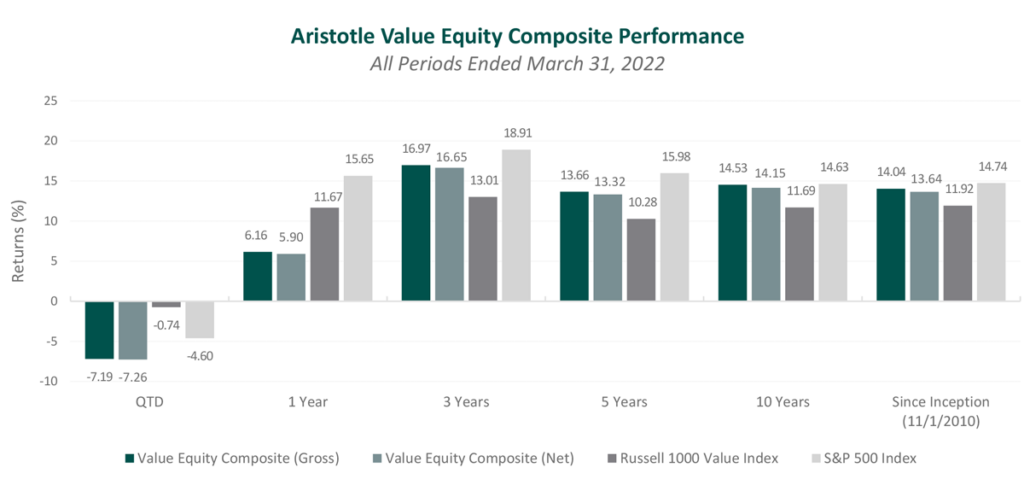
Composite returns for all periods ended March 31, 2022 are preliminary pending final account reconciliation.

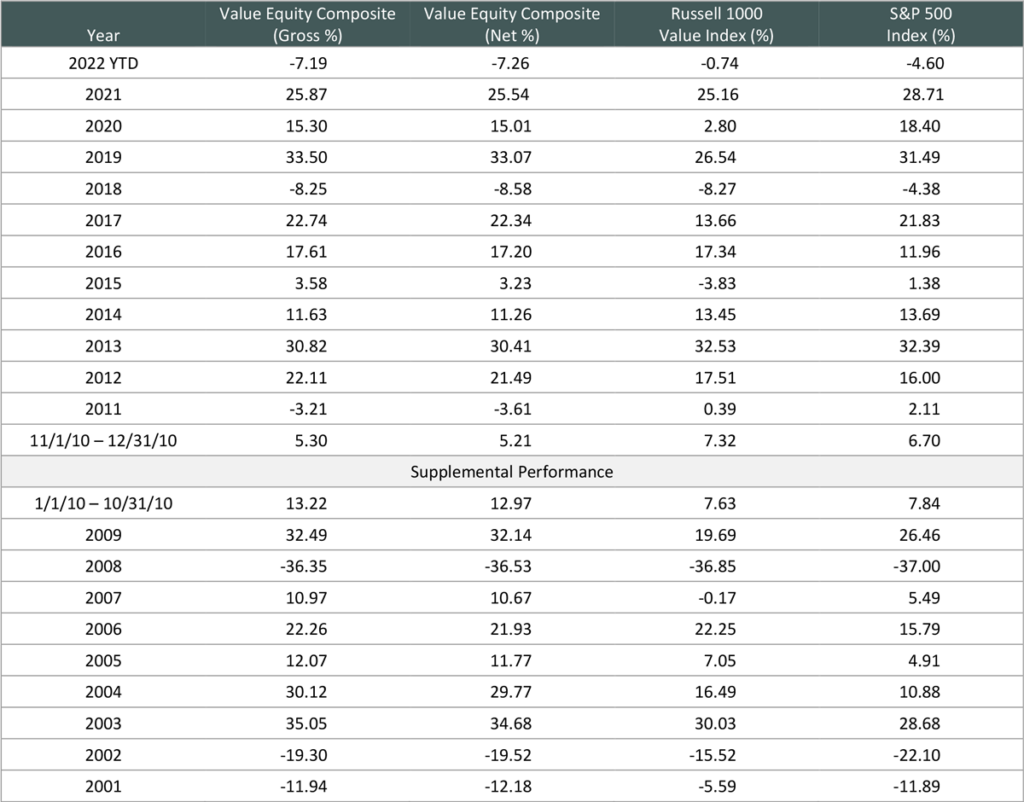
Past performance is not indicative of future results. Performance results for periods greater than one year have been annualized. Returns presented are gross and net of investment advisory fees and include the reinvestment of all income. The Aristotle Value Equity strategy has an inception date of November 1, 2010; however, the strategy initially began at Mr. Gleicher’s predecessor firm in October 1997. A supplemental performance track record from January 1, 2001 through October 31, 2010 is provided above. The returns are based on two separate accounts and performance results are based on custodian data. During this time, Mr. Gleicher had primary responsibility for managing the two accounts. Mr. Gleicher began managing one account in November 2000 and the other December 2000.
FOR FINANCIAL ADVISORS ONLY. NOT FOR PUBLIC DISTRIBUTION.

Markets Review

The U.S. equity market finished in the red, ending seven consecutive quarters of positive performance. Overall, the S&P 500 Index fell 4.60% during the period. Concurrently, the Bloomberg U.S. Aggregate Bond Index dropped 5.93% for the quarter. In terms of style, the Russell 1000 Value Index outperformed its growth counterpart by 8.30% during the quarter.

Sources: SS&C Advent, Bloomberg
Past performance is not indicative of future results. Aristotle Value Equity Composite returns are presented gross and net of investment advisory fees and include the reinvestment of all income. Aristotle Capital Composite returns are preliminary pending final account reconciliation. Please see important disclosures at the end of this document.

On a sector basis, seven out of eleven sectors within the Russell 1000 Value Index finished lower for the quarter, with Consumer Discretionary, Information Technology and Real Estate posting the largest declines. The strongest performers were Energy, Materials and Utilities.

On the economic front, the labor market continued to improve and inflation continued to rise, resulting in tighter monetary policy. Specifically, the unemployment rate continued its descent, falling to 3.8%, while the CPI rose 7.9% — the fastest pace of annual inflation in 40 years – amid increases in gasoline, food and housing rental prices. Inflation remained at elevated levels due to factors such as supply-chain disruptions, a tight labor market and increasing commodity prices. In turn, the Federal Reserve (Fed) voted to raise the target for its benchmark federal funds rate by a quarter percentage point to a range of 0.25% to 0.50%, the first rate increase since 2018. Fed officials reiterated their mandate of achieving maximum employment and 2% inflation in the long run and expect that ongoing interest rate hikes will be needed. Additionally, the central bank ended its bond-buying program and will begin reducing its holdings of Treasury securities, agency debt and agency mortgage-backed securities.

Geopolitical tensions spiked as Russia’s invasion of Ukraine created a grave humanitarian crisis that also impacted world economies. An unprecedented level of sanctions has been placed on Russia by Western governments, paired with a disruption of commodity supplies – with oil at one point eclipsing $130 a barrel – and renewed tensions between the U.S. and China. Policymakers have thus acknowledged the likely continued upward pressure on inflation and adverse impact on global economic activity.

In corporate earnings, supply-chain disruptions, input price pressures and wage growth remained major talking points for management teams. Nevertheless, the S&P 500 constituents continued to push past pre-pandemic levels, reporting ~26% earnings growth since 2019, as businesses across a wide range of industries continued to benefit from strong demand.

Performance and Attribution Summary

For the first quarter of 2022, Aristotle Capital’s Value Equity Composite posted a total return of -7.19% gross of fees (-7.26% net of fees), underperforming the -0.74% return of the Russell 1000 Value Index and the -4.60% return of the S&P 500 Index. Please refer to the table for detailed performance.

Performance (%) 1Q22 1 Year3 Years5 Years10 Years
Value Equity Composite (gross)-7.196.1616.9713.6614.53
Value Equity Composite (net)-7.265.9016.6513.3214.15
Russell 1000 Value Index-0.7411.6713.0110.2811.69
S&P 500 Index-4.6015.6518.9115.9814.63
Past performance is not indicative of future results. Returns are presented gross and net of investment advisory fees and include the reinvestment of all income. Aristotle Capital Composite returns are preliminary pending final account reconciliation. Please see important disclosures at the end of this document.

Source: FactSet
Past performance is not indicative of future results. Attribution results are based on sector returns, which are gross of investment advisory fees and include the reinvestment of all income. Please see important disclosures at the end of this document.

The portfolio’s underperformance relative to the Russell 1000 Value Index this quarter can be attributed to both security selection and allocation effects. Security selection in Information Technology and Materials and an underweight in Energy detracted the most from relative performance. Conversely, security selection in Financials, an overweight in Materials and an underweight in Communication Services contributed. (Relative weights are the result of bottom-up security selection.)

Contributors and Detractors for 1Q 2022

ContributorsDetractors
Coterra EnergyLennar
Corteva AgriscienceAdobe
Cincinnati FinancialANSYS
BlackstoneXylem
Atmos EnergySony

Lennar, one of the nation’s largest homebuilders, was a primary detractor for the quarter. The combination of rising home values and higher mortgage rates in the U.S. has reduced homeownership affordability, causing concern of a slowdown in the housing market. While we recognize higher mortgage rates reduce affordability, we also recognize there is a supply deficit caused by nearly 10 years of new home construction lagging demand. Despite rising construction and land costs, Lennar’s profitability has increased, with the company’s year-over-year home sales gross margin expanding 190 basis points to 26.9%. First-quarter new orders and home deliveries also exceeded management’s expectations, and the firm raised its home delivery target for fiscal year 2022. With increased FREE cash flow as both margins and volume increased, Lennar continued to buy back shares, and the Board approved a 50% increase in the annual dividend, as well as an additional $2 billion stock repurchase authorization (over 8% of the current market cap). Lennar’s conservative capital allocation and prudent inventory management have allowed, and we believe will continue to allow, the company to overcome higher interest rates.

Corteva Agriscience, one of the world’s largest seed and crop protection companies, was a primary contributor for the quarter. Due to its respected brand and the value-added benefits of its patented seeds and crop protection solutions for farmers, Corteva has been able to more than offset input cost inflation with sustainable price increases. In addition, the company’s ongoing mix shift to higher-margin, premium products, a catalyst we previously identified, is aiding both sales and profit growth. Shares were likely also buoyed by the rise in crop prices. Market participants, perhaps eager to chase short-term trends, poured into the sector. At Aristotle Capital, we look past such gyrations and, as long-term investors, do not attempt to predict short-term changes in commodity prices. We remain excited about what we view to be high-quality characteristics and fundamental improvements that permeate Corteva’s business, not the least of which include its pricing power.

Recent Portfolio Activity

During the quarter, we sold our positions in Chubb, East West Bancorp, Johnson Controls and Walgreens Boots Alliance and invested in Atmos Energy, Blackstone, Oshkosh and Xcel Energy.

Although we were more active than normal this quarter, we want to stress that this is not a reaction to the current economic conditions. All portfolio activity is a reflection of our underlying investment philosophy and process.

BuysSells
Atmos EnergyChubb
BlackstoneEast West Bancorp
OshkoshJohnson Controls
Xcel EnergyWalgreens Boots Alliance

Our investment in Chubb began in the fourth quarter of 2015, shortly after ACE Limited announced it would acquire the Chubb Corporation, creating the largest global property and casualty insurance company by underwriting income. During our nearly seven-year holding period, the company’s combination progressed leading to the realization of main catalysts we had identified. These included cost savings, broadened product offerings and an expanded customer base, as well as enhanced distribution capabilities and improved pricing due to scale. In addition, Chubb successfully grew its profitable high-net-worth personal lines. While we still consider Chubb to be a high-quality business, few catalysts remain after what was, in our opinion, a remarkable run of successful business execution. As such, we decided to step aside in favor of what we believe to be a more optimal investment in Blackstone.

We purchased East West Bancorp in the third quarter of 2017; however, our history with the business stretches back further having twice previously invested. Companies we consider to be high-quality like East West tend to remain high quality, and we have long admired the business for its uniqueness among the otherwise homogenous U.S. banking industry. Its dominant market share built over generations in Asian communities – and difficult-to-replicate experience due to culture, geography and business practices – create distinct competitive advantages in our view. During our most recent holding period, the bank achieved sustained loan growth, a catalyst we identified, through its continued leadership position as the financial “bridge” for customers doing business in the U.S. and China. Moreover, East West also realized market share gains in its headquarters state of California. With these catalysts nearing completion, we decided to exit our investment to fund the purchase of Oshkosh. As always, we will continue to study East West and, in the future, may once again find an opportunity to be investors.

As investors since the fourth quarter of 2017, we have enjoyed a front-row view of the large transformation that has taken place at Johnson Controls. Once a multi-industrial corporation, the company successfully turned itself into a pure-play buildings solutions and technology provider. Catalysts we previously identified for Johnson Controls included synergies following its merger with Tyco International, which provides fire safety and building security products, as well as benefits from its separation of non-building-focused businesses, such as automotive seating and batteries. With all catalysts in sight now nearing completion, and Johnson Controls now a better business for it – with higher recurring revenues and lower capital intensity – we decided to exit our investment to help fund the purchases of Xcel Energy and Atmos Energy.

We first invested in Walgreens Boots Alliance in early 2013. Over our holding period, Walgreens merged with U.K.-based Boots Alliance, establishing itself as a global leading retail pharmacy chain. CEO Stefano Pessina set the company on a path of pursuing strategic partnerships (as opposed to vertical integration deals) to increase store traffic and to, over time, transform the business into a neighborhood health destination around a more modern pharmacy. Using its strong FREE cash flow generation, the company ramped up its investments in technology, aiming to accelerate the digitalization of health information. Mr. Pessina was not successful, however, at turning around the firm’s U.S. retail segment and had to deal with increasing prescription drug reimbursement pressures. He stepped down as CEO in 2020, and in 2021, Roz Brewer took the reins of the firm. We admire Ms. Brewer’s impressive track record at companies that include Starbucks and Walmart (Sam’s Club). However, given management’s decision to divest core cash-generative businesses and redeploy capital to embryonic healthcare startups, we prefer to step aside while we follow the company’s progress.

Atmos Energy Corporation

Headquartered in Dallas, Atmos Energy is the largest fully regulated natural gas-only utility in the U.S. It serves over three million distribution customers across eight states, primarily in the South. Approximately 70% of its revenue comes from Texas, where it owns one of the largest natural gas pipeline systems in the state.

High-Quality Business

Some of the quality characteristics we have identified for Atmos Energy include:

  • Strong balance sheet and financial strength, perhaps most visible during 2021’s winter storm Uri when millions of Texans lost power. The significant spikes in natural gas prices stressed distributors, but Atmos handled over $2 billion of incremental costs with little long-term impact;
  • Experienced and shareholder-friendly management team, as demonstrated by 38 consecutive years of dividend increases; and
  • Attractive demographics and favorable regulatory environments in the states where it operates.

Attractive Valuation

Given our estimates of higher normalized earnings and dividend payments, we believe shares of Atmos Energy are trading at a discount relative to our estimate of their intrinsic value.

Compelling Catalysts

Catalysts we have identified for Atmos Energy, which we believe will cause its stock price to appreciate over our three- to five-year investment horizon, include:

  • Old pipes and aging infrastructure, coupled with a growing population, have created a large backlog of safety and maintenance projects – completion of which should drive earnings growth and steady dividend increases. Updates should both increase reliability as well as the value of Atmos Energy’s assets, enhancing profit levels permitted by regulators;
  • Well positioned to source low-cost natural gas from prolific basins in Texas to its distribution network, helping to keep customer prices down and economically favorable relative to other sources of energy; and
  • Advantageous regulatory environment should continue to support rate adjustments so that revenues are earned on capital projects within six to 12 months.

Blackstone, Inc.

Founded by its current CEO Stephen Schwarzman and Pete Peterson in 1985, Blackstone is one of the largest alternative asset managers in the world, with more than $880 billion of assets under management (AUM). The firm creates and manages investment vehicles that span asset classes globally and serve both institutional clients as well as high-net-worth individuals. Its core business segments include Real Estate (34% of fee-earning AUM), Credit and Insurance (31%), Private Equity (24%), and Hedge Fund Solutions (11%).

Blackstone has leveraged its broad product portfolio and enviable investment performance to not only raise substantial amounts of capital but also maintain its reputation as a one-stop shop for investors looking to gain exposure to alternative assets. In contrast to traditional asset managers that rely on investor inaction to keep redemption rates low, the products offered by alternative asset managers typically have lockup periods that prevent redemptions for a substantial amount of time (often 10+ years).

High-Quality Business

Some of the quality characteristics we have identified for Blackstone include:

  • Reputable management team that has produced an admirable track record of investment performance and demonstrated its ability to raise capital (the firm is now 9x larger since its 2007 IPO);
  • Stable client base and sticky asset base with 73% of its capital locked up for over 10 years; and
  • Significant scale and strong brand that provides a myriad of advantages, including for distribution and new product launches.

Attractive Valuation

Based on our estimates of normalized earnings, we believe shares of Blackstone are offered at a discount relative to our estimate of intrinsic value. It is our view that current valuation does not appropriately reflect our estimated future levels of fee-based revenue.

Compelling Catalysts

Catalysts we have identified for Blackstone, which we believe will cause its stock price to appreciate over our three- to five- year investment horizon, include:

  • Increased fee-based revenue as dry powder committed capital that has yet to be invested is deployed. As of the fourth quarter of 2021, there was a total of $136 billion in dry powder across the firm;
  • Given its scale and sustained investment prowess, Blackstone is uniquely positioned to benefit from the secular shift in investor allocation away from traditional managers and toward less liquid and higher expected return strategies in the alternative asset management sector; and
  • Further penetration in the retail and private wealth channel, a segment of investors that has historically been excluded from participating in alternative assets. Blackstone has a first-mover advantage in providing institutional-quality products across its expanding distribution teams that focus on financial advisors.

Oshkosh Corporation

Founded in 1917 and based in its namesake Oshkosh, Wisconsin, Oshkosh is a prominent producer of specialty trucks and access equipment. It designs and manufactures products such as aerial lifts, military vehicles, fire trucks, garbage trucks and cement mixers. The business generated $7.9 billion in revenue in 2021 and operates in four segments: Access Equipment (40% of revenue), Defense (32%), Fire & Emergency (16%) and Commercial (12%).

Oshkosh is typically a North American market share leader in its respective equipment types and supplies a wide swath of industries and end customers. For instance, it is the global leader in aerial work platforms through its JLG brand. It is also the largest light defense truck supplier to the U.S military, with its Joint Light Tactical Vehicle (JLTV) chosen to replace the Humvee in 2015.

We had previously owned Oshkosh in our Value Equity portfolios for the better part of a decade. As long-time admirers of the company’s quality characteristics, and through our diligent process continuing to closely follow as management creates ways to improve, we have once again found an opportunity to be investors.

High-Quality Business

Some of the quality characteristics we have identified for Oshkosh include:

  • Pricing power stemming from its leading market share positions in nearly every business segment, vital nature of its products and industry concentration;
  • Diversified product line and customer base, as well as high barriers to entry in many of its businesses, such as fire trucks, aircraft rescue vehicles and defense; and
  • Consistent positive FREE cash flow generation, even during the 2008 financial crisis when most of its segments faced the steepest downturn in a generation.

Attractive Valuation

Through market share gains, we expect operating margins and FREE cash flow to be higher on a normalized basis. Thus, we believe Oshkosh shares are offered at a discount to our estimates of the company’s intrinsic value.

Compelling Catalysts

Catalysts we have identified for Oshkosh, which we believe will cause its stock price to appreciate over our three- to five-year investment horizon, include:

  • Further innovation and technological improvements, particularly in the electrification of its vehicles, which could drive additional demand;
  • Continued rollout of its recently awarded U.S. Postal Service vehicle contract and market share gains for its JLG aerial work platforms;
  • Increased international orders for its JLTV military trucks as countries around the world replace aging Humvee fleets. In addition, further development of its aftermarket business can help improve profitability; and
  • Strong balance sheet can give management the ability to run a balanced capital allocation strategy that advances organic growth and returns cash to shareholders.

Xcel Energy, Inc.

Xcel Energy owns and operates four utilities serving 3.7 million electric customers and 2.1 million natural gas customers in eight states. Headquartered in Minneapolis, Minnesota, the firm generates $11.5 billion in annual revenue and owns infrastructure that ranges from nuclear power plants to wind farms.

The company has been a leader in renewable energy development among regulated utilities. At the end of 2020, 47% of the energy Xcel produced came from carbon-free sources, making it one of the foremost wind producers and renewable energy providers in the U.S. It was also an early mover to announce (in December 2018) a 100% carbon free goal by 2050. The company plans to invest $26 billion in 2022-26, much of it going to renewable energy projects and electric grid infrastructure to support clean energy.

High-Quality Business

Some of the quality characteristics we have identified for Xcel Energy include:

  • Consistent operator with a long history of rate base growth, fair customer rates, balance sheet strength, and appropriate operating and maintenance expenses;
  • Presence in states with favorable regulatory environments that support the shift toward renewable energy generation, transmission and distribution; and
  • Strong management team with demonstrated business acumen having at an early stage successfully positioned Xcel for the ongoing renewable energy transition.

Attractive Valuation

We believe Xcel Energy’s current stock price is offered at a discount to our determination of the company’s intrinsic value given our estimates for higher normalized earnings and dividend payments.

Compelling Catalysts

Catalysts we have identified for Xcel Energy, which we believe will cause its stock price to appreciate over our three- to five-year investment horizon, include:

  • Xcel is well positioned to benefit from increased demand for clean energy, as its service territories have what we believe to be some of the best wind and solar resources in the country, and the states it serves are strong supporters of shifting from a heavy reliance on coal generation to renewables;
  • Continue leading the clean energy transition by aggressively replacing its coal generated energy capacity in a cost-effective manner. Xcel has plans to develop >5GW of solar and wind, including both greenfield and repowering opportunities; and
  • Capital spending to build out the electric transmission network will support the expansion of renewables in Xcel’s service territory and should result in earnings and dividend growth.

Conclusion

Performance for the first few months of 2022 has undoubtedly been disappointing. However, in both strong short-term periods and weak ones, we are resolute in our mantra — “not every quarter, not every year.” Down markets and short-term price swings are a natural part of investing. While issues such as inflation, interest rates, war and trade relations will certainly persist in the coming quarters, we remain focused on what, in our opinion, is analyzable. As such, while we are ever cognizant of the events and environment around us, we will always choose to instead concentrate on the long-term fundamentals of the businesses we study. We believe our approach of understanding companies’ earnings power from a normalized perspective, combined with our focus on high-quality, undervalued businesses that possess significant catalysts, is the best way to create lasting long-term value for our clients.

Disclosures

The opinions expressed herein are those of Aristotle Capital Management, LLC (Aristotle Capital) and are subject to change without notice. Past performance is not a guarantee or indicator of future results. This material is not financial advice or an offer to purchase or sell any product. You should not assume that any of the securities transactions, sectors or holdings discussed in this report were or will be profitable, or that recommendations Aristotle Capital makes in the future will be profitable or equal the performance of the securities listed in this report. The portfolio characteristics shown relate to the Aristotle Value Equity strategy. Not every client’s account will have these characteristics. Aristotle Capital reserves the right to modify its current investment strategies and techniques based on changing market dynamics or client needs. There is no assurance that any securities discussed herein will remain in an account’s portfolio at the time you receive this report or that securities sold have not been repurchased. The securities discussed may not represent an account’s entire portfolio and, in the aggregate, may represent only a small percentage of an account’s portfolio holdings. The performance attribution presented is of a representative account from Aristotle Capital’s Value Equity Composite. The representative account is a discretionary client account which was chosen to most closely reflect the investment style of the strategy. The criteria used for representative account selection is based on the account’s period of time under management and its similarity of holdings in relation to the strategy. Recommendations made in the last 12 months are available upon request.

Returns are presented gross and net of investment advisory fees and include the reinvestment of all income. Gross returns will be reduced by fees and other expenses that may be incurred in the management of the account. For example, a 0.5% annual fee deducted quarterly (0.125%) from an account with a ten-year annualized growth rate of 5.0% will produce a net result of 4.4%. Actual performance results will vary from this example.

The Russell 1000 Value® Index measures the performance of the large cap value segment of the U.S. equity universe. It includes those Russell 1000 Index companies with lower price-to-book ratios and lower expected growth values. The S&P 500® Index is the Standard & Poor’s Composite Index of 500 stocks and is a widely recognized, unmanaged index of common stock prices. The Russell 1000® Growth Index measures the performance of the large cap growth segment of the U.S. equity universe. It includes those Russell 1000 companies with higher price-to-book ratios and higher forecasted growth values. The Russell 2000® Index measures the performance of the small cap segment of the U.S. equity universe. The Russell 2000 Index is a subset of the Russell 3000® Index representing approximately 10% of the total market capitalization of that index. It includes approximately 2,000 of the smallest securities based on a combination of their market cap and current index membership. The Dow Jones Industrial Average® is a price-weighted measure of 30 U.S. blue-chip companies. The Index covers all industries except transportation and utilities. The NASDAQ Composite Index measures all NASDAQ domestic and international based common type stocks listed on The NASDAQ Stock Market. The NASDAQ Composite includes over 3,000 companies, more than most other stock market indexes. The Bloomberg U.S. Aggregate Bond Index is an unmanaged index of domestic investment grade bonds, including corporate, government and mortgage-backed securities. The WTI Crude Oil Index is a major trading classification of sweet light crude oil that serves as a major benchmark price for oil consumed in the United States. The 3-Month U.S. Treasury Bill is a short-term debt obligation backed by the U.S. Treasury Department with a maturity of three months. Consumer Price Index is a measure of the average change over time in the prices paid by urban consumers for a market basket of consumer goods and services. The volatility (beta) of the Composite may be greater or less than its respective benchmarks. It is not possible to invest directly in these indices.

This presentation is to report on the investment strategies as reported by Aristotle Capital Management, LLC and is for illustrative purposes only. The information contained herein is obtained from multiple sources and believed to be reliable. Information has not been verified by Morgan Stanley Wealth Management, and may differ from documents created by Morgan Stanley Wealth Management. The financial advisor should refer to the Profile. This must be preceded or accompanied by the Morgan Stanley Wealth Management Profile, which you can obtain from the Morgan Stanley Wealth Management Performance Analytics. For additional information on other programs, please speak to Patrick Schussman at Aristotle Capital at (310) 954-8156.

Aristotle Capital Management, LLC is an independent registered investment adviser under the Advisers Act of 1940, as amended. Registration does not imply a certain level of skill or training. More information about Aristotle Capital, including our investment strategies, fees and objectives, can be found in our ADV Part 2, which is available upon request. ACM-2204-23-MSFA

Performance Disclosures


Composite returns for all periods ended March 31, 2022 are preliminary pending final account reconciliation.

Past performance is not indicative of future results. Performance results for periods greater than one year have been annualized. Returns presented are gross and net of investment advisory fees and include the reinvestment of all income. The Aristotle Value Equity strategy has an inception date of November 1, 2010; however, the strategy initially began at Mr. Gleicher’s predecessor firm in October 1997. A supplemental performance track record from January 1, 2001 through October 31, 2010 is provided above. The returns are based on two separate accounts and performance results are based on custodian data. During this time, Mr. Gleicher had primary responsibility for managing the two accounts. Mr. Gleicher began managing one account in November 2000 and the other December 2000.
FOR FINANCIAL ADVISORS ONLY. NOT FOR PUBLIC DISTRIBUTION.

Markets Review

The U.S. equity market finished in the red, ending seven consecutive quarters of positive performance. Overall, the S&P 500 Index fell 4.60% during the period. Concurrently, the Bloomberg U.S. Aggregate Bond Index dropped 5.93% for the quarter. In terms of style, the Russell 1000 Value Index outperformed its growth counterpart by 8.30% during the quarter.

Sources: SS&C Advent, Bloomberg
Past performance is not indicative of future results. Aristotle Value Equity Composite returns are presented gross and net of investment advisory fees and include the reinvestment of all income. Aristotle Capital Composite returns are preliminary pending final account reconciliation. Please see important disclosures at the end of this document.

On a sector basis, seven out of eleven sectors within the Russell 1000 Value Index finished lower for the quarter, with Consumer Discretionary, Information Technology and Real Estate posting the largest declines. The strongest performers were Energy, Materials and Utilities.

On the economic front, the labor market continued to improve and inflation continued to rise, resulting in tighter monetary policy. Specifically, the unemployment rate continued its descent, falling to 3.8%, while the CPI rose 7.9% — the fastest pace of annual inflation in 40 years – amid increases in gasoline, food and housing rental prices. Inflation remained at elevated levels due to factors such as supply-chain disruptions, a tight labor market and increasing commodity prices. In turn, the Federal Reserve (Fed) voted to raise the target for its benchmark federal funds rate by a quarter percentage point to a range of 0.25% to 0.50%, the first rate increase since 2018. Fed officials reiterated their mandate of achieving maximum employment and 2% inflation in the long run and expect that ongoing interest rate hikes will be needed. Additionally, the central bank ended its bond-buying program and will begin reducing its holdings of Treasury securities, agency debt and agency mortgage-backed securities.

Geopolitical tensions spiked as Russia’s invasion of Ukraine created a grave humanitarian crisis that also impacted world economies. An unprecedented level of sanctions has been placed on Russia by Western governments, paired with a disruption of commodity supplies – with oil at one point eclipsing $130 a barrel – and renewed tensions between the U.S. and China. Policymakers have thus acknowledged the likely continued upward pressure on inflation and adverse impact on global economic activity.

In corporate earnings, supply-chain disruptions, input price pressures and wage growth remained major talking points for management teams. Nevertheless, the S&P 500 constituents continued to push past pre-pandemic levels, reporting ~26% earnings growth since 2019, as businesses across a wide range of industries continued to benefit from strong demand.

Performance and Attribution Summary

For the first quarter of 2022, Aristotle Capital’s Value Equity Composite posted a total return of -7.19% gross of fees (-7.26% net of fees), underperforming the -0.74% return of the Russell 1000 Value Index and the -4.60% return of the S&P 500 Index. Please refer to the table for detailed performance.

Performance (%) 1Q22 1 Year3 Years5 Years10 Years
Value Equity Composite (gross)-7.196.1616.9713.6614.53
Value Equity Composite (net)-7.265.9016.6513.3214.15
Russell 1000 Value Index-0.7411.6713.0110.2811.69
S&P 500 Index-4.6015.6518.9115.9814.63
Past performance is not indicative of future results. Returns are presented gross and net of investment advisory fees and include the reinvestment of all income. Aristotle Capital Composite returns are preliminary pending final account reconciliation. Please see important disclosures at the end of this document.

Source: FactSet
Past performance is not indicative of future results. Attribution results are based on sector returns, which are gross of investment advisory fees and include the reinvestment of all income. Please see important disclosures at the end of this document.

The portfolio’s underperformance relative to the Russell 1000 Value Index this quarter can be attributed to both security selection and allocation effects. Security selection in Information Technology and Materials and an underweight in Energy detracted the most from relative performance. Conversely, security selection in Financials, an overweight in Materials and an underweight in Communication Services contributed. (Relative weights are the result of bottom-up security selection.)

Contributors and Detractors for 1Q 2022

ContributorsDetractors
Coterra EnergyLennar
Corteva AgriscienceAdobe
Cincinnati FinancialANSYS
BlackstoneXylem
Atmos EnergySony

Lennar, one of the nation’s largest homebuilders, was a primary detractor for the quarter. The combination of rising home values and higher mortgage rates in the U.S. has reduced homeownership affordability, causing concern of a slowdown in the housing market. While we recognize higher mortgage rates reduce affordability, we also recognize there is a supply deficit caused by nearly 10 years of new home construction lagging demand. Despite rising construction and land costs, Lennar’s profitability has increased, with the company’s year-over-year home sales gross margin expanding 190 basis points to 26.9%. First-quarter new orders and home deliveries also exceeded management’s expectations, and the firm raised its home delivery target for fiscal year 2022. With increased FREE cash flow as both margins and volume increased, Lennar continued to buy back shares, and the Board approved a 50% increase in the annual dividend, as well as an additional $2 billion stock repurchase authorization (over 8% of the current market cap). Lennar’s conservative capital allocation and prudent inventory management have allowed, and we believe will continue to allow, the company to overcome higher interest rates.

Corteva Agriscience, one of the world’s largest seed and crop protection companies, was a primary contributor for the quarter. Due to its respected brand and the value-added benefits of its patented seeds and crop protection solutions for farmers, Corteva has been able to more than offset input cost inflation with sustainable price increases. In addition, the company’s ongoing mix shift to higher-margin, premium products, a catalyst we previously identified, is aiding both sales and profit growth. Shares were likely also buoyed by the rise in crop prices. Market participants, perhaps eager to chase short-term trends, poured into the sector. At Aristotle Capital, we look past such gyrations and, as long-term investors, do not attempt to predict short-term changes in commodity prices. We remain excited about what we view to be high-quality characteristics and fundamental improvements that permeate Corteva’s business, not the least of which include its pricing power.

Recent Portfolio Activity

During the quarter, we sold our positions in Chubb, East West Bancorp, Johnson Controls and Walgreens Boots Alliance and invested in Atmos Energy, Blackstone, Oshkosh and Xcel Energy.

Although we were more active than normal this quarter, we want to stress that this is not a reaction to the current economic conditions. All portfolio activity is a reflection of our underlying investment philosophy and process.

BuysSells
Atmos EnergyChubb
BlackstoneEast West Bancorp
OshkoshJohnson Controls
Xcel EnergyWalgreens Boots Alliance

Our investment in Chubb began in the fourth quarter of 2015, shortly after ACE Limited announced it would acquire the Chubb Corporation, creating the largest global property and casualty insurance company by underwriting income. During our nearly seven-year holding period, the company’s combination progressed leading to the realization of main catalysts we had identified. These included cost savings, broadened product offerings and an expanded customer base, as well as enhanced distribution capabilities and improved pricing due to scale. In addition, Chubb successfully grew its profitable high-net-worth personal lines. While we still consider Chubb to be a high-quality business, few catalysts remain after what was, in our opinion, a remarkable run of successful business execution. As such, we decided to step aside in favor of what we believe to be a more optimal investment in Blackstone.

We purchased East West Bancorp in the third quarter of 2017; however, our history with the business stretches back further having twice previously invested. Companies we consider to be high-quality like East West tend to remain high quality, and we have long admired the business for its uniqueness among the otherwise homogenous U.S. banking industry. Its dominant market share built over generations in Asian communities – and difficult-to-replicate experience due to culture, geography and business practices – create distinct competitive advantages in our view. During our most recent holding period, the bank achieved sustained loan growth, a catalyst we identified, through its continued leadership position as the financial “bridge” for customers doing business in the U.S. and China. Moreover, East West also realized market share gains in its headquarters state of California. With these catalysts nearing completion, we decided to exit our investment to fund the purchase of Oshkosh. As always, we will continue to study East West and, in the future, may once again find an opportunity to be investors.

As investors since the fourth quarter of 2017, we have enjoyed a front-row view of the large transformation that has taken place at Johnson Controls. Once a multi-industrial corporation, the company successfully turned itself into a pure-play buildings solutions and technology provider. Catalysts we previously identified for Johnson Controls included synergies following its merger with Tyco International, which provides fire safety and building security products, as well as benefits from its separation of non-building-focused businesses, such as automotive seating and batteries. With all catalysts in sight now nearing completion, and Johnson Controls now a better business for it – with higher recurring revenues and lower capital intensity – we decided to exit our investment to help fund the purchases of Xcel Energy and Atmos Energy.

We first invested in Walgreens Boots Alliance in early 2013. Over our holding period, Walgreens merged with U.K.-based Boots Alliance, establishing itself as a global leading retail pharmacy chain. CEO Stefano Pessina set the company on a path of pursuing strategic partnerships (as opposed to vertical integration deals) to increase store traffic and to, over time, transform the business into a neighborhood health destination around a more modern pharmacy. Using its strong FREE cash flow generation, the company ramped up its investments in technology, aiming to accelerate the digitalization of health information. Mr. Pessina was not successful, however, at turning around the firm’s U.S. retail segment and had to deal with increasing prescription drug reimbursement pressures. He stepped down as CEO in 2020, and in 2021, Roz Brewer took the reins of the firm. We admire Ms. Brewer’s impressive track record at companies that include Starbucks and Walmart (Sam’s Club). However, given management’s decision to divest core cash-generative businesses and redeploy capital to embryonic healthcare startups, we prefer to step aside while we follow the company’s progress.

Atmos Energy Corporation

Headquartered in Dallas, Atmos Energy is the largest fully regulated natural gas-only utility in the U.S. It serves over three million distribution customers across eight states, primarily in the South. Approximately 70% of its revenue comes from Texas, where it owns one of the largest natural gas pipeline systems in the state.

High-Quality Business

Some of the quality characteristics we have identified for Atmos Energy include:

  • Strong balance sheet and financial strength, perhaps most visible during 2021’s winter storm Uri when millions of Texans lost power. The significant spikes in natural gas prices stressed distributors, but Atmos handled over $2 billion of incremental costs with little long-term impact;
  • Experienced and shareholder-friendly management team, as demonstrated by 38 consecutive years of dividend increases; and
  • Attractive demographics and favorable regulatory environments in the states where it operates.

Attractive Valuation

Given our estimates of higher normalized earnings and dividend payments, we believe shares of Atmos Energy are trading at a discount relative to our estimate of their intrinsic value.

Compelling Catalysts

Catalysts we have identified for Atmos Energy, which we believe will cause its stock price to appreciate over our three- to five-year investment horizon, include:

  • Old pipes and aging infrastructure, coupled with a growing population, have created a large backlog of safety and maintenance projects – completion of which should drive earnings growth and steady dividend increases. Updates should both increase reliability as well as the value of Atmos Energy’s assets, enhancing profit levels permitted by regulators;
  • Well positioned to source low-cost natural gas from prolific basins in Texas to its distribution network, helping to keep customer prices down and economically favorable relative to other sources of energy; and
  • Advantageous regulatory environment should continue to support rate adjustments so that revenues are earned on capital projects within six to 12 months.

Blackstone, Inc.

Founded by its current CEO Stephen Schwarzman and Pete Peterson in 1985, Blackstone is one of the largest alternative asset managers in the world, with more than $880 billion of assets under management (AUM). The firm creates and manages investment vehicles that span asset classes globally and serve both institutional clients as well as high-net-worth individuals. Its core business segments include Real Estate (34% of fee-earning AUM), Credit and Insurance (31%), Private Equity (24%), and Hedge Fund Solutions (11%).

Blackstone has leveraged its broad product portfolio and enviable investment performance to not only raise substantial amounts of capital but also maintain its reputation as a one-stop shop for investors looking to gain exposure to alternative assets. In contrast to traditional asset managers that rely on investor inaction to keep redemption rates low, the products offered by alternative asset managers typically have lockup periods that prevent redemptions for a substantial amount of time (often 10+ years).

High-Quality Business

Some of the quality characteristics we have identified for Blackstone include:

  • Reputable management team that has produced an admirable track record of investment performance and demonstrated its ability to raise capital (the firm is now 9x larger since its 2007 IPO);
  • Stable client base and sticky asset base with 73% of its capital locked up for over 10 years; and
  • Significant scale and strong brand that provides a myriad of advantages, including for distribution and new product launches.

Attractive Valuation

Based on our estimates of normalized earnings, we believe shares of Blackstone are offered at a discount relative to our estimate of intrinsic value. It is our view that current valuation does not appropriately reflect our estimated future levels of fee-based revenue.

Compelling Catalysts

Catalysts we have identified for Blackstone, which we believe will cause its stock price to appreciate over our three- to five- year investment horizon, include:

  • Increased fee-based revenue as dry powder committed capital that has yet to be invested is deployed. As of the fourth quarter of 2021, there was a total of $136 billion in dry powder across the firm;
  • Given its scale and sustained investment prowess, Blackstone is uniquely positioned to benefit from the secular shift in investor allocation away from traditional managers and toward less liquid and higher expected return strategies in the alternative asset management sector; and
  • Further penetration in the retail and private wealth channel, a segment of investors that has historically been excluded from participating in alternative assets. Blackstone has a first-mover advantage in providing institutional-quality products across its expanding distribution teams that focus on financial advisors.

Oshkosh Corporation

Founded in 1917 and based in its namesake Oshkosh, Wisconsin, Oshkosh is a prominent producer of specialty trucks and access equipment. It designs and manufactures products such as aerial lifts, military vehicles, fire trucks, garbage trucks and cement mixers. The business generated $7.9 billion in revenue in 2021 and operates in four segments: Access Equipment (40% of revenue), Defense (32%), Fire & Emergency (16%) and Commercial (12%).

Oshkosh is typically a North American market share leader in its respective equipment types and supplies a wide swath of industries and end customers. For instance, it is the global leader in aerial work platforms through its JLG brand. It is also the largest light defense truck supplier to the U.S military, with its Joint Light Tactical Vehicle (JLTV) chosen to replace the Humvee in 2015.

We had previously owned Oshkosh in our Value Equity portfolios for the better part of a decade. As long-time admirers of the company’s quality characteristics, and through our diligent process continuing to closely follow as management creates ways to improve, we have once again found an opportunity to be investors.

High-Quality Business

Some of the quality characteristics we have identified for Oshkosh include:

  • Pricing power stemming from its leading market share positions in nearly every business segment, vital nature of its products and industry concentration;
  • Diversified product line and customer base, as well as high barriers to entry in many of its businesses, such as fire trucks, aircraft rescue vehicles and defense; and
  • Consistent positive FREE cash flow generation, even during the 2008 financial crisis when most of its segments faced the steepest downturn in a generation.

Attractive Valuation

Through market share gains, we expect operating margins and FREE cash flow to be higher on a normalized basis. Thus, we believe Oshkosh shares are offered at a discount to our estimates of the company’s intrinsic value.

Compelling Catalysts

Catalysts we have identified for Oshkosh, which we believe will cause its stock price to appreciate over our three- to five-year investment horizon, include:

  • Further innovation and technological improvements, particularly in the electrification of its vehicles, which could drive additional demand;
  • Continued rollout of its recently awarded U.S. Postal Service vehicle contract and market share gains for its JLG aerial work platforms;
  • Increased international orders for its JLTV military trucks as countries around the world replace aging Humvee fleets. In addition, further development of its aftermarket business can help improve profitability; and
  • Strong balance sheet can give management the ability to run a balanced capital allocation strategy that advances organic growth and returns cash to shareholders.

Xcel Energy, Inc.

Xcel Energy owns and operates four utilities serving 3.7 million electric customers and 2.1 million natural gas customers in eight states. Headquartered in Minneapolis, Minnesota, the firm generates $11.5 billion in annual revenue and owns infrastructure that ranges from nuclear power plants to wind farms.

The company has been a leader in renewable energy development among regulated utilities. At the end of 2020, 47% of the energy Xcel produced came from carbon-free sources, making it one of the foremost wind producers and renewable energy providers in the U.S. It was also an early mover to announce (in December 2018) a 100% carbon free goal by 2050. The company plans to invest $26 billion in 2022-26, much of it going to renewable energy projects and electric grid infrastructure to support clean energy.

High-Quality Business

Some of the quality characteristics we have identified for Xcel Energy include:

  • Consistent operator with a long history of rate base growth, fair customer rates, balance sheet strength, and appropriate operating and maintenance expenses;
  • Presence in states with favorable regulatory environments that support the shift toward renewable energy generation, transmission and distribution; and
  • Strong management team with demonstrated business acumen having at an early stage successfully positioned Xcel for the ongoing renewable energy transition.

Attractive Valuation

We believe Xcel Energy’s current stock price is offered at a discount to our determination of the company’s intrinsic value given our estimates for higher normalized earnings and dividend payments.

Compelling Catalysts

Catalysts we have identified for Xcel Energy, which we believe will cause its stock price to appreciate over our three- to five-year investment horizon, include:

  • Xcel is well positioned to benefit from increased demand for clean energy, as its service territories have what we believe to be some of the best wind and solar resources in the country, and the states it serves are strong supporters of shifting from a heavy reliance on coal generation to renewables;
  • Continue leading the clean energy transition by aggressively replacing its coal generated energy capacity in a cost-effective manner. Xcel has plans to develop >5GW of solar and wind, including both greenfield and repowering opportunities; and
  • Capital spending to build out the electric transmission network will support the expansion of renewables in Xcel’s service territory and should result in earnings and dividend growth.

Conclusion

Performance for the first few months of 2022 has undoubtedly been disappointing. However, in both strong short-term periods and weak ones, we are resolute in our mantra — “not every quarter, not every year.” Down markets and short-term price swings are a natural part of investing. While issues such as inflation, interest rates, war and trade relations will certainly persist in the coming quarters, we remain focused on what, in our opinion, is analyzable. As such, while we are ever cognizant of the events and environment around us, we will always choose to instead concentrate on the long-term fundamentals of the businesses we study. We believe our approach of understanding companies’ earnings power from a normalized perspective, combined with our focus on high-quality, undervalued businesses that possess significant catalysts, is the best way to create lasting long-term value for our clients.

Disclosures

The opinions expressed herein are those of Aristotle Capital Management, LLC (Aristotle Capital) and are subject to change without notice. Past performance is not a guarantee or indicator of future results. This material is not financial advice or an offer to purchase or sell any product. You should not assume that any of the securities transactions, sectors or holdings discussed in this report were or will be profitable, or that recommendations Aristotle Capital makes in the future will be profitable or equal the performance of the securities listed in this report. The portfolio characteristics shown relate to the Aristotle Value Equity strategy. Not every client’s account will have these characteristics. Aristotle Capital reserves the right to modify its current investment strategies and techniques based on changing market dynamics or client needs. There is no assurance that any securities discussed herein will remain in an account’s portfolio at the time you receive this report or that securities sold have not been repurchased. The securities discussed may not represent an account’s entire portfolio and, in the aggregate, may represent only a small percentage of an account’s portfolio holdings. The performance attribution presented is of a representative account from Aristotle Capital’s Value Equity Composite. The representative account is a discretionary client account which was chosen to most closely reflect the investment style of the strategy. The criteria used for representative account selection is based on the account’s period of time under management and its similarity of holdings in relation to the strategy. Recommendations made in the last 12 months are available upon request.

Returns are presented gross and net of investment advisory fees and include the reinvestment of all income. Gross returns will be reduced by fees and other expenses that may be incurred in the management of the account. For example, a 0.5% annual fee deducted quarterly (0.125%) from an account with a ten-year annualized growth rate of 5.0% will produce a net result of 4.4%. Actual performance results will vary from this example.

The Russell 1000 Value® Index measures the performance of the large cap value segment of the U.S. equity universe. It includes those Russell 1000 Index companies with lower price-to-book ratios and lower expected growth values. The S&P 500® Index is the Standard & Poor’s Composite Index of 500 stocks and is a widely recognized, unmanaged index of common stock prices. The Russell 1000® Growth Index measures the performance of the large cap growth segment of the U.S. equity universe. It includes those Russell 1000 companies with higher price-to-book ratios and higher forecasted growth values. The Russell 2000® Index measures the performance of the small cap segment of the U.S. equity universe. The Russell 2000 Index is a subset of the Russell 3000® Index representing approximately 10% of the total market capitalization of that index. It includes approximately 2,000 of the smallest securities based on a combination of their market cap and current index membership. The Dow Jones Industrial Average® is a price-weighted measure of 30 U.S. blue-chip companies. The Index covers all industries except transportation and utilities. The NASDAQ Composite Index measures all NASDAQ domestic and international based common type stocks listed on The NASDAQ Stock Market. The NASDAQ Composite includes over 3,000 companies, more than most other stock market indexes. The Bloomberg U.S. Aggregate Bond Index is an unmanaged index of domestic investment grade bonds, including corporate, government and mortgage-backed securities. The WTI Crude Oil Index is a major trading classification of sweet light crude oil that serves as a major benchmark price for oil consumed in the United States. The 3-Month U.S. Treasury Bill is a short-term debt obligation backed by the U.S. Treasury Department with a maturity of three months. Consumer Price Index is a measure of the average change over time in the prices paid by urban consumers for a market basket of consumer goods and services. The volatility (beta) of the Composite may be greater or less than its respective benchmarks. It is not possible to invest directly in these indices.

Aristotle Capital Management, LLC is an independent registered investment adviser under the Advisers Act of 1940, as amended. Registration does not imply a certain level of skill or training. More information about Aristotle Capital, including our investment strategies, fees and objectives, can be found in our ADV Part 2, which is available upon request. ACM-2204-23-UBSFA

Performance Disclosures


Composite returns for all periods ended March 31, 2022 are preliminary pending final account reconciliation.

Past performance is not indicative of future results. Performance results for periods greater than one year have been annualized. Returns presented are gross and net of investment advisory fees and include the reinvestment of all income. The Aristotle Value Equity strategy has an inception date of November 1, 2010; however, the strategy initially began at Mr. Gleicher’s predecessor firm in October 1997. A supplemental performance track record from January 1, 2001 through October 31, 2010 is provided above. The returns are based on two separate accounts and performance results are based on custodian data. During this time, Mr. Gleicher had primary responsibility for managing the two accounts. Mr. Gleicher began managing one account in November 2000 and the other December 2000.
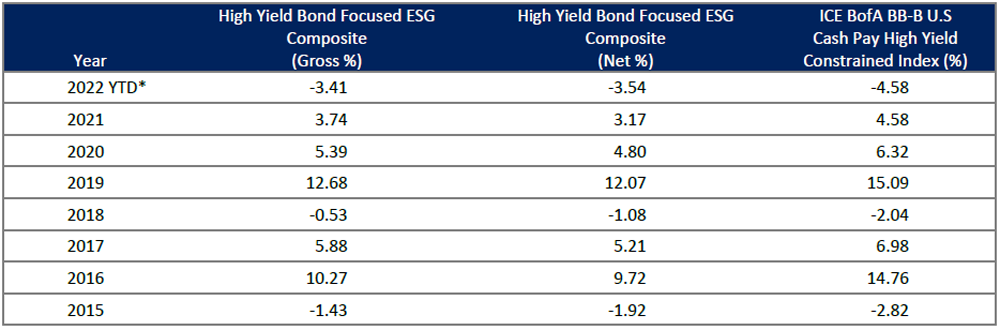
FOR FINANCIAL ADVISORS ONLY. NOT FOR PUBLIC DISTRIBUTION.

Summary

U.S. corporate credit markets declined sharply in the first quarter amidst a large backup in interest rates as bank loans significantly outperformed high yield bonds and investment grade corporate bonds in the first quarter. Bank loans returned -0.10% during the period as measured by the Credit Suisse Leveraged Loan Index. High yield bonds faced their worst quarter since the first quarter of 2020 and returned -4.84% as measured by the Bloomberg U.S. Corporate High Yield Bond Index. Investment grade corporate bonds underperformed amidst a rout in longer duration assets and returned -7.69%, the worst quarterly return since 2008, as measured by the Bloomberg U.S. Corporate Bond Index.

U.S. equities fell as the S&P 500 Index returned -4.60% during the period. The decline was driven by several factors including an aggressive hawkish pivot from global central banks led by the Federal Reserve (Fed), persistent inflationary pressures and a spike in geopolitical tensions emerging from Russia’s invasion of Ukraine in February. U.S. economic data painted a mixed picture as the labor market continued to improve while inflation continued to rise. The unemployment rate fell to 3.8% in February, its lowest level since February 2020, while inflation accelerated further from already elevated levels as the February Consumer Price Index (CPI) rose by 7.9% year-over-year, the fastest annual pace in nearly 40 years. At its March meeting, the Fed voted to raise the target for the benchmark federal funds rate by 25 basis points, the first increase since 2018. The Fed reiterated additional interest rate hikes will be needed, and it will accelerate the pace of tapering, reducing its holdings of Treasuries, agency debt and agency mortgage-backed securities (MBS). Geopolitical tensions also rose significantly with Russia’s invasion of Ukraine, further clouding the global economic outlook and sparking a broad-based rally in commodities. On the COVID-19 front, while trends continued to improve in the U.S., a resurgence in China toward the end of the quarter led to regional lockdowns and added further uncertainty to the global growth outlook.

Market Environment

U.S. Treasury yields rose sharply in the first quarter with the front end of the curve leading the way, resulting in significant bear flattening. The yield on the U.S. 2-Year note climbed roughly 160 basis points during the period, while the yield on the U.S. 10-Year note rose roughly 83 basis points. The curve flattened further and threatened inversion beyond the 2-Year point toward the end of the quarter as the Treasury market rapidly repriced the Fed’s tightening cycle. Longer duration bonds underperformed as the Bloomberg U.S. Aggregate Bond Index fell 5.93%, its largest quarterly decline in more than 40 years.

Alongside the selloff in risk assets, corporate credit spreads widened modestly but ended the quarter well off their widest levels seen in early March. High yield bond spreads widened roughly 38 basis points but ended the quarter more than 80 basis points below the March high as measured by the Bloomberg U.S. Corporate High Yield Bond Index. Investment grade corporate bond spreads also widened roughly 22 basis points as measured by the Bloomberg U.S. Corporate Bond Index.

High yield bond issuance slowed markedly in the first quarter with issuance totaling roughly $43 billion, the lowest first quarter total since 2016, as borrowers were cautious amidst the market turmoil and sharp backup in yields. Investment grade corporate bond issuance topped $450 billion in the first quarter with issuance rebounding in March, as monthly supply topped $230 billion. Additionally, leveraged loan supply totaled close to $110 billion in the first quarter, a modest slowdown compared to last year’s pace.

On the demand side, investors continued to favor bank loan funds over high yield bond and investment grade corporate bond funds amidst robust demand for floating-rate instruments. U.S. leveraged loan funds experienced inflows of nearly $20 billion in the first quarter, while U.S. high yield bond funds experienced outflows of nearly $25 billion and investment grade corporate bond funds experienced outflows of more than $10 billion.

Within the high yield bond market, the riskier segments outperformed as ‘B’s (-3.53%) and ‘CCC’s (-3.88%) outperformed ‘BB’s (-5.94%) with higher quality bonds bearing more interest rate risk than the lower quality segments of the market. From an industry perspective, Energy (-2.60%) outperformed led by the rally in commodities, while Communications (-6.60%) trailed the broader high yield bond market. Default activity remained very low by historical standards with only $1.6 billion of actual defaults during the quarter as the 12-month trailing, par-weighted U.S. high-yield default rate fell to a record low of 0.23% at the end of March.

Performance and Attribution Summary

High Yield Bond – SMA

The Aristotle High Yield Bond – SMA Composite returned -3.48% gross of fees (-3.61% net of fees) in the first quarter, outperforming the -4.58% return of the ICE BofA BB-B U.S. Cash Pay High Yield Constrained Index.

Security selection contributed to relative performance led by holdings in Media & Entertainment and Automotive & Captive Finance. This was partially offset by security selection in Telecommunications and Diversified Manufacturing & Construction Machinery. Industry allocation also contributed to relative performance led by an underweight in Food, Beverage & Tobacco and an overweight in Media & Entertainment. This was partially offset by an underweight in Energy and an overweight in Automotive & Captive Finance. Additionally, sector rotation contributed modestly to relative performance led by the allocation to cash, which was partially offset by the allocation to investment grade corporate bonds.

Top Five Contributors Top Five Detractors
Quad/GraphicsPBF Energy
Kraft HeinzLevel 3 Financing
TennecoDell
Murphy OilTelecom Italia
Mercer InternationalAirlease
*Bold securities held in representative account

High Yield Bond Focused ESG

The Aristotle High Yield Bond Focused ESG Composite returned -3.41% gross of fees (-3.54% net of fees) in the first quarter, outperforming the -4.58% return of the ICE BofA BB-B U.S. Cash Pay High Yield Constrained Index.

Security selection contributed to relative performance led by holdings in Media & Entertainment and Retailers & Restaurants. This was partially offset by security selection in Diversified Manufacturing & Construction Machinery and Telecommunications. Industry allocation also contributed modestly to relative performance led by an underweight in Food, Beverage & Tobacco and an overweight in Lodging & Leisure. This was partially offset by an overweight in Retailers & Restaurants and an underweight in Energy. Additionally, sector rotation contributed modestly to relative performance led by the allocation to cash, which was partially offset by the allocation to investment grade corporate bonds.

Top Five Contributors Top Five Detractors
Quad/GraphicsTelecom Italia
Murphy OilDell
Kraft HeinzScotts Miracle-Gro
iHeartMediaUnited Rentals
Macy’sAir Lease
*Bold securities held in representative account

Short Duration High Yield Bond

The Aristotle Short Duration High Yield Bond Composite returned -1.72% gross of fees (-1.86% net of fees) in the first quarter, outperforming the -1.97% return of the ICE BofA 1-3 Year BB-B U.S. Cash Pay Fixed Maturity High Yield Constrained Index. Security selection was the primary contributor to relative performance, while industry allocation was the primary detractor from relative performance.

Security selection contributed to relative performance led by holdings in Chemicals and Healthcare. This was partially offset by security selection in Finance Companies and Lodging & Leisure. Sector rotation also contributed modestly to relative performance led by the allocation to cash, which was partially offset by the allocation to investment grade corporate bonds.

Industry allocation detracted modestly from relative performance led by an overweight in Chemicals and an underweight in Paper & Packaging. This was partially offset by an overweight in Media & Entertainment and an underweight in Technology.

Top Five Contributors Top Five Detractors
Uralkali PJSCEquitrans Midstream
Murphy OilRoyal Carribbean
Intesa SanpaoloService Properties Trust
Delta Air LinesMGM Resorts
Macy’sCitgo
*Bold securities held in representative account

Outlook

We believe three major themes have shaped the performance of corporate credit markets thus far in 2022: A more hawkish Fed, more persistent and higher-than-expected inflation and increased geopolitical risk resulting from Russia’s invasion of Ukraine. Despite the increase in uncertainty generated by these three themes, we continue to believe there are opportunities in U.S. corporate credit markets and maintain a positive outlook, especially for shorter duration high yield bonds.

The overall global macroeconomic backdrop has become significantly cloudier than it was at the end of 2021. While the Fed telegraphed tighter policy toward the end of last year, the Fed’s hawkishness so far in 2022 has caught the market by surprise and led to a rapid selloff, concentrated in the front end of the yield curve. With the Fed signaling quantitative tightening will begin in June, we believe there is the potential for the yield curve to steepen given the backdrop of a still strong economy and the extent of the repricing that has already occurred in the front end of the yield curve.

We also believe inflation risks could prove to be more stubborn than originally forecasted toward the end of last year. The impact of the war in Ukraine on commodity prices is just one example of how exogenous shocks have only magnified issues that could lead to stickier inflation. We believe consumers are already beginning to adapt their behavior to higher inflation, and the resulting rise in consumer inflation expectations could lead to more endemic inflation. In our opinion, there is a possibility that companies could eventually face a slowdown in topline demand as consumers’ discretionary income comes under pressure. For companies, the resulting pressure on margins and pricing power could push them to seek topline growth through more leveraged, shareholder-friendly policies.

High yield supply decreased more than we originally expected in the first quarter, and we believe issuance may continue to fall below expectations over the next few quarters. In our opinion, the opportunistic refinancing window for corporates is closed, thus the issuance that does occur this year could be used to fund share repurchases and mergers and acquisitions (M&A). We believe a shift from refinancing-related issuance to M&A and share repurchase-related issuance would be negative for credit market fundamentals. In the investment grade market, we also expect issuance to slow down, which would be positive on the margin for the supply/demand picture.

We believe overall risk, from geopolitical to credit risk, has increased significantly over the past three months. While we see these risks persisting in the coming quarters, we believe the best strategy to protect against these risks is to focus on credit fundamentals and segments of the market that, in our opinion, have already priced in what we believe to be a significant amount of risk, while seeking to avoid the segments of the market that could succumb to less balance sheet-friendly activities.

High Yield Bond Positioning

In our high yield bond portfolios, we continue to favor short duration high yield bonds, especially after the rapid repricing of the 2- to 3-year segment of the yield curve over the past quarter. From an industry perspective, we adjusted our portfolios to add exposure to companies that focus on providing consumer experiences rather than consumer goods.

While duration and interest rates are typically inversely correlated, duration has increased for many high yield bond benchmarks over the past quarter despite the large backup in U.S. yields. Before the increase in interest rates, many bonds had been trading to their call date but as interest rates have increased, these bonds are now trading to their maturity date. We believe most of this adjustment has already happened, and we continue to hold a duration underweight relative to the benchmark in our high yield bond portfolios.

With the reopening of the economy, we also believe there is pent-up demand for consumer experiences (e.g., travel and concerts), which could benefit companies in certain industries. Despite rising input costs, we believe some of the areas that may benefit are concert and event providers, conference-oriented lodging providers and airlines. As a result, we increased exposure to these areas, holding overweights in Media & Entertainment, Transportation and Lodging & Leisure alongside underweights in Technology, Telecommunications and Healthcare.

Disclosures

The opinions expressed herein are those of Aristotle Credit Partners, LLC (Aristotle Credit) and are subject to change without notice. Past performance is not a guarantee or indicator of future results. This material is not financial advice or an offer to buy or sell any product. You should not assume that any of the securities transactions, sectors or holdings discussed in this report are or will be profitable, or that recommendations Aristotle Credit makes in the future will be profitable or equal the performance of the securities listed in this report. The portfolio characteristics shown relate to the Aristotle Credit High Yield Bond – SMA strategy, the Aristotle Credit High Yield Bond Focused ESG strategy and the Aristotle Credit Short Duration High Yield Bond strategy. Not every client’s account will have these characteristics. Aristotle Credit reserves the right to modify its current investment strategies and techniques based on changing market dynamics or client needs. There is no assurance that any securities discussed herein will remain in an account’s portfolio at the time you receive this report or that securities sold have not been repurchased. The securities discussed may not represent an account’s entire portfolio and, in the aggregate, may represent only a small percentage of an account’s portfolio holdings. For a full list of all recommendations made by Aristotle Credit during the last 12 months, please contact us at (949) 681-2100. This is not a recommendation to buy or sell a particular security.

Returns are presented gross and net of investment advisory fees and include the reinvestment of all income. Gross returns will be reduced by fees and other expenses that may be incurred in the management of the account. For example, a 0.5% annual fee deducted quarterly (0.125%) from an account with a ten-year annualized growth rate of 5.0% will produce a net result of 4.4%. Actual performance results will vary from this example.

The Bloomberg U.S. Corporate Bond Index measures the investment grade, fixed-rate, taxable corporate bond market. It includes securities publicly issued by U.S. and non-U.S. industrial, utility and financial issuers that are all U.S. dollar denominated. The Bloomberg U.S. Corporate Bond Index is a component of the Bloomberg U.S. Credit Bond Index. The Bloomberg U.S. Corporate High Yield Bond Index measures the U.S. dollar-denominated, high yield, fixed-rate corporate bond market. Securities are classified as high yield if the middle rating of Moody’s, Fitch and S&P is Ba1/BB+/BB+ or below. Bonds from issuers with an emerging markets country of risk, based on Bloomberg EM country definition, are excluded. The Credit Suisse Leveraged Loan Index is a market-weighted index designed to track the performance of the investable universe of the U.S. dollar-denominated leveraged loan market. The Bloomberg U.S. Aggregate Bond Index is a broad base, market capitalization-weighted bond market index representing intermediate term investment grade bonds traded in the United States. The Index is frequently used as a stand-in for measuring the performance of the U.S. bond market. In addition to investment grade corporate debt, the Index tracks government debt, mortgage-backed securities (MBS) and asset-backed securities (ABS) to simulate the universe of investable bonds that meet certain criteria. In order to be included in the Index, bonds must be of investment grade or higher, have an outstanding par value of at least $100 million and have at least one year until maturity. The S&P 500 Index is the Standard & Poor’s Composite Index and is a widely recognized, unmanaged index of common stock prices. It is market cap weighted and includes 500 leading companies, capturing approximately 80% coverage of available market capitalization. The ICE Bank of America (ICE BofA) BB-B U.S. Cash Pay High Yield Constrained Index measures the performance of the U.S. dollar-denominated BB-rated and B-rated corporate debt issued in the U.S. domestic market, a fixed coupon schedule and a minimum amount outstanding of $100 million, issued publicly. Allocations to an individual issuer in the Index will not exceed 2%. The ICE Bank of America (ICE BofA) 1-3 Year BB-B U.S. Cash Pay Fixed Maturity High Yield Constrained Index tracks the performance of the U.S. dollar-denominated below investment grade corporate debt, currently in a coupon paying period, that is publicly issued in the U.S. domestic market; including 144A securities, both with and without registration rights. Qualifying securities must have risk exposure to countries are members of the FX-G10, Western Europe, or territories of the United States and Western Europe. The FX-G10 includes all Euro members: the United States, Japan, the United Kingdom, Canada, Australia, New Zealand, Switzerland, Norway and Sweden. Qualifying securities include only those rated BB1 through B3. Perpetual securities are not included as all securities must have a fixed final maturity date. All final maturity dates must range between one and three years. It is a capitalization-weighted index, constrained to 2% maximum weighting per issuer. The Consumer Price Index (CPI) is a measure of the average change over time in the prices paid by urban consumers for a market basket of consumer goods and services. The volatility (beta) of the Composites may be greater or less than the indices. It is not possible to invest directly in these indices. Composite and index returns reflect the reinvestment of income.

Aristotle Credit Partners, LLC is an independent registered investment adviser under the Advisers Act of 1940, as amended. Registration does not imply a certain level of skill or training. More information about Aristotle Credit, including our investment strategies, fees and objectives, can be found in our Form ADV Part 2, which is available upon request. ACP-2204-14-UBSFA

Performance Disclosures

Sources: SS&C Advent; ICE BofA
*Composite returns are preliminary pending final account reconciliation.
**2014 is a partial-year period of eleven months, representing data from February 1, 2014 to December 31, 2014.
Past performance is not indicative of future results. Returns presented are gross and net of investment advisory fees and include the reinvestment of all income. Please refer to disclosures at the end of this document.


Sources: SS&C Advent; ICE BofA
*Composite returns are preliminary pending final account reconciliation.
Past performance is not indicative of future results. Returns presented are gross and net of investment advisory fees and include the reinvestment of all income. Please refer to disclosures at the end of this document.


Sources: SS&C Advent; ICE BofA
*Composite returns are preliminary pending final account reconciliation.
**2014 is a partial-year period of period of nine months, representing data from April 1, 2014 to December 31, 2014.
Past performance is not indicative of future results. Returns presented are gross and net of investment advisory fees and include the reinvestment ofall income. Please refer to disclosures at the end of this document.

FOR FINANCIAL ADVISORS ONLY. NOT FOR PUBLIC DISTRIBUTION.

Summary

U.S. corporate credit markets declined sharply in the first quarter amidst a large backup in interest rates as bank loans significantly outperformed high yield bonds and investment grade corporate bonds in the first quarter. Bank loans returned -0.10% during the period as measured by the Credit Suisse Leveraged Loan Index. High yield bonds faced their worst quarter since the first quarter of 2020 and returned -4.84% as measured by the Bloomberg U.S. Corporate High Yield Bond Index. Investment grade corporate bonds underperformed amidst a rout in longer duration assets and returned -7.69%, the worst quarterly return since 2008, as measured by the Bloomberg U.S. Corporate Bond Index.

U.S. equities fell as the S&P 500 Index returned -4.60% during the period. The decline was driven by several factors including an aggressive hawkish pivot from global central banks led by the Federal Reserve (Fed), persistent inflationary pressures and a spike in geopolitical tensions emerging from Russia’s invasion of Ukraine in February. U.S. economic data painted a mixed picture as the labor market continued to improve while inflation continued to rise. The unemployment rate fell to 3.8% in February, its lowest level since February 2020, while inflation accelerated further from already elevated levels as the February Consumer Price Index (CPI) rose by 7.9% year-over-year, the fastest annual pace in nearly 40 years. At its March meeting, the Fed voted to raise the target for the benchmark federal funds rate by 25 basis points, the first increase since 2018. The Fed reiterated additional interest rate hikes will be needed, and it will accelerate the pace of tapering, reducing its holdings of Treasuries, agency debt and agency mortgage-backed securities (MBS). Geopolitical tensions also rose significantly with Russia’s invasion of Ukraine, further clouding the global economic outlook and sparking a broad-based rally in commodities. On the COVID-19 front, while trends continued to improve in the U.S., a resurgence in China toward the end of the quarter led to regional lockdowns and added further uncertainty to the global growth outlook.

Market Environment

U.S. Treasury yields rose sharply in the first quarter with the front end of the curve leading the way, resulting in significant bear flattening. The yield on the U.S. 2-Year note climbed roughly 160 basis points during the period, while the yield on the U.S. 10-Year note rose roughly 83 basis points. The curve flattened further and threatened inversion beyond the 2-Year point toward the end of the quarter as the Treasury market rapidly repriced the Fed’s tightening cycle. Longer duration bonds underperformed as the Bloomberg U.S. Aggregate Bond Index fell 5.93%, its largest quarterly decline in more than 40 years.

Alongside the selloff in risk assets, corporate credit spreads widened modestly but ended the quarter well off their widest levels seen in early March. High yield bond spreads widened roughly 38 basis points but ended the quarter more than 80 basis points below the March high as measured by the Bloomberg U.S. Corporate High Yield Bond Index. Investment grade corporate bond spreads also widened roughly 22 basis points as measured by the Bloomberg U.S. Corporate Bond Index.

High yield bond issuance slowed markedly in the first quarter with issuance totaling roughly $43 billion, the lowest first quarter total since 2016, as borrowers were cautious amidst the market turmoil and sharp backup in yields. Investment grade corporate bond issuance topped $450 billion in the first quarter with issuance rebounding in March, as monthly supply topped $230 billion. Additionally, leveraged loan supply totaled close to $110 billion in the first quarter, a modest slowdown compared to last year’s pace.

On the demand side, investors continued to favor bank loan funds over high yield bond and investment grade corporate bond funds amidst robust demand for floating-rate instruments. U.S. leveraged loan funds experienced inflows of nearly $20 billion in the first quarter, while U.S. high yield bond funds experienced outflows of nearly $25 billion and investment grade corporate bond funds experienced outflows of more than $10 billion.

Within the high yield bond market, the riskier segments outperformed as ‘B’s (-3.53%) and ‘CCC’s (-3.88%) outperformed ‘BB’s (-5.94%) with higher quality bonds bearing more interest rate risk than the lower quality segments of the market. From an industry perspective, Energy (-2.60%) outperformed led by the rally in commodities, while Communications (-6.60%) trailed the broader high yield bond market. Default activity remained very low by historical standards with only $1.6 billion of actual defaults during the quarter as the 12-month trailing, par-weighted U.S. high-yield default rate fell to a record low of 0.23% at the end of March.

Performance and Attribution Summary

High Yield Bond – SMA

The Aristotle High Yield Bond – SMA Composite returned -3.48% gross of fees (-3.61% net of fees) in the first quarter, outperforming the -4.58% return of the ICE BofA BB-B U.S. Cash Pay High Yield Constrained Index.

Security selection contributed to relative performance led by holdings in Media & Entertainment and Automotive & Captive Finance. This was partially offset by security selection in Telecommunications and Diversified Manufacturing & Construction Machinery. Industry allocation also contributed to relative performance led by an underweight in Food, Beverage & Tobacco and an overweight in Media & Entertainment. This was partially offset by an underweight in Energy and an overweight in Automotive & Captive Finance. Additionally, sector rotation contributed modestly to relative performance led by the allocation to cash, which was partially offset by the allocation to investment grade corporate bonds.

Top Five Contributors Top Five Detractors
Quad/GraphicsPBF Energy
Kraft HeinzLevel 3 Financing
TennecoDell
Murphy OilTelecom Italia
Mercer InternationalAirlease
*Bold securities held in representative account

High Yield Bond Focused ESG

The Aristotle High Yield Bond Focused ESG Composite returned -3.41% gross of fees (-3.54% net of fees) in the first quarter, outperforming the -4.58% return of the ICE BofA BB-B U.S. Cash Pay High Yield Constrained Index.

Security selection contributed to relative performance led by holdings in Media & Entertainment and Retailers & Restaurants. This was partially offset by security selection in Diversified Manufacturing & Construction Machinery and Telecommunications. Industry allocation also contributed modestly to relative performance led by an underweight in Food, Beverage & Tobacco and an overweight in Lodging & Leisure. This was partially offset by an overweight in Retailers & Restaurants and an underweight in Energy. Additionally, sector rotation contributed modestly to relative performance led by the allocation to cash, which was partially offset by the allocation to investment grade corporate bonds.

Top Five Contributors Top Five Detractors
Quad/GraphicsTelecom Italia
Murphy OilDell
Kraft HeinzScotts Miracle-Gro
iHeartMediaUnited Rentals
Macy’sAir Lease
*Bold securities held in representative account

Short Duration High Yield Bond

The Aristotle Short Duration High Yield Bond Composite returned -1.72% gross of fees (-1.86% net of fees) in the first quarter, outperforming the -1.97% return of the ICE BofA 1-3 Year BB-B U.S. Cash Pay Fixed Maturity High Yield Constrained Index. Security selection was the primary contributor to relative performance, while industry allocation was the primary detractor from relative performance.

Security selection contributed to relative performance led by holdings in Chemicals and Healthcare. This was partially offset by security selection in Finance Companies and Lodging & Leisure. Sector rotation also contributed modestly to relative performance led by the allocation to cash, which was partially offset by the allocation to investment grade corporate bonds.

Industry allocation detracted modestly from relative performance led by an overweight in Chemicals and an underweight in Paper & Packaging. This was partially offset by an overweight in Media & Entertainment and an underweight in Technology.

Top Five Contributors Top Five Detractors
Uralkali PJSCEquitrans Midstream
Murphy OilRoyal Carribbean
Intesa SanpaoloService Properties Trust
Delta Air LinesMGM Resorts
Macy’sCitgo
*Bold securities held in representative account

Outlook

We believe three major themes have shaped the performance of corporate credit markets thus far in 2022: A more hawkish Fed, more persistent and higher-than-expected inflation and increased geopolitical risk resulting from Russia’s invasion of Ukraine. Despite the increase in uncertainty generated by these three themes, we continue to believe there are opportunities in U.S. corporate credit markets and maintain a positive outlook, especially for shorter duration high yield bonds.

The overall global macroeconomic backdrop has become significantly cloudier than it was at the end of 2021. While the Fed telegraphed tighter policy toward the end of last year, the Fed’s hawkishness so far in 2022 has caught the market by surprise and led to a rapid selloff, concentrated in the front end of the yield curve. With the Fed signaling quantitative tightening will begin in June, we believe there is the potential for the yield curve to steepen given the backdrop of a still strong economy and the extent of the repricing that has already occurred in the front end of the yield curve.

We also believe inflation risks could prove to be more stubborn than originally forecasted toward the end of last year. The impact of the war in Ukraine on commodity prices is just one example of how exogenous shocks have only magnified issues that could lead to stickier inflation. We believe consumers are already beginning to adapt their behavior to higher inflation, and the resulting rise in consumer inflation expectations could lead to more endemic inflation. In our opinion, there is a possibility that companies could eventually face a slowdown in topline demand as consumers’ discretionary income comes under pressure. For companies, the resulting pressure on margins and pricing power could push them to seek topline growth through more leveraged, shareholder-friendly policies.

High yield supply decreased more than we originally expected in the first quarter, and we believe issuance may continue to fall below expectations over the next few quarters. In our opinion, the opportunistic refinancing window for corporates is closed, thus the issuance that does occur this year could be used to fund share repurchases and mergers and acquisitions (M&A). We believe a shift from refinancing-related issuance to M&A and share repurchase-related issuance would be negative for credit market fundamentals. In the investment grade market, we also expect issuance to slow down, which would be positive on the margin for the supply/demand picture.

We believe overall risk, from geopolitical to credit risk, has increased significantly over the past three months. While we see these risks persisting in the coming quarters, we believe the best strategy to protect against these risks is to focus on credit fundamentals and segments of the market that, in our opinion, have already priced in what we believe to be a significant amount of risk, while seeking to avoid the segments of the market that could succumb to less balance sheet-friendly activities.

High Yield Bond Positioning

In our high yield bond portfolios, we continue to favor short duration high yield bonds, especially after the rapid repricing of the 2- to 3-year segment of the yield curve over the past quarter. From an industry perspective, we adjusted our portfolios to add exposure to companies that focus on providing consumer experiences rather than consumer goods.

While duration and interest rates are typically inversely correlated, duration has increased for many high yield bond benchmarks over the past quarter despite the large backup in U.S. yields. Before the increase in interest rates, many bonds had been trading to their call date but as interest rates have increased, these bonds are now trading to their maturity date. We believe most of this adjustment has already happened, and we continue to hold a duration underweight relative to the benchmark in our high yield bond portfolios.

With the reopening of the economy, we also believe there is pent-up demand for consumer experiences (e.g., travel and concerts), which could benefit companies in certain industries. Despite rising input costs, we believe some of the areas that may benefit are concert and event providers, conference-oriented lodging providers and airlines. As a result, we increased exposure to these areas, holding overweights in Media & Entertainment, Transportation and Lodging & Leisure alongside underweights in Technology, Telecommunications and Healthcare.

Disclosures

The opinions expressed herein are those of Aristotle Credit Partners, LLC (Aristotle Credit) and are subject to change without notice. Past performance is not a guarantee or indicator of future results. This material is not financial advice or an offer to buy or sell any product. You should not assume that any of the securities transactions, sectors or holdings discussed in this report are or will be profitable, or that recommendations Aristotle Credit makes in the future will be profitable or equal the performance of the securities listed in this report. The portfolio characteristics shown relate to the Aristotle Credit High Yield Bond – SMA strategy, the Aristotle Credit High Yield Bond Focused ESG strategy and the Aristotle Credit Short Duration High Yield Bond strategy. Not every client’s account will have these characteristics. Aristotle Credit reserves the right to modify its current investment strategies and techniques based on changing market dynamics or client needs. There is no assurance that any securities discussed herein will remain in an account’s portfolio at the time you receive this report or that securities sold have not been repurchased. The securities discussed may not represent an account’s entire portfolio and, in the aggregate, may represent only a small percentage of an account’s portfolio holdings. For a full list of all recommendations made by Aristotle Credit during the last 12 months, please contact us at (949) 681-2100. This is not a recommendation to buy or sell a particular security.

Returns are presented gross and net of investment advisory fees and include the reinvestment of all income. Gross returns will be reduced by fees and other expenses that may be incurred in the management of the account. For example, a 0.5% annual fee deducted quarterly (0.125%) from an account with a ten-year annualized growth rate of 5.0% will produce a net result of 4.4%. Actual performance results will vary from this example.

The Bloomberg U.S. Corporate Bond Index measures the investment grade, fixed-rate, taxable corporate bond market. It includes securities publicly issued by U.S. and non-U.S. industrial, utility and financial issuers that are all U.S. dollar denominated. The Bloomberg U.S. Corporate Bond Index is a component of the Bloomberg U.S. Credit Bond Index. The Bloomberg U.S. Corporate High Yield Bond Index measures the U.S. dollar-denominated, high yield, fixed-rate corporate bond market. Securities are classified as high yield if the middle rating of Moody’s, Fitch and S&P is Ba1/BB+/BB+ or below. Bonds from issuers with an emerging markets country of risk, based on Bloomberg EM country definition, are excluded. The Credit Suisse Leveraged Loan Index is a market-weighted index designed to track the performance of the investable universe of the U.S. dollar-denominated leveraged loan market. The Bloomberg U.S. Aggregate Bond Index is a broad base, market capitalization-weighted bond market index representing intermediate term investment grade bonds traded in the United States. The Index is frequently used as a stand-in for measuring the performance of the U.S. bond market. In addition to investment grade corporate debt, the Index tracks government debt, mortgage-backed securities (MBS) and asset-backed securities (ABS) to simulate the universe of investable bonds that meet certain criteria. In order to be included in the Index, bonds must be of investment grade or higher, have an outstanding par value of at least $100 million and have at least one year until maturity. The S&P 500 Index is the Standard & Poor’s Composite Index and is a widely recognized, unmanaged index of common stock prices. It is market cap weighted and includes 500 leading companies, capturing approximately 80% coverage of available market capitalization. The ICE Bank of America (ICE BofA) BB-B U.S. Cash Pay High Yield Constrained Index measures the performance of the U.S. dollar-denominated BB-rated and B-rated corporate debt issued in the U.S. domestic market, a fixed coupon schedule and a minimum amount outstanding of $100 million, issued publicly. Allocations to an individual issuer in the Index will not exceed 2%. The ICE Bank of America (ICE BofA) 1-3 Year BB-B U.S. Cash Pay Fixed Maturity High Yield Constrained Index tracks the performance of the U.S. dollar-denominated below investment grade corporate debt, currently in a coupon paying period, that is publicly issued in the U.S. domestic market; including 144A securities, both with and without registration rights. Qualifying securities must have risk exposure to countries are members of the FX-G10, Western Europe, or territories of the United States and Western Europe. The FX-G10 includes all Euro members: the United States, Japan, the United Kingdom, Canada, Australia, New Zealand, Switzerland, Norway and Sweden. Qualifying securities include only those rated BB1 through B3. Perpetual securities are not included as all securities must have a fixed final maturity date. All final maturity dates must range between one and three years. It is a capitalization-weighted index, constrained to 2% maximum weighting per issuer. The Consumer Price Index (CPI) is a measure of the average change over time in the prices paid by urban consumers for a market basket of consumer goods and services. The volatility (beta) of the Composites may be greater or less than the indices. It is not possible to invest directly in these indices. Composite and index returns reflect the reinvestment of income.

This presentation is to report on the investment strategies as reported by Aristotle Capital Management, LLC and is for illustrative purposes only. The information contained herein is obtained from multiple sources and believed to be reliable. Information has not been verified by Morgan Stanley Wealth Management, and may differ from documents created by Morgan Stanley Wealth Management. The financial advisor should refer to the Profile. This must be preceded or accompanied by the Morgan Stanley Wealth Management Profile, which you can obtain from the Morgan Stanley Wealth Management Performance Analytics. For additional information on other programs, please speak to Patrick Schussman at Aristotle Capital at (310) 954-8156.

Aristotle Credit Partners, LLC is an independent registered investment adviser under the Advisers Act of 1940, as amended. Registration does not imply a certain level of skill or training. More information about Aristotle Credit, including our investment strategies, fees and objectives, can be found in our Form ADV Part 2, which is available upon request. ACP-2204-14-MSFA

Performance Disclosures


Sources: SS&C Advent; ICE BofA
*Composite returns are preliminary pending final account reconciliation.
**2014 is a partial-year period of eleven months, representing data from February 1, 2014 to December 31, 2014.
Past performance is not indicative of future results. Returns presented are gross and net of investment advisory fees and include the reinvestment of all income. Please refer to disclosures at the end of this document.


Sources: SS&C Advent; ICE BofA
*Composite returns are preliminary pending final account reconciliation.
Past performance is not indicative of future results. Returns presented are gross and net of investment advisory fees and include the reinvestment of all income. Please refer to disclosures at the end of this document.


Sources: SS&C Advent; ICE BofA
*Composite returns are preliminary pending final account reconciliation.
**2014 is a partial-year period of period of nine months, representing data from April 1, 2014 to December 31, 2014.
Past performance is not indicative of future results. Returns presented are gross and net of investment advisory fees and include the reinvestment ofall income. Please refer to disclosures at the end of this document.

ARISTOTLE CAPITAL BOSTON, LLC

FOR FINANCIAL ADVISORS ONLY. NOT FOR PUBLIC DISTRIBUTION.

Markets Review

After a strong 2021, small/mid cap equities declined alongside other risk assets to begin the year as investors grappled with a myriad of uncertainties, including a shift to tighter monetary policy, the impact of rampant inflation and the ripple effects from Russia’s invasion of Ukraine. On the policy front, the Federal Reserve (Fed) raised the target rate by 0.25%, as expected, making it clear that further increases will be appropriate. Fed officials will now focus on the challenging task of taming inflation without stunting economic growth and sending the U.S. economy into a recession. In related news, supply shortages fueled by the Ukraine-Russia conflict, along with a host of pre-existing factors, drove commodity prices higher during the period. Oil prices were particularly volatile, with crude oil at one point eclipsing $130 a barrel. Natural gas, fertilizer and agriculture-related commodity prices also experienced sharp increases during the period.

From a sector perspective, performance varied widely during the quarter, ranging from the 40.39% total return of the Russell 2500 Energy sector to the 15.16% decline of the Consumer Discretionary sector. To put this type of dispersion into context, Energy’s 40.39% gain versus Consumer Discretionary’s 15.16% loss marked the second largest divergence between any two Russell 2500 sectors in a single quarter. Only Information Technology’s outperformance of Utilities in the fourth quarter of 1999 was greater. Other areas of the small/mid cap market that were hit hard in the first quarter included Health Care (-14.94%) and Information Technology (-9.52%), while Materials (+6.76%) and Utilities (+2.49%) followed Energy as the only other sectors to close the quarter in positive territory.

Stylistically, value continued its outperformance of growth in the first quarter, as evidenced by the Russell 2500 Value Index’s return of -1.50% compared to the -12.30% return of the Russell 2500 Growth Index. This marks the third consecutive quarter of outperformance for the Russell 2500 Value Index relative to the Russell 2500 Growth Index. Factor performance was decidedly mixed during the period, as companies with lower valuations and stronger profitability generally outperformed during the first half of the quarter before ceding leadership to more expensively valued securities during the second half of the quarter. On the other hand, March market performance was particularly bifurcated, as the final three weeks of the month saw pronounced outperformance from the meme stocks, bitcoin and other risk-on proxies, a complete reversal from the first two weeks of the month and factor leadership during the January period.

Sources: SS&C Advent; Russell Investments

Past performance is not indicative of future results. Returns are presented gross and net of investment advisory fees and include the reinvestment of all income. Aristotle Boston Composite returns are preliminary pending final account reconciliation. Please see important disclosures at the end of this document.

Performance Review

For the first quarter of 2022, the Aristotle Small/Mid Cap Equity Composite generated a total return of -4.38% gross of fees (-4.52% net of fees), outperforming the -5.82% total return of the Russell 2500 Index. Outperformance during the quarter was driven entirely by security selection, while allocation effects modestly detracted. Overall, security selection within the Health Care, Energy and Information Technology sectors added the most value on a relative basis, while selection within Financials, Materials and Consumer Discretionary detracted. From an allocation perspective, the portfolio benefited from an underweight in Consumer Discretionary and an overweight in Financials; however, this was offset by an underweight in Energy and an overweight in Information Technology.

Relative ContributorsRelative Detractors
Range ResourcesMACOM Technology Solutions
NexTier Oilfield SolutionsAerCap Holdings
HealthEquityCharles River Laboratories
Cal-Maine FoodsHarsco
KBR1-800-FLOWERS.COM

CONTRIBUTORS

Security selection added the most value within the Health Care, Energy and Information Technology sectors. From an allocation perspective, an underweight in Consumer Discretionary and an overweight in Financials contributed positively to relative performance. At the company level, Range Resources and NexTier Oilfield Solutions were two of the largest contributors during the quarter.

  • Range Resources (RRC), a natural gas focused exploration and production company with operations in the Appalachian Basin, appreciated due to improved investor sentiment following an uptick in natural gas pricing. We maintain a position, as we believe the company’s low-cost acreage allows it to translate the healthy price environment into earnings and cash flow that is being used to reduce financial leverage, which can accrue additional value to equity shareholders in periods to come.
  • NextTier Oilfield Solutions (NEX), a provider of hydraulic fracturing and other completion-oriented oilfield services to exploration and production companies in the U.S., benefited from rising U.S. completion activity and rising prices due to tight supply/demand fundamentals for frac equipment. We maintain a position, as we believe the company’s dedicated service agreements, solid execution and merger synergies from recent mergers and acquisitions activity can unlock additional value for shareholders in periods to come.

DETRACTORS

Security selection detracted within the Financials, Materials and Consumer Discretionary sectors. Additionally, the portfolio’s underweight in Energy and overweight in Information Technology detracted from relative performance. At the company level, MACOM Technology Solutions and AerCap Holdings were two of the largest detractors during the quarter.

  • MACOM Technology Solutions (MTSI), a designer and manufacturer of high-performance semiconductors, declined in the face of industry-wide supply chain issues.  Nevertheless, the company’s fundamentals continue to advance, as we believe the company’s meaningful exposure to growing demand from Data Center and 5G end market applications plus solid company-specific execution has driven faster-than-expected profitability. We believe the underlying demand drivers are sustainable for the foreseeable future and continue to maintain our position.
  • AerCap Holdings (AER), the world’s largest aircraft leasing firm, declined due to negative sentiment associated with the business given its exposure to the airline industry and the recovery of certain eastern European assets. We maintain a position, as we believe the company is well-positioned to weather this period of volatility given its competitive position, robust pipeline of new aircraft orders and strong balance sheet.

Recent Portfolio Activity

Buys/AcquisitionsSells/Liquidations
AZEKEvercore
iStarKraton
Jacobs Engineering Group
Sonos

BUYS/ACQUISITIONS

  • AZEK (AZEK), a leading manufacturer of residential building products, primarily focused on wood-alternative decking, railing and trim, was added to the portfolio. We believe the strong secular demand backdrop for alternative, sustainably sourced building products along with company-specific margin improvements should benefit shareholders in periods to come.
  • iStar (STAR), an internally-managed real estate investment trust specializing in ground leases through its ownership of 65% of Safehold Inc. (SAFE), was added the to the portfolio. We believe the recent sale of the company’s net-lease asset portfolio will allow management to focus on continued investments in its SAFE ground lease business and also paves the way for management to acquire the remaining portion of SAFE that it does not already own.
  • Jacobs Engineering Group (J) is a professional services firm focused on engineering and government services that is in the early stages of transforming its business strategy by divesting several capital-intensive cyclical businesses in favor of asset-light engineering and consulting businesses.  We believe the company is now well-positioned to benefit from several attractive secular trends, including environmental, defense and intelligence spending by government and business customers.
  • Sonos (SONO), a consumer electronics company with proprietary multi-room smart speaker technology, was added to the portfolio on the belief that strong consumer demand for the company’s differentiated product offering plus a multi-year pipeline of upcoming new product introductions are expected to drive shareholder value for the next several years.

SELLS/LIQUIDATIONS

  • Evercore (EVR), a boutique investment bank that provides advisory and wealth management services, was removed from the portfolio due to our belief that shares were fully valued and we were nearing a cyclical peak in demand for the company’s services.
  • Kraton Corporation (KRA), a chemical company that manufactures and sells specialty polymers to various end markets, was removed from the portfolio by virtue of its acquisition by DL Chemical.

Outlook and Positioning

Despite the pickup in volatility over the first few months of 2022, we continue to believe that generally positive fundamentals and low relative valuations support further upside for small/mid cap equities. While near-term price movements and volatility continue to be driven by macroeconomic and geopolitical issues in the short term, we believe business fundamentals will ultimately determine equity values in the long run. Additionally, as the Fed continues its path toward interest rate normalization, and as company fundamentals and valuations become increasingly more important, we believe this development should be beneficial for fundamentally-oriented, active managers like ourselves. As such, we remain optimistic about the prospects for small/mid cap equities going forward, given our views on the overall fundamentals of our individual holdings at this stage in the market cycle. While economic growth may slow globally and even domestically, we continue to believe the U.S. economy is on relatively healthier footing than other markets around the world, which should benefit the more domestically-oriented small/mid cap market. Small/mid caps, which derive the vast majority of their revenues from U.S. sources, may also be less impacted by continued geopolitical turmoil abroad relative to large caps. With that said, we recognize there are certain areas of the market that continue to appear to be stretched in terms of balance sheet quality and valuations, and the small/mid cap market continues to have a high percentage of negative earning companies (roughly one-fifth of constituents). We believe these later cycle conditions, along with the heightened periods of market volatility, favor quality-oriented investors like ourselves and can provide us with additional opportunities to add value on an absolute and relative basis.

Our current positioning is a function of our bottom-up security selection process and our ability to identify what we view as attractive investment candidates, regardless of economic sector definitions. Recent purchases have been spread across industries and are idiosyncratic in nature, as opposed to being tied to an outlook for a particular sector. Overweights in Industrials and Information Technology are mostly a function of the performance of our holdings in these sectors over the past few years. Conversely, we continue to be underweight in Consumer Discretionary, as we have been unable to identify what we consider to be compelling opportunities that fit our discipline given the rising risk profiles as a result of structural headwinds for various brick and mortar businesses. We also continue to be underweight in Real Estate as a result of valuations and structural challenges for various end markets within the sector. Given our focus on long-term business fundamentals, patient investment approach and low portfolio turnover, the strategy’s sector positioning generally does not change significantly from quarter to quarter; however, we may take advantage of periods of volatility by adding selectively to certain companies when appropriate. As always, our focus remains on identifying what we view as attractive, long-term investment opportunities that can create value for shareholders over the next three to five years, which we believe gives us the best opportunity to generate alpha for our clients.

Disclosures

The opinions expressed herein are those of Aristotle Capital Boston, LLC (Aristotle Boston) and are subject to change without notice. Past performance is not indicative of future results. The information provided in this report should not be considered financial advice or a recommendation to purchase or sell any particular security. There is no assurance that any securities discussed herein will remain in an account’s portfolio at the time you receive this report or that securities sold have not been repurchased. The securities discussed may not represent an account’s entire portfolio and, in the aggregate, may represent only a small percentage of an account’s portfolio holdings. The performance attribution presented is of a representative account from Aristotle Boston’s Small/Mid Cap Equity Composite. The representative account is a discretionary client account which was chosen to most closely reflect the investment style of the strategy. The criteria used for representative account selection is based on the account’s period of time under management and its similarity of holdings in relation to the strategy. It should not be assumed that any of the securities transactions, holdings or sectors discussed were or will be profitable, or that the investment recommendations or decisions Aristotle Boston makes in the future will be profitable or equal the performance of the securities discussed herein. Aristotle Boston reserves the right to modify its current investment strategies and techniques based on changing market dynamics or client needs. Recommendations made in the last 12 months are available upon request.

Returns are presented gross and net of investment advisory fees and include the reinvestment of all income. Gross returns will be reduced by fees and other expenses that may be incurred in the management of the account. For example, a 0.5% annual fee deducted quarterly (0.125%) from an account with a ten-year annualized growth rate of 5.0% will produce a net result of 4.4%. Actual performance results will vary from this example.

The Russell 2500 Index is a subset of the Russell 3000® Index representing approximately 10% of the total market capitalization of that index. It includes approximately 2000 of the smallest securities based on a combination of their market cap and current index membership. The Russell 2500 Growth® Index measures the performance of the small/mid cap companies located in the United States that also exhibit a growth probability. The Russell 2500 Value® Index measures the performance of the small/mid cap companies located in the United States that also exhibit a value probability. The volatility (beta) of the composite may be greater or less than the benchmarks. It is not possible to invest directly in these indices.

This presentation is to report on the investment strategies as reported by Aristotle Capital Management, LLC and is for illustrative purposes only. The information contained herein is obtained from multiple sources and believed to be reliable. Information has not been verified by Morgan Stanley Wealth Management, and may differ from documents created by Morgan Stanley Wealth Management. The financial advisor should refer to the Profile. This must be preceded or accompanied by the Morgan Stanley Wealth Management Profile, which you can obtain from the Morgan Stanley Wealth Management Performance Analytics. For additional information on other programs, please speak to Patrick Schussman at Aristotle Capital at (310) 954-8156.

Aristotle Capital Boston, LLC is an independent investment adviser registered under the Investment Advisers Act of 1940, as amended. Registration does not imply a certain level of skill or training. More information about Aristotle Boston, including our investment strategies, fees and objectives, can be found in our Form ADV Part 2, which is available upon request. ACB-2204-21-MSFA

Performance Disclosures


Sources: SS&C Advent, Russell Investments
Composite returns for periods ended March 31, 2022 are preliminary pending final account reconciliation.
*The Aristotle Small/Mid Cap Equity Composite has an inception date of January 1, 2008 at a predecessor firm. During this time, Jack McPherson and Dave Adams had primary responsibility for managing the strategy. Performance starting January 1, 2015 was achieved at Aristotle Boston.
Past performance is not indicative of future results. Performance results for periods greater than one year have been annualized.
Returns are presented gross and net of investment advisory fees and include the reinvestment of all income. Gross returns will be reduced by fees and other expenses that may be incurred in the management of the account. Please see important disclosures enclosed within this document.

Rather than reflect on markets and the performance of our investment strategies (for those interested, please see www.aristotlecap.com for our publications on these matters), this year we would like to share insights on key initiatives within Aristotle1. We hope you come away with refreshed insight into our organization and values.

As we look back on 2021, adapting continued to be top of mind for people around the world and also here at Aristotle. During the year, we prioritized workplace health and safety as our employees settled into a routine with remote/hybrid working environments. Additionally, with over 30 new members joining our firm throughout the year, we remained focused on building a culture of honesty, hard work and integrity. We continued to pursue our purpose of enabling our clients to achieve their individual missions. As a reminder, our six corporate values are shown below:

  • We place our clients’ interests first
  • We act with integrity
  • We seek to achieve excellence through accountability and collaboration
  • We are respectful
  • We empower our employees
  • We value community

In this year’s letter, we highlight key initiatives at our four affiliates and provide an update from the firm’s Diversity, Equity and Inclusion Council and, as well as our Human Resources and Technology departments.

1The term “Aristotle” as a stand-alone refers to Aristotle Capital Management and its affiliates. Aristotle represents a group of affiliated investment advisers that provides equity and fixed income management solutions across a unified platform. Aristotle Capital Management, LLC, Aristotle Capital Boston, LLC, Aristotle Credit Partners, LLC, and Aristotle Atlantic Partners, LLC are independent investment advisers registered under the Investment Advisers Act of 1940, as amended. Registration does not imply a certain level of skill or training.

To read the full letter, please use the link below.