


Research
Patience Powered by Fundamental Research
Active small-cap managers experienced performance headwinds since Liberation Day. Historically, how have small-cap core, growth, and value managers performed following similar challenging periods?
Extreme small-cap active underperformance has historically been followed by recovery.
Small-cap active managers are coming off one of the worst 9-month relative performance periods in the past 25 years.
History shows that after similar drawdowns:
- Alpha has typically turned positive within 6-12 months
- The strongest payoffs have come over 3 years, particularly in Small Core and Small Value
Periods of pain have often set the stage for opportunity.
For disciplined, long-term investors, mean reversion has mattered.
Better Times Tend to Follow Small Active Underperformance
As of December 31, 2025
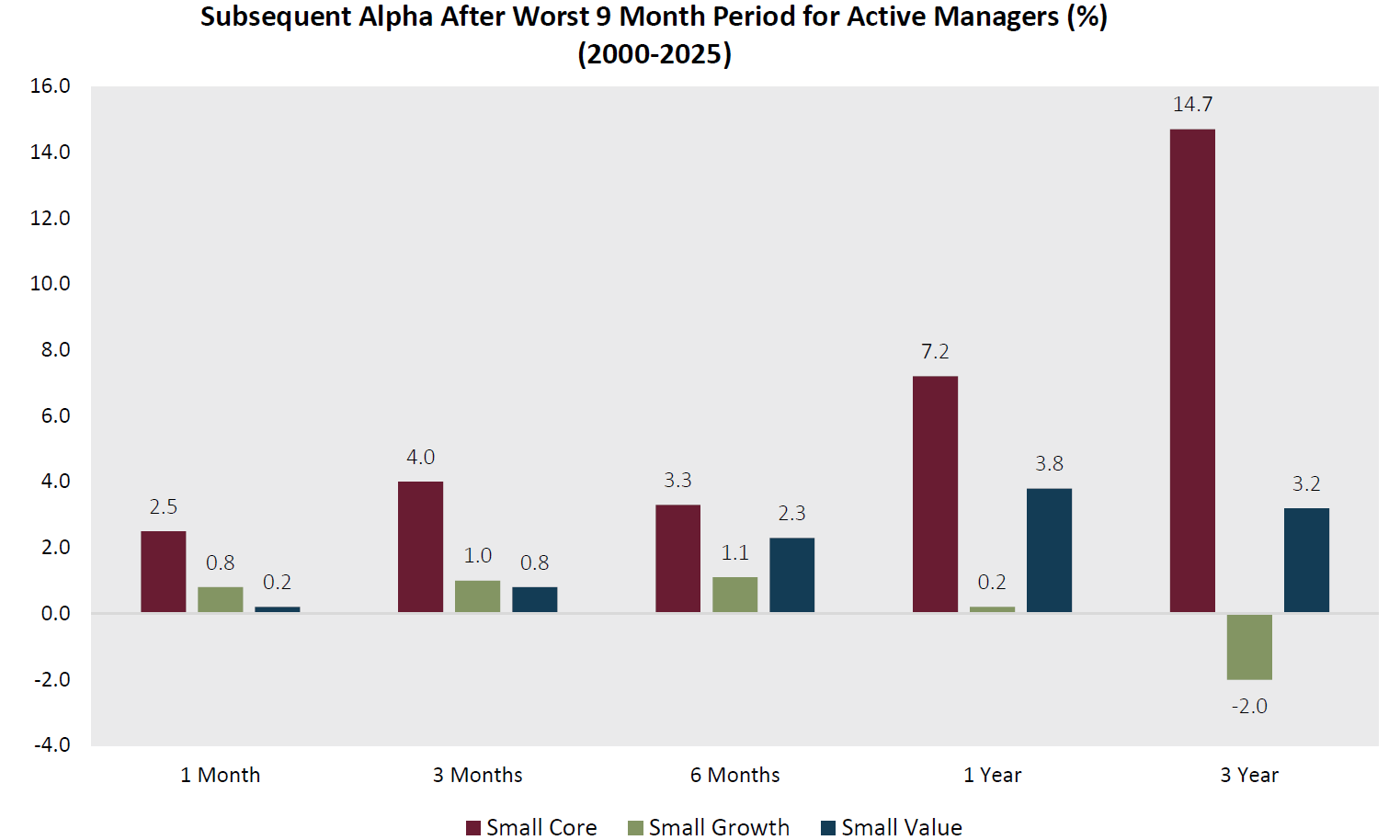
Source: Jefferies Research Services; FTSE Russell; Lipper Analytical Services; FactSet as of 12/31/2025. Subsequent alpha is calculated following the worst nine-month relative return periods for each group of small cap managers: core, growth, and value.
For more small caps observations click here.
The opinions expressed herein are those of Aristotle Capital Boston (Aristotle Boston) and are subject to change without notice. This material is not financial advice or an offer to purchase or sell any product. Aristotle Boston reserves the right to modify its current investment strategies and techniques based on changing market dynamics or client needs.
All investments carry a certain degree of risk, including the possible loss of principal. Investments are also subject to political, market, currency and regulatory risks or economic developments. International investments involve special risks that may in particular cause a loss in principal, including currency fluctuation, lower liquidity, different accounting methods and economic and political systems, and higher transaction costs. These risks typically are greater in emerging markets. Securities of small- and medium-sized companies tend to have a shorter history of operations, be more volatile and less liquid. Value stocks can perform differently from the market as a whole and other types of stocks. The material is provided for informational and/or educational purposes only and is not intended to be and should not be construed as investment, legal or tax advice and/or a legal opinion. Investors should consult their financial and tax adviser before making investments. The opinions referenced are as of the date of publication, may be modified due to changes in the market or economic conditions, and may not necessarily come to pass. Information and data presented has been developed internally and/or obtained from sources believed to be reliable. Aristotle Boston does not guarantee the accuracy, adequacy or completeness of such information.
Past performance is not indicative of future results. The information provided in this report should not be considered financial advice or a recommendation to purchase or sell any particular security.
The Russell 2000® Index measures the performance of the small cap segment of the U.S. equity universe. The Russell 2000 Index is a subset of the Russell 3000® Index representing approximately 10% of the total market capitalization of that index. It includes approximately 2000 of the smallest securities based on a combination of their market cap and current index membership. The Russell 2000 Growth® Index measures the performance of the small cap companies located in the United States that also exhibit a growth probability. The Russell 2000 Value® Index measures the performance of the small cap companies located in the United States that also exhibit a value probability. The Russell 1000 Index is a subset of the Russell 3000® Index. It includes approximately 1000 of the largest securities based on a combination of their market cap and current index membership. The volatility (beta) of the portfolios may be greater or less than the benchmarks. It is not possible to invest directly in these indices.
Aristotle Capital Boston, LLC is an independent investment adviser registered under the Investment Advisers Act of 1940, as amended. Registration does not imply a certain level of skill or training. More information about Aristotle Boston, including our investment strategies, fees and objectives, can be found in Form ADV Part 2, which is available upon request. ACB-2603-8