


Chart Insights
Looking Beneath the Value Rally
Over the past six months, high-and low-beta stocks within the Russell 1000 Value have experienced dramatically different returns.

The Russell 1000 Value surge concealed an unusually wide dispersion between high- and low-beta stocks.

Since 3/31/26, the highest-beta quintile gained 53%, while the lowest-beta quintile declined 2%, a spread of more than 54 percentage points!

Beta—not simply value exposure—was a major driver of relative returns during the quarter.

For long-term investors, a value rally driven by higher beta can mask greater market risk, as higher returns may reflect greater market sensitivity rather than improving fundamentals.
Looking Beneath the Value Rally
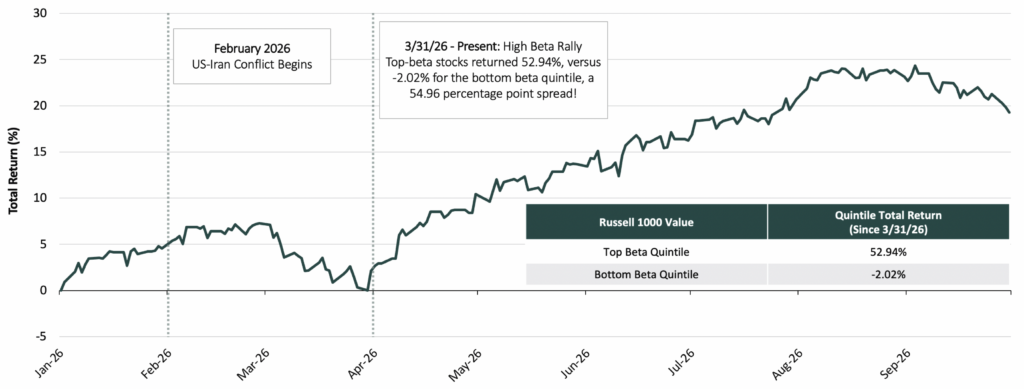
Note: Past performance is not indicative of future results. Please see additional disclosures at the end of this document. January 1, 2026 was selected as the starting date for the chart to analyze recent drivers of underlying performance. The Russell 1000 Value Index measures the performance of the large-cap value segment of the U.S. equity universe. It includes those Russell 1000 Index companies with lower price-to-book ratios and lower expected growth values.
Source: FactSet. Data as of 9/30/26.
All investments carry a certain degree of risk, including the possible loss of principal. Investments are also subject to political, market, currency and regulatory risks or economic developments. International investments involve special risks that may in particular cause a loss in principal, including currency fluctuation, lower liquidity, different accounting methods and economic and political systems, and higher transaction costs. These risks typically are greater in emerging markets. While largecapitalization companies may have more stable prices than smaller, less established companies, they are still subject to equity securities risk. In addition, large-capitalization equity security prices may not rise as much as prices of equity securities of small-capitalization companies. Securities of small- and medium-sized companies tend to have a shorter history of operations, be more volatile and less liquid. Value stocks can perform differently from the market as a whole and other types of stocks. The material is provided for informational and/or educational purposes only and is not intended to be and should not be construed as investment, legal or tax advice and/or a legal opinion. Investors should consult their financial and tax adviser before making investments. The opinions referenced are as of the date of publication, may be modified due to changes in the market or economic conditions, and may not necessarily come to pass. Information and data presented has been developed internally and/or obtained from sources believed to be reliable. Aristotle Capital does not guarantee the accuracy, adequacy or completeness of such information. The opinions expressed herein are those of Aristotle Capital and are subject to change without notice. This material is not financial advice or an offer to purchase or sell any product. Aristotle Capital reserves the right to modify its current investment strategies and techniques based on changing market dynamics or client needs.
Aristotle Capital Management, LLC (Aristotle Capital) is an independent investment adviser registered under the Investment Advisers Act of 1940, as amended. Registration does not imply a certain level of skill or training. More information about Aristotle Capital, including our investment strategies, fees and objectives, can be found in our Form ADV Part 2, which is available upon request. ACM-2609-126