


Commentary
Small/Mid Cap Equity WM 3Q 2026
ARISTOTLE CAPITAL BOSTON, LLC
Markets Review
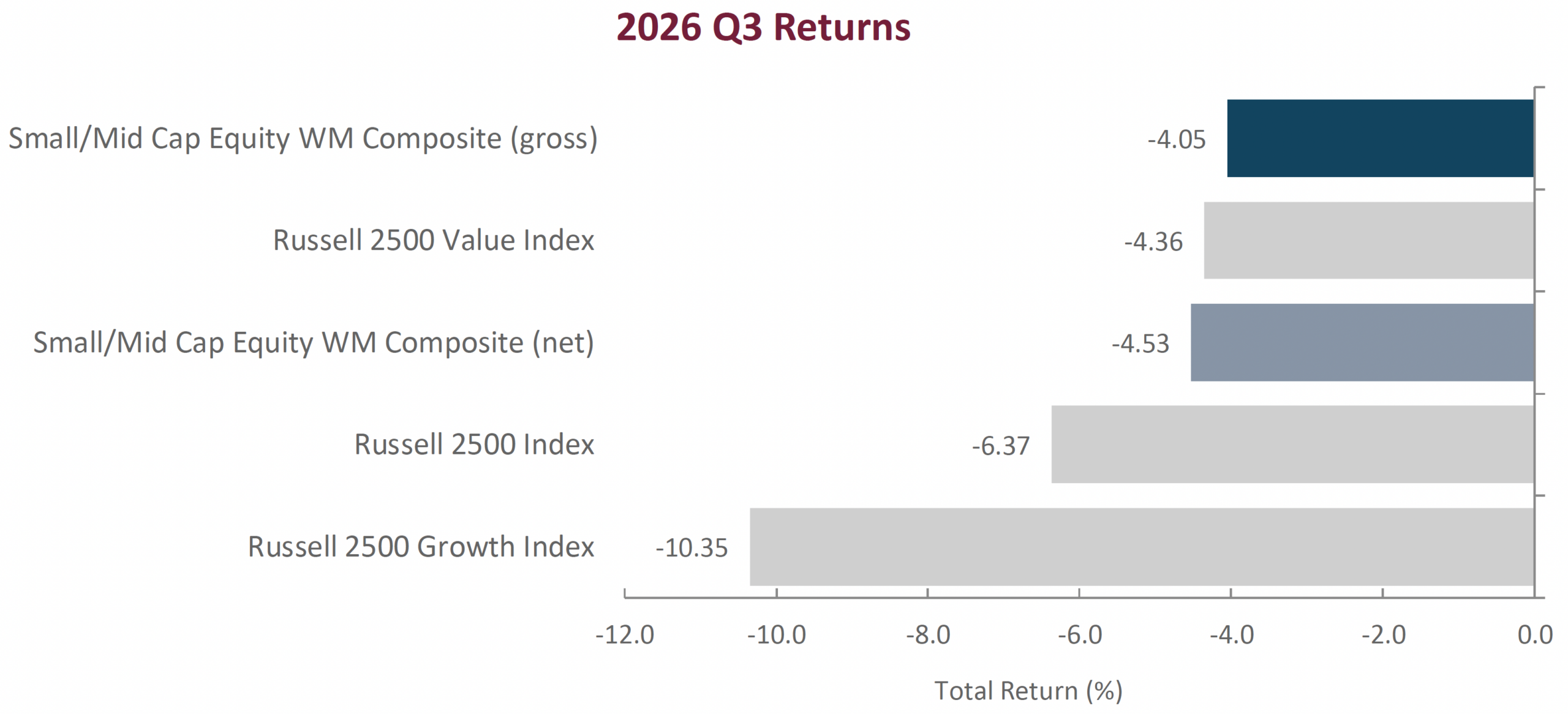
U.S. small/mid cap equities retreated during the third quarter of 2026, underperforming large cap stocks as investor capital rotated back toward mega cap technology and AI beneficiaries following an exceptionally strong first half of 2026. The Russell 2500 Index declined -6.37% during the quarter as rising Treasury yields, higher energy prices, and renewed inflation concerns weighed on risk appetite and compressed valuation multiples across many economically sensitive businesses. Despite the third quarter consolidation, small cap fundamentals remained constructive. Many of the quarter’s laggards had been among the strongest performers earlier in the year, and profit taking combined with a narrow rally in large cap technology masked continued improvement in earnings expectations across much of the small cap universe. As a result, the asset class retained a meaningful year to date advantage over larger cap equities at quarter end, supported by attractive relative valuations and improving operating fundamentals.
Stylistically, value stocks outperformed their growth counterparts during the quarter, with the Russell 2500 Value Index returning -4.36% compared to the -10.35% return of the Russell 2500 Growth Index. Sector performance was highly uneven. Energy was among the strongest contributors as crude oil prices surged during the quarter, benefiting small cap exploration, production, and oilfield services companies. Healthcare was another bright spot, supported by resilient earnings and company specific execution within Life Sciences and Health Care Equipment despite declines in Biotechnology and Pharmaceuticals. Conversely, several of the index’s largest cyclical exposures weighed on returns. Industrials, Consumer Discretionary, Utilities and Real Estate underperformed as higher interest rates and tighter financial conditions pressured investor sentiment toward domestically focused companies. Rate sensitive industries such as commercial real estate, housing related businesses, and other capital intensive sectors faced additional headwinds from sharply higher long-term bond yields. From a factor perspective, low volatility, value and quality had the strongest payoffs, while beta, high leverage and momentum had negative payoffs.
Almost all sectors paid off negatively during the third quarter. The best performing sectors were Energy (+7.00%), Health Care (+1.78%), and Financials (-4.06%) while conversely the worst performing sectors were Industrials (-14.64%), Consumer Discretionary (-10.46%), and Utilities (-9.23%).
Sources: CAPS Composite Hub, Russell Investments
Past performance is not indicative of future results. Aristotle Small/Mid Cap Equity WM Composite returns are presented gross and net of the maximum wrap fee and include the reinvestment of all income. Net returns are calculated by subtracting the highest applicable wrap/SMA fee, which includes trading costs and custodial fees, from the gross monthly composite return (2.00% on an annual basis, or 0.167% monthly). Please see important disclosures at the end of this document.
Performance Review
For the third quarter of 2026, the Aristotle Small/Mid Cap Equity WM Composite generated a total return of -4.53% net of fees (-4.05% gross of fees), outperforming the -6.37% total return of the Russell 2500 Index. Security selection and allocation effect both contributed to performance. The largest contributors to relative performance were security selection in Health Care (owning Haemonetics coupled with not owning biotechnology stocks) and Industrials coupled with an underweight allocation to Consumer Discretionary and an overweight allocation to Financials. This was partially offset by security selection in the Consumer Discretionary and Materials sectors coupled with underweight allocations to Health Care and Communication Services.
| Relative Contributors | Relative Detractors |
|---|---|
| Huron Consulting Group | FTAI Aviation |
| Haemonetics | MACOM Technology Solutions |
| Charles River Laboratories | Mercury Systems |
| Merit Medical Systems | Dycom Industries |
| Encompass Health | Scotts Miracle-Gro |
CONTRIBUTORS
Huron Consulting Group (HURN), is a provider of technology, data, analytics, and consulting solutions to healthcare, education, and commercial clients. The stock contributed positively during the quarter as the company delivered record financial results, exceeded earnings expectations, and raised full year guidance. Strong demand for healthcare, education, and digital transformation services, coupled with consistent double digit revenue growth, margin expansion, and increasing exposure to higher value managed services and AI-enabled solutions, supported investor sentiment. We continue to hold the position, as we believe the company is well positioned to benefit from durable demand, expanding profitability, and long-term secular growth driven by digital transformation and increasing regulatory complexity across its end markets.
Haemonetics (HAE), is a global provider of hematology and blood management products and solutions. The company delivered better than expected financial results, driven by strong performance in its plasma and hospital businesses, expanding margins, and improving cash flow generation. Investors responded favorably to the company’s disciplined execution, market share gains, and growing confidence in its ability to deliver sustainable earnings growth and shareholder value. We believe that the company’s strong competitive position within the plasmapheresis market along with increased investment in research and development should create value for shareholders over a multi-year period.
DETRACTORS
FTAI Aviation (FTAI), owns and leases aircraft engines and operates a maintenance, repair, and exchange (MRE) platform. FTAI Aviation underperformed during the quarter as weaker than expected earnings, near-term margin pressures, and lingering investor uncertainty prompted a reassessment of its valuation following strong prior appreciation. We continue to hold the position, as we believe growing air travel demand, an aging global engine fleet, and the company’s evolving asset light leasing strategy support attractive long-term earnings growth and shareholder value creation.
MACOM Technology Solutions (MTSI), is a designer and manufacturer of high performance semiconductor products. The stock declined during the quarter as investor sentiment toward AI and semiconductor related stocks weakened following a period of strong share price appreciation. While the company continued to deliver robust operating results, including record revenue, bookings, and backlog, concerns regarding the pace of future AI infrastructure spending and broader valuation pressures weighed on the shares. We maintain our position, as we believe the company’s meaningful exposure to growing demand from Data Center and 5G end market applications along with the integration of recent acquisitions and domestic manufacturing footprint should continue to drive shareholder value.
Recent Portfolio Activity
| Buys/Acquisitions | Sells/Liquidations |
|---|---|
| Bentley Systems | Essential Utilities |
| Corpay | Euronet Worldwide |
| Freshpet | Gartner |
| Trimble | Knowles |
| U.S. Physical Therapy | Oceaneering International |
| Weatherford International | SLR Investment Corp |
BUYS/ACQUISITIONS
Bentley Systems (BSY), is an infrastructure engineering software company that provides software and digital twin solutions used to design, build, and operate critical infrastructure across transportation, water, energy, and construction markets worldwide. We believe the company offers a rare combination of mission critical infrastructure software, highly recurring revenue, and consistent double digit margin expansion coupled with revenue growth, supported by long-term tailwinds from global infrastructure investment, electrification, and grid modernization. We believe the company is attractive due to its strong free cash flow, high customer retention, and durable competitive advantages trading at a discount to our estimates of its long-term intrinsic value. These characteristics should support improving earnings growth and long term shareholder value.
Corpay (CPAY), is a corporate payments and expense management platform that helps businesses automate payables, manage cross-border transactions, and control vehicle related spending. The company offers a combination of double digit organic revenue growth, high customer retention, and strong free cash flow generation. We believe that the company has significant potential for continued market share gains in large, underpenetrated payments markets which may support improving earnings growth and long term shareholder value.
Freshpet (FRPT), is a premium pet food company that manufactures and distributes fresh, refrigerated dog and cat food through a proprietary network of branded refrigerators in retail stores across North America. We believe the company is well positioned to benefit from secular growth in premium pet nutrition, with accelerating market share gains, expanding distribution, and strong brand loyalty, supported by double digit revenue growth, rising margins, increasing free cash flow, and upward earnings guidance, which may suggest the market was underappreciating the company’s long-term earnings growth and shareholder value.
Trimble (TRMB), is a provider of software, data, and positioning solutions that help customers across the construction, agriculture, geospatial, and transportation industries improve productivity and automate workflows. We believe the company is well positioned to benefit from a growing base of recurring revenue, continued margin expansion, and long-term digitalization trends as it evolves from a hardware focused business into a higher margin software and subscription platform, which may support attractive earnings growth and long-term shareholder value creation.
U.S. Physical Therapy (USPH), is an operator of outpatient physical and occupational therapy clinics, providing rehabilitation services and workplace injury prevention solutions through a nationwide network of partner-led practices. We believe the company may benefit from an aging population, increasing demand for outpatient rehabilitation services, and continued market consolidation. We believe its disciplined acquisition strategy, expanding clinic network, and opportunities for operational efficiencies and margin improvement will support sustainable earnings growth and long-term shareholder value creation.
Weatherford International (WFRD), is a global oilfield services and equipment provider that helps energy producers optimize drilling, well construction, production, and asset performance through a combination of engineering expertise, advanced technologies, and digital solutions. The company has what we believe to be strong free cash flow generation, a fortress balance sheet that provides financial flexibility, and disciplined margin management. We believe the company is well positioned to benefit from continued investment in international and offshore oil and gas development, supported by its exposure to longer cycle production and well-optimization activities. We believe its focus on higher margin technologies, operational efficiencies, and disciplined capital allocation will support sustainable earnings growth, margin expansion, and long-term shareholder value creation.
SELLS/LIQUIDATIONS
Essential Utilities (WTRG), is a regulated utility company that provides water, wastewater, and natural gas services to customers across multiple U.S. states through its Aqua and Peoples Natural Gas subsidiaries. We exited the position as the share price appreciated reducing the stock’s potential upside and made its risk/reward profile less compelling redeploying the capital into what we view as higher conviction opportunities.
Euronet Worldwide (EEFT), is a global payments and fintech company that provides ATM outsourcing, electronic payment processing, prepaid solutions, and cross-border money transfer services through brands including Ria and XE. The position was liquidated due to increased uncertainty surrounding the pace of recovery and potential margin pressures that diminished the attractiveness of the risk/reward profile, prompting us to redeploy capital into higher conviction opportunities.
Gartner (IT), is a provider of technology research, advisory, consulting, and conference services that help organizations make strategic business and technology decisions. The position was liquidated due to deteriorating fundamentals.
Knowles (KN), is a specialty electronic components company that designs and manufactures high performance capacitors, RF filters, medical microphones, and advanced audio components for the defense, medtech, industrial, and electrification markets. We exited our position in Knowles following strong share price appreciation, which reduced the potential upside and made the risk/reward profile less compelling. We subsequently redeployed capital into investment opportunities offering what we consider to be more attractive valuations and greater long-term return potential.
Oceaneering International (OII), is a global technology and engineering company that provides subsea robotics, offshore services, and mission critical solutions to the energy, defense, aerospace, and industrial markets. We exited the position after Q2 earnings beat expectations resulting in the stock’s appreciation which compressed the risk/reward profile. We took profits on this position, and the proceeds were redeployed into what we consider to be higher conviction opportunities.
SLR Investment Corp (SLRC), is a business development company that provides senior secured loans and specialty finance solutions to U.S. middle market companies, generating income for shareholders through a diversified private credit portfolio. The position was liquidated due to deteriorating fundamentals.
Outlook
We remain constructive on the long-term outlook for the small/mid-cap segment of the U.S. market. Valuations continue to appear attractive, with the Russell 2500 Index trading near multi-decade lows relative to large caps, while earnings continue to accelerate. Consensus estimates point to small cap earnings growth surpassing large cap growth by late 2026/early 2027. A strong US GDP environment, incremental increases in M&A activity, improving domestic manufacturing trends supported by reshoring and infrastructure investment, and a more favorable regulatory and tariff backdrop should provide longer term tailwinds for the asset class. Near term, we remain cautious as geopolitical risks, including the Iran conflict and related inflationary spillovers, may contribute to elevated volatility. Separately, mid-term election uncertainty has historically been associated with increased market volatility but has often given way to more durable small cap recoveries following the election cycle.
Positioning
Our current positioning is a function of our bottom-up security selection process and our ability to identify what we view as attractive investment candidates, regardless of economic sector definitions. Overweights in Information Technology and Financials are mostly a function of our underlying company specific views rather than any top-down predictions for each sector. Conversely, we continue to be underweight in Consumer Discretionary, as we have been unable to identify what we consider to be compelling long-term opportunities that fit our discipline given the rising risk profiles of many retail businesses and a potential deceleration in goods spending following a period of strength. We are also underweight in Real Estate, as the sector has elevated interest rate sensitivity, refinancing risk, and structural challenges in segments such as office and retail, combined with generally weaker balance sheets, leading us to seek what we consider to be more attractive reward to risk opportunities. Given our focus on long-term business fundamentals, our patient investment approach and low portfolio turnover, the strategy’s sector positioning generally does not change significantly from quarter to quarter. However, we may take advantage of periods of volatility by adding selectively to certain companies when appropriate.
The opinions expressed herein are those of Aristotle Capital Boston, LLC (Aristotle Boston) and are subject to change without notice.
Past performance is not indicative of future results. The information provided in this report should not be considered financial advice or a recommendation to purchase or sell any particular security. There is no assurance that any securities discussed herein will remain in an account’s portfolio at the time you receive this report or that securities sold have not been repurchased. The securities discussed may not represent an account’s entire portfolio and, in the aggregate, may represent only a small percentage of an account’s portfolio holdings. The performance attribution presented is of a representative account from Aristotle Boston’s Small/Mid Cap Equity WM Composite. The representative account is a discretionary client account which was chosen to most closely reflect the investment style of the strategy. The criteria used for representative account selection is based on the account’s period of time under management and its similarity of holdings in relation to the strategy. It should not be assumed that any of the securities transactions, holdings or sectors discussed were or will be profitable, or that the investment recommendations or decisions Aristotle Boston makes in the future will be profitable or equal the performance of the securities discussed herein. Aristotle Boston reserves the right to modify its current investment strategies and techniques based on changing market dynamics or client needs. Recommendations made in the last 12 months are available upon request.
Composite returns are presented gross and net of the maximum wrap fee and include the reinvestment of all income. Net returns are calculated by subtracting the highest applicable wrap/SMA fee, which includes trading costs and custodial fees, from the gross monthly composite return (2.00% on an annual basis, or 0.167% monthly).
All investments carry a certain degree of risk, including the possible loss of principal. Investments are also subject to political, market, currency and regulatory risks or economic developments. International investments involve special risks that may in particular cause a loss in principal, including currency fluctuation, lower liquidity, different accounting methods and economic and political systems, and higher transaction costs. These risks typically are greater in emerging markets. While Large-capitalization companies may have more stable prices than smaller, less established companies, they are still subject to equity securities risk. In addition, large-capitalization equity security prices may not rise as much as prices of equity securities of small-capitalization companies. Securities of small- and medium-sized companies tend to have a shorter history of operations, be more volatile and less liquid. Value stocks can perform differently from the market as a whole and other types of stocks. The material is provided for informational and/or educational purposes only and is not intended to be and should not be construed as investment, legal or tax advice and/or a legal opinion. Investors should consult their financial and tax adviser before making investments. The opinions referenced are as of the date of publication, may be modified due to changes in the market or economic conditions, and may not necessarily come to pass. Information and data presented has been developed internally and/or obtained from sources believed to be reliable. Aristotle Boston does not guarantee the accuracy, adequacy or completeness of such information.
Aristotle Capital Boston, LLC is an independent investment adviser registered under the Investment Advisers Act of 1940, as amended. Registration does not imply a certain level of skill or training. More information about Aristotle Boston, including our investment strategies, fees and objectives, can be found in our Form ADV Part 2, which is available upon request. ACB-2610-3
Sources: CAPS Composite Hub, Russell Investments
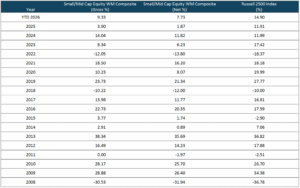
*The Aristotle Small/Mid Cap Equity WM Composite (“Composite”) has an inception date of January 1, 2008, at a predecessor firm. During this time, Jack McPherson and Dave Adams had primary responsibility for managing the strategy. Performance starting January 1, 2015, was achieved at Aristotle Boston.
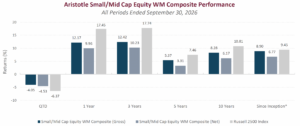
The Composite includes all discretionary accounts managed in this strategy and is based on the institutional composite track record. The composite currently consists of only institutional accounts and does not contain any fully bundled fee wrap portfolios. Past performance is not indicative of future results. Performance results for periods greater than one year have been annualized. Composite returns are presented gross and net of the maximum wrap fee and include the reinvestment of all income. Net returns are calculated by subtracting the highest applicable wrap/SMA fee, which includes trading costs and custodial fees, from the gross monthly composite return (2.00% on an annual basis, or 0.167% monthly). Please see important disclosures enclosed within
this document.
The Russell 2500® Index measures the performance of the small to mid cap segment of the U.S. equity universe. The Russell 2500 Index is a subset of the Russell 3000® Index. It includes approximately 2500 of the smallest securities based on a combination of their market cap and current index membership. The Russell 2500 Growth® Index measures the performance of the small/mid cap companies located in the United States that also exhibit a growth probability. The Russell 2500 Value® Index measures the performance of the small/mid cap companies located in the United States that also exhibit a value probability. The volatility (beta) of the composite may be greater or less than the benchmarks. It is not possible to invest directly in these indices.